
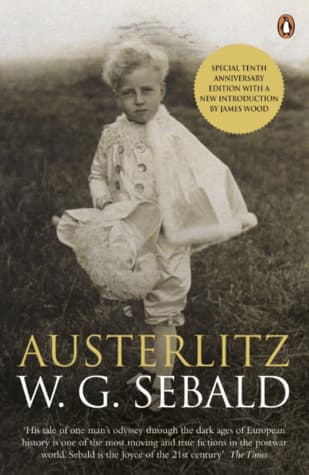
Synopsis
Covers the whole plot, including the ending.
- Difficulty
- Hard
- Pacing
- Slow
- Mood
- Melancholy, Reflective, Somber, Atmospheric, Haunting
- Read it if
- You appreciate a contemplative, melancholic exploration of memory, identity, and the lingering shadows of the Holocaust, presented through a unique, associative narrative style.
- Skip it if
- You prefer fast-paced plots, strong character dialogue, or a clear, linear narrative structure.
Austerlitz Plot Summary
Covers the whole plot, including the ending.
Antwerp Central Station: The First Encounter
The story begins with the narrator describing his architectural trips across Europe. In the summer of 1967, at Antwerp Central Station, he meets Jacques Austerlitz. Austerlitz, a seemingly unusual and solitary man, talks with the narrator for a long time about the station's history and architecture. He discusses its role in human movement and memory. This first meeting shows Austerlitz's intellectual curiosity and his deep, though then unstated, connection to themes of displacement and time, which will later be central to his own life story.
London Meetings: Photography and Memory's Stirrings
Years pass, and the narrator occasionally sees Austerlitz in London, often at places like Liverpool Street Station or the London Library. During these meetings, Austerlitz, now an art history professor, starts to reveal more about himself. He shares his interest in photography, especially pictures of old buildings and empty landscapes, which he sees as holding historical memory. In these talks, Austerlitz first mentions a deep personal emptiness and a strange feeling of being an outsider, hinting at a past he cannot fully recall but which strongly affects him.
The Kindertransport Revelation
Austerlitz has a major breakthrough during a visit to Liverpool Street Station. He is suddenly overwhelmed by a memory: a large, busy station and the feeling of being a small child among many others. This makes him realize he arrived in England in 1939 as part of the Kindertransport, a rescue effort for Jewish children fleeing Nazi persecution. He had been raised by a Welsh Methodist minister and his wife, Emyr and Gwenllian Elias, in a remote parsonage, unaware of his true identity or background. This discovery starts his conscious search for his past.
Wales: The Adoptive Home
After his discovery, Austerlitz travels to the remote Welsh village where he grew up with the Eliases. He visits the parsonage and the surrounding area, trying to recall parts of his early childhood. He remembers the strict, emotionally distant upbringing, the unfamiliar language, and the constant feeling of being an outsider, despite the Eliases' care. This journey is marked by a deep sadness, as he looks at his past life from a distance, understanding now why he always felt disconnected from his adoptive parents and the life they gave him.
The Search for Answers in London
Back in London, Austerlitz dedicates himself to finding his origins. He spends many hours in archives, libraries, and government offices, looking through Kindertransport records and other refugee organizations. He searches for any mention of his birth parents, their names, and their fate. This period involves careful, often frustrating, detective work, as he deals with bureaucracy and the many lost histories from that time. His research becomes an obsession, driven by a desperate need to fill the emptiness of his unknown past.
Meeting Vera: The Truth About His Mother
A significant discovery happens when Austerlitz meets Vera, an elderly woman who knew his mother. Vera reveals that his mother was Agáta, a well-known actress from Prague, and his father was Maximilián Aychenwald, a communist intellectual. Vera recounts Agáta's last days, her efforts to get Austerlitz to safety, and her eventual deportation to Theresienstadt concentration camp. This meeting gives Austerlitz specific details about his parents' identities and their tragic end, bringing painful clarity to the previously abstract void of his past.
Theresienstadt: Confronting the Holocaust
With knowledge of his mother's fate, Austerlitz travels to Theresienstadt (Terezín), the former ghetto-concentration camp in Czechoslovakia. He explores the fortress-like architecture, the barracks, and the crematorium, trying to imagine his mother's experiences there. This visit is intensely emotional and difficult, as he confronts the physical remains of the Holocaust and the suffering it caused. He walks through the silent spaces, feeling the weight of history and the personal tragedy of his mother's death, trying to connect with a past he was spared but which shaped him.
Prague: His Childhood Home
From Theresienstadt, Austerlitz goes to Prague, his birthplace. He visits the apartment building where he lived as a small child with his parents, trying to recall images of their life before the war. He walks the streets, visits the Jewish Quarter, and observes the architecture, looking for any echoes of his family. While he finds no direct physical evidence of his parents, the city's atmosphere, full of history and memory, allows him to feel a deeper connection to his heritage and to imagine the lively, intellectual world his parents lived in before its destruction.
The Father's Fate: Maximilián Aychenwald
Through more research and conversations, Austerlitz learns more about his father, Maximilián Aychenwald. Maximilián, a committed communist, was arrested shortly after the German occupation and died in a concentration camp, likely in France. This discovery completes the tragic picture of his parents' lives, showing that both were victims of the totalitarian regimes that devastated Europe. Knowing his father's political beliefs and his persecution adds another layer of understanding to Austerlitz's own feeling of being rootless and his deep engagement with history and memory.
Return to Antwerp and Reflection
The story returns to Antwerp, where Austerlitz and the narrator meet again. Austerlitz, having finished his difficult journey of discovery, tells the narrator the full story of his origins and his parents' fate. He thinks about memory, the burden of history, and how the past deeply affects the present. While he has found answers, the process has left him with a deep sadness and a lasting awareness of how fragile life is and how vast human suffering can be. His quest, though finished, leaves him with a permanent sense of the 'void' at the center of his identity.
Austerlitz Characters
Jacques Austerlitz
Protagonist
An art historian haunted by an unknown past, searching for his origins.
Jacques Austerlitz is a reclusive and highly intelligent art historian, characterized by his profound melancholy, his meticulous observations of architecture and photography, and his almost obsessive engagement with history. He struggles with a deep-seated sense of displacement and an inexplicable void in his personal history, which manifests as anxiety and a feeling of being an outsider. His intellectual pursuits often serve as a distraction from this internal turmoil until the repressed memories of his childhood begin to surface. He is driven by an intense need for truth and a desire to reconstruct the narrative of his identity.
Relationships: The Narrator (Confidant and listener, a passive observer of Austerlitz's journey.); Emyr and Gwenllian Elias (Adoptive parents, distant and uncommunicative about his past.); Agáta (Birth mother, an actress deported to Theresienstadt.); Maximilián Aychenwald (Birth father, a communist intellectual who perished in a camp.); Vera (A key figure who provides information about his mother's past.)
The Narrator
Supporting
A silent, unnamed observer and recorder of Austerlitz's story.
The narrator is an unnamed, observant individual, primarily a listener and a chronicler of Austerlitz's life. He functions as a stand-in for the reader, piecing together Austerlitz's fragmented story through their sporadic encounters across Europe. His own architectural interests and melancholic sensibility align with Austerlitz's, fostering a quiet empathy. He asks few direct questions, allowing Austerlitz's narrative to unfold organically, emphasizing the subjective and often circuitous nature of memory and discovery. He is less a character with his own arc and more a framing device for Austerlitz's profound journey.
Relationships: Jacques Austerlitz (Friend and confidant, the primary subject of his observations.)
Agáta
Mentioned
Austerlitz's birth mother, a spirited actress from Prague who perished in the Holocaust.
Agáta was a talented and beautiful actress in Prague, known for her vibrant personality and intellectual circles. She was Austerlitz's mother, who, in a desperate act of love and foresight, arranged for his escape on the Kindertransport in 1939. Her story is pieced together through Austerlitz's research and the memories of others like Vera. She represents the vibrant pre-war Jewish culture of Central Europe and the countless individuals whose lives were brutally cut short by the Holocaust, leaving behind a profound legacy of loss and unanswered questions for their descendants.
Relationships: Jacques Austerlitz (Son, whom she saved from persecution.); Maximilián Aychenwald (Husband and intellectual partner.); Vera (Friend and witness to her final days in Prague.)
Maximilián Aychenwald
Mentioned
Austerlitz's birth father, a committed communist intellectual.
Maximilián Aychenwald was an intellectual and a fervent communist, deeply involved in the political movements of pre-war Czechoslovakia. He was Austerlitz's father, whose political convictions ultimately led to his persecution and death in a concentration camp, likely in France. His story, like Agáta's, is reconstructed through Austerlitz's painstaking research. Maximilián embodies the broader political turmoil of the era and the crushing of dissenting voices under totalitarian regimes. His legacy contributes to Austerlitz's understanding of the intellectual and political landscape his parents navigated, and the profound forces that shattered their lives.
Relationships: Jacques Austerlitz (Son, whose life he indirectly shaped.); Agáta (Wife and intellectual companion.)
Emyr and Gwenllian Elias
Supporting
Austerlitz's adoptive parents, a Welsh Methodist minister and his wife.
Emyr and Gwenllian Elias are the devout Welsh Methodist minister and his wife who adopted the young Jacques Austerlitz (then known as Dafydd Elias) after his arrival on the Kindertransport. They provided him with a home and an upbringing, but their strict religious environment and their emotional reticence, combined with their decision to conceal his true origins, created a profound sense of alienation in Austerlitz. They represent well-meaning but ultimately unequipped caregivers, whose actions, though intended to protect, inadvertently contributed to Austerlitz's lifelong struggle with identity and memory.
Relationships: Jacques Austerlitz (Adoptive parents, who raised him but kept his past secret.)
Vera
Supporting
An elderly woman who provides crucial information about Austerlitz's mother.
Vera is an elderly woman whom Austerlitz encounters during his search for his past. She had known Austerlitz's mother, Agáta, in Prague and provides him with invaluable, firsthand accounts of Agáta's life, her vibrant personality, and the tragic circumstances leading up to her deportation. Vera serves as a living link to Austerlitz's lost past, offering not just facts but also a sense of the human warmth and cultural richness that existed before the war. Her testimony is a pivotal moment in Austerlitz's journey, transforming abstract historical events into tangible personal narratives.
Relationships: Jacques Austerlitz (Source of vital information about his mother.); Agáta (Friend and contemporary from pre-war Prague.)
Austerlitz Themes
Memory and History
The novel explores the connection between personal memory and collective history, especially regarding the Holocaust. Austerlitz's fragmented memories and anxieties are tied to the traumatic events of the 20th century. His search tries to bridge his personal amnesia with the historical truth. Sebald suggests that history is not distant but an ever-present force that shapes lives, often appearing as haunting echoes in buildings, photographs, and landscapes. Remembering, even painful memories, is shown as essential for understanding identity and confronting the 'void' left by past horrors, as seen in Austerlitz's difficult but necessary visit to Theresienstadt.
“But the past is not dead, it is not even past; we carry it with us, it is in our present.”
Loss and Displacement
A central theme is the deep loss and displacement experienced by people uprooted by historical events. Austerlitz's journey begins with his arrival in England as a child refugee, separating him from his family, language, and culture. This early trauma causes a lifelong feeling of being an outsider, a 'blank slate' without a true past. The novel examines the psychological impact of such displacement, showing how it can lead to sadness and a constant search for belonging. The loss extends beyond personal identity to the wider loss of a civilization and the destruction of a rich cultural life, especially in Central Europe, symbolized by the vanished lives of Austerlitz's parents.
“I felt that I was a living anachronism, a ghost of myself.”
Architecture and the Traces of the Past
Architecture serves as a key motif and a holder of memory in the novel. Sebald carefully describes grand railway stations, fortresses, libraries, and old buildings, presenting them not just as structures but as physical signs of history, bearing the marks of human lives and suffering. Austerlitz, as an architectural historian, is drawn to these places, sensing their historical weight. The buildings become silent witnesses to past events, and by examining their details, Austerlitz tries to read the stories embedded within them, connecting the physical environment to his personal search for truth. The decaying grandeur often reflects the decay of memory and the passage of time.
“The greater the darkness, the more the past is illuminated.”
The Burden of Silence and Unspoken Truths
The novel explores the harm caused by silence and unspoken truths, particularly about traumatic pasts. Austerlitz's adoptive parents' choice to hide his origins leaves him with a deep inner emptiness and a feeling of not being authentic. This silence, though possibly well-meaning, prevents him from forming a complete identity and leaves him haunted by an unknown past. The narrative emphasizes the human need to face and speak about traumatic histories, both personal and collective, even when they are painful. Only by breaking the silence and piecing together his family's story can Austerlitz begin to understand himself, even if that understanding brings more sorrow than comfort.
“I was always trying to find a way back to the point where I had been taken from myself.”
Plot Devices & Literary Techniques
The Unnamed Narrator
A silent, observant chronicler who frames Austerlitz's story.
The unnamed narrator functions as an attentive listener and a recorder of Austerlitz's fragmented recollections. He provides a detached, almost scholarly, lens through which Austerlitz's deeply personal and emotional journey is presented. His presence allows for a multi-layered narrative, where Austerlitz's story is filtered through another consciousness, emphasizing the subjective nature of memory and storytelling. The narrator's own architectural interests and melancholic tone resonate with Austerlitz's, creating a sympathetic but largely passive container for the protagonist's profound introspection.
Ekphrasis (Detailed Description of Photographs and Architecture)
Extensive descriptions of images and buildings as repositories of memory.
Sebald employs vivid and lengthy descriptions of photographs, architectural details, and historical sites. These descriptions are not merely ornamental; they are integral to the narrative, serving as catalysts for Austerlitz's memories and as physical manifestations of the past. The photographs, often of desolate or forgotten places, act as a visual language for the themes of loss and the passage of time. Similarly, the meticulous detailing of stations, fortresses, and libraries grounds the abstract concepts of history and memory in tangible, observable reality, inviting the reader to 'read' the past embedded in these physical traces.
Non-Linear Narrative and Digressions
A fragmented, episodic structure mirroring the nature of memory.
The novel's plot unfolds in a highly non-linear fashion, mirroring Austerlitz's own fragmented memories and his circuitous quest for his past. The story moves back and forth in time, often through lengthy digressions and associative leaps, rather than a straightforward chronological progression. These digressions, which often delve into historical details, architectural theories, or the lives of minor figures, create a dense, layered texture that mimics the way memory and history are experienced – not as a clear line, but as a complex web of interconnected events, thoughts, and feelings. This structure emphasizes the difficulty and the subjective nature of reconstructing a lost past.
Melancholic Tone and Pervasive Nostalgia
An overarching mood of sadness and longing for a lost past.
The entire novel is imbued with a deep sense of melancholy and a pervasive nostalgia for a lost world. This tone is established through the narrator's reflective voice, Austerlitz's profound sadness, and the recurrent imagery of decay, ruins, and forgotten histories. It reflects not just Austerlitz's personal grief but also a broader lament for the destruction of European Jewish culture and the trauma of the 20th century. The melancholic mood underscores the idea that certain losses are irreparable and that even understanding them brings a form of sorrow, rather than resolution.
Austerlitz Quotes
“But at the same time, I also understood that the things we do in life, no matter how small, leave a trace, a memory that can be reactivated at any time.”
“For the most part, we are unaware of the continuity of the past, and it is only when we are confronted with its traces that we begin to understand how deeply it has shaped us.”
“It seems to me that we can never really know what is going on in the minds of others, and that all our attempts to communicate are doomed to failure.”
“The past, it seems, is not dead; it is not even past. We cut ourselves off from it at our peril.”
“The greater the destruction, the more it seems to me, the more the past is present in the ruins.”
“And I gradually came to the conclusion that the world is a gigantic memory, which conserves everything, and which we ourselves are part of.”
“Perhaps it is only when we are no longer able to understand the world that we begin to see it as it really is.”
“The feeling of having been robbed of my past, of having been cut off from my own life, was something I never entirely overcame.”
“Time, it seems, does not heal all wounds. Some wounds remain open, bleeding for a lifetime.”
“The railway stations, the waiting rooms, the corridors, the platforms, the tracks, all of them seem to me to be imbued with a particular melancholy.”
“We live in a world that is constantly forgetting, and yet everything that has ever happened is still there, somewhere, waiting to be remembered.”
“And the longer I looked at it, the more I felt as if the photograph were a kind of membrane, separating me from a reality that was both intensely present and irrevocably lost.”
“It is always the children who pay for the mistakes of their parents, and for the blindness of society.”
“How many times, in the course of our lives, do we pass by something without noticing it, only to discover its significance much later?”
Quiz
10 questions on the plot and the characters. Each answer comes with a short explanation.
Question 1
What is the name of the protagonist whose search for his past forms the central narrative of 'Austerlitz'?
- W.G. Sebald
- Jacques Austerlitz
- Max Ferber
- Elias Canetti
Show answer
B. Jacques Austerlitz The book is named after its protagonist, Jacques Austerlitz, who recounts his life story and search for identity.
Question 2
By what means did the young Austerlitz arrive in England in the summer of 1939?
- A refugee boat
- A Kindertransport
- An evacuation flight
- He was born in England
Show answer
B. A Kindertransport The book explicitly states that Austerlitz came to England on a Kindertransport, a historical rescue effort for Jewish children.
Question 3
What profession does Austerlitz pursue as an adult, reflecting his interest in architecture and historical structures?
- Historian
- Linguist
- Architectural historian
- Photographer
Show answer
C. Architectural historian Austerlitz is an architectural historian, a profession that aligns with his detailed observations of buildings and their historical weight, which are prominent throughout the novel.
Question 4
Which specific architectural structure does Austerlitz become particularly obsessed with and study extensively, often returning to it?
- Buckingham Palace
- The British Museum Reading Room
- Prague's St. Vitus Cathedral
- The Reichstag building
Show answer
B. The British Museum Reading Room Austerlitz spends a significant amount of time studying and observing the British Museum Reading Room, a place that becomes a focal point for his reflections on memory and the past.
Question 5
What is the name of the fortress in Belgium that Austerlitz visits and contemplates as a symbol of European military history and confinement?
- Fort Douaumont
- Fort Breendonk
- The Maginot Line
- The Bastille
Show answer
B. Fort Breendonk Fort Breendonk, a former Nazi transit camp in Belgium, is a significant location Austerlitz visits, representing themes of suffering and institutionalized cruelty.
Question 6
What is the primary emotional state that characterizes Austerlitz's early life and much of his adult existence before he begins his active search for his past?
- Joy and contentment
- A deep sense of belonging
- A profound emptiness and amnesia
- Anger and resentment
Show answer
C. A profound emptiness and amnesia Austerlitz experiences a profound sense of emptiness and amnesia regarding his origins, a void that drives his later quest for his identity.
Question 7
Where does Austerlitz eventually trace his mother's fate, discovering she was deported during the Holocaust?
- A camp in Poland
- Theresienstadt (Terezin)
- A ghetto in Warsaw
- A labor camp in Germany
Show answer
B. Theresienstadt (Terezin) Austerlitz discovers that his mother, Agáta, was deported to Theresienstadt (Terezin), a concentration camp that served as a transit point for many Jews.
Question 8
The narrative structure of 'Austerlitz' is characterized by the narrator (Sebald's persona) listening to Austerlitz's long, meandering monologues. What is a key stylistic device used to convey these conversations?
- Direct dialogue with quotation marks
- Stream of consciousness from Austerlitz's perspective
- Indirect discourse, often blurring the lines between narrator and Austerlitz's voice
- Short, fragmented sentences to reflect memory loss
Show answer
C. Indirect discourse, often blurring the lines between narrator and Austerlitz's voice Sebald employs a distinctive style of indirect discourse, where Austerlitz's words are often recounted by the narrator without explicit quotation marks, creating a fluid and interwoven narrative voice.
Question 9
What is the significance of the Battle of Austerlitz (1805) in relation to the protagonist's name?
- His family fought in the battle
- It is merely a coincidence with no deeper meaning
- His father chose the name to signify a new beginning
- It symbolically connects his personal struggle with grand historical events and the trauma of European history.
Show answer
D. It symbolically connects his personal struggle with grand historical events and the trauma of European history. The name Austerlitz, shared with Napoleon's famous victory, symbolically links the protagonist's individual trauma and search for identity with the broader, often violent, sweep of European history and its forgotten or suppressed pasts.
Question 10
Beyond the written text, what unique element does Sebald frequently incorporate into 'Austerlitz' and his other works to enhance the narrative and blur the lines between fiction and reality?
- Hand-drawn maps and illustrations
- Musical scores and lyrics
- Uncaptioned black and white photographs
- Appendices with historical documents
Show answer
C. Uncaptioned black and white photographs Sebald famously includes uncaptioned black and white photographs throughout his novels, including 'Austerlitz,' which serve to authenticate the narrative while also adding to its enigmatic quality.
Austerlitz FAQ
What is the central premise of 'Austerlitz'?
'Austerlitz' follows Jacques Austerlitz, an architectural historian, as he grapples with repressed memories of his childhood. He slowly uncovers that he arrived in England via Kindertransport in 1939, having been separated from his Jewish parents in Prague, leading him on a quest to reconstruct his forgotten past and heritage.
Who is Jacques Austerlitz, and what is his profession?
Jacques Austerlitz is the protagonist, an architectural historian whose academic pursuits often reflect his own fragmented identity and fascination with monumental, often desolate, structures. His work on fortifications and public buildings subtly mirrors his internal search for stability and understanding of his own origins.
How does Austerlitz begin to recall his past?
Austerlitz's memories are not linear but emerge as fleeting images and sensations, often triggered by specific places or objects, such as the waiting room at Liverpool Street Station, which he dimly recognizes. These fragmented recollections compel him to investigate his forgotten early life, starting with his arrival in England.
What role does the Kindertransport play in Austerlitz's story?
The Kindertransport is the pivotal event that defines Austerlitz's early life, as it was the means by which he, a young Jewish boy named Salomon, was sent from Prague to safety in England. This separation from his family and subsequent adoption by a Welsh couple resulted in his complete loss of memory regarding his origins.
Where does Austerlitz's journey of discovery take him geographically?
Austerlitz's journey takes him from London to various locations across Europe, including Antwerp, Marienbad, Prague, and Theresienstadt. Each location holds a piece of his past, from the grand, often oppressive architecture he studies to the specific sites connected to his family's fate.
What is the significance of the narrator's relationship with Austerlitz?
The unnamed narrator acts as a listener and chronicler of Austerlitz's story, meeting him serendipitously over many years in various European cities. This allows for Austerlitz's fragmented narrative to be pieced together through their conversations, emphasizing the subjective and reconstructive nature of memory.
How do photographs and other visual elements function within the novel?
Photographs, postcards, and other images are interspersed throughout the text, serving not merely as illustrations but as integral parts of the narrative, blurring the line between fact and fiction. They often depict the places Austerlitz visits or figures from his past, acting as tangible anchors for his elusive memories and providing a sense of documentary authenticity.
What is the importance of architecture and ruins in Austerlitz's psychological landscape?
Architecture, particularly grand and often decaying structures like fortresses, railway stations, and libraries, functions as a metaphor for memory and history in Austerlitz's mind. These imposing, often empty spaces reflect his own internal void and the overwhelming, sometimes destructive, forces of history that shaped his life.
How does Austerlitz's study of fortifications relate to his personal history?
Austerlitz's academic focus on fortifications, designed for defense and often to withstand siege, mirrors his own psychological defenses against his traumatic past. These structures, built to preserve boundaries, ironically represent the very breaches in his own life and identity caused by war and displacement.
What is the psychological impact of Austerlitz's repressed memories?
Austerlitz's repressed memories manifest as a profound sense of anomie, melancholia, and an inability to form deep personal connections. His life is characterized by a pervasive feeling of displacement and a constant, albeit unconscious, search for meaning and origin, leading to a deep-seated loneliness.
How does the novel explore the theme of identity and belonging?
The novel deeply explores identity as a fluid and constructed concept, particularly for someone like Austerlitz who has lost his original name, language, and family history. His journey is a desperate attempt to reclaim a sense of belonging and reconcile his fragmented self with the historical traumas that defined his early life.
What is the significance of the name 'Austerlitz' itself?
The name 'Austerlitz' evokes the famous Napoleonic battle, a site of immense historical upheaval and loss, subtly foreshadowing the personal devastation and historical trauma Austerlitz uncovers. It also represents a name given to him, not chosen, highlighting his adopted identity and the layers of history imposed upon him.
How does the novel address the legacy of the Holocaust?
The novel addresses the legacy of the Holocaust through Austerlitz's personal story, representing the countless individuals whose lives were shattered and identities erased. His visit to Theresienstadt, where his mother was imprisoned, provides a stark, poignant confrontation with the systematic destruction and the enduring trauma of the Shoah.
What is the role of dreams and subconscious in Austerlitz's journey?
Dreams and subconscious associations are crucial catalysts for Austerlitz's memory retrieval, often appearing as vivid, unsettling images that prefigure his conscious discoveries. These provide glimpses into his repressed past, functioning as a bridge between his present amnesia and his buried historical trauma.
Is there a definitive resolution to Austerlitz's search for his past?
While Austerlitz uncovers significant details about his parents and their fate, including his mother's imprisonment and his father's disappearance, there isn't a definitive, comforting resolution. His journey is more about the process of confronting and integrating his fragmented history than finding a complete, happy ending, leaving him with a profound understanding of his losses.
How does Sebald's distinctive narrative style contribute to the book's themes?
Sebald's distinctive narrative style, characterized by long, winding sentences, lack of paragraph breaks, and the integration of photographs, mirrors Austerlitz's fragmented memory and the meandering nature of his search. This style immerses the reader in Austerlitz's internal world, creating a sense of continuous thought and melancholic reflection.
What is the significance of Austerlitz's mother, Agáta?
Agáta, Austerlitz's mother, represents the tragic fate of many Jewish individuals during the Holocaust. Her brief appearances in his recovered memories and the discovery of her fate in Theresienstadt are deeply emotional moments, highlighting the immense personal loss and the devastating impact of historical events on individual lives.
How does the novel challenge traditional notions of history?
The novel challenges traditional, linear historical narratives by emphasizing the subjective, fragmented, and deeply personal experience of history. It suggests that history is not just a collection of facts but a lived, often traumatic, experience that continues to resonate and shape individual identities long after events have passed.
About the author

W.G. Sebald was a German writer known for his distinctive blend of fiction and memoir. His notable works include "Austerlitz," which explores themes of memory and identity, and "Vertigo," a narrative that intertwines personal history with broader reflections on travel and loss. Sebald's writing often incorporates photographs and other visual elements, creating a unique reading experience.
Similar books
- The Ghost Writer
Philip Roth
3.4 (5k) average on GoodreadsHistorical FictionRoth's novel deals with the lingering presence and moral weight of the Holocaust through a fictional encounter involving a mysterious woman. Austerlitz, however, delves far deeper into the architectural and environmental imprints of historical trauma, making the very landscape and buildings of Europe active participants in the protagonist's journey of remembrance. Sebald's work is more concerned with the physical embodiment of history and memory in space.
- To Kill a Mockingbird
Harper Lee
4.3 (4.5M) average on GoodreadsHistorical FictionIn the 1930s Jim Crow South, Harper Lee writes about racial injustice, moral growth, and the quiet courage of a lawyer father, Atticus Finch, as seen through his young daughter's eyes.
- The Great Gatsby
F. Scott Fitzgerald
3.9 (3.8M) average on GoodreadsHistorical FictionIn the opulent Roaring Twenties, a mysterious millionaire's lavish parties hide his desperate, tragic pursuit of a lost love, exposing the emptiness within the American Dream.
- Pride and Prejudice
Jane Austen
4.3 (3M) average on GoodreadsHistorical FictionIn a society focused on status and money, Elizabeth Bennet navigates love and pride, challenging Mr. Darcy and social expectations to find true affection.
- Angels & Demons
Dan Brown
3.9 (2.7M) average on GoodreadsThrillerA Harvard symbologist races through Rome's ancient sites, deciphering cryptic clues to unmask the Illuminati and stop a vengeful plot to destroy the Vatican with a stolen antimatter weapon.
- The Kite Runner
Khaled Hosseini
4.3 (2.4M) average on GoodreadsHistorical FictionIn pre-Taliban Afghanistan, a wealthy boy's betrayal of his servant's son during a kite-running tournament starts a lifelong journey for amends as his country collapses.





Enjoyed the summary?
A summary gives you the shape of the book. The book itself has the detail, the examples and the voice.
Find Austerlitz on AmazonAs an Amazon Associate, BookBrief earns from qualifying purchases. How we're funded