
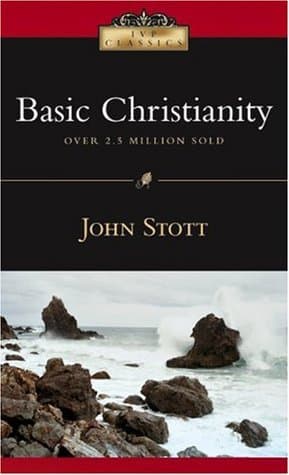
Core Idea
- Difficulty
- Easy
Key Takeaways from Basic Christianity
Jesus' Uniqueness: Claims and Implications
Jesus' self-perception as divine sets him apart from all other religious figures.
Stott carefully builds the case for Jesus' claims, showing that Jesus consistently presented himself as more than a prophet or good teacher. He claimed to be God's Son, with divine authority to forgive sins, judge humanity, and offer eternal life. This is not just a theological idea but a historical one, found in the Gospels. Stott argues that if these claims are true, Jesus calls for worship and obedience; if false, he was either a deluded fanatic or a deliberate deceiver. This clear choice, famously made by C.S. Lewis, is the book's main idea, making readers face the serious nature of Jesus' identity.
“Either this man was, and is, the Son of God, or else a madman or something worse.”
In the book: Analysis of Jesus' 'I AM' statements in John's Gospel (e.g., 'I am the way, the truth, and the life,' 'I am the bread of life'), his claims of authority to forgive sins (Mark 2:5-10), and his acceptance of worship.
Try this: Reflect on the implications of Jesus' claims for your own worldview. Is he merely a historical figure, a moral teacher, or truly divine? Your answer profoundly impacts your understanding of reality and ethics.
The Evidence for the Resurrection
The resurrection is presented as the cornerstone of Christian faith, supported by historical evidence.
Stott focuses on the resurrection, arguing it is not a myth but a historical event supported by strong evidence. He addresses common skeptical theories—the swoon theory, the theft theory, the hallucination theory—and disproves them. Key evidence includes the empty tomb, many eyewitness accounts of Jesus' post-resurrection appearances to different groups, and the disciples' change from fearful followers to bold evangelists. Stott believes no other explanation fully accounts for these facts, making the resurrection the ultimate proof of Jesus' divine claims and God's power over death. This argument is one of the book's strongest points, offering a strong defense for Christianity's historical truth.
“If Christ has not been raised, your faith is futile and you are still in your sins.”
In the book: The empty tomb, the sudden and dramatic change in the disciples' behavior, the existence of multiple eyewitnesses (referenced in 1 Corinthians 15:3-8), and the inability of authorities to produce Jesus' body.
Try this: Investigate the historical arguments for the resurrection. Consider how this event, if true, reshapes our understanding of life, death, and hope.
The Nature of Sin and Human Condition
Stott highlights humanity's inherent brokenness and separation from God as the fundamental problem.
Before presenting the solution, Stott outlines the problem: sin. He defines sin not just as individual wrongdoings but as a widespread rebellion against God, affecting every part of human nature—our thoughts, desires, and actions. This inherent flaw leads to separation from God, from others, and even from ourselves. Stott shows that human efforts to bridge this gap through good works, philosophy, or religion are not enough. This understanding of sin is important because it establishes the need for divine help, setting the stage for Jesus' atoning work. While some might find this view negative, Stott presents it as a realistic assessment of the human condition, necessary for understanding God's grace.
“Sin is not merely an action, but a state; not merely a doing, but a being.”
In the book: Biblical teaching on the universality of sin (Romans 3:23), the fallen nature of humanity (Genesis 3), and the inadequacy of human righteousness (Isaiah 64:6).
Try this: honestly examine your own life and the world around you for evidence of brokenness, selfishness, and moral failure. Consider whether Stott's definition of sin resonates with your observations.
The Cross as Atonement
Jesus' death on the cross is presented as the unique and necessary solution to humanity's sin.
Stott explains the meaning of the cross, seeing it as more than a historical execution but as atonement. He argues that Jesus' death was not martyrdom but a substitutionary sacrifice, where he paid the penalty for humanity's sins, satisfying God's justice and bringing humanity back to God. This idea of atonement is central to Stott's gospel presentation, showing that salvation is not earned but freely given through Christ's work. He clarifies that God's love and justice are both upheld at the cross—love in providing a way, justice in demanding a penalty. This insight clarifies the often-misunderstood nature of Christian salvation, showing God's active role in redemption.
“God made him who had no sin to be sin for us, so that in him we might become the righteousness of God.”
In the book: Biblical passages describing Jesus as a sacrifice (Hebrews 9-10), bearing sins (Isaiah 53), and reconciling humanity to God (Romans 5:8-10).
Try this: Reflect on the concept of substitutionary atonement. Consider how this understanding of the cross might change your perception of God's character and your own worth.
Grace Through Faith, Not Works
Salvation is a gift received through faith in Christ, not through human merit or effort.
Stott strongly states the doctrine of salvation by grace through faith, a central idea of Protestant theology. He contrasts this with any system that suggests salvation through human works, rituals, or moral achievement. He argues that because humanity is sinful, no amount of good deeds can bridge the gap between a holy God and fallen humanity. Instead, salvation is a free gift from God, received by trusting in Jesus Christ's completed work on the cross. This emphasis on grace provides great relief and assurance, removing the burden of earning salvation and replacing it with the joy of receiving it. This argument is important for understanding Christianity's liberating message.
“For it is by grace you have been saved, through faith—and this is not from yourselves, it is the gift of God—not by works, so that no one can boast.”
In the book: Paul's epistles, particularly Romans and Galatians, which strongly advocate for justification by faith apart from works of the law.
Try this: Examine your own inclination to earn approval or salvation. Consider the freedom and humility that comes from accepting a gift you cannot earn.
The Call to Repentance and Faith
Responding to the gospel requires a twofold action: turning from sin and trusting in Christ.
Stott clarifies that receiving God's grace through faith is not a passive intellectual agreement but an active response involving both repentance and faith. Repentance is a genuine change of mind and heart, leading to turning away from sin and self-centeredness toward God. Faith, on the other hand, is not just belief in historical facts but a personal trust and commitment to Jesus Christ as Lord and Savior. These two elements are inseparable, forming the complete human response to the gospel. This explanation helps readers understand that a superficial acceptance is not enough; true conversion involves a fundamental reorientation of one's life. This is a practical takeaway for anyone considering Christianity.
“Repentance is a change of mind, a turning from sin; faith is a change of trust, a turning to Christ.”
In the book: Jesus' call to 'repent and believe the good news' (Mark 1:15) and the apostles' preaching in Acts, which consistently combined these two commands.
Try this: Evaluate whether your understanding of faith includes a genuine turning away from past patterns and a committed reliance on Christ.
The New Birth and Holy Spirit
Conversion involves a spiritual rebirth and the indwelling of the Holy Spirit.
Stott emphasizes that Christian conversion is not merely a decision but a supernatural transformation, a 'new birth' initiated by God through the Holy Spirit. This spiritual rebirth gives a new nature, allowing individuals to understand spiritual truths, desire holiness, and live a life pleasing to God. The Holy Spirit living within believers empowers them, guiding them, comforting them, and convicting them. This concept shows the internal, transformative power of Christianity, moving beyond simply following rules. While this aspect may be less tangible than others, Stott argues it is essential for a genuine Christian experience, showing that Christianity is about a changed heart, not just changed behavior. The argument has limits for those seeking purely rational evidence, but it speaks to the experiential side of faith.
“Unless one is born again he cannot see the kingdom of God.”
In the book: Jesus' conversation with Nicodemus in John 3 and Paul's teaching on the indwelling Spirit in Romans 8 and Galatians 5.
Try this: Consider if your spiritual experience includes a sense of internal change and empowerment. How does the concept of spiritual rebirth shape your understanding of growth?
The Lordship of Christ and Discipleship
Accepting Jesus as Savior entails acknowledging him as Lord, leading to a life of committed discipleship.
Stott makes it clear that faith in Jesus is not just about receiving forgiveness but also about submitting to his authority as Lord. This means a commitment to discipleship, which involves following Jesus' teachings, striving for obedience, and living a life that reflects his character. He rejects the idea of a 'cheap grace' that accepts salvation without demanding a changed life. True faith, Stott argues, leads to a desire to honor Christ in all areas. This emphasis corrects superficial understandings of Christianity, highlighting the cost and commitment involved in authentic faith. It is a challenging but necessary aspect of the gospel, ensuring that belief translates into lived reality.
“If Jesus is not Lord of all, he is not Lord at all.”
In the book: Jesus' call to 'take up your cross and follow me' (Matthew 16:24) and his teachings on obedience and fruit-bearing (John 15).
Try this: Assess the areas of your life where you might be holding back from Christ's Lordship. What practical steps can you take to align your life more fully with his teachings?
The Urgency of the Gospel Message
The eternal implications of the gospel necessitate a thoughtful and timely response.
Throughout the book, Stott conveys a strong sense of urgency regarding the gospel message. He argues that the stakes are eternal, involving not just earthly well-being but the ultimate destiny of every individual. This urgency is not about fear-mongering but comes from a deep conviction about the truth of Jesus' claims and the seriousness of humanity's sin. Stott invites readers to seriously consider the implications of Jesus' identity and work, emphasizing that putting it off carries significant spiritual risk. This takeaway shows the book's evangelistic purpose and challenges readers to move beyond intellectual consideration to personal decision. While some might find the urgency off-putting, it reflects Stott's deep pastoral concern.
“The gospel is not an optional extra for those who like it; it is the vital truth for all humanity.”
In the book: Jesus' warnings about judgment (Matthew 25) and the apostles' fervent appeals for conversion in the book of Acts.
Try this: Reflect on the eternal implications of your beliefs. What steps can you take to ensure your response to the gospel is genuine and timely?
A Rational and Coherent Worldview
Christianity, when understood correctly, offers a logical and comprehensive explanation of reality.
Stott consistently presents Christianity not as a blind leap of faith but as a rational worldview. He systematically addresses common objections and questions, showing how the Christian narrative—from creation to redemption to future hope—provides a comprehensive way to understand the universe, human nature, morality, and purpose. He argues that the historical evidence for Jesus, the internal consistency of scripture, and the transformative power of the gospel provide compelling reasons for belief. This is the book's strongest insight, showing that faith and reason are not separate but can powerfully work together. Stott's approach is intellectual yet accessible, inviting thoughtful engagement rather than demanding unquestioning acceptance.
“Christianity is not an irrational superstition, but a coherent worldview that makes sense of human experience.”
In the book: The logical progression of arguments throughout the book, addressing sin, atonement, resurrection, and the implications for human life, demonstrating internal consistency.
Try this: Consider how Christianity provides answers to life's biggest questions. Does it offer a more satisfying and coherent explanation of reality than other worldviews you've encountered?
Quiz
10 questions on the main ideas. Each answer comes with a short explanation.
Question 1
According to the provided text, what is the central theme of John Stott's "Basic Christianity"?
- The history of the early church.
- A clear statement of the Christian gospel and the nature of Jesus Christ.
- The philosophical arguments for and against the existence of God.
- The social impact of Christianity throughout history.
Show answer
B. A clear statement of the Christian gospel and the nature of Jesus Christ. The text explicitly states that John Stott presents 'his clear classic statement of the gospel,' which is further elaborated by the questions about Jesus Christ's identity and divinity.
Question 2
What is the consequence if Jesus is not who he claimed to be and did not do what he claimed he came to do, according to the text?
- Christianity would need to be reinterpreted.
- The foundations of Christianity would remain intact.
- The entire structure of Christianity would collapse.
- It would lead to a new philosophical movement.
Show answer
C. The entire structure of Christianity would collapse. The text directly states, 'If he is not who he said he was and if he did not do what he said he had come to do the whole superstructure of Christianity crumbles in ruins to the ground.'
Question 3
The book "Basic Christianity" explores the plausibility of Jesus being what?
- A great moral teacher.
- A political revolutionary.
- Truly divine.
- A historical myth.
Show answer
C. Truly divine. The text poses the question, 'Is it plausible that Jesus was truly divine?' which is a core topic explored in the book.
Question 4
What does the text imply about the significance of Jesus' claims regarding his divinity?
- They are secondary to his teachings on ethics.
- They are fundamental to the validity of Christianity.
- They are primarily symbolic and open to interpretation.
- They are a matter of personal belief with no objective consequence.
Show answer
B. They are fundamental to the validity of Christianity. The statement 'If he is not who he said he was and if he did not do what he said he had come to do the whole superstructure of Christianity crumbles in ruins to the ground' highlights the foundational importance of his claims, including his divinity.
Question 5
The phrase 'superstructure of Christianity crumbles in ruins to the ground' suggests that the core of Christianity is dependent on what?
- The historical accuracy of the Gospels.
- The moral teachings of Jesus.
- The divine nature and actions of Jesus.
- The interpretation of biblical prophecies.
Show answer
C. The divine nature and actions of Jesus. The sentence directly links the crumbling of the 'superstructure' to Jesus not being who he said he was or not doing what he said he came to do, implying his claims about his identity and mission are the foundation.
Question 6
What is the primary purpose of posing the question 'And what might this mean for us?' in the context of Jesus' divinity?
- To encourage academic debate on theological concepts.
- To explore the practical implications and relevance of Jesus' divinity for individuals.
- To question the historical evidence for Jesus' divine claims.
- To introduce a section on the social justice aspects of Christianity.
Show answer
B. To explore the practical implications and relevance of Jesus' divinity for individuals. This question directly follows the discussion of Jesus' divinity and asks about its meaning 'for us,' indicating a focus on personal relevance and impact.
Question 7
The text presents John Stott's work as a 'classic statement.' What does this suggest about the book's reception and influence?
- It is a recent and controversial theological work.
- It is a foundational and widely respected exposition of Christian beliefs.
- It is an outdated text with little contemporary relevance.
- It is a collection of personal spiritual reflections.
Show answer
B. It is a foundational and widely respected exposition of Christian beliefs. The term 'classic statement' implies enduring quality, significant impact, and widespread acceptance within its field, suggesting it's a foundational text.
Question 8
Which of the following best characterizes the approach taken by John Stott as described in the excerpt?
- Skeptical and questioning of traditional Christian doctrines.
- Evangelical and focused on the core tenets of the Christian faith.
- Liberal and seeking to reconcile Christianity with modern science.
- Mystical and emphasizing personal spiritual experience over doctrine.
Show answer
B. Evangelical and focused on the core tenets of the Christian faith. The focus on 'basic Christianity,' the 'gospel,' and the 'divinity' of Jesus, presented as a 'clear classic statement,' aligns with an evangelical approach that emphasizes foundational doctrines.
Question 9
The text uses the metaphor of a 'superstructure' crumbling to emphasize:
- The fragility of religious institutions.
- The potential for spiritual disillusionment.
- The absolute necessity of Jesus' claimed identity and actions for the coherence of Christianity.
- The historical evolution of Christian theology.
Show answer
C. The absolute necessity of Jesus' claimed identity and actions for the coherence of Christianity. The metaphor directly links the integrity of the entire 'superstructure' (Christianity) to the foundational claims about Jesus' identity and actions. If these are false, the whole structure collapses.
Question 10
Considering the questions posed in the excerpt ('Who is Jesus Christ? Is it plausible that Jesus was truly divine? And what might this mean for us?'), what can be inferred about the book's overall argument?
- The book primarily aims to debunk common misconceptions about Jesus.
- The book argues that the divinity of Jesus is a central, non-negotiable aspect of Christianity with profound personal implications.
- The book suggests that the historical Jesus is less important than the spiritual message he conveyed.
- The book focuses on the philosophical challenges of proving Jesus' divinity.
Show answer
B. The book argues that the divinity of Jesus is a central, non-negotiable aspect of Christianity with profound personal implications. The sequence of questions moves from identity to divinity, and then to personal meaning, strongly suggesting that the core argument revolves around establishing the plausibility and significance of Jesus' divine nature for believers.
Basic Christianity FAQ
What is the main message of John Stott's 'Basic Christianity'?
The book presents a clear and classic statement of the Christian gospel, focusing on the essential beliefs and claims of Christianity. It aims to explain who Jesus Christ is and what he did, forming the foundation of the faith.
Who is Jesus Christ according to 'Basic Christianity'?
According to Stott, Jesus Christ is presented as a central figure whose claims and actions are fundamental to Christianity. The book explores the significance of his identity and his purpose in coming to the world.
Why is Jesus' divinity important in Christianity?
Stott argues that the plausibility of Jesus being truly divine is crucial. If Jesus was not divine, the entire structure and message of Christianity would collapse. His divinity has profound implications for believers.
What does it mean for us if Jesus was truly divine?
The divinity of Jesus has significant implications for individuals. Stott explores how this belief impacts our understanding of salvation, our relationship with God, and the purpose of our lives.
Is 'Basic Christianity' suitable for newcomers to the faith?
Yes, the book is designed as a clear and accessible introduction to the core tenets of Christianity. It breaks down complex theological ideas into understandable terms for those exploring the faith.
What is the 'superstructure of Christianity' that Stott refers to?
The 'superstructure of Christianity' refers to the entire system of beliefs, practices, and doctrines that are built upon the foundation of who Jesus is and what he accomplished. If the foundation is removed, the whole structure falls.
Does 'Basic Christianity' compare Christianity to other religions?
While the book focuses on the distinct claims of Christianity, its primary aim is to explain the 'basics' of the faith rather than engage in extensive comparative religion. It centers on the unique assertions about Jesus Christ.
How does John Stott approach the topic of spirituality in this book?
Stott connects spirituality directly to the person and work of Jesus Christ. He presents a faith that is grounded in historical events and theological truths, offering a framework for a meaningful spiritual life.
What practical advice or guidance can be found in 'Basic Christianity'?
The book provides a practical foundation for Christian belief by clearly articulating what it means to be a Christian. Understanding these basics is essential for living out the faith authentically.
What is the significance of the book's title, 'Basic Christianity'?
The title signifies that the book addresses the fundamental, essential elements of the Christian faith. It aims to strip away complexities and present the core message in a clear and understandable manner.
Similar books
- The Case for Christ
Lee Strobel
4.2 (100k) average on GoodreadsHistoryStrobel's "The Case for Christ" shares Stott's commitment to presenting a rational basis for faith, but their methodologies differ significantly. Strobel, a former investigative journalist, uses an interview-based approach, exploring various fields (archaeology, textual criticism, psychology) through conversations with experts to examine the evidence for Jesus's life, death, and resurrection. Stott, on the other hand, presents a more integrated theological argument from within a biblical framework, assuming the authority of scripture while still appealing to reason. Strobel's book is highly accessible for those who prefer an evidence-based, journalistic inquiry, while Stott offers a more systematic, pastorally-oriented theological exposition.
- Eat, Pray, Love
Elizabeth Gilbert
3.6 (1.5M) average on GoodreadsLifestyleA heartbroken writer leaves her conventional life for a year-long global search for pleasure in Italy, spiritual devotion in India, and unexpected love and balance in Bali.
- Educated
Tara Westover
4.5 (796k) average on GoodreadsBiographyRaised in the Idaho mountains by fundamentalist survivalists, a young woman forges her own path to education, battling fierce family loyalty and personal demons to discover a world beyond her isolated upbringing.
- The Poisonwood Bible
Barbara Kingsolver
4.1 (659k) average on GoodreadsLiterary FictionA zealous missionary's rigid faith clashes with the Belgian Congo's wilderness and people, unraveling his family through the eyes of his five unforgettable women.
- Siddhartha
Hermann Hesse
4.0 (583k) average on GoodreadsHistorical FictionSiddhartha leaves a life of privilege and piety, embracing asceticism, wealth, and love to find enlightenment not in dogma, but in the whispers of a river and the unity of all existence.
- The Five People You Meet in Heaven
Mitch Albom
3.9 (578k) average on GoodreadsFantasyAn amusement park mechanic, Eddie, dies saving a child and awakens in an afterlife where five souls, some familiar, some strangers, reveal the meaning of his ordinary life.





Enjoyed the summary?
A summary gives you the shape of the book. The book itself has the detail, the examples and the voice.
Find Basic Christianity on AmazonAs an Amazon Associate, BookBrief earns from qualifying purchases. How we're funded