
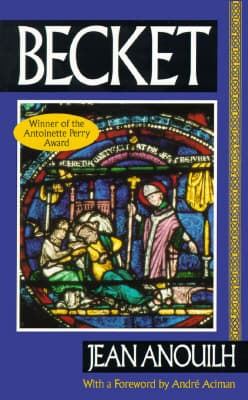
Synopsis
Covers the whole plot, including the ending.
- Difficulty
- Medium
- Pacing
- Moderate
- Mood
- Dramatic, Tragic, Profound, Thought-provoking, Intense
- Read it if
- You enjoy historical dramas exploring complex character transformations, the clash between church and state, and the tragic unraveling of a deep friendship.
- Skip it if
- You prefer fast-paced action over philosophical and moral debates, or if you are looking for a light, uplifting story.
Becket Plot Summary
Covers the whole plot, including the ending.
Penance at Canterbury
The play opens with King Henry II, stripped and whipped, kneeling in penance at Thomas Becket's tomb in Canterbury Cathedral. Monks administer the lashes. This scene immediately sets up the main conflict and Becket's tragic end, creating a somber tone. Henry's actions are a public show of regret and an attempt to reconcile with the Church and his conscience after his former Chancellor and Archbishop's murder. The scene frames the story, hinting at the deep relationship that led to this moment of humility for the King.
The Saxon and the Norman King
The story flashes back to Henry II, a young, loud Norman king, struggling to control the Saxon people and the Church. He is frustrated by his Norman barons' inefficiency and the constant need to please the Archbishop of Canterbury. During a hunt, he meets Thomas Becket, a young, sophisticated, and seemingly amoral Saxon. Impressed by Becket's intelligence, wit, and lack of typical ambition, Henry likes him. Despite Becket being a Saxon, a group generally disliked by Normans, Henry sees him as a potential confidant and a way to consolidate his power, especially against the Church.
Chancellor of England
Becket quickly rises, becoming Henry's Chancellor and closest friend. He fully adopts the lavish lifestyle of a Norman lord, sharing Henry's love for hunting, women, and entertainment. Becket proves to be a very effective Chancellor, ruthlessly carrying out Henry's will and centralizing power. He helps Henry bring order to the kingdom, often at the expense of the Church's traditional rights. Their bond is deep, marked by mutual affection, shared interests, and understanding. Becket, despite his Saxon roots, becomes more Norman than the Normans, enjoying his new status and power.
The Vacant See of Canterbury
The old Archbishop of Canterbury dies, creating a vacancy. Henry, wanting to control the Church and ensure its obedience, sees an opportunity. He decides to appoint Becket as the new Archbishop, believing his loyal Chancellor will continue to serve the King's interests and help limit the Church's power. Despite warnings from his mother and others about a possible spiritual change in Becket, Henry trusts his friend's loyalty and perceived lack of religious belief. Becket initially resists, sensing the profound shift this appointment would bring.
Becket's Transformation
Despite his initial reluctance and warnings to Henry, Becket accepts the Archbishopric. The moment he puts on the Church's robes, a deep and unexpected change begins. He gives up his flamboyant lifestyle, renounces his worldly possessions, and dedicates himself entirely to God and the Church. His former love for luxury and power is replaced by asceticism, piety, and an unwavering commitment to his new spiritual role. This sudden change shocks Henry, who expected his loyal Chancellor to remain compliant. Becket's transformation begins the irreconcilable conflict between the two men.
Conflict over Church Privileges
As Archbishop, Becket immediately champions the Church's rights and privileges, often directly opposing Henry's policies. He challenges Henry on issues like the jurisdiction of church courts and the Church's right to property. What Henry saw as a way to control the Church, Becket now sees as a divine calling to protect it. Their intimate friendship quickly turns into a power struggle. Henry is angry at what he sees as Becket's betrayal, while Becket views his actions as fulfilling his sacred duty. Their personal bond is now overshadowed by their conflicting institutional roles.
Exile in France
The conflict grows, with Henry trying to strip Becket of his lands and authority. Becket, refusing to compromise, flees to France, seeking protection from King Louis VII and Pope Alexander III. During his exile, Becket lives a life of austerity, strengthening his spiritual commitment. Henry, meanwhile, faces pressure from the Pope and other European monarchs who threaten excommunication if he does not reconcile with Becket. The political consequences of their feud grow, involving the entire European Christian world and showing the Church's immense power.
Attempted Reconciliation
Several attempts to make peace occur, including a meeting between Henry and Becket in France. While there are moments of warmth and hope for their old friendship to rekindle, their fundamental differences remain. Henry demands Becket's submission to royal authority over the Church, while Becket insists on the supremacy of God's law and the Church's independence. Neither man will yield on their core principles. The meeting fails, with both men realizing the gap between them is too wide, sealing their tragic fate.
Return to England
Under pressure from the Pope and tired of exile, Becket eventually agrees to return to England, having secured a fragile peace with Henry, though without full resolution. He knows, however, that his return is dangerous. Before leaving France, he makes arrangements for his burial, showing he foresees martyrdom. His arrival in England is met with popular acclaim and the resentment of Henry's loyalists and certain bishops he had excommunicated. Becket's return is an act of faith, knowing it could lead to his ultimate sacrifice.
The King's Rash Words
Back in England, Becket continues to assert the Church's authority, excommunicating bishops who supported Henry. This angers Henry, who, hearing the news at Christmas, shouts in rage, "Will no one rid me of this turbulent priest?" Though Henry later claims he did not mean it as a direct command for murder, four of his knights interpret his words as such. This moment is the turning point, leading directly to the tragic climax and showing Henry's impulsiveness and the dangerous power of a king's anger.
Martyrdom at Canterbury
The four knights travel to Canterbury Cathedral, confronting Becket. They demand he revoke the excommunications and submit to the King. Becket steadfastly refuses, declaring his loyalty to God and the Church. Despite warnings from his monks to flee, Becket calmly awaits his fate. The knights kill him on the altar steps. His death is a shocking and sacred event, solidifying his image as a martyr and transforming him into a saint. This violence deeply affects Henry and the kingdom, leading to widespread condemnation and Becket's veneration.
Henry's Guilt and Legacy
The play returns to Henry's penance at Canterbury. Henry is haunted by Becket's death and the loss of his friend. He acknowledges his role in the tragedy, even if unintended. He reflects on Becket's change and his own ongoing struggle with spiritual and temporal matters. Becket, though dead, achieves an eternal victory, becoming a saint and a symbol of spiritual defiance against temporal power. Henry, despite his power, is left with the burden of his actions and the deep void left by the man who was once his closest companion and then his greatest enemy. The ending shows the lasting impact of their conflict.
Becket Characters
Thomas Becket
Protagonist
The Saxon Chancellor turned Archbishop and martyr.
Initially a charming, cynical, and worldly Saxon noble, Becket serves as King Henry II's loyal and highly effective Chancellor, embracing the Norman way of life. He is intelligent, witty, and seemingly devoid of deep religious conviction. However, upon being appointed Archbishop of Canterbury, he undergoes a profound spiritual transformation, becoming devout, ascetic, and fiercely dedicated to the Church's independence and God's will. This change leads him to an unyielding conflict with his former friend, Henry.
Relationships: King Henry II (Closest friend and confidant, then bitter adversary); Gwendolen (Mistress/lover (prior to transformation)); The Pope (Spiritual superior and ally during exile)
King Henry II
Antagonist/Co-Protagonist
The powerful Norman King of England, driven by a desire for order and control.
Henry is a passionate, volatile, and pragmatic Norman king, obsessed with consolidating his power, bringing order to England, and curbing the influence of the Church. He is deeply human, capable of great affection and brutal rage. He initially finds in Becket a kindred spirit and a loyal tool for his ambitions. His love for Becket is genuine, making Becket's transformation and subsequent opposition a profound personal betrayal. Henry struggles with the spiritual implications of his actions and the loss of his friend.
Relationships: Thomas Becket (Closest friend and confidant, then bitter adversary); Queen Eleanor (Wife, often an object of his frustration); Gwendolen (Shared mistress with Becket, then taken by Henry); His Sons (Source of frustration and political maneuvering)
Gwendolen
Supporting
Becket's mistress, a symbol of his worldly life.
Gwendolen is a young Saxon woman who serves as Becket's mistress during his time as Chancellor. She represents the sensual, carefree, and worldly life that Becket enjoys alongside Henry. Her character underscores the depth of Becket's transformation when he renounces his former life. She is a gentle, loving figure, but ultimately a pawn in the power dynamics between Henry and Becket. Her eventual fate at Henry's hands further highlights the king's ruthlessness and Becket's detachment from his past.
Relationships: Thomas Becket (Lover); King Henry II (Taken by him after Becket's transformation)
Queen Eleanor
Supporting
Henry's wife, a shrewd and often critical observer.
Queen Eleanor is Henry's intelligent and politically astute wife. She is often critical of Henry's impetuous decisions and his over-reliance on Becket. She represents a more traditional, established power base within the Norman court. Eleanor is skeptical of Becket, particularly his Saxon origins, and warns Henry about the dangers of elevating him too highly, especially within the Church. She is a voice of caution and sometimes cynicism amidst the passionate drama between Henry and Becket.
Relationships: King Henry II (Wife, often at odds with him); Thomas Becket (Skeptical observer)
The Pope (Alexander III)
Supporting
The head of the Catholic Church, a powerful political and spiritual figure.
The Pope, though not always physically present, is a formidable presence throughout the play. He represents the ultimate spiritual authority in the Christian world and is a key player in the conflict between Henry and Becket. He offers Becket sanctuary during his exile and wields the powerful threat of excommunication and interdict against Henry, forcing the King's hand towards reconciliation. He is a pragmatic leader, balancing spiritual principles with political necessity.
Relationships: Thomas Becket (Spiritual superior and protector); King Henry II (Political and spiritual adversary)
King Louis VII of France
Supporting
The pious and opportunistic King of France, who offers Becket refuge.
Louis VII is the King of France, Henry's political rival, and a more outwardly pious ruler. He offers Becket refuge during his exile, partly out of genuine religious conviction and partly to exploit the political instability caused by the conflict between Henry and Becket. Louis enjoys seeing Henry's difficulties and subtly encourages Becket to maintain his defiance, thereby weakening England. He serves as a contrast to Henry's more secular and pragmatic approach to kingship.
Relationships: Thomas Becket (Protector during exile); King Henry II (Political rival)
Archbishop of Canterbury (Old)
Mentioned
Becket's predecessor, whose death creates the central conflict.
The old Archbishop of Canterbury is the figure whose death creates the vacancy that Henry exploits to appoint Becket. He represents the traditional, established power of the Church that Henry seeks to control. His death is the catalyst for Becket's elevation and subsequent transformation, setting the stage for the entire drama.
The Four Knights
Supporting
Henry's loyal followers who murder Becket.
Reginald Fitzurse, William de Tracy, Hugh de Morville, and Richard le Breton are the four knights who, misinterpreting Henry's outburst, travel to Canterbury and murder Becket. They are fiercely loyal to Henry and act out of a misguided sense of duty to their king. Their actions are brutal and decisive, serving as the instrument of Becket's martyrdom and sealing Henry's guilt. They represent the dangerous consequences of a ruler's unchecked rage.
Relationships: King Henry II (Loyal subjects); Thomas Becket (Victims of their violence)
Becket Themes
Identity and Transformation
The play explores identity, especially through Thomas Becket's radical change. Becket begins as a Saxon who adopts Norman culture and a worldly life, seemingly without a fixed moral center. His acceptance of the Archbishopric, however, forces him to shed his old identity for one rooted in spiritual duty. This change is sudden and complete, leading him to find 'God's honor' that goes beyond earthly loyalty. Henry also struggles with his identity as a king versus his feelings for Becket. The play suggests true identity can be found in selfless devotion to a higher cause, even if it brings conflict and martyrdom.
“I was a man without honor. I was a man who served his King. Now I am a man who serves God. And in that, I have found my honor.”
Loyalty vs. Principle
This is the play's central conflict. Henry demands absolute loyalty to the crown, seeing Becket's change as a betrayal of their friendship and his king. Becket, however, shifts his loyalty from the king's temporal power to God and the Church's spiritual principles. The play asks where ultimate loyalty should lie: with a personal bond, a political entity, or a divine calling. Becket's unwavering commitment to his principles, even to death, highlights how these two forms of loyalty clash irreconcilably.
“You are my friend, Becket! My creature! You owe me everything!”
The Nature of Power
Anouilh examines various forms of power: the king's absolute temporal power, the Church's spiritual power, and the personal power of conviction. Henry wields political and military power, believing he can control all aspects of his kingdom, including the Church. Becket, once a master of political power as Chancellor, finds a different, more lasting power in spiritual authority and martyrdom. The play shows that while temporal power can enforce obedience, spiritual power can inspire faith and ultimately last beyond death, leaving a legacy even kings must face.
“The King's power is only for a lifetime. God's power is eternal.”
Friendship and Betrayal
The deep, complex friendship between Henry and Becket forms the play's emotional core. They share a unique bond, a love for life, and mutual understanding. Henry feels a deep sense of personal betrayal when Becket, as Archbishop, turns against him. Becket, in turn, feels he has betrayed his old self, but not his true calling. The play explores how political and spiritual obligations can tragically destroy even the strongest personal bonds, leaving both individuals deeply scarred. Henry's penance is as much for the loss of his friend as for the murder of an archbishop.
“I loved him, you see. I loved him. And he betrayed me.”
Plot Devices & Literary Techniques
Frame Narrative
The play begins and ends with Henry's penance at Becket's tomb.
The play opens with King Henry II performing public penance at Becket's tomb, then flashes back to the beginning of their relationship, and finally returns to the present-day penance. This device immediately establishes the tragic outcome and the profound weight of the past events. It creates a sense of foreboding and allows the audience to view the unfolding events through the lens of their inevitable conclusion, emphasizing the themes of guilt, fate, and the lasting impact of the conflict.
Dramatic Irony
The audience is aware of Becket's future martyrdom from the outset.
From the very first scene, the audience knows that Becket will die and that Henry will be implicated in his death, leading to his penance. This creates dramatic irony as the audience watches Henry's initial delight in Becket and his confident appointment of him as Archbishop. The audience understands the tragic consequences of Henry's actions and Becket's transformation long before the characters do, heightening the tension and the sense of inevitability in their escalating conflict.
The Robes of Office
A symbolic prop representing a character's role and transformation.
The robes that Becket wears, first as Chancellor (luxurious, worldly) and then as Archbishop (austere, spiritual), are powerful symbols. The act of Becket donning the Archbishop's vestments marks his immediate and profound spiritual transformation. The robes represent not just a change in office, but a complete shift in identity, loyalty, and purpose. They visually signify the moment Becket sheds his worldly self and fully embraces his divine calling, setting him on an irreversible path towards martyrdom.
The King's Outburst
A rash statement leading to unforeseen, tragic consequences.
Henry's infamous cry, "Will no one rid me of this turbulent priest?" is a classic example of a king's words having unintended, yet devastating, consequences. It serves as the direct catalyst for Becket's murder. This device highlights the immense power of a monarch's words, even when spoken in a moment of unbridled rage, and the dangerous loyalty of those who interpret them literally. It underscores Henry's impulsiveness and his ultimate responsibility for the tragic climax, despite his later claims of not intending murder.
Becket Quotes
“The State is me. I am the State. I can do what I like with you, and with the whole of England.”
“I was a Saxon. That's a great deal to be, for me. For a long time, I didn't know what I was. Now I know.”
“When one has to govern a country, one must have a certain amount of cynicism. And a certain amount of indifference.”
“God's honour, my Lord. It is not mine, but His.”
“You are my friend, Thomas. My only friend. Don't go and become God's friend, too, it's too much.”
“One does not choose God, one is chosen.”
“I had a Saxon for a friend. Now I have a saint for an enemy.”
“There are times when one must choose between one's king and one's conscience.”
“It is a terrible thing to have to choose between God and Caesar.”
“A man must be true to what he is, even if it kills him.”
“When you are a king, you are never alone. But you are always lonely.”
“I am not God. I am only a man. But I am a man who has chosen his path.”
“There is no more dangerous animal than a priest who believes in God.”
“I have loved him, and I have hated him. And I shall never forget him.”
Quiz
10 questions on the plot and the characters. Each answer comes with a short explanation.
Question 1
At the beginning of the play, what is the nature of King Henry II's relationship with Thomas Becket?
- They are bitter rivals, constantly vying for power.
- They are close friends and confidantes, sharing many personal moments.
- Becket is Henry's distant advisor, rarely interacting directly.
- Henry views Becket as a nuisance, tolerating him only out of political necessity.
Show answer
B. They are close friends and confidantes, sharing many personal moments. Initially, Henry and Becket share a very close, informal friendship, spending much time together in revelry and shared confidences.
Question 2
What position does King Henry II appoint Thomas Becket to, expecting him to remain loyal to the crown's interests?
- Lord Chancellor
- Archbishop of Canterbury
- Chief Justiciar
- Bishop of London
Show answer
B. Archbishop of Canterbury Henry appoints Becket as Archbishop of Canterbury, believing Becket will continue to prioritize the King's will over the Church's.
Question 3
What is the primary conflict that arises immediately after Becket's appointment as Archbishop?
- Becket's refusal to accept the position, preferring his old life.
- Becket's sudden and unexpected devotion to the Church's authority, clashing with the King.
- The Pope's refusal to consecrate Becket as Archbishop.
- Henry's immediate regret and attempt to revoke the appointment.
Show answer
B. Becket's sudden and unexpected devotion to the Church's authority, clashing with the King. Upon becoming Archbishop, Becket undergoes a profound transformation, dedicating himself wholly to the Church, which puts him in direct opposition to Henry's desire for royal control over ecclesiastical matters.
Question 4
What does Henry II famously exclaim in frustration, which is later interpreted as a command to kill Becket?
- "Will no one rid me of this turbulent priest?"
- "I wish this man had never been born!"
- "He has betrayed my trust and will pay for it!"
- "To hell with the Church and all its priests!"
Show answer
A. "Will no one rid me of this turbulent priest?" In a moment of extreme anger and frustration over Becket's defiance, Henry utters this line, which four knights overhear and take as a literal command.
Question 5
What is the central theme explored through Becket's transformation from a hedonistic companion to a devout Archbishop?
- The corrupting influence of power on individuals.
- The conflict between personal loyalty and a higher spiritual calling.
- The inevitability of betrayal in political alliances.
- The struggle for succession within the English monarchy.
Show answer
B. The conflict between personal loyalty and a higher spiritual calling. Becket's journey highlights the profound internal struggle when one must choose between their bond with a friend and their duty to God or a higher principle.
Question 6
How does Becket respond to the King's demands regarding the 'Constitutions of Clarendon'?
- He immediately signs them without question to appease the King.
- He initially agrees under duress but later retracts his consent, leading to further conflict.
- He negotiates a compromise that satisfies both the Church and the Crown.
- He flees England before he can be forced to consider them.
Show answer
B. He initially agrees under duress but later retracts his consent, leading to further conflict. Becket initially gives way to Henry's pressure regarding the Constitutions, which sought to limit Church power, but his conscience compels him to later recant, deepening the rift.
Question 7
What is the significance of Becket's 'honor' (or 'sake') as a recurring motif in the play?
- It represents Becket's desire for personal glory and recognition.
- It signifies his shifting allegiances, initially to the King, then to God and the Church.
- It refers to the material wealth and prestige associated with his positions.
- It is a term used by Henry to mock Becket's perceived arrogance.
Show answer
B. It signifies his shifting allegiances, initially to the King, then to God and the Church. Becket frequently speaks of acting for his 'sake' or 'honor,' which evolves from serving the King's interests to serving God's, reflecting his profound personal and spiritual transformation.
Question 8
What happens to Becket at the end of the play, directly following Henry's outburst?
- He is banished from England for life.
- He is reconciled with King Henry and they resume their friendship.
- He is murdered by four of Henry's knights in Canterbury Cathedral.
- He abdicates his position and becomes a hermit.
Show answer
C. He is murdered by four of Henry's knights in Canterbury Cathedral. Inspired by Henry's frustrated words, four knights travel to Canterbury Cathedral and brutally murder Becket, making him a martyr.
Question 9
How does the play portray King Henry II's feelings and actions after Becket's death?
- He expresses immediate relief and satisfaction that his rival is gone.
- He performs public penance and expresses deep regret and guilt.
- He attempts to cover up his involvement and blame the knights.
- He wages war against the Pope in defiance of the Church.
Show answer
B. He performs public penance and expresses deep regret and guilt. The play opens with Henry performing penance at Becket's tomb, demonstrating his profound remorse and the political necessity of atoning for the murder.
Question 10
What does the play suggest about the nature of power and duty through the evolving relationship between Henry and Becket?
- That personal relationships are always secondary to political ambition.
- That true power lies in the ability to manipulate others for one's own gain.
- That the demands of office can transform individuals and create insurmountable divisions even between the closest friends.
- That the Church will always ultimately submit to the authority of the Crown.
Show answer
C. That the demands of office can transform individuals and create insurmountable divisions even between the closest friends. The play profoundly illustrates how the weighty responsibilities and conflicting duties of their respective high offices force Henry and Becket apart, ultimately leading to tragedy.
Becket FAQ
What is the central conflict in 'Becket'?
The central conflict revolves around the clash between King Henry II's desire to assert royal authority over the Church and Thomas Becket's eventual transformation into a devout Archbishop who champions the Church's independence. Initially, their conflict is political and personal, but it deepens into a profound ideological struggle once Becket embraces his spiritual role, leading to an irreconcilable divide.
How does Thomas Becket's character evolve throughout the play?
Becket begins as a cynical, pleasure-loving Saxon Archdeacon, loyal companion, and Chancellor to King Henry II, seemingly indifferent to spiritual matters. However, upon his appointment as Archbishop of Canterbury, he undergoes a profound spiritual conversion, becoming a zealous defender of the Church's rights and an ascetic figure, ultimately choosing martyrdom over compromise with the King.
What is the nature of the relationship between King Henry II and Thomas Becket?
Their relationship is deeply complex, initially characterized by a strong, almost fraternal bond of shared youth, camaraderie, and mutual understanding, despite their differing backgrounds. Henry views Becket as his closest friend and confidant, someone he can trust and manipulate, but this bond fractures irrevocably as Becket's spiritual transformation puts him on a collision course with the King's political ambitions.
What role does Gwendolen play in the early part of the story?
Gwendolen is a young Saxon girl, a mistress of Becket, who embodies his initial detachment and hedonism. Her tragic death, at the hands of Henry's men during a raid on Becket's home, serves as an early catalyst for Becket's growing disillusionment with the King's brutal methods and the secular world, subtly foreshadowing his later rejection of worldly pleasures.
What historical liberties does Anouilh take with the actual events of Becket's life?
Anouilh significantly condenses timelines and simplifies complex political motivations, focusing intensely on the psychological drama between Henry and Becket rather than historical accuracy. For instance, the play exaggerates Becket's Saxon heritage and his initial cynicism, and streamlines many historical figures and events to heighten the personal conflict and dramatic impact.
How does the play use the 'hunting' motif to symbolize the characters' pursuits?
The hunting motif, particularly King Henry's passion for it, symbolizes his relentless pursuit of power, control, and his desires, whether it's for land, women, or the subjugation of the Church. Becket's initial participation in the hunt reflects his early alignment with Henry's worldly ambitions, while his later rejection of it signifies his shift to a spiritual hunt for salvation and divine will.
What is the significance of the opening scene with Henry II praying at Becket's tomb?
The opening scene immediately establishes the play's framing device, showing Henry years after Becket's death, full of remorse and seeking penance. This device foreshadows Becket's ultimate fate and frames the entire narrative as a flashback, lending a sense of tragic inevitability and emphasizing the lasting impact of Becket's martyrdom on the King.
Are there any subtle indications of Becket's latent spirituality before his appointment as Archbishop?
While Becket appears worldly, there are subtle hints, such as his disciplined nature, his moments of quiet contemplation, and his underlying sense of detachment even from his own pleasures. His deep loyalty to Henry, almost a form of service, can also be seen as a precursor to his later absolute devotion, simply redirected from a temporal master to a spiritual one.
How does the 'Saxon' identity of Becket contrast with Henry's 'Norman' identity?
Anouilh emphasizes Becket's Saxon heritage to highlight a deeper cultural and historical divide between him and the Norman King Henry. This contrast underscores Becket's initial position as an outsider who gains Henry's favor, and later, as a champion of a distinct English identity and a more 'pure' spiritual path against the conquering, worldly Normans, adding a layer of social commentary.
Discuss Henry II's psychological struggle with Becket's transformation.
Henry struggles with profound confusion, betrayal, and a sense of personal loss. He cannot comprehend Becket's radical shift, viewing it as a deliberate act of spite or a game, rather than genuine spiritual conviction. This inability to understand his friend's new identity leads to escalating frustration, rage, and eventually, a deep, unresolved guilt that haunts him.
What psychological factors contribute to Becket's sudden and absolute embrace of his spiritual role?
Becket's transformation can be seen as a culmination of his existential search for meaning, a need for absolute devotion, and a sense of finding his true 'honor' in serving God rather than man. His previous life with Henry, filled with cynicism and a lack of true purpose, made him ripe for a conversion that offered an ultimate, unwavering cause to which he could dedicate himself entirely.
How does the concept of 'honor' evolve for both Henry and Becket?
For Henry, honor is tied to royal authority, power, and his word as King, asserting dominance over all institutions, including the Church. For Becket, initially, honor is loyalty to the King and personal integrity, but it transforms into an absolute adherence to divine law and the honor of God, which supersedes all earthly loyalties, ultimately leading to his martyrdom.
To what extent is Becket's martyrdom a conscious choice, rather than an inevitable fate?
Becket's martyrdom is presented as a conscious, deliberate choice. Despite opportunities for compromise or escape, he actively embraces his destiny, seeing it as the ultimate act of fidelity to God and the Church. He understands the consequences of his defiance and, rather than avoiding them, he accepts them as the path to true spiritual honor and a transcendent purpose.
Is Becket truly a 'saint' in the traditional sense, or a man driven by pride and a need for an absolute cause?
This is a central interpretive question. Anouilh presents Becket as complex; while he achieves sainthood through martyrdom, his motivations are layered. Some argue his transformation is driven by a profound spiritual awakening, while others suggest it's a redirection of his earlier pride and need for an ultimate challenge, finding a new 'game' to play with eternal stakes, making his sainthood more human and less purely divine.
Does Henry II genuinely love Becket, or does he merely view him as a useful tool and companion?
Henry's feelings for Becket are a blend of genuine affection, reliance, and possessiveness. He undeniably values Becket's companionship, wit, and efficiency, suggesting a deep personal bond. However, his inability to accept Becket's independence and his ultimate rage when Becket defies him also reveal a utilitarian aspect to their relationship, where Becket was expected to serve Henry's will above all else.
How does Anouilh use the character of the French King Louis VII to comment on power and morality?
King Louis VII serves as a foil to Henry II. He is portrayed as a more pious, perhaps weaker, but ultimately more pragmatic ruler who understands the political power of the Church. His interactions with Becket and Henry highlight the different approaches to kingship and the manipulation of religious authority, contrasting Henry's direct confrontation with Louis's more subtle diplomacy and moral posturing.
What is the play's ultimate message about the conflict between temporal and spiritual power?
The play suggests that the conflict between temporal and spiritual power is often irreconcilable, driven by fundamentally different definitions of authority, honor, and loyalty. It highlights the tragic consequences when these spheres clash, particularly when an individual like Becket attempts to serve both, ultimately finding that one must choose an absolute allegiance, even unto death.
Does the play offer a definitive judgment on who was 'right' in the conflict between Henry and Becket?
Anouilh deliberately avoids a definitive judgment, presenting both Henry and Becket with their own justifications, flaws, and tragic dimensions. The play focuses on the human cost of their ideological struggle, allowing the audience to grapple with the complexities of power, faith, friendship, and sacrifice, rather than siding unequivocally with one figure over the other.
About the author

Jean Anouilh was a French playwright known for his contributions to the theatre in the 20th century. He is recognized for works that often explore themes of conflict between individual desires and societal expectations, with "Becket" being one of his notable plays. Anouilh's writing reflects a blend of classical and modern elements, making his work significant in the landscape of French drama.
Similar books
- A Man for All Seasons
Robert Bolt
3.9 (11k) average on GoodreadsHistorical FictionExplores a similar theme of an individual's conscience clashing with state power, focusing on Sir Thomas More.
- Murder in the Cathedral
T.S. Eliot
3.8 (8k) average on GoodreadsHistorical FictionA poetic drama directly depicting the martyrdom of Thomas Becket, offering a different artistic interpretation.
- The Lion in Winter
James Goldman
4.2 (10k) average on GoodreadsHistorical FictionFeatures King Henry II and his family, delving into historical power struggles and complex relationships within the Plantagenet dynasty.
- To Kill a Mockingbird
Harper Lee
4.3 (4.5M) average on GoodreadsHistorical FictionIn the 1930s Jim Crow South, Harper Lee writes about racial injustice, moral growth, and the quiet courage of a lawyer father, Atticus Finch, as seen through his young daughter's eyes.
- The Great Gatsby
F. Scott Fitzgerald
3.9 (3.8M) average on GoodreadsHistorical FictionIn the opulent Roaring Twenties, a mysterious millionaire's lavish parties hide his desperate, tragic pursuit of a lost love, exposing the emptiness within the American Dream.
- Pride and Prejudice
Jane Austen
4.3 (3M) average on GoodreadsHistorical FictionIn a society focused on status and money, Elizabeth Bennet navigates love and pride, challenging Mr. Darcy and social expectations to find true affection.





Enjoyed the summary?
A summary gives you the shape of the book. The book itself has the detail, the examples and the voice.
Find Becket on AmazonAs an Amazon Associate, BookBrief earns from qualifying purchases. How we're funded