

Synopsis
Covers the whole plot, including the ending.
- Difficulty
- Medium
- Pacing
- Moderate
- Mood
- Introspective, suspenseful, thought-provoking, melancholic
Brazzaville Beach Plot Summary
Covers the whole plot, including the ending.
Arrival in Congo and Early Research
Hope Clearwater, a young British primatologist, arrives in the fictional African country of Congo. She wants to continue her research into chimpanzee behavior and escape her brilliant mathematician husband, John Clearwater, to start her own intellectual path. She begins by observing a group of chimps, led by a male named Moses, in a peaceful forest. She records their social interactions, feeding habits, and communication, hoping to find new insights into their cognitive abilities and social structures. The early days give her a sense of purpose and the excitement of scientific discovery, despite a distant civil war.
The Enigma of John Clearwater
Hope often thinks back to her difficult marriage with John Clearwater. John is a mathematical genius, but his work on chaos theory, the 'Clearwater Conjecture,' consumes him. Their relationship, which started with intellectual passion, slowly worsens because of his obsessive personality and her growing feeling of not being good enough. Hope remembers his distant manner, his intense focus followed by withdrawal, and how his intellect overshadowed her goals. These memories show the emotional pain from a relationship that was intellectually stimulating but emotionally isolating and ultimately damaging for Hope.
The Emergence of Violence
As Hope continues her research, the chimpanzee troop's behavior changes. She sees aggression and violence that go against what was previously understood about them. The chimps, especially Moses, attack rival groups and commit infanticide within their own community. These incidents are not just defensive; they seem planned and even cruel, challenging Hope's basic understanding of primate behavior. The increasing violence among the chimps mirrors the human conflict nearby, creating an unsettling parallel that affects Hope's scientific objectivity and peace of mind. She struggles to accept these observations with her belief in nature's 'noble savage' aspect.
The Arrival of Eugene Mallabar
The arrival of Eugene Mallabar, a well-known but controversial primatologist, complicates Hope's research. Mallabar is charming and has an unusual approach to primatology, often using methods Hope finds unethical. He quickly takes charge, subtly questioning Hope's findings and suggesting other, often more dramatic, interpretations of the chimps' behavior. Mallabar's presence changes the research camp, bringing both intellectual stimulation and a growing unease. Hope is drawn to his charisma but also repulsed by his cynicism and his apparent disregard for scientific rules, especially as he seems to encourage the very behaviors she finds disturbing.
The 'Kill for Pleasure' Hypothesis
Mallabar starts to present a radical and unsettling idea: that chimpanzees, like humans, can kill for pleasure, not just for survival or territory. He supports his 'Kill for Pleasure' theory with convincing, though biased, evidence, using the increasing violence of Moses's troop as his main examples. Hope is horrified by this idea at first, as it challenges her basic understanding of animal ethics and the perceived boundary between human and animal cruelty. However, as the chimp violence grows, Mallabar's arguments begin to make her doubt, forcing her to confront the darker aspects of both animal and human nature. His theory becomes a central, unsettling focus of their joint research.
The Descent into Madness
As the chimpanzee violence increases and Mallabar's influence grows, Hope's mental state declines. Constant exposure to brutality, combined with Mallabar's manipulation and her own unresolved marital trauma, pushes her to her limit. She has vivid nightmares, sees things that aren't there, and feels deeply disoriented. The lines between human and animal, sanity and madness, begin to blur. Hope questions her perceptions, her research, and even her own moral compass. Her careful scientific observations give way to a more subjective and fragmented understanding of the world, reflecting the chaos within and around her.
The Ultimate Betrayal
In a horrifying discovery, Hope finds evidence that Mallabar has been manipulating the chimpanzees, giving them drugs and weapons (like sharpened sticks) to start and increase their violent behavior. He has been creating the 'kill for pleasure' phenomena he claims to only observe, turning the chimpanzees into tools for his twisted experiment. This revelation destroys Hope's remaining trust in Mallabar and exposes his false science and deep moral corruption. The discovery forces her to confront the true extent of human depravity and the danger of unchecked scientific ambition, realizing that the 'savagery' she witnessed was not purely natural.
Escape from the Camp
After uncovering Mallabar's deceit, Hope realizes she is in serious danger. She flees the research camp, leaving behind the manipulated chimps and the increasingly unstable Mallabar. Her escape is dangerous, as the civil war in the region has worsened, making travel risky. She is pursued by Mallabar, who fears exposure, and by the growing conflict, encountering both rebel fighters and government soldiers. This journey through the chaotic African landscape tests her survival instincts, mirroring her internal struggle for sanity and truth. The physical escape represents her desperate attempt to break free from the psychological prison Mallabar and her past have created.
The Brazzaville Beach
Hope eventually reaches Brazzaville Beach, a desolate and remote coastline, where she finds a temporary break from immediate dangers. The story often returns here, presenting her entire story as flashbacks and reflections. On the beach, she tries to put together her experiences, to understand the horrors she witnessed, the betrayals she endured, and the deep psychological toll it has taken. The beach is a space for contemplation, where she can begin to process the difficult truths about human and animal nature, marriage, madness, and the corruption of science.
Reconciliation and Uncertain Future
On Brazzaville Beach, Hope struggles with the trauma she has endured. She thinks about the nature of evil, both human and animal, and how the lines between them blur. She tries to reconcile her scientific idealism with the brutal realities she witnessed. While she has escaped physical danger, her psychological scars are deep. The ending leaves her future uncertain, but with a new understanding of herself and the world that is far more complex and darker than before. She has survived, but at great cost, and must now find a way to live with the disturbing knowledge she has acquired, changed forever by the 'savagery of charlatan science' and the true nature of 'pleasure killing'.
Principal Figures
Hope Clearwater
Protagonist
A primatologist seeking truth and autonomy amidst chaos.
Hope Clearwater is a young, intelligent, and initially idealistic British primatologist. Driven by a desire to make her own mark and escape the intellectual shadow of her brilliant husband, John, she embarks on a research project in Africa. She is meticulous in her observations and deeply committed to understanding chimpanzee behavior. However, her idealism is slowly eroded by the escalating violence she witnesses and the manipulative influence of Eugene Mallabar. She is observant, reflective, and prone to introspection, often revisiting her past to understand her present. Her journey is one of profound disillusionment and a struggle for psychological survival.
Relationships: John Clearwater (Husband (estranged/deceased)); Eugene Mallabar (Colleague/Antagonist); Moses (Research subject (dominant chimpanzee))
John Clearwater
Supporting
Hope's brilliant but obsessive mathematician husband.
John Clearwater is Hope's husband, a celebrated and brilliant mathematician obsessed with chaos theory and his 'Clearwater Conjecture.' He is portrayed primarily through Hope's flashbacks, revealing a man of immense intellect but profound emotional detachment. His single-minded pursuit of mathematical truth often renders him oblivious to the emotional needs of those around him, particularly Hope. His genius is both admired and feared by Hope, as it ultimately overshadows her own aspirations and contributes to the breakdown of their marriage. He represents a form of intellectual abstraction that contrasts sharply with the raw, visceral reality Hope encounters in Africa.
Relationships: Hope Clearwater (Wife)
Eugene Mallabar
Antagonist
A charismatic and morally corrupt primatologist.
Eugene Mallabar is a renowned, yet controversial, primatologist who joins Hope's research. He is charismatic, articulate, and possesses a compelling, if cynical, worldview. Mallabar's theories, particularly his 'Kill for Pleasure' hypothesis, challenge conventional primatology and initially intrigue Hope. However, beneath his intellectual facade lies a deep-seated moral corruption and a willingness to manipulate and exploit. He actively orchestrates the very chimpanzee violence he claims to observe, driven by a perverse desire to prove his controversial theories, regardless of the ethical cost. He embodies the dangerous potential of unchecked scientific ambition and intellectual arrogance.
Relationships: Hope Clearwater (Colleague/Antagonist)
Moses
Supporting
The dominant chimpanzee whose behavior becomes increasingly violent.
Moses is the dominant male of the chimpanzee troop that Hope Clearwater observes. Initially, he embodies the typical alpha male characteristics: strength, leadership, and a role in maintaining group cohesion. However, under the subtle and later explicit influence of Eugene Mallabar, Moses's behavior becomes increasingly aggressive and violent. He leads the troop in brutal attacks on rivals, infanticide, and acts of seemingly gratuitous cruelty. Moses serves as a focal point for Hope's scientific inquiry into primate behavior and later becomes a terrifying symbol of the 'kill for pleasure' hypothesis, embodying the blurred lines between natural instinct and learned, manipulated depravity.
Relationships: Hope Clearwater (Observer/Subject); Eugene Mallabar (Manipulator/Subject)
The Congolese Soldiers/Rebels
Supporting
Faceless forces representing the pervasive civil war.
The Congolese soldiers and rebels are not individual characters but rather a collective presence representing the backdrop of the ongoing civil war. They are a constant, distant threat that occasionally intrudes upon Hope's research and directly impacts her escape. They embody the human capacity for violence and chaos, mirroring the escalating aggression observed in the chimpanzees. Their presence underscores the fragility of order and the pervasive nature of conflict in the region, adding another layer of danger and psychological stress to Hope's ordeal. They are a stark reminder that the 'savagery' Hope observes is not confined to the animal kingdom.
Themes & Insights
The Nature of Violence and Evil
The novel explores the origins of violence, asking if it is natural in humans and animals or if it comes from specific situations and manipulation. It blurs the lines between 'natural' aggression and 'needless' cruelty, especially through Mallabar's 'kill for pleasure' idea and his active encouragement of chimp violence. The ongoing civil war in the background further highlights humanity's capacity for widespread destruction. This theme forces Hope, and the reader, to face uncomfortable truths about the darker parts of existence, suggesting that evil is not always rational or about survival.
“The chimpanzees were killing, not for food, not for territory, but for pleasure. It was a terrible, beautiful truth.”
The Corruption of Science and Knowledge
Brazzaville Beach examines the ethical limits of scientific research and how knowledge can be misused. Eugene Mallabar shows this corruption, manipulating his research subjects and making up evidence to support his dramatic theories. His actions show how ambition, ego, and a desire for fame can lead to deep moral compromise in science. Hope's early idealism clashes with Mallabar's cynicism, forcing her to see that science is not always a pure search for truth but can be twisted for selfish reasons, with terrible results for both subjects and researchers.
“Charlatan science. It was the worst kind of betrayal, worse than any personal infidelity, for it poisoned the very wellspring of understanding.”
Sanity and Madness
The novel explores the delicate balance between sanity and madness, especially through Hope's declining mental state. Exposed to increasing violence, betrayal, and the psychological weight of her past, Hope experiences hallucinations, paranoia, and deep disorientation. The chaotic world outside, with civil war and animal brutality, mirrors her inner turmoil. The question arises whether her perceptions are reliable or if she is losing her grip on reality. This theme explores how extreme situations can erode one's hold on reality and asks the reader to consider the nature of subjective truth.
“Was it the chimps who were mad, or was it I, for trying to find order in such a chaos?”
Identity and Autonomy
Hope Clearwater's journey is about finding her own identity and independence, separate from her brilliant husband, John. Her decision to study primatology in Africa is an attempt to create her own intellectual path and escape his overshadowing genius. However, her search for self-discovery is repeatedly challenged by Mallabar's manipulation and the traumatic events she witnesses. The novel explores the struggle to maintain a sense of self when faced with overwhelming external pressures and internal struggles. Her arrival on Brazzaville Beach represents a solitary space for confronting these identity questions and rebuilding herself.
“I had come to Africa to find myself, to escape the gravitational pull of John's mind. Instead, I found a new kind of gravity, pulling me down into something far darker.”
Plot Devices & Literary Techniques
Flashbacks
Interspersed memories of Hope's past marriage.
The narrative frequently shifts between Hope's present-day experiences in Africa and her past marriage to John Clearwater. These flashbacks serve to contextualize Hope's motivations, reveal her emotional vulnerabilities, and highlight the intellectual and personal pressures that shaped her. They create a parallel narrative, contrasting the 'controlled chaos' of John's mathematical world with the raw, visceral chaos of the African jungle. This device deepens the reader's understanding of Hope's psychological state and underscores the lingering impact of her past on her present perceptions and reactions to the unfolding horrors.
Unreliable Narrator
Hope's deteriorating mental state clouds her perception of events.
As Hope Clearwater's psychological state unravels due to trauma, stress, and potentially Mallabar's influence, her narration becomes increasingly unreliable. She experiences hallucinations, vivid dreams, and moments of profound confusion, making it difficult for the reader to discern objective reality from her subjective, distorted perceptions. This device enhances the novel's suspense and psychological depth, forcing the reader to question what is truly happening and what might be a product of Hope's fractured mind. It underscores the theme of sanity versus madness and keeps the reader immersed in Hope's internal struggle for truth.
Symbolism of the Chimpanzees
The apes represent a mirror to human nature.
The chimpanzees, particularly Moses's troop, serve as a potent symbol throughout the novel. Initially, they represent a 'natural' state, offering insights into primal behavior and social structures. However, as their behavior becomes increasingly violent and later revealed to be manipulated, they symbolize the darker aspects of both animal and human nature. They act as a mirror, reflecting humanity's capacity for violence, cruelty, and the 'kill for pleasure' instinct. Their corrupted behavior, instigated by Mallabar, highlights the destructive power of human interference and the blurred lines between instinct and learned depravity.
The Brazzaville Beach Setting
A liminal space for reflection and reckoning.
Brazzaville Beach functions as more than just a physical location; it is a symbolic, liminal space where Hope Clearwater finds herself at the beginning and end of her narrative. It is a place of temporary refuge, isolation, and profound reflection, allowing her to process the traumatic events she endured. The beach, with its vast, indifferent ocean and desolate landscape, mirrors Hope's internal emptiness and her struggle to come to terms with the 'hard and elusive truths' she uncovered. It represents a state of being 'washed up,' both physically and psychologically, but also a potential starting point for rebuilding.
Quiz
10 questions on the plot and the characters. Each answer comes with a short explanation.
Question 1
What is the primary setting for a significant portion of the novel "Brazzaville Beach"?
- London, England
- Brazzaville Beach, Africa
- New York City, USA
- Paris, France
Show answer
B. Brazzaville Beach, Africa The title and description explicitly mention Brazzaville Beach as a key location.
Question 2
What is Hope Clearwater's profession?
- Journalist
- Diplomat
- Primate researcher
- Botanist
Show answer
C. Primate researcher The text states, 'primate researcher Hope Clearwater made a shocking discovery about apes and man'.
Question 3
What is one of the themes explored in the novel, as mentioned in the description?
- The challenges of urban planning
- The complexities of space exploration
- Marriage and madness
- The history of ancient civilizations
Show answer
C. Marriage and madness The description lists themes such as 'marriage and madness', 'greed and savagery of charlatan science'.
Question 4
What type of conflict is occurring in the African nation where Hope is located?
- A trade dispute
- A civil war
- A natural disaster
- A political election
Show answer
B. A civil war The description states, 'In the heart of a civil war-torn African nation'.
Question 5
The description hints that Hope Clearwater's discoveries involve the relationship between apes and what other species?
- Dolphins
- Humans
- Birds
- Insects
Show answer
B. Humans The text mentions 'Hope Clearwater made a shocking discovery about apes and man'.
Question 6
What does the description suggest about the nature of some scientific endeavors in the novel?
- They are always ethical and benevolent.
- They are driven by pure curiosity.
- They can be characterized by greed and charlatanism.
- They are primarily focused on technological advancement.
Show answer
C. They can be characterized by greed and charlatanism. The description mentions 'the greed and savagery of charlatan science'.
Question 7
What is the emotional state of Hope Clearwater as she contemplates past events?
- Overjoyed and celebratory
- Indifferent and detached
- Confused and troubled
- Angry and vengeful
Show answer
C. Confused and troubled The text states she must 'come to terms with the perplexing and troubling circumstances of her recent past'.
Question 8
The novel explores what compels seemingly benign creatures to do what?
- To build elaborate structures
- To migrate long distances
- To kill for pleasure
- To form complex social hierarchies
Show answer
C. To kill for pleasure The description ends with 'And about what compels seemingly benign creatures to kill for pleasure alone.'
Question 9
Hope Clearwater is described as being 'young, alone, and far from her family'. This suggests which of the following about her situation?
- She is on a well-supported expedition with ample resources.
- She has a strong support network present in Africa.
- She is experiencing isolation and vulnerability.
- She is actively seeking a career change away from research.
Show answer
C. She is experiencing isolation and vulnerability. The phrasing emphasizes her lack of proximity to family and her solitude, implying vulnerability and isolation.
Question 10
The phrase 'washed up like driftwood on Brazzaville Beach' is a metaphor suggesting Hope Clearwater's experience is one of:
- A planned and controlled arrival.
- A deliberate and purposeful journey.
- An accidental and perhaps unfortunate landing.
- A triumphant return to a familiar place.
Show answer
C. An accidental and perhaps unfortunate landing. Driftwood is typically carried by currents and deposited passively, suggesting a lack of control and an unplanned, possibly difficult, arrival.
Brazzaville Beach FAQ
What is Brazzaville Beach by William Boyd about?
Brazzaville Beach is a literary and historical fiction novel that follows Hope Clearwater, a primate researcher in a war-torn African nation. She uncovers a disturbing discovery about apes and humans, forcing her to confront the brutal realities of her past, including madness, scientific greed, and the darker aspects of human nature.
Who is the main character in Brazzaville Beach?
The main character is Hope Clearwater, a young, British primate researcher working in Africa. She finds herself in a precarious situation after a traumatic experience and must piece together the events that led her there.
What kind of themes are explored in Brazzaville Beach?
The novel explores themes of marriage and madness, the savagery of charlatan science, greed, and the capacity for violence and pleasure in both humans and animals. It delves into the complexities of human nature and survival in extreme circumstances.
Is Brazzaville Beach a thriller?
While it has elements of suspense and explores dark themes, Brazzaville Beach is primarily considered literary and historical fiction. The thriller aspects stem from the dangerous circumstances and the psychological unraveling of the characters.
What is the setting of Brazzaville Beach?
The novel is set in an unnamed, civil war-torn African nation, specifically focusing on a remote and lonely area referred to as Brazzaville Beach.
What discovery does Hope Clearwater make?
Hope Clearwater makes a shocking and significant discovery about the relationship between apes and humans. The specifics of this discovery are central to the novel's plot and its exploration of human and animal behavior.
Does Brazzaville Beach deal with scientific ethics?
Yes, the book critically examines charlatan science and the ethical implications of scientific ambition, particularly when driven by greed and a disregard for consequences. It questions the motivations behind certain scientific endeavors.
What is the role of violence in Brazzaville Beach?
Violence, both human and potentially animal, plays a significant role. The novel explores the cruelty of war and the darker impulses within seemingly benign creatures, including the capacity to kill for pleasure.
Is Brazzaville Beach based on a true story?
While inspired by the complexities of scientific research and human behavior, Brazzaville Beach is a work of fiction. It is not based on a single true event but rather draws on broader themes and potential scenarios.
What can readers expect from William Boyd's writing style in Brazzaville Beach?
William Boyd is known for his immersive storytelling, vivid descriptions, and compelling character development. Readers can expect a richly detailed narrative that blends psychological depth with a gripping plot, often set against significant historical backdrops.
About the author

William Boyd is a British author known for his fiction, particularly his novels exploring complex characters and intricate narratives. His notable works include "Brazzaville Beach," which delves into themes of love and conflict in Africa, and "A Good Man in Africa," a satirical look at colonialism and politics. Boyd's writing often reflects his interest in history and human relationships.
Similar books
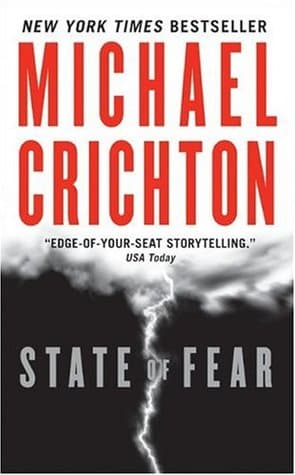
- State of Fear
Michael Crichton
3.7 (81k) average on GoodreadsPoliticsWhile both "Brazzaville Beach" and Crichton's "State of Fear" incorporate scientific themes and thriller elements, their approaches diverge significantly. Crichton's novel is a high-octane eco-thriller, prioritizing rapid-fire plot, action sequences, and a clear, often didactic, scientific argument (or counter-argument). "Brazzaville Beach," by contrast, uses science more as a lens for philosophical inquiry and character development. Boyd's thriller elements are more subdued, serving the deeper literary ambitions rather than dominating them. The prose styles are also distinct: Crichton's is direct and functional, while Boyd's is more literary, nuanced, and reflective, focusing on the internal lives of his characters as much as the external threats.
- Ape and Essence
Aldous Huxley
3.8 (5k) average on GoodreadsScience FictionBoth "Brazzaville Beach" and Huxley's dystopian novel "Ape and Essence" explore the darker aspects of human nature and our relationship with other primates, but from vastly different perspectives. Huxley's work is a satirical and stark post-apocalyptic vision, using the 'ape' motif to critique human folly and barbarism, with a more allegorical and overtly philosophical tone. Boyd's novel, while also examining human flaws, does so through a more grounded, realistic narrative, focusing on individual psychological journeys and scientific discovery. While Huxley presents a future where humanity has devolved into a more primitive state, Boyd explores the present-day complexities of human-animal interaction and the scientific quest to understand the boundaries of intelligence, offering a more hopeful, albeit still challenging, view of discovery and understanding.
- The Old Man and the Sea
Ernest Hemingway
3.8 (831k) average on GoodreadsLiterary FictionA Cuban fisherman's long struggle with a giant marlin becomes a story of endurance and dignity, now retold for young adults with illustrations, phonetic guides, and writing prompts in Traditional Chinese.
- One Hundred Years of Solitude
Gabriel García Márquez
4.1 (753k) average on GoodreadsLiterary FictionThrough the multi-generational story of the Buendía family, a mythical town deals with the repeating patterns of time, love, and solitude, as the extraordinary mixes with the ordinary.
- The Goldfinch
Donna Tartt
3.9 (720k) average on GoodreadsLiterary FictionHaunted by a tragic explosion and clutching a stolen Dutch masterpiece, a young orphan navigates the opulent drawing rooms of New York and the gritty underbelly of the art world, desperately seeking connection and redemption amidst a life spiraling into crime and obsession.
- Little Fires Everywhere
Celeste Ng
4.1 (713k) average on GoodreadsLiterary FictionIn Shaker Heights, an artist and her daughter move in, and their free-spirited lives clash with a rule-bound matriarch, revealing hidden conflicts beneath a perfect surface.





Enjoyed the summary?
A summary gives you the shape of the book. The book itself has the detail, the examples and the voice.
Find Brazzaville Beach on AmazonAs an Amazon Associate, BookBrief earns from qualifying purchases. How we're funded