
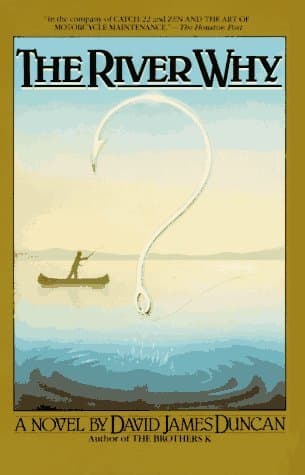
Synopsis
Covers the whole plot, including the ending.
- Difficulty
- Medium
- Pacing
- Moderate
- Mood
- Philosophical, Reflective, Nature-focused, Thought-provoking
- Read it if
- You appreciate lyrical prose, philosophical exploration of nature and purpose, and a protagonist's journey of self-discovery.
- Skip it if
- You prefer fast-paced plots, clear-cut resolutions, or are not interested in detailed descriptions of fishing and nature.
The River Why Plot Summary
Covers the whole plot, including the ending.
A Family of Anglers
Gus Orviston, the narrator, introduces his unconventional and fishing-focused family. His father, H.L. Orviston, is a legendary fly fisherman, while his mother, Ma, is an equally formidable steelheader. Their lives revolve entirely around fish, creating a chaotic and competitive household. Gus, despite growing up in this world, feels a growing disillusionment with their single-minded obsession and constant arguments. He recounts his early experiences with fishing, developing a deep connection to the sport that goes beyond competition, suggesting a deeper, more spiritual yearning his family's approach cannot satisfy.
The Retreat to the River
At eighteen, Gus decides to leave his family's chaotic home and their rigid, competitive fishing philosophies. He buys a small, dilapidated cabin on a remote river, intending to devote his entire existence to fly fishing, free from societal distractions and family pressures. He carefully organizes his new life around the river's rhythms, dedicating himself to understanding every detail of the fish and their habitat. His goal is to achieve pure fishing bliss, believing that through this singular pursuit, he can find contentment and escape the spiritual emptiness he felt back home.
The Angler's Routine and Growing Discontent
Gus establishes a precise and demanding daily routine, rising before dawn to fish, studying entomology, and meticulously tying flies. He achieves remarkable skill and success, catching many fish. However, despite his mastery and initial satisfaction, a deep emptiness begins to creep into his solitude. He observes the river's ecological degradation — pollution, declining fish populations — and feels a growing unease. His self-imposed isolation, meant to bring peace, instead amplifies his internal struggles, leading him to question his purpose and the true meaning of his passion for fishing beyond the act of catching.
The Arrival of Eddy and the Search for Meaning
His solitude is interrupted by Eddy, a logger and self-proclaimed 'wise fool,' who camps near Gus's cabin. Eddy is a jovial, philosophical man who challenges Gus's rigid worldview and self-imposed isolation. He shares stories, observations about nature, and unconventional wisdom, often humorously. Eddy encourages Gus to look beyond the surface, to consider life's interconnectedness, and to question his own assumptions about happiness and purpose. Their interactions, though initially disruptive, begin to chip away at Gus's defenses and plant seeds of doubt about his solitary quest.
The Vision of the Golden Girl
While fishing, Gus experiences a profound, almost mystical vision of a beautiful, golden-haired woman. This encounter deeply affects him, intensifying his longing for connection and meaning beyond his solitary pursuits. The vision acts as a catalyst, pushing him further into an existential crisis. He realizes that his fishing, no matter how skillful, is not enough to fill his void. This spiritual awakening forces him to confront his current life's limitations and ignites a reluctant but undeniable desire to seek out the source of this profound beauty and connection, hinting at a love he has yet to experience.
The Quest for the Golden Girl
Driven by the powerful vision and his growing spiritual unease, Gus decides to leave his secluded cabin and embark on a quest to find the 'Golden Girl.' This is a significant turning point, as he abandons his carefully constructed solitary existence. His journey takes him away from the familiar comfort of the river and into the broader world, forcing him to engage with people and situations he had previously avoided. This outward journey mirrors an internal one, as he begins to shed his self-imposed limitations and open himself to new experiences and possibilities, however daunting they may seem.
Meeting Eddy's Family and the World Beyond
Gus's search eventually leads him back to Eddy, who is a more complex figure than initially perceived. Eddy introduces Gus to his family, including his wife and children, and their vibrant, if unconventional, community. This exposure to a different kind of family and social structure broadens Gus's perspective, showing him the warmth and complexities of human relationships outside of his own dysfunctional upbringing. He witnesses the give-and-take of community life, the joys and challenges of raising a family, and the simple beauty of shared existence, all of which contrast sharply with his solitary and emotionally distant past.
The Revelation of Mandy
Through Eddy, Gus finally encounters Mandy, the woman from his vision. Mandy is strong-willed, intelligent, and deeply connected to nature, working as a logger and living a self-sufficient life. Their initial interactions are marked by awkwardness and undeniable attraction. Gus is captivated by her spirit and her deep understanding of the natural world, which resonates deeply with his own. He discovers that she is not merely an ethereal vision but a real, grounded woman whose presence challenges his previous understanding of love, relationships, and his own place in the world. Their meeting is the beginning of a transformative relationship.
Love, Connection, and Environmental Activism
Gus and Mandy fall deeply in love, and their relationship is a cornerstone of his new understanding of life. Mandy introduces Gus to a more active and communal form of environmentalism, showing him how to channel his love for nature into tangible action. They become involved in local efforts to protect the river and its surrounding ecosystem from pollution and overdevelopment. This shared purpose strengthens their bond and gives Gus a new sense of meaning and belonging. He realizes that true fulfillment is not in isolation but in connection — with nature, with loved ones, and with a cause greater than himself.
Reconciliation and Family
Inspired by Mandy and his new maturity, Gus tentatively reconciles with his estranged family. While their eccentricities remain, he approaches them with a new understanding and compassion. He begins to bridge the emotional distance that had separated them, realizing that love and family, in all their imperfections, are vital components of a full life. He learns to appreciate his parents' passion, even if he doesn't fully embrace their competitive approach to fishing. His definition of 'home' expands beyond a solitary cabin to include the people he loves and the community he has found, integrating his passion for fishing with his human connections.
The Meaning of Fishing
Gus's understanding of fishing changes greatly. It is no longer a solitary escape or a competitive sport but a spiritual practice, a way to connect with the natural world and a metaphor for life itself. He learns to fish not just for the catch, but for the experience, the beauty, and the interconnectedness it represents. His passion for fishing becomes integrated with his love for Mandy, his commitment to environmentalism, and his new appreciation for community. He discovers that the 'why' of the river is not a single answer but a complex set of relationships, meaning, and purpose.
The River Why - A New Beginning
By the end of the novel, Gus Orviston has evolved from a disillusioned, solitary angler into a man who embraces life fully. He has found love with Mandy, made meaningful connections, and discovered a deep sense of purpose in environmental activism. His fishing, once a source of isolation, now grounds him in the natural world and connects him to others. He understands that true fulfillment comes from a balance of passion, relationship, and responsibility. Gus's journey ends in a holistic worldview where his love for the river, his love for Mandy, and his love for life itself are intertwined, offering a hopeful vision for the future.
Principal Figures
Gus Orviston
Protagonist
A young, idealistic fly fisherman on a quest for meaning.
Gus is an intelligent, sensitive, and deeply introspective young man. Initially, he is driven by an intense, almost obsessive passion for fly fishing, which he sees as a path to escape the chaos of his family and find personal fulfillment. He is observant, philosophical, and prone to introspection, often questioning the deeper meaning of his pursuits. His early self-imposed isolation reflects a yearning for purity and authenticity, but also a naivety about the complexities of life and human connection. He is an earnest seeker, open to new ideas, even when they challenge his preconceived notions.
Relationships: H.L. Orviston (Son, initially estranged due to differing fishing philosophies, later reconciles); Ma Orviston (Son, initially estranged due to differing fishing philosophies, later reconciles); Eddy (Friend and philosophical mentor); Mandy (Love interest and life partner)
H.L. Orviston
Supporting
Gus's legendary, competitive fly fisherman father.
H.L. Orviston is a renowned and highly competitive fly fisherman, almost a mythical figure in the angling world. He embodies a rigid, scientific, and almost militaristic approach to fishing, focused on technique, strategy, and the size of the catch. He is fiercely proud and opinionated, often clashing with Ma and Gus over their differing fishing philosophies. Despite his gruff exterior and competitive nature, he possesses an undeniable passion for the sport, though it often manifests in a way that alienates those closest to him. He represents one extreme of fishing obsession.
Relationships: Gus Orviston (Father, initially estranged due to differing fishing philosophies); Ma Orviston (Husband, competitive and often bickering fishing rivals)
Ma Orviston
Supporting
Gus's equally legendary and competitive steelheader mother.
Ma Orviston is Gus's mother and a formidable steelheader, equally as legendary and competitive as H.L. She approaches fishing with an intuitive, almost spiritual intensity, often relying on instinct and a deep connection to the river. Her methods are unconventional, and she often clashes with H.L. over their differing styles. She is strong-willed, independent, and fiercely passionate. While her relationship with Gus is often strained by the family's fishing obsession, she holds a deep, if sometimes unspoken, love for him. She represents a different, more intuitive extreme of fishing obsession.
Relationships: Gus Orviston (Mother, initially estranged due to differing fishing philosophies); H.L. Orviston (Wife, competitive and often bickering fishing rivals)
Eddy
Supporting
A wise and philosophical logger who becomes Gus's mentor.
Eddy is a jovial, philosophical, and seemingly simple logger who becomes a crucial mentor for Gus. He possesses a deep, intuitive understanding of nature and human nature, often expressing his wisdom through riddles, stories, and humorous observations. He challenges Gus's rigid worldview and self-imposed isolation, encouraging him to embrace life's complexities and human connection. Eddy is a free spirit, unburdened by societal conventions, and represents a grounded, holistic approach to living that stands in stark contrast to Gus's initial asceticism. He is a catalyst for Gus's personal growth.
Relationships: Gus Orviston (Mentor and friend); Mandy (Friend and colleague (implied through their shared community))
Mandy
Supporting
Gus's love interest, a strong, independent woman deeply connected to nature.
Mandy is the 'Golden Girl' of Gus's vision, a strong, independent, and intelligent woman who works as a logger. She embodies a deep, practical connection to nature, living a life of self-sufficiency and environmental awareness. Mandy is direct, honest, and possesses a quiet strength that both challenges and attracts Gus. She is not just a romantic ideal but a grounded individual who actively works to protect the environment. Her presence introduces Gus to the joys of human connection, shared purpose, and a more active form of environmental stewardship, profoundly shaping his worldview.
Relationships: Gus Orviston (Love interest and life partner); Eddy (Friend and colleague (implied through their shared community))
The River
Mentioned/Setting
The central setting and a character in its own right, symbolizing life and spirituality.
The River is more than just a setting; it acts as a silent character throughout the novel. It is the primary object of Gus's obsession, his sanctuary, and the mirror reflecting his inner turmoil and eventual enlightenment. The river embodies both beauty and degradation, purity and pollution, mirroring the human condition. It represents the flow of life, the interconnectedness of nature, and the spiritual depths that Gus seeks to plumb. Its health and vitality are inextricably linked to Gus's emotional and spiritual well-being, making it a powerful symbol.
Relationships: Gus Orviston (Primary object of obsession, spiritual guide, and environmental concern); H.L. Orviston (Source of competition and mastery); Ma Orviston (Source of intuitive connection and mastery)
Themes & Insights
The Search for Meaning and Spiritual Fulfillment
Gus's entire journey is a quest for meaning beyond the superficial. Initially, he believes singular devotion to fishing will bring enlightenment, but he discovers spiritual barrenness in isolation. His vision of Mandy and his interactions with Eddy and the larger community force him to confront the limitations of his asceticism. He learns that true fulfillment comes from connection—to nature, to others, and to a purpose greater than himself, transforming his understanding of fishing from an escape to a spiritual practice. This is clear when he realizes catching fish alone doesn't fill his void, leading him to seek the 'Golden Girl'.
“I had fished my way into a state of grace, but it wasn't enough. It was a grace without meaning, a gift I couldn't share.”
Man's Relationship with Nature and Environmentalism
The novel explores humanity's connection to nature, particularly through fishing. Gus's initial respect for the river evolves into an active concern for its degradation due to pollution and human exploitation. The contrast between his family's competitive approach to nature and Mandy's active stewardship highlights different ways humans interact with their environment. The novel advocates for a holistic, respectful relationship with nature, seeing it not just as a resource or a playground, but as an interconnected living system that requires protection and understanding. This is powerfully shown when Gus and Mandy join local environmental efforts.
“The river was not just a river; it was a living, breathing being, and it was dying.”
Love, Connection, and Community
Isolation, initially sought by Gus as a path to purity, ultimately proves to be a source of spiritual emptiness. His journey emphasizes the vital role of human connection in achieving a full life. The love he finds with Mandy, the mentorship from Eddy, and his eventual reconciliation with his family all show that meaning is often found in shared experiences and relationships. The novel suggests that true happiness is not a solitary pursuit but is woven into the fabric of community and intimate bonds, challenging Gus's initial belief that he could find peace entirely alone. His realization that 'grace without meaning' is insufficient captures this.
“Love, I was beginning to realize, was not about catching, but about letting go; not about possessing, but about sharing.”
The Nature of Obsession and Passion
The Orviston family is defined by their intense obsession with fishing, which appears as both competitive rivalry and deep personal devotion. Gus initially mirrors this obsession but seeks a purer, less competitive form. The novel explores how passion, when taken to an extreme or pursued in isolation, can become destructive or unfulfilling. It contrasts the Orviston's single-minded focus with Mandy's more balanced and integrated passion, suggesting that true passion should enhance life, not narrow it. Gus's arc shows a journey from an isolating obsession to a more integrated and healthy passion.
“My family had taught me that fishing was everything. But I was learning that everything was more than just fishing.”
Plot Devices & Literary Techniques
The Vision of the Golden Girl
A mystical encounter that acts as a catalyst for Gus's spiritual quest.
This powerful, almost dreamlike vision of a beautiful, golden-haired woman serves as a pivotal turning point in Gus's journey. It shatters his self-imposed isolation and challenges his belief that fishing alone can bring fulfillment. The vision represents an intuitive, spiritual awakening, hinting at a love and connection he has yet to experience. It acts as a divine call to action, compelling Gus to leave his secluded cabin and embark on an outward search that ultimately leads to profound internal transformation and the discovery of Mandy.
The River as a Metaphor
The central setting that symbolizes life's flow, spiritual depth, and ecological health.
The river is much more than just a place where Gus fishes; it functions as a multifaceted metaphor throughout the novel. It symbolizes the flow of life, constantly changing and evolving, mirroring Gus's own journey of self-discovery. Its depths represent spiritual truths and the unconscious mind. Furthermore, the river's ecological health directly reflects the health of humanity's relationship with nature, and by extension, Gus's own spiritual well-being. Its degradation serves as a stark warning, while its beauty offers constant inspiration and connection.
The Orviston Family's Fishing Philosophies
Contrasting approaches to fishing that highlight different worldviews.
The distinct and often clashing fishing philosophies of H.L. and Ma Orviston, along with Gus's evolving approach, serve as a central plot device. H.L.'s scientific, competitive method and Ma's intuitive, spiritual steelheading represent two extremes of human interaction with nature. These contrasting views create familial conflict and force Gus to define his own relationship with fishing and the natural world. They symbolize different ways of approaching life itself – through logic and mastery versus intuition and connection – and are crucial in shaping Gus's initial disillusionment and subsequent search for a more balanced path.
Eddy's Role as a Wise Fool
A character who provides philosophical guidance and challenges Gus's assumptions.
Eddy embodies the archetype of the 'wise fool' or mentor. His unconventional wisdom, often delivered through parables and humor, gently prods Gus to question his rigid worldview and embrace life's complexities. Eddy's grounded presence and philosophical insights serve to break down Gus's intellectual and emotional barriers, opening him up to new possibilities, particularly regarding human connection and the interconnectedness of all things. He acts as a catalyst for Gus's personal growth, guiding him away from isolation and towards a more holistic understanding of existence.
The River Why Quotes
“There are two things that I want to be: I want to be a good fisherman, and I want to be a good man.”
“Most men lead lives of quiet desperation and go to the grave with the song still in them.”
“The greatest gift you can give another is the purity of your attention.”
“The river is a living thing, Gus, and you are part of its life, and it is part of yours.”
“Every fish is a miracle.”
“The best way to find yourself is to lose yourself in the service of others.”
“There's a difference between catching fish and understanding fishing.”
“You can't catch a fish you don't believe in.”
“To be a good fisherman you must understand the fish, and to understand the fish you must understand the river, and to understand the river you must understand the earth itself.”
“The river is not just water; it is a way of life, a philosophy.”
“Solitude is not loneliness, but a necessary condition for self-discovery.”
“The world is full of beauty, Gus, if you only take the time to see it.”
“Love is the only net that can truly catch the human heart.”
“Every cast is a prayer.”
Quiz
10 questions on the plot and the characters. Each answer comes with a short explanation.
Question 1
What is the primary reason Gus Orviston initially leaves his family to live in a secluded cabin?
- To escape a forced marriage arrangement.
- To pursue his fly-fishing passion with unrelenting zeal.
- To write a book about his family's fishing obsession.
- To conduct scientific research on river ecosystems.
Show answer
B. To pursue his fly-fishing passion with unrelenting zeal. Gus leaves his family to dedicate himself entirely to his passion for fly-fishing in solitude, hoping to find fishing bliss.
Question 2
What is the name of Gus's younger brother, who is also a keen fisherman?
- Hoot Owl
- Bill Bob
- Paxton
- Eddy
Show answer
C. Paxton Gus's younger brother, Paxton, is also deeply immersed in the family's fishing culture, though his approach differs from Gus's.
Question 3
What unexpected realization troubles Gus despite his initial pursuit of fishing bliss in solitude?
- He discovers he dislikes fishing as much as his family.
- He finds himself constantly harassed by local authorities.
- He becomes troubled by the degradation of the natural world and his own spiritual barrenness.
- He realizes he misses his family's eccentricities too much.
Show answer
C. He becomes troubled by the degradation of the natural world and his own spiritual barrenness. Instead of pure bliss, Gus encounters a growing unease about environmental degradation and a sense of emptiness in his own life, prompting a deeper quest.
Question 4
What is the central philosophical conflict Gus grapples with regarding his fishing and the natural world?
- Whether to use artificial flies or live bait.
- The balance between his intense passion for fishing and the ethical implications of catching and releasing vs. keeping fish.
- The superiority of river fishing over ocean fishing.
- The ideal time of day to fish for maximum catch.
Show answer
B. The balance between his intense passion for fishing and the ethical implications of catching and releasing vs. keeping fish. Gus's journey involves a profound internal struggle with the ethics of fishing, questioning his role and impact on the natural world, moving beyond just the act of catching.
Question 5
What is the name of Gus's love interest, who challenges his solitary existence and worldview?
- Maria
- Eddy
- Sarah
- Willow
Show answer
B. Eddy Eddy is the free-spirited woman Gus encounters who significantly impacts his perspective and pushes him towards self-discovery and connection.
Question 6
What unique characteristic defines Gus's parents' relationship and their approach to fishing?
- They are rival fishing guides who rarely speak.
- They are both obsessed with fishing, but his mother uses bait and his father uses flies.
- They only fish together during specific lunar cycles.
- They believe fishing is a waste of time and prefer other hobbies.
Show answer
B. They are both obsessed with fishing, but his mother uses bait and his father uses flies. Gus's parents represent a fundamental divide in fishing philosophy: his mother, Ma, uses bait (worms), while his father, Hoot Owl, exclusively uses flies, leading to a humorous and profound 'war' in their household.
Question 7
What does Gus ultimately discover through his quest for self-discovery and meaning?
- He is meant to be a professional fishing instructor.
- The meaninglessness of all human endeavor.
- A deeper understanding of himself, his connection to others, and the sacredness of the natural world.
- That he should return to his family's fishing traditions unchanged.
Show answer
C. A deeper understanding of himself, his connection to others, and the sacredness of the natural world. The synopsis states his quest is 'ultimately fruitful beyond his wildest dreams,' leading to a profound understanding of self, relationships, and the environment.
Question 8
What significant event or discovery causes Gus to question the purity of his fishing obsession and the health of the river?
- He witnesses illegal logging operations upstream.
- He finds a large number of dead fish, indicating pollution.
- He is confronted by environmental activists.
- His fishing gear is stolen by poachers.
Show answer
B. He finds a large number of dead fish, indicating pollution. The sight of dead fish deeply impacts Gus, forcing him to confront the reality of environmental degradation and its effect on his beloved river, shifting his focus beyond just catching fish.
Question 9
How does Gus's perspective on 'catching' fish evolve throughout the novel, especially after his spiritual awakening?
- He becomes solely focused on catching the largest possible fish.
- He completely abandons fishing for other spiritual practices.
- He moves from a desire to 'catch' to a more contemplative appreciation of 'being with' the fish and the river.
- He starts to view fishing as a competitive sport.
Show answer
C. He moves from a desire to 'catch' to a more contemplative appreciation of 'being with' the fish and the river. Gus's journey is one of profound philosophical growth, moving from an almost obsessive pursuit of catching fish to a more holistic and reverent relationship with the river and its inhabitants, emphasizing presence over possession.
Question 10
What specific literary device is prominently used to convey Gus's inner thoughts and philosophical musings?
- Third-person omniscient narration.
- Extensive dialogue between multiple characters.
- First-person narration with a strong, distinct voice.
- Letters and journal entries from various characters.
Show answer
C. First-person narration with a strong, distinct voice. The book is told by Gus Orviston himself, making it a first-person narrative, which allows his 'irreverent young fly fisherman' voice to directly convey his thoughts and philosophical journey.
The River Why FAQ
What prompts Gus Orviston to leave his family and seek solitude?
Gus leaves his family, particularly his fishing-obsessed parents, Ma and H.L. Orviston, because he feels suffocated by their competitive and often superficial approach to fishing. He desires a purer, more solitary connection to the sport and nature, seeking to understand fishing on his own terms rather than through their inherited biases and constant rivalry.
Describe Gus's initial vision for his life in the secluded cabin.
Gus envisions a life of pure fishing devotion, meticulously planning his days around angling, studying entomology, and perfecting his technique. He believes that by dedicating himself solely to the river and its fish, he will achieve an unparalleled level of skill and an almost monastic connection to the natural world, free from societal distractions.
Who is Eddy and what role does she play in Gus's journey?
Eddy is a free-spirited and insightful young woman whom Gus encounters during his solitary period. She challenges his rigid worldview and introduces him to a more holistic understanding of love, spirituality, and environmental interconnectedness. Her presence is a catalyst for Gus's emotional and philosophical awakening, moving him beyond his singular focus on fishing.
How does Gus's relationship with his brother, Bill, differ from his relationship with his parents?
Gus and Bill share a more nuanced and less overtly competitive bond than Gus has with his parents. While Bill is also a skilled fisherman, he seems to possess a greater empathy and understanding for Gus's internal struggles, often acting as a bridge between Gus's solitude and the outside world, offering a different perspective than their parents' constant rivalry.
What environmental themes are explored through Gus's experiences?
The novel highlights the degradation of natural rivers and fish populations due to human activity, such as pollution and overfishing. Gus's growing disillusionment stems from witnessing the decline of the very environment he cherishes, prompting him to question human responsibility and the spiritual cost of environmental neglect.
What is the significance of the 'River Why' in the title?
The 'River Why' symbolizes Gus's ultimate quest for meaning and purpose beyond mere fishing. It represents the profound existential questions he grapples with – the 'why' of life, love, suffering, and the human connection to the natural world. It's a metaphor for the deeper spiritual current underlying all existence.
How does the author use the Orviston family's fishing obsession as a critique of modern society?
The Orviston family's competitive, gear-focused, and often trophy-driven approach to fishing serves as a satire of consumerism and the human tendency to commodify even spiritual pursuits. Their focus on 'how' to catch fish, rather than 'why' or 'what for,' mirrors a societal detachment from deeper meaning and genuine connection.
Are there specific literary or philosophical allusions in the text that deepen its meaning?
The novel subtly references transcendentalist ideas, particularly Emerson and Thoreau, through Gus's pursuit of nature and self-reliance. It also draws on Eastern philosophies and Christian mysticism in its exploration of spiritual awakening, non-attachment, and the interconnectedness of all life, moving beyond a purely Western materialistic worldview.
What is the significance of Gus's 'fishing journal' and its evolution?
Gus's fishing journal initially serves as a meticulous record of his catches and techniques, reflecting his precise and analytical mind. As his spiritual journey progresses, the journal transforms into a more philosophical and introspective diary, documenting his emotional struggles, spiritual insights, and evolving understanding of life, rather than just fish.
How does Gus's initial pursuit of 'pure' fishing reflect a form of escapism?
Gus's intense focus on fishing, to the exclusion of human relationships and societal engagement, initially functions as a sophisticated form of escapism. He uses the discipline and solitude of angling to avoid confronting his emotional barrenness and the complexities of human connection, particularly the unresolved issues with his family.
Analyze Gus's transformation from an isolated individual to someone capable of deep connection.
Gus's transformation is driven by his increasing dissatisfaction with mere solitude and the realization that his 'perfect' fishing life is spiritually unfulfilling. His encounters with Eddy, his brother Bill, and even his parents force him to confront his emotional walls, leading him to embrace love, community, and a more expansive understanding of his place in the world.
What psychological impact does the degradation of the environment have on Gus?
The environmental degradation Gus witnesses deeply affects his psyche, causing profound disillusionment and a sense of spiritual crisis. It shatters his idealized vision of nature, forcing him to confront human culpability and the interconnectedness of external destruction with internal barrenness, leading to a period of intense despair before his eventual awakening.
How does Gus's relationship with his mother, Ma, evolve and what does it reveal about his own identity?
Initially, Gus views Ma with a mix of awe and frustration due to her unparalleled fishing skill and eccentricities. As he matures, he begins to understand her deeper spiritual connection to nature, realizing that her intensity, while sometimes overwhelming, stems from a profound love. This understanding allows him to reconcile parts of his own identity that he previously rejected.
Is 'The River Why' primarily a fishing novel, a philosophical treatise, or a coming-of-age story?
While fishing is the central metaphor and setting, 'The River Why' transcends being solely a fishing novel. It is primarily a philosophical coming-of-age story, using Gus's journey through angling to explore profound questions of meaning, spirituality, environmental ethics, and human connection, making the 'how-to' of fishing secondary to the 'why' of existence.
How does the novel balance humor with its serious philosophical themes?
The novel masterfully balances its serious philosophical themes with a unique, often irreverent humor, primarily through Gus's witty narration and the eccentricities of his family. This humor prevents the philosophical discussions from becoming overly didactic, making the profound insights more accessible and the characters more endearing, creating a rich, engaging narrative.
What is the ultimate message of the book regarding the human relationship with nature?
The book argues for a holistic and respectful relationship with nature, one that moves beyond exploitation or mere recreation to a spiritual communion. It suggests that true fulfillment comes from understanding our interconnectedness with the natural world, recognizing its intrinsic value, and protecting it not just for ourselves, but for its own sake.
Does the ending offer a definitive resolution for Gus, or a new beginning?
The ending offers less of a definitive resolution and more of a profound new beginning for Gus. He has found love, spiritual clarity, and a deeper purpose, but his journey of understanding and engagement with the world is clearly ongoing. It signifies a shift from seeking answers in isolation to finding meaning in connection and active participation.
How does the novel critique the concept of 'mastery' in relation to fishing and life?
The novel critiques the idea of 'mastery' as purely technical skill or dominance over nature. Gus initially seeks to master fishing, but his journey teaches him that true mastery lies in humility, surrender, and a deep understanding of interdependence. It's about being in harmony with the river, not just conquering it, extending this lesson to life itself.
Similar books
- A River Runs Through It
Norman Maclean
4.2 (8k) average on GoodreadsHistorical FictionExplores the deep connection between fishing, family, and nature with a philosophical undertone.
- Walden
Henry David Thoreau
3.8 (158k) average on GoodreadsBiographyFocuses on a retreat to nature for self-sufficiency and philosophical contemplation.
- Zen and the Art of Motorcycle Maintenance: An Inquiry Into Values
Robert M. Pirsig
3.8 (200k) average on GoodreadsPsychologyCombines a physical journey with deep philosophical inquiry and a quest for meaning.
- The Old Man and the Sea
Ernest Hemingway
3.8 (831k) average on GoodreadsLiterary FictionA Cuban fisherman's long struggle with a giant marlin becomes a story of endurance and dignity, now retold for young adults with illustrations, phonetic guides, and writing prompts in Traditional Chinese.
- One Hundred Years of Solitude
Gabriel García Márquez
4.1 (753k) average on GoodreadsLiterary FictionThrough the multi-generational story of the Buendía family, a mythical town deals with the repeating patterns of time, love, and solitude, as the extraordinary mixes with the ordinary.
- The Goldfinch
Donna Tartt
3.9 (720k) average on GoodreadsLiterary FictionHaunted by a tragic explosion and clutching a stolen Dutch masterpiece, a young orphan navigates the opulent drawing rooms of New York and the gritty underbelly of the art world, desperately seeking connection and redemption amidst a life spiraling into crime and obsession.




Enjoyed the summary?
A summary gives you the shape of the book. The book itself has the detail, the examples and the voice.
Find The River Why on AmazonAs an Amazon Associate, BookBrief earns from qualifying purchases. How we're funded