BookBrief
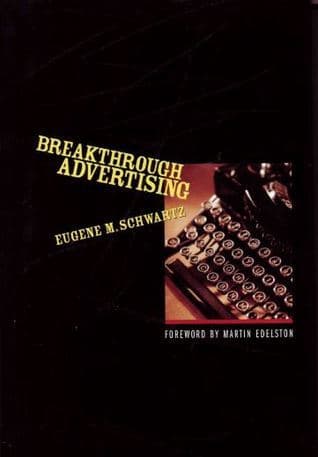
Breakthrough Advertising cover

Breakthrough Advertising Summary

Eugene Schwartz (2017)

Get the book

Goodreads Rating

4.54/ 5(1,147 reviews)

Genre

General

Summary Read

13 min

Book Length

10-15 hours (for thorough study)

By BookBrief EditorialLast updated August 20, 2026

Track Your Reading

Sign in to track this book

My Notes

Only visible to you
This core work reveals the psychological drivers of consumer desire, teaching advertisers how to tap into existing needs and create powerful messages.

Core Idea

Breakthrough Advertising posits that the primary role of advertising is not to create desire, but to channel existing mass desires into a specific product. Schwartz argues that effective advertising taps into the public's current state of awareness and desire for a product category, then presents the advertised product as the ultimate fulfillment of that desire. The book meticulously breaks down how to identify these mass desires, understand the five stages of market sophistication, and craft compelling copy that resonates with the prospect's current mental state, using mechanisms, headlines, and offers to capture and direct their attention and purchasing power.
Reading time
10-15 hours (for thorough study)
Difficulty
Hard
✓ Read this if...
You're a copywriter, marketer, business owner, or anyone looking to deeply understand the psychological underpinnings of effective advertising and how to craft persuasive messages that convert. It's essential for those who want to move beyond surface-level tactics and grasp the timeless principles of market research and consumer psychology.
✗ Skip this if...
You're only interested in modern digital advertising tactics without understanding foundational principles, or you're looking for a quick, superficial read on marketing. The book is dense and requires careful study, not a casual skim.

Chat with this book

Ask anything about Breakthrough Advertising and get instant answers grounded in the summary.

Key Takeaways from Breakthrough Advertising

1

The Five Stages of Market Sophistication

Advertising's effectiveness is inversely proportional to market maturity.

Quote

The more sophisticated your market, the more sophisticated your advertising must be.

Schwartz introduces a basic model: the five stages of market sophistication. In a Stage 1 market, where a new product or idea appears (like the first car), simple claims such as 'It's a car!' work. As competitors enter (Stage 2), advertisers must show differences, often by making the original claim stronger ('Our car is faster!'). Stage 3 requires a new method ('Our car has a V8 engine!'). Stage 4 focuses on expanding the method's benefits or a 'new' experience ('Feel the thrill of our V8!'). Finally, Stage 5, the most crowded, needs ...

Supporting evidence

Schwartz illustrates this with examples from early 20th-century advertising, such as the evolution of claims for hair tonics or diet pills as more competitors entered the market.

Apply this

Before writing a single headline, analyze your market's sophistication. Are you speaking to a virgin market, or one saturated with similar claims? Your approach to headlines, body copy, and offer must align with this stage to resonate.


market-sophisticationadvertising-evolutioncompetitive-analysis
2

Power of the 'Big Idea'

A singular, compelling concept that drives all advertising efforts.

Quote

The greatest copywriters in history have always understood that the copy they write is merely the articulation of a single, central, powerful idea.

Schwartz says that good advertising does not just list features; it embodies a 'Big Idea.' This is not just a slogan, but a main concept that grabs the audience and makes the product essential. For instance, instead of just selling soap, the Big Idea might be 'cleanliness as a way to social acceptance.' This idea should be simple, strong, and unique enough to stand out. It guides the headline, the body copy, and even the visual parts. Without a strong Big Idea, advertising is a collection of separate claims, failing to make a lasting ...

Supporting evidence

Schwartz frequently references campaigns from the 'Mad Men' era, showing how successful ads were built around a single, unifying concept rather than just product attributes.

Apply this

Before writing, distill your product or service down to its single most compelling, unique, and emotionally resonant idea. This 'Big Idea' should be able to be articulated in a single sentence and should guide every element of your campaign.

big-ideacreative-conceptunique-selling-proposition
3

Headline as the Ad's Siren Song

The headline's sole purpose is to stop the reader and pull them into the body copy.

Quote

The headline is the ticket on the meat. If you don't use a headline, you're losing 80% of your money.

Schwartz focuses on headlines, saying they are the most important part. A headline is not meant to sell, but to get attention and lead the reader into the next sentence. He groups headlines by their approach: direct benefit (e.g., 'Lose Weight Fast'), indirect (provocative, curiosity-driven), news-oriented, or command. The main point is to speak to the prospect's deepest desires or problems directly. A strong headline acts as a filter, attracting the right audience while turning away those for whom the product is not relevant. This fo...

Supporting evidence

Schwartz analyzes countless headlines from successful direct-response campaigns, dissecting their psychological triggers and structural effectiveness.

Apply this

Spend 80% of your headline writing time on crafting a compelling headline. Focus on addressing your target audience's core desire or problem directly, using strong verbs and intriguing language. Test multiple headlines vigorously.

headline-writingdirect-responseattention-economy
4

Mechanism: The 'How' Behind the Benefit

People crave the 'why' and 'how' a product delivers its promise.

Quote

The greatest single advertising discovery is the discovery of the 'mechanism' — the unique selling proposition that makes your product work.

Beyond simply stating a benefit, Schwartz argues for the importance of a 'mechanism.' This is the unique process, ingredient, or system that explains how the product delivers its promised benefit. For example, instead of just 'lose weight,' the mechanism might be 'our patented enzyme blend that burns fat.' The mechanism provides credibility, novelty, and a unique differentiator, especially in sophisticated markets. It gives the reader a solid reason to believe your claim over competitors'. Without a mechanism, claims can seem empty or...

Supporting evidence

Schwartz cites examples of pharmaceutical advertising and health supplements that thrived by highlighting their unique chemical compounds or processes.

Apply this

Identify the unique 'secret sauce' or process behind your product's benefit. Don't just tell people what it does; explain *how* it does it in a compelling, easy-to-understand way. This becomes your unique selling proposition.

mechanismunique-selling-propositioncredibility-building
5

Igniting the Core Desire

Advertising doesn't create desire; it channels existing desires towards a specific product.

Quote

Advertising can only take a hunger that already exists and focus it onto a particular product.

Schwartz states that advertisers do not create new desires; they tap into existing, deep-seated human hungers (e.g., for health, wealth, love, security, status). The skill is in finding these hidden desires within the target audience and then presenting the product as the ideal solution to meet them. This means understanding the prospect's psychology before writing any message. Trying to create a desire where none exists is pointless. This is a key observation, moving the focus from product-centered selling to audience-centered unders...

Supporting evidence

Schwartz draws on psychological principles, arguing that fundamental human needs and desires have remained constant throughout history, only their manifestations change.

Apply this

Conduct thorough customer research to uncover the underlying, unfulfilled desires and frustrations of your target audience. Your advertising should then articulate how your product uniquely satisfies these pre-existing hungers.

human-psychologydesire-fulfillmentmarket-research
6

The Art of Specificity and Proof

Vague claims diminish credibility; specific details build trust.

Quote

Specificity sells. Generalities bore and confuse.

Schwartz stresses the importance of specificity. Instead of saying 'this product saves you money,' say 'this product saves you $27.32 per month.' Instead of 'feel better,' say 'reduces joint pain by 60% in 30 days.' Specificity adds credibility and makes claims real. It moves advertising from vague promises to concrete results. Further, he emphasizes the role of proof—testimonials, scientific studies, demonstrations, guarantees—to support these specific claims. In an age of doubt, concrete evidence is essential. This idea is timeless,...

Supporting evidence

Schwartz frequently dissects ads where specific numbers, percentages, and detailed scenarios made the difference in conversion rates.

Apply this

Replace all vague claims with precise, quantifiable details. Provide clear evidence (testimonials, studies, demonstrations, money-back guarantees) to support every significant claim you make about your product or service.

specificitycredibilityproof-elements
7

Body Copy's Rhythmic Flow

The body copy is a hypnotic journey, not a list of facts.

Quote

The copy is a continuous, unbroken chain of thought, leading the prospect inevitably to the desired action.

While headlines stop the reader, body copy must keep them engaged and build desire. Schwartz describes body copy as a 'hypnotic rhythm,' guiding the reader through an emotional and logical journey. It is not about dry facts, but about painting clear pictures, telling stories, and using language that connects with the reader's desires and fears. He suggests short paragraphs, active voice, and varying sentence length to create an engaging flow. The goal is to make the reader feel understood, to highlight their problem, and then present ...

Supporting evidence

Schwartz breaks down successful long-form sales letters, showing how they build momentum, introduce new angles, and maintain reader interest over hundreds or thousands of words.

Apply this

Structure your body copy to flow logically and emotionally. Use storytelling, vivid imagery, and short, impactful sentences. Read your copy aloud to ensure it has a natural, compelling rhythm that draws the reader deeper into your message.

copywriting-flowpersuasive-writingemotional-appeal
8

Offers: The Irresistible Call to Action

The offer is the final push, making action feel like a foregone conclusion.

Quote

The offer is the closest you can get to literally putting money into the prospect's hands.

Schwartz says that even the best copy needs a strong offer to convert. The offer is not just the price; it includes everything the prospect gets, such as bonuses, guarantees, payment terms, and scarcity elements. A strong offer lowers perceived risk and increases perceived value, making it almost impossible for the prospect to say no. He suggests stacking value (multiple bonuses), using strong guarantees, and creating urgency. The offer is where the advertiser shows confidence in their product and removes any final barriers to purchas...

Supporting evidence

Schwartz analyzes various offers, from free trials to multi-bonus packages, demonstrating how each component contributes to perceived value and urgency in different campaigns.

Apply this

Craft an offer that is so compelling and risk-free that it's difficult for your prospect to refuse. Include strong guarantees, valuable bonuses, and clear calls to action, potentially leveraging scarcity or urgency.

offer-creationcall-to-actionrisk-reversalscarcity
9

The Power of Congruence: Ad to Product

The advertisement must perfectly reflect the product's true nature.

Quote

The advertisement is the product, in the mind of the prospect.

Schwartz argues that for lasting success, the advertisement's promise and the product's actual ability to deliver must match perfectly. Over-promising and under-delivering leads to customer unhappiness, returns, and a damaged reputation. The ad creates an expectation, and the product must meet or exceed it. This is not just an ethical point, but a strategic one: a misaligned ad will generate churn, not loyal customers. This idea acts as an important check on unchecked creativity, reminding advertisers that their ultimate goal is long-...

Supporting evidence

While not citing specific studies, Schwartz consistently warns against 'trick' advertising that may generate initial sales but ultimately destroys customer trust and brand longevity.

Apply this

Ensure your advertising claims are truthful, accurate, and fully supported by your product's capabilities. Test your product thoroughly and gather genuine feedback to confirm that your ad's promise aligns perfectly with the customer's experience.

brand-integritycustomer-satisfactionethical-advertising
10

Constant Testing and Adaptation

Advertising is an ongoing experiment, not a static creation.

Quote

Every ad is an experiment. Every ad is an opportunity to learn.

The book, though written before digital analytics, supports a culture of constant testing and adaptation. Schwartz understood that no ad is perfect on its first run. He encourages testing different headlines, offers, and even entire approaches to find what connects most strongly with the market. Advertising is not about finding a single 'magic bullet' but about continuous improvement based on real-world results. This iterative process, constantly improving based on feedback (even if it was just coupon returns in his era), is key to ma...

Supporting evidence

Schwartz describes how direct mail marketers would run split tests with different elements to incrementally improve response rates over time.

Apply this

Never assume your ad is perfect. Implement a rigorous testing strategy for every element of your campaign – headlines, body copy, offers, and visuals. Analyze results and continuously iterate to optimize performance.

a/b-testingconversion-rate-optimizationiterative-design

Breakthrough Advertising Quotes

The most important thing in advertising is to be able to get inside the prospect's mind and see the world as he sees it.

Schwartz emphasizes the importance of understanding the customer's perspective and desires.

The average person is not interested in your product. They are interested in themselves.

A core principle of direct response marketing, highlighting the need to focus on customer benefits.

The secret of all advertising is to make the prospect feel that he is making the discovery himself.

Schwartz discusses how to create a sense of revelation for the potential buyer.

The more specific you can be about the benefits of your product, the more believable it will be.

Advocating for concrete and detailed descriptions of value propositions.

You must understand the market's desires, its needs, and its frustrations before you can possibly hope to create advertising that will move it.

Stressing the foundational research required before crafting any advertising message.

The ultimate goal of advertising is not to sell a product, but to sell a solution to a problem.

Reframing advertising's purpose from mere transaction to problem-solving.

The only way to get people to buy is to make them want to buy.

A concise statement on the power of desire in driving purchasing decisions.

The headline is the most important part of your advertisement. If it doesn't grab the reader, the rest of your ad won't matter.

Highlighting the critical role of the headline in capturing attention.

You must constantly be aware of the changing desires of your market. What was true yesterday may not be true today.

Emphasizing the dynamic nature of consumer desires and the need for continuous adaptation.

The most powerful emotion in advertising is hope.

Schwartz identifies hope as a primary driver for consumer action.

The difference between a good advertisement and a great advertisement is often the difference between a promise and a proof.

Distinguishing between simply stating a benefit and providing evidence for it.

Your advertising should be a mirror reflecting the deepest desires of your prospect.

Advocating for advertising that resonates with the core aspirations of the target audience.

The best way to sell is to make the prospect feel that he is the hero of the story.

Encouraging a narrative approach where the customer is the protagonist.

The market will always tell you what it wants. Your job is to listen.

A reminder to pay close attention to market signals and feedback.

Quiz

Test Your Knowledge

Ready to see how well you understood this book? Take our interactive quiz with 10 questions.

10
Questions
~5
Minutes
?
Best Score

Breakthrough Advertising FAQ

Breakthrough Advertising is a seminal work on direct response copywriting. It delves into the psychology of desire, how to identify and understand market potential, and how to craft compelling messages that drive sales.

About the author

Eugene Schwartz was a legendary copywriting guru whose work is still revered today. "Breakthrough Advertising" is considered by many to be the bible of direct response copywriting, distilling Schwartz's most powerful insights into a comprehensive guide.

Enjoyed the summary?

Support the author — grab the full book.

As an Amazon Associate, BookBrief earns from qualifying purchases, at no extra cost to you. How we're funded.

Get the book