
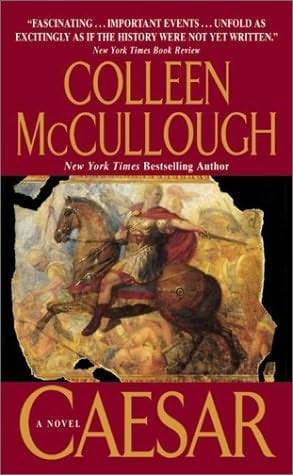
Synopsis
Covers the whole plot, including the ending.
- Difficulty
- Medium
- Pacing
- Moderate
- Mood
- Epic, Political, Grand, Strategic, Dramatic
- Read it if
- You love detailed, character-driven historical epics about ancient Rome, political intrigue, and military strategy.
- Skip it if
- You prefer fast-paced thrillers or are not interested in long, detailed historical accounts with numerous characters and political nuances.
Caesar Plot Summary
Covers the whole plot, including the ending.
The Gallic Campaigns and Roman Unease
In 54 BCE, Gaius Julius Caesar is busy with his Gallic Wars, winning battles against various Celtic tribes, including the Nervii and the Eburones under Ambiorix. His legions, especially the Tenth, are loyal and well-led. These conquests expand Roman territory and bring wealth, but they also cause growing worry and anger in Rome. Senators like Cato the Younger and Marcus Calpurnius Bibulus see Caesar's ambition and popularity as a direct threat to the Republic. Pompey Magnus, once Caesar's ally, begins to distance himself, influenced by the senatorial group that fears Caesar's return to Rome with his army.
Political Maneuvering in Rome
Back in Rome, politics are dangerous. Publius Clodius Pulcher, a street politician and Caesar's former supporter, is killed by Titus Annius Milo, causing riots and a power vacuum. This chaos allows Caesar's enemies in the Senate to push their agenda. Cato and Bibulus, along with the optimates, propose laws to recall Caesar from Gaul, making him a private citizen and open to charges for alleged abuses during his consulship. Caesar's remaining allies, like the tribune Curio, try to block these moves, suggesting compromises that would have both Caesar and Pompey give up their commands, but these efforts fail against the opposition.
The Rise of Vercingetorix
While Roman politics are troubled, a new threat appears in Gaul. Vercingetorix, a chieftain of the Arverni, unites many Gallic tribes into a large confederation, forming a strong resistance against Roman rule. He uses scorched-earth tactics, burning his own towns and food to deny resources to Caesar's legions, and shows great strategic skill. This rebellion tests Caesar, forcing him to use all his military genius and his men's loyalty to prevent losing Gaul. The size of this uprising is new, threatening to undo years of Roman conquest.
The Siege of Alesia
The Gallic Wars culminate at Alesia, a strong hillfort where Vercingetorix and his main army are located. Caesar performs one of military history's most daring feats: building a massive circumvallation (a wall around the city) to blockade Vercingetorix, and at the same time building a contravallation (an outer wall) to defend against a huge Gallic relief army. His legions are significantly outnumbered, facing attacks from both inside and outside their defenses. The battle is brutal and long, testing the Roman soldiers' endurance and discipline. Caesar personally leads charges, inspiring his men through sheer will and strategic brilliance.
Vercingetorix's Surrender and Gaul's Pacification
Despite being outnumbered, Caesar's double-siege at Alesia holds. The Gallic relief army is defeated, and Vercingetorix, seeing no hope and wanting to spare his starving people, decides to surrender. He rides out of Alesia and lays down his arms before Caesar, a moment of defeat for the Gauls and triumph for Rome. With Vercingetorix captured, the remaining Gallic resistance is crushed, and Gaul becomes a Roman province. Caesar's reputation as a military commander is cemented, but his power only increases the fear and anger among his senatorial opponents in Rome.
The Rubicon and Civil War
The Senate, influenced by Cato and Pompey, issues an ultimatum: Caesar must disband his army and return to Rome as a private citizen to face charges. Knowing this means political ruin and likely execution, Caesar faces an impossible choice. In January 49 BCE, after much thought and with his loyal legions' support, he decides to cross the Rubicon River, the legal border separating his province of Cisalpine Gaul from Italy, with his army. His famous declaration, 'Alea iacta est' (The die is cast), marks the point of no return. This act challenges the Republic and starts a civil war against Pompey and the senatorial forces.
The Pursuit of Pompey
Caesar's fast advance through Italy surprises Pompey and the Optimates. Pompey, unprepared for Caesar's speed and the loyalty of the Italian cities, decides to abandon Rome and Italy, retreating across the Adriatic Sea to Greece with his legions and most of the Senate. Caesar, unable to pursue immediately without a fleet, takes control of Italy and then launches a campaign to secure Spain, defeating Pompey's legions there. After securing his rear, Caesar transports his army across the Adriatic in a dangerous winter crossing, setting up a direct fight with Pompey in Greece.
Pharsalus: The Decisive Battle
The main battle between Caesar and Pompey happens at Pharsalus in 48 BCE. Pompey commands a much larger army, strengthened by senatorial legions and Eastern allies, and holds a strong defensive position. Caesar, though outnumbered, relies on his veteran legions' discipline and experience and his own tactical skill. He plans brilliantly, including a hidden fourth line of infantry to counter Pompey's cavalry flank attack. The battle is fierce, but Caesar's strategy wins. Pompey's forces are routed, suffering heavy losses, and Pompey himself flees the battlefield, ending his command and the senatorial cause in Greece.
Pompey's Demise and the Egyptian Interlude
After his defeat at Pharsalus, Pompey seeks safety in Egypt, hoping for help from the young Pharaoh Ptolemy XIII, a nominal ally of Rome. However, Ptolemy's advisors, believing it would gain favor with the victorious Caesar, betray and assassinate Pompey as he disembarks from his ship. When Caesar arrives in Egypt pursuing Pompey, he is given Pompey's severed head, a gesture that horrifies him. Caesar then gets involved in the civil war between Ptolemy XIII and his sister, Cleopatra VII. Impressed by Cleopatra's intelligence and charm, Caesar sides with her, eventually defeating Ptolemy's forces and securing Cleopatra's place on the throne, with whom he begins a famous affair.
Further Campaigns and Return to Rome
After leaving Egypt, Caesar continues to eliminate the remaining Optimates who have regrouped under Cato the Younger and Metellus Scipio in Africa. He wins another decisive victory at the Battle of Thapsus in 46 BCE, where Cato commits suicide rather than face Caesar. Later, Pompey's sons, Gnaeus and Sextus, raise a final large army in Spain. Caesar, though tired, again leads his legions to battle, ending in the brutal Battle of Munda in 45 BCE, where he achieves a final, complete victory over the last Republican resistance. With all his major opponents defeated, Caesar returns to Rome as the undisputed master of the Roman world.
Dictator Perpetuo and Reforms
Upon his return, Caesar is given the title of Dictator for Life by a compliant Senate, consolidating absolute power. He begins an ambitious reform program, including calendar reform (the Julian calendar), land redistribution for veterans and the poor, public works projects to create jobs, and the reorganization of provincial administration. He expands the Senate, filling it with his loyalists and even Gauls, further lessening the influence of the old Roman aristocracy. While these reforms benefit many, his accumulation of power and perceived disregard for Republican traditions deeply alarm many senators, who fear he intends to establish a monarchy.
The Ides of March
Despite warnings, Caesar increasingly dismisses personal security, believing his popularity and reforms protect him. A conspiracy, led by Marcus Junius Brutus and Gaius Cassius Longinus, involving dozens of senators who call themselves 'Liberators,' forms to assassinate him and restore the Republic. On March 15, 44 BCE (the Ides of March), Caesar goes to a Senate meeting at the Theatre of Pompey. The conspirators surround him and stab him multiple times. His final moments show his realization of betrayal, especially upon seeing Brutus among the attackers. Caesar's assassination throws Rome into more chaos and civil war, setting the stage for his adopted son, Octavian, to rise to power.
Caesar Characters
Gaius Julius Caesar
Protagonist
Rome's most brilliant general and ambitious politician.
Caesar is a man of unparalleled military genius, charisma, and boundless ambition. He possesses an uncanny ability to inspire loyalty in his soldiers and connect with the common people. Despite his aristocratic background, he champions the populares faction. He is a master strategist, both on the battlefield and in the political arena, capable of ruthless pragmatism but also demonstrating moments of clemency. His driving force is a desire for glory, power, and to leave an indelible mark on Rome, believing he is destined to reshape the Republic. He is depicted as a complex figure, a visionary leader who ultimately subverts the very system he claims to serve.
Relationships: Pompey Magnus (Former ally, then bitter rival in civil war); Cleopatra VII (Political ally and lover); Marcus Junius Brutus (Trusted friend and later, one of his assassins); Mark Antony (Loyal general and political ally)
Pompey Magnus
Antagonist
A revered general and Caesar's primary rival in the civil war.
Pompey is a celebrated general, known for his earlier military triumphs and his status as the darling of the Senate and the optimates. He initially forms the First Triumvirate with Caesar and Crassus, but as Caesar's power grows, Pompey increasingly aligns himself with the traditional Republican faction, viewing Caesar as a dangerous threat. He is portrayed as a man of considerable prestige but also indecision and a tendency to underestimate Caesar. His adherence to traditional Republican values and his fear of Caesar's ambition ultimately lead him to oppose his former ally, culminating in their civil war. He represents the old guard's struggle against a new, dominant force.
Relationships: Gaius Julius Caesar (Former ally, then bitter rival in civil war); Cato the Younger (Political ally and staunch Republican); Julia (Caesar's daughter and Pompey's wife, whose death weakened the Triumvirate)
Marcus Junius Brutus
Supporting
A respected senator and one of Caesar's assassins, driven by Republican ideals.
Brutus is a complex figure, known for his integrity, his philosophical leanings, and his deep commitment to the Roman Republic. He is a trusted friend of Caesar, who has shown him much favor. However, Brutus is torn between his personal loyalty to Caesar and his unwavering belief in the principles of the Republic, which he feels Caesar is destroying. He struggles with the moral dilemma of assassination, ultimately convinced by Cassius and others that it is his duty to act to prevent Caesar from becoming a king. His actions are driven by what he perceives as a higher calling to liberty, rather than personal gain or animosity.
Relationships: Gaius Julius Caesar (Close friend and benefactor, later his assassin); Gaius Cassius Longinus (Brother-in-law and co-conspirator); Cato the Younger (His uncle, a strong Republican influence)
Cato the Younger
Supporting
A rigid Stoic and unyielding defender of the Roman Republic.
Cato is the embodiment of traditional Roman virtue and staunch Republicanism. He is an unyielding and uncompromising opponent of Caesar, viewing him as a demagogue and a tyrant who threatens to destroy the Republic. Cato's actions are driven by his rigid Stoic philosophy and his absolute commitment to ancestral customs and laws. He consistently opposes Caesar's every move, often resorting to filibuster and obstruction in the Senate. He is a man of immense personal integrity but also inflexibility, unable to compromise even when it might be politically pragmatic. His suicide after Thapsus epitomizes his refusal to live under a dictatorship.
Relationships: Gaius Julius Caesar (Implacable political enemy); Pompey Magnus (Political ally in defense of the Republic); Marcus Junius Brutus (His nephew and ideological heir)
Vercingetorix
Supporting
The courageous chieftain who united Gaul against Roman conquest.
Vercingetorix is a charismatic and intelligent Gallic chieftain who emerges as the leader of a unified Gallic resistance against Caesar's legions. He demonstrates remarkable strategic skill, employing scorched-earth tactics and rallying disparate tribes under his banner, posing the greatest military challenge Caesar faces in Gaul. He is a symbol of Gallic independence and pride, fighting fiercely for the freedom of his people. Despite his ultimate defeat and surrender at Alesia, he is portrayed with dignity and courage, a formidable adversary whose actions underscore Caesar's military genius.
Relationships: Gaius Julius Caesar (Primary military adversary in Gaul)
Cleopatra VII
Supporting
The cunning and ambitious Queen of Egypt, Caesar's lover and political ally.
Cleopatra is depicted as an intelligent, ambitious, and highly manipulative ruler, determined to secure her position on the Egyptian throne and restore the Ptolemaic dynasty's power. She is fluent in multiple languages and possesses a captivating charisma that enthralls Caesar. Her relationship with Caesar is both personal and political, as she strategically uses his power to consolidate her own. She is a shrewd politician, capable of navigating the treacherous waters of both Egyptian and Roman politics, and plays a crucial role in Caesar's Egyptian campaign.
Relationships: Gaius Julius Caesar (Lover and political ally); Ptolemy XIII (Her brother and rival for the Egyptian throne)
Mark Antony
Supporting
Caesar's loyal lieutenant and a rising political figure.
Mark Antony is a devoted and capable general, fiercely loyal to Caesar. He serves as one of Caesar's most trusted lieutenants during the Gallic Wars and the subsequent civil war, often left in command of forces in Italy while Caesar is campaigning abroad. Antony is a charismatic and ambitious man, though sometimes prone to excess. He is a staunch supporter of Caesar's policies and plays a crucial role in the political machinations in Rome, often acting as Caesar's voice in the Senate and among the people. His loyalty to Caesar is unwavering, making him a key figure in the aftermath of the assassination.
Relationships: Gaius Julius Caesar (Loyal general and political ally)
Gaius Cassius Longinus
Supporting
The primary instigator and organizer of the conspiracy against Caesar.
Cassius is a shrewd and cynical senator, driven by a deep-seated hatred and fear of Caesar's growing power. He is the mastermind behind the assassination plot, actively recruiting Brutus and other senators, playing on their fears for the Republic. Cassius is a pragmatist, less concerned with moral dilemmas than with effective action to remove what he perceives as a tyrannical threat. His persuasive arguments and organizational skills are crucial in bringing the conspiracy to fruition. He represents the more ruthless and calculating side of the Republican opposition.
Relationships: Gaius Julius Caesar (Implacable enemy and victim of his conspiracy); Marcus Junius Brutus (Brother-in-law and co-conspirator, whom he manipulates)
Caesar Themes
Ambition vs. Republic
This theme explores the conflict between individual ambition, especially Caesar's drive for glory and power, and the Roman Republic's traditional values and institutions. Caesar's successes in Gaul and his accumulation of power directly challenge the checks and balances designed to prevent any one man from becoming too powerful. The Senate's fear, particularly from figures like Cato, is that Caesar's ambition will destroy the Republic and lead to a monarchy. The crossing of the Rubicon symbolizes this clash, as Caesar chooses personal power over adherence to the Republic's laws, leading to civil war and the Republic's end. The assassination itself is a desperate, but ultimately useless, attempt to restore the Republic by removing the man who posed its greatest threat.
“The die is cast.”
Loyalty and Betrayal
The story is full of shifting loyalties and betrayals. Caesar inspires strong loyalty among his legions, who follow him through difficult campaigns and into civil war, showing an almost family-like bond. Conversely, Rome's political scene is a constant struggle of alliances and betrayals, seen in the end of the First Triumvirate and Pompey's alignment with the optimates against Caesar. The most striking example of this theme is Caesar's assassination by Brutus, a man Caesar considered a friend and had favored greatly. This act of betrayal, driven by conflicting ideals, highlights the brutal personal cost of political struggle in ancient Rome and how fragile trust can be when power is at stake.
“Et tu, Brute?”
Military Genius and Its Consequences
Caesar's military genius drives the story. His campaigns in Gaul, especially the siege of Alesia, show his strategic brilliance, tactical innovation, and ability to inspire his troops against great odds. These victories bring glory and wealth to Rome, but they also create an army loyal to Caesar himself, rather than the Senate. This personal army becomes the main tool of his ambition, allowing him to defy the Republic and win the civil war. The consequences of this military skill are significant: while it expands Roman rule, it also weakens the Republic's civilian authority, showing how military power can destabilize a political system.
“Better to be first in a village than second in Rome.”
The Price of Power
The book details the great personal and political costs of seeking and holding ultimate power. Caesar's rise to Dictator for Life comes at the cost of years of brutal warfare, countless soldiers' lives, and the destruction of the Republic he served. While he achieves unmatched authority, he also becomes isolated and surrounded by enemies, both open and hidden. His reforms, though good for many, are seen as dictatorial by others, fueling the conspiracy against him. Ultimately, his absolute power leads directly to his assassination, showing that even the most powerful individuals are vulnerable to the forces they unleash, and that the highest office can demand the ultimate sacrifice.
“Men readily believe what they wish.”
Plot Devices & Literary Techniques
The Rubicon
A symbolic and literal boundary whose crossing signifies an irreversible decision.
The Rubicon River serves as a critical plot device, representing the legal boundary between Caesar's province and Italy. His decision to cross it with his legions is not merely a geographical act but a profound symbolic one, signifying an irreversible commitment to civil war and a direct challenge to the authority of the Roman Senate. It marks the point of no return for Caesar, irrevocably altering the course of Roman history and setting the stage for the dramatic conflicts that follow. The phrase 'crossing the Rubicon' has since become an idiom for making a decisive, irrevocable step.
Omens and Prophecies
Foreshadowing devices used to heighten tension and underscore Caesar's fate.
Throughout the narrative, various omens, prophecies, and warnings are presented, particularly leading up to Caesar's assassination. These include dreams, unusual natural phenomena, and direct warnings from soothsayers (like the famous 'Beware the Ides of March'). These devices serve to heighten dramatic tension, create a sense of impending doom, and underscore the tragic inevitability of Caesar's fate. They also reflect the Roman belief in divine intervention and fate, suggesting that Caesar's destiny, though shaped by his ambition, was perhaps also preordained, making his demise feel both earned and inescapable.
Military Campaigns as Political Tools
Caesar's wars are used not only for conquest but also to gain political leverage and popular support.
Caesar's extensive military campaigns, particularly in Gaul, are presented not just as acts of conquest but as crucial political tools. His victories bring him immense wealth, prestige, and a fiercely loyal army, all of which he leverages to outmaneuver his political rivals in Rome. The glory of his conquests endears him to the Roman populace, while the resources gained help fund his political machine. This device highlights how military success in the late Republic could be directly translated into political power, ultimately allowing a general to challenge and eventually overcome the civilian government, blurring the lines between military and political authority.
Rhetoric and Oratory
The power of speech used to sway public opinion and influence political outcomes.
In the Roman Republic, rhetoric and oratory were potent weapons, and the book frequently showcases their use. Characters like Caesar, Cicero (though less prominent in this specific book), Cato, and various tribunes employ powerful speeches to rally support, demonize opponents, defend their actions, and influence the Senate and the Roman people. Caesar himself is a master orator, able to inspire his troops and charm the masses. This device underscores the importance of public opinion and persuasive argument in Roman politics, where verbal battles could be as decisive as military ones, shaping alliances and fueling animosity.
Caesar Quotes
“There are no friends in politics, only allies.”
“Power is not given, it is taken.”
“The die is cast.”
“Better to be first in a village than second in Rome.”
“A man's worth is measured by his enemies.”
“Rome is not a city, but an idea.”
“The greatest glory is not in never falling, but in rising every time we fall.”
“To be truly free, one must be able to choose one's own chains.”
“The Republic is a mask, behind which men plot for their own gain.”
“Victory has a hundred fathers, but defeat is an orphan.”
“No man is so foolish as to prefer war to peace, for in peace sons bury their fathers, but in war fathers bury their sons.”
“Fortune favors the bold.”
“The greatest danger is to stand still while the world moves.”
“History is written by the victors.”
Quiz
10 questions on the plot and the characters. Each answer comes with a short explanation.
Question 1
In 54 BCE, where is Gaius Julius Caesar primarily campaigning, as described in the book?
- Britannia
- Gaul
- Egypt
- Hispania
Show answer
B. Gaul The book explicitly states that Caesar is 'sweeping thru Gaul, crushing the fierce, long-haired warrior-kings'.
Question 2
What is the primary concern of the leaders of the Roman Republic regarding Caesar's military successes?
- That he will lose a major battle and discredit Rome
- That he will demand too much treasure from the Senate
- That his boundless ambition will lead him to overthrow the government
- That he will form an alliance with the Gallic tribes against Rome
Show answer
C. That his boundless ambition will lead him to overthrow the government The text states the leaders 'are terrified. Where will the boundless ambition of Rome's most brilliant soldier stop? He must be destroyed before he can overthrow the government & install himself as Dictator.'
Question 3
Which of the following terms best describes the Gallic leaders Caesar is fighting?
- Senators
- Pharaohs
- Warrior-kings
- Tribunes
Show answer
C. Warrior-kings The book describes Caesar 'crushing the fierce, long-haired warrior-kings who stand in his way'.
Question 4
What is the specific year in which the story is set, according to the provided information?
- 44 BCE
- 60 BCE
- 54 BCE
- 70 BCE
Show answer
C. 54 BCE The very first sentence specifies, 'It's 54 BCE.'
Question 5
The leaders of the Republic are described as being 'terrified' of Caesar. What specific role do they fear he might install himself as?
- Consul for life
- Emperor
- King
- Dictator
Show answer
D. Dictator The text states, 'He must be destroyed before he can overthrow the government & install himself as Dictator.'
Question 6
What is the underlying motivation of the Roman Republic's leaders to 'destroy' Caesar?
- To prevent him from losing control of Gaul
- To maintain the existing republican form of government
- To seize his personal wealth and military spoils
- To punish him for disobeying direct Senate orders
Show answer
B. To maintain the existing republican form of government Their fear is that he will 'overthrow the government & install himself as Dictator,' indicating a desire to preserve the Republic against his ambition.
Question 7
Colleen McCullough's 'Caesar' is categorized as which genre?
- Fantasy
- Biography
- Historical Fiction
- Mythology
Show answer
C. Historical Fiction The book is explicitly listed under 'Genre: Politics, History, Historical Fiction.'
Question 8
How do Caesar's victories in Gaul affect the sentiment of the Roman Republic's leaders towards him?
- They are pleased and offer him more resources.
- They are indifferent, focused on other matters.
- They are terrified by his ambition, despite the victories.
- They consider him a minor threat compared to external enemies.
Show answer
C. They are terrified by his ambition, despite the victories. The text states, 'His victories in the name of Rome are epic, but the leaders of the Republic are not pleased. They're terrified.' This highlights their fear despite his successes.
Question 9
The phrase 'boundless ambition' is used to describe Caesar. What does this term imply about his character in the context of the Roman Republic?
- He is a loyal servant of the Republic, seeking only its glory.
- His desire for power and influence knows no limits, posing a threat to the established order.
- He is an effective military leader who strictly adheres to traditional Roman values.
- He is primarily interested in personal wealth and not political power.
Show answer
B. His desire for power and influence knows no limits, posing a threat to the established order. The 'boundless ambition' is explicitly linked to the fear that he will 'overthrow the government & install himself as Dictator,' indicating a dangerous drive for personal power beyond the Republic's norms.
Question 10
Considering the conflict described, what is the core ideological clash presented in the book's premise?
- Roman expansionism versus Gallic independence.
- The traditional values of the Roman Republic versus the potential for autocratic rule.
- The power of the military versus the power of the priesthood.
- Economic prosperity versus military austerity.
Show answer
B. The traditional values of the Roman Republic versus the potential for autocratic rule. The central tension is between Caesar's ambition to potentially 'overthrow the government & install himself as Dictator' and the Republic's leaders' desire to prevent this, representing a clash between republican ideals and a strongman's rule.
Caesar FAQ
What is the primary historical period and setting for 'Caesar' by Colleen McCullough?
'Caesar' is set in 54 BCE, primarily focusing on Gaius Julius Caesar's ongoing campaigns in Gaul. The narrative details his military conquests against various Gallic tribes and the political machinations unfolding concurrently in Rome.
Who is the central protagonist and what is his main objective at the outset of the novel?
Gaius Julius Caesar is the central protagonist, a brilliant Roman general. His main objective is to complete the conquest of Gaul, securing immense glory and resources for Rome, while also solidifying his personal power base through military victories.
What is the political climate like in Rome regarding Caesar's successes in Gaul?
The political climate in Rome is one of growing fear and resentment among the Republic's leaders. While Caesar's victories are undeniable, they view his boundless ambition and immense popularity with his legions as a direct threat to the established government and their own power.
Who are some of the key antagonists or opposing forces Caesar faces, both militarily and politically?
Militarily, Caesar faces fierce Gallic warrior-kings, such as Vercingetorix, who lead significant resistance. Politically, his primary antagonists are prominent Roman senators and consuls who fear his ambition, like Pompey, Cato the Younger, and Cicero, who actively work to undermine him.
What major military campaigns or battles are central to the narrative in Gaul?
The narrative details several significant campaigns, including the ongoing subjugation of various tribes and the lead-up to the climactic Battle of Alesia. These campaigns showcase Caesar's strategic genius and the brutal realities of Roman expansion.
How do Caesar's personal relationships, particularly with his lieutenants or family, influence his decisions?
Caesar's relationships with loyal lieutenants like Labienus and his deep bond with his legions reinforce his command, while his distant but politically crucial ties to family members, such as his daughter Julia (though she passed before 54 BCE, her memory and impact on the Triumvirate are relevant), indirectly shape his strategic calculations and alliances.
Are there any subtle foreshadowing elements regarding Caesar's eventual fate or the fall of the Republic?
Yes, McCullough subtly weaves in numerous foreshadowing elements, particularly through the growing paranoia of the Roman Senate and the increasing consolidation of power in Caesar's hands. The constant discussion of 'dictator' and 'tyrant' by his enemies hints at the future civil war and his assassination.
What role do intelligence gathering and espionage play in Caesar's campaigns and Roman politics?
Intelligence gathering is crucial for Caesar, who relies on spies and scouts to understand Gallic movements and tribal alliances. In Rome, political espionage, rumor-mongering, and the manipulation of information are rampant, with both sides employing agents to discredit their rivals.
How does McCullough portray Caesar's ambition – as a virtue, a vice, or something more complex?
McCullough portrays Caesar's ambition as a complex blend, neither purely virtuous nor entirely vicious. It is the driving force behind his achievements and his loyalty to Rome, but also the source of his ruthlessness and his willingness to challenge established norms, leading to both greatness and eventual conflict.
What psychological pressures does Caesar face, balancing military command with political maneuvering?
Caesar faces immense psychological pressure from constantly balancing the demands of military leadership on the battlefield with the intricate, often treacherous, political maneuvering required in Rome. He must project unwavering confidence to his troops while simultaneously calculating every move to counter his enemies in the Senate.
How does the novel explore the psychology of the Roman elite who fear Caesar?
The novel delves into the psychology of fear among the Roman elite, driven by a deep-seated reverence for the Republic's traditions and a personal terror of losing their own power and influence. Their fear of Caesar is not just political but existential, viewing him as a destroyer of their world.
What is the psychological impact of constant warfare on Caesar and his legions?
Constant warfare has a profound psychological impact, hardening Caesar into a decisive and often brutal commander. For his legions, it fosters an unbreakable loyalty born of shared hardship and victory, but also desensitizes them to violence and makes them fiercely devoted to their general above all else.
Is Caesar genuinely loyal to the Roman Republic, or does he view it merely as a tool for his own advancement?
This is a central interpretive debate. While Caesar undoubtedly believes in Rome's greatness and expansion, his methods and ultimate goals often transcend traditional Republican ideals. He likely sees himself as the only one capable of truly saving and guiding Rome, even if it means reshaping its government to do so.
To what extent is Caesar a product of his time, and to what extent does he transcend it?
Caesar is very much a product of his time, embodying Roman military virtues and political ambition. However, he transcends it through his unparalleled strategic genius, his progressive reforms (implied, even if not fully realized in this volume), and his willingness to challenge the decaying traditions of the Republic, setting a new course for Rome.
How does McCullough's portrayal of the Gallic tribes challenge or reinforce traditional Roman perspectives?
McCullough offers a nuanced portrayal of the Gallic tribes, moving beyond simple Roman stereotypes of barbarians. She depicts them as complex societies with their own warrior codes, political structures, and deep love for their land, challenging the singular Roman perspective of them as merely obstacles to conquest.
What is the novel's stance on the concept of 'destiny' versus 'free will' in Caesar's rise?
The novel suggests a blend of destiny and free will. Caesar's extraordinary talents and the tumultuous political climate seem to 'destine' him for greatness, yet his relentless choices, strategic decisions, and sheer force of will are what actively drive his rise, demonstrating a powerful interplay between the two.
Does the novel present Caesar as a hero, a villain, or a morally ambiguous figure?
The novel largely presents Caesar as a morally ambiguous figure. While his actions lead to immense suffering and challenge the Republic, his genius, loyalty to his men, and vision for Rome prevent him from being a clear villain. He is a complex historical force, neither wholly good nor evil.
How does McCullough use the narrative to comment on the nature of power and corruption in ancient Rome?
McCullough uses the narrative to vividly illustrate how power in ancient Rome was intrinsically linked to personal ambition, wealth, and military might, and how this often led to deep-seated corruption. The political maneuvering and backstabbing highlight the fragility of the Republic when confronted by individuals willing to bend or break rules for control.
About the author

Colleen Margaretta McCullough was an Australian author known for her novels, her most well-known being The Thorn Birds and The Ladies of Missalonghi.
Similar books
- Augustus
John Williams
4.2 (10k) average on GoodreadsHistorical FictionExplores the life of another pivotal Roman figure with deep character insight and historical detail.
- 1984
George Orwell
4.2 (3.1M) average on GoodreadsPoliticsIn a future where surveillance and thought control are absolute, a man's search for truth clashes with the Party, showing that hope can be a form of rebellion.
- Animal Farm
George Orwell
4.0 (2.7M) average on GoodreadsPoliticsA farm animals' rebellion against humans turns into a pig-led dictatorship, showing how power corrupts and revolutionary ideals are betrayed.
- Freakonomics: A Rogue Economist Explores the Hidden Side of Everything
Steven D. Levitt
4.0 (709k) average on GoodreadsBusinessThis book uses economic principles to reveal the surprising incentives behind everything from drug dealing and real estate to cheating teachers and the decline of crime.
- I Am Malala: The Story of the Girl Who Stood Up for Education and Was Shot by the Taliban
Malala Yousafzai
4.1 (419k) average on GoodreadsPoliticsA teenage girl from a Taliban-controlled valley refuses to give up her books, becoming a global voice for education even after an assassination attempt.
- Atlas Shrugged
Ayn Rand
3.7 (354k) average on GoodreadsPoliticsIn a dystopian America where innovators vanish, a brilliant heiress races to uncover the truth behind the disappearing industrialists and the enigmatic John Galt, who vows to stop the world's progress.





Enjoyed the summary?
A summary gives you the shape of the book. The book itself has the detail, the examples and the voice.
Find Caesar on AmazonAs an Amazon Associate, BookBrief earns from qualifying purchases. How we're funded