
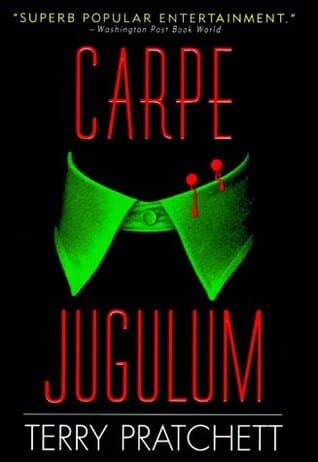
Synopsis
Covers the whole plot, including the ending.
- Difficulty
- Medium
- Pacing
- Moderate
- Mood
- Humorous, Witty, Satirical, Clever
- Read it if
- You enjoy satirical fantasy, witty dialogue, and a fresh take on vampire lore.
- Skip it if
- You prefer serious, high-stakes fantasy with no humor or a traditional portrayal of vampires.
Carpe Jugulum Plot Summary
Covers the whole plot, including the ending.
The Birth of a Princess and an Ill-Advised Invitation
King Verence II of Lancre, embracing new ideas, invites the Magpyr family, modern vampires from Uberwald, to his newborn daughter Esmeralda's naming ceremony. He wants to improve relations with other kingdoms and show Lancre's open-mindedness, despite his wife Queen Magrat's unease about the Magpyrs' true intentions. The Lancre witches, particularly Granny Weatherwax, Nanny Ogg, and Agnes Nitt, also feel uneasy about this decision, recognizing the danger of inviting such powerful, ancient creatures, even if these vampires claim to be 'modern' and reformed.
Arrival of the Magpyrs
The Magpyr family—Count Magpyr, Countess Magpyr, and their children Vlad and Lacrimosa—arrive at Lancre Castle. They are not typical vampires; they drink wine, eat garlic, and are seemingly unaffected by sunlight, presenting themselves as sophisticated and modern. However, their politeness barely hides a predatory nature and an intention to take over Lancre. They begin to charm the Lancre people, especially the younger generation, with their appealing new customs and promises of a 'better' life, slowly eroding traditional beliefs and values.
The Witches' Growing Concern
Granny Weatherwax and Nanny Ogg, along with the newest witch, Agnes Nitt (who houses the persona of Perdita), watch the Magpyrs with growing suspicion. They realize that the vampires' 'modernity' is simply a more subtle form of control. The Magpyrs are not afraid of traditional anti-vampire measures because they have moved past them, instead preying on people's minds and wills. Granny Weatherwax begins to feel the weight of a growing magical battle, recognizing that the Magpyrs' power comes from their ability to manipulate perception and belief, rather than brute force.
Father Mightily Oats and the Power of Belief
Father Mightily Oats, a young Omnian priest, arrives in Lancre to bless the new princess. He is a troubled man, constantly questioning his faith and feeling inadequate. He carries with him a heavy 'God of the Gaps'—a conceptual representation of his fragmented beliefs. He is initially confused by the witches' practical magic and the Magpyrs' seemingly kind nature. However, as he sees the Magpyrs' subtle manipulation and the witches' struggle, he begins to understand faith not as rigid rules, but as the power of belief itself.
Agnes Nitt and the Vampires' Influence
Agnes Nitt, feeling overlooked, finds herself drawn to the Magpyrs' sophisticated charm, especially Vlad. The vampires subtly try to convert her, promising her beauty and power, preying on her inner doubts and the 'Perdita' persona. This shows the Magpyrs' main weapon: psychological manipulation and the erosion of self-worth. Agnes, with Perdita's help, fights against their influence, representing how common people are vulnerable to the vampires' 'modern' seduction, which aims to turn them into willing servants rather than traditional victims.
The Witches' Counter-Attack
Granny Weatherwax, realizing that traditional magic and physical fighting are ineffective against the 'modern' Magpyrs, begins to understand their true weakness: they are still sustained by belief, though a different kind. They fear not garlic or crosses, but the loss of their own self-image and others' belief in their power. She plans to undermine their confidence and make them doubt themselves, a form of psychological warfare. This involves using the power of Lancre's deep traditions and the witches' own strong self-belief.
The Power of Common Sense and Tradition
While Granny Weatherwax focuses on undermining the Magpyrs' mental game, Nanny Ogg and the Lancre villagers use their own resistance: stubborn common sense and practical earthiness. They refuse to be impressed by the vampires' airs and graces, continuing their daily routines and staying skeptical. This collective indifference and refusal to be intimidated slowly reduces the Magpyrs' sense of superiority, as they find their sophisticated manipulations less effective against people who are simply too busy living their lives to be bothered.
The Princess's Naming Ceremony and the Confrontation
During Princess Esmeralda's naming ceremony, the Magpyrs move to fully convert the royal family and take control of Lancre. They plan to 'claim' the princess, securing their hold. This leads to a direct confrontation between the witches (Granny Weatherwax, Nanny Ogg, and Agnes/Perdita), Father Oats, and the Magpyr family. The situation escalates as the Magpyrs show their full, terrifying power, but also their underlying fragility when faced with genuine, steady belief and the force of human will and common sense.
Father Oats's Moment of Faith
In the final confrontation, Father Mightily Oats, seeing the Magpyrs' true evil and inspired by the witches' resolve, finally loses his doubts. He realizes that true faith is not about rigid rules or external signs, but about belief in something good and the courage to act on it. He uses his newfound, heartfelt conviction, not as a weapon, but as a shield and inner strength, which proves genuinely painful and disruptive to the Magpyrs, who thrive on cynicism and control, making them vulnerable.
The Witches' Ultimate Weapon: Self-Belief
Granny Weatherwax, Nanny Ogg, and Agnes Nitt (fully embracing Perdita's strength) use their combined power, not through spells, but through an overwhelming projection of their own self-belief and the land's belief. They make the Magpyrs believe in the very things they claim to be immune to—garlic, sunlight, crosses—by sheer force of will and the power of their reputation. The vampires, who get their strength from controlling others' beliefs, are overwhelmed when their own beliefs are turned against them, causing them to falter and be defeated.
The Magpyrs' Demise and Lancre's Restoration
Overwhelmed by the witches' steady belief and Father Oats's genuine faith, the Magpyrs are defeated. They are not destroyed in a conventional way but are made to believe in their own weaknesses, causing them to flee Lancre in disarray, their sophisticated facade broken. The kingdom is saved from their takeover, and life in Lancre slowly returns to its strange normalcy. The experience changes the characters: Verence is a little wiser, Magrat is more assertive, Father Oats finds his faith, and Agnes Nitt embraces her full identity.
Carpe Jugulum Characters
Esmeralda 'Granny' Weatherwax
Protagonist
The formidable and pragmatic Lancre witch.
Granny Weatherwax is the most powerful and respected witch in Lancre, known for her sharp intellect, unwavering self-belief, and stern demeanor. She rarely uses overt magic, preferring 'headology' – the power of suggestion and knowing people's minds. She is fiercely protective of Lancre and its traditions, constantly battling against external threats and internal foolishness. Her core drive is to maintain balance and ensure that people take responsibility for their own lives and beliefs.
Relationships: Nanny Ogg (Long-standing, often bickering, but deeply loyal best friends and fellow witches.); Agnes Nitt (Mentor and stern guide, pushing Agnes to embrace her true self.); King Verence II (Skeptical but ultimately respected advisor, often exasperated by his 'progressive' ideas.)
Gytha 'Nanny' Ogg
Protagonist
The earthy, fun-loving, and wise Lancre witch.
Nanny Ogg is the matriarch of a large, boisterous family and a key figure in the Lancre coven. She is known for her love of a good time, her bawdy humor, and her practical, down-to-earth wisdom. While not as outwardly intimidating as Granny Weatherwax, her common sense and deep understanding of human nature are equally formidable. She is a grounding force, often providing a pragmatic counterpoint to Granny's intensity, and is beloved by the community.
Relationships: Granny Weatherwax (Best friend and co-leader of the coven, providing a balance of personalities.); Agnes Nitt (Supportive and encouraging, offering a different kind of mentorship than Granny.); King Verence II (A respected figure, though often the subject of Nanny's less formal observations.)
Agnes Nitt / Perdita X. Dream
Protagonist
The self-conscious witch with a powerful inner persona.
Agnes Nitt is a young woman who wants to be a witch but struggles with her self-image and insecurity, particularly regarding her size. She houses an inner persona named Perdita X. Dream, who is everything Agnes wishes she could be: confident, beautiful, and assertive. Agnes's internal conflict between her true self and her idealized self is a central theme. She possesses a powerful singing voice and a strong, if often suppressed, will, making her a unique and valuable member of the coven.
Relationships: Granny Weatherwax (Stern mentor, pushing Agnes to find her inner strength.); Nanny Ogg (More encouraging mentor, providing comfort and practical advice.); Vlad Magpyr (Target of his seductive manipulation, which she ultimately resists.)
Father Mightily Oats
Protagonist
A troubled Omnian priest seeking true faith.
Father Oats is a young, earnest priest of Om, sent to bless Princess Esmeralda. He is deeply uncertain about his faith, constantly questioning dogma and burdened by a 'God of the Gaps' – a conceptual entity that only fills the unknowns. He is prone to anxiety and self-doubt but possesses a fundamental goodness and a desire for genuine understanding. His journey in Lancre forces him to confront his abstract beliefs with the very real and pragmatic magic of the witches and the insidious evil of the Magpyrs.
Relationships: Granny Weatherwax (Initially bewildered by her pragmatism, later comes to respect and understand her 'headology'.); The Magpyrs (Initially sees them as benign, but later recognizes their evil and confronts them with his newfound faith.)
Count Magpyr
Antagonist
The patriarch of the 'modern' vampire family.
Count Magpyr is the leader of the Magpyr family, presenting himself as a sophisticated, cultured, and enlightened modern vampire. He claims to have moved beyond the old weaknesses, embracing science and psychology over crude bloodlust. However, beneath this veneer lies a deeply arrogant and manipulative predator who seeks to control minds and societies, viewing humans as little more than resources to be managed. His true power lies in his ability to make others believe in his superiority and invincibility.
Relationships: Countess Magpyr (His equally cunning and manipulative wife and partner in their schemes.); Vlad and Lacrimosa Magpyr (His children, whom he is training to be equally manipulative and powerful 'modern' vampires.); King Verence II (His naive host, whom he intends to depose and replace.)
King Verence II
Supporting
The well-meaning but naive King of Lancre.
King Verence II is the monarch of Lancre, a well-meaning but often misguided ruler who strives to be modern and progressive. He is easily swayed by new ideas and a desire to be seen as enlightened, leading him to make the ill-advised decision to invite the Magpyrs. He is a good man at heart, but lacks the practical wisdom and skepticism of his subjects, particularly his wife and the witches. He genuinely loves his kingdom but sometimes overlooks the practical realities of its people.
Relationships: Queen Magrat (His wife, whose practical common sense he often dismisses but slowly learns to value.); Granny Weatherwax (A constant, often annoying, source of unwanted but necessary advice.); Count Magpyr (His guest, whom he initially trusts and respects, but later recognizes as a grave threat.)
Queen Magrat Garlick
Supporting
The pragmatic and surprisingly assertive Queen of Lancre.
Queen Magrat, formerly a witch and now Queen, is more grounded and practical than her husband, King Verence. She is skeptical of the Magpyrs from the start, sensing their danger. Despite her past as a rather sentimental and New Age-y witch, motherhood has made her more assertive and protective. She is often the voice of reason and common sense in the castle, though her husband doesn't always heed her warnings. Her strength lies in her unwavering love for her family and kingdom.
Relationships: King Verence II (Her husband, whom she loves but often finds exasperating.); Granny Weatherwax (Former mentor, whose wisdom she still respects, though their relationship is now more equal.); Princess Esmeralda (Her newborn daughter, for whom she is fiercely protective.)
Vlad Magpyr
Supporting
The charming and manipulative son of Count Magpyr.
Vlad Magpyr is the son of Count Magpyr, a handsome and charismatic young vampire who embodies the 'modern' Magpyr philosophy. He is adept at psychological manipulation, using charm and flattery to disarm his targets. He attempts to seduce Agnes Nitt, preying on her insecurities and desire for acceptance. Vlad represents the next generation of vampires, even more refined in their methods of control, viewing conversion as a preferable alternative to traditional blood-drinking.
Relationships: Count Magpyr (His father and mentor, from whom he learns the art of modern vampirism.); Lacrimosa Magpyr (His sister, with whom he shares a competitive yet collaborative relationship.); Agnes Nitt (His primary target for conversion, whose resistance proves challenging.)
Lacrimosa Magpyr
Supporting
The quiet and intense daughter of Count Magpyr.
Lacrimosa Magpyr is the daughter of Count Magpyr, a more reserved but equally intense and manipulative vampire. She is focused on the practicalities of their takeover and possesses a keen, often unsettling, intelligence. She is less outwardly charming than Vlad but no less dangerous, often observing and analyzing rather than directly engaging. She embodies the colder, more calculating aspect of the Magpyr family's ambition, demonstrating a deep understanding of human weakness and how to exploit it.
Relationships: Count Magpyr (Her father, whom she respects and learns from.); Vlad Magpyr (Her brother, with whom she collaborates on their family's schemes.)
Carpe Jugulum Themes
The Power of Belief and Self-Belief
This theme is central to the novel. The Magpyrs are 'modern' vampires because they have learned to manipulate belief, making people believe in their invincibility and their own weaknesses. However, the witches and Father Oats defeat them by turning this power against them. Granny Weatherwax's 'headology' is the art of manipulating belief, and the climax shows the witches projecting such a strong belief in traditional vampire weaknesses that the Magpyrs themselves begin to believe it. Father Oats finds true faith not in rules, but in his own genuine belief in good, proving that steady personal conviction is the ultimate shield and weapon. The book argues that what people believe, about themselves and the world, is very powerful.
“Belief is a tool. And it is a weapon. It is a sword and a shield, and a spear and a net. It is a mirror and a lens. It is a hammer and a nail, and it is the building itself. And it is the emptiness that allows the building to be built.”
Modernity vs. Tradition
The Magpyrs represent a 'modern' form of evil, sophisticated and subtle, contrasting sharply with Lancre's traditional, though quirky, way of life. They scorn traditional vampire weaknesses and seek to 'update' Lancre, but their modernity is merely a more effective form of control. The novel explores the tension between accepting progress and preserving valuable traditions. While King Verence is eager for modernity, the witches and the common folk of Lancre show that traditional common sense, community, and an understanding of human nature are often more resilient and effective than superficial 'progress.' The Magpyrs' attempts to 'civilize' Lancre fail because they underestimate the deep roots of its culture and the strength found in its unconventional traditions.
“The thing about tradition is, if you don't know where you're going, it's a good idea to know where you've come from.”
Identity and Self-Acceptance
Agnes Nitt's struggle with her inner persona, Perdita X. Dream, is a key exploration of identity. Agnes feels inadequate and wishes to be someone else, making her vulnerable to the Magpyrs' promises of transformation. Her journey is about learning to integrate her different selves and accept her true, powerful identity, rather than hiding behind an idealized image. This theme is mirrored in Father Oats's struggle to reconcile his priestly role with his personal doubts, and even in the Magpyrs' carefully constructed 'modern' identities which hide their true, predatory nature. The novel suggests that true strength comes from accepting and embracing one's authentic self, flaws and all.
“You are you. You are your own, and you are beautiful. You are not a copy of anything.”
The Nature of Evil
The novel redefines evil, moving beyond typical monsters to a more subtle, psychological form. The Magpyrs are not afraid of crosses or garlic; they are afraid of losing control and being disbelieved. Their evil is in their desire to control minds, erode free will, and turn people into willing servants rather than mere victims. This 'modern' evil is harder to fight with traditional methods, forcing the protagonists to adapt. It shows how evil can appear as sophistication or progress, preying on insecurity and the desire for something 'better.' The book argues that true evil is the suppression of individual will and the manipulation of belief.
“They don't want to drink your blood, they want to drink your life.”
Plot Devices & Literary Techniques
Headology
The pragmatic use of psychology and reputation as magic.
Headology is Granny Weatherwax's primary 'magic,' a form of practical psychology where belief, reputation, and suggestion are used to achieve magical effects. It's about knowing people's minds, understanding their expectations, and making them believe what you want them to believe. Against the Magpyrs, who also manipulate belief, headology becomes the ultimate weapon. Granny uses her formidable reputation and the power of collective belief to make the vampires believe in their own weaknesses, effectively turning their own psychological warfare against them.
The God of the Gaps
A metaphorical representation of Father Oats's fragmented faith.
Father Mightily Oats carries a metaphorical 'God of the Gaps' – a conceptual entity that represents his fragmented, intellectualized faith, filling only the areas where scientific or logical explanations are lacking. This device illustrates his struggle with dogma versus genuine spiritual conviction. As the story progresses, he learns to shed this 'God of the Gaps' and embrace a more holistic, heartfelt belief, demonstrating that true faith is not about filling voids but about an unwavering personal commitment and courage, which proves to be a powerful force against the Magpyrs.
Agnes Nitt's Inner Persona (Perdita X. Dream)
A manifestation of Agnes's idealized self and insecurity.
Perdita X. Dream is the name Agnes Nitt gives to her inner, idealized persona – a confident, beautiful, and assertive woman. This device externalizes Agnes's internal conflict between her self-consciousness and her hidden strength. The Magpyrs attempt to exploit this division, but ultimately, Agnes learns to integrate Perdita's strengths into her own identity, becoming a more complete and powerful individual. It highlights the theme of self-acceptance and the danger of letting external perceptions dictate one's self-worth.
The Magpyrs' 'Modernity'
A deceptive facade of sophistication hiding ancient evil.
The Magpyrs' 'modernity' is a crucial plot device. By presenting themselves as evolved vampires who drink wine, eat garlic, and are unaffected by sunlight, they disarm their victims and defy traditional expectations. This allows them to infiltrate Lancre without immediate suspicion, making their insidious takeover more effective. Their modernity is a sophisticated mask for their true nature, which is still predatory and controlling, but now operates through psychological manipulation rather than brute force. This forces the protagonists to adapt their strategies, as traditional anti-vampire measures are useless.
Carpe Jugulum Quotes
“Sin, young man, is when you treat people as things. Including yourself. That's what sin is.”
“The Monks of Cool, whose very name was a contradiction in terms, were an ancient order.”
“You can't go around telling people they're going to die. Where's the fun in that?”
“Vampires don't exist. They're like werewolves or the tooth fairy. Or love.”
“She had a face that could stop a clock, and a personality to match.”
“It was a truth universally acknowledged that a man in possession of a good fortune must be in want of a wife.”
“There was a lot to be said for the old ways. And a lot to be said against them, too.”
“The future was a dark, uncharted country, and the only way to get through it was to make your own light.”
“It was a strange thing, but the more you tried to ignore something, the more it seemed to demand your attention.”
“Sometimes it was better to be a human being, with all the messiness that entailed, than to be a perfect machine.”
“Granny Weatherwax did not approve of women doing magic for money. It was like selling a part of yourself.”
“He didn't want to be a hero. He just wanted to go home and have a nice cup of tea.”
“The world was full of people who were so busy being themselves that they didn't have time to be anyone else.”
Quiz
10 questions on the plot and the characters. Each answer comes with a short explanation.
Question 1
What is the name of King Verence's newborn daughter, whose birth is the initial reason for the Magpyrs' invitation to Lancre?
- Esmeralda
- Anastasia
- Erzulie
- Eszter
Show answer
D. Eszter King Verence's daughter is named Eszter. Her christening is the event that brings the Magpyr family to Lancre Castle.
Question 2
Which witch is initially most resistant to the idea of confronting the Magpyr vampires and believes they should be left alone?
- Granny Weatherwax
- Nanny Ogg
- Agnes Nitt
- Perdita X. Dream
Show answer
B. Nanny Ogg Nanny Ogg initially expresses reluctance and suggests that the vampires might be harmless, preferring to avoid direct confrontation, much to Granny Weatherwax's annoyance.
Question 3
What is the primary philosophical difference between the traditional vampires of old and the 'modern' Magpyr family?
- The Magpyrs only drink animal blood, not human blood.
- The Magpyrs embrace modernity, sunlight, garlic, and wine, viewing traditional weaknesses as superstitious.
- The Magpyrs are vegetarians and do not consume blood at all.
- The Magpyrs are benevolent and seek to integrate peacefully with humans.
Show answer
B. The Magpyrs embrace modernity, sunlight, garlic, and wine, viewing traditional weaknesses as superstitious. The Magpyrs pride themselves on being 'modern' vampires, immune to traditional weaknesses like sunlight and garlic, which they view as outdated superstitions. They also enjoy wine and other human luxuries.
Question 4
What is the name of the young priest who forms an uneasy alliance with the witches?
- Father A. E. Pessimal
- Reverend Oats
- Brother Doorkeeper
- Deacon Frost
Show answer
B. Reverend Oats Reverend Oats is the young, nervous priest sent by the Omnians who struggles with his faith and ultimately joins forces with the witches to fight the Magpyrs.
Question 5
What unique magical ability does Agnes Nitt develop or reveal during the events of the book, which becomes crucial in the fight against the Magpyrs?
- The ability to turn invisible at will.
- The ability to control animals with her mind.
- The ability to project an incredibly powerful and disruptive singing voice (Perdita X. Dream).
- The ability to conjure fire from her fingertips.
Show answer
C. The ability to project an incredibly powerful and disruptive singing voice (Perdita X. Dream). Agnes Nitt's 'inner voice,' Perdita X. Dream, gains a powerful, almost weaponized singing ability that can shatter glass and disrupt the Magpyrs' concentration, proving vital in the climax.
Question 6
What is the Magpyrs' ultimate goal once they are established in Lancre Castle?
- To establish a new trading route for Uberwaldian goods.
- To convert the people of Lancre to their modern vampiric lifestyle.
- To find a legendary hidden treasure beneath the castle.
- To learn the secrets of Lancre witchcraft.
Show answer
B. To convert the people of Lancre to their modern vampiric lifestyle. The Magpyrs' goal is not just to occupy the castle, but to 'modernize' Lancre by turning its inhabitants into their own kind, thereby establishing a new 'flock' for their bloodlust.
Question 7
Which member of the Magpyr family is particularly interested in 'collecting' and studying the local Lancre beliefs and superstitions?
- Count Magpyr
- Countess Magpyr
- Ladik
- Vlad
Show answer
D. Vlad Vlad Magpyr is the more intellectual and curious of the Magpyr sons, showing a keen interest in understanding and cataloging local customs and 'superstitions,' rather than just dismissing them.
Question 8
What is Granny Weatherwax's ultimate strategy for defeating the Magpyrs, based on her understanding of their 'modern' nature?
- Direct magical combat using powerful spells.
- Exposing them to overwhelming amounts of garlic and sunlight.
- Using psychological warfare and their own self-doubt against them.
- Summoning ancient heroes to fight on Lancre's behalf.
Show answer
C. Using psychological warfare and their own self-doubt against them. Granny Weatherwax realizes that since the Magpyrs believe themselves immune to traditional weaknesses, their only true vulnerability is their own belief system. She targets their cultivated self-image and makes them doubt their own power, which is the core of her 'headology.'
Question 9
What is the significance of the phrase 'Carpe Jugulum' in the context of the book's themes?
- It is a traditional Lancre greeting.
- It is the Magpyrs' family motto, meaning 'Seize the Throat,' reflecting their predatory nature.
- It is a spell used by the witches to repel vampires.
- It refers to a specific type of wine favored by King Verence.
Show answer
B. It is the Magpyrs' family motto, meaning 'Seize the Throat,' reflecting their predatory nature. 'Carpe Jugulum' is the Magpyr family motto, a play on 'Carpe Diem,' meaning 'Seize the Throat.' It perfectly encapsulates their predatory philosophy and intent to dominate and consume.
Question 10
How does the witches' approach to magic and belief contrast with the Magpyrs' 'modern' scientific worldview?
- The witches rely on ancient texts and formal spells, while Magpyrs use advanced technology.
- The witches understand that belief shapes reality and power, while the Magpyrs dismiss it as superstition until it's used against them.
- The witches are strictly rational, while the Magpyrs are deeply superstitious.
- Both groups share a similar understanding of the world, differing only in their choice of victims.
Show answer
B. The witches understand that belief shapes reality and power, while the Magpyrs dismiss it as superstition until it's used against them. The core conflict highlights the contrast between the witches' 'headology' – the understanding that belief and consensus reality are powerful forces – and the Magpyrs' dismissive, 'scientific' view of the world, which ultimately makes them vulnerable to the witches' methods.
Carpe Jugulum FAQ
What is the central conflict in 'Carpe Jugulum'?
The central conflict arises when King Verence invites the modern, sophisticated Magpyr vampires of Uberwald to Lancre for the christening of his daughter, Esmeralda. Once inside Lancre Castle, the Magpyrs, led by Count Magpyr and his family, reveal their true intentions: to subtly take over Lancre and establish a new bloodline of 'enlightened' vampires, exploiting the kingdom's hospitality and the local populace.
Who are the main protagonists fighting against the Magpyrs?
The primary protagonists are the Lancre witches: Granny Weatherwax, Nanny Ogg, and the young, burgeoning witch Agnes Nitt (who is also host to the persona of Perdita X. Dream, a cynical and more gothic alter ego). They are reluctantly joined by Father Might, a young Omnian priest who is struggling with his faith and the practicalities of a world that doesn't always conform to scripture.
What makes the Magpyr vampires different from traditional vampires?
The Magpyrs are 'modern' vampires who have adapted to overcome traditional weaknesses. They can walk in sunlight, eat garlic, and even drink wine. Their true power lies in their sophisticated psychological manipulation and their ability to subtly dominate minds, rather than relying solely on brute force or classic vampiric tropes. They see themselves as enlightened conquerors, not bloodthirsty monsters.
How does Agnes Nitt contribute to the story, particularly with her alter ego?
Agnes Nitt is initially a reluctant witch, struggling with her self-image and the expectations of others. Her alter ego, Perdita X. Dream, emerges as a more confident, cynical, and 'gothic' personality, often providing sharp commentary and a different perspective. Perdita's unique worldview, particularly her understanding of dramatic tropes and the nature of fear, proves unexpectedly useful in the witches' confrontation with the Magpyrs, especially against Vlad and Lacrimosa.
What role does Igor play in the Magpyr household, and how does he subvert expectations?
Igor is the Magpyrs' loyal, hunchbacked servant, fulfilling the traditional role of a 'mad scientist's assistant' or 'vampire's minion.' However, this Igor is a member of a long line of Igors, each highly skilled in surgery and improvisation. He is fiercely loyal to the concept of 'the master' rather than any specific individual, and his true allegiance ultimately lies with the preservation of his own family's traditions and the natural order, subtly undermining the Magpyrs when their actions become too extreme.
How do the witches use 'headology' against the Magpyrs, and what is its significance?
The witches, particularly Granny Weatherwax, primarily use 'headology,' a form of practical psychology and applied common sense, to combat the Magpyrs. Instead of relying on traditional magic, they manipulate perceptions, expectations, and the Magpyrs' own sophisticated self-image. This is significant because it highlights that true power often comes from understanding human (and vampiric) nature, rather than just casting spells, and it directly challenges the Magpyrs' preferred method of mental domination.
What is the significance of the Magpyrs' 'modernity' and how does it ultimately become a weakness?
The Magpyrs pride themselves on their 'modernity,' believing they have evolved beyond crude superstitions and physical weaknesses. They embrace psychology, propaganda, and a refined aesthetic. However, this very sophistication makes them vulnerable to the witches' down-to-earth headology and the raw, primal fear that Granny Weatherwax embodies. Their intellectual approach to conquest fails when confronted with an opponent who understands the fundamental, visceral nature of belief and fear, which they had tried to intellectualize away.
How does Father Might's character arc reflect a broader commentary on faith?
Father Might begins as a rigid Omnian priest, struggling to reconcile his strict dogmatic beliefs with the chaotic reality of Lancre and the existence of magic. His journey involves questioning his literal interpretations of scripture and learning that true faith might lie in action, compassion, and understanding, rather than strict adherence to doctrine. He learns to 'believe in people' and finds a more practical, less dogmatic form of faith, ultimately using his belief to directly confront the Magpyrs' mental influence.
What psychological tactics do the Magpyrs employ to subjugate Lancre?
The Magpyrs use sophisticated psychological tactics, including gaslighting, manipulation of public perception through propaganda (like the 'Carpe Jugulum' slogan), and mental domination. They subtly undermine the villagers' confidence, make them doubt their own perceptions, and slowly erode their will to resist. They aim to make people desire their own subjugation, believing it to be a form of 'enlightenment' rather than conquest.
How does Granny Weatherwax's confrontation with the Magpyrs exemplify her philosophy?
Granny Weatherwax's confrontation exemplifies her philosophy that true power comes from within and from understanding the nature of belief. She doesn't use grand spells but rather projects an overwhelming presence, an unshakeable will, and the primal fear of death itself. She understands that the Magpyrs, for all their modernity, still rely on fear, and she turns that fear back on them, showing them that there are older, more fundamental terrors than their cultivated bloodlust. Her 'borrowing' of the Magpyr's minds and her use of their own fears against them is a masterclass in headology.
What is the psychological impact of the Magpyrs' 'Carpe Jugulum' philosophy on the villagers?
The 'Carpe Jugulum' philosophy, meaning 'seize the throat,' is initially presented by the Magpyrs as a metaphor for seizing opportunity and living life to the fullest. However, its true psychological impact on the villagers is to subtly normalize violence, ambition, and a predatory mindset. It encourages them to be self-interested and to accept the Magpyrs' dominance as a natural order, eroding their sense of community and their will to resist, making them more pliable to the vampires' control.
Is 'Carpe Jugulum' a critique of modernism or traditionalism, or both?
'Carpe Jugulum' can be interpreted as a critique of both. It critiques a certain type of 'modernism' represented by the Magpyrs, which prioritizes superficial sophistication, intellectualized cruelty, and an arrogant dismissal of tradition and common sense. However, it also implicitly critiques the dangers of rigid traditionalism if it means being unprepared for new threats, as seen in the initial complacency of Lancre. Ultimately, it champions a pragmatic approach that combines the best of wisdom, adaptation, and an understanding of fundamental human nature.
What is the significance of the Magpyrs' names (Vlad, Lacrimosa, etc.) and their connection to traditional vampire lore?
The Magpyrs' names subtly connect them to traditional vampire lore while subverting it. 'Vlad' immediately evokes Vlad the Impaler, the historical figure often associated with Dracula, hinting at their underlying cruelty despite their modern facade. 'Lacrimosa' (meaning 'weeping') and 'Magpyr' (a play on 'magpie,' known for stealing and collecting shiny things) suggest a blend of sorrow, vanity, and a predatory nature. These names are a nod to their heritage, reminding the reader of the classic vampire tropes they claim to have transcended.
How does the book explore the nature of belief and its power?
The book deeply explores the nature of belief, demonstrating its immense power. The Magpyrs rely on people believing in their sophistication and superiority to exert control. The Omnian faith, as represented by Father Might, grapples with the power of collective belief versus individual conviction. Most importantly, Granny Weatherwax shows that belief, even in something as abstract as 'fear' or 'death,' can be harnessed as a potent weapon. The witches understand that what people believe to be true often becomes true, and they use this understanding to dismantle the Magpyrs' influence.
What philosophical statement does the ending make about good vs. evil or change vs. tradition?
The ending makes a statement that true evil often disguises itself as progress or enlightenment, and that genuine good often lies in pragmatic, grounded resistance. It suggests that while change is inevitable, tradition, especially the wisdom embedded in it, should not be dismissed. The victory of the witches and Father Might over the Magpyrs isn't a triumph of brute force but of understanding, resilience, and the power of community over sophisticated, predatory individualism. It champions the enduring strength of the ordinary against the extraordinary, and the importance of knowing who you are.
How does the character of Nanny Ogg provide comedic relief while also contributing to the plot?
Nanny Ogg provides significant comedic relief through her bawdy humor, love of drink, and practical, often earthy, approach to life. Her less intellectual, more visceral reactions often highlight the absurdity of the Magpyrs' pretensions. However, she also contributes to the plot by maintaining a strong connection to the community, offering practical witchy wisdom, and her unwavering loyalty to Granny Weatherwax. Her ability to connect with people and her grounded perspective are vital counterpoints to the Magpyrs' psychological manipulation and Granny's intense focus.
What is the ultimate fate of the Magpyr family members?
The Magpyr family meets various fates. Count Magpyr is ultimately defeated by Granny Weatherwax, who 'borrows' his mind and forces him to confront his own mortality and the primal fear of death. His son, Vlad, is driven to a breakdown by Agnes/Perdita's psychological warfare, particularly her understanding of theatrical tropes. Lacrimosa, the daughter, also succumbs to psychological manipulation and fear. The infant, Esmeralda, is protected and remains human, her fate secured by the witches' intervention. The remaining Magpyrs are effectively neutralized, their power broken.
How does the book satirize the concept of 'modern' evil or 'enlightened' villains?
The book satirizes 'modern' evil by presenting the Magpyrs as highly cultured, articulate, and self-proclaimed 'enlightened' beings who believe they are above crude, traditional villainy. They eschew capes and coffins for silk waistcoats and psychology. This satire highlights how true evil can often hide behind a facade of sophistication and progress, making it more insidious. Their belief in their own superiority and their disdain for 'primitive' ways ultimately blinds them to the true, primal power wielded by the witches.
About the author

Sir Terence David John Pratchett was an English humorist, satirist, and author of fantasy novels, especially comical works. He is best known for his Discworld series of 41 novels.
Similar books
- Interview With The Vampire
Anne Rice
4.0 (485k) average on GoodreadsFantasyRice romanticizes and humanizes her vampires, exploring their psychological depth and existential angst. Pratchett, conversely, deconstructs the glamour of vampires, presenting them as ultimately superficial and susceptible to common sense, using humor to deflate their mystique.
- Harry Potter and the Sorcerer's Stone
J.K. Rowling
4.5 (7M) average on GoodreadsFantasyRescued from a miserable life under the stairs, an orphaned boy discovers he's a wizard destined for a magical school, where he uncovers a dangerous secret tied to the dark wizard who murdered his parents.
- The Hunger Games
Suzanne Collins
4.3 (6.4M) average on GoodreadsFantasyIn a future where children fight to the death on live television, Katniss Everdeen volunteers for the arena, turning a death sentence into a fight for survival and a spark of rebellion.
- 1984
George Orwell
4.2 (3.1M) average on GoodreadsPoliticsIn a future where surveillance and thought control are absolute, a man's search for truth clashes with the Party, showing that hope can be a form of rebellion.
- Divergent
Veronica Roth
4.2 (2.9M) average on GoodreadsFantasyIn a society divided by virtues, a sixteen-year-old's difference from the norm starts a rebellion that threatens her world.
- The Hobbit, or There and Back Again
J.R.R. Tolkien
4.3 (2.9M) average on GoodreadsFantasyA comfort-loving hobbit named Bilbo Baggins is whisked away by a mischievous wizard and a band of dwarves on an unexpected journey to reclaim stolen treasure from a fearsome dragon, discovering courage and a magical ring along the way.





Enjoyed the summary?
A summary gives you the shape of the book. The book itself has the detail, the examples and the voice.
Find Carpe Jugulum on AmazonAs an Amazon Associate, BookBrief earns from qualifying purchases. How we're funded