
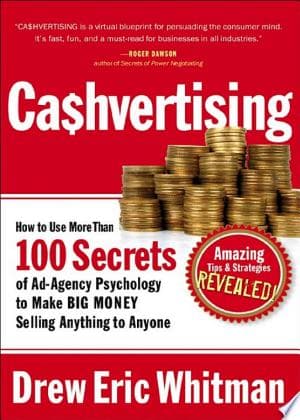
Core Idea
- Difficulty
- Medium
- Read it if
- You are a small business owner, marketer, copywriter, or entrepreneur looking for practical, direct-response advertising techniques to increase sales and conversions without a massive budget. You want to understand the psychological triggers that make people buy.
- Skip it if
- You are looking for a theoretical exploration of branding, digital marketing trends, or abstract advertising philosophy. This book is not for those seeking a purely academic or high-level strategic overview without a focus on immediate, measurable results.
Key Takeaways from Cashvertising
The Primacy of the Headline
Your headline is the gatekeeper of engagement; neglect it, and your message dies unseen.
Whitman states that the headline is the most important part of any ad. In a world full of information, people quickly scan things, and their attention is brief. A weak headline acts as a barrier, making sure even good ad copy goes unread. The headline's only job is to get immediate attention and make the reader want to read more. It filters out those not interested and draws in the target audience with a promise, a question, or a bold statement. This is not just about clever words; it's about using psychology to create curiosity and self-interest. Without a strong headline, all other efforts in writing and design are mostly wasted.
“Sixty percent of people read only headlines. Your headline must stop them or your advertising will likely fail.”
In the book: The statistic that 'sixty percent of people read only headlines' underscores the urgency and importance of this element, suggesting that most of your ad's potential impact rests on these crucial opening words.
Try this: Dedicate disproportionate time to crafting headlines. Brainstorm 20-30 headlines for every piece of copy. Test different angles: benefit-driven, curiosity-driven, news-driven, and question-based. Always aim for clarity, specificity, and a strong value proposition that resonates with your target audience's deepest desires or fears.
Related ideas: headline-crafting, attention-grabbing, copywriting-fundamentals
The Power of Visual Proof
Images with captions significantly boost engagement, providing context and credibility that text alone often lacks.
Beyond headlines, Whitman highlights the power of visuals, especially with good captions. This is not just about looks; it uses a basic part of human perception. People are naturally drawn to images, and a good photo or drawing can share information, emotion, and trust faster than plain text. The caption then acts as a link, explaining the image's importance, reinforcing the ad's message, and pulling the reader further into the story. This combination creates a strong effect, where the visual gets attention and the caption provides the convincing context, making the ad more effective and memorable.
“Captions under photos get 200 percent greater readership than non-headline copy.”
In the book: The startling fact that 'captions under photos get 200 percent greater readership than non-headline copy' provides concrete evidence of the effectiveness of this technique, demonstrating a significant uplift in engagement.
Try this: Always include relevant, high-quality images in your advertising. Ensure every image has a compelling caption that explains its significance, highlights a benefit, or offers a mini-story. Don't just describe the image; use the caption to sell, inform, or persuade. For product ads, show the product in use; for service ads, show the results or the people providing the service.
Related ideas: visual-marketing, image-captions, ad-design-principles
The Irresistible Allure of a Deal
Explicitly stating a sale price is a direct psychological trigger that significantly increases ad attention.
Whitman points out a basic truth about consumer behavior: people want good value and a good deal. Clearly advertising a 'sale price' is not just about lowering prices; it's about signaling an opportunity that might be missed. This uses the psychological principles of scarcity and urgency, even if the sale isn't temporary. A reduced price immediately makes the ad stand out in a crowded space. It suggests a clear benefit to the reader, avoiding the need for much persuasion by directly addressing their desire to save money or get more value. This simple addition can greatly improve an ad's initial appeal.
“Ads with sale prices draw 20 percent more attention.”
In the book: The statistic 'Ads with sale prices draw 20 percent more attention' quantifies the direct impact of this strategy, making it a clear, actionable recommendation for advertisers.
Try this: Whenever possible, prominently feature sale prices, discounts, or special offers in your advertising. Use clear, bold typography for the price. Consider comparing it to the original price to emphasize the savings. Frame the offer in terms of value or opportunity rather than just a markdown. Use phrases like 'Limited Time Offer,' 'Save X%,' or 'Special Introductory Price.'
Related ideas: sales-psychology, pricing-strategies, value-proposition
Size Matters (But Not Always How You Think)
Larger ads capture more attention, but their effectiveness doesn't scale linearly, offering strategic placement options.
While it might seem that bigger ads always work better, Whitman notes that the return on investment for ad size is not always direct. A full-page ad certainly gets attention, but a half-page ad can have much of that impact at a lower cost. This idea is important for advertisers with limited budgets, allowing them to use their money wisely. It suggests that while making ads bigger is generally good, there are points where it stops being as effective. Understanding these ratios helps advertisers make smart choices about ad placement and size, balancing visibility with cost-effectiveness, and perhaps choosing more frequent smaller ads over fewer, larger ones if the budget is tight.
“Half-page ads pull about 70 percent of full-page ads; quarter-page ads pull about 50 percent of full-page ads.”
In the book: The specific pull rates – 'Half-page ads pull about 70 percent of full-page ads; quarter-page ads pull about 50 percent of full-page ads' – provide a practical guideline for media planning and budget allocation.
Try this: Don't automatically assume a full-page ad is the only effective option. Evaluate your budget and objectives. If a full page is too expensive, consider a half-page ad to achieve significant impact for less. For smaller budgets, a well-designed quarter-page ad can still be effective, especially if combined with a powerful headline and image. Focus on maximizing the impact within the chosen size rather than just increasing size for its own sake.
Related ideas: ad-placement, media-buying, advertising-roi
The Vibrancy of Color
Color isn't just aesthetic; it's a powerful tool that significantly enhances ad effectiveness and reader engagement.
Whitman emphasizes that color in advertising is more than just decoration; it is a smart psychological tool. Color ads naturally stand out more in print, immediately catching the eye and giving a sense of quality, energy, and modernity. Beyond just being seen, color can create emotions, build brand identity, and highlight key information. The increased effectiveness is not just about getting attention; it's about creating a richer, more engaging experience that can lead to better memory and stronger persuasive power. In a world where visual appeal is important, choosing black and white when color is an option misses a strong persuasive advantage.
“Four-color ads are up to 45 percent more effective than black and white.”
In the book: The data point that 'Four-color ads are up to 45 percent more effective than black and white' provides a compelling, quantifiable reason to invest in color advertising.
Try this: Whenever budget allows, opt for full-color advertising over black and white. Use color strategically to highlight calls to action, important benefits, or product features. Choose colors that align with your brand identity and evoke the desired emotional response from your target audience. Don't just add color; use it purposefully to enhance readability and impact.
Related ideas: color-psychology, brand-identity, visual-impact
Psychology Over Budget
Effective advertising hinges on understanding human behavior, not just large spending.
This is a main point of 'Cashvertising': the most effective advertising strategies come from timeless principles of human psychology, not necessarily large budgets. Whitman frees advertisers from the idea that only big agencies with lots of money can create good campaigns. He argues that understanding how people think, what motivates them, and what makes them buy is more valuable than just spending money on ad placements. Many of the 'secrets' he shares are about writing messages that deeply connect with universal human desires and fears, making them widely useful and often free to use. This makes effective advertising available to even the smallest businesses.
“These techniques are based on human psychology. They work no matter where you're located, no matter what kind of product or service you sell, and no matter where you advertise. In fact, most don't cost a penny to use.”
In the book: Whitman explicitly states that the techniques 'don't cost a penny to use' and are effective 'no matter where you're located, no matter what kind of product or service you sell,' emphasizing the psychological foundation.
Try this: Prioritize learning about consumer psychology. Read books, observe behavior, and understand the core desires (e.g., security, belonging, power) and fears (e.g., loss, rejection, pain) that drive your target audience. Craft your messages to directly address these psychological triggers, rather than just listing features. Focus on benefits and emotional outcomes, not just product specifications.
Related ideas: consumer-psychology, behavioral-economics, persuasion-techniques
Believability is Paramount
Without trust, even the most compelling claims fall flat; credibility is the bedrock of persuasion.
Whitman suggests that even the best-written ad copy is useless if the audience doesn't believe it. In a time of doubt and too much information, advertisers must actively build and keep trust. This is not just about avoiding lies, but about presenting information in a way that feels real, supported, and reliable. Trust can be built through testimonials, statistics, expert endorsements, guarantees, and even the ad's tone and professionalism. Without trust, any promises made will be met with doubt, making the entire persuasive effort ineffective. Trust is what leads to sales.
“How to make people believe what you say.”
In the book: The book explicitly lists 'How to make people believe what you say' as a key learning outcome, highlighting its foundational importance to effective advertising.
Try this: Incorporate elements of social proof (testimonials, reviews), data (statistics, research), and authority (expert endorsements, awards) into your ads. Offer strong, clear guarantees. Use a sincere, confident, and transparent tone. Avoid hyperbole or claims that sound too good to be true. Be specific with your claims, as vagueness erodes trust.
Related ideas: credibility-building, social-proof, trust-marketing
The Art of 'Sneaky' Persuasion
Effective advertising subtly guides prospects to action using psychological triggers, not overt force.
Whitman suggests that true persuasion is not about negative manipulation, but about understanding the subtle psychological triggers that encourage a desired response. These 'sneaky' methods are not deceptive; they use natural human tendencies and biases. This could involve framing choices, using scarcity or urgency, anchoring effects, or starting with a question that prepares the reader for a 'yes.' The goal is to make the desired action feel like the most natural, beneficial, or logical next step for the potential customer, rather than an imposed one. It is about creating an experience where the reader feels they are making an informed, self-interested decision, even if the ad has skillfully guided them there.
“Sneaky' ways to persuade people to respond.”
In the book: The book's promise to teach 'Sneaky' ways to persuade people to respond directly points to the use of psychological tactics rather than aggressive, overt selling.
Try this: Employ psychological triggers such as urgency (limited-time offers), scarcity (limited stock), social proof (what others are doing), and reciprocity (offering value upfront). Use clear, compelling calls to action that make it easy for the prospect to respond. Frame benefits in terms of loss aversion (what they'll miss out on) rather than just gains. Use open loops to maintain curiosity.
Related ideas: persuasion-tactics, cognitive-biases, call-to-action
Mastering the Magnetic Headline
Headlines must act as powerful magnets, drawing in the target audience with irresistible promises or questions.
Repeating the headline's important role, Whitman specifically focuses on making them 'magnetic.' This means more than just being read; it means creating an irresistible pull that makes skipping the main ad copy almost impossible. A magnetic headline doesn't just announce; it promises a solution, sparks curiosity, presents a surprising fact, or directly addresses a core problem. It is short, convincing, and speaks directly to the reader's self-interest. By mastering these 'tricks,' advertisers can ensure their message cuts through noise and reaches their target audience, making every word after it as effective as possible.
“Effective tricks for writing 'magnetic' headlines.”
In the book: The explicit mention of 'Effective tricks for writing 'magnetic' headlines' as a key skill taught by the book underscores the actionable nature of this takeaway.
Try this: Utilize proven headline formulas: 'How to [Benefit] Without [Pain]', 'The Secret of [Desire]', 'Warning: Are You Making This [Mistake]?', 'Get [Desired Result] in [Timeframe]'. Focus on strong verbs, specific numbers, and clear benefits. Test different headline types (e.g., question, command, news, benefit) to see which resonates most with your audience.
Related ideas: headline-formulas, copywriting-techniques, attention-economy
Avoiding Costly Advertising Mistakes
Knowing what NOT to do is as crucial as knowing what to do, preventing wasted effort and resources.
Whitman implies that many advertising failures come from mistakes that could have been avoided, rather than a lack of brilliance. Finding and fixing common errors directly improves ad performance. These mistakes can include unclear calls to action, general messages, focusing on features instead of benefits, using weak headlines, or not understanding the target audience. By highlighting these 'don'ts,' the book offers a protective strategy, saving advertisers from wasting time and money on ineffective campaigns. This proactive approach ensures efforts go into proven methods, increasing the chances of success.
“What mistakes to avoid...at all costs!”
In the book: The book's explicit promise to teach 'What mistakes to avoid...at all costs!' signifies the importance of understanding and sidestepping common errors.
Try this: Regularly audit your ads for common mistakes: weak headlines, vague calls to action, feature-focused instead of benefit-focused copy, lack of urgency, or targeting the wrong audience. Get feedback from others. Always have a clear objective for each ad. Ensure your message is simple, direct, and easy to understand. Avoid jargon and industry-speak.
Related ideas: advertising-pitfalls, campaign-optimization, effective-advertising
Cashvertising Quotes
“People don’t buy products or services. They buy solutions to their problems.”
“Every ad should be a complete sales presentation.”
“The greatest copywriters in the world are not great writers. They are great salesmen.”
“Emotion sells, logic justifies.”
“Never assume your prospect knows anything about your product, service, or offer.”
“The purpose of a headline is to stop prospects and get them to read your first sentence.”
“People are interested in themselves, not in you or your company.”
“Give your prospects a reason to believe.”
“The more you tell, the more you sell.”
“Always include a call to action.”
“Your customer is not a statistic. Your customer is a person with feelings, desires, and problems.”
“Benefits sell, features don't.”
“Fear of loss is a stronger motivator than desire for gain.”
“Every ad must have a unique selling proposition (USP).”
“The selling power of testimonials is immense.”
Quiz
10 questions on the main ideas. Each answer comes with a short explanation.
Question 1
According to 'Cashvertising,' what percentage of people read only headlines?
- 20 percent
- 45 percent
- 60 percent
- 70 percent
Show answer
C. 60 percent The book explicitly states, 'Sixty percent of people read only headlines. Your headline must stop them or your advertising will likely fail.' This highlights the critical importance of effective headlines.
Question 2
What is the stated impact of captions under photos compared to non-headline copy?
- They get 50 percent greater readership.
- They get 200 percent greater readership.
- They get 70 percent greater readership.
- They get 45 percent greater readership.
Show answer
B. They get 200 percent greater readership. The text states, 'Captions under photos get 200 percent greater readership than non-headline copy.' This emphasizes the power of visual elements and their accompanying text.
Question 3
What percentage more attention do ads with sale prices draw?
- 10 percent
- 20 percent
- 30 percent
- 40 percent
Show answer
B. 20 percent The book mentions, 'Ads with sale prices draw 20 percent more attention.' This is a practical tip for increasing ad effectiveness.
Question 4
How effective are half-page ads compared to full-page ads, according to the book?
- About 50 percent of full-page ads.
- About 60 percent of full-page ads.
- About 70 percent of full-page ads.
- About 80 percent of full-page ads.
Show answer
C. About 70 percent of full-page ads. The text states, 'Half-page ads pull about 70 percent of full-page ads.' This provides guidance on optimizing ad size for budget and impact.
Question 5
What is the primary reason the techniques in 'Cashvertising' are effective, regardless of business size or location?
- They are endorsed by New York's biggest ad agencies.
- They leverage advanced digital marketing algorithms.
- They are based on fundamental human psychology.
- They require significant financial investment to implement.
Show answer
C. They are based on fundamental human psychology. The book explicitly states, 'These techniques are based on human psychology. They work no matter where you're located, no matter what kind of product or service you sell, and no matter where you advertise.' This is a core argument for the book's universal applicability.
Question 6
According to the excerpt, what is one of the 'sneaky' ways 'Cashvertising' teaches to persuade people?
- How to create powerful ads and brochures.
- How to make people believe what you say.
- Ways to persuade people to respond.
- Effective tricks for writing 'magnetic' headlines.
Show answer
C. Ways to persuade people to respond. The list of what the book teaches includes '"Sneaky" ways to persuade people to respond.' This highlights a specific area of focus for the book's practical advice.
Question 7
What is the stated effectiveness of four-color ads compared to black and white ads?
- Up to 20 percent more effective.
- Up to 45 percent more effective.
- Up to 60 percent more effective.
- Up to 70 percent more effective.
Show answer
B. Up to 45 percent more effective. The book states, 'Four-color ads are up to 45 percent more effective than black and white.' This is a specific detail regarding visual impact in advertising.
Question 8
What is a key benefit of the techniques taught in 'Cashvertising' regarding their cost?
- They are only effective for large corporations with big budgets.
- Most of them don't cost a penny to use.
- They require significant investment in specialized software.
- They are primarily for online advertising, which is always free.
Show answer
B. Most of them don't cost a penny to use. The text highlights, 'In fact, most don't cost a penny to use.' This emphasizes the accessibility and practical value of the book's advice for businesses of all sizes, including 'mom-and-pop pizza shop[s].'
Question 9
Beyond creating powerful ads, what else does 'Cashvertising' teach readers to make people do?
- How to negotiate better advertising rates.
- How to make people believe what you say.
- How to design compelling product packaging.
- How to track complex marketing analytics.
Show answer
B. How to make people believe what you say. The book promises to teach 'How to make people believe what you say,' which is crucial for building trust and credibility in advertising.
Question 10
What specific advertising formats does 'Cashvertising' aim to help readers create effectively?
- Only television commercials and radio spots.
- Only social media posts and email newsletters.
- Ads, brochures, sales letters, Websites, and more.
- Only print magazine advertisements.
Show answer
C. Ads, brochures, sales letters, Websites, and more. The book aims to teach 'How to create powerful ads, brochures, sales letters, Websites, and more,' indicating a broad applicability across various marketing channels.
Cashvertising FAQ
What is 'Cashvertising' about?
Cashvertising reveals little-known advertising and marketing secrets based on human psychology, used by top agencies, to persuade people to buy. It provides practical tips, tricks, and strategies for creating powerful ads, brochures, sales letters, and websites.
Does 'Cashvertising' work for small businesses?
Yes, 'Cashvertising' is designed to work for businesses of all sizes, from corporate giants to mom-and-pop shops. The techniques are based on fundamental human psychology, making them universally applicable regardless of your product, service, or advertising platform.
What is the importance of headlines in advertising, according to 'Cashvertising'?
Headlines are crucial because sixty percent of people read only them. A powerful, magnetic headline is essential to capture attention and prevent your advertising from failing, as it's often the only part of your ad that potential customers will engage with.
How does 'Cashvertising' differ from other marketing books?
Cashvertising focuses on dozens of specific, often overlooked psychological facts and 'sneaky' persuasion tricks used by New York's biggest ad agencies. It offers a practical, fast-paced guide to these little-known secrets rather than broad marketing theory.
Does including a sale price in an ad really make a difference?
Yes, 'Cashvertising' states that ads featuring sale prices draw 20 percent more attention. This simple inclusion can significantly increase engagement and response from your target audience.
Are the techniques in 'Cashvertising' expensive to implement?
No, many of the techniques taught in 'Cashvertising' do not cost a penny to use. They are primarily based on psychological principles and strategic wording or design choices rather than requiring large budgets.
What kind of advertising materials can 'Cashvertising' help me create?
'Cashvertising' provides guidance on creating a wide range of advertising materials, including powerful ads, brochures, sales letters, and websites. It teaches you how to make people believe what you say across various mediums.
Does using color in ads improve their effectiveness?
Yes, 'Cashvertising' highlights that four-color ads can be up to 45 percent more effective than black and white ads. Utilizing color strategically can significantly boost the impact and readership of your advertisements.
What are some common mistakes to avoid in advertising?
While the book details specific mistakes, a core principle is to avoid anything that fails to grab attention or build belief. The book emphasizes what you should always and never do, ensuring you steer clear of pitfalls that diminish ad effectiveness.
Similar books
- Influence: The Psychology of Persuasion
Robert B. Cialdini
4.2 (101k) average on GoodreadsBusinessExplores the core psychological principles that drive compliance and purchasing decisions.
- Ogilvy on Advertising
David Ogilvy
4.2 (12k) average on GoodreadsMarketingOgilvy's book, like Whitman's, champions direct-response principles and the importance of strong headlines and visual impact. Both emphasize research and testing. However, Ogilvy places a greater emphasis on brand building, creative strategy, and the nuances of agency-client relationships, offering a broader perspective on advertising beyond just the immediate sale. 'Cashvertising' is more singularly focused on the immediate, measurable response, often with a 'hard-sell' approach, whereas Ogilvy, while effective, also valued elegance and long-term brand equity. Whitman's tone is more aggressive and instructional, while Ogilvy's is more reflective and strategic, drawing from a vast career in agency leadership.
- The Diary of a Young Girl
Anne Frank
4.2 (2.7M) average on GoodreadsBiographyDuring the Nazi occupation, a teenage girl's diary, written from a secret annex, shares observations on humanity, hope, and the wait for freedom.
- Twisted 1. Twisted love
Ana Huang
3.7 (1.7M) average on GoodreadsA quiet billionaire with a difficult past finds his guarded heart opening to the woman he must protect, but their growing passion uncovers dangerous secrets and a shared, traumatic history.
- Eat, Pray, Love
Elizabeth Gilbert
3.6 (1.5M) average on GoodreadsLifestyleA heartbroken writer leaves her conventional life for a year-long global search for pleasure in Italy, spiritual devotion in India, and unexpected love and balance in Bali.
- Night
Elie Wiesel
4.3 (970k) average on GoodreadsBiographyIn the darkness of Auschwitz and Buchenwald, a teenage Elie Wiesel faces the extermination of his family, the loss of his faith, and the lasting scars of humanity's deepest cruelty.





Enjoyed the summary?
A summary gives you the shape of the book. The book itself has the detail, the examples and the voice.
Find Cashvertising on AmazonAs an Amazon Associate, BookBrief earns from qualifying purchases. How we're funded