
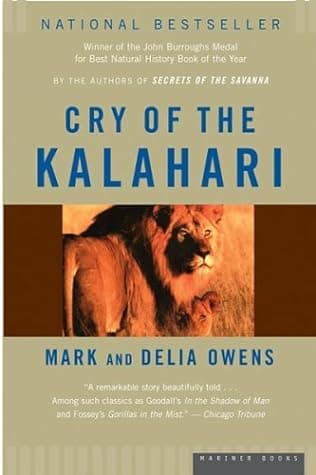
Core Idea
- Difficulty
- Medium
- Read it if
- You are fascinated by true-life adventure, pioneering scientific research, the challenges of living off-grid in extreme environments, or want to understand the intimate lives of African predators.
- Skip it if
- You prefer urban settings, dislike detailed descriptions of animal behavior and ecology, or are uncomfortable with narratives of prolonged isolation and hardship.
Key Takeaways from Cry of the Kalahari
Unconventional Research
Immersive living as the ultimate scientific method.
The Owens' way of doing ecological research was new and effective. They did not just observe; they lived. By giving up traditional fieldwork for deep immersion, spending years in an isolated, often dangerous environment, they became very close to their subjects. This was not just about collecting data; it was about understanding life in the Kalahari, from the social groups of brown hyenas to the subtle behaviors of lions and meerkats. Their method, born from need and kept going by strong dedication, shows that real insight often comes from dropping usual boundaries and living the experience. This allows for observations that go beyond academic study and show how an ecosystem connects.
“Living amongst the animals, sharing their world, was the only way to truly understand them.”
In the book: Their prolonged cohabitation with the animals, often sleeping mere yards from lion prides or observing brown hyenas at their dens for months on end, allowed them to document behaviors and social structures previously unknown to science.
Try this: To gain deeper understanding in any field, consider how full immersion or sustained, intimate engagement with the subject matter can reveal insights that more detached, conventional methods might miss. Prioritize long-term observation over short-term data gathering.
Related ideas: immersive-research, ethology, field-ecology
The Kalahari's Harsh Beauty
Survival in a land of extremes shapes every aspect of life.
The Kalahari Desert is not just a setting but a main part of the Owens' story, a land known for its harsh conditions. From extreme droughts that turn plains to dust to heavy rains that change the land overnight, every living thing—plant, animal, and human—is always fighting to survive. This challenging environment controls migration, hunting, and social behaviors, forcing adaptation and strength. The Kalahari's beauty is tied to its harshness; the life that grows there does so against great odds. Every successful hunt, every drop of water, and every generation that survives shows the power of adaptation and nature's raw, strong force.
“The Kalahari does not forgive weakness; it demands resilience, testing every creature, including us, to its very limits.”
In the book: The cyclical droughts and subsequent floods, which dictated the availability of water and prey, profoundly impacted the survival rates and behaviors of all animal species they studied, and directly threatened the Owens' own existence.
Try this: When facing challenging environments or situations, recognize that adversity often shapes resilience and unique adaptations. Learn to appreciate the inherent beauty and strength found in systems that endure extreme conditions.
Related ideas: desert-ecology, environmental-adaptation, survival-strategies
Predator-Prey Dynamics
The intricate, often brutal, ballet of life and death.
The Owens' observations show the basic, often hard, truth of predator-prey relationships in the wild. They saw the cleverness of lions, the opportunistic scavenging of brown hyenas, and the desperate fight of their prey. This is not senseless violence but a system where predators control herbivore numbers, keeping vegetation healthy. Prey animals develop amazing defenses, making their hunters better. The constant back and forth of life and death keeps ecological balance, creating a stable system needed for all species to survive. Understanding this delicate, often violent, balance helps us understand the natural world and each creature's part in it.
“In the Kalahari, the line between hunter and hunted is constantly redrawn, a primal dance essential for the health of the entire ecosystem.”
In the book: Detailed accounts of lion hunts, the strategic scavenging of brown hyenas following kills, and the constant vigilance of herbivores like springbok and gemsbok against predation.
Try this: Recognize that seemingly harsh interactions in nature often serve a vital role in maintaining balance. When analyzing systems, look beyond individual events to understand the interconnected roles and long-term effects of each component.
Related ideas: food-web, ecological-balance, natural-selection
The Brown Hyena's Secret World
Dispelling myths and revealing complex social structures.
Before the Owens' work, the brown hyena was mostly unknown and often confused with the more common spotted hyena, often seen as a lone scavenger. Their dedicated, long-term study changed these ideas, showing a social, smart, and adaptable animal. They recorded complex clan structures, denning behaviors, cooperative cub-rearing, and a strong ability to survive in harsh conditions by both scavenging and hunting. Their findings gave important scientific data and showed how important it is to question old ideas about species. It showed that deeper observation often reveals more richness and complexity than first thought.
“The brown hyena, often misunderstood and maligned, proved to be one of the most fascinating and complex creatures of the Kalahari.”
In the book: Their extensive observations of a specific brown hyena clan, detailing their social hierarchy, communal denning, and diverse foraging strategies, which established much of the foundational knowledge about this species.
Try this: Challenge your own preconceived notions about people, ideas, or even entire fields. Dedicate time to deep, unbiased observation and research to uncover the true complexity and nuance that often lie beneath surface assumptions.
Related ideas: species-conservation, behavioral-ecology, myth-busting
Human Resilience and Isolation
The psychological toll and triumph of extreme solitude.
Beyond the scientific discoveries, 'Cry of the Kalahari' shows human strength when facing extreme isolation. The Owens lived years in deep solitude, often without contact with other humans. They faced constant physical dangers and the mental strain of being completely alone in a vast, wild place. This isolation improved their observation skills and deepened their connection to nature, but it also tested them. It showed the human need for companionship and the great mental strength needed to do well in such conditions. Their story highlights that while solitude can lead to deep insights, it also requires extraordinary inner strength to keep it from becoming too much.
“The Kalahari demands not only physical endurance but a profound mental fortitude to withstand its relentless solitude.”
In the book: Recounts of weeks or months without seeing another human, the struggles with loneliness, the constant threat of injury or illness without immediate help, and the mental discipline required to maintain their research.
Try this: When undertaking ambitious, solitary projects, anticipate the psychological challenges of isolation. Develop coping mechanisms, maintain purpose, and appreciate the value of human connection when it is available.
Related ideas: psychological-endurance, wilderness-survival, solitude-effects
The Ethics of Intervention
Navigating the fine line between observation and interference.
A repeated ethical problem for the Owens was whether to intervene. Living so closely with the animals, they often saw situations where their help could save a life—a trapped animal, an injured cub, or a creature suffering during drought. However, their main role as observers, and their commitment to letting nature take its course, often went against their kind instincts. This tension shows a key ethical challenge in field research: how to have the least human impact while learning the most. Their struggle shows the great responsibility researchers have and the hard choices involved in keeping scientific honesty without giving up human kindness, emphasizing non-interference in natural processes.
“Every action we took, or failed to take, had the potential to ripple through the lives of the animals we studied. The responsibility was immense.”
In the book: Their internal debates and sometimes agonizing decisions about whether to intervene when witnessing an animal in distress, such as a lion cub separated from its pride or an animal trapped in a snare.
Try this: In any observational or research capacity, establish clear ethical guidelines regarding intervention. Understand the potential ripple effects of your actions and prioritize the long-term integrity of the system you are studying.
Related ideas: research-ethics, conservation-dilemmas, human-impact
The Fragility of Ecosystems
Human encroachment threatens even the most remote wildernesses.
Despite their remote location, the Owens often saw signs of human impact on the Kalahari ecosystem. Poaching, growing cattle ranches, and fences disrupted old migration routes and threatened animal populations. Their observations were an early warning, showing that even vast, seemingly untouched wild areas are not safe from human development. This is a strong reminder of how global ecosystems connect and the urgent need for conservation. It shows that protecting biodiversity means not just protecting specific species, but also protecting whole habitats from the small, but damaging, effects of human expansion.
“Even in the heart of the Kalahari, the shadow of human influence loomed, a stark reminder of how fragile these wild places truly are.”
In the book: The discovery of illegal snares and poachers, the impact of veterinary fences on wildebeest migration, and the increasing presence of cattle in areas previously dominated by wildlife.
Try this: Support conservation efforts that focus on habitat protection and sustainable land use. Be aware of how human activities, even seemingly minor ones, can have far-reaching impacts on natural environments.
Related ideas: habitat-loss, biodiversity-conservation, environmental-threats
The Language of the Wild
Learning to interpret subtle cues and non-verbal communication.
A key part of the Owens' success was their ability to 'read' the Kalahari. Years of intense observation taught them to understand the smallest signs: a bird's flight direction, a predator's scent on the wind, the texture of disturbed sand, or the specific calls of animals. This deep understanding went beyond scientific data; it was an intuitive grasp of the ecosystem's 'language.' This allowed them to expect danger, find animals, and understand complex interactions. This highlights the power of sustained, multi-sensory observation in gaining deep knowledge, showing that real mastery often comes from learning to interpret the non-obvious signals in an environment.
“To truly understand the Kalahari, one must learn to listen not just with ears, but with every sense, to the silent language of the wild.”
In the book: Their ability to track animals for miles by reading faint spoor, predicting weather changes based on atmospheric cues, and understanding the alarm calls of various species to anticipate predator movements.
Try this: Cultivate your observational skills in your own environment or field of interest. Pay attention to subtle cues, patterns, and non-verbal signals, as these often hold crucial information that direct observation might miss.
Related ideas: ecological-literacy, sensory-perception, tracking-skills
Cry of the Kalahari Quotes
“The wind was picking up, and the first few drops of rain began to fall, pattering softly on the dry earth.”
“We had come to Africa to live with the animals, not to simply observe them.”
“Living in the Kalahari was a constant lesson in humility, a reminder of how small we were in the grand scheme of things.”
“Each sunrise brought with it a renewed sense of purpose, a fresh opportunity to learn and discover.”
“The lions were not just predators; they were complex social beings with intricate relationships and individual personalities.”
“Our camp was a tiny island of human endeavor in a sea of untamed wilderness.”
“The silence of the desert was not an absence of sound, but a symphony of subtle noises that required careful listening.”
“We learned to read the subtle signs of the bush, to anticipate the movements of the animals, and to understand their unspoken language.”
“The Kalahari has a way of stripping away all pretense, leaving you with only the raw essentials of life.”
“Even in the harshest conditions, life finds a way to adapt, to persevere, and to thrive.”
“Our research was driven by a deep curiosity, a desire to understand the hidden mechanisms that governed this incredible ecosystem.”
“The beauty of the Kalahari was not always obvious; sometimes it was found in the smallest detail, the most delicate flower, or the most fleeting moment.”
“To truly know a place, you must live in it, breathe its air, and feel its pulse.”
“The challenges we faced only made our accomplishments more meaningful.”
Quiz
10 questions on the main ideas. Each answer comes with a short explanation.
Question 1
What was the primary mode of transportation Mark and Delia Owens used to reach the remote Deception Valley in the Kalahari?
- A small airplane
- A Land Rover
- A camel caravan
- By foot with local guides
Show answer
B. A Land Rover The Owens acquired a sturdy Land Rover, which became their indispensable vehicle for navigating the harsh terrain of the Kalahari.
Question 2
Which animal species became the primary focus of Mark and Delia Owens' initial research in Deception Valley?
- Elephants
- Lions
- Brown Hyenas
- Meerkats
Show answer
C. Brown Hyenas The Owens initially focused their research on the elusive brown hyenas, observing their nocturnal habits and social structures.
Question 3
What significant natural challenge did the Owens frequently face during their time in the Kalahari, often leading to scarcity of resources?
- Volcanic eruptions
- Persistent blizzards
- Drought
- Frequent earthquakes
Show answer
C. Drought Drought was a recurring and life-threatening challenge in the Kalahari, impacting water availability for both the Owens and the wildlife.
Question 4
How did Mark and Delia Owens primarily distinguish individual brown hyenas for their research?
- By attaching radio collars to all individuals
- By unique scar patterns and ear notches
- By vocalization analysis through recordings
- By genetic testing of scat samples
Show answer
B. By unique scar patterns and ear notches The Owens relied on meticulous observation of natural markings like scars, ear tears, and variations in fur patterns to identify individual hyenas.
Question 5
What unique adaptation did the Kalahari lions exhibit that surprised the Owens, particularly regarding their hunting strategy?
- They primarily hunted during the day in open savannas.
- They specialized in hunting small birds and rodents.
- They developed a reliance on water sources for ambushing prey.
- They used tools to extract prey from burrows.
Show answer
C. They developed a reliance on water sources for ambushing prey. The Kalahari lions, unlike those in more water-rich areas, learned to use the scarce waterholes as ambush points, waiting for prey to come to them.
Question 6
What was the significance of the 'island' of vegetation in Deception Valley for the wildlife, particularly during the dry season?
- It served as a denning site exclusively for hyenas.
- It was the only source of permanent fresh water in the valley.
- It provided crucial shelter and grazing when other areas were barren.
- It was a sacred place for local indigenous tribes.
Show answer
C. It provided crucial shelter and grazing when other areas were barren. The 'island' offered vital refuge, shade, and residual grazing during the brutal dry seasons, making it a critical hub for many animal species.
Question 7
Beyond scientific observation, what personal challenge did the Owens face regarding their food supply in the remote Kalahari?
- They had to hunt all their food locally.
- They struggled with consistent refrigeration for perishables.
- Their diet was solely based on native desert plants.
- They regularly traded with nomadic tribes for provisions.
Show answer
B. They struggled with consistent refrigeration for perishables. Without reliable electricity, maintaining a supply of fresh food was a constant struggle. They often relied on canned goods and ingenious methods to preserve what they had.
Question 8
What was the ethical dilemma the Owens grappled with when observing animals suffering from drought or injury?
- Whether to intervene and provide medical aid or let nature take its course.
- If they should capture and relocate the suffering animals to a sanctuary.
- If documenting the suffering was exploiting the animals.
- Whether to report the suffering to global conservation organizations immediately.
Show answer
A. Whether to intervene and provide medical aid or let nature take its course. As scientists, they felt compelled to observe without interference, but as compassionate humans, they often struggled with the desire to help animals in distress, particularly during severe droughts.
Question 9
How did the Owens' long-term presence and non-threatening behavior impact the animals' perception of humans in Deception Valley?
- The animals became more aggressive and territorial towards them.
- The animals learned to associate humans with food handouts.
- The animals largely lost their fear of the Owens, allowing for close observation.
- The animals migrated away from their research camp due to disturbance.
Show answer
C. The animals largely lost their fear of the Owens, allowing for close observation. Over years, their consistent, non-intrusive presence allowed many species, including brown hyenas and lions, to habituate to them, enabling unprecedented close-up studies.
Question 10
What was the most significant danger posed by the large herds of elephants that occasionally passed through Deception Valley?
- They preyed on the smaller animals the Owens were studying.
- They were highly aggressive towards humans and attacked on sight.
- Their sheer size and destructive foraging could obliterate the Owens' camp and water sources.
- They carried diseases that could infect the Owens.
Show answer
C. Their sheer size and destructive foraging could obliterate the Owens' camp and water sources. While generally not aggressive, the immense power and destructive feeding habits of elephant herds, especially when stressed by drought, posed a significant threat to the Owens' fragile camp and vital water supplies.
Cry of the Kalahari FAQ
What is 'Cry of the Kalahari' about?
'Cry of the Kalahari' is the true story of Mark and Delia Owens, two young American zoologists who ventured into the remote Kalahari Desert in the 1970s to study its wildlife. Their memoir details their eight years living in isolation, facing extreme environmental challenges, and their groundbreaking research on lions and brown hyenas.
Does living in the Kalahari Desert for scientific research work?
Yes, 'Cry of the Kalahari' demonstrates that immersive living in the Kalahari Desert was highly effective for the Owens' scientific research, allowing them unprecedented access and insight into animal behaviors. Their dedication led to significant discoveries about species like the brown hyena, which were previously little understood.
What kind of animals did the Owens study in the Kalahari?
The Owens primarily focused their research on lions and brown hyenas, observing their social structures, hunting patterns, and interactions within the desert ecosystem. They also encountered and documented a wide variety of other Kalahari wildlife, including meerkats, giraffes, and various antelope species.
How different is 'Cry of the Kalahari' from typical safari travelogues?
'Cry of the Kalahari' differs significantly from typical safari travelogues by offering an in-depth, long-term immersion rather than a brief visit. It focuses on scientific research, the daily struggles of remote living, and the personal sacrifices involved, providing a much deeper and more intimate perspective on the wilderness and its challenges.
What challenges did Mark and Delia Owens face in the Kalahari?
The Owens faced numerous life-threatening challenges including severe droughts, devastating bushfires, violent sandstorms, and constant dangers from wild animals. They also struggled with extreme isolation, limited resources, and the logistical complexities of conducting long-term scientific research in such a remote environment.
Is 'Cry of the Kalahari' suitable for animal lovers?
Absolutely, 'Cry of the Kalahari' is highly suitable for animal lovers, offering intimate and detailed observations of various African wildlife species. The book provides a profound look into animal behavior, conservation efforts, and the deep emotional connection the Owens developed with the creatures they studied.
What is the significance of the Kalahari Desert in the book?
The Kalahari Desert is not just a setting but a central character in the book, shaping the Owens' experiences and research. Its harsh yet beautiful environment, with its unique ecosystem and extreme conditions, profoundly influenced their scientific discoveries and personal journey.
Does the book discuss conservation efforts?
Yes, 'Cry of the Kalahari' implicitly and explicitly addresses conservation efforts by highlighting the fragility of the desert ecosystem and the importance of protecting its wildlife. The Owens' research itself contributed valuable data for conservation, and their experiences underscore the need for wilderness preservation.
Similar books
- Gorillas in the Mist
Dian Fossey
4.2 (19k) average on GoodreadsBiographyDetails a dedicated scientist's long-term, isolated research into a specific large mammal species in a challenging African environment, facing conservation issues.
- Eat, Pray, Love
Elizabeth Gilbert
3.6 (1.5M) average on GoodreadsLifestyleA heartbroken writer leaves her conventional life for a year-long global search for pleasure in Italy, spiritual devotion in India, and unexpected love and balance in Bali.
- Wild: From Lost to Found on the Pacific Crest Trail
Cheryl Strayed
4.0 (615k) average on GoodreadsLifestyleAfter losing her mother and her marriage, a young woman impulsively hikes over a thousand miles of the Pacific Crest Trail alone, finding strength and healing in the unforgiving wilderness.
- Into Thin Air: A Personal Account of the Mount Everest Disaster
Jon Krakauer
4.2 (395k) average on GoodreadsLifestyleOn May 10, 1996, ambition and a sudden, violent storm turned Mount Everest into a deadly trap, leaving Jon Krakauer to tell the harrowing story of a disaster that took lives and shattered climbers' dreams.
- On The Road
Jack Kerouac
3.6 (349k) average on GoodreadsLifestyleDean Moriarty and Sal Paradise go on a wild, cross-country trip with jazz, drugs, and a desperate search for meaning on America's post-war roads.
- A Walk in the Woods: Rediscovering America on the Appalachian Trail
Bill Bryson
4.1 (346k) average on GoodreadsLifestyleBill Bryson humorously describes his ill-prepared yet insightful attempt to hike the Appalachian Trail, meeting unique characters and the raw beauty of the wilderness.





Enjoyed the summary?
A summary gives you the shape of the book. The book itself has the detail, the examples and the voice.
Find Cry of the Kalahari on AmazonAs an Amazon Associate, BookBrief earns from qualifying purchases. How we're funded