
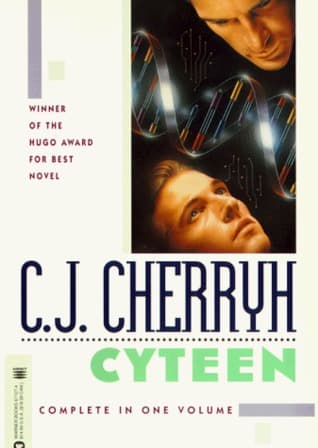
Synopsis
Covers the whole plot, including the ending.
- Difficulty
- Hard
- Pacing
- Slow
- Mood
- Introspective, cerebral, tense, politically charged, meticulous
Cyteen Plot Summary
Covers the whole plot, including the ending.
The Legacy of Ariane Emory
The novel begins after the sudden death of Ariane Emory I, the brilliant and autocratic Director of Reseune and the force behind the Union's genetic engineering programs. Her death is officially an accident, but powerful political factions in the Union suspect foul play. Ariane I had prepared for her succession by creating a young clone, Ariane II, to inherit her position and continue her work. The story introduces Cyteen's complex political system, dominated by Reseune and the Council, and explains 'azi,' a key part of Union society and Reseune's power.
Ariane II's Early Life
Ariane II, a child azi, is placed with key figures from Ariane I's inner circle: Florian, head of Security, and Catlin, a high-ranking Reseune official. Her upbringing is carefully controlled, designed to replicate Ariane I's experiences and knowledge through 'tape-training.' She is raised in isolation within Reseune, shielded from outside influences and put through strict education. This early period shows the ethical challenges of azi replication and the immense pressure on Ariane II to live up to her predecessor, while also dealing with the subtle differences that develop between a clone and her original.
Political Intrigue and Shifting Alliances
With Ariane I gone, various factions in the Union Council and Reseune compete for control. Figures like Justin, a powerful politician, and Stani, a military leader, navigate the delicate balance of power. Ariane II's 'tape-training' becomes a point of disagreement, with some questioning its effectiveness or ethics. Rumors of a conspiracy around Ariane I's death continue, creating an atmosphere of paranoia. Ariane II, though young, becomes central to these political struggles, as her future leadership is seen as important for Union stability.
Growing Up in Reseune
As Ariane II grows, her sharp mind becomes clear. Despite her strict training, she develops her own personality, showing keen observation and intelligence. Her interactions with her guardians, Florian and Catlin, become more complex as she questions information and forms her own conclusions. She researches Reseune's archives, studying Ariane I's scientific and political theories, but also seeking independent knowledge. This period shows her growing independence and the challenges of replicating a genius while allowing for individual growth.
The Shadow of Murder
Through her careful research and intelligence, Ariane II starts to find inconsistencies in the official story of Ariane I's death. She finds subtle differences in reports and begins to question the loyalty of those around her. The story follows her growing suspicions, focusing on her analysis of Reseune's security logs and personnel files. She realizes the 'accident' might have been deliberate, and that the killer could still be in Reseune's highest ranks. This realization drives her to uncover the truth, putting her on a path against powerful figures who might want to keep the past hidden.
The Azi Question and Ethics
As Ariane II understands Reseune's operations better, she confronts the complex ethical questions about creating and treating azi. She observes the different classes of azi, from the specialized 'beta' azi like herself to the more subservient 'gamma' azi, and recognizes the power imbalances. Her own identity as an azi clone of a powerful figure helps her understand the psychological and societal effects of this technology. She begins to consider reforms and improvements to the azi system, showing her growing empathy and a desire to move beyond Ariane I's purely practical approach.
Confronting the Past
Ariane II carefully investigates Ariane I's personal and professional relationships, looking for clues to the murder. She examines old records, letters, and testimonies from those who worked closely with Ariane I. Her investigation brings her into contact with people who were both loyal allies and bitter rivals of Ariane I, forcing her to tell truth from lies. She especially focuses on the motivations of key figures like Catlin and Florian, recognizing that their closeness to Ariane I also made them potential suspects. This period shows her growing political skill and her ability to use information and people to her advantage.
The Alliance Threat
Beyond internal power struggles, the ongoing cold war with the Alliance is a constant threat to the Union. Ariane II's research into Ariane I's work reveals how important Reseune's genetic programs are for maintaining the Union's technological and military advantage. The possibility of Alliance spying or intervention adds another layer of complexity to the political situation, making Ariane II's search for truth even more uncertain. She realizes that the Union's stability depends not only on internal unity but also on a strong defense against outside enemies, a task she is increasingly preparing for.
Unmasking the Killer
Through her own deduction, careful observation, and strategic manipulation, Ariane II uncovers Ariane I's murderer. The revelation is shocking, involving a trusted advisor with complex and personal reasons for the act. The story builds tension as Ariane II carefully sets her traps, gathering undeniable evidence. The confrontation is not just about justice, but a planned political move to consolidate her own power and remove a threat to Reseune and the Union. This climax shows her strategic genius and her willingness to make difficult, practical decisions.
Consolidating Power
With the killer exposed, Ariane II firmly establishes her authority as Director of Reseune. She shows her skill at political maneuvering, outsmarting rivals and securing the loyalty of key staff. Her actions are decisive and calculated, aimed at strengthening Reseune's position in the Union and preventing future internal conflict. The ending shows her not just as a clone, but as a distinct and powerful leader, ready to guide the Union into a new era. She begins to implement her own policies, showing that while she inherited a legacy, she is creating her own path.
Cyteen Characters
Ariane Emory II
Protagonist
The brilliant genetic replication of Ariane Emory I, destined to lead Reseune.
Ariane Emory II is a 'beta' azi, a genetically engineered human designed to be a perfect replicate of the original Ariane Emory, the revered and feared Director of Reseune. Raised in a highly controlled environment, she undergoes extensive 'tape-training' to absorb her predecessor's knowledge and experiences. Initially a child prodigy, she matures into an extraordinarily intelligent and perceptive young woman. She is driven by a profound need to understand her predecessor, solve her murder, and ultimately forge her own identity while upholding the Union's interests. She possesses a keen political mind, a sharp scientific intellect, and a growing sense of empathy for the azi population.
Relationships: Ariane Emory I (Original/clone, predecessor/successor); Florian (Guardian/security chief); Catlin (Guardian/Reseune official); Justin (Political adversary/ally)
Ariane Emory I
Deceased Protagonist/Influence
The visionary, autocratic founder of Reseune, whose legacy profoundly shapes the Union.
Ariane Emory I is the brilliant but ruthless Director of Reseune, a scientific and political titan whose genetic engineering programs are the backbone of the Union. Though deceased at the novel's opening, her presence looms large, influencing every character and plot point. She was a visionary scientist, an astute politician, and a complex individual whose motivations and actions are slowly revealed through Ariane II's investigations. Her ambition shaped the Union, and her meticulous planning for her own succession through azi replication demonstrates her foresight and control, even from beyond the grave. Her perceived 'accident' is the central mystery driving the plot.
Relationships: Ariane Emory II (Original/clone, predecessor/successor); Florian (Trusted aide/security chief); Catlin (Trusted aide/Reseune official); Justin (Political rival/collaborator)
Florian
Supporting
Ariane II's chief guardian and head of Reseune Security, fiercely loyal to the Emory legacy.
Florian is the head of Reseune Security and a fiercely loyal, though sometimes inscrutable, aide to both Ariane I and Ariane II. He is one of Ariane II's primary guardians, responsible for her physical safety and the integrity of her 'tape-training.' Florian is a pragmatic and highly disciplined individual, deeply entrenched in the complex politics of Reseune. His loyalty is primarily to the institution and the Emory line, making him a powerful, if somewhat intimidating, mentor figure for Ariane II. He provides crucial insights into the workings of Reseune and the dangers inherent in the political landscape.
Relationships: Ariane Emory I (Subordinate/trusted aide); Ariane Emory II (Guardian/security chief); Catlin (Colleague/rival)
Catlin
Supporting
A high-ranking Reseune official and co-guardian of Ariane II, with a complex past.
Catlin is a high-ranking Reseune official and, along with Florian, a guardian to Ariane II. He is an intelligent and ambitious man who was a close confidante and collaborator of Ariane I. His relationship with Ariane I was multifaceted, encompassing both professional partnership and personal complexities. Catlin is a master of internal Reseune politics and a key player in the power struggles following Ariane I's death. His motivations are often ambiguous, making him a significant figure in Ariane II's investigation into the murder, as he represents both a potential ally and a potential threat.
Relationships: Ariane Emory I (Subordinate/confidante); Ariane Emory II (Guardian/Reseune official); Florian (Colleague/rival)
Justin
Supporting
A powerful and influential Union politician, often at odds with Reseune.
Justin is a prominent and powerful figure on the Union Council, representing the political wing that frequently clashes with the scientific autonomy of Reseune. He is a shrewd and experienced politician, always seeking to balance the power of Reseune with the broader interests of the Union. While often an antagonist to Reseune's more extreme policies, he is not necessarily malicious, but rather pragmatic. He views Ariane II with a mixture of suspicion and hope, recognizing her potential but also wary of the unchecked power she might wield. His interactions with Ariane II highlight the delicate balance between scientific progress and political governance.
Relationships: Ariane Emory I (Political rival/collaborator); Ariane Emory II (Political adversary/ally)
Stani
Supporting
A high-ranking military leader within the Union, focused on external defense.
Stani is a respected and influential military leader within the Union, primarily concerned with the defense against the Alliance. He represents the military's perspective within the Union Council, often advocating for policies that strengthen the Union's defensive capabilities. While less directly involved in the internal power struggles of Reseune, he is aware of its strategic importance and the necessity of its scientific output for the Union's survival. He is a pragmatic and straightforward individual, who respects competence and leadership, regardless of its source.
Relationships: Ariane Emory I (Military liaison); Ariane Emory II (Military liaison)
Paul
Supporting
An azi aide to Ariane I, later serving Ariane II.
Paul is a highly specialized azi, initially serving Ariane I as a personal aide and later assigned to Ariane II. He is a calm, efficient, and exceptionally loyal individual, whose programming makes him an invaluable resource for information retrieval and complex data analysis. His presence provides Ariane II with a stable and unbiased source of information, crucial in her investigations. Paul represents the pinnacle of azi development, demonstrating their capacity for sophisticated thought and unwavering dedication, even while operating within strict behavioral parameters.
Relationships: Ariane Emory I (Azi aide); Ariane Emory II (Azi aide)
Jordan
Supporting
A younger azi, companion and confidante to Ariane II.
Jordan is a younger azi, initially assigned as a companion and playmate to Ariane II during her formative years. He is a more emotionally developed azi, designed to provide a sense of normalcy and companionship. His presence allows Ariane II to explore aspects of her personality and emotions that are often suppressed by her rigorous training. Jordan's loyalty and affection for Ariane II are genuine, and he serves as a sounding board and a source of emotional support, providing a crucial human connection in her isolated upbringing. He represents the potential for deeper emotional lives within the azi population.
Relationships: Ariane Emory II (Azi companion/aide)
Cyteen Themes
Identity and Self-Determination
The main theme is Ariane II's struggle to define her own identity as a genetic copy of a powerful predecessor. She is expected to be Ariane I, but her experiences and developing consciousness make her unique. The novel explores how much environment and individual choice can shape a person, even with an identical genetic blueprint. This extends to the broader question of azi identity—are they just tools, or do they have rights and individuality?
“She was not her mother. She was not the dead woman. She was herself, and she would make her own decisions.”
Power and Politics
Cyteen is a political novel, examining the power dynamics within the Union, especially between Reseune and the Council. Ariane I's death creates a power vacuum, leading to intense maneuvering, alliances, and betrayals. Ariane II must learn to navigate this dangerous environment, using her intelligence and political skill to secure her position and protect Reseune's influence. The novel explores how power is gained, maintained, and used, and the moral compromises often required.
“Power was a carefully constructed illusion, built on loyalty, fear, and the perception of control.”
Ethics of Genetic Engineering
The novel explores the ethical implications of advanced genetic engineering, particularly the creation of 'azi'—genetically engineered humans for specific roles. It questions the morality of creating sentient beings for servitude, the potential for exploitation, and the blurred lines between human and azi. Ariane II, an azi herself, confronts these ethical dilemmas as she deals with her own identity and the rights of others like her. The story explores the societal impact of such technology and the responsibility of those who use it.
“They were not slaves. They were designed. But what was the difference, in the end, if choice was denied?”
Legacy and Succession
The core of Cyteen is the concept of legacy and the challenges of succession. Ariane II is burdened by Ariane I's monumental legacy, expected to perfectly replicate her predecessor's genius and leadership. The novel explores the pressure of living up to such expectations, the difficulty of inheriting a complex political and scientific empire, and the tension between honoring a legacy and forging a new path. It questions whether true succession is about exact replication or about evolving a vision for the future.
“A legacy was not merely a set of instructions; it was a living, breathing thing that demanded evolution.”
Plot Devices & Literary Techniques
Azi Replication
The genetic cloning and 'tape-training' of humans for specific roles.
Azi replication is the core scientific innovation and a primary plot device in Cyteen. It involves the genetic cloning of individuals, often highly specialized, and their subsequent 'tape-training' – a process of accelerated learning and memory implantation designed to impart vast amounts of knowledge and experience. Ariane II is a 'beta' azi, a replicate of Ariane I, intended to seamlessly continue her work. This device drives the central conflict of identity for Ariane II and raises profound ethical questions about personhood, free will, and the very nature of humanity. It also serves as a source of power for Reseune and a unique method of succession for key Union figures.
The Murder Mystery
The unsolved death of Ariane I, driving Ariane II's investigation.
The mysterious death of Ariane Emory I, initially ruled an accident but suspected by many to be murder, serves as a crucial plot device. It provides the primary impetus for Ariane II's intellectual development and her deep dive into Reseune's history and politics. The investigation allows the author to reveal intricate details about Ariane I's life, her relationships, and the political machinations within the Union. It creates suspense and allows Ariane II to demonstrate her formidable detective skills and strategic thinking, ultimately leading to the unmasking of the killer and the consolidation of her own power.
Tape-Training
Accelerated learning and memory implantation for azi.
Tape-training is a specialized form of accelerated education and memory implantation used for azi. It involves direct neural input of vast amounts of information, experiences, and even personality traits. For Ariane II, it is meant to perfectly replicate Ariane I's knowledge base and intellectual framework. As a plot device, tape-training highlights the tension between programmed identity and emergent individuality. It provides Ariane II with an unparalleled foundation of knowledge, but also presents the challenge of discerning which 'memories' are truly hers and which are implanted, ultimately forcing her to question her own sense of self and the authenticity of her experiences.
Internal Monologue and Perspective
Extensive use of Ariane II's internal thoughts and analytical processes.
The narrative heavily relies on Ariane II's internal monologue and her highly analytical perspective. This plot device allows the reader direct access to her brilliant mind, her meticulous thought processes, and her emotional development. It is through her internal analysis of data, interactions, and historical records that the plot unfolds, the murder mystery is solved, and the complex political landscape is understood. This immersive perspective emphasizes her intellectual prowess and her unique journey of self-discovery, making the reader privy to her deductions and her evolving understanding of the world around her, often making her seem more 'human' than her creators intended.
Quiz
10 questions on the plot and the characters. Each answer comes with a short explanation.
Question 1
What is the primary genre of the book 'Cyteen'?
- Mystery
- Science Fiction
- Historical Fiction
- Romance
Show answer
B. Science Fiction The provided description explicitly states that 'Cyteen' is a Science Fiction novel, also mentioning elements of politics and fantasy.
Question 2
Who is the author of 'Cyteen'?
- Isaac Asimov
- Ursula K. Le Guin
- C.J. Cherryh
- Arthur C. Clarke
Show answer
C. C.J. Cherryh The description clearly states, 'the latest Union-Alliance novel by the author of Downbelow Station.' C.J. Cherryh is the author.
Question 3
What key element of science fiction is mentioned as a framework in 'Cyteen'?
- Time Travel
- Alien Invasion
- Genetic Manipulation
- Cyberpunk
Show answer
C. Genetic Manipulation The description specifically lists 'genetic manipulation' as one of the frameworks for the novel.
Question 4
What personal conflict haunts the young scientist protagonist?
- A past scientific failure
- The death of her genetic duplicate
- A political rival's betrayal
- A forbidden love affair
Show answer
B. The death of her genetic duplicate The description states she is 'haunted by the knowledge that her predecessor and genetic duplicate died at the hands of one of her trusted advisors.'
Question 5
The novel is described as a 'Union-Alliance novel'. This suggests a conflict or relationship between which entities?
- Two different alien races
- Two human factions or governments
- A human government and a rogue AI
- Internal factions within a single government
Show answer
B. Two human factions or governments The terms 'Union' and 'Alliance' typically refer to distinct political entities or groups, often in a human-centric science fiction context.
Question 6
Which of the following themes is explicitly mentioned as being present in 'Cyteen'?
- Environmental collapse
- Space exploration
- Murder
- First contact with extraterrestrials
Show answer
C. Murder The description lists 'Murder, politics, and genetic manipulation' as providing the framework for the novel.
Question 7
The description mentions the protagonist is a 'brilliant young scientist'. What is her role or position in the novel?
- A rebel leader
- A diplomat
- Someone who rises to power
- A lone explorer
Show answer
C. Someone who rises to power The description states she 'rises to power on Cyteen'.
Question 8
The author's talent is described as 'intense, literate storytelling'. What does this imply about the reading experience?
- The book is likely to be fast-paced and action-packed with simple language.
- The book might be challenging to read due to complex vocabulary and plot.
- The book offers a rich and engaging narrative with sophisticated writing.
- The book focuses more on character development than plot.
Show answer
C. The book offers a rich and engaging narrative with sophisticated writing. 'Intense' suggests a strong emotional or narrative drive, while 'literate' implies well-crafted prose and intellectual depth. This combination points to a sophisticated and engaging reading experience, not necessarily simple or purely character-focused.
Question 9
The phrase 'genetic duplicate' suggests a significant plot element related to:
- Artificial intelligence and consciousness
- Cloning and identity
- Interstellar genetics and evolution
- Bio-engineering for space travel
Show answer
B. Cloning and identity A 'genetic duplicate' directly implies the concept of cloning, raising questions about identity, lineage, and potentially the nature of the original person.
Question 10
Considering the elements of 'murder, politics, and genetic manipulation' within a 'Union-Alliance' framework, what kind of atmosphere is most likely conveyed in 'Cyteen'?
- A lighthearted adventure in space
- A dark and complex political thriller with sci-fi elements
- A straightforward exploration of scientific ethics
- A romantic comedy set on a space station
Show answer
B. A dark and complex political thriller with sci-fi elements The combination of murder, intricate politics, genetic manipulation, and potential inter-factional conflict points towards a serious, possibly morally ambiguous, and complex narrative rather than a lighthearted or simple one.
Cyteen FAQ
What is Cyteen about?
Cyteen is a science fiction novel by C.J. Cherryh that delves into the complex world of politics, genetic manipulation, and murder on the planet Cyteen. It follows the rise of a brilliant young scientist who is also a genetic duplicate of her predecessor, while dealing with the consequences of a past assassination.
Who is Ariane Emory in Cyteen?
Ariane Emory is the central figure in Cyteen, a brilliant scientist and the 'Azi' or successor to the original Ariane Emory. She is a clone or genetic duplicate, grappling with the memories and responsibilities of her predecessor while navigating the treacherous political landscape of Cyteen.
What is the role of genetics in Cyteen?
Genetics plays a pivotal role in Cyteen, with the concept of cloning and genetic duplication being central to the plot. The novel explores the ethical implications of creating and manipulating human life for political and societal control, particularly through the use of 'Azi' or successors.
What is the political situation on Cyteen?
Cyteen is depicted as a highly controlled and politically charged society, dominated by the Union-Alliance conflict. The ruling council, known as the Rese, wields immense power, and political intrigue, manipulation, and power struggles are constant themes.
What is the Union-Alliance conflict in Cyteen?
The Union-Alliance conflict is the overarching backdrop of Cyteen, representing a long-standing interstellar war or tension between different factions. Cyteen itself is a key player in this conflict, with its advanced technology and political maneuvering influencing the broader galactic struggle.
Is Cyteen a standalone novel?
While Cyteen is a complex and lengthy novel that can be read on its own, it is part of C.J. Cherryh's larger Union-Alliance universe. Familiarity with other books in this series, like Downbelow Station, might enhance the understanding of the broader political context.
What are the main themes in Cyteen?
The main themes in Cyteen include power, identity, memory, morality, the ethics of genetic engineering, political manipulation, and the nature of leadership. The novel deeply explores how these elements intertwine and shape individuals and societies.
Who is the main antagonist in Cyteen?
The concept of antagonism in Cyteen is complex and multifaceted. While there are certainly characters who act in opposition to Ariane Emory's goals, the novel often blurs the lines between protagonist and antagonist, with betrayal and hidden agendas being key drivers of conflict.
How does Cyteen compare to other C.J. Cherryh novels?
Cyteen is known for its intricate plotting, deep character development, and exploration of complex political and philosophical themes, which are hallmarks of C.J. Cherryh's writing. It's considered one of her most ambitious and rewarding novels, particularly for readers who enjoy dense, character-driven science fiction.
What kind of reader would enjoy Cyteen?
Readers who enjoy intricate political thrillers, philosophical science fiction, and character-driven narratives will likely enjoy Cyteen. It's best suited for those who appreciate detailed world-building and are willing to invest time in a long and complex story.
About the author

C. J. Cherryh is a Hugo Award-winning author celebrated for her intricate and meticulously researched science fiction. Her works, including the critically acclaimed novel "Cyteen" and the "Foreigner" series, are known for their complex political intrigue, alien cultures, and realistic portrayals of interstellar societies. Cherryh's dedication to world-building and character development has earned her a significant following among science fiction enthusiasts.
Similar books
- Dune
Frank Herbert
4.2 (766k) average on GoodreadsFantasy"Cyteen" shares with "Dune" a masterful command of intricate political systems and the long-term impact of individual actions on a vast interstellar empire. Both novels feature powerful, almost god-like central figures (Ariane Emory and Paul Atreides) who are products of unique genetic and environmental conditioning, and whose influence shapes the future of humanity. However, while "Dune" focuses more on ecological themes and messianic prophecy, "Cyteen" delves deeper into the ethics of identity replication and the scientific institutions that drive societal evolution. Cherryh's world feels more technologically advanced and less mystical than Herbert's Arrakis.
- The Dispossessed
Ursula K. Le Guin
4.2 (88k) average on GoodreadsPoliticsBoth "Cyteen" and "The Dispossessed" are exemplary works of sociological science fiction, meticulously crafting societies with distinct ideologies and exploring their strengths and weaknesses. Le Guin's novel contrasts anarcho-syndicalist Anarres with capitalist Urras, examining economic and social structures. "Cyteen", while not a direct comparison of opposing systems, similarly scrutinizes the societal implications of its core premise – azza and the power of Reseune. Both authors excel at creating believable, complex characters who are products of their environments and grapple with profound ethical dilemmas. Le Guin's prose is generally more accessible and less dense than Cherryh's, but both offer deeply thoughtful explorations of humanity's future.
- 1984
George Orwell
4.2 (3.1M) average on GoodreadsPoliticsIn a future where surveillance and thought control are absolute, a man's search for truth clashes with the Party, showing that hope can be a form of rebellion.
- Animal Farm
George Orwell
4.0 (2.7M) average on GoodreadsPoliticsA farm animals' rebellion against humans turns into a pig-led dictatorship, showing how power corrupts and revolutionary ideals are betrayed.
- Freakonomics: A Rogue Economist Explores the Hidden Side of Everything
Steven D. Levitt
4.0 (709k) average on GoodreadsBusinessThis book uses economic principles to reveal the surprising incentives behind everything from drug dealing and real estate to cheating teachers and the decline of crime.
- I Am Malala: The Story of the Girl Who Stood Up for Education and Was Shot by the Taliban
Malala Yousafzai
4.1 (419k) average on GoodreadsPoliticsA teenage girl from a Taliban-controlled valley refuses to give up her books, becoming a global voice for education even after an assassination attempt.





Enjoyed the summary?
A summary gives you the shape of the book. The book itself has the detail, the examples and the voice.
Find Cyteen on AmazonAs an Amazon Associate, BookBrief earns from qualifying purchases. How we're funded