
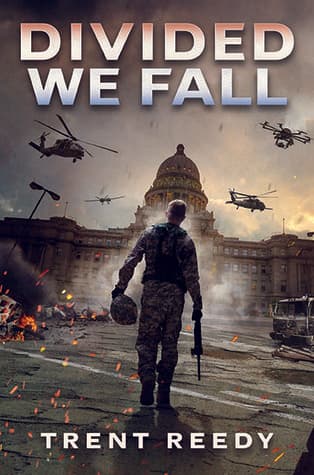
Synopsis
Covers the whole plot, including the ending.
- Difficulty
- Medium
- Pacing
- Fast
- Mood
- Suspenseful, Thought-provoking, Intense, Realistic
- Read it if
- You enjoy thought-provoking YA science fiction with a strong focus on political themes, military action, and the potential for a modern-day civil war in the USA.
- Skip it if
- You prefer fantasy or romance over realistic political thrillers, or find military conflict and themes of national division too intense.
Divided We Fall Plot Summary
Covers the whole plot, including the ending.
The Boise Incident
Private Danny Wright, a new recruit in the Idaho National Guard, deploys with his unit to Boise to control a protest against federal overreach, specifically a new federal speed limit law. The crowd is large and agitated, and the atmosphere is tense. Amid the chaos, Danny's M-16 rifle accidentally discharges. This single shot triggers panicked firing from other soldiers, resulting in twelve protestor deaths and many injuries. The incident immediately escalates, drawing national attention and condemnation, with the federal government demanding the arrest and prosecution of the soldiers involved, while Idaho's Governor Pruitt vows to protect his Guardsmen.
Federal Demands and State Defiance
Following the Boise incident, President Martinez publicly calls the Idaho National Guard's actions a massacre and demands Governor Pruitt surrender the implicated soldiers, including Danny, to federal authorities for trial. Governor Pruitt refuses, citing state sovereignty and his belief that the soldiers acted in self-defense under extreme pressure. This defiance sets up a direct confrontation between the federal government and Idaho. Federal agents arrive in Idaho to try to arrest the soldiers, but they meet resistance from state police and the remaining National Guard units loyal to Pruitt, who fortify their positions and prepare for a potential federal invasion.
The Siege of Boise
As Governor Pruitt continues to refuse the President's demands, the federal government escalates its response. President Martinez declares Idaho in rebellion and orders a federal blockade. Federal troops, including Army Rangers and Marine units, surround Idaho's borders, cutting off all supply lines, communication, and access to the state. Boise becomes a besieged city, with its citizens facing dwindling resources and an uncertain future. Danny and his unit, now seen as heroes by many Idahoans and traitors by the federal government, find themselves on the front lines of what is rapidly becoming a full-blown conflict, with their loyalty to Idaho tested against their oath to the United States.
The Spread of Secession
The standoff between Idaho and the federal government spreads across the nation. Other states, particularly in the Pacific Northwest and the South, begin to express sympathy for Idaho's stance on states' rights and federal overreach. Montana and Wyoming, in particular, declare their support for Idaho and threaten to secede if the federal government continues its aggressive actions. This growing movement of state defiance puts immense pressure on President Martinez and shows the deep divisions within the United States. The initial incident in Boise, once a local tragedy, has now become the cause for a much larger national crisis, pushing the country to the brink of a second civil war.
The First Shots of War
The federal blockade intensifies, and skirmishes begin to break out along Idaho's borders. Danny and his fellow Guardsmen deploy to defensive positions, seeing firsthand the transition from a political standoff to active military conflict. Federal forces attempt to breach Idaho's defenses, leading to firefights and casualties on both sides. These engagements, though initially small, mark the official start of hostilities. The reality of war sets in for Danny and his unit as they face the difficult decision of firing upon fellow Americans, some of whom they once considered allies. The conflict quickly moves beyond the initial incident, becoming a struggle for control and sovereignty.
Danny's Internal Conflict
As the conflict escalates, Danny is plagued by guilt over his accidental shot that triggered the entire crisis. He struggles with the morality of fighting against federal troops, questioning whether he is truly serving his country by fighting against it. His father, a veteran, encourages him to stand by his state, while his own conscience wrestles with the broader implications of a divided America. Danny witnesses the devastating impact of war on civilians and soldiers alike, forcing him to confront the harsh realities of his situation. He begins to question the motives of both sides and desperately seeks a way to end the bloodshed without betraying his comrades or his principles.
The Role of Media and Propaganda
Throughout the conflict, both the federal government and the secessionist states use extensive propaganda campaigns. Federal media portrays the Idaho National Guard as rogue terrorists and Governor Pruitt as a dangerous demagogue, while Idaho's media frames the federal government as tyrannical and oppressive, infringing on states' rights. Danny observes how easily information can be manipulated to fuel hatred and division. He sees how the narratives shape public perception, making it increasingly difficult for people to understand the truth or empathize with the 'other side.' This media war intensifies the animosity and makes reconciliation seem increasingly impossible.
The Oregon Front
Oregon, a neighboring state, initially declares neutrality but increasingly leans towards Idaho's cause due to popular sentiment and shared grievances against federal policies. When federal forces begin to pressure Oregon to conform, Governor Pruitt sends a contingent of Idaho National Guard, including Danny's unit, to assist in defending Oregon's borders. This expansion of the conflict draws Idahoan forces thinner and opens a new front in the burgeoning civil war. Danny finds himself fighting alongside Oregonian militias against federal troops, further blurring the lines of allegiance and showing the rapid spread of the conflict beyond Idaho's initial borders.
A Desperate Mission
As the war continues, resources become scarce, and both sides look for strategic advantages. Danny and his unit are tasked with a perilous mission: to infiltrate federal lines and destroy a key communication hub, hoping to disrupt federal command and control. This mission is dangerous, requiring them to operate deep behind enemy lines. During the operation, they encounter the brutal realities of close-quarters combat and the moral ambiguities of war. Danny is forced to make difficult decisions under extreme pressure, further solidifying his transformation from an ordinary recruit into a hardened soldier grappling with the heavy cost of conflict.
The Collapse of the Union
The civil war intensifies, and the initial conflict between Idaho and the federal government spirals out of control. Several more states, emboldened by Idaho's resistance and their own grievances, declare independence from the United States. The nation fragments into multiple warring factions, with alliances shifting and new conflicts erupting. The vision of a unified America shatters, replaced by a patchwork of independent states and regional powers. Danny witnesses the complete breakdown of national order, realizing that the 'Divided We Fall' prophecy has tragically come to pass, with no clear end in sight to the widespread chaos and bloodshed.
Divided We Fall Characters
Danny Wright
Protagonist
A young Idaho National Guardsman whose accidental shot sparks a civil war.
Danny is a naive and idealistic young man from rural Idaho who joins the National Guard out of a sense of duty and patriotism, following in his father's footsteps. He's initially overwhelmed by the military environment and struggles with the moral implications of his actions. He is characterized by his internal conflict and his desire to do the right thing, even when the 'right thing' becomes ambiguous. Danny is observant and empathetic, often questioning the motives and justifications of both sides of the conflict.
Relationships: Governor Pruitt (subordinate to his commander-in-chief); His Father (son, seeks his father's approval and guidance); Fellow Guardsmen (comrade-in-arms, develops strong bonds of loyalty)
Governor Pruitt
Supporting
The defiant Governor of Idaho who champions states' rights against federal authority.
Governor Pruitt is a charismatic and staunch defender of states' rights, deeply committed to protecting Idaho's sovereignty. He is portrayed as a strong leader, willing to stand against the federal government, even at the cost of war. His resolve is unwavering, and he becomes a symbol of resistance for other states. While his actions lead to conflict, he is presented as genuinely believing in his cause and the protection of his citizens and soldiers.
Relationships: Danny Wright (commander-in-chief to Danny and the Idaho National Guard); President Martinez (political adversary, direct opposition)
President Martinez
Antagonist
The President of the United States, determined to preserve the Union by force.
President Martinez is a firm and resolute leader who believes in the absolute authority of the federal government and the sanctity of the Union. She views Governor Pruitt's actions as an act of treason and is determined to use all means necessary to bring Idaho back into compliance and prevent the fragmentation of the United States. She is characterized by her unwavering commitment to federal power and her willingness to use military force to achieve her objectives, even if it means civil war.
Relationships: Governor Pruitt (political adversary, direct opposition)
Danny's Father
Supporting
A veteran who guides Danny with a sense of duty and loyalty to Idaho.
Danny's father is a former military man who instills in Danny a strong sense of duty and loyalty, initially to his country, but then to his home state of Idaho when the conflict begins. He serves as a moral compass for Danny, encouraging him to stand by his comrades and his state, even when it means fighting against the federal government. He understands the complexities of war but believes in the importance of protecting one's own.
Relationships: Danny Wright (father, mentor, and moral guide)
Sergeant Miller
Supporting
Danny's immediate superior, a seasoned and pragmatic Guardsman.
Sergeant Miller is Danny's squad leader, a more experienced and pragmatic Guardsman. He is tough but fair, providing leadership and guidance to Danny and the other recruits. He understands the realities of military life and combat, and he tries to prepare his soldiers for the difficult situations they face. Miller often acts as a voice of reason and experience, helping Danny navigate the moral and tactical challenges of the escalating conflict.
Relationships: Danny Wright (superior officer, mentor); Fellow Guardsmen (squad leader, comrade)
Private Higgins
Supporting
A fellow Guardsman in Danny's unit, often providing comic relief and camaraderie.
Higgins is one of Danny's closest friends and fellow recruits in the Idaho National Guard. He often provides moments of levity and camaraderie amidst the growing tension and violence. Higgins represents the average young soldier, often expressing fear and confusion but ultimately standing by his comrades. His presence highlights the human element of the war and the bonds formed under extreme circumstances.
Relationships: Danny Wright (friend, comrade-in-arms)
Divided We Fall Themes
The Fragility of Unity
The novel clearly shows how quickly a seemingly stable nation can break apart under political pressure and ideological division. The Boise incident, though initially isolated, acts as a catalyst, using existing tensions between states' rights and federal authority. The rapid escalation from protest to civil war, with states choosing sides and ultimately seceding, shows that national unity is not a given but a delicate balance that can be shattered by a single spark, showing how deeply ingrained disagreements can unravel a society when trust and communication break down.
“Divided we fall. It was just a saying, a warning. Now it was real.”
The Morality of Duty and Loyalty
Danny Wright's journey explores conflicting loyalties. He initially joins the National Guard to serve his country, but when his state, Idaho, defies the federal government, he is forced to choose between his oath to the United States and his loyalty to his home, his family, and his comrades. The novel questions what 'country' truly means when it is divided, and whether one's primary duty lies with the abstract nation or with the tangible community. This theme appears in the difficult decisions soldiers like Danny must make, firing upon those they once swore to protect, highlighting the devastating personal cost of political division.
“We swore an oath to the Constitution. But we also swore an oath to Idaho. Which one matters more when they're at war with each other?”
The Power of Propaganda and Media Manipulation
The narrative shows how both the federal government and the secessionist states use media and propaganda to shape public opinion and demonize the opposition. News reports are biased, selectively presenting information to fuel hatred and division. This manipulation makes it difficult for characters like Danny, and by extension the reader, to discern the objective truth, emphasizing how narratives can be weaponized in conflict. The constant barrage of conflicting information shows that in a divided society, truth itself becomes a casualty, making reconciliation almost impossible as each side entrenches in its own version of reality.
“The news said we were terrorists. The Idaho news said we were heroes. Which one was true?”
The Cost of Conflict
The novel clearly portrays the human and societal costs of civil war. Beyond the immediate casualties of combat, it depicts the breakdown of essential services, the scarcity of resources, and the fear and suffering of civilians caught in the crossfire. Danny witnesses the psychological toll on soldiers, the destruction of infrastructure, and the irreversible damage to the social fabric of the nation. This theme serves as a clear warning about the devastating consequences of political extremism and the failure of peaceful resolution, emphasizing that even 'victories' come at an unbearable price for everyone involved.
“There were no winners in this war. Only degrees of losing.”
Plot Devices & Literary Techniques
Accidental Discharge
A single, unintentional gunshot that triggers a chain reaction of violence.
Danny Wright's accidental discharge of his M-16 during the Boise protest is the inciting incident of the entire novel. It serves as a pivotal plot device, transforming a tense standoff into a deadly massacre. This single, seemingly minor technical malfunction becomes the spark that ignites the larger conflict, demonstrating how small, unforeseen events can have catastrophic, far-reaching consequences, escalating political tensions into full-blown civil war. It emphasizes the unpredictability of human events and the thin line between peace and chaos.
The Blockade
A federal siege isolating Idaho, leading to resource scarcity and escalating hostilities.
The federal blockade of Idaho is a crucial plot device that intensifies the conflict and raises the stakes. By cutting off all external supplies and communication, it creates immediate hardship for Idaho's citizens and forces Governor Pruitt's government into a desperate struggle for survival. This strategic move by President Martinez effectively transforms the political standoff into a military siege, leading to skirmishes and forcing the Idaho National Guard, including Danny, into active combat roles. It highlights the economic and logistical pressures of warfare and accelerates the fragmentation of the Union.
Conflicting Oaths
The moral dilemma faced by soldiers sworn to both federal and state authority.
The conflicting oaths sworn by National Guardsmen – to uphold the U.S. Constitution and to obey their state governor – serve as a central moral plot device. This dilemma forces characters like Danny to confront the profound question of where their ultimate loyalty lies when the two authorities are at war. It creates deep internal conflict for the soldiers, reflecting the larger national division. This device underscores the human cost of political fragmentation, as individuals are forced to choose between deeply held principles, often leading to tragic outcomes regardless of their decision.
Divided We Fall Quotes
“It was a strange feeling, being a weapon again. Like putting on a familiar, but long-forgotten, coat.”
“The truth was, we weren't fighting for America anymore. We were fighting for the idea of it.”
“Sometimes, the only way to save something is to break it first.”
“Fear can make you do terrible things, but it can also make you incredibly brave.”
“The line between hero and villain was blurrier than any map could show.”
“Home wasn't a place on a map. It was the people you were willing to fight for.”
“You don't get to choose your war, but you do get to choose how you fight it.”
“Every victory felt like a defeat, because every victory meant more American blood.”
“The internet had connected us, but it had also shown us how easily we could be divided.”
“When everything is broken, you have to build something new, even if it's just hope.”
“The loudest voices weren't always the wisest, and the quietest often held the most truth.”
“We were all just trying to survive, and sometimes survival meant doing things you never thought you would.”
“A flag is just cloth until you give it meaning.”
“The past was a ghost that haunted every step we took into the future.”
Quiz
10 questions on the plot and the characters. Each answer comes with a short explanation.
Question 1
What is the initial event that sparks the conflict in Boise, leading to the deaths of twelve people?
- A sniper attack on the National Guard by protestors.
- Danny Wright's gun misfiring, which spooks soldiers and the crowd.
- The Idaho governor directly ordering the National Guard to fire into the crowd.
- A protestor throwing a Molotov cocktail at a National Guard vehicle.
Show answer
B. Danny Wright's gun misfiring, which spooks soldiers and the crowd. The initial tragic incident is triggered by Danny Wright's gun misfiring during a protest, causing a chain reaction of panic and violence.
Question 2
Why did Danny Wright originally enlist in the National Guard?
- To escape a troubled home life.
- For the college tuition benefits.
- To serve his country the way his father did.
- He was conscripted against his will.
Show answer
C. To serve his country the way his father did. Danny enlisted in the National Guard out of a sense of duty and a desire to follow in his father's footsteps, serving his country.
Question 3
What is the core disagreement between the President and the Idaho Governor following the Boise incident?
- The President wants to fund the National Guard more, but the Governor refuses.
- The President wants the involved soldiers arrested, while the Governor vows to protect them.
- The President wants to declare martial law, but the Governor opposes it.
- The President demands an apology from Idaho, which the Governor refuses to give.
Show answer
B. The President wants the involved soldiers arrested, while the Governor vows to protect them. The central conflict arises from the President's demand for the soldiers' arrest and the Governor's staunch refusal, leading to escalating tensions.
Question 4
What larger societal theme does the novel primarily explore through the escalating conflict?
- The impact of climate change on national security.
- The dangers of unchecked corporate power.
- The fragility of unity and the potential for a second American civil war.
- The challenges of space exploration and colonization.
Show answer
C. The fragility of unity and the potential for a second American civil war. The novel's title and premise directly address the theme of national division and the frightening possibility of a second American civil war.
Question 5
What is the primary setting for the initial events of the story?
- Washington D.C., during a presidential address.
- Boise, Idaho, during a protest.
- A military base in Texas.
- New York City, following a terrorist attack.
Show answer
B. Boise, Idaho, during a protest. The story explicitly states that the conflict begins when the Guard is called up on the Idaho governor's orders to police a protest in Boise.
Question 6
How does the author describe the plausibility of the novel's plot?
- Highly improbable and purely fantastical.
- Frighteningly plausible and could far too easily become real.
- A historical retelling of past events.
- A comedic satire of political extremism.
Show answer
B. Frighteningly plausible and could far too easily become real. The book's description highlights its 'frighteningly plausible near future' and a 'provocative plot that could far too easily become real.'
Question 7
What specific type of military unit is Danny Wright a part of?
- United States Marine Corps
- United States Army
- National Guard
- United States Air Force
Show answer
C. National Guard The synopsis clearly states that Danny 'enlisted in the National Guard' and that 'the Guard is called up.'
Question 8
The novel is described as having 'political questions that are popular in American culture yet rare in YA fiction.' What does this suggest about the book's approach?
- It avoids controversial topics to remain broadly appealing.
- It delves into complex and potentially divisive political issues for a younger audience.
- It focuses solely on character relationships without political undertones.
- It uses politics as a backdrop but doesn't explore them in depth.
Show answer
B. It delves into complex and potentially divisive political issues for a younger audience. The description implies the book tackles significant and often-debated political questions, which is uncommon for the Young Adult genre, suggesting a deeper engagement with these themes.
Question 9
How does the conflict involving Danny Wright's unit escalate from a local incident to a national crisis?
- International allies intervene, turning it into a global conflict.
- The President and Governor's inability to agree on the soldiers' fate leads to a broader state-vs-federal standoff.
- A widespread economic collapse overshadows the initial conflict.
- Danny Wright personally leads a rebellion against the federal government.
Show answer
B. The President and Governor's inability to agree on the soldiers' fate leads to a broader state-vs-federal standoff. The core escalation is driven by the political impasse between the President and the Governor over the accountability of the soldiers, pushing the nation towards 'unthinkable: a second American civil war.'
Question 10
What is the significance of the title 'Divided We Fall' in the context of the book's premise?
- It refers to the physical division of the country by a new border.
- It highlights the importance of individual success over collective action.
- It alludes to the potential collapse of the United States if its constituent parts cannot remain united.
- It describes the fall of a single, powerful political party.
Show answer
C. It alludes to the potential collapse of the United States if its constituent parts cannot remain united. The title directly references the well-known phrase 'United We Stand, Divided We Fall,' clearly foreshadowing the theme of national disunity and the potential collapse of the United States as a single entity.
Divided We Fall FAQ
What is the central conflict that ignites the plot of 'Divided We Fall'?
The central conflict begins when Danny Wright, a National Guard soldier, accidentally discharges his weapon during a protest in Boise, Idaho. This incident, coupled with an already tense crowd and confused soldiers, leads to twelve civilian deaths. This tragedy immediately pits the Idaho governor against the U.S. President regarding the accountability and arrest of the soldiers involved.
Who is Danny Wright and what is his initial motivation for joining the National Guard?
Danny Wright is the protagonist, a young man who joins the National Guard primarily out of a sense of duty and a desire to emulate his father's service. He initially views his enlistment as a way to serve his country, not as an act that would inadvertently trigger a national crisis.
How does the author portray the escalation from a local incident to a national crisis?
The author meticulously portrays the escalation by showing how political rhetoric, media manipulation, and a lack of clear communication amplify the initial incident. The Idaho governor's defiance of federal orders and the President's firm stance create an unyielding stalemate that gradually pulls other states into the conflict, turning a local tragedy into a nationwide division.
What role does the media play in fueling the conflict in the book?
The media plays a crucial and often detrimental role, sensationalizing events and presenting biased narratives that deepen the divide between factions. News outlets on both sides selectively report information, reinforce existing prejudices, and demonize opposing viewpoints, making reconciliation increasingly difficult.
Are there any characters who try to de-escalate the situation, and what happens to them?
Yes, there are characters like Sergeant First Class Miller who attempt to uphold discipline and de-escalate tensions within the Guard unit, advocating for calm and adherence to proper procedures. However, their efforts are often overshadowed by the larger political forces at play and the rapid descent into chaos, making their individual attempts largely ineffective against the tide of conflict.
What specific historical events or political ideologies might have inspired the premise of 'Divided We Fall'?
The premise draws heavily from historical instances of federal-state clashes, such as the Little Rock Nine crisis or even the Whiskey Rebellion, where state sovereignty clashed with federal authority. It also taps into modern American political polarization, debates over gun control, and the increasing distrust in government institutions.
Are there subtle hints early in the narrative about the underlying tensions between states or different factions?
Yes, the narrative includes subtle hints through background news reports, casual conversations among soldiers, and the general atmosphere of the protest crowd, indicating pre-existing economic grievances, regional distrust, and ideological divides. These details suggest that the Boise incident was a spark igniting already simmering national tensions, rather than an isolated cause.
How does the author use the setting of Idaho to symbolize broader American divisions?
Idaho, often perceived as a more conservative and independent-minded state, serves as a potent symbol for states' rights and resistance to federal overreach. Its geographical isolation and political leanings allow it to represent a broader sentiment of states potentially feeling marginalized by or defiant towards the central government, making it an ideal flashpoint for a civil conflict.
What is the psychological impact of Danny's accidental shot on his character arc?
Danny's accidental shot profoundly impacts his psychological state, burdening him with immense guilt and responsibility for the ensuing chaos. He grapples with PTSD-like symptoms, questioning his own actions and purpose, and transforms from an idealistic recruit into a hardened, disillusioned soldier forced to confront the harsh realities of war and moral ambiguity.
How does the book explore the psychological toll of war on young soldiers like Danny and his peers?
The book vividly portrays the psychological toll through the experiences of Danny and his peers, showcasing their initial naiveté giving way to fear, trauma, and moral compromise. They struggle with the rapid loss of innocence, the dehumanizing aspects of conflict, and the psychological burden of fighting fellow Americans, leading to significant emotional scarring and altered perspectives.
What psychological mechanisms do the characters employ to cope with the escalating violence and moral dilemmas?
Characters employ various psychological coping mechanisms, including denial, gallows humor, group solidarity, and a focus on immediate survival. Some develop a sense of detachment, while others cling to their initial convictions or personal loyalties to navigate the moral quagmire, often at the expense of their mental well-being.
How does the novel depict the erosion of trust between individuals and institutions as the conflict progresses?
The novel meticulously depicts the erosion of trust, starting with the public's distrust in the government after the Boise incident, and extending to soldiers losing faith in their commanders, and citizens doubting their neighbors. This breakdown of trust is portrayed as a critical factor in the societal fragmentation, making cooperation and peaceful resolution nearly impossible.
Is the novel making a definitive statement about the inevitability of political division, or is it a cautionary tale?
The novel primarily functions as a cautionary tale, highlighting the dangers of extreme political polarization, unchecked rhetoric, and the rapid escalation of conflict. While it doesn't explicitly state that division is inevitable, it strongly suggests that neglecting underlying tensions and failing to compromise can lead to catastrophic consequences.
How does the ending of 'Divided We Fall' leave room for interpretation regarding the future of the United States?
The ending is deliberately ambiguous, leaving the future of the United States uncertain and fragmented. It doesn't offer a clear resolution or a triumphant reunification, instead presenting a landscape of ongoing conflict and profound division. This open ending compels readers to consider the long-term implications and the arduous path to healing, if any.
What is the author's stance on the concept of 'duty' versus 'conscience' as explored through Danny's actions?
The author explores 'duty' versus 'conscience' as a central theme, portraying Danny's internal struggle between following orders and his personal moral compass. While Danny initially acts out of a sense of duty, the escalating conflict forces him to confront situations where his conscience dictates actions that conflict with his official duties, suggesting that true morality often transcends blind obedience.
Could the events in 'Divided We Fall' be seen as a critique of modern American society, and if so, what specific aspects?
Yes, the events can be seen as a sharp critique of modern American society, particularly its deep political polarization, the pervasive influence of partisan media, and the erosion of civil discourse. It criticizes the tendency to demonize opposing viewpoints, the quick resort to violence, and the failure of leadership to bridge divides, reflecting anxieties about contemporary social trends.
How does the book challenge traditional notions of patriotism and loyalty?
The book profoundly challenges traditional notions of patriotism and loyalty by presenting a scenario where these concepts become weaponized and contradictory. Characters are forced to choose between loyalty to their state, their federal government, their unit, or their personal ethics, demonstrating that in a fractured nation, patriotism can become a source of conflict rather than unity.
What is the significance of the title 'Divided We Fall' in relation to the book's overarching message?
The title 'Divided We Fall' directly encapsulates the book's overarching message about the fragility of unity and the catastrophic consequences of internal strife. It serves as a stark warning, referencing the historical adage to underscore how the breakdown of national cohesion, fueled by political and ideological rifts, inevitably leads to destruction and suffering.
About the author

Trent Reedy is an author known for his works of fiction, including "Divided We Fall." His writing often explores themes of conflict and resilience in contemporary settings. Reedy's storytelling has garnered attention for its engaging narratives and thought-provoking content.
Similar books
- The Hunger Games
Suzanne Collins
4.3 (6.4M) average on GoodreadsFantasyExplores a dystopian future with a young protagonist caught in a national conflict and rebellion.
- Unwind
Neal Shusterman
4.2 (192k) average on GoodreadsThrillerYA dystopian novel dealing with complex ethical and political issues in a fractured society.
- The Road
Cormac McCarthy
4.0 (716k) average on GoodreadsScience FictionWhile both portray a shattered America, 'The Road' focuses on post-apocalyptic survival in a world already destroyed, emphasizing the complete absence of societal structures. 'Divided We Fall' instead depicts the process of societal collapse and civil war, showing the active breakdown of institutions and the immediate, brutal transition from peace to conflict. Reedy's focus is on the genesis of the disaster rather than its aftermath.
- 1984
George Orwell
4.2 (3.1M) average on GoodreadsPoliticsIn a future where surveillance and thought control are absolute, a man's search for truth clashes with the Party, showing that hope can be a form of rebellion.
- Divergent
Veronica Roth
4.2 (2.9M) average on GoodreadsFantasyIn a society divided by virtues, a sixteen-year-old's difference from the norm starts a rebellion that threatens her world.
- Animal Farm
George Orwell
4.0 (2.7M) average on GoodreadsPoliticsA farm animals' rebellion against humans turns into a pig-led dictatorship, showing how power corrupts and revolutionary ideals are betrayed.





Enjoyed the summary?
A summary gives you the shape of the book. The book itself has the detail, the examples and the voice.
Find Divided We Fall on AmazonAs an Amazon Associate, BookBrief earns from qualifying purchases. How we're funded