
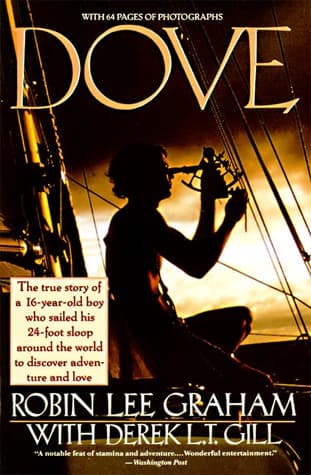
Core Idea
- Difficulty
- Easy
- Read it if
- You are fascinated by true-life adventure stories, coming-of-age narratives, or the psychological toll of extreme isolation and public expectation.
- Skip it if
- You prefer fast-paced thrillers or are looking for a detailed technical guide to sailing.
Key Takeaways from Dove
The Allure of the Open Sea
A romanticized yet challenging pursuit of freedom and self-discovery.
Robin Lee Graham's journey shows the strong pull of the ocean for those seeking escape, adventure, and a deep connection with nature. His solo circumnavigation, started at a young age, was not just about sailing; it was a test that made him grow, forcing him to face isolation, the elements, and his own limits. The book captures this two-sided experience: the beauty of sunsets over the ocean contrasted with the danger of storms. This ideal of the sea is balanced by the real dangers and the demanding, often repetitive, reality of long-distance sailing. It shows the human desire to push limits and find meaning in the unknown.
“The sea, once it casts its spell, holds one in its net of wonder forever.”
In the book: Graham's vivid descriptions of both idyllic days spent watching whales and terrifying nights battling gales, often alone for weeks on end, demonstrate the sea's dual nature.
Try this: Embrace challenges that push your comfort zone, recognizing that true growth often lies in confronting the beautiful and the terrifying aspects of a grand pursuit.
Related ideas: solo-sailing, adventure-travel, self-discovery
The Weight of Expectation
Navigating personal desires amidst external pressures and media scrutiny.
What began as a personal goal for a 16-year-old quickly became a global event, bringing much pressure. Graham felt increasingly limited by sponsors, media interest, and the public's view of his journey. This outside attention, while giving support, also took away some of the freedom he wanted. He struggled with the expectation to perform, to keep a certain image, and to follow a schedule that often went against his own pace and desires. This highlights the often-unseen cost of public attention on personal efforts, forcing individuals to balance their inner reasons with the stories others create for them.
“I was no longer just Robin Graham; I was 'the boy sailing around the world,' and that was a heavy burden.”
In the book: The constant need to report to sponsors, the arrival of journalists in various ports, and the public's fascination with his age and ambition all contributed to this pressure.
Try this: When pursuing ambitious goals, be mindful of external influences. Define your 'why' clearly and periodically re-evaluate if your actions align with your intrinsic motivations, not just external expectations.
Related ideas: public-scrutiny, personal-goals, media-pressure
Love in Unexpected Harbors
Finding profound human connection in isolation and transience.
One of the most surprising parts of Graham's trip is his meeting and eventual marriage to Patti Ratterree. Their meeting in a remote port, followed by their reunions across continents, shows the human need for connection, even on a journey defined by being alone. Patti became an anchor, a source of stability and love that changed his solo adventure into a shared life. This shows that even the most independent pursuits can be made better and fundamentally changed by deep human relationships, challenging the idea that true adventure must be done entirely alone. Their story adds unexpected romance and home life to a rugged tale.
“It was in the most remote places, far from home, that I found my true home in Patti.”
In the book: The detailed accounts of their meetings in various ports like Durban and their eventual decision to marry, despite the logistical challenges of his ongoing voyage.
Try this: Be open to unexpected relationships and connections, as they can profoundly shape your journey and provide invaluable support and meaning, even in the midst of personal quests.
Related ideas: relationship-building, human-connection, unexpected-love
The School of Hard Knocks
Learning essential life skills through direct experience and resilience.
Graham's journey was a practical lesson in problem-solving and self-reliance. From navigating dangerous waters with basic tools to repairing a damaged mast in the middle of the ocean, he constantly had to learn and adjust. He became a skilled mechanic, navigator, and survivalist out of need, learning a lot about his boat and nature. This emphasizes the value of learning by doing, where mistakes teach important lessons and strength grows from facing problems. It makes a strong case for leaving structured environments to gain skills that only real-world challenges can provide.
“Every breakdown, every storm, every moment of fear was a lesson, etched deeper than any textbook could teach.”
In the book: His detailed descriptions of repairing his steering gear in the middle of the Indian Ocean, improvising with limited tools, and mastering celestial navigation highlight his practical learning.
Try this: Actively seek out opportunities for hands-on learning and problem-solving, even if they seem daunting. Embrace failures as essential steps in developing practical skills and mental toughness.
Related ideas: experiential-learning, resilience, problem-solving
The Slow Pace of Discovery
Embracing a deliberate journey over rushing to a destination.
Despite the initial goal of being the youngest circumnavigator, Graham's journey became something far deeper than a race against time. The book shows the value of slow travel, allowing him to experience different cultures, spend time on remote islands, and truly see the world at a human pace. His five-year trip, much longer than planned, became an example of valuing deep experience over speed or breaking records. This challenges the modern tendency to consume experiences quickly, instead supporting a more deliberate, thoughtful engagement with one's surroundings, which leads to richer understanding and personal change.
“The purpose wasn't just to get around the world, but to see it, to feel it, to live it, however long it took.”
In the book: His extended stays in places like Fiji and South Africa, where he worked odd jobs and truly integrated into local life, rather than just passing through.
Try this: Prioritize depth and immersion over speed in your pursuits. Allow for detours and extended stays, as these often lead to the most meaningful discoveries and growth.
Related ideas: slow-travel, cultural-immersion, mindful-living
The Price of Freedom
Understanding the sacrifices inherent in pursuing an unconventional life.
Graham's journey, while offering great freedom, also came with significant personal costs. He missed typical teenage experiences, spent years away from family, and faced loneliness and hardship. The book subtly explores the trade-offs of choosing a radical path: the exciting highs are often balanced by big sacrifices. This makes us think about the real cost of chasing extraordinary dreams, reminding us that freedom often means giving up comfort, stability, and familiar connections. It is a nuanced look at the reality behind the romantic idea of adventure, showing that every choice, especially a grand one, has its price.
“Every mile sailed was a mile away from what I knew, a mile closer to a life I was creating, but it wasn't without its costs.”
In the book: His candid reflections on loneliness during long stretches at sea, his longing for home, and the challenges of maintaining relationships from afar.
Try this: Before embarking on a major life change, honestly assess the potential sacrifices and prepare for them. Understand that true freedom often requires letting go of certain comforts and familiarities.
Related ideas: sacrifice, unconventional-life, loneliness
The Power of a Single Goal
How a clear objective can propel one through immense adversity.
Despite many problems, including multiple mast failures, equipment breakdowns, and personal doubts, Graham never completely gave up on his main goal. The simple, powerful aim of sailing around the world gave him constant motivation and direction. This shows the psychological strength that comes from having a single, clear objective. It demonstrates how a clear vision can be a steady point during chaos and despair, helping people get through seemingly impossible obstacles. It is a strong lesson in setting goals, suggesting that clear purpose is often the most important tool for overcoming problems and achieving big feats.
“The idea of sailing around the world was a beacon, pulling me forward even when everything else seemed to fall apart.”
In the book: His unwavering determination to continue after 'Dove' was dismasted twice, requiring major repairs and significant delays, yet he always found a way to press on.
Try this: Define one overarching, compelling goal for yourself. When faced with challenges, return to this core objective to reignite your motivation and guide your actions.
Related ideas: goal-setting, perseverance, motivation
Beyond the Finish Line
The challenge of reintegration and finding meaning after an epic journey.
Graham's return home was not the simple, triumphant end one might expect. After five years of intense independence and unique experiences, returning to normal society was its own challenge. The world had moved on, and he was no longer just a boy but a man with a wife and child, dealing with the complexities of a settled life. This highlights the often-overlooked 'post-adventure' phase, where the skills and perspectives gained on an epic journey may not easily fit back into everyday life. It is a reminder that growth continues, and the biggest adventures often change us permanently, requiring new navigation upon returning home.
“Coming home was not the end of the journey, but the beginning of another, perhaps even more challenging one.”
In the book: His reflections on the difficulties of adjusting to normal life, finding work, and settling down after years of being untethered, even with the joy of his family.
Try this: When undertaking major life transitions or achieving significant goals, anticipate and prepare for the reintegration phase. Recognize that returning to 'normal' may require a new set of skills and a period of adjustment.
Related ideas: reintegration, post-adventure-blues, life-transitions
Dove Quotes
“I was not running away from anything; I was running to something.”
“The sea does not reward those who are too anxious, too greedy, or too impatient.”
“To be truly challenging, a voyage, like a life, must rest on a firm foundation of financial unrest.”
“I found that I could be alone without being lonely.”
“The important thing was not to arrive but to travel well.”
“A ship is safe in harbor, but that's not what ships are for.”
“I learned that the world was both smaller and larger than I had imagined.”
“The stars were my compass when the instruments failed.”
“Home is not a place, but the feeling of being where you belong.”
“Every storm passed, and with it came a clearer sky.”
“I traded the certainty of land for the uncertainty of the sea, and found freedom.”
“The ocean taught me humility in ways that land never could.”
“Love, like the wind, cannot be seen but can be felt in its effects.”
“Adventure is worthwhile in itself.”
Quiz
10 questions on the main ideas. Each answer comes with a short explanation.
Question 1
What was the name of the 24-foot sloop that Robin Lee Graham sailed on his solo around-the-world voyage?
- Sea Sprite
- Dove
- Wanderer
- Spirit
Show answer
B. Dove The book is titled 'Dove' after the name of the 24-foot sloop that Graham sailed on his journey, which is central to the memoir's narrative.
Question 2
How old was Robin Lee Graham when he began his solo around-the-world voyage?
- 15 years old
- 16 years old
- 17 years old
- 18 years old
Show answer
B. 16 years old The book states that Graham was 16 years old in 1965 when he started his voyage from San Pedro, California, highlighting his youth and courage.
Question 3
From which port did Robin Lee Graham depart on his voyage?
- San Francisco, California
- Los Angeles, California
- San Pedro, California
- San Diego, California
Show answer
C. San Pedro, California Graham's journey began in San Pedro, California, as specified in the book, which is a key detail in setting the scene for his adventure.
Question 4
What significant personal change did Robin Lee Graham experience by the end of his five-year voyage?
- He became a professional sailor
- He wrote a bestselling book
- He returned with a wife and daughter
- He decided to settle in a foreign country
Show answer
C. He returned with a wife and daughter The book describes how Graham returned to home port after five years not only with extraordinary experiences but also with a wife and daughter, marking a profound personal transformation.
Question 5
Approximately how many miles did Robin Lee Graham sail during his around-the-world voyage?
- 25,000 miles
- 30,000 miles
- 33,000 miles
- 40,000 miles
Show answer
C. 33,000 miles Graham's voyage covered 33,000 miles over five years, as noted in the book, emphasizing the vast scale of his solo journey.
Question 6
What year did Robin Lee Graham begin his solo around-the-world voyage?
- 1963
- 1964
- 1965
- 1966
Show answer
C. 1965 The voyage started in 1965, a key historical context in the book that places Graham's adventure in the mid-1960s.
Question 7
Which of the following best describes the primary genre of 'Dove' as indicated in the book description?
- Fiction
- Biography and Memoir
- Science Fiction
- Self-Help
Show answer
B. Biography and Memoir The book is categorized as a Biography and Memoir, reflecting Graham's personal account of his real-life sailing adventure.
Question 8
What was a key motivation or theme underlying Robin Lee Graham's decision to undertake such a challenging solo voyage at a young age?
- To escape family problems
- To prove his sailing skills in competitions
- To seek adventure and personal growth
- To conduct scientific research
Show answer
C. To seek adventure and personal growth The book portrays Graham's voyage as driven by a desire for adventure and personal growth, common themes in memoirs about solo journeys.
Question 9
How does the book 'Dove' primarily convey the experiences of Robin Lee Graham's voyage?
- Through fictionalized dialogues
- As a technical sailing manual
- Via a first-person narrative based on real events
- Through a collection of letters
Show answer
C. Via a first-person narrative based on real events As a memoir, 'Dove' uses a first-person narrative to recount Graham's real-life experiences, making it personal and engaging for readers.
Question 10
What practical lesson might readers take from 'Dove' regarding undertaking ambitious personal projects?
- Always plan extensively before starting
- Age and inexperience are not barriers to achieving great things
- Solo travel is the best way to learn about the world
- Financial security is essential for adventures
Show answer
B. Age and inexperience are not barriers to achieving great things Graham's story demonstrates that youth and lack of extensive experience did not prevent him from completing a monumental voyage, inspiring readers to pursue their own goals regardless of perceived limitations.
Dove FAQ
What is the book 'Dove' by Robin Lee Graham about?
'Dove' is a memoir chronicling Robin Lee Graham's solo around-the-world sailing voyage, which he began at age 16 in 1965. Over five years and 33,000 miles, he navigated challenges, found love, and documented his extraordinary journey in this bestselling book.
How old was Robin Lee Graham when he started his voyage?
Robin Lee Graham was only 16 years old when he embarked on his solo around-the-world sailing journey in 1965, making his adventure a remarkable feat of youthful courage and determination.
What type of boat did Robin Lee Graham sail in 'Dove'?
Robin Lee Graham sailed in a 24-foot sloop named 'Dove,' which was his vessel for the entire 33,000-mile, five-year voyage around the world, as detailed in his memoir.
Does 'Dove' include details about Robin Lee Graham's personal life?
Yes, 'Dove' includes personal aspects such as how Graham met and married his wife during the voyage and became a father, adding depth to the adventure narrative with themes of family and growth.
How is 'Dove' different from other sailing memoirs like 'The Long Way' by Bernard Moitessier?
Unlike 'The Long Way,' which focuses on competitive sailing and solitude, 'Dove' emphasizes a coming-of-age story, highlighting Graham's youth, personal relationships, and the transformative journey of a teenager navigating the world alone.
What is the significance of the title 'Dove'?
The title 'Dove' refers to the name of Graham's 24-foot sloop, symbolizing peace, freedom, and the spirit of adventure that carried him through his solo voyage and personal discoveries.
Does 'Dove' work as an inspiration for young adventurers?
Yes, 'Dove' serves as an inspiring tale for young adventurers, showcasing how determination and resilience at a young age can lead to life-changing experiences and personal growth against all odds.
What challenges did Robin Lee Graham face during his voyage?
Graham faced numerous challenges including rough seas, isolation, and the logistical difficulties of sailing solo for five years, all of which he overcame to complete his 33,000-mile journey and share his story.
How long did Robin Lee Graham's voyage take?
Robin Lee Graham's voyage took five years to complete, covering 33,000 miles from his departure in San Pedro, California, to his return, as recounted in the book 'Dove.'
What practical lessons can readers learn from 'Dove'?
Readers can learn practical lessons about perseverance, self-reliance, and adapting to unforeseen circumstances, as Graham's journey demonstrates the importance of preparation and resilience in achieving long-term goals.
Similar books
- Sailing Alone around the World
Joshua Slocum
4.1 (8k) average on GoodreadsLifestyleSlocum's account, written by a seasoned mariner, offers a more philosophical and often humorous perspective on solo circumnavigation. While both detail the practicalities of sailing, Slocum's narrative is imbued with the wisdom of experience, contrasting with Graham's youthful idealism and more raw emotional journey. Slocum's work is a foundational text, while Graham's provides a specific historical snapshot of a younger generation.
- Eat, Pray, Love
Elizabeth Gilbert
3.6 (1.5M) average on GoodreadsLifestyleA heartbroken writer leaves her conventional life for a year-long global search for pleasure in Italy, spiritual devotion in India, and unexpected love and balance in Bali.
- Wild: From Lost to Found on the Pacific Crest Trail
Cheryl Strayed
4.0 (615k) average on GoodreadsLifestyleAfter losing her mother and her marriage, a young woman impulsively hikes over a thousand miles of the Pacific Crest Trail alone, finding strength and healing in the unforgiving wilderness.
- Into Thin Air: A Personal Account of the Mount Everest Disaster
Jon Krakauer
4.2 (395k) average on GoodreadsLifestyleOn May 10, 1996, ambition and a sudden, violent storm turned Mount Everest into a deadly trap, leaving Jon Krakauer to tell the harrowing story of a disaster that took lives and shattered climbers' dreams.
- On The Road
Jack Kerouac
3.6 (349k) average on GoodreadsLifestyleDean Moriarty and Sal Paradise go on a wild, cross-country trip with jazz, drugs, and a desperate search for meaning on America's post-war roads.
- A Walk in the Woods: Rediscovering America on the Appalachian Trail
Bill Bryson
4.1 (346k) average on GoodreadsLifestyleBill Bryson humorously describes his ill-prepared yet insightful attempt to hike the Appalachian Trail, meeting unique characters and the raw beauty of the wilderness.





Enjoyed the summary?
A summary gives you the shape of the book. The book itself has the detail, the examples and the voice.
Find Dove on AmazonAs an Amazon Associate, BookBrief earns from qualifying purchases. How we're funded