
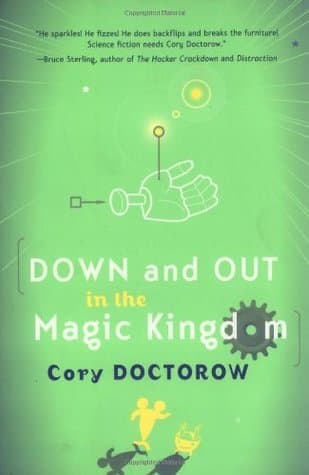
Synopsis
Covers the whole plot, including the ending.
- Difficulty
- Medium
- Pacing
- Moderate
- Mood
- Thought-provoking, Quirky, Speculative, Humorous
- Read it if
- You enjoy speculative fiction exploring post-scarcity societies, digital immortality, and the clash between tradition and progress, especially with a unique setting like a future Disney World.
- Skip it if
- You prefer traditional narratives without extensive world-building around reputation economies and transhumanism, or find the idea of 'death as an inconvenience' unappealing.
Down and Out in the Magic Kingdom Plot Summary
Covers the whole plot, including the ending.
Welcome to the Afterlife (and Disney World)
Jules, a 'young' man in a future where death is curable and scarcity eliminated, enjoys his life working as an 'ad-hoc' in Disney World. He is part of a community that preserves the park's classic attractions as they were first conceived, with only minor technology. His current project is restoring the Carousel of Progress. Life is comfortable, measured in 'Whuffie' (reputation currency), and focused on a shared love for the park. One day, while working, Jules is suddenly and violently killed, shot in the head. This is not his first death, but it is unexpected and leaves him disoriented after his immediate revival, unable to figure out why or who did it.
The Threat to Tradition
After his revival, Jules learns about a new group, the 'Citizens of the World' (COTW), led by Hakim. They are taking over attractions to 'improve' them. Their first big target is the Hall of Presidents, which they are turning into an immersive, direct-to-brain experience, replacing the traditional audio-animatronics. This upsets Jules and the other ad-hocs, who see it as an attack on Disney World's art and history. Jules suspects a link between the COTW's aggressive modernization and his recent murder, which makes him determined to investigate and fight their changes.
Enlisting Allies and Losing Ground
Jules contacts his long-time friend and mentor, Dan, a veteran ad-hoc and respected community member, hoping to get support against the COTW. However, Dan, while understanding, seems hesitant to act directly, preferring diplomacy. Meanwhile, the COTW's influence quickly grows. They start gaining Whuffie and public support by appealing to a desire for newness and 'progress.' Jules and his girlfriend, Lil, watch more attractions fall under COTW control, replaced by their high-tech, immersive experiences. This further erodes the traditional Disney experience Jules values.
A Second Death and Deepening Mystery
Jules experiences a second, equally sudden and unexplained death, this time while working on another attraction. This repeated targeting confirms his belief that his murders are directly linked to the conflict over Disney World's future. The mysterious nature of his deaths—no clear motive, no obvious perpetrator, and the ease with which his 're-sleeving' is delayed—suggests a deeper plot. This personal vendetta combines with his fight for the park, pushing him to take more direct and risky actions to expose the COTW and understand who is trying to remove him permanently.
The Whuffie Economy and Public Opinion
The conflict over Disney World is fought not just with actions but also by manipulating 'Whuffie,' the reputation-based currency that runs society. Jules sees how Hakim and the COTW are good at generating positive Whuffie for their 'innovations,' portraying the ad-hocs as people against progress. This makes it hard for Jules and his allies to gain support, as public opinion leans toward the flashier, more 'modern' experiences from the COTW. Jules struggles to find a way to counter this story and show the value of preserving the original attractions.
Confrontation and Betrayal
Jules directly confronts Hakim, the COTW leader, accusing him of causing his deaths and trying to erase the park's history. Hakim, however, presents himself as a visionary simply offering a new, better experience. During his investigations, Jules starts to notice odd behavior in some of his own ad-hoc colleagues. He suspects that not everyone is as dedicated to the old ways as they claim, or that some might even be secretly helping the COTW. This realization adds distrust to his already difficult situation, making it harder to tell friends from enemies.
The Hall of Presidents Under Siege
The transformation of the Hall of Presidents is a central battleground in the ideological war. The COTW replaces the animatronics with their direct-to-brain interfaces, letting guests 'become' the presidents. For Jules, this is a profound disrespect, a loss of tangible, historical art. He tries to disrupt their operations, but the COTW's technology and popularity make it hard. The Hall of Presidents becomes a clear symbol of the conflict: the clash between preserving tangible history and embracing immersive, temporary experiences.
The Nature of Immortality and Loss
Even though immortality is common, Jules's repeated deaths are uniquely unsettling. He grapples with what true loss means in a world where physical death is temporary. The fact that someone is intentionally trying to 'kill' him, and possibly delay his re-sleeving, shows a deeper malicious intent than just vandalism. This makes Jules consider the psychological impact of being targeted, even when physical permanence is assured. He realizes that while his body can be remade, the experience of being murdered, and the fear of a permanent 'delete,' still carries significant weight.
Unmasking the True Perpetrator
Through careful investigation and putting together small clues, Jules starts to suspect that his long-time friend and mentor, Dan, is not just a bystander but is actively involved with the COTW and responsible for his deaths. He discovers that Dan has been manipulating the Whuffie system and using his influence to help the COTW take over. The realization that someone he trusted completely has betrayed him for ideological or personal gain is a deep shock, shaking Jules's understanding of loyalty and community within Disney World.
The Final Confrontation
Jules confronts Dan, who admits his involvement. Dan reveals he caused Jules's deaths, not out of malice, but as a twisted attempt to 'save' Jules from stagnation and force him to accept change. Dan believes the ad-hocs have become too comfortable and that the park needs to change to stay relevant in a world of constant technological progress. His actions were a radical, misguided effort to shake up the system and push for a new vision of Disney World, even if it meant sacrificing the traditional values Jules held dear.
Aftermath and a New Beginning
Afterward, Dan is shunned, his Whuffie drops, and the COTW's progress is somewhat slowed by their methods being exposed. Jules, though hurt by the betrayal, finds a new sense of purpose. He realizes that while preserving the past is important, standing still can be a form of death itself. He starts to explore ways to combine thoughtful innovation with tradition, aiming to create a Disney World that honors its past while embracing a dynamic future. He and Lil work to find a balance, ensuring the park's legacy continues in an ever-changing world.
Principal Figures
Jules
Protagonist
A young, immortal Disney ad-hoc dedicated to preserving the park's classic attractions.
Jules is a 'young' man, barely a century old, who has embraced the post-scarcity, post-death future by fulfilling his dream of living and working in Disney World. He is an 'ad-hoc,' part of a community dedicated to meticulously maintaining the park's classic attractions, valuing authenticity and tradition above all else. He is passionate, somewhat idealistic, and deeply attached to the historical and artistic integrity of Disney. His sense of identity is closely tied to his work and the community he belongs to. He is driven by a desire to preserve what he sees as beautiful and meaningful.
Relationships: Lil (Romantic partner and fellow ad-hoc, his closest confidante.); Dan (Long-time friend and mentor, who ultimately betrays him.); Hakim (Ideological antagonist, leader of the 'Citizens of the World'.)
Lil
Supporting
Jules's girlfriend and fellow ad-hoc, practical and supportive.
Lil is Jules's girlfriend and a devoted ad-hoc herself, sharing his passion for Disney World's original charm. She is often more pragmatic than Jules, offering a grounded perspective and emotional support throughout his ordeal. While she values tradition, she is also open to considering new ideas, though she ultimately stands by Jules in his fight against the COTW. She is intelligent, resourceful, and a steadying presence in Jules's life, helping him navigate the complex social and political landscape of their future.
Relationships: Jules (Romantic partner and close ally.)
Dan
Antagonist/Supporting
Jules's mentor and friend, who secretly orchestrates his deaths and the park's modernization.
Dan is an older, highly respected member of the ad-hoc community, a mentor to Jules, and a figure of authority and wisdom. He is initially presented as a staunch defender of Disney World's original vision. However, he secretly believes that the ad-hocs have become stagnant and that the park needs radical change to remain relevant. His true motivation is a misguided attempt to 'save' Disney World and force its evolution, even if it means betraying his friends and resorting to extreme measures like 'killing' Jules to shake things up. He is driven by a complex mix of love for the park and a desire for its continued vitality.
Relationships: Jules (Mentor and friend, then betrayer and antagonist.); Hakim (Secretly collaborates with Hakim to achieve his goals.)
Hakim
Antagonist
The charismatic leader of the 'Citizens of the World', advocating for technological modernization in Disney World.
Hakim is the charismatic and influential leader of the 'Citizens of the World' (COTW), a group dedicated to 'modernizing' Disney World's attractions with cutting-edge technology like direct-to-brain interfaces. He represents the opposing ideology to Jules: progress, innovation, and immersive experiences over historical preservation. Hakim is adept at manipulating public opinion and the Whuffie system to gain support for his vision. He is articulate, persuasive, and genuinely believes his approach will enhance the park, viewing the ad-hocs as outdated and resistant to necessary change. He is a formidable ideological opponent.
Relationships: Jules (Ideological and direct antagonist.); Dan (Unwitting or willing collaborator in the modernization efforts.)
Brother Frank
Supporting
An older ad-hoc who is initially skeptical of Jules's concerns but eventually offers support.
Brother Frank is an older, more established ad-hoc, known for his wisdom and experience within the Disney World community. He initially appears somewhat detached from the immediate conflict, perhaps a bit weary of constant change or political maneuvering. However, as the COTW's actions become more aggressive, Brother Frank provides Jules with advice and a sense of historical context, helping him understand the deeper currents at play. He represents the older generation of ad-hocs who are deeply rooted in the park's traditions but also possess a broader understanding of its history.
Relationships: Jules (Mentor figure and source of wisdom.)
The Ad-Hocs
Supporting/Collective
The community of individuals dedicated to preserving Disney World's original attractions.
The ad-hocs are a collective of individuals, mostly immortal, who have chosen to dedicate their lives to maintaining Disney World's original attractions. They operate on a system of shared knowledge, reputation (Whuffie), and a deep reverence for the park's history and artistic integrity. They are characterized by their meticulous attention to detail, their collaborative spirit, and their resistance to what they perceive as superficial or destructive modernization. They form the social and professional backbone of Jules's world, representing the traditional values he fights to uphold.
Relationships: Jules (His community and colleagues.); Lil (Her community and colleagues.)
The Citizens of the World (COTW)
Antagonistic/Collective
A group advocating for radical technological modernization of Disney World attractions.
The Citizens of the World (COTW) are a collective led by Hakim, driven by the belief that Disney World must evolve and embrace advanced technology to remain relevant. They champion immersive, direct-to-brain experiences, viewing the traditional animatronics as outdated. They are skilled at generating Whuffie and leveraging public opinion, often portraying the ad-hocs as Luddites. Their methods are aggressive and often disregard historical preservation, focusing instead on novelty and cutting-edge engagement. They represent the force of 'progress' and technological advancement in the narrative.
Relationships: Hakim (Their leader and spokesperson.); Jules (Their ideological opponents.)
The Guests
Mentioned
The visitors to Disney World whose evolving preferences drive the conflict.
The Guests are the unnamed, collective visitors to Disney World. Their desires and preferences, particularly their increasing appetite for novelty and immersive experiences, play a crucial role in shaping the conflict between the ad-hocs and the COTW. They are the ultimate arbiters of Whuffie and public opinion, their choices influencing which vision for the park gains traction. While not active characters, their collective will acts as a powerful, unseen force driving the narrative and the struggle for Disney World's future.
Themes & Insights
The Nature of Immortality and Loss
In a future where physical death is curable and 're-sleeving' is common, the novel explores what true loss means. Jules's repeated murders, though temporary, are unsettling because they are intentional acts of harm, not accidents. This makes him face the psychological impact of being targeted and the fear of a permanent 'delete,' even in a world without typical death. It shows that even with biological immortality, emotional and social loss, or the threat of being erased from memory, remains deeply impactful, as seen in the plummeting Whuffie of those who commit social wrongs.
“Death was a hassle, but it wasn't the end of the world. Unless someone decided to make it the end of the world for you.”
Tradition vs. Innovation
This is the novel's main conflict, shown by the struggle between the ad-hocs and the Citizens of the World. Jules and the ad-hocs represent preserving tradition, valuing Disney World's original art and history. In contrast, Hakim and the COTW support radical innovation, believing that technology and immersive experiences are needed for relevance. The novel questions if holding onto the past leads to stagnation, or if constant innovation erases valuable history. It suggests a need for thoughtful integration, as Jules himself starts to understand after Dan's betrayal.
“We were the memory of the place, the living, breathing, remembering memory.”
The Economy of Reputation (Whuffie)
The novel introduces 'Whuffie' as a social currency based on reputation, influence, and public approval. This system controls status, access, and even political power in the future society. The conflict over Disney World is greatly affected by the manipulation of Whuffie; the COTW gain power by appealing to public desires for newness, while the ad-hocs struggle to keep their Whuffie when seen as resistant to progress. Dan's downfall, marked by his Whuffie collapsing, shows the harsh results of social disapproval in this system, highlighting how reputation can be stronger than traditional money or even physical survival.
“Whuffie was the only real currency, after all. It bought you friends, favors, and a place in the sun.”
The Nature of Art and Authenticity
The book explores what 'art' and 'authenticity' mean in a technologically advanced world. Jules sees the original animatronics and ride mechanics as tangible art, their flaws and historical context part of their appeal. The COTW, however, views immersive, direct-to-brain experiences as a better, more engaging form of art. This raises questions about whether art must be static and physical, or if it can be temporary and entirely experiential. The debate over the Hall of Presidents shows this: is the art in the original mechanical figures, or in the illusion of 'being' a president?
“It was art, damn it. And they were destroying it, piece by piece, to replace it with... what? A brain massage?”
Betrayal and Idealism
Betrayal is central to Jules's personal journey, especially through Dan's actions. Dan, a respected mentor, betrays Jules not out of malice, but from a misguided, extreme idealism – believing his actions are for Disney World's greater good. This makes Jules grapple with the idea that even those with good intentions can cause deep harm and that unchecked idealism can lead to ruthless and destructive behavior. It highlights the complexity of human motivation in a world where physical consequences are lessened, making ideological battles even more intense.
“He said he was doing it for me, for us, for Disney. That's what made it hurt the most.”
Plot Devices & Literary Techniques
Whuffie
A reputation-based social currency and influence system.
Whuffie is the central economic and social plot device. It's a quantifiable measure of a person's reputation, influence, and goodwill within the community. It determines access to resources, opportunities, and even social standing. Characters gain Whuffie through positive contributions and lose it through negative actions or social missteps. This system drives much of the conflict, as both the ad-hocs and the COTW vie for public approval and high Whuffie scores to legitimize their vision for Disney World. Dan's manipulation of Whuffie and his eventual dramatic loss of it underscore its power.
Re-sleeving/Immortality
The ability to transfer consciousness to a new body after death.
Re-sleeving is the technological process that grants immortality by allowing consciousness to be uploaded and downloaded into new bodies. While it removes the finality of death, it introduces new forms of vulnerability and conflict. Jules's repeated murders, though temporary, are acts of aggression meant to cause distress and disrupt his life, rather than end it. The threat of a delayed re-sleeving or permanent deletion creates tension, demonstrating that even in a post-death world, harm and control over one's existence remain powerful plot points, enabling personal vendettas to take on new dimensions.
Disney World as a Microcosm
The theme park serves as a symbolic battleground for broader societal debates.
Disney World functions as a microcosm for larger societal debates about tradition, progress, art, and the value of history in a technologically advanced, post-scarcity future. The conflict over its attractions—whether to preserve classic animatronics or embrace immersive digital experiences—mirrors broader philosophical questions facing humanity. By setting the story within this familiar, yet subtly altered, iconic location, Doctorow grounds complex themes in a tangible and relatable setting, making the ideological struggle feel personal and immediate, while also highlighting the enduring human desire for meaning and connection to the past.
The Hall of Presidents
A specific attraction that symbolizes the ideological clash.
The Hall of Presidents serves as a potent symbolic plot device. Its transformation from an attraction featuring traditional audio-animatronics to one using immersive, direct-to-brain interfaces becomes the focal point of the conflict between tradition and innovation. For Jules, its desecration represents the ultimate betrayal of artistic integrity. For the COTW, its modernization signifies progress. The attraction's fate directly reflects the fluctuating power dynamics and the ideological shifts occurring within Disney World, making it a tangible representation of the abstract battle for the park's soul.
Down and Out in the Magic Kingdom Quotes
“The thing about the future is that it's not going to be like the past. It's not even going to be like the present.”
“Fame isn't a zero-sum game. You can have as much fame as you want, and so can everyone else.”
“Anything that can be copied, will be copied.”
“The whole point of being immortal is that you get to do things forever.”
“Every time you die, you lose a little bit of yourself.”
“Happiness is not a state to arrive at, but a manner of traveling.”
“The past is another country, they do things differently there.”
“Whuffie is the currency of cool, of respect, of attention.”
“You don't own your body, you just borrow it from the universe.”
“The magic of the Magic Kingdom wasn't in its rides, but in its ability to transport you.”
“The greatest trick the Devil ever pulled was convincing the world he didn't exist. The greatest trick the twenty-first century pulled was convincing everyone that scarcity still mattered.”
“We're all just trying to make our mark, leave something behind.”
“The future doesn't wait for anyone, not even the dead.”
“It's not about what you have, it's about what you do.”
Quiz
10 questions on the plot and the characters. Each answer comes with a short explanation.
Question 1
What is Jules's primary motivation for being upset about the changes to the Hall of the Presidents?
- He believes the new technology is unsafe for guests.
- He is concerned about the economic impact on the 'ad-hocs'.
- He views the changes as an attack on the artistic purity of Disney World.
- He wants to be the one to implement new technologies.
Show answer
C. He views the changes as an attack on the artistic purity of Disney World. Jules explicitly views the replacement of audioanimatronics with direct-to-brain interfaces as 'an attack on the artistic purity of Disney World itself'.
Question 2
How many times has Jules died and been revived prior to the events of the story?
- Once
- Twice
- Three times
- Five times
Show answer
C. Three times The text states that his current death is 'only his fourth death and revival', meaning he had died and been revived three times previously.
Question 3
What technological advancement has made death a curable condition in Jules's time?
- Advanced medical robots
- The cure for death
- Life-extending nanobots
- Consciousness transfer
Show answer
B. The cure for death The synopsis explicitly mentions that Jules has 'lived long enough to see the cure for death'.
Question 4
Who are the 'ad-hocs' in the context of Disney World?
- Corporate executives from the original Disney company.
- A network of individuals who maintain the classic attractions.
- Guests who volunteer to operate rides temporarily.
- Security personnel responsible for park safety.
Show answer
B. A network of individuals who maintain the classic attractions. The text describes the 'ad-hocs' as 'a network of 'ad-hocs' who keep the classic attractions running as they always have'.
Question 5
What specific type of new interface is being introduced in the Hall of the Presidents?
- Augmented reality overlays
- Holographic projections
- Immersive direct-to-brain interfaces
- Advanced haptic feedback systems
Show answer
C. Immersive direct-to-brain interfaces The new group is replacing audioanimatronics with 'new, immersive direct-to-brain interfaces'.
Question 6
What broader societal change, besides the cure for death, has occurred in Jules's era?
- The rise of a global authoritarian government.
- The end of scarcity.
- Widespread space colonization.
- A return to pre-industrial lifestyles.
Show answer
B. The end of scarcity. Jules has 'lived long enough to see the cure for death and the end of scarcity'.
Question 7
What is the stated artistic achievement that Disney World represents for Jules?
- The greatest architectural wonder of the modern age.
- The greatest artistic achievement of the long-ago twentieth century.
- A perfect blend of technology and nature.
- A preserved relic of ancient human culture.
Show answer
B. The greatest artistic achievement of the long-ago twentieth century. Jules considers Disney World to be 'The greatest artistic achievement of the long-ago twentieth century'.
Question 8
The new group taking over the Hall of the Presidents is described as performing what action against Jules?
- They had him evicted from Disney World.
- They publicly discredited his artistic opinions.
- They had him killed.
- They stole his personal belongings.
Show answer
C. They had him killed. The text states: 'Worse: it appears this new group has had Jules killed.'
Question 9
What is the ultimate consequence of the new group's actions, as far as Jules is concerned?
- A formal debate on the future of Disney World.
- A technological arms race for park control.
- A 'war' against the new group.
- The complete abandonment of Disney World.
Show answer
C. A 'war' against the new group. After being killed, Jules's reaction is: 'Now it's war....'
Question 10
Beyond Disney World, what other personal accomplishments has Jules achieved in his long life?
- He has traveled to other planets and met alien species.
- He has learned ten languages and composed three symphonies.
- He has founded several successful corporations.
- He has invented new forms of transportation.
Show answer
B. He has learned ten languages and composed three symphonies. The text mentions Jules has 'learn ten languages and compose three symphonies'.
Down and Out in the Magic Kingdom FAQ
What is the core conflict that drives the plot in 'Down and Out in the Magic Kingdom'?
The core conflict arises when a new faction, led by the charismatic Dan, begins to 'upgrade' classic Disney World attractions, starting with the Hall of the Presidents, by replacing traditional audio-animatronics with direct-to-brain immersive experiences. Jules, a long-time 'ad-hoc' and purist, views this as an egregious violation of Disney's original artistic integrity, sparking a culture war over the park's future.
Who is Jules and what is his primary motivation throughout the story?
Jules is the protagonist, a 'young' man barely a century old who has embraced immortality and found his calling as an 'ad-hoc' maintainer of classic Disney World. His primary motivation is to preserve the original, physical artistry and experience of Disney World attractions against what he perceives as the destructive, inauthentic modernizations proposed by Dan's faction, driven by a deep reverence for the park's historical significance.
How does the concept of 'whuffie' function in this future society?
'Whuffie' is the social credit system that replaces traditional currency in this post-scarcity future. It's a measure of one's reputation, influence, and goodwill, accumulated through contributions to society and positive interactions. Individuals gain or lose whuffie based on how others perceive their actions, directly impacting their access to resources and social standing.
What role does immortality play in the characters' lives and the story's themes?
Immortality, achieved through regular backups and re-sleeving, is a fundamental aspect of life in this future, making death a temporary inconvenience. It influences characters' long-term perspectives, their willingness to take risks (like Jules's fourth death), and contributes to the generational conflict between those who value historical preservation and those eager for constant innovation.
Who is Dan, and what are his goals for Disney World?
Dan is the leader of the opposing faction, characterized by his ambition and vision for a 'modernized' Disney World. He advocates for enhancing attractions with cutting-edge direct-to-brain interfaces and immersive technologies, believing these upgrades offer a superior, more engaging experience for guests. His goal is to push Disney World into a new era of interactive entertainment, rather than preserving its original form.
What is the significance of Jules's 'fourth death' in the narrative?
Jules's fourth death is a pivotal moment, orchestrated by Dan's faction, which solidifies the conflict and raises the stakes. It highlights the casualness of death in an immortal society while also underscoring the seriousness of the cultural war – it's a direct attack on Jules and his ideals, fueling his resolve to fight back against the modernizers.
How does the book subtly explore the idea of 'authenticity' in a post-scarcity, post-death world?
The book explores authenticity through the debate over Disney World's attractions: is the original audio-animatronic an authentic experience, or is a direct-to-brain simulation more 'real'? It questions whether a replicated consciousness is truly the same person, and if constant technological upgrades dilute the essence of historical art, prompting readers to consider what makes something genuinely authentic.
Are there any deeper connections between the 'ad-hocs' and the concept of open-source culture?
Yes, the 'ad-hocs' embody the spirit of open-source culture. They are a decentralized, volunteer-driven network maintaining complex systems (Disney World) out of passion and shared expertise, rather than for profit or centralized control. Their collaborative, improvisational approach reflects the community-driven development common in open-source projects.
How does Jules's long lifespan affect his emotional attachment to Disney World?
Jules's long lifespan intensifies his emotional attachment to Disney World, making him a steadfast guardian of its history. Having witnessed centuries of change and experienced multiple 'lives,' the park represents a constant, tangible link to a past he cherishes. This deep, almost familial bond fuels his fierce protectiveness and resistance to change, contrasting with newer generations' more fluid perspectives.
What psychological implications does the 'whuffie' system have on individual behavior and social dynamics?
The 'whuffie' system creates a society driven by reputation and social approval, where individuals constantly monitor their public perception. This can lead to altruistic acts for social gain, but also to performative kindness, fear of ostracism, and potentially manipulative behavior to accumulate influence. It fosters a highly interconnected, transparent, and often anxiety-inducing social environment.
How do characters cope with the psychological weight of immortality and repeated deaths?
Characters cope with immortality and repeated deaths by developing a detached perspective on physical existence, viewing death as a temporary inconvenience rather than a finality. They often embrace new skills, experiences, and identities over centuries, but also risk losing personal connections and developing a sense of existential ennui, as seen in Jules's occasional weariness.
How does the book portray the psychological struggle between nostalgia and progress?
The book vividly portrays the psychological struggle between nostalgia and progress through the conflict between Jules's faction and Dan's. Jules represents the comfort and security of the familiar past, while Dan embodies the drive for innovation and improvement. This creates a deeply personal and emotional battle, as characters grapple with the fear of losing cherished memories versus the excitement of new possibilities.
Is the book ultimately arguing for the preservation of historical art or for embracing technological advancement?
The book doesn't offer a definitive answer, instead presenting a nuanced debate. It highlights the value of preserving historical art and the unique experience it offers (Jules's perspective) while also exploring the allure and potential of technological advancement to create new forms of engagement (Dan's perspective). The narrative encourages readers to consider the complexities and trade-offs of both approaches.
What philosophical questions does the existence of 'copies' and re-sleeving raise about personal identity?
The existence of 'copies' and re-sleeving raises profound philosophical questions about what constitutes personal identity. If a person dies and is revived from a backup, is it truly the same individual, or merely a perfect copy? The book implicitly questions the continuity of consciousness and soul, suggesting that identity might be more fluid and less tied to a single physical body in this future.
How does the ending of the book resolve the conflict, and what does it suggest about the future of Disney World?
The ending doesn't offer a clean resolution, but rather a temporary truce or an evolving stalemate. Jules and his faction manage to prevent a complete takeover, but the threat of modernization remains, and the park's future is still contested. It suggests that the conflict between preservation and innovation is ongoing and cyclical, reflecting the continuous evolution of cultural institutions.
Could the conflict between Jules and Dan be seen as a metaphor for broader cultural wars in our own society?
Yes, the conflict between Jules and Dan serves as a powerful metaphor for broader cultural wars in our own society, particularly those concerning tradition versus progress, artistic purity versus commercialization, and the digital versus the physical. Their clash over Disney World mirrors contemporary debates about how to adapt cherished institutions and art forms to new technologies and changing societal values.
What is the implied fate of the 'ad-hocs' in the long term, given the societal shifts depicted?
The implied fate of the 'ad-hocs' is one of constant adaptation and struggle. While they embody a resilient, decentralized model, the relentless drive for technological innovation and efficiency, coupled with the pressure of 'whuffie' economics, suggests they will always face challenges to their purist ideals. They represent a persistent counter-culture, likely to continue their fight for authenticity in an ever-changing world.
About the author
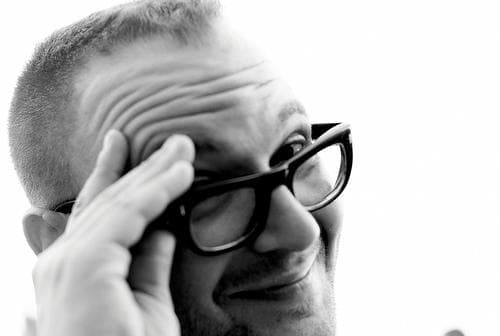
Cory Doctorow is a Canadian blogger, journalist, and science fiction author. He is best known for his novels 'Down and Out in the Magic Kingdom,' 'Little Brother,' and 'Walkaway,' which explore themes of technology, copyright, and social issues. Doctorow is also a co-founder of the technology website Boing Boing and a prominent advocate for digital rights.
Similar books
- Brave New World
Aldous Huxley
4.0 (1.4M) average on GoodreadsFantasyExamines a future society where technology dictates social norms and individual desires, touching on themes of control and happiness.
- Harry Potter and the Sorcerer's Stone
J.K. Rowling
4.5 (7M) average on GoodreadsFantasyRescued from a miserable life under the stairs, an orphaned boy discovers he's a wizard destined for a magical school, where he uncovers a dangerous secret tied to the dark wizard who murdered his parents.
- The Hunger Games
Suzanne Collins
4.3 (6.4M) average on GoodreadsFantasyIn a future where children fight to the death on live television, Katniss Everdeen volunteers for the arena, turning a death sentence into a fight for survival and a spark of rebellion.
- 1984
George Orwell
4.2 (3.1M) average on GoodreadsPoliticsIn a future where surveillance and thought control are absolute, a man's search for truth clashes with the Party, showing that hope can be a form of rebellion.
- Divergent
Veronica Roth
4.2 (2.9M) average on GoodreadsFantasyIn a society divided by virtues, a sixteen-year-old's difference from the norm starts a rebellion that threatens her world.
- The Hobbit, or There and Back Again
J.R.R. Tolkien
4.3 (2.9M) average on GoodreadsFantasyA comfort-loving hobbit named Bilbo Baggins is whisked away by a mischievous wizard and a band of dwarves on an unexpected journey to reclaim stolen treasure from a fearsome dragon, discovering courage and a magical ring along the way.






Enjoyed the summary?
A summary gives you the shape of the book. The book itself has the detail, the examples and the voice.
Find Down and Out in the Magic Kingdom on AmazonAs an Amazon Associate, BookBrief earns from qualifying purchases. How we're funded