
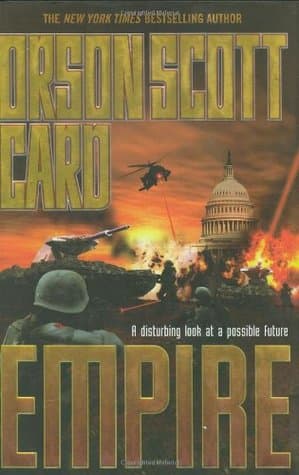
Synopsis
Covers the whole plot, including the ending.
- Difficulty
- Medium
- Pacing
- Fast
- Mood
- Intense, thought-provoking, cautionary, suspenseful
Empire Plot Summary
Covers the whole plot, including the ending.
The First Salvo
The story begins with a seemingly ordinary protest in Washington D.C., organized by the 'Righteous Cause,' a far-right militia group. This demonstration quickly turns into an attack on the White House. High-tech weapons, never before seen in civilian hands, cause massive destruction and many casualties among the Secret Service and military personnel. The President is evacuated, but the assault's boldness and effectiveness shock the nation. This event ends political discussion and starts open warfare, pushing the United States into a new civil conflict. The attack reveals a terrifying level of organization and technology within the extremist groups, far beyond what intelligence agencies expected.
The President's Dilemma
After the White House attack, President Sullivan is in a difficult position. His advisors are divided: some want a quick, overwhelming military response to crush the rebellion, while others warn against further dividing the nation and alienating potential allies. Sullivan knows the historical dangers of using military force against American citizens. He struggles to balance restoring order and punishing those responsible with preventing a full-blown civil war that could irreparably tear the country apart. His decisions are complicated by the enemy's advanced nature and the widespread support they seem to have in some regions.
The Rise of Averell and Marcus
The story introduces Averell Torrent and Marcus Gladstone, childhood friends with a shared past but now on opposite sides of the growing conflict. Averell, a brilliant but disillusioned former military strategist, joins the 'Righteous Cause' because he believes the government has become corrupt and tyrannical. Marcus, a pragmatic and loyal military officer, remains committed to defending the United States government and its constitutional principles. Their stories unfold, showing their leadership and motivations. Their eventual clash is hinted at as their influence grows within their groups.
The 'Righteous Cause' Strikes Again
The initial White House attack is followed by a series of coordinated, advanced strikes against national infrastructure. Power grids, communication networks, and transportation hubs are targeted, causing widespread chaos. These attacks are carefully planned and executed, showing the 'Righteous Cause's' deep understanding of strategic weaknesses and access to sophisticated cyber warfare. The goal is clear: to cripple the government's ability to respond, spread fear, and further erode public trust. The effectiveness of these attacks shows the seriousness of the threat and the innovative tactics used by the insurgents.
Marcus's Counter-Offensive
As the nation falls into chaos, Marcus Gladstone is tasked with leading a counter-offensive. He quickly sees the need for unconventional tactics to fight an enemy operating outside traditional military structures and possessing advanced technology. Marcus puts together a team, including intelligence experts, cyber specialists, and special operations forces. His strategy focuses on disrupting the 'Righteous Cause's' command, identifying their technology sources, and protecting remaining infrastructure. He faces immense pressure and limited resources, but his resolve and strategic skill are evident as he navigates the complex and quickly changing battlefield, trying to prevent total collapse.
Averell's Strategic Brilliance
On the opposing side, Averell Torrent is the strategic mind behind the 'Righteous Cause's' early successes. His deep understanding of military strategy, combined with his innovative and often ruthless approach, allows the insurgents to consistently outmaneuver government forces. He uses surprise, psychological warfare, and an intimate knowledge of the American landscape to his advantage. Averell sees the conflict as a battle for the American people's hearts and minds, aiming to expose the government's weaknesses and gather popular support for his cause. His brilliance is clear, even as his methods become more morally questionable.
The Civilian Toll
As the war intensifies, civilians bear the true cost. Cities become battlegrounds, supply lines are cut, and daily life is shattered. The conflict creates a refugee crisis, widespread food shortages, and a breakdown of social order in many areas. Both sides, despite their stated intentions, contribute to the suffering through their actions or inactions. The story explores the moral dilemmas faced by ordinary citizens caught between the warring groups, forced to choose sides or simply try to survive. The human tragedy of a nation at war with itself is clearly shown, highlighting the devastating consequences beyond political and military goals.
The Unveiling of the Benefactor
Marcus's investigation into the 'Righteous Cause's' advanced weaponry eventually uncovers their mysterious benefactor: a shadowy, immensely wealthy, and technologically advanced organization with global reach, aiming to destabilize the U.S. for its own geopolitical gain. This revelation changes the scope of the conflict from a domestic civil war to one with international implications. The benefactor has been secretly supplying the insurgents with cutting-edge arms, intelligence, and strategic advice, using them as proxies to achieve their objectives. This discovery complicates the government's response and highlights the deep conspiracies at play.
Averell's Moral Crisis
As the war progresses and the 'Righteous Cause' achieves significant victories, Averell Torrent starts to have a moral crisis. He sees the brutal realities of the conflict, the collateral damage, and the increasingly extreme rhetoric of some within his own ranks. More critically, he begins to suspect that their shadowy benefactors' true agenda might not align with his original vision of restoring America. The atrocities committed in the name of the cause, coupled with the growing realization that he might be a pawn in a larger, darker game, force Averell to re-evaluate his loyalties and the rightness of his actions. His internal struggle becomes a central part of his character.
The Confrontation
The inevitable confrontation between Marcus Gladstone and Averell Torrent finally happens. Their paths cross during a critical battle or strategic maneuver, forcing the two former friends to face each other on opposing sides. This encounter is not just a military clash but a deeply personal one, weighed down by their shared history and different beliefs. The confrontation highlights the tragedy of their broken friendship and the civil war's destructive power. The outcome of their direct interaction has significant implications for the broader conflict, potentially turning the tide for one side or the other, or revealing a path towards a different kind of resolution.
The Shifting Tides
Following the direct confrontation or a critical turning point, the tide of the war begins to shift, slowly and painfully. Government forces, under Marcus's leadership, start to gain an advantage, often through strategic intelligence gathered about the benefactor or internal divisions within the 'Righteous Cause.' However, these gains come at an immense cost in human lives, national resources, and deep emotional scars left on the populace. The victories are hard-won and do not necessarily mean a quick end to the conflict, but rather a prolonged struggle to rebuild and heal a deeply fractured nation. The emphasis is on the arduous path to recovery.
Averell's Redemption/Sacrifice
Faced with the full realization of his benefactors' true intentions and the devastating impact of the war, Averell Torrent makes a decision. This could involve a desperate act of redemption, such as betraying his former allies, leaking critical intelligence to the government, or making a significant personal sacrifice to mitigate the damage he has helped cause. His action, born from his moral awakening, plays a role in altering the conflict's trajectory, potentially weakening the 'Righteous Cause's' leadership or exposing the benefactor's plans. This decision solidifies his character arc from misguided idealist to a figure seeking to atone.
The Aftermath and the Future
The book concludes with the immediate aftermath of the most intense fighting, but not necessarily a complete end to all hostilities. The 'Righteous Cause' might be severely weakened or fractured, and the shadowy benefactor's influence diminished, but the nation remains deeply scarred. The challenges of reunification, rebuilding infrastructure, and healing deep societal divisions are immense. President Sullivan and Marcus Gladstone face the daunting task of forging a new path for America, one that addresses the underlying grievances that fueled the conflict while preventing future outbreaks. The ending suggests a long and difficult road ahead, emphasizing the civil war's lasting impact on the American psyche and political landscape.
Principal Figures
Marcus Gladstone
Protagonist
A loyal and strategic military officer defending the U.S. government.
Marcus Gladstone is a highly competent and principled military officer, deeply committed to the United States and its constitutional ideals. He possesses a sharp strategic mind, an unwavering sense of duty, and the courage to make difficult decisions under immense pressure. Despite the chaos and moral ambiguities of the civil war, Marcus strives to maintain his integrity and lead with compassion. He is pragmatic, adaptable, and capable of inspiring loyalty in his subordinates. His personal connection to Averell Torrent adds a layer of emotional complexity to his character, as he grapples with fighting a former friend.
Relationships: Averell Torrent (Childhood friends, now ideological adversaries); President Sullivan (Subordinate and trusted advisor)
Averell Torrent
Antagonist
A brilliant but disillusioned strategist leading the 'Righteous Cause'.
Averell Torrent is a charismatic and exceptionally intelligent former military strategist who becomes the tactical genius behind the 'Righteous Cause'. Driven by a profound disillusionment with the established government, he believes drastic measures are necessary to 'save' America. His methods are often ruthless and pragmatic, prioritizing strategic objectives over moral considerations. However, as the war progresses, he experiences a growing moral crisis, questioning the true motives of his allies and the escalating violence. His internal conflict and potential for redemption make him a complex and compelling antagonist.
Relationships: Marcus Gladstone (Childhood friends, now ideological adversaries); The Benefactor (Strategic partner, later perceived as manipulator)
President Sullivan
Supporting
The beleaguered President of the United States facing a civil war.
President Sullivan is a seasoned politician and leader thrust into the most challenging crisis of his presidency: a domestic civil war. He is portrayed as a thoughtful and burdened leader, constantly weighing the difficult choices between decisive military action and the need for national reconciliation. Sullivan is committed to preserving the Union and its democratic institutions, but he understands the delicate balance required to avoid further fracturing the country. He relies heavily on his advisors, particularly Marcus Gladstone, while struggling with the moral weight of his decisions and the immense pressure from all sides.
Relationships: Marcus Gladstone (Commander-in-chief and trusted military advisor); The American People (Leader and protector)
The Benefactor (Shadowy Organization)
Antagonist
A mysterious, powerful entity manipulating the civil war for its own ends.
The Benefactor is a nebulous, highly powerful, and technologically advanced organization with global reach and a hidden agenda. They act as the primary financier and arms supplier for the 'Righteous Cause,' covertly providing cutting-edge weaponry, intelligence, and strategic guidance. Their ultimate goal is not necessarily to see the 'Righteous Cause' win, but to destabilize the United States, thereby serving their own geopolitical and economic interests. They operate in the shadows, pulling strings from afar, and represent a deeper, more insidious threat than the domestic insurgents alone. Their true identity and motives are slowly unveiled throughout the narrative.
Relationships: Averell Torrent (Manipulator and manipulated proxy); The 'Righteous Cause' (Financial and technological backer)
Sarah Chen
Supporting
A brilliant cyber warfare specialist and Marcus's key intelligence asset.
Sarah Chen is a sharp, resourceful, and highly skilled cyber warfare expert who joins Marcus Gladstone's team. She plays a crucial role in uncovering the 'Righteous Cause's' communication networks, disrupting their technological capabilities, and ultimately identifying the mysterious Benefactor. Sarah is characterized by her quick wit, technical prowess, and unwavering dedication to her mission. She provides critical intelligence and technical support that is often the turning point in various engagements. Her expertise in the digital realm is indispensable in combating the high-tech insurgency.
Relationships: Marcus Gladstone (Team member and trusted colleague)
General Thompson
Supporting
A seasoned military leader advocating for decisive action.
General Thompson is a high-ranking military officer and a key advisor to President Sullivan. He represents the more hawkish perspective within the administration, advocating for a strong, decisive military response to crush the rebellion swiftly. Thompson is a traditional soldier, firm in his belief in military might and the need to protect national sovereignty. While his intentions are to restore order, his approach sometimes clashes with President Sullivan's more cautious and reconciliation-minded strategies. He provides a counterpoint to Marcus's often unconventional tactics.
Relationships: President Sullivan (Military advisor); Marcus Gladstone (Colleague, sometimes in strategic disagreement)
Maria Rodriguez
Supporting
A civilian caught in the conflict, representing the voice of the common people.
Maria Rodriguez is a civilian character whose perspective offers a ground-level view of the civil war's impact. She is not directly involved in the military or political leadership but represents the everyday American citizen struggling to survive and make sense of the chaos. Her narrative thread highlights the human cost of the conflict, the breakdown of social order, and the desperate choices people are forced to make. Maria's experiences underscore the themes of resilience, community, and the search for peace amidst widespread destruction. She symbolizes the hope for national healing.
Relationships: The American People (Representative of the civilian populace)
Colonel Vance
Supporting
A dedicated officer under Marcus's command, providing tactical support.
Colonel Vance is a loyal and capable officer who serves directly under Marcus Gladstone. He is a reliable second-in-command, providing tactical expertise and support in the field. Vance is characterized by his professionalism, courage, and unwavering commitment to Marcus's leadership and the mission. He often acts as Marcus's sounding board and helps implement complex strategies on the ground. His presence ensures that Marcus has a trusted and competent ally in the midst of the escalating conflict, demonstrating the importance of strong team dynamics in warfare.
Relationships: Marcus Gladstone (Subordinate and trusted colleague)
Themes & Insights
The Fragility of Democracy and Unity
The novel shows how easily a stable democracy can break under ideological pressure and outside manipulation. It explores the deep divisions within American society – between Right and Left, urban and rural, traditional and progressive – and how these differences can start a civil war. The collapse of civil discussion into armed conflict is a warning, showing the constant effort needed to maintain national unity and the rule of law. The story highlights that even strong nations are vulnerable to internal conflict if grievances are not addressed or are actively inflamed.
“The words had stopped working. Now, only the bullets spoke, and they were deafening.”
The Nature of Patriotism and Loyalty
The book explores the complex and often conflicting ideas of patriotism. Characters like Marcus Gladstone embody loyalty to the established government and its principles, while Averell Torrent and his followers believe their actions, however violent, are the only true way to 'save' America from corruption. This theme explores whether loyalty should be to the state, an ideology, or the abstract idea of a nation. It questions what makes a 'true' patriot when two groups are fighting for what they both believe is their country's soul, highlighting the moral relativism of war.
“We both claim to love America, but we are tearing her apart with our love.”
The Ethics of Warfare and Technology
The novel examines the ethical problems of modern warfare, especially when advanced technology is used against a nation's own citizens. It explores the blurred lines between fighters and civilians, the use of cyber warfare, and the moral compromises leaders must make. The 'Righteous Cause's' use of high-tech weapons raises questions about accountability and the disproportionate power it gives. The story also touches on the psychological cost of fighting a civil war, where the enemy could be a former neighbor or friend, and the long-term consequences of such violence on the national mind.
“When your enemy wears the same flag, every victory feels like a wound.”
Manipulation and Hidden Agendas
A central theme is the hidden nature of manipulation, especially by outside forces seeking to use internal conflicts for their own gain. The shadowy Benefactor's role in supplying and guiding the 'Righteous Cause' reveals that the civil war is not purely an organic uprising but is being carefully orchestrated. This highlights how easily ideological passion can be taken over and used as a weapon by powerful, unseen actors. The theme emphasizes the importance of seeing true motives and recognizing when one is being used as a pawn in a larger, more complex game, even by those who initially appear to be allies.
“We thought we were fighting for freedom, but we were merely dancing to another's tune.”
Plot Devices & Literary Techniques
The Childhood Friendship
A personal bond turned into ideological opposition.
The deep-seated childhood friendship between Marcus Gladstone and Averell Torrent serves as a powerful dramatic device. It personalizes the civil war, transforming an abstract ideological conflict into a tragic struggle between two men with a shared past. This device heightens the emotional stakes, making their eventual confrontation not just a military clash but a profound human tragedy. It allows the narrative to explore themes of loyalty, betrayal, and the devastating impact of war on personal relationships, underscoring that the conflict tears at the very fabric of society, including its most intimate bonds.
Advanced, Covert Technology
The 'Righteous Cause's' unexpected high-tech arsenal.
The sudden appearance of advanced, covert technology in the hands of the 'Righteous Cause' is a key plot device. It immediately establishes the severity of the threat, distinguishes this civil war from historical precedents, and creates a sense of mystery around the insurgents' capabilities and funding. This technology—from sophisticated drones and cyber warfare tools to powerful, compact weaponry—drives much of the initial plot, forcing the government to adapt and leading Marcus to investigate the true source of this power, ultimately revealing the shadowy Benefactor. It raises the stakes and makes the conflict feel contemporary and terrifyingly plausible.
The Unseen Benefactor
A mysterious external entity pulling strings from behind the scenes.
The 'Unseen Benefactor' is a classic plot device used to introduce a larger, more complex conspiracy beyond the immediate conflict. Initially a shadowy presence hinted at through the 'Righteous Cause's' advanced resources, the Benefactor's gradual unveiling shifts the narrative scope from a purely domestic civil war to one with international implications. This device provides a clear antagonist beyond the misguided patriots, raises the stakes, and offers a path for Averell's moral awakening. It serves to expose the geopolitical machinations that often fuel internal strife, adding layers of intrigue and complexity to the plot.
Quiz
10 questions on the plot and the characters. Each answer comes with a short explanation.
Question 1
What is the primary genre of the book "Empire" by Orson Scott Card, as described in the text?
- Historical Fiction
- Fantasy, Science Fiction, Romance
- Mystery, Thriller
- Western
Show answer
B. Fantasy, Science Fiction, Romance The text explicitly states the genres as 'Fantasy, Science Fiction, Romance'.
Question 2
According to the description, what is causing the 'fault lines at home' to be stressed to the breaking point in the American Empire?
- An alien invasion
- Economic depression
- The empire's rapid expansion
- A natural disaster
Show answer
C. The empire's rapid expansion The text mentions, 'The American Empire has grown too fast, and the fault lines at home are stressed to the breaking point.'
Question 3
What has the 'war of words' between Right and Left devolved into?
- A diplomatic negotiation
- A shooting war
- A trade dispute
- A propaganda campaign
Show answer
B. A shooting war The description states, 'The war of words between Right and Left has collapsed into a shooting war.'
Question 4
What is the contrast presented between the two sides in the conflict?
- One side has advanced technology, the other uses ancient weaponry.
- One side uses high-technology weapons, the other uses militia foot-soldiers.
- One side is foreign, the other is domestic.
- One side is organized, the other is chaotic.
Show answer
B. One side uses high-technology weapons, the other uses militia foot-soldiers. The text highlights this contrast: 'The battle rages between the high-technology weapons on one side, and militia foot-soldiers on the other'.
Question 5
What is the primary desire of the 'vast majority' of people mentioned in the text?
- To join the high-technology forces
- To win the war quickly
- To stop the killing and return to peaceful days
- To overthrow the government
Show answer
C. To stop the killing and return to peaceful days The text states, 'But the vast majority, who only want the killing to stop and the nation to return to more peaceful days...'
Question 6
Who does the text suggest possesses 'technology, weapons and strategic geniuses' that could help the majority?
- The militia foot-soldiers
- The leaders of the Right and Left factions
- The vast majority themselves
- An external peacekeeping force
Show answer
C. The vast majority themselves The phrasing 'the vast majority... have technology, weapons and strategic geniuses of their own' implies they possess these assets.
Question 7
What is the central conflict that arises when the 'American dream shatters into violence'?
- Who can hold the people and the government together.
- Whether to surrender to the militia forces.
- How to develop new technologies for warfare.
- Which foreign power will intervene.
Show answer
A. Who can hold the people and the government together. The text poses the question directly: 'When the American dream shatters into violence, who can hold the people and the government together?'
Question 8
Orson Scott Card is described as a 'master storyteller' who has earned millions of fans for which type of novels?
- Historical Romances
- Political Thrillers
- Science Fiction and Fantasy
- Biographical Dramas
Show answer
C. Science Fiction and Fantasy The text states, 'Orson Scott Card is a master storyteller, who has earned millions of fans and reams of praise for his previous science fiction and fantasy novels.'
Question 9
How does "Empire" differ from Card's previous works, according to the description?
- It is a purely fantasy novel with no science fiction elements.
- It is set further in the past than his previous books.
- It steps 'a little closer to the present day' with a near-future scenario.
- It focuses exclusively on romance and lacks political themes.
Show answer
C. It steps 'a little closer to the present day' with a near-future scenario. The text says, 'Now he steps a little closer to the present day with this chilling look at a near future scenario of a new American Civil War.'
Question 10
What is the tone used to describe the near-future scenario in "Empire"?
- Optimistic and hopeful
- Humorous and light-hearted
- Chilling and cautionary
- Nostalgic and sentimental
Show answer
C. Chilling and cautionary The description calls it a 'chilling look at a near future scenario'.
Empire FAQ
What is the main plot of Orson Scott Card's "Empire"?
"Empire" depicts a near-future America torn apart by a civil war, pitting high-technology forces against militia soldiers. The story explores the collapse of political discourse into violence and the struggle to hold the nation together amidst widespread conflict.
What genres does "Empire" by Orson Scott Card fall into?
The novel "Empire" blends elements of science fiction, fantasy, and romance. It presents a near-future scenario with advanced technology but also touches on personal relationships and emotional depth.
Who are the main factions in the civil war in "Empire"?
The primary conflict is between the technologically advanced forces of the American Empire and the militia foot-soldiers. The story also highlights the perspective of the vast majority of citizens who simply want the violence to end.
What is the underlying cause of the civil war in the book "Empire"?
The civil war in "Empire" is a result of the American Empire growing too rapidly, leading to internal stresses and a breakdown in political dialogue. The conflict between the "Right" and the "Left" escalates from verbal disputes to actual armed combat.
What is the role of technology in the conflict depicted in "Empire"?
Technology plays a significant role, with one side employing high-technology weapons against the other. However, the narrative also suggests that strategic genius and the will of the people can be equally powerful forces.
Is "Empire" a sequel or part of a series?
"Empire" is a standalone novel that explores a near-future scenario. While Orson Scott Card is known for series like "Ender's Game," "Empire" is presented as a self-contained story.
What themes are explored in "Empire"?
The novel delves into themes of political division, the consequences of rapid expansion, the nature of warfare, the desire for peace, and the strength of ordinary citizens in times of crisis. It also examines the challenges of leadership and national unity.
What can readers expect from Orson Scott Card's writing style in "Empire"?
Readers can expect Orson Scott Card's signature masterful storytelling, characterized by compelling characters, intricate plotting, and thought-provoking exploration of complex societal issues. He is known for drawing readers into his worlds and making them consider difficult questions.
Who would enjoy reading "Empire"?
Fans of Orson Scott Card's previous science fiction and fantasy works, as well as readers interested in political thrillers, near-future speculative fiction, and stories that examine societal breakdown and resilience, would likely enjoy "Empire."
Does "Empire" offer a hopeful outlook on the future?
While the book depicts a devastating civil war, it also highlights the resilience of the human spirit and the potential for ordinary people to influence the course of events. The ending focuses on the possibility of holding the nation together, suggesting a nuanced, rather than purely bleak, outlook.
About the author

Orson Scott Card is an American writer known best for his science fiction works. He is the first and only person to win both a Hugo Award and a Nebula Award in consecutive years, winning both awards for both his novel Ender's Game (1985) and its sequel Speaker for the Dead (1986). A feature film adaptation of Ender's Game, which Card co-produced, was released in 2013. Card also wrote the Locus Fantasy Award-winning series The Tales of Alvin Maker (1987–2003).
Similar books
- The Road
Cormac McCarthy
4.0 (716k) average on GoodreadsScience FictionWhile both 'Empire' and 'The Road' depict societal collapse, their approaches differ significantly. McCarthy's novel focuses on the intimate, brutal struggle for survival in a post-apocalyptic wasteland, emphasizing the human spirit's resilience and despair. Card's 'Empire', by contrast, is more concerned with the process of collapse and the political/military response, examining the macro-level decisions and ideological battles that lead to such a state. 'The Road' is intensely personal and devoid of hope, whereas 'Empire' is a grander, more politically charged narrative, attempting to find solutions within the chaos, albeit controversial ones. McCarthy's world is a quiet, desolate horror; Card's is a loud, violent political struggle.
- The Dispossessed
Ursula K. Le Guin
4.2 (88k) average on GoodreadsPoliticsLe Guin's 'The Dispossessed' also grapples with political ideologies and societal structures, but from a purely intellectual and philosophical standpoint, comparing anarchism with capitalism across two distinct planets. It's a 'thought experiment' in novel form, exploring the strengths and weaknesses of each system through the eyes of a physicist. Card's 'Empire', while also deeply political, is far more action-oriented and grounded in a contemporary, albeit fictionalized, American context. Le Guin's work is a nuanced, slow-burn exploration of ideals, whereas Card's is a fast-paced, high-stakes thriller that directly addresses the immediate dangers of political extremism and national division, often presenting a more definitive, albeit contested, viewpoint on how society should function or defend itself.
- Harry Potter and the Sorcerer's Stone
J.K. Rowling
4.5 (7M) average on GoodreadsFantasyRescued from a miserable life under the stairs, an orphaned boy discovers he's a wizard destined for a magical school, where he uncovers a dangerous secret tied to the dark wizard who murdered his parents.
- The Hunger Games
Suzanne Collins
4.3 (6.4M) average on GoodreadsFantasyIn a future where children fight to the death on live television, Katniss Everdeen volunteers for the arena, turning a death sentence into a fight for survival and a spark of rebellion.
- 1984
George Orwell
4.2 (3.1M) average on GoodreadsPoliticsIn a future where surveillance and thought control are absolute, a man's search for truth clashes with the Party, showing that hope can be a form of rebellion.
- Divergent
Veronica Roth
4.2 (2.9M) average on GoodreadsFantasyIn a society divided by virtues, a sixteen-year-old's difference from the norm starts a rebellion that threatens her world.





Enjoyed the summary?
A summary gives you the shape of the book. The book itself has the detail, the examples and the voice.
Find Empire on AmazonAs an Amazon Associate, BookBrief earns from qualifying purchases. How we're funded