
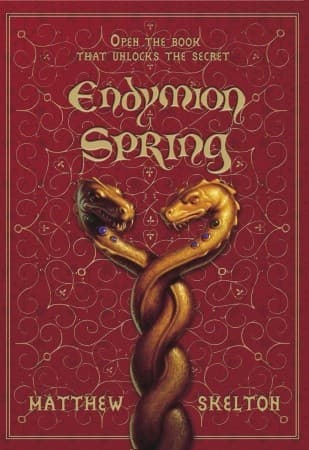
Synopsis
Covers the whole plot, including the ending.
- Difficulty
- Medium
- Pacing
- Moderate
- Mood
- Mysterious, Magical, Whimsical, Historical, Suspenseful
- Read it if
- You enjoy magical realism, historical mysteries, and stories where children uncover ancient secrets in atmospheric settings like old libraries. Perfect for fans of 'Inkheart' or 'The Neverending Story'.
- Skip it if
- You prefer fast-paced thrillers or stories without a strong emphasis on literary history and the power of books.
Endymion Spring Plot Summary
Covers the whole plot, including the ending.
An Ancient Secret in Gutenberg's Workshop
The story begins in 1452 Mainz, Germany, with Endymion Spring, a timid apprentice in Johannes Gutenberg's printing workshop. Endymion does menial labor and is mocked by other apprentices, especially Otto. One day, while cleaning, Endymion finds a strange, blank book hidden in a heavy, serpent-clasped chest. The book is made of unique, vellum-like paper that seems almost alive. When Endymion pricks his finger on the serpent clasp, a drop of blood falls onto the blank page, causing faint, shimmering words to appear. He quickly realizes that the book, which he calls the 'Liber Noctis' (Book of Night), shows text only to him and responds to his thoughts and proximity to certain inks. Endymion begins to secretly study the book, unaware of its true power and the dangers it brings, including Gutenberg's watchful eyes and a mysterious, cloaked figure.
Maia and the Bodleian Library
Centuries later, in modern-day Oxford, England, eleven-year-old Maia and her younger brother, Alex, are spending their summer vacation with their academic mother, Mary, who is researching at the Bodleian Library. Maia feels out of place and isolated, often reading books. During one of her explorations, she finds the restricted 'Duke Humfrey's Library' and is drawn to an old, heavily bound book on a dusty shelf. When she touches it, she feels a prick and sees a faint shimmer on the blank pages. This book is the same 'Liber Noctis' Endymion found centuries earlier. Maia is captivated, but her mother dismisses it as an ordinary blank book. Alex, meanwhile, finds a peculiar, empty box that seems to hum with strange energy, unknowingly connected to the book's history.
The Book of Night Awakens
Maia's interest in the blank book grows. She notices that the pages are not truly blank; faint, shimmering words appear and disappear, visible only to her. The book seems to communicate with her, showing snippets of text that hint at an ancient, powerful secret related to printing and making books. She learns that the book is alive, a creation designed to record and reveal truths. Maia keeps her discovery a secret from her mother and Alex, feeling a deep, personal connection to the artifact. At the same time, the mysterious 'cloaked figure' from Endymion's timeline, later revealed as the enigmatic printer, starts to appear in the modern era, subtly observing Maia and the book, showing a long pursuit of its power.
Alex's Connection and the Serpent Chest
While Maia learns more from the Liber Noctis, Alex discovers more about the 'empty' box he found. It is, in fact, the serpent-clasped chest that once held the Liber Noctis in Gutenberg's workshop. Alex, with his innocent curiosity, finds that the box is not truly empty but contains hidden compartments and mechanisms. He realizes it is more than just an old container; it is a key to understanding the book. The chest, like the book, seems to respond to him, revealing faint impressions and clues. This discovery links Alex directly to the historical narrative, showing that the power of the Liber Noctis and its related artifacts is not limited to Maia alone, and that the ancient secrets are starting to resurface in their present.
Gutenberg's Ambition and the Printer's Pursuit
In the 15th-century storyline, Endymion continues to secretly study the Liber Noctis. He learns that Gutenberg is not just a craftsman but an ambitious man obsessed with the book's power to create perfect, living text. Endymion also meets the mysterious 'printer' – an ancient, shadowy figure who has pursued the Liber Noctis for centuries, believing it holds the key to immortality or ultimate knowledge. This printer, who uses various names throughout history (including Mr. Rouncewell in the modern era), is a master of manipulation and dark arts, always trying to get the book. Endymion realizes he is caught in a dangerous game between Gutenberg's possessiveness and the printer's relentless, malevolent quest.
Maia Seeks Answers and Meets Mr. Rouncewell
Driven by the book's cryptic messages, Maia begins to research its origins. She looks for information about ancient printing, alchemy, and the history of the Bodleian. Her inquiries attract the attention of Mr. Rouncewell, a seemingly kind but subtly sinister old man who works at the library. Rouncewell, who is the modern version of the 'printer,' pretends to be helpful, offering Maia obscure texts and seemingly innocent advice. However, his true goal is to get closer to Maia and the Liber Noctis. Maia, still naive, senses something uneasy about him but is too focused on her quest to fully recognize the danger he poses, slowly falling into his trap.
The Liber Noctis Reveals Its History
As Maia interacts more with the Liber Noctis, the book gradually reveals its full history through shimmering images and text. She learns about Endymion Spring, his life in Gutenberg's workshop, his discovery of the book, and his growing understanding of its power. The book shows her how Endymion, guided by its magic, tried to protect it from Gutenberg and the 'printer.' Maia sees Endymion's fear, his courage, and his fate. She understands that the book itself is a living creation, with a consciousness, and that Endymion's essence, or a part of it, is tied to its pages, making his story a central part of its existence.
The Printer's Trap and Alex's Role
Mr. Rouncewell's true nature appears as he tries to take the Liber Noctis from Maia. He reveals his ancient identity as the relentless 'printer' who has pursued the book for centuries. He explains his belief that the book, combined with the serpent chest, holds the secret to eternal life and control over knowledge. Rouncewell tries to manipulate Maia, using her mother as leverage. During this confrontation, Alex, who has been reading clues from the serpent chest, realizes its connection to the book and Rouncewell's sinister plans. Alex's innocence and his ability to interact with the chest are important, as he holds a piece of the puzzle Rouncewell needs to fully activate the book's power.
The Convergence and the Final Choice
The climax happens as Maia and Alex, guided by the Liber Noctis, confront the printer, Mr. Rouncewell, in a hidden chamber under the Bodleian Library. The serpent chest and the book are brought together, creating a powerful, mystical energy. Rouncewell tries to force the children to activate the book's ultimate power, believing it will grant him immortality. However, the book, through Maia, reveals that its true power is in spreading knowledge and the beauty of creation. Maia, understanding Endymion's sacrifice and the book's true purpose, makes a final, selfless choice about the Liber Noctis's fate, choosing to protect its magic from falling into the wrong hands forever.
A New Beginning for the Book and the Siblings
After the confrontation, the Liber Noctis, having found a protector in Maia, changes. Its pages become truly blank, its magic diffused, or hidden, waiting for another guardian. The printer is defeated, his ancient quest finally stopped. Maia and Alex return to a normal life, but they are changed by their summer. Maia has found her voice and purpose, no longer feeling isolated but empowered by her connection to a timeless mystery. Alex has matured, his curiosity leading him to a deeper understanding of the world. The experience leaves them with a strong bond and a secret knowledge of the magic in books and the power of stories.
Principal Figures
Maia
Protagonist
An eleven-year-old girl who discovers the magical Liber Noctis.
Maia is initially a quiet, somewhat introverted and lonely eleven-year-old, feeling out of place during her summer in Oxford. She loves books as an escape but struggles with self-confidence. Her discovery of the Liber Noctis awakens a deep sense of purpose and courage within her. She possesses a unique sensitivity that allows her to perceive the book's hidden words and understand its ancient story. Maia's journey is one of self-discovery, as she transforms from a passive observer into an active protector of a powerful secret, demonstrating resilience and intelligence in the face of danger.
Relationships: Alex (Younger brother, initially a source of annoyance but later a crucial ally); Mary (Mother, academic, initially oblivious to Maia's discoveries); Endymion Spring (Historical counterpart, connected through the Liber Noctis)
Alex
Supporting
Maia's curious younger brother who finds the serpent-clasped chest.
Alex is Maia's younger brother, characterized by his boundless energy, mischievousness, and keen observational skills. He is less interested in traditional books than Maia but possesses a hands-on curiosity that leads him to discover the serpent-clasped chest. His innocent tampering with the chest unwittingly unlocks its secrets, providing crucial clues to the Liber Noctis's history and its connection to the modern world. Alex's practical insights and bravery, particularly during the climax, prove invaluable to Maia, highlighting his unexpected importance to the overall mystery.
Relationships: Maia (Older sister, initially a playful antagonist but later a close confidante); Mary (Mother)
Endymion Spring
Protagonist (historical)
A timid apprentice in Gutenberg's workshop who first discovers the Liber Noctis.
Endymion Spring is a young, timid, and often bullied apprentice in Johannes Gutenberg's 15th-century printing workshop in Mainz. Despite his humble position, he possesses an innate sensitivity and intellectual curiosity that allows him to discover and understand the Liber Noctis. He develops a deep, protective bond with the book, recognizing its unique, living qualities. Endymion's journey is one of courage born out of necessity, as he attempts to guard the book from the ambitions of Gutenberg and the malevolent pursuit of the 'printer,' ultimately making a profound sacrifice that links him eternally to the book's essence.
Relationships: Johannes Gutenberg (Master, ambitious and possessive); The 'Printer' (Mr. Rouncewell) (Ancient antagonist, relentless pursuer of the book); Liber Noctis (His discovery and life's purpose)
The 'Printer' / Mr. Rouncewell
Antagonist
An ancient, shadowy figure relentlessly pursuing the Liber Noctis.
The 'printer' is the primary antagonist, an ancient, shadowy alchemist and master printer who has pursued the Liber Noctis for centuries, believing it holds the key to immortality and ultimate knowledge. In the 15th century, he is a menacing cloaked figure, subtly manipulating events. In the modern era, he adopts the guise of Mr. Rouncewell, a seemingly benign but subtly sinister elderly man working at the Bodleian Library. He is cunning, manipulative, and ruthless, using his vast historical knowledge and influence to get close to Maia and the book. His obsession drives the central conflict, representing the corrupting power of unchecked ambition.
Relationships: Endymion Spring (Historical target of his manipulations); Maia (Modern target of his manipulations); Alex (Target of his manipulations)
Johannes Gutenberg
Supporting (historical)
Endymion's master, an ambitious printer obsessed with the Liber Noctis.
Johannes Gutenberg is depicted as a brilliant but ambitious and somewhat ruthless master printer in 15th-century Mainz. While famous for his revolutionary printing press, the book portrays his darker side: his possessiveness and desire to exploit the Liber Noctis's unique properties for his own gain. He sees the book not as a living entity but as a tool to achieve unprecedented printing perfection and power. His ambition puts him at odds with Endymion and makes him a secondary antagonist in the historical timeline, driven by a desire for control over the ultimate form of printed text.
Relationships: Endymion Spring (Apprentice, whose discovery threatens Gutenberg's control); The 'Printer' (Rival for the book's power)
Mary
Supporting
Maia and Alex's academic mother, researching at the Bodleian Library.
Mary is Maia and Alex's mother, an academic engrossed in her research at the Bodleian Library. She is intelligent and dedicated to her work but often oblivious to the extraordinary events unfolding around her children. Initially, she dismisses Maia's claims about the blank book as childish imagination. Her focus on logical, academic pursuits makes her a foil to Maia's intuitive connection with the magical. However, her presence in Oxford is the catalyst for the children's discovery, and she eventually plays a minor role in the climax, though she never fully comprehends the magical reality.
Relationships: Maia (Daughter, whose experiences she initially dismisses); Alex (Son)
Otto
Mentioned (historical)
A cruel fellow apprentice in Gutenberg's workshop.
Otto is a minor character in the 15th-century storyline, serving as Endymion's primary tormentor among the other apprentices. He is depicted as cruel, bullying, and jealous of any attention Endymion might receive. His actions highlight Endymion's vulnerability and timidity at the beginning of the story, making Endymion's eventual bravery more impactful. Otto represents the mundane cruelty that Endymion faces before being drawn into the extraordinary world of the Liber Noctis.
Relationships: Endymion Spring (Fellow apprentice, whom he bullies)
The Liber Noctis (Book of Night)
Supporting (object/entity)
A magical, living book that reveals words only to certain individuals.
The Liber Noctis is not merely an object but a central character in itself. It is a unique, blank book made of vellum-like paper that appears to be alive, with fine veins running through its pages. It reveals shimmering words and images only to those with a special connection, typically through blood. It is a repository of ancient knowledge, capable of recording and revealing its own history, and seems to possess a consciousness. Its power is linked to the creation of perfect, living text, and it actively guides its chosen guardians (Endymion and Maia) in its protection. It is both a magical artifact and a sentient entity.
Relationships: Maia (Its modern guardian and reader); Endymion Spring (Its original discoverer and guardian); The 'Printer' (Its relentless pursuer)
Themes & Insights
The Power and Nature of Books and Knowledge
The main theme is the power of books, not just as information sources, but as living things that affect destiny. The Liber Noctis itself is a sentient book, showing that knowledge can be alive, magical, and dangerous. The story explores the responsibility that comes with such power, contrasting Gutenberg's desire to control it and the 'printer's' desire to exploit it with Endymion's and Maia's more respectful, protective relationship with the book. It suggests that true knowledge is not just about facts but about understanding, connection, and creation.
“'Words are living things,' he whispered. 'They breathe. They have blood.”
Identity and Self-Discovery
Maia and Endymion both go through journeys of self-discovery because of their connection to the Liber Noctis. Maia, initially shy and lonely, finds her voice, courage, and purpose as she solves the book's mystery. Endymion, a timid apprentice, finds his bravery and makes a sacrifice to protect the book. The book acts as a mirror, showing their inner strengths and challenging them to grow beyond their initial situations. Their individual searches for understanding the book match their personal growth and the formation of their true identities.
“She felt a sense of belonging she hadn't known she was missing, a quiet understanding that this book, this mystery, was hers.”
The Duality of Creation and Destruction
The novel explores creation and destruction, especially in printing and knowledge. Gutenberg, a revolutionary creator, is also driven by destructive ambition. The Liber Noctis, a creation of great power, can be used for good (spreading knowledge) or evil (immortality and control). The 'printer' represents the destructive pursuit of knowledge for selfish gain. The story suggests that every act of creation can have both positive and negative results, and the intention and character of the user determine its final impact.
“The greatest creations hold the greatest dangers.”
Past and Present Intertwined
The narrative connects two distinct timelines—15th-century Mainz and modern-day Oxford—to show how the past directly affects the present. The Liber Noctis is the bridge, carrying its history and Endymion's essence to Maia. The 'printer's' long life further emphasizes this theme, as his ancient quest continues across centuries. This intertwining shows the lasting nature of secrets, the echoes of historical events, and how old mysteries can resurface and need resolution in contemporary times, blurring the lines between different eras.
“Some stories are never finished; they simply wait for a new reader.”
The Nature of Immortality
The 'printer's' pursuit of the Liber Noctis is driven by his desire for immortality, believing the book holds the secret to eternal life. However, the novel redefines what true immortality means. While the printer seeks a physical, unending existence, the book itself, and Endymion's spirit within it, suggests a different kind of immortality: the lasting life of knowledge, stories, and the legacy left behind. Endymion's sacrifice and Maia's protection of the book imply that true lasting impact comes from selfless acts and the preservation of truth, rather than selfish eternal existence.
“He did not want to live forever. He wanted the book to live forever.”
Plot Devices & Literary Techniques
Dual Timeline Narrative
Alternating chapters between 15th-century Mainz and modern-day Oxford.
The novel employs a dual timeline narrative, alternating between Endymion Spring's story in 15th-century Mainz and Maia's story in contemporary Oxford. This structure slowly reveals the interconnectedness of the two plots, building suspense as the reader pieces together how the past events directly influence the present. It allows for a gradual unveiling of the Liber Noctis's history and the 'printer's' ancient pursuit, creating a rich tapestry that emphasizes the timeless nature of the book's magic and the enduring echoes of historical secrets.
The Liber Noctis (Sentient Book)
A magical, living book that reveals its secrets to specific individuals.
The Liber Noctis itself is the central plot device. It's not just an artifact but a sentient, magical entity that actively participates in the story. Its ability to reveal words only to Maia (and Endymion), to show its own history through shimmering text and images, and to seemingly guide its protectors, drives the entire plot. It acts as a bridge between the timelines, a source of mystery, and a character in its own right, forcing the protagonists to interact with it and understand its profound power and purpose.
The Serpent-Clasped Chest
A mystical chest that acts as a key to the Liber Noctis's power.
The serpent-clasped chest serves as a crucial plot device, initially appearing as a simple, ancient container. Its intricate design, particularly the serpent clasp that requires blood to open, and its hidden compartments, act as a physical key and a source of clues. Alex's discovery and interaction with the chest parallel Maia's with the book, revealing that the chest is integral to fully unlocking the Liber Noctis's power. It represents the binding and protection of ancient magic, and its reunification with the book is essential for the climax of the story.
The 'Printer' (Ageless Antagonist)
A character who transcends time, linking the two narrative timelines.
The 'printer' is a pivotal plot device as an ageless antagonist. His presence in both the 15th century (as the cloaked figure) and the modern era (as Mr. Rouncewell) directly connects the two timelines and provides continuity to the overarching conflict. His relentless, centuries-long pursuit of the Liber Noctis creates a sense of urgency and deep-rooted danger, demonstrating the enduring power of ambition and obsession. He serves as the primary external conflict for both Endymion and Maia, embodying the threat to the book's true purpose.
The Bodleian Library
A historical setting that acts as both a sanctuary and a battleground.
The Bodleian Library in Oxford is more than just a setting; it's a significant plot device. As a repository of ancient knowledge, it provides the perfect backdrop for the discovery of a magical book and serves as a symbolic sanctuary for books and learning. Its labyrinthine passages, restricted sections, and hidden chambers become a metaphorical battleground for the conflict between preserving knowledge and exploiting it. The library's historical weight and atmosphere amplify the sense of mystery and danger surrounding the Liber Noctis.
Endymion Spring Quotes
“Books are not just words on a page; they are doors to other worlds, and some doors should never be opened.”
“The book chooses its reader, not the other way around.”
“Words have power, and some words have more power than others.”
“In every library, there is a book that holds a secret waiting to be discovered.”
“The past is not dead; it is just waiting to be read.”
“Fear is the lock, and courage is the key.”
“Some stories are meant to be hidden, and some are meant to be told.”
“A book without a reader is like a soul without a body.”
“The ink of scholars is more precious than the blood of martyrs.”
“Magic is not in the wand, but in the words.”
“Every page turned is a step into the unknown.”
“The greatest treasures are not gold, but stories.”
“In the silence of a library, the loudest stories are told.”
“To unlock a mystery, you must first unlock yourself.”
Quiz
10 questions on the plot and the characters. Each answer comes with a short explanation.
Question 1
What is the name of the boy who discovers the blank book in the Oxford library?
- Endymion Spring
- Blake Winters
- Matthew Skelton
- Peter Duck
Show answer
B. Blake Winters Blake Winters is the protagonist who discovers the mysterious blank book in the Oxford library, which begins to reveal words only he can see.
Question 2
What must happen for the serpent's-head clasp on the chest to open?
- It must be exposed to moonlight
- It must hear a specific incantation
- Its fangs must taste blood
- It must be touched by a child
Show answer
C. Its fangs must taste blood The book's description explicitly states that the chest 'can only be opened when the fangs of its serpent's-head clasp taste blood,' establishing a key magical mechanism.
Question 3
In which city does the modern-day story primarily take place?
- Cambridge
- London
- Oxford
- Paris
Show answer
C. Oxford The modern narrative is set in Oxford, where Blake discovers the book in a library, while historical sections occur elsewhere.
Question 4
What unusual characteristic does the blank book have when Blake first touches it?
- It glows with a faint light
- It feels warm to the touch
- It has fine veins in the paper and seems to quiver
- It emits a humming sound
Show answer
C. It has fine veins in the paper and seems to quiver The description notes that the book's 'paper has fine veins running through it and seems to quiver, as if it's alive,' hinting at its magical nature.
Question 5
Who is Endymion Spring in the context of the story?
- A modern-day librarian in Oxford
- A mythical beast depicted on the chest
- A historical figure connected to the book's creation
- Blake's imaginary friend
Show answer
C. A historical figure connected to the book's creation Endymion Spring is a historical character from the 15th century, an apprentice to Johannes Gutenberg, who is linked to the mysterious book's origins.
Question 6
What happens when Blake touches the blank book for the first time?
- He is transported to another time
- He feels something pierce his finger
- The book immediately fills with writing
- He hears voices from the past
Show answer
B. He feels something pierce his finger The book description states that 'a boy touches a strange book and feels something pierce his finger,' which is Blake's initial encounter with the magical volume.
Question 7
Which historical figure is Endymion Spring apprenticed to in the story?
- William Caxton
- Johannes Gutenberg
- Leonardo da Vinci
- Nicolaus Copernicus
Show answer
B. Johannes Gutenberg Endymion Spring works as an apprentice to Johannes Gutenberg, the inventor of the printing press, connecting the book's magic to historical printing innovations.
Question 8
What is a central theme explored through the parallel narratives in 'Endymion Spring'?
- The dangers of technological advancement
- The power and mystery of books and knowledge
- The importance of family loyalty
- The inevitability of historical cycles
Show answer
B. The power and mystery of books and knowledge The book intertwines historical and modern stories to explore themes of hidden knowledge, the magical nature of books, and the timeless quest for understanding.
Question 9
Why is the chest described as being dragged through snow-covered streets significant to the story?
- It symbolizes the cold reception of new ideas
- It establishes a mysterious, secretive historical event that sets up the modern mystery
- It represents the harsh winter in Oxford
- It foreshadows Blake's cold relationship with his family
Show answer
B. It establishes a mysterious, secretive historical event that sets up the modern mystery The opening scene with the cloaked figure dragging the chest in the snow creates a historical mystery that parallels and influences Blake's modern discovery, linking past and present.
Question 10
How does the book's ability to show words only to Blake connect to larger themes in the story?
- It suggests Blake has a unique destiny tied to the book's secret
- It indicates that Blake has a vivid imagination
- It proves that the book is a ordinary object
- It shows that all children can see the words
Show answer
A. It suggests Blake has a unique destiny tied to the book's secret The book revealing words only to Blake emphasizes themes of chosen individuals, hidden knowledge, and personal connection to historical secrets that drive the plot.
Endymion Spring FAQ
What is 'Endymion Spring' about?
The novel interweaves two timelines: in 1453, the printer's apprentice Endymion Spring discovers a magical blank book that reveals secrets only to him, while in modern-day Oxford, 12-year-old Blake Winters accidentally activates the same book, which begins showing him hidden words. Both boys must protect the book from sinister forces seeking its power, uncovering a centuries-old mystery involving Johann Gutenberg, alchemy, and a living library.
Why should I read 'Endymion Spring'?
The book offers a compelling blend of historical mystery and contemporary adventure, with rich descriptions of medieval printing and modern Oxford libraries. Its unique premise of a living book that communicates differently with each reader creates an immersive experience that appeals to both young adult and adult readers who enjoy puzzles, secret societies, and literary mysteries.
What is the background/setting of 'Endymion Spring'?
The story alternates between 1453 Mainz, Germany, during Johannes Gutenberg's development of the printing press, and present-day Oxford, England, specifically the Bodleian Library. The historical setting explores the dangerous world of early printing and alchemy, while the modern setting uses Oxford's ancient libraries and secret passages to create an atmospheric mystery.
What are the most memorable quotes?
Key quotes include 'You've stumbled on to something much larger than you can possibly imagine' (the book's tagline), 'The book is alive' (describing the magical volume), and 'Words have power, but some words have more power than others' (referring to the book's hidden knowledge). These capture the novel's themes of discovery, magic, and the potency of written language.
What writing style does the author use?
Matthew Skelton employs a dual narrative structure with alternating chapters between 1453 and present day, using vivid sensory descriptions particularly for the magical book's appearance and behavior. The prose balances historical detail with fast-paced mystery, incorporating elements of gothic atmosphere in the historical sections and contemporary detective work in the modern timeline.
What minor details add significant meaning?
The serpent's-head clasp that requires blood to open foreshadows the book's connection to alchemical transformation. The 'fine veins' in the paper that Blake notices mirror both blood vessels and the fibrous structure of real paper, hinting at the book's organic nature. Endymion's name itself references Greek mythology about eternal sleep and awakening, symbolizing the book's dormant power.
What are some subtle foreshadowing moments?
Early descriptions of the book 'quivering as if alive' prepare readers for its true sentient nature. Blake's initial finger prick from the book mirrors the blood requirement of the ancient chest. Endymion's observations about certain letters in Gutenberg's workshop having 'a life of their own' foreshadow the magical properties that will become central to the plot.
What unexpected character connections exist?
Blake Winters discovers he's spiritually connected to Endymion Spring through their mutual sensitivity to the book. The mysterious figure pursuing the book in both timelines is revealed to be part of a secret society that has protected/altered the book for centuries. Minor characters like library staff members have hidden knowledge about the book's history that connects the timelines.
What are unspoken character motivations?
Blake's initial reluctance to engage with the book stems from his insecurity about being an outsider in Oxford, not just typical childhood fear. Endymion's devotion to protecting the book is driven by guilt over his family's poverty and his desire to prove his worth beyond being a mere apprentice. The antagonists seek the book not just for power, but from a twisted belief they're preserving knowledge from being misused.
What psychological complexities do characters exhibit?
Blake struggles with feeling invisible in his academic family, making his unique connection to the book both empowering and isolating. Endymion grapples with the moral dilemma of whether powerful knowledge should be shared or protected. Adult characters like Blake's mother demonstrate conflicted loyalty between protecting her son and pursuing academic discovery of the book's secrets.
What are the major emotional turning points?
When Blake first sees words appear that others cannot, he transitions from skepticism to terrified wonder. Endymion's decision to risk his life to separate the book from Gutenberg's workshop marks his commitment to its protection. The climax where Blake must choose between revealing the book's secrets or keeping them hidden forces him to mature beyond his years.
How do relationship dynamics evolve?
Blake's initially distant relationship with his academic parents deepens as they become involved in the mystery, though tension arises from their different approaches to the book. Endymion's apprentice-master relationship with Gutenberg transforms from reverence to cautious independence as he realizes the dangers of the book's power. The book itself becomes a third party in these relationships, altering how characters interact with each other.
Which parts remain ambiguous or open-ended?
The exact origin and full capabilities of the magical book are never completely explained, leaving its nature mysterious. The ultimate fate of some historical characters connected to the book is left uncertain. Whether the book will continue to communicate with future readers or has completed its purpose with Blake remains open to interpretation.
What are controversial scenes or decisions?
Endymion's choice to essentially steal the book from Gutenberg raises questions about whether protecting dangerous knowledge justifies theft. Blake's decision to keep the book's full secrets from adults, including his parents, presents ethical dilemmas about childhood autonomy versus adult guidance. The blood requirement to open the chest/book troubles some readers with its violent connotations.
'Endymion Spring' ending explained: how it ends & what it means
The story concludes with Blake safeguarding the book's secrets while gaining new confidence from his experience. The parallel timelines resolve with Endymion successfully hiding the book for future discovery and Blake understanding his role in its protection. The ending suggests that some knowledge must remain guarded rather than fully revealed, emphasizing responsibility over curiosity, and that ordinary individuals can become guardians of extraordinary things.
What is the significance of the book only revealing words to certain people?
This selective revelation represents the theme that true understanding requires both readiness and inherent sensitivity, not just intelligence. It creates a bond between Blake and Endymion across centuries while excluding those who would misuse the knowledge. The mechanism suggests that the book has a consciousness that judges who is worthy of accessing its secrets.
How does the novel connect printing history to fantasy elements?
Skelton uses Gutenberg's historical printing revolution as the foundation for the fantasy premise: if ordinary printing gave words power, this magical book represents the ultimate extension of that power. The lead type and alchemical processes of historical printing are reimagined as sources of literal magic, creating a believable bridge between documented history and imaginative fantasy.
What role does Oxford's Bodleian Library play in the story?
The Bodleian serves as both setting and character—its ancient architecture, hidden passages, and vast collections provide the physical mystery for Blake to navigate. Historically, it represents continuity with the past where Endymion's book might realistically be preserved. The library's atmosphere of silent scholarship contrasts with the dangerous activity happening within its walls.
How does the blood motif function throughout the story?
Blood operates on multiple levels: literally as the key to unlocking the book's container, symbolically as life force connecting characters across time, and metaphorically as the 'bloodlines' of knowledge transmission. Blake's accidental blood contact mirrors ancient ritual requirements, suggesting that some magic requires personal sacrifice or commitment.
About the author

Matthew Skelton is an author known for his work in fiction, particularly for the novel "Endymion Spring." This book intertwines themes of adventure and mystery, appealing to readers of various ages. Skelton's writing often explores the intersection of history and imagination.
Similar books
- Inkheart
Cornelia Funke
3.9 (369k) average on GoodreadsFantasyFeatures a magical book that brings characters to life and a young protagonist with a unique connection to it.
- The Neverending Story
Michael Ende
4.2 (162k) average on GoodreadsFantasyA boy finds a magical book that draws him into its world, exploring themes of imagination and the power of stories.
- The Golden Compass
Philip Pullman
4.0 (1.3M) average on GoodreadsFantasyA young protagonist uncovers a vast conspiracy and an ancient secret in an Oxford setting, blending fantasy with mystery.
- Harry Potter and the Sorcerer's Stone
J.K. Rowling
4.5 (7M) average on GoodreadsFantasyRescued from a miserable life under the stairs, an orphaned boy discovers he's a wizard destined for a magical school, where he uncovers a dangerous secret tied to the dark wizard who murdered his parents.
- The Hunger Games
Suzanne Collins
4.3 (6.4M) average on GoodreadsFantasyIn a future where children fight to the death on live television, Katniss Everdeen volunteers for the arena, turning a death sentence into a fight for survival and a spark of rebellion.
- 1984
George Orwell
4.2 (3.1M) average on GoodreadsPoliticsIn a future where surveillance and thought control are absolute, a man's search for truth clashes with the Party, showing that hope can be a form of rebellion.



Enjoyed the summary?
A summary gives you the shape of the book. The book itself has the detail, the examples and the voice.
Find Endymion Spring on AmazonAs an Amazon Associate, BookBrief earns from qualifying purchases. How we're funded