

Synopsis
Covers the whole plot, including the ending.
- Difficulty
- Medium
- Pacing
- Fast
- Mood
- Chaotic, Disillusioned, Absurdist, Paranoid, Gonzo
- Read it if
- You enjoy experimental, first-person narratives, counter-culture themes, and a raw, unapologetic look at the 1960s drug scene and its disillusionment.
- Skip it if
- You prefer traditional plot structures, find extensive drug use and chaotic behavior off-putting, or are sensitive to explicit language and themes.
Fear and Loathing in Las Vegas Plot Summary
Covers the whole plot, including the ending.
The Road to Las Vegas
The story begins with Raoul Duke, a journalist, and his attorney, Dr. Gonzo, speeding across the Nevada desert in a red convertible, called the 'Great Red Shark.' They are very high on illegal drugs, including ether, mescaline, and LSD. Duke is supposed to cover the Mint 400 motorcycle race for a sports magazine, but his and Gonzo's real goal quickly turns into a wild search for the 'American Dream' through extreme drug use and watching American culture. Their first interactions with normal people, like a hitchhiker they pick up, are full of paranoia and confusion, setting the tone for their confusing adventure.
The Mint 400
Duke and Gonzo arrive in Las Vegas and check into the Mint Hotel, a main spot for the Mint 400. Duke tries half-heartedly to cover the motorcycle race, interviewing racers and officials, but his mind is very distorted by drugs. He struggles to focus, his notes make no sense, and he feels more and more separate from the 'normal' people around him. Dr. Gonzo, meanwhile, acts more erratically, pushing Duke deeper into their shared delusion. The race itself becomes a blurry, minor concern, overshadowed by their internal chaos and the strange things they do with the city's residents.
The District Attorneys' Conference
After the Mint 400, Duke is unexpectedly assigned to cover a conference on narcotics, also in Las Vegas. This job creates a dark, funny situation, as Duke and Gonzo are themselves deep in a drug-induced haze. They attend the conference, barely hiding their intoxication, and find themselves surrounded by the very people fighting drug use. The paranoia grows as Duke imagines being found out, while Gonzo acts even more wildly. He threatens to jump from their hotel balcony while on acid, forcing Duke to stop him.
The Rave-Up in the Desert
After the conference, Duke and Gonzo, still in Las Vegas, decide to go to a 'Rave-Up' – a music festival in the desert – looking for a more real, counter-cultural experience than the mainstream events they have been covering. They continue to use many drugs, especially LSD, hoping for some kind of amazing discovery or connection to the 'spirit of the sixties' they feel is disappearing. The festival, however, turns out to be another source of confusion and disappointment. They find it filled with a mix of true free spirits and opportunistic people, further blurring the lines between reality and their drug-induced perceptions.
The Search for the American Dream
Throughout their adventures, Duke often thinks about the 'American Dream' and its perceived decline. He sees Las Vegas as a small example of this decline, a place where buying things, fakery, and a desperate chase for quick pleasures have replaced real ideals. His drug use is, in part, an attempt to see past society's surface and find a deeper truth, or perhaps just to escape the harsh realities he sees. This search becomes a main, though often hidden, theme of their journey, driving their constant pursuit of altered states and their critical observations of the world around them.
Escalating Madness at the Hotel
Duke and Gonzo's hotel rooms become the center of their growing madness. They trash rooms, use many drugs and alcohol, and do increasingly strange and destructive things. Their interactions with hotel staff, bellboys, and maids are often surreal and aggressive, fueled by paranoia and their distorted views. These incidents show their separation from normal society and their self-destructive path. The hotel rooms change from temporary places to stay into chaotic centers of excess, showing the internal trouble of their drug-addled minds and their rejection of society's rules.
The Fear and Loathing Deepens
As their drug journey continues, Duke has intense periods of fear and disgust. He deals with deep paranoia, believing that he and Gonzo are being watched or are about to be exposed. These moments of terror are mixed with cynical thoughts on American society, the counterculture, and his own place in it. He questions the meaning of their journey and if their methods work, often feeling stuck in a cycle of self-made madness. These thoughtful moments offer a brief look into the worries behind his excessive behavior.
The Leaving of Las Vegas
Eventually, Duke and Gonzo decide it is time to leave Las Vegas, though their departure is as chaotic and drug-filled as their arrival. They are almost arrested, barely escape various fights, and leave behind a trail of destruction and unpaid bills. The 'Great Red Shark' is once again their escape vehicle, taking them away from the neon madness and back into the desert. Their exit is not a moment of clarity or relief, but rather a continuation of their wild, unpredictable journey, leaving the reader to wonder about the real impact of their experiences.
Return to Reality (of sorts)
After returning from Las Vegas, Duke tries to make sense of his experiences and write his articles. However, the lasting effects of the drugs and the deep impact of his journey make it hard to return to any sense of normalcy. His writing is broken, filled with his subjective, drug-induced perceptions, blurring the line between objective journalism and personal hallucination. He struggles with the everyday parts of life, finding it boring and uninspiring after the intense highs and lows of Las Vegas. The trip has permanently changed his view, making him feel separate from normal society.
The Aftermath and Lingering Questions
The novel ends with Duke thinking about what his Las Vegas adventure means. He considers the fate of the counterculture generation, the unclear nature of truth, and the widespread feeling of disappointment in America. There is no clear ending; instead, the conclusion emphasizes that their journey was not about finding answers but about experiencing the extreme decline of the American Dream. Duke is left with a feeling of unease, a sense that something important has been lost, and that his drug-fueled quest, though chaotic, offered a strange kind of insight into the soul of a nation.
Principal Figures
Raoul Duke
Protagonist
A cynical, drug-addled journalist on a quest for the American Dream.
Raoul Duke is the alter ego of Hunter S. Thompson and the unreliable narrator of the story. He is a journalist ostensibly on assignment, but his true purpose is to immerse himself in a drug-fueled exploration of American culture and the decaying ideals of the 1960s counterculture. Cynical, intelligent, and deeply paranoid, Duke uses an array of illegal substances to alter his perception, believing it allows him to see a more authentic, albeit terrifying, reality. He is often overwhelmed by his drug-induced hallucinations and the absurdity of the world around him, yet he maintains a peculiar sense of journalistic duty, attempting to record his experiences.
Relationships: Dr. Gonzo (Attorney, accomplice, and fellow drug enthusiast; their relationship is co-dependent and often destructive.)
Dr. Gonzo
Supporting/Antagonist
Raoul Duke's Samoan attorney and equally unhinged companion.
Dr. Gonzo is Duke's volatile, unpredictable, and often terrifying attorney. He is a large, Samoan man with an insatiable appetite for drugs and extreme behavior. While Duke is the observer and often a reluctant participant in their most outrageous acts, Gonzo is frequently the instigator, pushing their adventures to dangerous and destructive extremes. He embodies a raw, unrestrained id, making him both a source of dark humor and genuine menace. His actions often force Duke into increasingly precarious situations, highlighting the destructive potential of their shared drug use.
Relationships: Raoul Duke (Client and partner in drug-fueled escapades; their relationship is intense, co-dependent, and often fraught with tension and mutual manipulation.)
The Hitchhiker
Mentioned
A young, innocent hitchhiker who briefly encounters Duke and Gonzo.
The hitchhiker is a young, naive man Duke and Gonzo pick up early in their journey. He serves as a stark contrast to their drug-addled reality, representing the 'straight' world they are so aggressively rebelling against. His brief presence highlights the vast gulf between their chaotic existence and conventional society. Terrified by their erratic behavior, the sheer volume of drugs, and Gonzo's menacing threats, he quickly abandons their car, providing an early, humorous, and unsettling glimpse into the duo's destructive impact on others.
Relationships: Raoul Duke (Brief, terrifying encounter as a passenger.)
Lacerda
Supporting
Duke's sports editor, who assigns him to cover the Mint 400.
Lacerda is Raoul Duke's sports editor, the figure who assigns him to cover the Mint 400. He represents the journalistic establishment and the 'real world' responsibilities that Duke is ostensibly meant to uphold. His interactions with Duke are primarily through phone calls, where Duke tries to maintain a facade of professionalism despite his drug-induced chaos. Lacerda is largely oblivious to the true nature of Duke's reporting, serving as a symbol of the mainstream media's detachment from the raw, subjective reality Duke is experiencing. He is a distant, authority figure Duke constantly tries to appease or evade.
Relationships: Raoul Duke (Employer/employee relationship, strained by Duke's erratic behavior.)
Lucy
Mentioned
A young artist Dr. Gonzo brings to Las Vegas.
Lucy is a young artist whom Dr. Gonzo brings with him to Las Vegas, much to Duke's dismay. She is depicted as somewhat naive and vulnerable, quickly becoming overwhelmed and terrified by Gonzo's increasingly extreme drug use and violent tendencies. Her presence briefly introduces a moral dilemma for Duke, as he feels a responsibility to protect her from Gonzo, even as he is complicit in their drug-fueled environment. She represents an innocent caught in the crossfire of their self-destructive hedonism, and her eventual escape from their chaos underscores the destructive nature of their lifestyle.
Relationships: Dr. Gonzo (Companion, later victim of his erratic behavior.)
The Drug Dealer (Mexican)
Mentioned
A source of Duke and Gonzo's illicit substances.
The Mexican drug dealer is a minor character who supplies Duke and Gonzo with some of their extensive array of illicit substances. He briefly appears as a shadowy figure, facilitating their drug habits. His presence underscores the pervasive availability of drugs in their world and their deep immersion in the counterculture's dark underbelly. He is a transactional character, serving as a means to an end for the protagonists' continued altered states, and his interactions with Duke are quick and business-like, reflecting the clandestine nature of their dealings.
Relationships: Raoul Duke (Customer/supplier relationship for illicit substances.)
Themes & Insights
The Decline of the American Dream
The novel examines the decay of the American Dream, showing Las Vegas as a symbol of its corruption. Duke observes how the ideals and countercultural hopes of the 1960s have turned into a hollow pursuit of money, shallow entertainment, and drug-fueled escape. The Mint 400 and the conference, at first seen as symbols of American business or justice, are shown through Duke's drug-addled mind as absurd, hypocritical, and ultimately meaningless events. The search for a real 'dream' is replaced by a desperate, often destructive, pursuit of excitement.
“We were somewhere around Barstow on the edge of the desert when the drugs began to take hold. I remember saying something like 'I feel a bit lightheaded; maybe you should drive...' And suddenly there was a terrible roar all around us and the sky was full of what looked like huge bats, all swooping and screeching and diving around the car, which was going about a hundred miles an hour with the top down to Las Vegas.”
The Illusion of Reality vs. Subjective Truth
A main theme is the blurred line between real life and subjective, drug-induced perception. Duke's heavy drug use is not just for pleasure; it is a deliberate attempt to break through society's perceived illusions and uncover a 'truer' reality. However, this often leads to intense paranoia, hallucinations, and a deep inability to tell what is real from what is imagined. The story constantly challenges the reader to question what is true, suggesting that 'reality' is often made up, especially when seen through altered states of mind. The Mint 400 coverage, for example, is less about the race and more about Duke's internal, drug-fueled experience of it.
“The only way to make sense out of change is to plunge into it, move with it, and join the dance.”
The Failure of the Counterculture
Thompson, through Duke, reflects on the end of the 1960s counterculture movement. What started as a hopeful, revolutionary movement for peace and freedom is now seen as having turned into aimless pleasure-seeking, commercial exploitation, and a cynical retreat from political action. The 'wave' of idealism that Duke remembers from his past has broken, leaving only the 'aftermath' of drug problems and disappointed people. The book suggests that the counterculture failed to make lasting change, instead falling victim to the very excesses it first tried to avoid. The Las Vegas 'Rave-Up' shows this, presenting a commercialized, weaker version of real countercultural gatherings.
“There was no turning back. We had to go on. And we were going to Las Vegas.”
Fear and Paranoia
Fear and paranoia are common feelings throughout the novel, fueled by Duke and Gonzo's extreme drug use and their constant awareness of their illegal actions. Duke often describes a growing sense of dread, the feeling of being watched, and the constant threat of arrest or exposure. This paranoia is not entirely baseless, given what they do, but it is made much worse by their drug use, reaching hallucinatory levels. This theme highlights the psychological cost of their lifestyle and the natural anxiety of living outside society's rules. The conference, in particular, becomes a test for Duke's increasing fears.
“No, this is not a good town for psychedelic drugs. Reality itself is too twisted.”
Plot Devices & Literary Techniques
Unreliable Narrator
Raoul Duke's drug-addled perspective distorts reality for the reader.
Raoul Duke serves as a quintessential unreliable narrator. His constant state of intoxication means that his perceptions, descriptions, and interpretations of events are heavily skewed. The reader is never entirely sure what is objectively happening versus what is a hallucination or a paranoid delusion. This device forces the reader to question the narrative, creating a sense of disorientation and empathy for Duke's altered state, while also highlighting the subjective nature of 'truth' in the story. It is central to the gonzo journalism style, where the journalist's subjective experience is paramount.
Symbolism of Las Vegas
Las Vegas represents the corrupted American Dream and societal excess.
Las Vegas functions as a powerful symbol throughout the novel. It is not merely a setting but a character in itself, embodying the grotesque excesses, superficiality, and ultimate failure of the American Dream. Its neon lights, casinos, and constant pursuit of fleeting pleasures represent a society that has lost its moral compass. For Duke, Las Vegas is a 'bad trip' made manifest, a place where reality is already so distorted that his drugs merely amplify its inherent madness. It serves as a microcosm for the larger societal decay Thompson is critiquing.
Gonzo Journalism
The author becomes a central, subjective character in the story.
Gonzo journalism is the overarching stylistic device. Rather than maintaining objective distance, the journalist (Duke/Thompson) is fully immersed in and becomes a central, subjective character within the story. The narrative is driven by his personal experiences, emotions, and drug-induced perceptions. This blurs the lines between reporter and subject, fact and fiction, allowing for a highly personal and often chaotic exploration of events. The book is less about reporting on Las Vegas and more about the experience of reporting on Las Vegas while completely unhinged.
Motif of Animals/Monsters
Recurring imagery of bats, lizards, and other creatures symbolizes paranoia and hallucination.
Throughout the narrative, Duke frequently hallucinates or perceives people as various animals or monsters, particularly bats and lizards. This motif serves to illustrate his drug-addled state and his deep-seated paranoia. These creatures represent the encroaching chaos and the 'fear' he experiences. The initial 'huge bats' in the desert, the 'lizard lounge' full of reptiles, and other such visions underscore the surreal, threatening nature of his environment as filtered through his altered consciousness, making the reader feel the disorientation and terror alongside him.
Fear and Loathing in Las Vegas Quotes
“We were somewhere around Barstow on the edge of the desert when the drugs began to take hold.”
“No, this is not a good town for psychedelic drugs. Too many cops.”
“One of the things you learn after a while is that you can have a lot more fun if you don't take your mind with you.”
“The only way to make sense out of change is to plunge into it, move with it, and join the dance.”
“He who makes a beast of himself gets rid of the pain of being a man.”
“In a nation of frightened dullards, we are the lords of the new--”
“The possibility of physical and mental collapse is not a pretty thing, but it is a necessary part of getting to where you want to go.”
“There was a fantastic universal sense that whatever we were doing was right, that we were on a roll.”
“We had two bags of grass, seventy-five pellets of mescaline, five sheets of high-powered blotter acid, a salt shaker half full of cocaine, and a whole galaxy of multi-colored uppers, downers, screamers, laughers... and also a quart of tequila, a quart of rum, a case of beer, a pint of raw ether, and two dozen amyl nitrites.”
“The Edge... There is no honest way to explain it because the only people who really know where it is are the ones who have gone over.”
“History is hard to know, because of all the hired liars.”
“So we bought the goddamn thing. And then the next question was: How to get rid of it?”
“It was the Law of the Jungle, and it applied to all of us.”
“There he goes. One of God's own prototypes. A high-powered mutant of some kind never even considered for mass production. Too weird to live, too rare to die.”
“We are all wired into a survival trip now. No choice but to ride it out.”
Quiz
10 questions on the plot and the characters. Each answer comes with a short explanation.
Question 1
What is the primary reason Raoul Duke and Dr. Gonzo originally travel to Las Vegas?
- To attend a legal conference on drug policy.
- To cover the Mint 400 motorcycle race for a sports magazine.
- To gamble their life savings on a high-stakes poker game.
- To meet with a potential presidential candidate.
Show answer
B. To cover the Mint 400 motorcycle race for a sports magazine. Duke, as a journalist, is initially sent to Las Vegas to cover the Mint 400 motorcycle race for a sports magazine, bringing Dr. Gonzo along as his attorney.
Question 2
What kind of car do Duke and Dr. Gonzo primarily use for their road trip?
- A red Chevrolet Corvette convertible.
- A white Cadillac convertible, often referred to as the 'Great Red Shark'.
- A black Ford Mustang Fastback.
- A silver Porsche 911.
Show answer
B. A white Cadillac convertible, often referred to as the 'Great Red Shark'. Their iconic vehicle for the majority of the trip is a white Cadillac convertible, which Duke frequently refers to as the 'Great Red Shark' due to its speed and his drug-addled perception.
Question 3
Which of these hallucinogenic drugs is NOT explicitly mentioned as being consumed by Duke and Gonzo during their trip to Las Vegas?
- LSD
- Mescaline
- PCP (Phencyclidine)
- Ether
Show answer
C. PCP (Phencyclidine) While Duke and Gonzo consume a vast array of substances including LSD, mescaline, ether, cocaine, and various uppers and downers, PCP is not specifically listed among their drug stash in the book.
Question 4
What is the name of the young, naive artist who Duke and Gonzo pick up on the highway?
- Lucy
- Alice
- Daisy
- Betty
Show answer
B. Alice They pick up a young, hitchhiking artist named Alice who is on her way to sketch the 'American Dream' in Las Vegas, a dream which Duke and Gonzo quickly shatter for her.
Question 5
What does Raoul Duke frequently refer to as the 'wave' or the 'high tide' that he feels has receded, leaving behind a generation of 'freaks'?
- The peak of the Las Vegas gambling boom.
- The counter-culture movement of the 1960s.
- The rise of conservative politics in America.
- The economic prosperity following World War II.
Show answer
B. The counter-culture movement of the 1960s. Duke often reflects on the 'wave' of the 1960s counter-culture movement, lamenting its passing and the sense of disillusionment that followed, leaving his generation adrift.
Question 6
When Duke checks into the Flamingo Hotel for the District Attorneys' Convention on Narcotics and Dangerous Drugs, what is his primary objective (besides causing general mayhem)?
- To expose the corruption within the legal system.
- To report on the convention for Rolling Stone magazine.
- To sell a large quantity of illicit drugs to the attendees.
- To find a way to legally purchase more drugs for his personal use.
Show answer
B. To report on the convention for Rolling Stone magazine. Duke is sent back to Las Vegas to cover the National District Attorneys' Conference on Narcotics and Dangerous Drugs for Rolling Stone, creating an ironic and chaotic scenario.
Question 7
What animal does Duke frequently hallucinate in his hotel room at the Flamingo during the D.A. convention?
- Giant bats
- Lizards and reptiles
- Spiders and insects
- Rats and mice
Show answer
B. Lizards and reptiles During his intense drug-induced paranoia at the Flamingo, Duke famously hallucinates the carpet coming alive with various lizards and reptiles, particularly when surrounded by the DAs.
Question 8
What is the significance of the title 'Fear and Loathing in Las Vegas' in relation to the book's themes?
- It refers to Duke's personal phobia of gambling and the city itself.
- It symbolizes the moral decay and psychological torment experienced by those chasing the American Dream.
- It describes the general public's reaction to Duke and Gonzo's antics.
- It's a direct quote from a Las Vegas local lamenting the state of the city.
Show answer
B. It symbolizes the moral decay and psychological torment experienced by those chasing the American Dream. The title encapsulates the pervasive paranoia, disillusionment, and moral revulsion Duke feels towards the superficiality and broken promises of the American Dream, particularly as embodied by Las Vegas.
Question 9
What extreme act does Dr. Gonzo threaten to commit involving a portable radio and a bathtub in their hotel room?
- He threatens to throw the radio out the window.
- He threatens to electrocute himself by dropping the radio into the bathtub while Duke is taking a bath.
- He threatens to smash the radio against the wall.
- He threatens to broadcast their drug use over the hotel's intercom system using the radio.
Show answer
B. He threatens to electrocute himself by dropping the radio into the bathtub while Duke is taking a bath. In a moment of drug-fueled madness and desperation, Dr. Gonzo threatens to drop a portable radio into a full bathtub while Duke is in it, highlighting the dangerous and erratic nature of their trip.
Question 10
At the end of the book, after their chaotic adventures, what is the ultimate fate of Raoul Duke and Dr. Gonzo?
- They are arrested and imprisoned in Las Vegas.
- They successfully complete their assignments and become respected journalists.
- They escape Las Vegas, leaving behind a trail of destruction and unpaid bills, with Duke reflecting on their experiences.
- They decide to settle down in Las Vegas and open their own law firm.
Show answer
C. They escape Las Vegas, leaving behind a trail of destruction and unpaid bills, with Duke reflecting on their experiences. Duke and Gonzo manage to flee Las Vegas, narrowly escaping various predicaments, with Duke reflecting on the 'savage journey' and the lost promise of the 60s counter-culture.
Fear and Loathing in Las Vegas FAQ
What is the basic premise of 'Fear and Loathing in Las Vegas'?
The book follows Raoul Duke, a journalist, and his attorney, Dr. Gonzo, on a drug-fueled road trip to Las Vegas. Their initial assignment is to cover the Mint 400 motorcycle race, but their journey quickly devolves into a chaotic exploration of the American Dream's decay, driven by vast quantities of illicit substances and a growing sense of paranoia.
Who are the main characters and what are their roles?
The main characters are Raoul Duke, the narrator and a thinly veiled alter ego for Hunter S. Thompson, who reports on events with a subjective, drug-addled perspective. His companion is Dr. Gonzo, a Samoan attorney, who acts as Duke's increasingly unhinged enabler and co-conspirator in their destructive escapades, often pushing their antics to extreme levels.
What is the 'American Dream' as depicted in the book?
The book portrays the American Dream as a lost ideal, corrupted by greed, consumerism, and the disillusionment following the counterculture movement of the 1960s. Duke and Gonzo's frantic search for it in Las Vegas reveals only its grotesque, commercialized remnants and the widespread societal anxieties of the era.
What is 'gonzo journalism' and how does this book exemplify it?
Gonzo journalism is a style of reporting where the journalist becomes a central figure in the story, often blurring the lines between objective reporting and subjective experience. 'Fear and Loathing' exemplifies this by presenting events entirely through Duke's drug-addled, highly personal, and often unreliable perspective, making his internal state as important as the external events.
What historical events or cultural shifts does the book implicitly comment on?
The book is deeply rooted in the post-1960s disillusionment, reflecting the perceived failure of the counterculture movement and the Vietnam War era's impact. It implicitly comments on the end of the 'Love Generation's' optimism and the subsequent rise of a more cynical, drug-fueled nihilism as a response to societal changes and political failures.
What is the significance of the Mint 400 race and the District Attorney's conference?
The Mint 400 race and the District Attorney's conference on narcotics are initially presented as legitimate journalistic assignments. However, they serve primarily as flimsy pretexts for Duke and Gonzo's drug-fueled escapades, highlighting their disdain for conventional reporting and their descent into personal chaos, ultimately rendering the 'assignments' irrelevant.
Are the events in the book entirely fictional, or based on real experiences?
The events are heavily based on Hunter S. Thompson's real experiences covering the Mint 400 and a District Attorneys' conference in 1971, with Oscar Zeta Acosta (Dr. Gonzo) as his companion. While embellished and dramatized for literary effect, the core narrative of a drug-fueled journalistic assignment in Las Vegas has roots in actual events.
What is the 'Great Wave' metaphor that Duke often references?
The 'Great Wave' metaphor, often mentioned by Duke, refers to the peak of the 1960s counterculture movement – a moment of intense optimism, idealism, and perceived societal change. Duke laments that he and Gonzo are now on the downslope of that wave, caught in the undertow of its aftermath, witnessing its decay rather than its triumph.
What role does the 'Red Shark' play in the narrative?
The 'Red Shark' is Raoul Duke's convertible, a constant companion and a symbol of their reckless journey. It serves as their mobile base of operations, drug stash, and a vehicle for their escape and pursuit of hedonism, becoming almost a character itself, bearing witness to their increasingly bizarre adventures across the Nevada desert.
How does Raoul Duke's perception of reality change throughout the book?
Raoul Duke's perception of reality becomes increasingly distorted and unreliable due to his constant drug consumption. Initially, he attempts to maintain some journalistic pretense, but by the end, his reality is a hallucinatory landscape of paranoia, grotesque figures, and a blurring of internal thoughts with external events, making it hard to discern truth from delusion.
Discuss Dr. Gonzo's psychological state and his influence on Duke.
Dr. Gonzo appears to be in a perpetually manic and aggressive psychological state, often pushing Duke further into dangerous and illegal situations. His lack of inhibition and volatile temper serve as both a catalyst for their destructive behavior and a mirror reflecting Duke's own underlying anxieties and impulses, amplifying the chaos.
What psychological effects of drug use are most prominent in the narrative?
The narrative vividly portrays paranoia, hallucinations, extreme mood swings, impaired judgment, and a profound sense of dissociation, all direct psychological effects of the characters' extensive drug use. These effects are not merely background but are central to the plot, driving the characters' actions and shaping their distorted perceptions of the world.
How does the setting of Las Vegas contribute to the characters' psychological breakdown?
Las Vegas, with its artificiality, overwhelming sensory input, and pursuit of instant gratification, acts as a perfect, amplifying backdrop for Duke and Gonzo's psychological breakdown. The city's inherent surrealism and moral ambiguity merge seamlessly with their drug-induced states, making it difficult to distinguish between the city's madness and their own.
Is the book a celebration of drug use or a cautionary tale?
This is highly debated. While it vividly describes drug-fueled 'good times,' the underlying tone is often one of desperation, paranoia, and the decay of ideals, suggesting a cautionary aspect. It can be interpreted as a raw, unfiltered depiction of a specific subculture, leaving the reader to draw their own conclusions about its implications.
What is the ultimate message or theme Thompson is trying to convey?
Thompson seems to convey the disillusionment and despair of a generation that witnessed the collapse of its ideals. The book can be seen as a lament for the lost innocence of the 1960s, a critique of American consumerism, and an exploration of the chaotic search for meaning in a world perceived as increasingly absurd and corrupt.
How does the book's ending contribute to its overall meaning?
The ending, with Duke's somewhat anticlimactic departure from Las Vegas and his reflection on the 'Great Wave,' reinforces the sense of loss and the futility of their chaotic quest. It suggests that while they survived, they found no answers, only a deeper understanding of the decay of the American Dream and the inability to recapture a lost era.
How does the novel satirize journalism and mainstream media?
The novel satirizes journalism by showing Duke's complete disregard for objective reporting, instead immersing himself in the story to the point of becoming the story. It critiques mainstream media's superficiality and its failure to capture the true, often chaotic, undercurrents of American society, presenting gonzo journalism as a radical, albeit flawed, alternative.
What is the significance of the various 'freaks' and bizarre characters Duke encounters?
The 'freaks' and bizarre characters Duke encounters serve multiple purposes: they heighten the surreal atmosphere, reflect his drug-addled perception, and symbolize the diverse, often grotesque, underbelly of American society. They are manifestations of the cultural anxieties and eccentricities that Duke believes mainstream society ignores or suppresses.
About the author
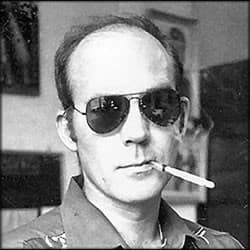
Hunter Stockton Thompson was an American journalist and author who founded the gonzo journalism movement. He rose to prominence with the publication of Hell's Angels (1967), a book for which he spent a year living and riding with the Hells Angels motorcycle club to write a first-hand account of their lives and experiences.
Similar books
- On The Road
Jack Kerouac
3.6 (349k) average on GoodreadsLifestyleExplores themes of freedom, rebellion, and the American road trip through a highly subjective lens.
- Eat, Pray, Love
Elizabeth Gilbert
3.6 (1.5M) average on GoodreadsLifestyleA heartbroken writer leaves her conventional life for a year-long global search for pleasure in Italy, spiritual devotion in India, and unexpected love and balance in Bali.
- Wild: From Lost to Found on the Pacific Crest Trail
Cheryl Strayed
4.0 (615k) average on GoodreadsLifestyleAfter losing her mother and her marriage, a young woman impulsively hikes over a thousand miles of the Pacific Crest Trail alone, finding strength and healing in the unforgiving wilderness.
- Into Thin Air: A Personal Account of the Mount Everest Disaster
Jon Krakauer
4.2 (395k) average on GoodreadsLifestyleOn May 10, 1996, ambition and a sudden, violent storm turned Mount Everest into a deadly trap, leaving Jon Krakauer to tell the harrowing story of a disaster that took lives and shattered climbers' dreams.
- A Walk in the Woods: Rediscovering America on the Appalachian Trail
Bill Bryson
4.1 (346k) average on GoodreadsLifestyleBill Bryson humorously describes his ill-prepared yet insightful attempt to hike the Appalachian Trail, meeting unique characters and the raw beauty of the wilderness.
- Three Cups of Tea: One Man's Mission to Promote Peace ... One School at a Time
Greg Mortenson
3.6 (326k) average on GoodreadsLifestyleA lost mountaineer's promise to build a school for impoverished villagers grows into a decade-long, dangerous effort to educate girls in Taliban territory, showing one person's dedication can build peace.




Enjoyed the summary?
A summary gives you the shape of the book. The book itself has the detail, the examples and the voice.
Find Fear and Loathing in Las Vegas on AmazonAs an Amazon Associate, BookBrief earns from qualifying purchases. How we're funded