
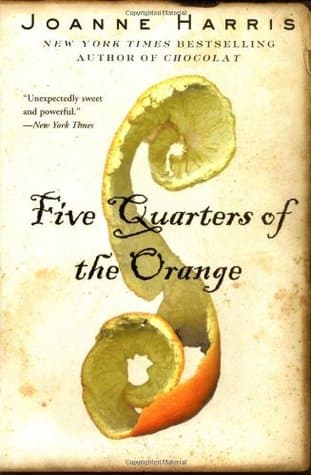
Synopsis
Covers the whole plot, including the ending.
- Difficulty
- Medium
- Pacing
- Moderate
- Mood
- Atmospheric, evocative, melancholic, reflective, sensual
Five Quarters of the Orange Plot Summary
Covers the whole plot, including the ending.
Return to Les Laveuses
Framboise Simon, in her late fifties, returns to Les Laveuses, a small Loire village, using the name Françoise Dartigen. She inherits a run-down farm, La Lanterne, where she plans to open a crêperie. She wants to live anonymously, escaping the shadow of her mother, Mirabelle Dartigen, who was blamed for a fire during the German Occupation. Framboise remembers her mother as a complex woman, good at cooking but often cruel and distant. The villagers, still holding old resentments, don't recognize her, letting her observe them and remember parts of her childhood.
The Inherited Scrapbook
Among her mother's things, Framboise finds a worn scrapbook with recipes, household tips, and Mirabelle's notes. This book, 'Five Quarters of the Orange,' is her main link to her mother. As she starts making the recipes for her crêperie, she realizes the entries are more than just cooking instructions. They contain coded messages, observations, and a hidden story of her mother's life during the war, especially the summer Framboise was nine. The scrapbook is like an orange, with each quarter showing a different side of Mirabelle and the past's hidden truths.
Childhood Memories and the Occupation
Through Framboise's memories, the story often shifts to 1943, during the German Occupation. Nine-year-old Framboise, with her younger siblings Cassis and Reinette, lives under their mother Mirabelle's strict and often unfair rules. Food is scarce, and Mirabelle uses her cooking skills to trade and survive, often with a German officer named Diehl. The children are often left alone, creating their own secret world and code. Framboise remembers her mother's changing moods, her strong protectiveness, and her acts of kindness and cruelty, all while the village struggles under occupation.
Meeting Diehl
A key part of Framboise's childhood memories involves Diehl, a German officer who often visits their farm. Mirabelle's dealings with him are complicated; she trades food and favors, seemingly for the family's survival, but there's more to it. The children, especially Framboise, are both drawn to and repelled by Diehl, seeing him as a symbol of the occupation. Mirabelle's relationship with Diehl causes village gossip and suspicion, leading to her later bad reputation. Framboise tries to make sense of her mother as a collaborator and her memories of Mirabelle's strong love for her children.
The Children's Games and Secrets
Framboise, Cassis, and Reinette invent games and a secret language to cope with their isolated and often ignored lives. They use the farm as their play area, watching the adults and forming their own ideas about events. Their games, especially one involving 'presents' in a hollow tree, become part of a secret resistance effort. The children, innocent but observant, unknowingly see and take part in small acts of defiance against the German occupiers, adding to the family's story and Mirabelle's real role during the war.
The Village's Resentment
As Françoise Dartigen, Framboise sees how much the villagers still dislike Mirabelle. They tell stories of her mother's coldness, her supposed work with the Germans, and her alleged part in the fire that killed several villagers, including the Mercier family's son. Framboise listens, gathering parts of the story, but finds the villagers' accounts often conflicting and based on rumor and bias. This anger makes her want to find the truth, to understand why her mother was so hated, and to compare the public view with her own memories.
The Role of the Scrapbook in Unveiling Truths
Framboise works to understand her mother's scrapbook. The recipes, in Mirabelle's writing, are mixed with symbols, coded messages, and seemingly random notes. Framboise realizes that the food itself often communicated things or served as a distraction. For example, a cake recipe might hide a meeting, or a specific ingredient might mean a hidden message. Slowly, Framboise starts to understand that her mother was not just a collaborator but was, in her own way, part of the resistance, using her skills to help people and protect her family.
The Truth of the Fire
The main point of Framboise's search is the fire. Through her own memories, the scrapbook's coded messages, and village gossip, Framboise puts together what happened. She discovers the fire was not Mirabelle's fault. Instead, it was an accident, or perhaps sabotage gone wrong, linked to the resistance. Mirabelle had tried to protect the children and others involved, taking the blame to shield them. The scrapbook shows Mirabelle's desperate attempts to warn people and her ultimate sacrifice of her reputation to save lives.
Reconciliation and Forgiveness
With the truth known, Framboise's view of her mother changes completely. The image of a cruel, distant woman is replaced by a resourceful, brave person who made huge sacrifices in impossible times. She understands Mirabelle's 'cruelty' as a way to protect them and her distance as a necessary shield. Framboise finds peace with her mother's memory, forgiving her for past wrongs and seeing the depth of her love. This new understanding allows Framboise to drop her assumed name and be herself.
New Beginnings and Shared Heritage
Having found the truth, Framboise drops her disguise and reclaims her identity. She reconnects with her estranged siblings, Cassis and Reinette, sharing what she learned from their mother's scrapbook. Their shared understanding of Mirabelle's past helps them heal old wounds and form a new bond. Framboise's crêperie, now openly run by Framboise Simon, becomes a place where the past is honored, and the community can begin to see Mirabelle's legacy differently. The book ends with Framboise finding peace, having accepted her heritage and finally understood the 'five quarters of the orange' that made up her mother's complex life.
Principal Figures
Framboise Simon (Françoise Dartigen)
Protagonist
A woman seeking to understand her mother and reconcile with her past.
Framboise is a woman in her late fifties, haunted by the memory of her infamous mother, Mirabelle. She returns to her childhood village, Les Laveuses, under an assumed name, hoping to escape her past and understand the truth about her mother's life during the German Occupation. She is initially reserved, observant, and carries deep-seated resentment and confusion towards Mirabelle. Her journey is one of discovery, both about her mother and herself, as she pieces together fragmented memories and deciphers her mother's cryptic scrapbook. She is a survivor, resilient, and ultimately capable of great empathy and forgiveness.
Relationships: Mirabelle Dartigen (Daughter, initially resentful and confused, later understanding and forgiving); Cassis (Older sister, initially estranged, later reconnected); Reinette (Older sister, initially estranged, later reconnected); Diehl (Childhood observer, later understanding of his role)
Mirabelle Dartigen
Central Figure (Antagonist/Supporting)
Framboise's enigmatic and vilified mother, whose true story is revealed.
Mirabelle is the deceased mother of Framboise, Cassis, and Reinette, and the central enigma of the novel. She is remembered by the villagers as cold, cruel, and a collaborator with the Germans, responsible for a tragic fire. Framboise remembers her as a complex woman: fiercely protective yet seemingly distant, sensuous in her love for food yet often arbitrary in her affections. Her true character is gradually unveiled through her scrapbook and Framboise's memories, revealing her as a courageous, resourceful woman who made immense sacrifices to protect her children and aid the resistance during the Occupation, taking on the role of a pariah to shield others.
Relationships: Framboise Simon (Mother, complex and often misunderstood); Cassis (Mother, complex and often misunderstood); Reinette (Mother, complex and often misunderstood); Diehl (Complex relationship, seemingly a collaborator but secretly involved in resistance/survival)
Cassis
Supporting
Framboise's younger sister, who shares a fraught childhood.
Cassis is Framboise's younger sister, who shared the difficult wartime childhood under Mirabelle's care. As an adult, she is estranged from Framboise, carrying her own burdens and interpretations of their mother's past. She is more pragmatic and perhaps less inclined to romanticize their mother than Reinette, but equally scarred by the family history. Her eventual reconciliation with Framboise is crucial for Framboise's healing and the complete understanding of their family's story. She represents another perspective on Mirabelle, adding to the nuanced portrayal of the matriarch.
Relationships: Framboise Simon (Sister, initially estranged); Mirabelle Dartigen (Daughter, complex and misunderstood); Reinette (Sister)
Reinette
Supporting
Framboise's youngest sister, who also carries the family's legacy.
Reinette is the youngest of the Dartigen sisters. Like Cassis, she has her own memories and interpretations of their mother, Mirabelle, and the events of the war. She is perhaps more sensitive and vulnerable than Framboise or Cassis, having been the youngest during their tumultuous childhood. Her eventual reconnection with Framboise helps to complete the family's healing process and provides another angle to the complex picture of Mirabelle. She represents the innocence lost during wartime and the lasting impact of family secrets.
Relationships: Framboise Simon (Sister, initially estranged); Mirabelle Dartigen (Daughter, complex and misunderstood); Cassis (Sister)
Diehl
Supporting (Antagonist in childhood perception)
A German officer whose true role is gradually revealed.
Diehl is a German officer stationed in Les Laveuses during the Occupation. In young Framboise's eyes, he is a menacing figure, a symbol of the enemy who frequently visits their farm. He engages in ambiguous dealings with Mirabelle, leading the villagers to suspect her of collaboration. However, as the story unfolds, it is revealed that Diehl was not a typical occupying officer. He was a more nuanced character, possibly a reluctant participant in the war or even a covert helper, whose interactions with Mirabelle were part of a larger, hidden strategy to protect the family and potentially aid resistance efforts. He represents the moral ambiguities of wartime.
Relationships: Mirabelle Dartigen (Ambiguous relationship, involving bartering and hidden cooperation); Framboise Simon (Feared figure in childhood)
Monsieur Mercier
Supporting (Antagonist)
A prominent villager who harbors deep resentment against Mirabelle Dartigen.
Monsieur Mercier is a powerful and influential figure in Les Laveuses, and a key voice in perpetuating the negative narrative surrounding Mirabelle Dartigen. He lost his son in the fire that Mirabelle was blamed for, fueling his lifelong animosity and desire for her to be held accountable. He represents the collective memory and prejudices of the village, and his unwavering belief in Mirabelle's guilt makes him an obstacle to Framboise's quest for truth. His character highlights the lasting impact of wartime trauma and the difficulty of challenging established narratives.
Relationships: Mirabelle Dartigen (Accuser, harbors deep hatred); Framboise Simon (Antagonistic, represents the past Framboise wants to understand)
Madame Dubois
Supporting
A village woman who offers some insight into Mirabelle's past.
Madame Dubois is one of the older villagers whom Framboise encounters in Les Laveuses. She is a source of local gossip and fragmented memories, providing Framboise with pieces of the puzzle about her mother. While she shares the general village sentiment against Mirabelle, her perspective is perhaps less overtly malicious than Mercier's, offering a slightly more nuanced, if still biased, view. She represents the collective memory of the village, both its truths and its fabrications, and helps Framboise understand the social context of her mother's ostracization.
Relationships: Mirabelle Dartigen (Acquaintance, source of village gossip); Framboise Simon (Source of information about the past)
Themes & Insights
The Nature of Truth and Memory
The novel shows how truth depends on individual memory, perspective, and time. Framboise tries to reconcile the public story of her mother as a villain with her own fragmented childhood memories. The scrapbook helps reveal a deeper, more complex truth, showing that what a community remembers or believes may not be what happened. The story highlights how trauma, guilt, and self-preservation can twist or hide memories, making the past a changing thing.
“Memory is a mischievous creature, fickle and unreliable, but stories, once told, take on a life of their own, becoming truer than truth itself.”
Mother-Daughter Relationships
A main theme is the complex relationship between mothers and daughters. Framboise's life has been shaped by her mother, Mirabelle, whom she resents, fears, and tries to understand. The novel explores the unspoken sacrifices, misunderstandings, and deep love that can exist in these bonds. It shows how daughters often inherit not just physical traits but also their mothers' burdens and legacies, and how understanding a mother's past can be key to a daughter's self-acceptance and healing.
“Mothers and daughters are linked. What one cannot do, the other must. What one fails to understand, the other will try to unravel.”
Survival and Sacrifice During Wartime
The novel clearly shows the harsh realities of life in occupied France, focusing on what people do to survive and protect their families. Mirabelle's actions, first seen as collaboration, are shown to be acts of great sacrifice and resourcefulness in a desperate situation. The theme explores the moral gray areas of war, where choices are rarely simple, and heroism can look like villainy. It highlights the quiet acts of resistance, subtle defiance, and the personal cost of keeping dignity and protecting loved ones under oppression.
“Sometimes, the hardest choices are made not for glory, but for survival. And sometimes, survival looks a lot like betrayal.”
Food as a Language and Connection
Food is more than just nourishment in this novel; it is a strong metaphor, a way to communicate, and a link to memory and heritage. Mirabelle's recipes are not just instructions but coded messages, reflections of her feelings, and a hidden story of her life. For Framboise, making these dishes is a way to literally taste and understand her mother's past, bridging the gap between them. Food symbolizes love, comfort, survival, and a secret language that goes beyond words, showing life's richness and complexity.
“Food is a language, you see. It speaks of culture, of family, of love and sometimes, of secrets.”
Plot Devices & Literary Techniques
The Scrapbook (Five Quarters of the Orange)
A tattered recipe book holding coded secrets and the truth of the past.
Mirabelle's inherited scrapbook is the central plot device, serving as a literal and metaphorical key to unlocking the novel's mysteries. Filled with recipes, household tips, and cryptic notes, it functions as a coded diary, revealing Mirabelle's true actions and intentions during the war. For Framboise, deciphering its entries is a quest that drives the narrative, connecting her to her mother and the past. The 'five quarters of the orange' title itself is symbolic, representing the multifaceted, often hidden, aspects of Mirabelle's personality and life, which Framboise must uncover piece by piece.
Dual Narrative (Past and Present)
Alternating timelines reveal the story through Framboise's present-day investigation and childhood memories.
The novel employs a dual narrative structure, alternating between Framboise's present-day experiences in Les Laveuses and her vivid flashbacks to her childhood during the German Occupation in 1943. This device allows the reader to experience the mystery alongside Framboise, piecing together information from both timelines. The present-day interactions with villagers inform her interpretation of the past, while the childhood memories provide crucial context and reveal the subjective nature of truth. This structure builds suspense and gradually unveils the complex layers of Mirabelle's story.
Unreliable Narrator (Framboise's Childhood Perspective)
The protagonist's childhood memories are filtered through a child's understanding, requiring reinterpretation.
Framboise's memories of her childhood are presented from the perspective of a nine-year-old, making her an initially unreliable narrator regarding the deeper complexities of her mother's actions. As an adult, she re-evaluates these memories, realizing that her child's understanding of events, such as her mother's 'cruelty' or 'collaboration,' was incomplete or mistaken. This device highlights the theme of truth and memory, showing how adult understanding can recontextualize childhood perceptions and reveal hidden motivations behind seemingly harsh actions, adding layers of psychological depth to Mirabelle's character.
Quiz
10 questions on the plot and the characters. Each answer comes with a short explanation.
Question 1
What is the name of the village Framboise Simon returns to?
- A village on the banks of the Seine
- A small village on the banks of the Loire
- A coastal town in Normandy
- A farming community in Provence
Show answer
B. A small village on the banks of the Loire The book description explicitly states that Framboise returns to 'a small village on the banks of the Loire'.
Question 2
Who is Mirabelle Dartigen?
- Framboise's grandmother
- The mayor of the village
- Framboise's mother
- A local historian
Show answer
C. Framboise's mother The text refers to Mirabelle Dartigen as 'the infamous' woman and Framboise as her 'daughter'.
Question 3
What object does Framboise inherit from her mother that holds clues to the past?
- A collection of old letters
- A diary
- A scrapbook of recipes
- A box of photographs
Show answer
C. A scrapbook of recipes Framboise inherits 'the scrapbook of recipes she has inherited from her dead mother'.
Question 4
What historical period is mentioned as the time of the 'terrible tragedy'?
- The French Revolution
- The First World War
- The German occupation
- The Belle Époque
Show answer
C. The German occupation The description states the locals hold Mirabelle responsible for a tragedy that took place 'during the German occupation decades before'.
Question 5
What does Framboise do with the recipes from her mother's scrapbook?
- She sells the scrapbook to a collector.
- She hides the scrapbook to forget the past.
- She re-creates the dishes in her small creperie.
- She burns the scrapbook in anger.
Show answer
C. She re-creates the dishes in her small creperie. The text says, 'With this book, Framboise re-creates her mother's dishes, which she serves in her small creperie.'
Question 6
What contradiction does Framboise try to understand about her mother?
- Her mother's love of cooking versus her cruel demeanor.
- Her mother's kindness to strangers versus her harshness to family.
- Her mother's artistic talent versus her practical nature.
- Her mother's love of the sea versus their life inland.
Show answer
A. Her mother's love of cooking versus her cruel demeanor. Framboise searches for clues to unlock the contradiction 'between her mother's sensuous love of food and often cruel demeanor'.
Question 7
What is the primary genre of the novel 'Five Quarters of the Orange'?
- Romance
- Science Fiction
- Historical Fiction, Mystery
- Fantasy
Show answer
C. Historical Fiction, Mystery The introductory text explicitly states the genres as 'Historical Fiction, Mystery'.
Question 8
What does Framboise hope to find within her mother's cryptic scribbles?
- A hidden treasure map
- The key to what actually transpired one summer when she was nine
- The location of a secret family inheritance
- A recipe for eternal youth
Show answer
B. The key to what actually transpired one summer when she was nine The text mentions she recognizes 'a deeper meaning behind Mirabelle's cryptic scribbles. Within the journal's tattered pages lies the key to what actually transpired the summer Framboise was nine years old.'
Question 9
The novel explores themes of mothers and daughters, past and present, and the struggle between resisting and succumbing. Which of these is NOT explicitly mentioned as a theme?
- Mothers and daughters
- The past and the present
- Family secrets
- Resisting and succumbing
Show answer
C. Family secrets The text states the novel is 'a novel of mothers and daughters of the past and the present, of resisting, and succumbing'. While family secrets are implied by the mystery element, they are not explicitly listed as a theme in this concluding sentence.
Question 10
How is the novel 'Five Quarters of the Orange' described in terms of its literary quality?
- A light and fluffy read
- A simple story with a predictable ending
- A literary feast for the senses, complex and sophisticated
- A straightforward historical account
Show answer
C. A literary feast for the senses, complex and sophisticated The description calls it 'a literary feast for the senses' and 'Harris's most complex and sophisticated work yet'.
Five Quarters of the Orange FAQ
What is the plot of Five Quarters of the Orange?
Framboise Simon returns to her childhood village in France, where she is confronted by the dark legacy of her mother, Mirabelle, who was blamed for a tragedy during the German occupation. Framboise attempts to uncover the truth about her mother and the past by deciphering a scrapbook of recipes.
Who is Framboise Simon in Five Quarters of the Orange?
Framboise Simon is the protagonist of the novel. She is the daughter of Mirabelle Dartigen and returns to her childhood village years after her mother's death, seeking to understand the past and her mother's complex nature.
What role do recipes play in Five Quarters of the Orange?
Recipes are central to the mystery. Framboise inherits her mother's scrapbook of recipes, which she uses to recreate dishes. However, she discovers cryptic messages and clues within the recipes that help her unravel the truth about her mother and the past tragedy.
What is the historical setting of Five Quarters of the Orange?
The novel is set in a small village in France on the banks of the Loire River. A significant part of the story and the past tragedy unfolds during the German occupation, adding a layer of historical context and tension.
What themes are explored in Five Quarters of the Orange?
The novel explores themes of mothers and daughters, the relationship between past and present, memory, secrets, resistance, and succumbing to fate. It also delves into the sensuous nature of food and its connection to memory and identity.
Is Five Quarters of the Orange a mystery novel?
Yes, Five Quarters of the Orange has strong elements of mystery. Framboise's return is driven by a desire to uncover the truth behind a past tragedy and the contradictory nature of her mother, with the recipe scrapbook serving as a key to solving the mystery.
How does Five Quarters of the Orange compare to other Joanne Harris books?
Five Quarters of the Orange is described as Joanne Harris's most complex and sophisticated work yet. Like her other novels, it features rich sensory details and a compelling narrative, but it delves deeper into intricate plotlines and darker themes.
What is the significance of the title 'Five Quarters of the Orange'?
While not explicitly detailed in the summary, the title likely alludes to a specific recipe or a metaphorical element within the story related to her mother's recipes and the secrets they hold. The orange itself could symbolize a hidden truth or a complex emotional state.
How does the book portray the relationship between food and memory?
The book uses food as a powerful conduit for memory. Framboise recreates her mother's dishes, which trigger recollections of her childhood and her mother's complex personality. The recipes themselves become vessels of memory and hidden meanings.
Can I learn to cook from Five Quarters of the Orange?
While the book features recipes and details about food preparation, its primary focus is on the narrative and mystery. You can certainly find inspiration and learn about the significance of these dishes within the story, but it's not a traditional cookbook.
About the author

Joanne Harris is a British author known for her fiction, particularly her novel "Chocolat," which explores themes of food and community. Other notable works include "Five Quarters of the Orange," a story of family and secrets, and "Gentlemen and Players," a psychological thriller set in a boys' school. Harris's writing often blends elements of magic realism with rich character development.
Similar books
- The Nightingale
Kristin Hannah
4.6 (698k) average on GoodreadsHistorical FictionBoth "Five Quarters of the Orange" and "The Nightingale" are set in World War II France and feature strong female protagonists grappling with wartime choices. However, Harris's novel focuses more on the aftermath of war and the subjective nature of memory, with the mystery unfolding from a present-day perspective looking back. Hannah's book is more of an immediate, sweeping saga of survival and resistance, with a clearer heroic arc. Harris delves deeper into the psychological scars and the unreliability of childhood recollections, offering a more nuanced and less overtly dramatic portrayal of courage and compromise.
- All the Light We Cannot See
Anthony Doerr
4.3 (1M) average on GoodreadsHistorical FictionWhile both novels use World War II as a backdrop and explore the lives of ordinary people caught in extraordinary circumstances, "Five Quarters of the Orange" is more intimately focused on a single family's secrets and the subjective nature of memory, told through a single, unreliable narrator. Doerr's novel, conversely, uses multiple perspectives and a more lyrical, almost poetic prose to paint a broader tapestry of interconnected lives across different locations, often highlighting the beauty and fragility of human connection amidst devastation. Harris's mystery is internal and domestic, whereas Doerr's narrative feels more expansive and philosophical about fate and human resilience.
- To Kill a Mockingbird
Harper Lee
4.3 (4.5M) average on GoodreadsHistorical FictionIn the 1930s Jim Crow South, Harper Lee writes about racial injustice, moral growth, and the quiet courage of a lawyer father, Atticus Finch, as seen through his young daughter's eyes.
- The Great Gatsby
F. Scott Fitzgerald
3.9 (3.8M) average on GoodreadsHistorical FictionIn the opulent Roaring Twenties, a mysterious millionaire's lavish parties hide his desperate, tragic pursuit of a lost love, exposing the emptiness within the American Dream.
- Pride and Prejudice
Jane Austen
4.3 (3M) average on GoodreadsHistorical FictionIn a society focused on status and money, Elizabeth Bennet navigates love and pride, challenging Mr. Darcy and social expectations to find true affection.
- Angels & Demons
Dan Brown
3.9 (2.7M) average on GoodreadsThrillerA Harvard symbologist races through Rome's ancient sites, deciphering cryptic clues to unmask the Illuminati and stop a vengeful plot to destroy the Vatican with a stolen antimatter weapon.



Enjoyed the summary?
A summary gives you the shape of the book. The book itself has the detail, the examples and the voice.
Find Five Quarters of the Orange on AmazonAs an Amazon Associate, BookBrief earns from qualifying purchases. How we're funded