
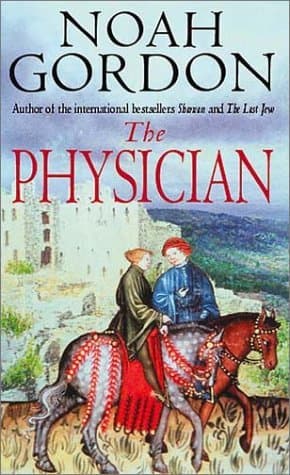
Synopsis
Covers the whole plot, including the ending.
- Difficulty
- Medium
- Pacing
- Moderate
- Mood
- Immersive, Educational, Adventurous, Resilient
- Read it if
- You enjoy epic historical sagas with a focus on personal growth, the history of medicine, and journeys across ancient cultures.
- Skip it if
- You prefer fast-paced thrillers or are uncomfortable with detailed descriptions of historical medical practices and religious/cultural conflicts.
The Physician Plot Summary
Covers the whole plot, including the ending.
The Orphan's Calling
In 11th-century London, nine-year-old Robert Jeremy Cole is orphaned when his family dies from 'sweating sickness.' He discovers a unique gift: he can sense when someone is about to die by feeling a 'coldness' in their hands. After burying his family, Rob is taken in by Henry Croft, a traveling barber-surgeon. Croft is a charlatan who performs crude surgeries, pulls teeth, and sells questionable elixirs. Under Croft, Rob learns basic herbs, anatomy (from animals and limited human remains), and the harsh realities of medieval medicine. He assists Croft, observing his methods and beginning to understand illness, while also enduring Croft's abuse.
A Glimpse of True Healing
While traveling with Croft, Rob meets Benjamin Merlin, a skilled Jewish physician. Merlin treats a patient with a bladder stone using a sophisticated, clean surgical procedure. Rob is impressed by Merlin's knowledge, precision, and genuine care, which contrasts sharply with Croft's crude methods. Merlin briefly explains the importance of studying the human body. This encounter sparks a deep desire in Rob to learn true medicine, making him realize Croft's methods are inadequate. He questions what he has learned and wants the advanced medical knowledge he believes exists elsewhere, especially in the East, which Merlin hints is a center of learning.
The Journey to Persia
After years with Croft, Rob, now a young man, leaves his master. He is driven by his ambition to become a true physician. He learns that the best medical school is in Isfahan, Persia, but only Jews and Muslims are admitted. To get around this, Rob decides to disguise himself as a Jew, taking the name Jesse ben Benjamin and performing a painful, dangerous self-circumcision. He studies Hebrew, Jewish customs, and prayers, then begins his difficult journey across Europe and Asia. He faces many dangers, including bandits, harsh weather, and disease. Along the way, he improves his medical skills by treating people he meets, using his growing knowledge of herbs and basic surgery.
Arrival in Isfahan
After a dangerous journey lasting years, Rob, as Jesse ben Benjamin, arrives in Isfahan. He is amazed by the city's grandeur and advanced civilization compared to England. His goal is to study under the physician and philosopher, Ibn Sina (Avicenna), at the city's madrasa. Rob faces skepticism due to his foreign origins and his claimed Jewish identity. He must prove his intelligence and dedication. He shows some of his practical medical knowledge and eagerness to learn, eventually impressing the admissions committee enough to be accepted into the prestigious school, though he remains under scrutiny.
Learning Under Ibn Sina
Rob, now Jesse, begins intensive studies at the madrasa under Ibn Sina. He learns about the works of Galen and Hippocrates, advanced anatomy, pharmacology, surgery, and the philosophy of medicine, far beyond anything he imagined in Europe. He excels in his studies, proving to be a gifted and diligent student. He befriends other students, including Mirdin, and earns the respect of his peers and teachers. Rob is particularly interested in the human body and wants to understand its inner workings, a pursuit largely forbidden due to religious rules against dissection. He secretly begins to observe human cadavers when he can.
Forbidden Knowledge and Love
Driven by his curiosity and desire to understand the human body, Rob secretly performs dissections on human cadavers, often those of executed criminals or unclaimed bodies. This practice is strictly forbidden by Islamic law. His anatomical knowledge grows quickly, giving him an advantage in understanding diseases. During this time, he meets and falls in love with Mary, an Englishwoman traveling through Persia with her merchant father. Their romance grows amidst cultural differences and Rob's secret identity. Mary becomes a source of comfort and a reminder of his origins, complicating his double life as Jesse ben Benjamin.
The Shah's Illness and a Moral Dilemma
A devastating plague sweeps through Isfahan. Rob, now a respected physician, works tirelessly with Ibn Sina to fight the disease. The Shah of Persia becomes gravely ill, and Rob is among the physicians summoned to treat him. The Shah has an unusual ailment, and Rob realizes that a diagnosis requires an internal examination, impossible on a living ruler. He proposes a radical idea: performing a post-mortem examination on a plague victim with similar symptoms to understand the disease. This act, while medically sound, is a deep religious and social taboo, pushing the limits of what is allowed.
The Discovery and Its Consequences
Rob performs the controversial dissection, carefully documenting his findings. He discovers that the plague is caused by tiny, almost invisible creatures, a groundbreaking observation for the time. This knowledge allows physicians to better understand the disease and implement more effective quarantine measures, ultimately saving many lives, including the Shah's. However, the discovery of his secret dissections, especially on human bodies, causes an uproar. Combined with ongoing suspicion about his Jewish identity, Rob's position becomes risky. He faces accusations of heresy and sacrilege, endangering his life and career, despite his medical successes.
Exile and Return
Because of the controversy over his dissections and the exposure of his true identity (or at least the suspicion that he is not a born Jew), Rob is forced to leave Isfahan. He is exiled, but not before making significant contributions to medicine and earning Ibn Sina's lasting respect. He reunites with Mary, who is pregnant, and they begin the long journey back to England. The return journey is difficult, but Rob's medical skills are essential for their survival and the well-being of their fellow travelers. They long for a place where they can practice medicine and raise their family in peace.
A Physician in His Own Land
Rob and Mary finally return to England. Rob, now a skilled physician, struggles to gain acceptance for his advanced Eastern medical practices in a land still relying on superstition and crude healing methods. He eventually settles in a small town, opening his own practice. He adapts his Persian knowledge to the English context, treating patients with herbal remedies, surgical skill, and a deep understanding of anatomy. He trains apprentices, subtly introducing them to more scientific methods. He and Mary build a family, and Rob, known as a respected healer, dedicates his life to improving his community's health, forever changed by his journey and the knowledge he gained in the East.
Principal Figures
Robert Jeremy Cole (Rob J. Cole / Jesse ben Benjamin)
Protagonist
An English orphan who travels to Persia to become a physician.
Rob is an intelligent, deeply empathetic, and extraordinarily driven individual. Orphaned at a young age, he possesses a unique gift for sensing impending death, which fuels his early fascination with life and loss. He is a keen observer, quick learner, and possesses an insatiable curiosity about the human body and the causes of illness. His journey is marked by immense perseverance, courage, and a willingness to defy social and religious norms to pursue true medical knowledge. He is dedicated to healing and improving the lives of others, often at great personal risk.
Relationships: Henry Croft (Abusive mentor and early influence); Ibn Sina (Revered mentor and intellectual inspiration); Mary (Wife and emotional anchor); Benjamin Merlin (Brief but profound inspiration)
Ibn Sina (Avicenna)
Supporting
The legendary Persian physician and philosopher, Rob's primary mentor.
Ibn Sina is depicted as a brilliant, wise, and highly respected scholar, physician, and philosopher. He is the head of the medical madrasa in Isfahan and embodies the pinnacle of medical knowledge in the 11th century. He is stern but fair, demanding excellence from his students while also recognizing true talent and dedication. He is a man of deep intellect and a pioneer in many fields, though even he is bound by some of the religious and cultural constraints of his time regarding practices like dissection. He sees potential in Rob and guides him, even subtly encouraging his pursuit of forbidden knowledge.
Relationships: Rob J. Cole (Mentor-student relationship, bordering on father-son)
Mary
Supporting
An Englishwoman Rob meets and falls in love with in Persia.
Mary is an independent, spirited, and practical Englishwoman traveling with her merchant father. She represents a connection to Rob's homeland and provides emotional support and grounding amidst his intense studies and secret life. She is intelligent and adaptable, capable of navigating different cultures. She understands and accepts Rob's ambition, even when it puts him in danger. Her love for Rob is steadfast, and she ultimately becomes his wife and the mother of his children, sharing his journey back to England and helping him establish a new life.
Relationships: Rob J. Cole (Love interest, then wife)
Henry Croft
Antagonist/Supporting
The crude, itinerant barber-surgeon who initially takes in young Rob.
Henry Croft is a coarse, uneducated, and often cruel traveling barber-surgeon. He represents the primitive state of medicine in early medieval Europe. He is a showman and a charlatan, more interested in profit than genuine healing. He teaches Rob rudimentary skills like bloodletting and basic herbalism, but his methods are often dangerous and based on superstition. He is abusive and neglectful towards Rob, yet he inadvertently sparks Rob's desire for true knowledge by demonstrating the inadequacy of his own practices. He serves as a contrast to the advanced medical world Rob later discovers.
Relationships: Rob J. Cole (Abusive master-apprentice relationship)
Mirdin
Supporting
Rob's loyal friend and fellow student at the Isfahan madrasa.
Mirdin is a fellow student at Ibn Sina's madrasa and becomes Rob's closest friend in Persia. He is kind, intelligent, and a dedicated student of medicine. He provides Rob with companionship, support, and sometimes a sounding board for his radical ideas. Mirdin represents the more traditional, yet still advanced, approach to medicine within the Islamic world. While he doesn't partake in Rob's forbidden dissections, he respects Rob's intellect and dedication, and their friendship endures through various challenges. He helps Rob navigate the cultural intricacies of Isfahan.
Relationships: Rob J. Cole (Close friendship and fellow student)
Benjamin Merlin
Mentioned/Supporting
A skilled Jewish physician who inspires young Rob.
Benjamin Merlin is a brief but pivotal character in Rob's early life. He is a learned and ethical Jewish physician who practices genuine medicine, in stark contrast to Henry Croft. His encounter with young Rob, where he performs a skilled bladder stone removal, opens Rob's eyes to the possibility of true healing and the existence of advanced medical knowledge. He subtly hints at the great centers of learning in the East, planting the seed for Rob's future journey. He represents a beacon of hope and a clear goal for Rob's aspirations.
Relationships: Rob J. Cole (Brief inspirational encounter)
Shah Ala-ud-Daula
Supporting
The ruler of Isfahan whose illness prompts Rob's most daring medical act.
The Shah is the powerful and revered ruler of Isfahan. His illness, particularly during a plague epidemic, becomes a critical plot point. He is a figure of authority and tradition, whose well-being is paramount to the stability of the kingdom. His trust in Ibn Sina and, by extension, his students, allows for Rob's radical medical interventions. His recovery due to Rob's insights validates Rob's methods, even if the methods themselves remain controversial. He represents the ultimate patient whose life is saved by Rob's bold pursuit of knowledge.
Relationships: Rob J. Cole (Patient-physician); Ibn Sina (Trusted advisor and physician)
Themes & Insights
The Pursuit of Knowledge Against All Odds
The novel's main theme is Rob's dangerous quest for medical knowledge. From leaving home to disguising his identity and performing forbidden dissections, Rob consistently puts learning and understanding ahead of personal safety or societal norms. This is clear when he makes the perilous journey to Persia, risking his life and freedom to study under Ibn Sina, and later when he secretly dissects cadavers to gain anatomical understanding, directly defying religious rules. His life shows the power of curiosity and the sacrifices made to pursue it.
“The hunger to know, to understand, was a fire in his belly that could not be quenched.”
The Conflict Between Science and Superstition/Religion
The story repeatedly shows the conflict between new scientific thought and old superstitions and religious rules. In England, Rob encounters crude barber-surgeons who use folklore and unproven remedies. In Persia, while medicine is more advanced, religious bans against dissecting human bodies limit true anatomical understanding. Rob's secret dissections challenge these religious limits, showing that observation and scientific inquiry are necessary for medical progress, even when they conflict with established beliefs. This conflict highlights the slow, often difficult, evolution of medicine.
“What good was knowledge if it could not be applied to ease suffering, even if it meant defying the ancient laws?”
Identity and Transformation
Rob's journey is one of changing identity. He starts as a poor English orphan, then becomes 'Jesse ben Benjamin,' a Jewish medical student, before returning to England as a physician. This theme explores how external events and personal choices shape one's identity. His adopted Jewish identity is more than a disguise; it is a deep immersion into a new culture and belief system, forcing him to learn and adapt. His experiences in Persia fundamentally change his worldview, making him a different man from the one who left England, embodying a mix of cultures and knowledge.
“He had shed his skin so many times, he sometimes wondered who the real Rob J. Cole was beneath the layers.”
The Nature of Healing and Compassion
At its heart, the novel explores the true meaning of healing. Rob learns that it involves more than just applying remedies. It requires empathy, careful observation, and a genuine desire to ease suffering. His early gift of sensing death highlights his connection to human vulnerability. Unlike Henry Croft, who sees patients as sources of income, Rob is driven by compassion, as seen in his tireless work during the plague and his willingness to take risks for his patients. The book suggests that true medicine is an art rooted in humanity as much as it is a science.
“To be a physician was not merely to know the remedies, but to feel the suffering of the patient as one's own.”
Plot Devices & Literary Techniques
The Gift of Sensing Death
Rob's unique, almost mystical ability to perceive impending death.
This inherited ability, first manifesting after his mother's death, serves as a crucial catalyst for Rob's early fascination with life, death, and healing. It sets him apart and imbues him with a sense of destiny, compelling him to understand the mechanisms of the human body and disease. While it diminishes as he gains scientific knowledge, it initially provides him with an intuitive connection to the fragility of life and a profound motivation to prevent death, foreshadowing his future as a dedicated physician.
The Disguise (Jesse ben Benjamin)
Rob's adoption of a Jewish identity to gain access to Eastern medical knowledge.
Rob's disguise as Jesse ben Benjamin is a central plot device that drives much of the narrative. It allows him to access the advanced medical world of Persia, which would otherwise be closed to him as a Christian. This device creates significant internal and external conflict, forcing Rob to learn a new language, culture, and religion. It highlights themes of identity, sacrifice, and the lengths one will go to achieve a goal, while also creating constant tension and the threat of exposure, which could lead to severe punishment or death.
The Journey to Persia
The arduous and transformative physical and metaphorical journey across continents.
The physical journey from England to Persia is a classic epic journey, filled with trials, dangers, and encounters that shape Rob's character and broaden his understanding of the world. Metaphorically, it represents his intellectual and personal transformation from an uneducated orphan to a world-class physician. Each stage of the journey contributes to his growth, preparing him for the challenges and learning opportunities that await him in Isfahan. It also serves to illustrate the vast cultural and technological differences between medieval Europe and the Islamic world.
Human Dissection
The forbidden practice of dissecting human cadavers for anatomical study.
Human dissection is a powerful plot device that symbolizes Rob's radical commitment to scientific truth over religious dogma. It is strictly forbidden by both Christian and Islamic law during this period, making Rob's secret practice incredibly dangerous. This device allows Rob to gain unparalleled anatomical knowledge, directly contributing to his diagnostic and surgical prowess, and ultimately leading to groundbreaking discoveries about diseases like the plague. It is the ultimate expression of his scientific curiosity and his willingness to defy authority for the sake of true understanding.
The Physician Quotes
“The physician’s calling is to ease suffering and to prolong life. All else is secondary.”
“Knowledge is a torch that illuminates the path of life.”
“To be a physician is to be a servant to humanity, not to a king or a creed.”
“The greatest healers are those who can inspire hope.”
“Every man has a right to the best medicine available, regardless of his station or his faith.”
“Fear is a poor companion on the road to discovery.”
“The human body is a universe of its own, waiting to be explored.”
“Love is a malady that no physician can cure, nor should he try.”
“The hand of God is in every healing, but the hand of man must do the work.”
“One must sometimes break the rules to find a better way.”
“The true physician never stops learning, for the body holds endless secrets.”
“A good doctor listens not only to the words of the patient but to the silence between them.”
“To conquer death is impossible, but to delay it honorably is the physician's greatest triumph.”
“The desert teaches patience, and patience is a virtue for those who seek knowledge.”
Quiz
10 questions on the plot and the characters. Each answer comes with a short explanation.
Question 1
What is the name of the main protagonist in 'The Physician'?
- William Cole
- Robert Cole
- Thomas Cole
- Richard Cole
Show answer
B. Robert Cole The main protagonist's full name is Robert Jeremy Cole, though he is often referred to as Rob.
Question 2
In what city does Rob Cole begin his journey and witness his mother's death from 'side sickness'?
- York
- London
- Canterbury
- Winchester
Show answer
B. London Rob Cole's story begins in 11th-century London, where his mother dies of appendicitis, sparking his initial interest in healing.
Question 3
What skill does Rob Cole possess from childhood that first indicates his unique connection to sickness and death?
- He can perfectly mimic voices.
- He can see a 'light' or 'aura' around people who are about to die.
- He has an extraordinary sense of smell for diseases.
- He can predict weather patterns accurately.
Show answer
B. He can see a 'light' or 'aura' around people who are about to die. From a young age, Rob can sense when someone is about to die by feeling a 'coldness' or seeing a 'light' leaving them, a mystical gift that guides his path to medicine.
Question 4
Under what false identity does Rob Cole enroll in the madrasa in Isfahan, Persia?
- Yusuf ibn Muhammad
- Ibn Sina al-Baghdadi
- Jesse ben Benjamin
- Ali al-Isfahani
Show answer
C. Jesse ben Benjamin To gain entry to the Muslim madrasa, Rob disguises himself as a Jew named Jesse ben Benjamin, as Christians were not permitted.
Question 5
Who is the famous Persian physician and philosopher that Rob Cole travels across the world to study under?
- Al-Razi
- Ibn Rushd (Averroes)
- Ibn Sina (Avicenna)
- Al-Khwarizmi
Show answer
C. Ibn Sina (Avicenna) Rob Cole undertakes the perilous journey to Persia specifically to study under the legendary physician Ibn Sina, also known as Avicenna in the West.
Question 6
What is the primary reason Rob Cole's master, the barber-surgeon, initially travels with him across England?
- To find a new apprentice.
- To escape the plague.
- To peddle his 'cures' and entertain crowds at fairs.
- To spread Christian teachings.
Show answer
C. To peddle his 'cures' and entertain crowds at fairs. The barber-surgeon, initially Rob's guardian and mentor, travels from town to town, performing minor surgeries, pulling teeth, and selling dubious remedies at fairs.
Question 7
What dangerous and forbidden act does Rob Cole perform in Isfahan to further his understanding of human anatomy?
- He illegally obtains rare medicinal herbs from the Shah's private garden.
- He conducts a secret dissection of a human cadaver.
- He performs unauthorized surgery on a living person without consent.
- He experiments with dangerous poisons on animals.
Show answer
B. He conducts a secret dissection of a human cadaver. Human dissection was strictly forbidden by religious law during that era, but Rob secretly performs one to gain invaluable knowledge of the body's internal workings.
Question 8
What major historical event or societal challenge impacts Rob's time in Isfahan, leading to widespread death and requiring his medical expertise?
- A severe drought and famine.
- A major earthquake.
- The Black Death (plague).
- An invasion by Mongol hordes.
Show answer
C. The Black Death (plague). The city of Isfahan is struck by the plague, an epidemic that tests Rob's medical knowledge and courage, forcing him to make difficult decisions.
Question 9
What is the eventual fate of Karim, the son of the Shah, after Rob performs a groundbreaking surgery on him?
- He dies shortly after the surgery due to complications.
- He recovers completely and lives a full life.
- He is left paralyzed but otherwise healthy.
- He suffers from recurring pain and never fully recovers.
Show answer
B. He recovers completely and lives a full life. Rob successfully removes a stone from Karim's bladder, a dangerous and innovative procedure for the time, leading to the boy's full recovery and securing Rob's reputation.
Question 10
What is the ultimate theme emphasized by Rob Cole's journey from a poor English orphan to a renowned physician in Persia?
- The superiority of Eastern medicine over Western practices.
- The power of religion to heal all ailments.
- The relentless pursuit of knowledge and the universal human desire to alleviate suffering.
- The inevitable triumph of good over evil in all circumstances.
Show answer
C. The relentless pursuit of knowledge and the universal human desire to alleviate suffering. Rob's entire life is driven by an insatiable hunger for medical knowledge and a profound empathy for the sick, transcending cultural and religious boundaries to fulfill his calling.
The Physician FAQ
What prompts Rob Cole to pursue medicine, and what is his initial training?
Rob Cole is orphaned early and becomes an apprentice to a barber-surgeon, initially learning basic medical practices, hustling, and juggling. His mother's death from a 'side sickness' and his inability to help her fuels his lifelong obsession with understanding and curing disease, a motivation that drives him to seek more advanced knowledge.
Why does Rob Cole decide to travel to Persia, and what challenges does he face on this journey?
Rob learns of advanced medical schools in Persia, specifically Ispahan, where the great physician Avicenna teaches, a level of knowledge unattainable in Europe. To gain entry, he must disguise himself as a Jew, converting and learning Hebrew, as Christians are forbidden. The journey itself is long and perilous, fraught with dangers like bandits, harsh weather, and disease.
Who is Ibn Sina (Avicenna), and what is his role in Rob Cole's education?
Ibn Sina, known as Avicenna in the West, is the brilliant physician and head of the madrasa in Ispahan, Persia, where Rob studies. He becomes Rob's primary mentor, teaching him advanced medical techniques, philosophy, and the importance of observation and dissection, profoundly shaping Rob's understanding of medicine.
What is the significance of dissection in Rob's medical training, and why is it controversial?
Dissection is crucial for Rob's understanding of human anatomy, allowing him to see the internal workings of the body directly. It is highly controversial because it is forbidden by both Islamic and Christian religious law, forcing Rob and a few others to perform dissections secretly and at great personal risk.
How does Rob Cole's romance with Mary impact his journey and decisions?
Mary, a Jewish woman he meets during his travels and later marries, provides Rob with emotional support and a sense of belonging in a foreign land. Her presence grounds him and influences his decision to eventually leave Ispahan and establish his own practice, balancing his medical ambition with his desire for a family.
What is the 'side sickness' that killed Rob's mother, and how does it foreshadow his future medical pursuits?
The 'side sickness' is later understood to be appendicitis, a condition Rob eventually learns to diagnose and treat through surgery. His mother's death from this mysterious ailment is a foundational trauma that drives his quest for medical knowledge, symbolizing the limitations of European medicine and the advanced understanding he seeks in Persia.
What is the significance of Rob's 'gift' for healing, and how does it manifest beyond learned skills?
Rob's 'gift' is an intuitive diagnostic ability, a keen sense of observation, and a profound empathy that allows him to connect with patients beyond their physical symptoms. This innate talent, often described as 'seeing' or 'feeling' the illness, complements his learned medical knowledge and sets him apart from other physicians.
How does the author use the historical context of the 11th century to highlight the contrast between Eastern and Western medicine?
The author vividly contrasts the primitive, superstition-laden medicine of 11th-century Europe with the sophisticated, scientifically-driven approach of Arab universities. This contrast underscores Rob's desperate need to travel east and highlights the intellectual stagnation in Europe versus the flourishing medical advancements in Persia, particularly in anatomy, pharmacology, and clinical observation.
How does Rob's initial experience with the barber-surgeon shape his ethical framework as a doctor?
His early apprenticeship exposes him to both the practical skills and the charlatanism of the barber-surgeon. Witnessing the suffering caused by ignorance and the exploitation of the sick instills in Rob a deep commitment to genuine healing and a strong ethical drive to acquire true knowledge, rather than merely peddle cures.
Discuss the psychological impact of Rob's deception regarding his religious identity in Persia.
Living under a false identity as a Jew for years creates significant psychological strain for Rob, requiring constant vigilance and the suppression of his true self. While it grants him access to invaluable knowledge, it also isolates him, forcing him to keep his deepest secrets from even his closest friends and mentors, leading to internal conflict and a sense of otherness.
How does Rob's relentless pursuit of knowledge reflect a deeper psychological need beyond just curing disease?
Rob's relentless pursuit of knowledge stems from a profound need to understand and control the forces of life and death, particularly after the trauma of his mother's unexplained death. It's a quest for mastery over the unknown and a way to mitigate his own powerlessness, giving his life meaning and purpose beyond personal gain.
Examine the role of resilience and adaptability in Rob Cole's character development.
Rob demonstrates extraordinary resilience, surviving poverty, arduous travel, and cultural displacement. His adaptability is evident in his quick mastery of new languages, customs, and medical techniques, allowing him to thrive in vastly different environments and overcome immense obstacles, crucial for his transformation into a skilled physician.
To what extent is 'The Physician' a story about cultural exchange versus cultural appropriation?
The novel primarily portrays a positive cultural exchange, with Rob genuinely embracing and integrating Persian medical knowledge into his practice. However, his initial deception of converting to Judaism to gain access could be viewed as a form of cultural appropriation, although it's framed as a necessary survival tactic rather than a dismissal of the culture itself.
Is Rob Cole's journey primarily driven by altruism, ambition, or a combination of both?
Rob's journey is a complex blend of altruism and ambition. His initial drive is deeply altruistic, stemming from a desire to prevent suffering like his mother's. However, his ambition to become the best physician and master medical knowledge is undeniable, pushing him to take risks and make sacrifices that serve both his personal growth and his humanitarian goals.
How does the novel explore the conflict between faith and science in the context of 11th-century medicine?
The novel vividly portrays the tension between religious dogma, which often hindered medical progress (e.g., forbidding dissection), and the emerging scientific method. Rob's mentors, particularly Avicenna, embody a rational approach that seeks understanding through observation and experimentation, often challenging prevailing religious beliefs without necessarily rejecting faith entirely.
What is the ultimate legacy of Rob Cole's journey, both personally and for the future of medicine in his region?
Personally, Rob achieves his dream of becoming a master physician and finds love and family. For medicine, he brings back advanced Persian medical knowledge, techniques like surgery for appendicitis, and the importance of clinical observation to a medically backward Europe. His journey seeds the beginnings of more rational and effective medical practice in his homeland.
Could Rob Cole have achieved his medical goals without leaving Europe, or was the journey to Persia absolutely essential?
The novel strongly suggests that Rob's journey to Persia was absolutely essential. The medical knowledge, techniques, and philosophical approach available in 11th-century Europe were too primitive and constrained by superstition and religious dogma to allow him to achieve his ambitious goals. Persia offered the only path to the advanced learning he sought.
How does the character of Karim, Rob's friend and fellow student, serve as a foil to Rob?
Karim, a devout Muslim, represents the established, yet progressive, intellectual tradition within Persia. He is bright and loyal, but less inclined to radical actions like dissection. He serves as a foil by highlighting Rob's daring, his willingness to break taboos for knowledge, and the unique challenges Rob faces as an outsider in the madrasa.
About the author

Noah Gordon is an American author known for his historical fiction. His notable work, The Physician, explores the journey of a young man in the 11th century who seeks to become a doctor. Gordon's writing often delves into themes of medicine and human experience.
Similar books
- The Pillars of the Earth
Ken Follett
4.3 (649k) average on GoodreadsFantasyEpic historical fiction following a character's life and ambition against a detailed medieval backdrop.
- Cutting for Stone
Abraham Verghese
4.3 (337k) average on GoodreadsLiterary FictionMedical drama with a strong focus on the lives of doctors and their personal and professional journeys.
- The Thorn Birds
Colleen McCullough
4.2 (314k) average on GoodreadsHistorical FictionBoth novels feature compelling romance narratives spanning significant periods, but The Physician distinguishes itself with its deep dive into a specialized historical field (medieval medicine) and cultural immersion, which is not a primary focus in McCullough's generational saga.
- To Kill a Mockingbird
Harper Lee
4.3 (4.5M) average on GoodreadsHistorical FictionIn the 1930s Jim Crow South, Harper Lee writes about racial injustice, moral growth, and the quiet courage of a lawyer father, Atticus Finch, as seen through his young daughter's eyes.
- The Great Gatsby
F. Scott Fitzgerald
3.9 (3.8M) average on GoodreadsHistorical FictionIn the opulent Roaring Twenties, a mysterious millionaire's lavish parties hide his desperate, tragic pursuit of a lost love, exposing the emptiness within the American Dream.
- Pride and Prejudice
Jane Austen
4.3 (3M) average on GoodreadsHistorical FictionIn a society focused on status and money, Elizabeth Bennet navigates love and pride, challenging Mr. Darcy and social expectations to find true affection.





Enjoyed the summary?
A summary gives you the shape of the book. The book itself has the detail, the examples and the voice.
Find The Physician on AmazonAs an Amazon Associate, BookBrief earns from qualifying purchases. How we're funded