
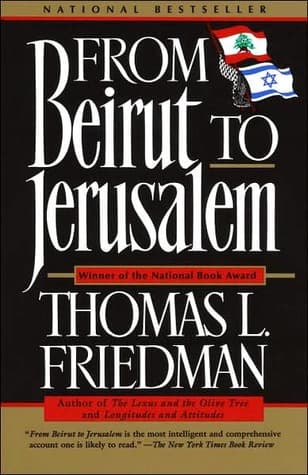
Core Idea
- Difficulty
- Medium
- Read it if
- You want a deep, personal, and historically rich journalistic account of the Arab-Israeli conflict, focusing on the human elements, internal politics, and cultural nuances from the late 1970s to late 1980s.
- Skip it if
- You are looking for a purely academic, detached analysis or an up-to-date account of the conflict's current state, as the book's observations are rooted in a specific historical period.
Key Takeaways from From Beirut to Jerusalem
The Cycle of Humiliation
How historical grievances and perceived slights fuel endless conflict.
Friedman shows how a deep sense of humiliation, especially among Arabs from the loss of Palestine and the perceived power of Western nations and Israel, drives conflict. This is not just about land or resources; it is about dignity, honor, and a desire to correct past wrongs. The cycle continues as each side inflicts new 'humiliations' on the other, ensuring grievances are never resolved, only made worse. This emotional core often overrides logical political decisions, making diplomacy difficult as leaders must manage a public deeply invested in historical stories of victimhood and resistance. Understanding this emotional base is key to understanding the region's continued instability.
“In the Middle East, the past is not dead. It's not even past. It's an active ingredient in every current event.”
In the book: Friedman frequently references the 'nakba' (catastrophe) for Palestinians and the collective Arab memory of Western colonial interference and the establishment of Israel as foundational humiliations that permeate political discourse and popular sentiment.
Try this: When analyzing Middle Eastern conflicts, look beyond immediate political demands to identify underlying narratives of historical injustice or perceived slights. Recognize that solutions solely focused on material gains may fail if they don't address the emotional and psychological need for dignity and recognition.
Related ideas: historical-grievances, arab-nationalism, nakba, dignity-politics
The 'Beirut Rules' of Disorder
The chaotic, often contradictory, logic governing conflict in failed states.
Friedman describes the 'Beirut Rules' as a state of constant, complex conflict where alliances change often, and no single group can win decisively. Instead, many armed groups, often supported by outside powers, compete for influence. This creates a power vacuum filled by militias and sectarian violence. This environment lacks central authority, blurs the lines between fighters and civilians, and shows deep distrust in any peace efforts. The 'rules' are essentially no rules, where survival dictates morality and short-term tactical gains outweigh any long-term strategy. It is a clear picture of what happens when a state collapses and becomes a battleground for proxy wars.
“Beirut was a city where no one really won, but everyone could lose. It was a place where the logic of war often defied the logic of peace.”
In the book: His extensive firsthand accounts of the Lebanese Civil War, detailing the numerous militias (Christian Phalangists, Druze, PLO factions, Amal, Hezbollah), their shifting allegiances, and the constant cycle of assassinations and retaliatory bombings.
Try this: When observing conflicts in areas with weak or failed states (e.g., Yemen, Syria, Libya), consider if the 'Beirut Rules' are at play: multiple non-state actors, external interference, and a lack of clear front lines or achievable victory for any single party. Avoid expecting rational, state-centric conflict resolution.
Related ideas: failed-states, proxy-wars, lebanaese-civil-war, sectarian-violence
Israel's Internal Contradictions
The tension between its democratic ideals and the realities of occupation.
Friedman explores the contradictions within Israeli society. He points out the constant effort to balance its founding as a democratic haven for Jews with its occupation of Palestinian territories and the challenges of integrating its diverse Arab minority. This tension creates a societal split, where the democratic principles stated internally often conflict with the military rule and discriminatory practices applied externally in the West Bank and Gaza. The book shows how this internal conflict shapes Israeli identity, politics, and its international relations. Israel is a nation constantly struggling with its own moral direction while facing threats. The military's constant presence, the continuous fear, and the internal debates about Israel's future are clearly shown.
“Israel is a country that wants to be both Sparta and Athens, both a Jewish state and a democratic state, a nation of law and a nation under siege.”
In the book: His discussions of the 'iron wall' security doctrine, the debates within Israeli society about the future of the occupied territories, and the impact of mandatory military service on Israeli youth.
Try this: To understand Israel, recognize that its actions are often driven by a complex interplay of security concerns, historical trauma, religious conviction, and democratic aspirations. Avoid simplistic narratives and appreciate the deep internal debates that shape its policies.
Related ideas: israeli-democracy, occupation, zionism, security-dilemma
The 'Two Jerusalems' Phenomenon
The stark contrast between the city's spiritual significance and its political reality.
Friedman describes Jerusalem as a city of two parts: the mythical, spiritual Jerusalem honored by billions across three faiths, and the harsh, disputed political Jerusalem, a battleground for sovereignty, demographics, and historical claims. The first inspires awe and pilgrimage; the second is a flashpoint for violence and difficult disputes. This division means that any political solution for Jerusalem must deal with not just earthly claims but also deeply held religious beliefs, making compromise very hard. The physical city itself reflects this, with ancient holy sites next to modern checkpoints and segregated neighborhoods, a constant reminder of its contested nature. He shows how the spiritual importance of the city often overpowers practical solutions.
“Jerusalem is a city that belongs to everyone, and therefore, to no one fully. It is a city of prophets and politicians, a place where the sacred and the profane constantly clash.”
In the book: His vivid descriptions of navigating the Old City, observing the daily lives of both Israeli and Palestinian residents, and the constant tension surrounding holy sites like the Temple Mount/Haram al-Sharif.
Try this: When discussing the status of Jerusalem, always acknowledge both its profound religious significance to multiple faiths and its highly politicized, contested territorial reality. Solutions that ignore either aspect are doomed to fail.
Related ideas: jerusalem-status, holy-sites, religious-conflict, israeli-palestinian-conflict
The Media's Double-Edged Sword
How journalism shapes, and is shaped by, the Middle East narrative.
Friedman offers valuable insight into the difficulties and ethical problems of reporting from such a complex and divided region. He details how journalists become targets, not just physically, but also ideologically, constantly accused of bias by all sides. The narrative is heavily shaped by the many competing 'truths,' propaganda, and the emotional intensity of the conflict. He also reflects on the media's power, both local and international, to inflame passions, shape public opinion, and even unintentionally contribute to conflict by simplifying complex issues or focusing on sensationalism. His honest reflections show the immense pressure and responsibility placed on foreign correspondents where every word is scrutinized and used as a weapon.
“Reporting from the Middle East is like trying to nail Jell-O to a wall. The story is constantly moving, and everyone has their own version of the truth.”
In the book: His personal anecdotes about navigating checkpoints, dealing with official censorship, being accused of bias by both Israelis and Arabs, and the constant struggle to verify information amidst conflicting claims.
Try this: Be a critical consumer of news from the Middle East. Question sources, seek multiple perspectives, and recognize that even well-intentioned journalism can inadvertently simplify or distort complex realities. Understand that objectivity is a constant, difficult pursuit, not a given.
Related ideas: media-bias, foreign-correspondent, propaganda, narrative-warfare
The Shifting Sands of Identity
How national and religious identities are constantly redefined by conflict.
Friedman shows how identities in the Middle East are not fixed but constantly change, shaped by historical events, political struggles, and conflict narratives. He explores the evolution of Palestinian identity from refugees to a national movement, the complexities of Israeli identity (religious vs. secular, Ashkenazi vs. Mizrahi), and the interaction between Arab nationalism and various sectarian or regional affiliations. These identities often form in opposition to an 'other,' making reconciliation inherently difficult. The book reveals how individual and collective self-perception becomes a powerful, often unyielding, force in the region's politics, dictating loyalties and driving actions more than economic or geopolitical interests alone. This constant re-evaluation of identity makes agreement hard to reach.
“In the Middle East, you are not just born into an identity; you are constantly fighting to define and defend it.”
In the book: His detailed accounts of the PLO's transformation, the rise of religious Zionism, and the internal debates within various Arab communities about their place in the broader Arab world or their specific national context.
Try this: When analyzing groups in the Middle East, avoid monolithic labels. Recognize that identities are layered, contested, and evolve over time, often in response to external pressures and internal debates. Understand that 'identity politics' is not a peripheral issue, but often the core of the conflict.
Related ideas: identity-politics, palestinian-identity, israeli-identity, arab-identity
The Illusion of External Solutions
Why foreign intervention often fails to resolve internal conflicts.
Friedman argues that while outside powers often try to impose or help solutions in the Middle East, these efforts often fail because they do not address the internal dynamics and the local actors' readiness to truly commit to peace. He highlights how foreign aid, military support, or even diplomatic initiatives can be co-opted or manipulated by local groups to further their own goals, worsening rather than resolving conflicts. The book suggests that true, lasting peace must come from within, driven by a genuine desire to compromise and a recognition of shared interests among the warring parties, rather than being dictated from the outside. The region's deep historical grievances and distrust make externally imposed frameworks likely to fail.
“The Middle East is a place where you can bring all the solutions in the world, but if the people aren't ready to solve their own problems, they will just use your solutions to fight each other.”
In the book: His observations of various American peace initiatives and their eventual collapse, and the ways in which foreign military or financial aid often emboldened specific factions in Lebanon rather than unifying them.
Try this: Be skeptical of 'grand bargain' solutions imposed by external powers. Focus on empowering local actors who demonstrate a genuine commitment to internal dialogue and compromise, and understand that sustainable peace requires fundamental shifts in local mindsets, not just external pressure or resources.
Related ideas: foreign-intervention, peace-process, external-aid, self-determination
The Enduring Power of Charisma
How powerful personalities shape the destiny of nations, for better or worse.
Friedman repeatedly stresses the significant role of charismatic leaders in the Middle East, who often operate with personal authority that goes beyond institutional checks and balances. He shows how figures like Yasser Arafat, Menachem Begin, and various Lebanese warlords commanded great loyalty, sometimes inspiring hope and sometimes leading their people to disaster. Their personal histories, grievances, and visions often became tied to the national destiny. This focus on individual personalities means that the region's political landscape can change dramatically with a leader's rise or fall, making succession and leadership transitions particularly unstable and impactful. These figures' ability to connect with their people's emotional and historical narratives is a recurring theme.
“In the Middle East, a leader is not just a politician; he is often a tribal chief, a prophet, and a warlord all rolled into one.”
In the book: His detailed character studies of key figures such as Yasser Arafat and Menachem Begin, exploring their backgrounds, motivations, and the profound impact of their leadership on their respective movements and nations.
Try this: When analyzing Middle Eastern politics, pay close attention to the personalities and influence of key leaders, understanding that their individual charisma and historical baggage can be as important as institutional structures or ideological platforms.
Related ideas: charismatic-leadership, autocracy, yasser-arafat, menachem-begin
The Arab-Israeli Conflict as a 'Family Feud'
A conflict rooted in shared history and intertwined destinies.
Friedman views the Arab-Israeli conflict not just as a geopolitical struggle, but as a deeply personal, almost familial, feud between peoples who share significant historical, cultural, and even genetic ties. This perspective highlights the intense emotional charge of the conflict, where betrayal, jealousy, and a sense of shared but contested heritage fuel animosity. Like a family feud, the conflict often involves a deep inability to see the other's perspective, a constant reliving of past wrongs, and difficulty moving past the pain to find common ground. This 'family' aspect also means that the potential for reconciliation, however distant, is always present, as the parties are linked and cannot truly escape each other. It is a tragedy of proximity and shared history turned bitter.
“The Arabs and Israelis are like two brothers who grew up in the same house, but one was always favored, and the other felt dispossessed.”
In the book: His discussions on the shared Semitic roots, the commonalities in language and culture, and the deeply personal nature of the conflict as experienced by individuals on both sides, often involving neighbors and former acquaintances.
Try this: Approach the Arab-Israeli conflict with an understanding that it's not just a clash of ideologies but a deeply emotional and personal struggle. Solutions may need to tap into shared humanity and history, not just political compromise, to be effective.
Related ideas: arab-israeli-conflict, shared-history, intertwined-destinies, reconciliation
The Enduring Quest for 'Normalcy'
The deep human desire for stability amidst perpetual chaos.
Despite the constant cycle of conflict, Friedman consistently finds a universal human desire for normalcy among the people of the Middle East. Whether in Beirut, Jerusalem, or refugee camps, individuals express a longing for peace, stability, and the ability to simply live their lives, raise families, and pursue goals without the constant threat of war or political strife. This yearning for 'normalcy' often acts as a powerful, though often hidden, counter-narrative to the common rhetoric of conflict and resistance. It represents the ultimate aspiration that, if used, could lead to true peace, but it is often overshadowed by the more vocal and politically dominant forces of division. This underlying hope shows human resilience.
“Beneath all the politics and the violence, there is a deep yearning in the Middle East for a normal life, a desire to live without fear, to build a future for one's children.”
In the book: His poignant interviews with ordinary citizens – shopkeepers, students, families – in various cities, who express exhaustion with the conflict and a simple wish for peace and a better future for their children, despite their political leanings.
Try this: When considering policy or humanitarian efforts in the Middle East, remember that the ultimate goal for most people is a return to 'normal' life. Support initiatives that empower individuals to build stable lives, pursue education, and foster economic development, as these can be powerful forces for long-term peace.
Related ideas: human-resilience, peace-aspirations, civil-society, post-conflict-reconstruction
From Beirut to Jerusalem Quotes
“The Middle East is a place where the past is never dead. It's not even past. It's happening right now.”
“Living in Beirut was like living in a mirror maze, where every reflection was a distortion, and you could never be sure what was real.”
“The greatest tragedy of the Middle East is that everyone is right. And because everyone is right, everyone is wrong.”
“In the Middle East, the only thing more dangerous than a bad plan is no plan.”
“Jerusalem is a city that makes you feel both ancient and utterly contemporary, a place where the sacred and the profane rub shoulders daily.”
“The Lebanese are the ultimate survivors, capable of adapting to any situation, no matter how absurd or tragic.”
“One of the reasons the Middle East is such a mess is that there are so many people living there who confuse their own personal pain with the will of God.”
“The greatest luxury in the Middle East is not wealth, but security.”
“In the Middle East, a good memory is not a blessing, but a curse.”
“The Israelis are a people who have learned to live with a siege mentality, always on guard, always prepared for the worst.”
“There are no atheists in foxholes, and there are no easy answers in the Middle East.”
“Every time I thought I understood the Middle East, it would do something to utterly confound me.”
“Journalism in the Middle East is not about reporting the news; it's about surviving the news.”
“The Middle East is a place where you can be both hopelessly optimistic and deeply cynical at the same time.”
Quiz
10 questions on the main ideas. Each answer comes with a short explanation.
Question 1
Which of the following best describes Thomas L. Friedman's initial role and experience in Beirut that forms the basis for the first part of the book?
- He was a freelance journalist covering the Lebanese Civil War from a safe distance.
- He was a diplomat stationed at the US Embassy in Beirut during a period of relative peace.
- He was the Beirut bureau chief for The New York Times, arriving as the civil war intensified.
- He was a humanitarian aid worker observing the social impact of the conflict.
Show answer
C. He was the Beirut bureau chief for The New York Times, arriving as the civil war intensified. Friedman arrived in Beirut in 1979 as the Beirut bureau chief for The New York Times, providing him direct and immersive experience in the unfolding Lebanese Civil War, which is chronicled in the first half of the book.
Question 2
Friedman introduces the concept of 'Lebanonization' to describe a specific phenomenon in the Middle East. What does 'Lebanonization' refer to?
- The process of a country adopting a democratic, multi-confessional government like Lebanon's pre-civil war system.
- The fragmentation of a state along sectarian, ethnic, or tribal lines, leading to internal conflict and collapse.
- The economic integration of Middle Eastern countries through trade agreements modeled after Lebanon's historical mercantile role.
- The cultural exchange and blending of traditions seen in diverse cities like Beirut.
Show answer
B. The fragmentation of a state along sectarian, ethnic, or tribal lines, leading to internal conflict and collapse. Friedman uses 'Lebanonization' to describe the dangerous tendency for a state to fragment and descend into civil conflict along sectarian or ethnic divisions, mirroring the collapse of Lebanon during its civil war.
Question 3
What is a key difference Friedman identifies between the 'wars of choice' fought by external powers and the 'wars of survival' fought by internal factions in Lebanon?
- Wars of choice are always won by external powers, while wars of survival are always lost by internal factions.
- Wars of choice involve clear military objectives, whereas wars of survival lack any discernible goals.
- Wars of choice are fought for strategic advantage or ideology, while wars of survival are fought for basic existence and identity, making them far more brutal and intractable.
- Wars of choice are characterized by conventional warfare, while wars of survival primarily involve guerrilla tactics.
Show answer
C. Wars of choice are fought for strategic advantage or ideology, while wars of survival are fought for basic existence and identity, making them far more brutal and intractable. Friedman argues that 'wars of survival' – those fought by groups for their very existence and identity – are far more vicious and difficult to end than 'wars of choice' waged by external actors for less existential stakes, a key insight from the Lebanese section.
Question 4
Upon his move to Jerusalem, what was Friedman's primary journalistic assignment?
- Covering the Israeli-Palestinian conflict and Israeli society as the Jerusalem bureau chief for The New York Times.
- Reporting on archaeological discoveries and cultural events in Israel.
- Focusing exclusively on the intricacies of Israeli domestic politics.
- Acting as a special envoy for peace negotiations between Israel and its neighbors.
Show answer
A. Covering the Israeli-Palestinian conflict and Israeli society as the Jerusalem bureau chief for The New York Times. After his stint in Beirut, Friedman moved to Jerusalem to become The New York Times' bureau chief there, where he covered the complex Israeli-Palestinian conflict and Israeli society, forming the second major part of the book.
Question 5
Friedman frequently uses personal anecdotes and interviews to illustrate broader points. Which of the following best describes his approach to understanding the Israeli-Palestinian conflict?
- He relies primarily on historical documents and academic analyses to maintain objectivity.
- He seeks to understand the narratives and grievances of both Israelis and Palestinians through extensive firsthand reporting and personal interactions.
- He advocates strongly for one side's perspective, believing it to be the only path to resolution.
- He focuses on the geopolitical strategies of external powers, largely ignoring local voices.
Show answer
B. He seeks to understand the narratives and grievances of both Israelis and Palestinians through extensive firsthand reporting and personal interactions. Friedman's strength lies in his immersive, on-the-ground reporting, actively listening to and interviewing individuals from both sides of the Israeli-Palestinian divide to convey their deeply held beliefs and experiences.
Question 6
What is the 'Iron Wall' concept, often discussed in the context of Israeli security and mentioned by Friedman?
- A physical barrier built by Israel along its borders to prevent infiltration.
- A metaphorical strategy proposed by Ze'ev Jabotinsky, suggesting that Israel must maintain overwhelming military strength until Arabs accept its existence.
- An economic blockade imposed by Arab states on Israel in its early years.
- A diplomatic initiative to build strong alliances with non-Arab nations.
Show answer
B. A metaphorical strategy proposed by Ze'ev Jabotinsky, suggesting that Israel must maintain overwhelming military strength until Arabs accept its existence. The 'Iron Wall' is a concept attributed to Ze'ev Jabotinsky, a Revisionist Zionist, proposing that Israel must build an 'iron wall' of military strength to deter Arab attacks and convince them that their only option is to accept a Jewish state.
Question 7
Friedman often contrasts the 'war of choice' in Lebanon with the 'war of survival' for Israel. How does this distinction shape his analysis of the Israeli-Palestinian conflict?
- He views both conflicts as essentially the same, driven by external interference.
- He argues that while Palestinians see it as a war of survival, many Israelis, particularly those on the left, increasingly see elements of choice in how the conflict is managed.
- He concludes that Israel's conflict is purely a war of choice, driven by expansionist ambitions.
- He suggests that the Israeli-Palestinian conflict has transitioned from a war of survival to a war of choice for both sides.
Show answer
B. He argues that while Palestinians see it as a war of survival, many Israelis, particularly those on the left, increasingly see elements of choice in how the conflict is managed. Friedman's distinction highlights the existential nature of the conflict for Palestinians, while also exploring how some Israelis, particularly those open to territorial compromise, begin to see the possibility of choices beyond constant conflict, contrasting with the more fundamental 'survival' mentality that often dominates.
Question 8
In his reflections, Friedman suggests that a fundamental obstacle to peace in the Middle East is often what he calls 'the conflict over memory.' What does he mean by this?
- The inability of younger generations to remember past peace agreements.
- The differing, often irreconcilable, historical narratives and interpretations of past events held by opposing sides, preventing a shared understanding for the future.
- The forgetting of cultural traditions due to modernization.
- The loss of historical archives during various conflicts.
Show answer
B. The differing, often irreconcilable, historical narratives and interpretations of past events held by opposing sides, preventing a shared understanding for the future. Friedman emphasizes that both Israelis and Palestinians have profoundly different, often mutually exclusive, memories and interpretations of key historical events, like the 1948 war. This 'conflict over memory' makes it incredibly difficult to build a shared future or even agree on a common basis for negotiations.
Question 9
Friedman's journalistic style is characterized by its vivid descriptions and use of local voices. Which of the following is a hallmark of his writing in 'From Beirut to Jerusalem'?
- Heavy reliance on classified government documents and official statements.
- A detached, academic tone focused on theoretical political science frameworks.
- Integrating personal experiences, direct quotes from ordinary people, and a narrative storytelling approach to explain complex political realities.
- Exclusive focus on the perspectives of political leaders and military strategists.
Show answer
C. Integrating personal experiences, direct quotes from ordinary people, and a narrative storytelling approach to explain complex political realities. Friedman's writing is renowned for its immersive quality, blending personal observations and experiences with the voices of people from all walks of life, allowing readers to grasp the human dimension of the conflicts.
Question 10
Considering the themes of 'From Beirut to Jerusalem,' what does Friedman ultimately suggest about the prospects for lasting peace in the region, particularly regarding the Israeli-Palestinian conflict?
- He optimistically predicts a swift resolution through international mediation.
- He argues that sustained peace is impossible due to inherent cultural differences.
- He suggests that peace requires a fundamental shift in the narratives and psychological frameworks of both sides, acknowledging the deep-seated historical grievances and fears, making it a long and arduous process.
- He concludes that a military solution is the only viable path to stability.
Show answer
C. He suggests that peace requires a fundamental shift in the narratives and psychological frameworks of both sides, acknowledging the deep-seated historical grievances and fears, making it a long and arduous process. Friedman's extensive reporting leads him to conclude that peace is not merely a political negotiation, but requires a profound change in the deeply ingrained psychological and historical narratives of both Israelis and Palestinians, a process that is incredibly challenging and time-consuming.
From Beirut to Jerusalem FAQ
What is 'From Beirut to Jerusalem' about?
'From Beirut to Jerusalem' is a comprehensive and deeply personal exploration of the Middle East, drawing on Thomas L. Friedman's ten years as a reporter in the region. It blends political analysis, historical context, and memoir to offer insights into the complex dynamics between Arabs and Israelis.
Does 'From Beirut to Jerusalem' offer a balanced perspective on the Israeli-Palestinian conflict?
Friedman strives to present a nuanced view by sharing experiences and perspectives from both sides of the conflict. He delves into the motivations, fears, and daily lives of Israelis and Palestinians, aiming to provide readers with a deeper understanding rather than a definitive judgment.
What is the 'Green Line' as discussed in the book?
The 'Green Line' refers to the demarcation line set out in the 1949 Armistice Agreements between Israel and its neighbors, marking the boundaries of the territory held by Israel after the 1948 Arab-Israeli War. The book often uses it to symbolize the geopolitical and psychological divisions in the region.
How does 'From Beirut to Jerusalem' differ from other books on the Middle East?
Unlike purely academic or historical texts, Friedman's book uniquely combines rigorous journalistic reporting with personal anecdotes and a narrative style. This blend allows it to be both intellectually stimulating and highly accessible, offering a more immersive and human perspective on the conflict.
Is 'From Beirut to Jerusalem' still relevant today, given it was written decades ago?
Yes, the book remains highly relevant. While specific events have changed, the fundamental cultural, historical, and psychological underpinnings of the conflict that Friedman illuminates are enduring. The updated editions include new chapters that bring the history up to date, reaffirming its timelessness.
What role does lifestyle play in understanding the politics of the Middle East, according to Friedman?
Friedman emphasizes that understanding the daily lives, cultural norms, and social pressures of people in Beirut and Jerusalem is crucial for grasping the region's political complexities. He illustrates how personal experiences and societal structures deeply influence political attitudes and actions.
Does Friedman offer solutions to the Middle East conflict in his book?
Rather than prescribing definitive solutions, Friedman aims to provide readers with a comprehensive understanding of the conflict's origins, complexities, and human dimensions. He encourages readers to think critically about the challenges and potential paths forward, without offering simplistic answers.
What is the significance of the two cities, Beirut and Jerusalem, in the book's title?
Beirut and Jerusalem serve as symbolic anchors for the book's narrative, representing the diverse and often contrasting experiences within the Middle East. Beirut embodies the vibrant, cosmopolitan, yet often volatile Arab world, while Jerusalem represents the spiritual, historical, and deeply contested heart of the Israeli-Palestinian conflict.
What is Thomas L. Friedman's background and how does it influence the book?
Thomas L. Friedman is a Pulitzer Prize-winning journalist and foreign affairs columnist for The New York Times. His extensive experience living and reporting in the Middle East for over a decade provides him with an intimate, on-the-ground perspective that deeply informs the book's insights and narrative authenticity.
About the author
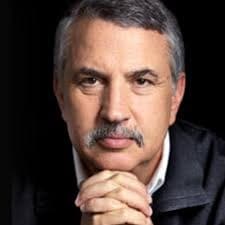
Thomas L. Friedman is an American author and journalist known for his work on international affairs and globalization. His book "From Beirut to Jerusalem" explores the complexities of the Middle East, drawing on his experiences as a foreign correspondent. Friedman has received multiple Pulitzer Prizes for his reporting and analysis.
Similar books
- 1984
George Orwell
4.2 (3.1M) average on GoodreadsPoliticsIn a future where surveillance and thought control are absolute, a man's search for truth clashes with the Party, showing that hope can be a form of rebellion.
- Animal Farm
George Orwell
4.0 (2.7M) average on GoodreadsPoliticsA farm animals' rebellion against humans turns into a pig-led dictatorship, showing how power corrupts and revolutionary ideals are betrayed.
- Freakonomics: A Rogue Economist Explores the Hidden Side of Everything
Steven D. Levitt
4.0 (709k) average on GoodreadsBusinessThis book uses economic principles to reveal the surprising incentives behind everything from drug dealing and real estate to cheating teachers and the decline of crime.
- I Am Malala: The Story of the Girl Who Stood Up for Education and Was Shot by the Taliban
Malala Yousafzai
4.1 (419k) average on GoodreadsPoliticsA teenage girl from a Taliban-controlled valley refuses to give up her books, becoming a global voice for education even after an assassination attempt.
- Atlas Shrugged
Ayn Rand
3.7 (354k) average on GoodreadsPoliticsIn a dystopian America where innovators vanish, a brilliant heiress races to uncover the truth behind the disappearing industrialists and the enigmatic John Galt, who vows to stop the world's progress.
- The Art of War
Sun Tzu
4.0 (330k) average on GoodreadsBusinessLearn ancient strategies for outsmarting rivals, whether on the battlefield or in the boardroom.






Enjoyed the summary?
A summary gives you the shape of the book. The book itself has the detail, the examples and the voice.
Find From Beirut to Jerusalem on AmazonAs an Amazon Associate, BookBrief earns from qualifying purchases. How we're funded