
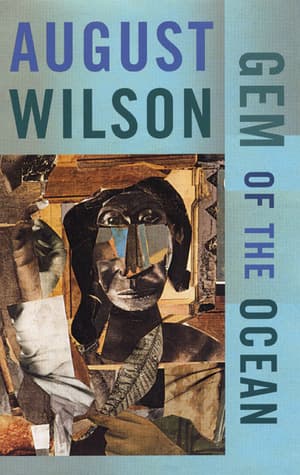
Synopsis
Covers the whole plot, including the ending.
- Difficulty
- Medium
- Pacing
- Moderate
- Mood
- Reverent, Reflective, Confrontational, Hopeful
- Read it if
- You want to experience the foundational play of August Wilson's Century Cycle, exploring themes of freedom, justice, and the ancestral past through powerful dialogue and rich character development.
- Skip it if
- You prefer fast-paced action over character-driven drama and philosophical exploration, or are not interested in historical fiction with a strong spiritual element.
Gem of the Ocean Plot Summary
Covers the whole plot, including the ending.
Aunt Esther's Sanctuary
The play starts in 1904 at the home of Aunt Esther Tyler, a 287-year-old spiritual healer in Pittsburgh's Hill District. Eli, her caretaker, and Black Mary, her assistant, manage the house. Citizen Barlow, a young man from Alabama, arrives, troubled by guilt. He admits to stealing nails from a white man's mill, which led to another black man, Garret Brown, being wrongly accused and drowned while trying to escape. Citizen wants redemption and believes Aunt Esther can cleanse his soul, asking to be 'washed' by her. Solly Two Kings, an elder born a slave and a Union Army scout, also visits the house, bringing news and historical context.
The Mill Strike and Caesar's Law
The Hill District is troubled by a strike at the local mill, where black workers demand better conditions. Caesar, a black constable and business owner, represents the white establishment's oppressive power. He strictly believes in law and order, often at the cost of his own community. Caesar confronts Solly Two Kings about his activities, especially Solly's role in helping people escape the South through an Underground Railroad-like network, hinting at historical struggles for freedom. The strike shows the economic hardship and racial injustice faced by the community, with Caesar contrasting Aunt Esther's spiritual and communal values.
Solly's Freedom Songs
Solly Two Kings, deeply connected to his people's history of struggle, shares stories from his past. He talks about being a 'shoe-fly' during the Civil War, scouting for the Union Army and guiding runaway slaves to freedom. He still carries his walking stick, which he used to mark paths to liberation. Solly's current goal is gathering rocks to build a pyre, a symbolic act of resistance and remembrance. His talks with Eli and Black Mary often touch on the ongoing fight for dignity and the importance of remembering their ancestors' sacrifices. He is a living link to the past, reminding everyone of the continuous journey towards true freedom.
Citizen's Confession and the Burning of the Mill
Citizen Barlow feels more and more guilty about Garret Brown's death. He struggles with how to make amends, seeking guidance from Aunt Esther. Meanwhile, the mill strike grows, and tensions rise. Solly Two Kings, driven by a desire for justice and a rejection of systemic oppression, takes a strong action. He sets fire to the mill, an act of defiance against exploitative conditions and a symbolic strike against the white power structure that has caused so much suffering. This act has major consequences, drawing Caesar's direct attention and intensifying the conflict.
Aunt Esther's Ritual: The Journey to the City of Bones
To cleanse Citizen Barlow's soul, Aunt Esther prepares him for a deep spiritual journey. She performs a ritual, taking him on a metaphorical voyage to the 'City of Bones,' a mythical place off the coast of Africa, built from the bones of Africans who died during the Middle Passage. During this powerful, dream-like experience, Citizen faces his guilt, sees his ancestors' immense suffering, and receives spiritual guidance. This journey is for his personal release and connects him to his people's collective history and trauma, helping him understand the deeper roots of his community's struggles and his place within that legacy.
Caesar's Hunt for Solly
After the mill burning, Constable Caesar starts a relentless search for Solly Two Kings, whom he immediately suspects. Caesar, driven by his strict belief in law and order and his desire to keep his position within the white power structure, sees Solly's act as a direct challenge to his authority. He sees Solly as a criminal, not a liberator. This pursuit shows the deep disagreement between Caesar and the other residents of Aunt Esther's house, who see Solly's act as a desperate, though violent, cry for justice. The hunt increases the danger for Solly and highlights the instability of Black lives in 1904 Pittsburgh.
Black Mary's Awakening
Black Mary, initially quiet, begins to assert herself more strongly as the conflict grows. She challenges Caesar directly, questioning his methods and his loyalty to the Black community. Her growing defiance shows a rising political awareness and a refusal to passively accept injustice. She defends Solly Two Kings, understanding his motivations, and stands firm against Caesar's threats. This change marks Black Mary's emergence as a strong, independent voice in the household, embodying resistance and the fight for community unity against oppressive forces.
Solly's Last Stand
Solly Two Kings, knowing Caesar is closing in, prepares for their inevitable confrontation. He sees his upcoming capture, and likely death, not as a defeat but as a final act of liberation and a sacrifice for his people. He understands his actions have consequences but believes the message of resistance is more important. He entrusts his legacy and the spirit of freedom to Citizen Barlow and the others. His resolve shows his lifelong commitment to fighting for dignity and justice, even against overwhelming odds, solidifying his role as a symbol of defiance against oppression.
The Confrontation and Aftermath
Caesar eventually tracks Solly Two Kings to Aunt Esther's house. A tense confrontation leads to Caesar shooting and killing Solly. This violent act shatters the community's fragile peace and deeply affects everyone present. Afterward, Citizen Barlow, having had his spiritual journey and witnessed Solly's sacrifice, makes a key choice. He decides to take up Solly's walking stick, symbolically inheriting the role of resistance and the ongoing fight for freedom. This moment marks Citizen's change from a guilt-ridden youth to a man committed to his community's fight.
A New Beginning for Citizen
With Solly Two Kings gone, Citizen Barlow fully accepts his new responsibility. He is no longer defined by his past mistake but by his commitment to his people's future. He now understands the deeper meaning of freedom and the continuous fight needed to achieve it. Aunt Esther's spiritual guidance and Solly's sacrifice have made him a new man, ready to contribute to the ongoing struggle for civil rights and racial justice. The play ends with Citizen looking to the future, empowered by his spiritual awakening and his connection to his community's rich, challenging history.
Principal Figures
Aunt Esther Tyler
Protagonist/Spiritual Guide
The 287-year-old matriarch and spiritual healer of the Hill District.
Aunt Esther is the ancient, revered spiritual leader and matriarch of the black community in Pittsburgh's Hill District. At 287 years old, she embodies the collective memory and ancestral wisdom of African Americans, serving as a living link to the past, including the Middle Passage and slavery. She possesses profound spiritual powers, capable of cleansing souls and guiding individuals through spiritual journeys. Her house is a sanctuary, a place of healing, counsel, and historical continuity. She is calm, wise, and profoundly connected to the spiritual realm, offering a counterpoint to the harsh realities of the physical world.
Relationships: Eli (Caretaker and loyal assistant); Black Mary (Assistant and protegée); Citizen Barlow (Spiritual guide and healer); Solly Two Kings (Friend and fellow elder)
Citizen Barlow
Protagonist
A young, guilt-ridden man seeking redemption and a new life.
Citizen Barlow is a young man from Alabama who arrives at Aunt Esther's house burdened by a profound sense of guilt. He stole a bucket of nails, an act that indirectly led to the death of another black man, Garret Brown. He is searching for spiritual cleansing and a new direction in life. Initially naive and overwhelmed by his sin, he is eager to atone and understand his place in the world. His journey is one of self-discovery, spiritual awakening, and ultimately, a commitment to his community's struggle for justice.
Relationships: Aunt Esther (Spiritual guide and mentor); Solly Two Kings (Mentor and predecessor in the fight for freedom); Black Mary (Friend and potential romantic interest)
Solly Two Kings
Supporting/Heroic Figure
An elder born into slavery, a Union Army scout, and a persistent fighter for freedom.
Solly Two Kings is a fierce, courageous, and deeply principled elder who was born a slave and served as a 'shoe-fly' (scout) for the Union Army, guiding runaways to freedom. He continues his fight against oppression in 1904, still involved in an underground network and actively resisting white authority. He is a living embodiment of the struggle for liberation, carrying the weight of history and the fire of defiance. Solly is willing to make ultimate sacrifices for the cause of freedom and justice, viewing his actions as part of a larger, ongoing war against systemic oppression.
Relationships: Aunt Esther (Friend and fellow elder); Citizen Barlow (Mentor and successor); Eli (Friend and confidante); Caesar (Ideological and physical antagonist)
Eli
Supporting
Aunt Esther's loyal and pragmatic caretaker.
Eli is Aunt Esther's devoted caretaker and a steady presence in her household. He is practical, grounded, and often serves as a voice of reason amidst the spiritual and political turmoil. Eli is deeply loyal to Esther and the community, offering support and a sense of stability. He understands the historical context of their struggles and the importance of maintaining the sanctuary of Esther's home. He represents the enduring strength and resilience of the black community, quietly supporting its leaders and traditions.
Relationships: Aunt Esther (Caretaker and loyal assistant); Solly Two Kings (Friend and fellow community member); Black Mary (Colleague in the household)
Black Mary
Supporting
Aunt Esther's assistant, who finds her voice and strength.
Black Mary is Aunt Esther's assistant, initially quiet and observant, but possessing a strong sense of justice and a burgeoning political awareness. She is deeply connected to the community and its struggles, and as the play progresses, she becomes more outspoken and assertive. Mary represents the rising generation of African Americans who are beginning to actively challenge oppression and assert their rights. Her journey involves finding her own voice and standing up against injustice, particularly against Caesar's authoritarianism.
Relationships: Aunt Esther (Assistant and protegée); Citizen Barlow (Friend and potential romantic interest); Caesar (Antagonist)
Caesar
Antagonist
A black constable and businessman who enforces white law and order.
Caesar is a black constable and businessman who has aligned himself with the white power structure. He rigidly adheres to the law, often to the detriment of his own community. He believes in order and property above all else, seeing Solly Two Kings' actions as criminal rather than liberatory. Caesar represents the internal divisions within the black community regarding the best path forward – assimilation versus resistance. He is driven by a desire for respect and status within the existing system, even if it means enforcing oppressive policies against his own people.
Relationships: Solly Two Kings (Ideological and physical antagonist); Black Mary (Opponent in challenging his authority); Aunt Esther (Represents an opposing moral and spiritual authority)
Rutherford Selig
Supporting/Mentioned
A white peddler and news-bringer, representing a bridge to the outside world.
Rutherford Selig is a white peddler who travels through the Hill District, buying and selling goods. He serves as a connection to the outside world, bringing news and gossip. While not a central character, he is a recurring figure in Wilson's plays, often representing the transactional nature of interactions between white and black communities. He is generally neutral, observing the events around him without deeply engaging in the community's struggles. His presence highlights the racial dynamics of the era.
Relationships: Aunt Esther (Business acquaintance); Eli (Business acquaintance)
Themes & Insights
The Weight of History and Ancestral Memory
The play explores how the past, especially the trauma of slavery and the Middle Passage, continues to shape the present for African Americans. Aunt Esther, at 287 years old, embodies this living history, connecting characters to their ancestors. Citizen Barlow's journey to the 'City of Bones' clearly shows this theme, forcing him to face his ancestors' suffering. Solly Two Kings, as a former slave and Union Army scout, carries the legacy of resistance, showing how historical fights for freedom continue today. The characters' self-understanding is tied to their collective past.
“There’s a world that sits on this one. A world where the souls of the dead are still alive. You go there to be made clean.”
Redemption and Atonement
Central to Citizen Barlow's journey is his quest for redemption from stealing nails, which indirectly led to Garret Brown's death. Aunt Esther's spiritual cleansing ritual, the journey to the City of Bones, is how he atones. The play suggests that true redemption is not just forgiveness, but a deep understanding of one's actions, a connection to collective suffering, and a commitment to positive change. Citizen's change from a guilt-ridden person to someone willing to take up Solly's resistance shows this theme, proving atonement can lead to new purpose.
“He got to get washed. He got to get clean. He carrying too much weight.”
Freedom and Resistance
The fight for freedom, both personal and collective, is a main theme. Solly Two Kings represents the active, lifelong fight against oppression, from his time as a slave and Union scout to burning the mill. His actions highlight that freedom often needs to be fought for, sometimes violently, against systemic injustice. The mill strike itself is a form of collective resistance against economic exploitation. The play contrasts Solly's active resistance with Caesar's more conforming approach, asking about the most effective paths to liberation. Citizen Barlow's eventual taking of Solly's walking stick symbolizes his adoption of this legacy of resistance.
“Freedom ain’t something you ask for. You got to take it.”
Community and Solidarity
Aunt Esther's house is a vital center for the Black community in the Hill District, offering sanctuary, spiritual guidance, and a place for shared history and culture. The characters in the house, despite their individual struggles, form a supportive and unified group. The mill strike highlights the workers' collective struggle. The play emphasizes the importance of community bonds when facing outside oppression and internal division. Black Mary's awakening and her defense of Solly against Caesar show the strengthening of community ties and the collective will to protect their own.
“This house is where the world begins.”
Law vs. Justice
This theme is clear in the conflict between Solly Two Kings and Caesar. Caesar, as a constable, represents the strict enforcement of white man's law, believing it is the only way to order and progress, even when it is unfair to his own people. Solly, conversely, represents a higher form of justice, born from his race's historical oppression, willing to break the law to achieve true freedom and dignity. The play questions whether 'law and order' can truly serve justice when the system itself is biased and oppressive, suggesting that sometimes, justice requires defying the law.
“There’s the law, and then there’s what’s right.”
Plot Devices & Literary Techniques
The City of Bones
A mythical, spiritual realm representing ancestral memory and collective trauma.
The City of Bones is a powerful symbolic setting, a mythical place off the coast of Africa, built from the bones of Africans who died during the Middle Passage. It functions as a spiritual purgatory and a site of profound ancestral memory. Aunt Esther guides Citizen Barlow on a hallucinatory journey to this city, where he confronts the immense suffering of his forebears. This device allows the play to transcend realism, connecting individual guilt to collective historical trauma and providing a potent vehicle for spiritual cleansing and understanding of the African American experience.
Aunt Esther's Age (287 years)
Symbolic representation of living history and ancestral wisdom.
Aunt Esther's improbable age of 287 years is a key symbolic device. It signifies her as a living embodiment of African American history, having witnessed slavery, the Middle Passage (through ancestral memory), and generations of struggle. Her age allows her to serve as a direct link to the past, a keeper of ancient wisdom, and a spiritual guide whose knowledge transcends mere human experience. It grounds the play in a deep historical context, suggesting that the past is not merely remembered but actively present and influential in the lives of the characters.
Solly's Walking Stick
A symbol of resistance, freedom, and inherited legacy.
Solly Two Kings' walking stick is a powerful symbol throughout the play. It represents his history as a 'shoe-fly' guiding runaway slaves to freedom, marking paths to liberation. It is a tangible link to the Underground Railroad and the continuous fight for freedom. When Citizen Barlow takes up the stick after Solly's death, it signifies his acceptance of Solly's legacy and his commitment to continuing the struggle for justice. The stick becomes a physical manifestation of inherited responsibility and the ongoing journey towards true liberation.
The Mill Strike
A catalyst for conflict and a symbol of economic oppression.
The ongoing strike at the local mill serves as a crucial plot device, setting the immediate social and economic context for the characters. It highlights the systemic exploitation faced by black workers and the resulting desperation in the community. The strike directly fuels Solly Two Kings' decision to burn the mill, escalating the conflict with Caesar and forcing characters to choose sides. It grounds the play's spiritual and historical themes in a concrete, contemporary struggle for dignity and fair treatment, showing how larger historical injustices manifest in everyday life.
Gem of the Ocean Quotes
“Everybody got to get their own ship. You can't be riding on nobody else's ship. Everybody got to get their own.”
“The past is a road. You can walk it. You can run it. You can stand still on it. But you can't go backwards on it.”
“You got to make a life for yourself. Nobody can make it for you.”
“There's a whole world out there waiting for you to make your mark on it.”
“The only difference between a slave and a free man is what he chooses to do with his freedom.”
“You got to carry your own weight. You can't be leaning on nobody else.”
“Every man got a song inside him. You just got to find it and sing it.”
“Some things you got to let go of to make room for new things.”
“The road to freedom ain't always smooth. Sometimes it's bumpy, sometimes it's rough, but you got to keep walking.”
“You can't hide from who you are. Sooner or later, it's gonna catch up to you.”
“The spirit don't die. It just changes form.”
“Sometimes you got to make your own justice when the law won't give it to you.”
“The world is a harsh place, but it's also full of beauty if you know where to look.”
“You got to believe in something. If you don't, you just drifting.”
Quiz
10 questions on the plot and the characters. Each answer comes with a short explanation.
Question 1
In what year is 'Gem of the Ocean' primarily set?
- 1918
- 1904
- 1865
- 1927
Show answer
B. 1904 'Gem of the Ocean' is chronologically the first play in August Wilson's cycle and is set in 1904 Pittsburgh.
Question 2
Which city serves as the primary setting for 'Gem of the Ocean'?
- New York City
- Chicago
- Pittsburgh
- New Orleans
Show answer
C. Pittsburgh The play is set in 1904 Pittsburgh, specifically in Aunt Esther's Hill District home.
Question 3
What is the approximate age of the matriarch, Aunt Esther, as described in the play's synopsis?
- 87 years old
- 100 years old
- 287 years old
- 50 years old
Show answer
C. 287 years old Aunt Esther is described as the drama’s 287-year-old fiery matriarch, emphasizing her deep connection to history and ancestral memory.
Question 4
Which character in 'Gem of the Ocean' was born into slavery and scouted for the Union Army?
- Citizen Barlow
- Aunt Esther
- Solly Two Kings
- Eli
Show answer
C. Solly Two Kings Solly Two Kings is introduced as a character who was born into slavery and served as a scout for the Union Army, highlighting his historical significance.
Question 5
What is Citizen Barlow's primary reason for coming to Aunt Esther's home in the Hill District?
- To escape the law
- To find a new life
- To visit relatives
- To start a business
Show answer
B. To find a new life Citizen Barlow is described as a young man from Alabama searching for a new life, a common theme for African Americans migrating north during this period.
Question 6
What significant role does 'Gem of the Ocean' hold within August Wilson's body of work?
- It is his only musical play.
- It is the final play in his decade-by-decade cycle.
- It is chronologically the first play in his decade-by-decade cycle.
- It is the only play not set in Pittsburgh.
Show answer
C. It is chronologically the first play in his decade-by-decade cycle. The provided text explicitly states that 'Gem of the Ocean' is chronologically the first work in August Wilson’s decade-by-decade cycle.
Question 7
The New Yorker critic John Lahr compares August Wilson's achievements in American theater to which other two prominent playwrights?
- Arthur Miller and Edward Albee
- Eugene O’Neill and Tennessee Williams
- Lorraine Hansberry and Langston Hughes
- Thornton Wilder and Neil Simon
Show answer
B. Eugene O’Neill and Tennessee Williams John Lahr is quoted as saying, 'No one except perhaps Eugene O’Neill and Tennessee Williams has aimed so high and achieved so much in the American theater' in reference to August Wilson.
Question 8
What broader theme is August Wilson's decade-by-decade cycle, including 'Gem of the Ocean,' intended to dramatize?
- The industrialization of America
- The African American experience during the 20th century
- The struggles of immigrant communities in America
- The evolution of American jazz music
Show answer
B. The African American experience during the 20th century The text explains that Wilson's cycle dramatizes 'the African American experience during the 20th century,' making this the overarching theme.
Question 9
What significant event related to August Wilson's legacy occurred in 2006, as mentioned in the text?
- His last play premiered in London.
- A major film adaptation of 'Fences' was released.
- A Broadway theatre was renamed the August Wilson Theater in his honor.
- He received a posthumous Pulitzer Prize.
Show answer
C. A Broadway theatre was renamed the August Wilson Theater in his honor. The text states, 'Fittingly the Broadway theatre where his last play will be produced in 2006 has been renamed the August Wilson Theater in his honor.'
Question 10
What does Ben Brantley of The New York Times suggest 'Gem of the Ocean' offers to theatergoers who have followed August Wilson's career?
- A departure from his usual style.
- A touchstone for everything else he has written.
- His most commercially successful play.
- A focus on a completely new historical period.
Show answer
B. A touchstone for everything else he has written. Ben Brantley's quote describes 'Gem of the Ocean' as 'a touchstone for everything else he has written,' implying it provides foundational context for his other works.
Gem of the Ocean FAQ
What is the central premise of 'Gem of the Ocean' and its historical context?
'Gem of the Ocean' is set in 1904 Pittsburgh and serves as the chronological beginning of August Wilson's Century Cycle. It explores the aftermath of slavery and the early 20th-century African American experience through characters like Citizen Barlow, a young man from Alabama seeking a new life in the North, and Solly Two Kings, a former slave and Union Army scout.
Who is Aunt Esther and what is her significance in the play?
Aunt Esther is the 287-year-old matriarch of the household in the Hill District, a fiery and spiritual figure. She is not just a character but a living embodiment of ancestral memory and spiritual wisdom, guiding characters like Citizen Barlow through a ritualistic cleansing and connecting them to their African heritage and the profound history of their people.
What brings Citizen Barlow to Aunt Esther's house and what is he seeking?
Citizen Barlow arrives at Aunt Esther's house after committing a grave sin – he let another man drown in a mill accident and then stole his bucket of nails. He is tormented by guilt and seeks spiritual absolution and a new beginning, which he believes Aunt Esther, with her deep spiritual insight, can provide.
What is the significance of the journey to the City of Bones?
The journey to the City of Bones is a powerful ritual orchestrated by Aunt Esther for Citizen Barlow. It is a metaphorical voyage to the depths of the Atlantic Ocean, representing the Middle Passage and the countless Africans lost to slavery, serving as a spiritual cleansing and a confrontation with the ancestral trauma of his people.
Who is Solly Two Kings and what is his role in the narrative?
Solly Two Kings is a former slave who scouted for the Union Army and is now an old man still fighting for justice. He is dedicated to helping people escape the oppressive conditions of the South, embodying a continuous struggle for freedom even after emancipation, and eventually sacrificing himself for this cause.
How does 'Gem of the Ocean' connect to other plays in August Wilson's Century Cycle?
'Gem of the Ocean' introduces Aunt Esther, a recurring spiritual figure or ancestral presence mentioned in other plays like 'The Piano Lesson' and 'Joe Turner's Come and Gone.' It establishes the foundational spiritual and historical struggles that resonate throughout the cycle, particularly themes of migration, identity, and the legacy of slavery.
What is the significance of the bucket of nails Citizen Barlow stole?
The bucket of nails represents Citizen Barlow's initial sin and the burden of guilt he carries. It's a tangible symbol of his transgression and the material world's demands that led him astray, contrasting sharply with the spiritual journey he undertakes to cleanse himself.
What is the implied fate of the character Eli and his connection to the community?
Eli is a quiet, observant man who lives with Aunt Esther and acts as a guardian of the house and its history. His steadfast presence and deep understanding of the community's struggles suggest he is a keeper of tradition and a silent witness to the ongoing fight for dignity and freedom.
How does the play portray the nascent African American community in Pittsburgh's Hill District?
The play depicts the Hill District as a vibrant but struggling community, a haven for those escaping the Jim Crow South, yet still facing systemic racism and economic hardship. It's a place where spiritual traditions and communal bonds are vital for survival and identity formation amidst new challenges.
Analyze Citizen Barlow's psychological journey from guilt to redemption.
Citizen Barlow begins in a state of profound psychological torment and self-loathing due to his sin. Through Aunt Esther's ritual and his confrontation with ancestral history in the City of Bones, he undergoes a cathartic transformation, shedding his guilt and emerging with a renewed sense of purpose and connection to his heritage.
How does the character of Aunt Esther embody collective memory and resilience?
Aunt Esther, with her extreme age, transcends individual memory to embody the collective historical memory of African Americans, particularly the trauma of slavery and the Middle Passage. She represents the enduring spirit, wisdom, and resilience that have sustained the community through centuries of oppression.
Discuss the psychological impact of migration from the South to the North on characters like Citizen Barlow.
Migration to the North for characters like Citizen Barlow brought the hope of freedom and new opportunities, but also significant psychological challenges. They faced the trauma of leaving familiar surroundings, the disillusionment of finding continued racial prejudice, and the struggle to forge new identities in an unfamiliar urban landscape, often carrying deep-seated guilt or trauma from their past.
How does the play explore themes of freedom and the continued struggle for it post-slavery?
The play powerfully demonstrates that legal emancipation did not equate to true freedom. Characters like Solly Two Kings continue to fight for liberation, highlighting that systemic oppression persisted through Jim Crow laws and economic exploitation, necessitating ongoing resistance and the assertion of dignity and self-determination.
What is the symbolic meaning of water throughout the play?
Water is a pervasive and multifaceted symbol, representing both destruction (the drowning man, the Middle Passage) and cleansing (Aunt Esther's rituals, the journey to the City of Bones). It signifies the historical trauma of the ocean voyage, but also the potential for spiritual renewal, purification, and the flow of ancestral memory.
How does the play balance historical realism with spiritual and mythical elements?
'Gem of the Ocean' masterfully blends historical realism, depicting the harsh realities of 1904 Pittsburgh, with profound spiritual and mythical elements, particularly through Aunt Esther's character and the journey to the City of Bones. This fusion elevates the personal stories to a universal, ancestral level, emphasizing the enduring power of faith and heritage.
What is the significance of the play being the chronological beginning of Wilson's Century Cycle?
As the chronological beginning, 'Gem of the Ocean' establishes the foundational spiritual and historical bedrock for the entire Century Cycle. It introduces the deep ancestral roots and the initial struggles of African Americans in the 20th century, setting the stage for the themes, characters, and historical developments explored in subsequent plays.
How does the play address the concept of justice, both legal and spiritual?
The play contrasts legal justice, which often fails the Black community, with a deeper spiritual justice. Citizen Barlow's journey highlights that true atonement and peace come not from worldly punishment but from confronting one's conscience and seeking spiritual cleansing, often guided by ancestral wisdom like Aunt Esther's.
What role does community play in the survival and identity of the characters?
Community is depicted as essential for survival, support, and the formation of identity. Aunt Esther's house serves as a sanctuary and a hub where individuals find solace, guidance, and a connection to their shared history, reinforcing that collective strength and mutual aid are crucial in overcoming systemic adversity.
About the author

August Wilson was a celebrated American playwright, renowned for his "Pittsburgh Cycle," a ten-play series chronicling the African American experience through the 20th century. His most acclaimed works include "Fences," "The Piano Lesson," and "Gem of the Ocean," earning him numerous awards, including two Pulitzer Prizes. Wilson's powerful dramas are celebrated for their lyrical language and profound exploration of identity, culture, and history.
Similar books
- Fences
August Wilson
3.9 (18k) average on GoodreadsHistorical FictionAnother powerful play from Wilson's Century Cycle, exploring family, legacy, and the African American experience.
- The Piano Lesson
August Wilson
3.8 (6k) average on GoodreadsHistorical FictionFeatures a central artifact and explores the weight of history and inheritance within an African American family.
- A Raisin in the Sun
Lorraine Hansberry
While both plays explore the African American experience, Hansberry's 'A Raisin in the Sun' focuses more on socio-economic aspirations, generational conflict, and the struggle for upward mobility within a realist framework. Wilson's 'Gem of the Ocean' delves deeper into spiritual and ancestral dimensions, using myth and ritual to understand the present, with less emphasis on material advancement and more on spiritual and historical liberation.
- To Kill a Mockingbird
Harper Lee
4.3 (4.5M) average on GoodreadsHistorical FictionIn the 1930s Jim Crow South, Harper Lee writes about racial injustice, moral growth, and the quiet courage of a lawyer father, Atticus Finch, as seen through his young daughter's eyes.
- The Great Gatsby
F. Scott Fitzgerald
3.9 (3.8M) average on GoodreadsHistorical FictionIn the opulent Roaring Twenties, a mysterious millionaire's lavish parties hide his desperate, tragic pursuit of a lost love, exposing the emptiness within the American Dream.
- Pride and Prejudice
Jane Austen
4.3 (3M) average on GoodreadsHistorical FictionIn a society focused on status and money, Elizabeth Bennet navigates love and pride, challenging Mr. Darcy and social expectations to find true affection.



Enjoyed the summary?
A summary gives you the shape of the book. The book itself has the detail, the examples and the voice.
Find Gem of the Ocean on AmazonAs an Amazon Associate, BookBrief earns from qualifying purchases. How we're funded