

Synopsis
Covers the whole plot, including the ending.
- Difficulty
- Medium
- Pacing
- Variable
- Mood
- Epic, Romantic, Dramatic, Resilient, Tragic
- Read it if
- You enjoy sweeping historical sagas with strong, complex female protagonists and a deep dive into the American South during the Civil War era.
- Skip it if
- You prefer fast-paced plots, dislike morally ambiguous characters, or are sensitive to outdated cultural perspectives.
Gone with the Wind Plot Summary
Covers the whole plot, including the ending.
Twelve Oaks and the Eve of War
In April 1861, sixteen-year-old Scarlett O'Hara, the eldest daughter of Gerald and Ellen O'Hara, lives at her family's plantation, Tara, in Georgia. She is vain and spoiled, obsessed with Ashley Wilkes, a kind, educated man engaged to his sweet cousin, Melanie Hamilton. At a barbecue at the nearby Twelve Oaks plantation, Scarlett tries to tell Ashley her feelings, but he rejects her, saying he will marry Melanie. The notorious blockade runner Rhett Butler, a cynical but observant social outcast, overhears this and mocks Scarlett's childish behavior. This creates an immediate rivalry and fascination between them. News of the coming Civil War, after Fort Sumter, overshadows the party, and young men, including Ashley and Melanie's brother, Charles Hamilton, prepare to enlist.
War's Early Days and a Hasty Marriage
Ashley's rejection devastates Scarlett, and to spite him, she quickly marries Melanie's brother, Charles Hamilton, a man she does not love. Charles soon dies from measles and pneumonia, not in battle, leaving Scarlett a nineteen-year-old widow with a baby, Wade Hampton Hamilton. She is expected to mourn in black. Scarlett finds the social rules for widows stifling and unbearable, missing the excitement and attention she once had. She hates the somber life of a widow and resents losing her youth and freedom, feeling trapped by her situation and the traditions of the Old South.
Atlanta and the Hospitals
To escape the dull life at Tara, Scarlett moves to Atlanta to live with Melanie and her Aunt Pittypat. She enjoys the city's more lively atmosphere, dancing and flirting despite her widow's clothes, which shocks polite society. Here, she often meets Rhett Butler, now a rich blockade runner. He openly flirts with her and sees through her pretenses, often challenging her with his cynical comments. To stop Scarlett's improper behavior and help the war effort, Melanie kindly persuades her to volunteer at a Confederate hospital. Scarlett finds the harsh realities of war, the suffering, and the smell of death very disturbing and is not suited for the work, but she continues out of duty and a desire to avoid boredom.
The Siege of Atlanta
As the Union army under General Sherman approaches Atlanta, the city becomes a target. Most people leave, but Scarlett stays behind because Melanie is heavily pregnant and having a difficult labor. Melanie's doctor has fled, leaving Scarlett to deliver the baby with only the help of Prissy, her young, terrified house servant, who proves useless. Amidst the burning city and bombardment, Scarlett successfully delivers Melanie's son, Beau Wilkes. With Union soldiers closing in, Scarlett desperately needs to escape. Unexpectedly, Rhett Butler appears, having returned to Atlanta to help them. He provides a horse and buggy and drives them through the burning streets to get Scarlett, Melanie, Beau, and Prissy out of the besieged city, showing surprising courage.
The Journey to Tara and Its Desecration
Rhett takes Scarlett, Melanie, Beau, and Prissy out of burning Atlanta. During their dangerous escape, Rhett suddenly leaves them to join the Confederate army, saying he will fight for the Lost Cause. Scarlett is furious and feels betrayed. Scarlett must drive the buggy through war-torn Georgia, facing deserted roads, starving soldiers, and the constant threat of Union patrols. Upon reaching Tara, she finds it desecrated: the land is barren, the house partially looted and damaged, and her mother, Ellen, dead from typhoid. Her father, Gerald, is mentally unstable, and her sisters, Suellen and Carreen, are weak and ill. Scarlett faces the complete collapse of her former privileged life and the harsh reality of survival.
Scarlett's Struggle for Survival
Facing starvation and ruin, Scarlett abandons her pampered past and takes on the responsibility of providing for Tara. She learns to farm, picks cotton alongside her former slaves, and even kills a Yankee soldier who tries to steal from them. She becomes tough and ruthless, driven by her vow: "As God is my witness, I'll never be hungry again." She makes her sisters work, uses the remaining field hands, and struggles to pay the high taxes from the Reconstruction government. Her main goal is to keep Tara, the symbol of her family's pride and her past, at all costs, showing an unyielding will to survive.
The Mill and Frank Kennedy
To get money for Tara's high taxes, Scarlett tries to get a loan from Rhett Butler, who is in a Yankee jail, but he refuses. Desperate, she learns that her sister Suellen's fiancé, Frank Kennedy, has become a successful and wealthy merchant in Atlanta. Without hesitation, Scarlett manipulates Frank into marrying her, lying that Suellen is engaged to someone else. She takes over Frank's lumber mill business, quickly expanding it through clever and often unfair practices, including using convict labor, buying cheap timber, and ignoring social rules. Her business skill ensures Tara's survival and provides financial security, but it makes her tougher and separates her from traditional Southern society.
The Ku Klux Klan and Frank's Death
Scarlett's independent business practices, especially driving her buggy unescorted through rough parts of Atlanta, lead to an attempted assault by a former slave and a white carpetbagger. In response, Frank Kennedy, Ashley Wilkes, and other former Confederates join a Ku Klux Klan raid to get revenge for Scarlett. The raid goes wrong, resulting in a shootout with Union soldiers. Frank is killed, and Ashley is wounded. Frank's death devastates Scarlett, not out of love for him, but because of the security he provided. Rhett Butler again steps in, helping to hide the Klan's involvement and saving Ashley and the others from severe punishment, further complicating his relationship with Scarlett.
Marriage to Rhett Butler
After Frank's death, Rhett Butler, now free and wealthy, proposes to Scarlett. He openly admits he wants her and promises her everything she could desire. Scarlett, still mainly motivated by financial security and a strange attraction to Rhett's strength and defiance, accepts, despite her lingering obsession with Ashley Wilkes. Their marriage is stormy, marked by passionate arguments, lavish gifts from Rhett, and Scarlett's emotional distance. Rhett showers her with luxuries and tries to win her love, but Scarlett remains emotionally distant, unable to fully return his affection because her heart is still consumed by her idealized image of Ashley, even though he is married to Melanie.
Bonnie Blue Butler's Birth and Death
Scarlett and Rhett have a daughter, Eugenie Victoria, whom Rhett adores and affectionately calls Bonnie Blue. Rhett's love for Bonnie changes him, making him seek respectability and a place in society for his daughter's sake. He spoils her and encourages her lively nature, seeing in her a reflection of Scarlett's best qualities. Bonnie becomes the emotional link between Scarlett and Rhett, the one thing they both truly love. However, tragedy strikes when Bonnie, like her adventurous father, tries a daring jump on her pony and breaks her neck, dying instantly. Her death shatters Rhett, driving him into deep grief and alcoholism, and further widens the emotional gap between him and Scarlett.
Melanie's Death and Scarlett's Realization
Melanie Hamilton Wilkes, weakened by difficult childbirths and fragile health, falls ill during her final pregnancy and dies. Her death is a deep loss for Ashley, but it also forces Scarlett to finally face her long-held infatuation. She realizes that her love for Ashley was a childish fantasy, an idealized image she held onto, and that the real Ashley is weak and dependent, not the strong hero she imagined. In her grief and confusion, Scarlett also realizes the depth of Rhett's love for her and her own growing love for him, which she had ignored. She rushes home to tell Rhett, finally ready to acknowledge her feelings.
Rhett's Departure and Scarlett's Resolve
Scarlett returns to Tara after Melanie's death, finally understanding that she truly loves Rhett. However, she finds Rhett at home, packing his bags. He is emotionally exhausted and broken by Bonnie's death and Scarlett's long emotional distance. He tells her that he is leaving, that he no longer cares, and famously says, "Frankly, my dear, I don't give a damn." Despite Scarlett's desperate pleas and her late confession of love, Rhett is determined. As he walks out, Scarlett is left alone, devastated but not defeated. She decides to return to Tara, find her strength there, and figure out a way to win Rhett back, famously concluding, "After all, tomorrow is another day."
Gone with the Wind Characters
Scarlett O'Hara
Protagonist
A beautiful, headstrong, and fiercely resilient Southern belle.
Scarlett O'Hara is the central figure, a spoiled and manipulative debutante from a wealthy Georgia plantation family. Initially driven by vanity, a desire for attention, and an obsessive infatuation with Ashley Wilkes, she transforms into a ruthless survivor during and after the Civil War. Her primary motivations are self-preservation, the protection of Tara (her family's plantation), and the pursuit of financial security. She possesses immense strength, business acumen, and an unyielding will, often at the expense of her emotional and moral compass. She struggles with self-awareness, particularly regarding her true feelings for Ashley and Rhett.
Relationships: Ashley Wilkes (Obsessive, unrequited love/infatuation); Rhett Butler (Complex, tempestuous, love-hate, eventually deep love); Melanie Hamilton Wilkes (Initial jealousy, evolving into a grudging respect and affection); Gerald O'Hara (Adoring daughter-father bond, later a burden); Ellen O'Hara (Admiration, but unable to emulate her mother's grace); Frank Kennedy (Marriage of convenience for financial security)
Rhett Butler
Love Interest / Anti-Hero
A cynical, charming, and wealthy blockade runner with a deep understanding of human nature.
Rhett Butler is a dashing, roguish, and intelligent man, ostracized by polite society for his unconventional views and actions. He is a successful blockade runner during the war, amassing a fortune. He sees through Scarlett's pretenses from their first meeting and is drawn to her strength and defiance. Despite his cynical exterior, he possesses a deep capacity for love, particularly for Scarlett and their daughter, Bonnie. He is fiercely independent, pragmatic, and often cruel in his honesty, but also capable of great tenderness and loyalty. His pride is as strong as Scarlett's, leading to their ultimate estrangement.
Relationships: Scarlett O'Hara (Complex, tempestuous, love-hate, eventually deep love); Bonnie Blue Butler (Deep, unconditional paternal love and devotion); Melanie Hamilton Wilkes (Respect and admiration)
Ashley Wilkes
Love Interest / Supporting
A gentle, intellectual Southern gentleman, idealized by Scarlett.
Ashley Wilkes is the embodiment of the Old South's ideals: cultured, honorable, and deeply attached to tradition. He is a sensitive, artistic, and introspective man, but lacks the practical skills and ruthlessness needed to survive the post-war world. He genuinely loves his wife, Melanie, and respects Scarlett, but is unable to reciprocate Scarlett's intense feelings. He represents a lost way of life and struggles to adapt to the harsh realities of Reconstruction, often relying on the strength of the women around him. Scarlett's idealized image of him is far from the reality of his character.
Relationships: Melanie Hamilton Wilkes (Deep, loving, and supportive marriage); Scarlett O'Hara (Object of unrequited infatuation, friend); Rhett Butler (Acquaintances, often at odds due to Scarlett)
Melanie Hamilton Wilkes
Supporting
Ashley's sweet, kind, and morally upright wife, Scarlett's foil.
Melanie Hamilton Wilkes is Scarlett's sister-in-law and Ashley's wife. She embodies the virtues of Southern womanhood: gentle, compassionate, loyal, and unfailingly good-hearted. Despite Scarlett's initial disdain and jealousy, Melanie consistently treats Scarlett with kindness, love, and unwavering loyalty, seeing the best in everyone. She is physically fragile but possesses immense inner strength and moral fortitude. She is the moral center of the story, serving as a foil to Scarlett's ruthlessness and a source of comfort and stability for those around her, especially Ashley.
Relationships: Ashley Wilkes (Deep, loving, and supportive marriage); Scarlett O'Hara (Unwavering love and loyalty, despite Scarlett's feelings for Ashley); Rhett Butler (Respect and fondness)
Gerald O'Hara
Supporting
Scarlett's boisterous, proud Irish father and owner of Tara.
Gerald O'Hara is Scarlett's father and the proud, hot-tempered, but ultimately kind owner of Tara. He immigrated from Ireland and built his fortune through shrewd land deals and hard work. He dotes on Scarlett, indulging her willfulness. After the war and the death of his wife, Ellen, he suffers a mental decline, becoming childlike and unable to manage the plantation, forcing Scarlett to take charge. He represents the romantic, often impractical, spirit of the Old South.
Relationships: Scarlett O'Hara (Adoring father-daughter bond); Ellen O'Hara (Deep, loving marriage)
Ellen O'Hara
Supporting
Scarlett's elegant, compassionate, and capable mother.
Ellen O'Hara is Scarlett's mother, a woman of immense grace, strength, and moral integrity. She is the true manager of Tara, running the household and caring for the sick and poor in the community with quiet dignity. She embodies the ideal of Southern womanhood and serves as Scarlett's moral compass, though Scarlett often struggles to live up to her example. Her death from typhoid during the war is a pivotal moment, plunging Tara into chaos and forcing Scarlett to step up.
Relationships: Gerald O'Hara (Deep, loving marriage); Scarlett O'Hara (Object of admiration, moral guide)
Mammy
Supporting
Scarlett's loyal and formidable house slave and confidante.
Mammy is the O'Hara family's head house servant and Scarlett's personal nurse. She is fiercely loyal to the O'Haras, particularly Scarlett, whom she scolds, advises, and protects with unwavering devotion. Mammy is a figure of immense strength, wisdom, and moral authority, often seeing through Scarlett's manipulations. She represents the complex, often contradictory, relationship between slaves and their owners in the antebellum South, embodying both the subservience and the quiet power within the household. She remains with Scarlett through all her trials.
Relationships: Scarlett O'Hara (Nurturing, protective, and critical caregiver); O'Hara Family (Loyal servant and surrogate family member)
Prissy
Supporting
A young, often incompetent, house slave who serves Scarlett.
Prissy is a young, flighty, and often exasperating house servant who accompanies Scarlett to Atlanta. She is prone to exaggeration and panic, most famously during Melanie's childbirth when she falsely claims to know how to deliver a baby. Despite her occasional uselessness, she remains with Scarlett through the war and its aftermath. She represents a more childlike and less reliable aspect of the enslaved population, often serving as comic relief or a source of frustration for Scarlett.
Relationships: Scarlett O'Hara (Servant, often exasperating)
Frank Kennedy
Supporting
Scarlett's second husband, originally her sister's fiancé.
Frank Kennedy is a kind, unassuming merchant who was initially engaged to Scarlett's sister, Suellen. He builds a successful business in Atlanta after the war. Scarlett manipulates him into marrying her to save Tara from foreclosure, using his wealth to expand her lumber business. He is a decent but somewhat weak man, unable to control Scarlett's ambitions or protect her from her own recklessness. His death in a Ku Klux Klan raid, while avenging Scarlett, leaves her a widow for the second time.
Relationships: Scarlett O'Hara (Husband (marriage of convenience)); Suellen O'Hara (Former fiancé)
Gone with the Wind Themes
Survival and Resilience
This theme is central to Scarlett's character. After the Civil War and Reconstruction, Scarlett loses her privileged life. She adapts ruthlessly, learning to farm, manage businesses, and even kill to protect Tara and her family. Her famous vow, 'As God is my witness, I'll never be hungry again,' shows this driving force. This theme is clear when she takes over Frank Kennedy's mill, using convict labor and clever, often unfair, business practices to succeed in a ruined economy. This shows an unyielding will to survive that goes beyond traditional gender roles and social expectations.
“As God is my witness, I'll never be hungry again.”
The End of an Era (The Lost Cause)
The novel clearly shows the end of the antebellum Southern aristocracy and the romantic 'Lost Cause' of the Confederacy. The destruction of Twelve Oaks, the burning of Atlanta, and the desolation of Tara symbolize the physical and social collapse of the Old South. Characters like Ashley Wilkes represent the old order's inability to adapt, clinging to outdated ideals. Rhett Butler, with his practical view, shows the necessary shift away from romanticism, while Scarlett, in her ruthless pursuit of wealth, embodies the start of a new, harder capitalist spirit in the South. The story often compares nostalgic memories of pre-war grandeur with the harsh realities of Reconstruction.
“It was the end of a civilization such as the world had not seen since the fall of Rome.”
Love, Infatuation, and Self-Delusion
Scarlett's emotional journey is dominated by her self-deception about love. She is obsessed with Ashley Wilkes, an idealized version of a Southern gentleman, for most of the novel, mistaking her obsession for true love. This blinds her to the genuine, passionate, and often difficult love offered by Rhett Butler, who truly understands her. Her pursuit of Ashley, even after marrying Rhett, keeps her from finding happiness. Only with Melanie's death does Scarlett realize Ashley's true, weak nature and the depth of her feelings for Rhett, showing how self-deception can lead to deep emotional loss. Her failure to recognize and return Rhett's love until it is too late is a tragic result of this theme.
“She had never understood either of the men she loved and so she had lost them both.”
Gender Roles and Female Agency
The novel explores the strict gender roles of the Old South and Scarlett's defiance of them. Initially, she is limited by expectations of proper behavior and fragility. However, the war forces her to break these norms. She takes on traditionally male roles, managing Tara, running a business, and making ruthless financial decisions. While Melanie represents the traditional, gentle Southern lady, Scarlett represents a new kind of woman, one who is fiercely independent and economically powerful, even if it means sacrificing social acceptance. Her refusal to conform to societal expectations for widows or wives demonstrates a powerful, though often selfish, form of female agency in a patriarchal society.
“She was not a lady and never would be.”
Plot Devices & Literary Techniques
Foil Characters
Characters who highlight the protagonist's traits through contrast.
Melanie Hamilton Wilkes serves as a direct foil to Scarlett O'Hara. Melanie's unwavering kindness, moral integrity, and selfless love for Ashley and others starkly contrast with Scarlett's vanity, selfishness, and ruthless ambition. This contrast emphasizes Scarlett's flaws and strengths, allowing the reader to understand the moral and emotional stakes of Scarlett's choices. Melanie's consistent goodness also makes Scarlett's eventual grudging affection for her more impactful, showing a subtle shift in Scarlett's character despite her outward hardened exterior.
Symbolism of Tara
The O'Hara plantation symbolizes the Old South and Scarlett's enduring connection to her roots.
Tara, the O'Hara plantation, is more than just a setting; it is a powerful symbol. Initially, it represents Scarlett's privileged, idyllic life in the Old South. After the war, its desecration and the constant struggle to save it symbolize the collapse of the Confederate dream and the harsh realities of Reconstruction. For Scarlett, Tara becomes a tangible representation of her family's pride, her past, and her unwavering will to survive. Her vow to never be hungry again is intrinsically tied to keeping Tara, making it the bedrock of her identity and a constant reminder of what she is fighting for.
Foreshadowing
Hints or clues about future events in the story.
Early in the novel, Rhett Butler's cynical observations about Scarlett's character and her infatuation with Ashley Wilkes often foreshadow the ultimate outcome of her relationships. For example, his early comments about her being a 'child' and seeing through her pretenses hint at his eventual disillusionment with her emotional immaturity. Similarly, the initial carefree attitude towards the war at Twelve Oaks, contrasted with Rhett's realistic warnings, foreshadows the devastating impact the conflict will have on their lives and the South, setting a tone of impending doom for the romanticized old ways.
Dramatic Irony
When the audience knows something a character does not.
Dramatic irony is frequently used, particularly concerning Scarlett's perception of Ashley Wilkes and Rhett Butler. The audience quickly understands that Ashley is weak and dependent, and that Rhett genuinely loves Scarlett and sees her true strength, long before Scarlett herself does. This creates tension and pathos, as the reader watches Scarlett make choices based on her misjudgments, prolonging her suffering and delaying her eventual, tragic realization. Her consistent misinterpretation of Rhett's actions and motives, seeing them as cynical rather than loving, is a prime example of this device.
Gone with the Wind Quotes
“Frankly, my dear, I don't give a damn.”
“After all, tomorrow is another day.”
“I'm tired of playing the part of a rich man's wife, tired of pretending to be something I'm not.”
“Land is the only thing in the world that amounts to anything, for 'tis the only thing in this world that lasts.”
“I can't think about that right now. If I do, I'll go crazy. I'll think about it tomorrow.”
“You're like the thief who isn't satisfied with stealing a man's money but has to steal his watch and chain too.”
“War is a man's business, not a woman's. Don't try to make it yours.”
“Burdens, like wounds, must be nursed in secret.”
“It was the one thing her father had taught her that she had never forgotten: love of the land.”
“I always said you were a fool, Scarlett, and now I know it.”
“She had never understood Ashley, and she had never understood Rhett.”
“He knew her for the selfish, grasping, unscrupulous little savage she was, and knowing, he loved her.”
“Scarlett O'Hara was not beautiful, but men seldom realized it when caught by her charm.”
“Only a fool tries to change what can't be changed.”
Quiz
10 questions on the plot and the characters. Each answer comes with a short explanation.
Question 1
What is the name of the O'Hara plantation where Scarlett grows up?
- Twelve Oaks
- Tara
- Belle Reve
- Ashland
Show answer
B. Tara Scarlett O'Hara's family plantation, a central setting for much of the novel, is named Tara.
Question 2
Which character does Scarlett initially pine for, despite his engagement to Melanie Hamilton?
- Frank Kennedy
- Ashley Wilkes
- Rhett Butler
- Charles Hamilton
Show answer
B. Ashley Wilkes Scarlett's enduring, unrequited love for Ashley Wilkes, who marries her cousin Melanie, drives much of her early romantic frustration.
Question 3
What major historical event leads to the destruction and poverty Scarlett experiences?
- The Great Depression
- The War of 1812
- The American Civil War and Reconstruction
- The Mexican-American War
Show answer
C. The American Civil War and Reconstruction The entire narrative of 'Gone with the Wind' is set against the backdrop of the American Civil War and the subsequent Reconstruction era.
Question 4
What is the primary reason Scarlett marries Charles Hamilton?
- She genuinely loves him.
- To spite Ashley Wilkes after he announces his engagement to Melanie.
- Her family arranged the marriage.
- She was pregnant with his child.
Show answer
B. To spite Ashley Wilkes after he announces his engagement to Melanie. Scarlett impulsively marries Charles Hamilton, Melanie's brother, primarily out of spite and anger after Ashley Wilkes rejects her and announces his engagement to Melanie.
Question 5
How does Scarlett manage to save Tara from being sold for taxes after the war?
- She borrows money from Rhett Butler.
- She sells her jewelry.
- She marries Frank Kennedy, who has saved money, and takes over his lumber business.
- She works as a seamstress in Atlanta.
Show answer
C. She marries Frank Kennedy, who has saved money, and takes over his lumber business. To save Tara, Scarlett schemes to marry Frank Kennedy, her sister Suellen's beau, because he has savings. She then takes control of his successful lumber mill.
Question 6
What is Rhett Butler's primary motivation for initially refusing to fight for the Confederacy?
- He is a pacifist.
- He believes the South's cause is foolish and doomed to fail from the start.
- He is secretly a Union spy.
- He is too old to enlist.
Show answer
B. He believes the South's cause is foolish and doomed to fail from the start. Rhett Butler is a cynical pragmatist who openly expresses his belief that the Confederacy cannot win the war, making him unpopular with many Southerners.
Question 7
Which of the following best describes Scarlett O'Hara's defining characteristic throughout the novel?
- Selfless devotion to others
- Unwavering adherence to Southern aristocratic ideals
- Resilience, ambition, and ruthless determination to survive and prosper
- A deep understanding of her own emotions and desires
Show answer
C. Resilience, ambition, and ruthless determination to survive and prosper Scarlett's most consistent and powerful trait is her fierce will to survive and improve her circumstances, often at the expense of others or social conventions.
Question 8
What is the ultimate fate of Bonnie Blue Butler, Scarlett and Rhett's daughter?
- She marries a wealthy businessman.
- She dies in childhood from a riding accident.
- She runs away to join a circus.
- She becomes a famous actress.
Show answer
B. She dies in childhood from a riding accident. Bonnie Blue, the beloved daughter of Scarlett and Rhett, dies tragically in a pony-jumping accident, a loss that profoundly impacts both parents and damages their relationship further.
Question 9
Why does Rhett Butler finally leave Scarlett at the end of the novel?
- He finds out she is still in love with Ashley Wilkes, and he is tired of her emotional immaturity and inability to reciprocate his love.
- He loses all his money in a bad business deal.
- He is drafted into another war.
- He falls in love with another woman.
Show answer
A. He finds out she is still in love with Ashley Wilkes, and he is tired of her emotional immaturity and inability to reciprocate his love. Rhett's iconic departure is driven by his realization that Scarlett will never truly love him, her continued obsession with Ashley, and his exhaustion with their dysfunctional relationship and her self-centeredness.
Question 10
What is the significance of Scarlett's final thought, 'After all, tomorrow is another day!'?
- It signifies her complete surrender and acceptance of defeat.
- It reflects her enduring resilience, optimism, and determination to find a solution or a way forward, even in despair.
- It suggests she plans to leave Tara forever.
- It indicates she has finally realized her love for Rhett.
Show answer
B. It reflects her enduring resilience, optimism, and determination to find a solution or a way forward, even in despair. This famous line encapsulates Scarlett's core character: her indomitable will, her ability to defer pain, and her persistent belief that she can overcome any obstacle, even after Rhett leaves her.
Gone with the Wind FAQ
What is the central conflict Scarlett O'Hara faces throughout the novel?
Scarlett's central conflict is her struggle for survival and prosperity in the face of the Civil War's devastation and Reconstruction's challenges. She must abandon her privileged upbringing and learn to be ruthless and pragmatic to protect her family and Tara, often sacrificing her emotional well-being and relationships in the process.
How does the Civil War directly impact Scarlett's personal circumstances?
The Civil War shatters Scarlett's opulent lifestyle, forcing her to endure poverty, famine, and the constant threat of violence. It leads to the deaths of loved ones, the burning of Atlanta, and the destruction of the Southern economy, leaving her responsible for Tara and her family's survival.
Describe the relationship between Scarlett O'Hara and Rhett Butler.
Scarlett and Rhett's relationship is a tumultuous and complex dance of mutual attraction, manipulation, and misunderstanding. Rhett sees through Scarlett's facade from the beginning and loves her for her strength and resilience, while Scarlett, initially infatuated with Ashley Wilkes, only realizes her love for Rhett after he has given up on her.
What role does Tara play in Scarlett's life and motivations?
Tara is not just a plantation; it is the embodiment of Scarlett's heritage, her family's legacy, and her deepest sense of belonging. Her unwavering determination to save Tara from ruin after the war becomes the primary driving force behind many of her ruthless decisions and entrepreneurial ventures, providing a constant anchor in her chaotic life.
Who is Ashley Wilkes and why is he significant to Scarlett?
Ashley Wilkes is the idealized, honorable Southern gentleman whom Scarlett believes she loves throughout much of the novel. He represents the lost world of antebellum gentility and a romantic ideal that Scarlett clings to, even though he is passive and ultimately unable to provide the strength and pragmatism she truly needs.
What is the true significance of the green velvet dress Scarlett makes from her mother's curtains?
The green velvet dress symbolizes Scarlett's fierce determination and resourcefulness in the face of destitution. Fashioned from her mother's draperies, it represents her refusal to be defeated and her willingness to use any available means to maintain an appearance of dignity and strength, even when she is starving.
How does the character of Melanie Hamilton Wilkes subtly influence Scarlett's development?
Melanie, despite her apparent fragility, serves as Scarlett's moral compass and a constant reminder of selfless love and unwavering loyalty. Her unconditional kindness and steadfast belief in Scarlett, even when others condemn her, subtly challenge Scarlett's cynicism and ultimately make her question her own harsh worldview, though she rarely admits it.
What is the symbolic meaning behind Rhett Butler's eventual departure from Scarlett?
Rhett's departure signifies the ultimate consequence of Scarlett's emotional blindness and her inability to appreciate love when it was offered. It represents the end of his capacity to endure her fixation on Ashley and her self-centeredness, symbolizing that even the most patient love can be exhausted when unrequited or unacknowledged.
What specific historical events are depicted or referenced that ground the story in reality?
The novel vividly portrays Sherman's March to the Sea, the burning of Atlanta, the siege of Vicksburg, and the subsequent Reconstruction era. These events directly shape the characters' lives, forcing them to adapt to a world utterly transformed by war and its aftermath, from economic collapse to carpetbagger rule.
How does Scarlett O'Hara's upbringing contribute to her later ruthlessness and survival instincts?
Scarlett's upbringing as a spoiled Southern belle taught her to manipulate men and prioritize her own desires, but her father's practical advice about the land also instilled a deep, almost primal, connection to Tara. When war strikes, her ingrained self-interest combined with her fierce attachment to her home transforms into a ruthless drive for survival.
Analyze Rhett Butler's psychological motivations for his cynical and often mocking demeanor.
Rhett's cynicism is a protective facade, born from his disillusionment with the romanticized Southern ideals and his keen observation of human nature. He uses his wit and mocking attitude to distance himself from emotional vulnerability and societal expectations, while secretly harboring a deep capacity for love and loyalty, especially towards Scarlett.
How does Scarlett's repeated assertion 'I'll think about that tomorrow' reflect her psychological coping mechanism?
This phrase is Scarlett's primary psychological coping mechanism, allowing her to defer overwhelming problems and emotional pain. It's a form of denial that enables her to focus solely on immediate survival and practical matters, preventing her from confronting difficult truths or processing grief and guilt until she feels strong enough, or until it's too late.
What psychological impact does the loss of Bonnie Blue Butler have on Scarlett and Rhett's relationship?
Bonnie's death shatters the fragile peace between Scarlett and Rhett, pushing them both further into despair. For Rhett, it destroys his last vestige of hope and his ability to connect with Scarlett, while for Scarlett, it's a devastating blow that she struggles to process, deepening her emotional isolation and her inability to comfort Rhett.
Is Scarlett O'Hara a truly admirable character, or is she primarily a product of her circumstances?
Scarlett is a complex character whose admirable resilience and strength are undeniable, particularly in her fight to save Tara and her family. However, her ruthlessness, selfishness, and emotional blindness often make her morally ambiguous, suggesting she is both a formidable individual and a product of the brutal circumstances that forced her to adapt or perish.
What is the ultimate message or theme conveyed by the novel's ending, 'After all, tomorrow is another day'?
The ending reinforces Scarlett's enduring optimism and indomitable will to survive, even after profound loss. It suggests that despite her emotional failures and Rhett's departure, she retains her core strength and belief in the future, implying a cycle of struggle and renewed hope rather than absolute despair, leaving her ultimate fate open to interpretation.
Does the novel romanticize the Old South, or does it offer a critical perspective?
The novel offers a dual perspective: it certainly romanticizes the charm and grace of the Old South's aristocratic society through characters like Ashley and Melanie, but it also brutally depicts its destruction and the harsh realities of slavery and war. It's a complex portrayal that both mourns a lost world and acknowledges its inherent flaws, particularly through Rhett's cynical observations and Scarlett's pragmatic struggles.
How does Margaret Mitchell use the setting of Georgia to reflect the emotional state of her characters?
Mitchell masterfully uses the Georgia landscape to mirror the characters' emotional journeys: the lush, vibrant Tara represents Scarlett's initial privilege and later her unwavering hope; the burning of Atlanta symbolizes the destruction of their world; and the scarred, war-torn land reflects the characters' profound losses and the struggle for rebirth amidst desolation.
Was Rhett Butler genuinely in love with Scarlett, or was his affection more of an obsession?
Rhett's affection for Scarlett was a genuine, deep love, not merely an obsession. He saw her true strength, resilience, and vitality beneath her superficial charm, loving her for who she truly was rather than her idealized self. His relentless pursuit and eventual heartbreak underscore the depth of his feelings, which persisted even through her mistreatment and emotional unavailability.
About the author

Margaret Mitchell was an American author known for her novel "Gone with the Wind," published in 1936. The book, set during the American Civil War and Reconstruction era, explores themes of love and survival, and it won the Pulitzer Prize for Fiction in 1937. Mitchell's work remains a significant part of American literature.
Similar books
- The Thorn Birds
Colleen McCullough
4.2 (314k) average on GoodreadsHistorical FictionA multi-generational saga with a strong female lead and forbidden romance against a historical backdrop.
- Doctor Zhivago
Boris Pasternak
4.0 (82k) average on GoodreadsHistorical FictionA grand romance set against the backdrop of war and societal upheaval, focusing on survival and love.
- Roots: The Saga of an American Family
Alex Haley
4.4 (146k) average on GoodreadsHistorical FictionCompared to Gone with the Wind, Alex Haley's Roots (1976) offers a starkly contrasting and essential counter-narrative to the romanticized view of slavery. While Mitchell's novel largely presents slavery from the perspective of the enslavers, often through the lens of 'benevolent' paternalism, Haley's work meticulously traces the lineage of Kunta Kinte from his capture in Africa through generations of enslavement and eventual freedom in America. Roots focuses explicitly on the brutality, dehumanization, and resilience of enslaved people, providing a vital corrective to the historical inaccuracies and racist stereotypes prevalent in Gone with the Wind. Haley's rigorous historical research and commitment to portraying the African American experience offer a deeply empathetic and unflinching account, making it a more historically responsible and ethically sound historical fiction regarding this period.
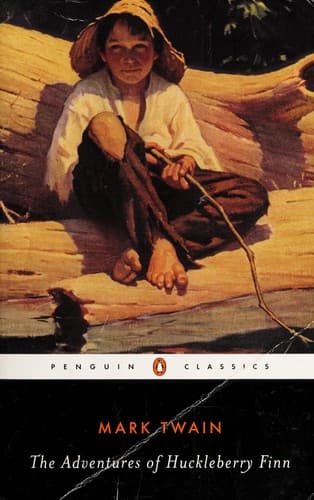
- The Adventures of Huckleberry Finn
Mark Twain
3.8 (1.2M) average on GoodreadsHistorical FictionWhile both Gone with the Wind and Mark Twain's The Adventures of Huckleberry Finn (1884) are set in the American South and grapple with issues of race and slavery, their approaches and critical reception differ significantly. Twain's novel, though also containing problematic racial language (e.g., the repeated use of the N-word), is often lauded for its powerful anti-slavery message, its critique of societal hypocrisy, and its development of a complex moral landscape through Huck's journey with Jim, an escaped enslaved man. Unlike Gone with the Wind's largely uncritical embrace of Southern traditions, Huckleberry Finn actively challenges and satirizes the prevailing social norms and prejudices of its time. Twain's exploration of individual conscience versus societal dictates provides a more nuanced and critical examination of race and freedom, making it, despite its own controversies, a more progressive work in its engagement with the era's central moral dilemmas.
- To Kill a Mockingbird
Harper Lee
4.3 (4.5M) average on GoodreadsHistorical FictionIn the 1930s Jim Crow South, Harper Lee writes about racial injustice, moral growth, and the quiet courage of a lawyer father, Atticus Finch, as seen through his young daughter's eyes.
- The Great Gatsby
F. Scott Fitzgerald
3.9 (3.8M) average on GoodreadsHistorical FictionIn the opulent Roaring Twenties, a mysterious millionaire's lavish parties hide his desperate, tragic pursuit of a lost love, exposing the emptiness within the American Dream.





Enjoyed the summary?
A summary gives you the shape of the book. The book itself has the detail, the examples and the voice.
Find Gone with the Wind on AmazonAs an Amazon Associate, BookBrief earns from qualifying purchases. How we're funded