
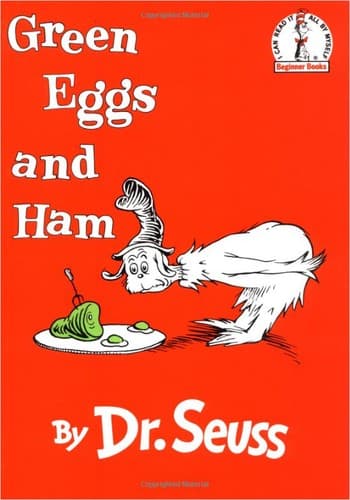
Synopsis
Covers the whole plot, including the ending.
- Difficulty
- Easy
- Pacing
- Fast
- Mood
- Whimsical, Persistent, Humorous, Lighthearted
- Read it if
- You enjoy whimsical rhymes, simple yet effective storytelling, and a clear message about trying new things.
- Skip it if
- You prefer complex narratives, deep character development, or stories without repetitive elements.
Green Eggs and Ham Plot Summary
Covers the whole plot, including the ending.
Sam-I-am's Persistent Offer
The story starts with Sam-I-am approaching an unnamed, grumpy character who is reading a newspaper. Sam-I-am immediately offers a plate of green eggs and ham and asks, 'Do you like green eggs and ham?' The grumpy character, without looking at the food, quickly says, 'I do not like them, Sam-I-am. I do not like green eggs and ham.' This first refusal sets up Sam-I-am's ongoing efforts to get the character to try the unusual meal.
First Refusals: House and Mouse
Not discouraged, Sam-I-am starts suggesting different places and companions for eating the green eggs and ham. He first asks, 'Would you like them here or there?' then adds, 'Would you like them in a house? Would you like them with a mouse?' The grumpy character, still refusing to consider the food, repeats his dislike for green eggs and ham. He says he does not like them in a house or with a mouse. His refusal stays firm, even as Sam-I-am lists more scenarios.
Escalating Scenarios: Box, Fox, Boat, and Goat
Sam-I-am's efforts grow as he suggests more creative and unlikely places to eat the green eggs and ham. He asks if the grumpy character would eat them 'in a box' or 'with a fox,' then suggests 'in a boat' or 'with a goat.' Each time, the grumpy character rejects the idea, repeating his dislike for the green eggs and ham and for all the suggested places and companions. The character's annoyance with Sam-I-am's questions begins to build, but he still has not tasted the food.
Traveling Further: Rain and Dark
Sam-I-am's attempt to convince the grumpy character continues, now moving to different weather conditions. Sam-I-am asks if he would eat them 'in the rain' or 'in the dark.' The grumpy character, becoming more annoyed, sticks to his position. He says he would not eat them in the rain, in the dark, in a box, with a fox, in a house, or with a mouse. His list of rejections gets longer, showing his complete refusal to try the dish under any circumstances Sam-I-am suggests.
On a Train and In a Tree
Sam-I-am's resolve strengthens as he follows the grumpy character onto a train and even up into a tree, still carrying the plate of green eggs and ham. He asks, 'Would you eat them on a train? In a tree?' The grumpy character, now clearly bothered by Sam-I-am's pursuit, firmly rejects these new ideas. He repeats his dislike for the food and all the places and companions suggested, making it clear he wants Sam-I-am to leave him alone.
The Final Plea and the Crash
As Sam-I-am keeps asking, the grumpy character reaches his limit. He loudly lists all his rejections, saying he would not eat green eggs and ham anywhere with anyone. In his frustration, and while Sam-I-am is still offering the food, the train they are on crashes into a car, which then falls into the water. This event puts the two characters in a new, unexpected place, surrounded by water and wreckage.
A Moment of Weakness and the Taste Test
After the crash, finding themselves in water, Sam-I-am makes one last request: 'You do not like them. So you say. Try them! Try them! And you may. Try them and you may, I say.' Overwhelmed by the situation and Sam-I-am's persistence, the grumpy character finally gives in, saying, 'Sam! If you will let me be, I will try them. You will see.' He takes a bite of the green eggs and ham, ending his long refusal.
A Surprising Revelation
To his surprise, the grumpy character finds he likes the green eggs and ham. His mood changes at once. He happily exclaims, 'Say! I like green eggs and ham! I do! I like them, Sam-I-am!' This sudden change reverses his earlier strong refusal, showing what can happen when you try new things.
Embracing the Dish
After tasting them, the formerly grumpy character enthusiastically lists all the places and companions he would now eat green eggs and ham with. He says he would eat them in a boat, with a goat, in a house, with a mouse, in a box, with a fox, in the dark, in the rain, on a train, and in a tree. His change is complete; he now enjoys the dish he once strongly rejected, and he thanks Sam-I-am for his persistence.
Green Eggs and Ham Characters
Sam-I-am
Protagonist
The persistent character determined to make another try green eggs and ham.
Sam-I-am is a small, energetic, and incredibly persistent character who serves as the story's driving force. He carries a plate of green eggs and ham and relentlessly offers them to an unnamed, grumpy character. His motivation seems to be the simple desire for the other character to try something new, believing they will enjoy it. Despite constant rejection, Sam-I-am remains cheerful and unwavering in his mission, employing a variety of scenarios to make his case. He represents curiosity, determination, and the spirit of trying new experiences.
Relationships: Unnamed Character (persistent pursuer and reluctant object of persuasion)
Unnamed Character
Antagonist/Protagonist (of his own journey)
The grumpy, initially stubborn character who refuses to try green eggs and ham.
This character, often depicted as a large, grumpy figure (sometimes called 'Guy-I-am' or 'Joey'), is initially presented as stubborn, close-minded, and resistant to new experiences. He vehemently rejects green eggs and ham without even tasting them, based purely on their unusual appearance. He grows increasingly annoyed and frustrated by Sam-I-am's persistence, trying to escape him. His journey is one of overcoming prejudice and discovering a surprising new preference, making him the central figure of the story's moral lesson.
Relationships: Sam-I-am (object of Sam-I-am's persuasion, initially resistant, then grateful friend)
Mouse
Mentioned
A proposed companion for eating green eggs and ham.
The mouse is one of the many creatures Sam-I-am suggests as a companion for eating green eggs and ham. It's part of the escalating list of scenarios designed to break down the grumpy character's resistance. While not an active participant, its inclusion highlights the whimsical and imaginative nature of the settings Sam-I-am proposes, adding to the absurdity and charm of the refusal sequence.
Fox
Mentioned
Another animal suggested as a dining partner.
Like the mouse, the fox is a creature Sam-I-am suggests as a companion for eating green eggs and ham. The inclusion of a fox further expands the range of imaginative and increasingly silly scenarios. It contributes to the repetitive and cumulative structure of the story, emphasizing the grumpy character's blanket refusal of the dish, regardless of the context or company.
Goat
Mentioned
A companion in a boat, part of the extensive list of settings.
The goat is featured in Sam-I-am's suggestion of eating green eggs and ham 'in a boat with a goat.' This particular pairing is memorable and contributes to the rhythmic, rhyming nature of the book. The goat, like other animals mentioned, serves to illustrate the lengths Sam-I-am goes to in suggesting various situations, and how the grumpy character rejects them all, sight unseen.
Green Eggs and Ham Themes
Persistence and Determination
Sam-I-am's steady effort to convince the unnamed character to try green eggs and ham drives the story. Despite constant rejections, Sam-I-am never quits, always suggesting new places and companions. This theme shows that consistent effort can lead to a breakthrough, even when someone strongly opposes it, as seen when the grumpy character finally gives in after many tries.
“I do not like them, Sam-I-am. I do not like green eggs and ham. I do not like them here or there. I do not like them anywhere.”
Trying New Things / Overcoming Prejudice
The book's main point is that you should try new things before deciding if you like them. The grumpy character first rejects the green eggs and ham just because they look strange, without tasting them. His journey from firm refusal to happy acceptance after one bite shows how judging something beforehand can stop you from finding enjoyable experiences. The story encourages readers to be open-minded and willing to try new foods or situations.
“Say! I like green eggs and ham! I do! I like them, Sam-I-am!”
The Power of Suggestion and Experience
Sam-I-am's repeated suggestions, though first met with resistance, eventually wear down the grumpy character's decision. The many different situations he suggests, from a house to a boat to a train, highlight that sometimes, you only truly know what you like by experiencing it. The story shows that while words can express dislike, only trying something can confirm or change that feeling, leading to a big shift in the grumpy character's view once he tastes the food.
“You do not like them. So you say. Try them! Try them! And you may. Try them and you may, I say.”
Plot Devices & Literary Techniques
Repetition and Cumulative Structure
The use of repeating phrases and building lists to create rhythm and emphasis.
The story heavily relies on repetition, particularly the phrase 'I do not like green eggs and ham,' and the cumulative listing of places and companions. This device creates a strong rhythm, making the book highly memorable and engaging for young readers. It emphasizes the grumpy character's stubbornness and highlights Sam-I-am's relentless persistence as the list of suggested scenarios grows longer with each page, building anticipation for the eventual taste test and the character's change of heart.
Rhyme Scheme
The consistent use of rhyming words to enhance readability and memorability.
Dr. Seuss's signature AABB rhyme scheme is central to 'Green Eggs and Ham.' The simple, predictable rhymes (e.g., 'Sam-I-am' / 'green eggs and ham,' 'house' / 'mouse,' 'boat' / 'goat') make the text highly rhythmic and enjoyable to read aloud. This device not only aids in memorization for children but also propels the narrative forward, creating a lighthearted tone despite the grumpy character's initial resistance, and reinforcing the story's playful nature.
Visual Gags and Exaggeration
Illustrations that visually extend the absurdity of the situations.
The illustrations in 'Green Eggs and Ham' play a crucial role, often exaggerating the situations described in the text. From Sam-I-am's determined facial expressions to the grumpy character's increasingly frantic attempts to escape, and the final comical crash involving a car and a train, the visuals amplify the humor and absurdity. The sight of green eggs and ham itself is a visual gag, immediately signaling something unusual and challenging the reader's (and character's) expectations.
Unusual Food as a Catalyst
The green eggs and ham serve as the central object of conflict and resolution.
The peculiar 'green eggs and ham' are not just a meal; they are the central catalyst for the entire plot. Their unusual color immediately sparks the grumpy character's prejudice and sets Sam-I-am's mission in motion. The food serves as a concrete, tangible symbol of 'newness' or 'difference' that must be confronted. The resolution of the story hinges entirely on the character's interaction with and eventual acceptance of this strange dish, making it a powerful symbol for trying new experiences.
Green Eggs and Ham Quotes
“I do not like green eggs and ham. I do not like them, Sam-I-am.”
“Would you like them in a house? Would you like them with a mouse?”
“I would not like them here or there. I would not like them anywhere.”
“You do not like them. So you say. Try them! Try them! And you may.”
“I do not like them in a box. I do not like them with a fox.”
“Say! I like green eggs and ham! I do! I like them, Sam-I-am!”
“And I would eat them in a boat. And I would eat them with a goat.”
“I will eat them here and there. Say! I will eat them anywhere!”
“Would you? Could you? In a car? Eat them! Eat them! Here they are!”
“Not in a tree! You let me be!”
“I do not like them, Sam-I-am. I do not like green eggs and ham.”
“Thank you! Thank you, Sam-I-am!”
“You may like them. You will see. You may like them in a tree!”
Quiz
10 questions on the plot and the characters. Each answer comes with a short explanation.
Question 1
What is the name of the persistent character who keeps asking about green eggs and ham?
- Sam-I-am
- The Grinch
- The Cat in the Hat
- Horton
Show answer
A. Sam-I-am Sam-I-am is the main character who repeatedly asks the other character if he would like green eggs and ham in various locations and with various companions.
Question 2
What type of animal is mentioned as a potential companion to eat green eggs and ham with?
- A mouse
- A dog
- A cat
- A bird
Show answer
A. A mouse Sam-I-am asks if the other character would eat green eggs and ham "with a mouse" as one of the many scenarios he proposes.
Question 3
In what type of vehicle does Sam-I-am suggest eating green eggs and ham?
- A train
- A car
- A plane
- A bus
Show answer
A. A train Sam-I-am asks if the other character would eat green eggs and ham "on a train" as part of the cumulative list of places.
Question 4
What is the main theme of 'Green Eggs and Ham'?
- The importance of trying new things before rejecting them
- The dangers of eating strange foods
- The value of cooking at home
- The fun of traveling to different places
Show answer
A. The importance of trying new things before rejecting them The story centers on Sam-I-am persistently encouraging the other character to try green eggs and ham, and once he does, he discovers he likes them, highlighting the theme of openness to new experiences.
Question 5
Where does Sam-I-am NOT suggest eating green eggs and ham?
- In a cave
- In a house
- In a tree
- In a boat
Show answer
A. In a cave Sam-I-am suggests eating green eggs and ham in a house, with a mouse, in a boat, with a goat, on a train, in a tree, in a car, and in the dark, but a cave is not mentioned in the book.
Question 6
What does the other character finally do at the end of the story?
- He tries the green eggs and ham and likes them
- He runs away from Sam-I-am
- He cooks his own meal
- He gives the food to an animal
Show answer
A. He tries the green eggs and ham and likes them After persistent asking, the other character finally tries green eggs and ham and admits, "I do so like green eggs and ham! Thank you! Thank you, Sam-I-am!"
Question 7
Which literary device is prominently used in 'Green Eggs and Ham' to create rhythm and engagement?
- Rhyme and repetition
- Metaphor
- Foreshadowing
- Irony
Show answer
A. Rhyme and repetition Dr. Seuss uses rhyme and repetitive phrases (e.g., "I do not like them, Sam-I-am") throughout the book, which is characteristic of his writing style and helps make it engaging for young readers.
Question 8
What is the cumulative nature of the tale in 'Green Eggs and Ham'?
- The list of places and companions to eat with gets longer as the story progresses
- The number of characters increases with each page
- The food changes color gradually
- The story becomes more complex with added plot twists
Show answer
A. The list of places and companions to eat with gets longer as the story progresses As described in the book summary, it is a cumulative tale where Sam-I-am keeps adding more scenarios (e.g., in a house, with a mouse, in a boat, with a goat) to persuade the other character to try green eggs and ham.
Question 9
Why is 'Green Eggs and Ham' considered a Beginner Book?
- It uses simple words and illustrations to help children read independently
- It is the first book Dr. Seuss ever wrote
- It only has pictures without any text
- It is designed for advanced readers to practice speed reading
Show answer
A. It uses simple words and illustrations to help children read independently As noted in the book summary, Beginner Books by Dr. Seuss, including 'Green Eggs and Ham,' encourage children to read by themselves with simple vocabulary and illustrations that provide context clues.
Question 10
What practical lesson might a child learn from 'Green Eggs and Ham' beyond the main theme?
- Persistence can lead to positive outcomes
- It's important to always eat healthy foods
- Animals make the best eating companions
- Traveling is necessary to enjoy food
Show answer
A. Persistence can lead to positive outcomes While the primary theme is about trying new things, Sam-I-am's persistent asking without giving up demonstrates that perseverance can eventually convince someone to change their mind, leading to a happy resolution.
Green Eggs and Ham FAQ
What is 'Green Eggs and Ham' about?
The story follows Sam-I-am, a persistent character who repeatedly asks an unnamed, grumpy character to try green eggs and ham in various locations and with different companions. Through a series of rhyming questions, Sam suggests trying them in a house, with a mouse, in a boat, with a goat, on a train, in a tree, and more, until the reluctant character finally gives in and discovers he actually likes them.
Why should I read 'Green Eggs and Ham'?
This classic children's book is an excellent tool for early readers due to its simple, repetitive vocabulary and engaging rhymes. It teaches valuable lessons about trying new things, persistence, and keeping an open mind, all wrapped in Dr. Seuss's whimsical illustrations and humor that appeal to both children and adults.
What is the background/setting of 'Green Eggs and Ham'?
The story unfolds across a series of imaginative and varied settings proposed by Sam-I-am, including a house, a box, a car, a tree, a train, a boat, and in the rain. These fantastical locations are typical of Dr. Seuss's style, creating a vibrant, nonsensical world that sparks a child's imagination without being tied to a specific time or place.
What are the most memorable quotes?
The most iconic lines are Sam-I-am's persistent questions: 'Do you like green eggs and ham?' and variations like 'Would you eat them in a box? Would you eat them with a fox?' The climax includes the reluctant character's admission: 'I do so like green eggs and ham! Thank you! Thank you, Sam-I-am!' which reinforces the book's theme of openness.
What writing style does the author use?
Dr. Seuss employs a cumulative, rhyming structure with simple, repetitive vocabulary, making it ideal for beginner readers. The text builds rhythmically as Sam-I-am lists increasingly absurd scenarios, using anapestic tetrameter and playful language to create a sing-song effect that enhances memorability and engagement.
What minor details add significant meaning?
The gradual expansion of Sam-I-am's proposals—from basic settings like a house to more outlandish ones like in a tree or with a goat—subtly emphasizes persistence and creativity. The unnamed character's initial scowls and final smiling expression visually track his emotional journey from resistance to enjoyment, adding depth without words.
What are some subtle foreshadowing moments?
Early in the story, Sam-I-am's unwavering confidence ('I do not like them, Sam-I-am.') hints that his persistence will pay off. The increasing absurdity of the locations—like on a train or in the dark—foreshadows that the reluctant character will eventually give in, as Sam exhausts all possible objections through his imaginative scenarios.
What unexpected character connections exist?
While the main characters are Sam-I-am and the unnamed grumpy character, the inclusion of animals like a mouse, fox, and goat as potential dining companions adds a whimsical layer. These creatures, though minor, symbolize the diverse and playful ways Sam tries to make the experience appealing, subtly connecting the human and animal worlds in Dr. Seuss's fantasy.
What are unspoken character motivations?
Sam-I-am's motivation goes beyond just sharing food; he seems driven by a desire to break the other character's stubbornness and introduce joy through new experiences. The reluctant character's initial refusal may stem from fear of the unknown or a need for control, which he overcomes when he finally tries the green eggs and ham, revealing a hidden curiosity.
What psychological complexities do characters exhibit?
The unnamed character displays a classic resistance to change, with his repeated 'I do not like them' reflecting a fixed mindset. Sam-I-am, in contrast, shows resilience and empathy by tailoring his approach to different scenarios, demonstrating adaptive persuasion. Their interaction highlights themes of cognitive flexibility versus rigidity in a child-friendly way.
What are the major emotional turning points?
The emotional climax occurs when the reluctant character finally agrees to try green eggs and ham after Sam's exhaustive list of possibilities. His subsequent exclamation—'I do so like green eggs and ham!'—marks a shift from frustration and denial to surprise and gratitude, transforming the dynamic from conflict to shared enjoyment and mutual respect.
How do relationship dynamics evolve?
Initially, the relationship is adversarial, with Sam-I-am as the persistent asker and the other character as the resistant refuser. Through Sam's unwavering patience and creativity, the dynamic softens, culminating in a moment of connection when the reluctant character tries the food. This evolution from annoyance to appreciation underscores the power of positive persistence.
Which parts remain ambiguous or open-ended?
The story leaves ambiguous why the food is green or what it tastes like, allowing readers to imagine their own interpretations. Additionally, the unnamed character's background and why he initially refuses so vehemently are not explained, inviting discussions about personal biases and the nature of trying new things without preconceptions.
What are controversial scenes or decisions?
Some readers debate whether Sam-I-am's persistence borders on coercion, as he repeatedly pressures the other character despite clear refusals. However, this is often interpreted as a playful exaggeration to teach children about persuasion and openness, with the positive outcome justifying Sam's methods in the context of a lighthearted, moral-driven tale.
'Green Eggs and Ham' ending explained: how it ends & what it means
The story ends with the reluctant character trying green eggs and ham and enthusiastically declaring that he likes them, thanking Sam-I-am. This conclusion reinforces the book's central message: that trying new things can lead to pleasant surprises, and persistence paired with an open mind can overcome initial resistance, promoting growth and enjoyment.
About the author

Dr. Seuss, born Theodor Seuss Geisel, was a beloved American children's author and illustrator. He is renowned for his imaginative tales and whimsical rhymes, including iconic works like 'The Cat in the Hat,' 'Green Eggs and Ham,' and 'Oh, the Places You'll Go!'. His unique style and memorable characters have made him a staple in children's literature for generations.
Similar books
- The Cat in the Hat
Dr. Seuss
4.2 (428k) average on GoodreadsFantasyShares Dr. Seuss's signature rhyming style and playful illustrations.
- The Very Hungry Caterpillar
Eric Carle
4.3 (396k) average on GoodreadsChildren'sCarle's book provides a gentle educational experience focused on natural cycles, transformation, and counting. In contrast, Green Eggs and Ham is less about imparting factual knowledge and more about a specific behavioral challenge: the reluctance to try new things and the power of persistence. Carle's narrative is more observational and instructional, while Seuss's is a direct, persuasive conflict.
- Harry Potter and the Sorcerer's Stone
J.K. Rowling
4.5 (7M) average on GoodreadsFantasyRescued from a miserable life under the stairs, an orphaned boy discovers he's a wizard destined for a magical school, where he uncovers a dangerous secret tied to the dark wizard who murdered his parents.
- The Hunger Games
Suzanne Collins
4.3 (6.4M) average on GoodreadsFantasyIn a future where children fight to the death on live television, Katniss Everdeen volunteers for the arena, turning a death sentence into a fight for survival and a spark of rebellion.
- 1984
George Orwell
4.2 (3.1M) average on GoodreadsPoliticsIn a future where surveillance and thought control are absolute, a man's search for truth clashes with the Party, showing that hope can be a form of rebellion.
- Divergent
Veronica Roth
4.2 (2.9M) average on GoodreadsFantasyIn a society divided by virtues, a sixteen-year-old's difference from the norm starts a rebellion that threatens her world.





Enjoyed the summary?
A summary gives you the shape of the book. The book itself has the detail, the examples and the voice.
Find Green Eggs and Ham on AmazonAs an Amazon Associate, BookBrief earns from qualifying purchases. How we're funded