
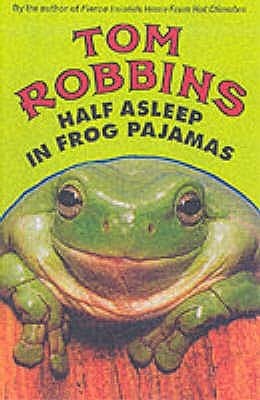
Synopsis
Covers the whole plot, including the ending.
- Difficulty
- Medium
- Pacing
- Moderate
- Mood
- Whimsical, Philosophical, Quirky, Surreal
- Read it if
- You enjoy eccentric characters, philosophical musings, and a plot that veers into the absurd while still exploring deeper themes of materialism vs. spirituality.
- Skip it if
- You prefer linear plots, realistic settings, or straightforward narratives without digressions and a strong authorial voice.
Half Asleep in Frog Pajamas Plot Summary
Covers the whole plot, including the ending.
The Crash and the Quest
Amanda Walker, a young, somewhat disillusioned stockbroker in Seattle, wakes up to news of a catastrophic stock market crash. Her portfolio is ruined, and her professional life is in chaos. Instead of despairing, Amanda finds herself drawn into a strange quest. Her eccentric neighbor, Mrs. Devalois, reveals a cryptic prophecy involving a golden frog effigy. Mrs. Devalois believes this effigy holds the key to stopping further global disaster and perhaps restoring Amanda's fortunes. She gives Amanda a series of bizarre clues and instructions, sending her on a journey that quickly moves away from the rational world of finance.
The First Clue: The Pigeon and the Psychic
Following Mrs. Devalois's first instruction, Amanda tracks a specific pigeon through Seattle. This seemingly absurd pursuit leads her to a rundown storefront where a psychic, Madame Zoya, works. During her session with Madame Zoya, Amanda has unsettling visions and receives more cryptic messages about the frog effigy. Here, she first meets Larry Diamond, a charming but mysterious man who seems to be involved in the same strange quest, or at least knows about it. Their initial interaction is a mix of suspicion and a growing attraction, as they both try to understand the unfolding absurdity.
The Golden Frog and the Conspiracy
Amanda and Larry, now loosely allied, begin to understand the history of the enigmatic golden frog effigy. They learn it is the legendary Golden Frog of Laos, an ancient artifact rumored to have mystical powers and be a center of cosmic energy. Their investigation uncovers a shadowy, secret organization called the 'Order of the Golden Frog.' This society is dedicated to either protecting or using the effigy's power. The stakes rise as they realize they are not just on a whimsical treasure hunt, but are caught in a much larger, more dangerous game involving powerful, unseen forces.
The Zen Master and the Brothel
The convoluted trail of clues leads Amanda and Larry to increasingly bizarre places and characters. One stop is a remote Zen monastery, where they consult with an eccentric Zen master who speaks in riddles and offers bewildering insights into reality and the frog's meaning. Later, their journey takes an unexpected turn to a high-end, philosophical brothel known as 'The Palace of Earthly Delights.' Here, they meet colorful characters who, despite their unconventional profession, possess surprisingly deep knowledge about the effigy and the esoteric forces at play. This further blurs the lines between the ordinary and the mystical.
The Interrogation and the Revelation
Amanda is eventually abducted and questioned by members of the 'Order of the Golden Frog.' During this intense encounter, she faces psychological pressure and philosophical questions about her motives and her role in the events. It is during this questioning that a shocking revelation comes to light: Amanda herself has an unexpected, personal connection to the Golden Frog and the Order, a connection hidden from her until now. This revelation changes her understanding of her quest, her identity, and her reality, adding a deeply personal dimension to the cosmic stakes.
Larry's True Identity and the Betrayal
Larry Diamond, Amanda's charming and mysterious companion, eventually shows his true nature. It is revealed that he is not just a fellow seeker but has deeper ties to the 'Order of the Golden Frog,' and his motivations are more complex than Amanda first thought. This revelation creates a deep sense of betrayal and disappointment for Amanda, shattering her trust and forcing her to re-evaluate everything she thought she knew about him. Their relationship, which had been growing, is now fractured by his hidden agenda and loyalties.
The Search for the Missing Piece
Despite the betrayal, Amanda remains determined to understand and potentially influence the fate of the Golden Frog. She learns that the effigy is incomplete, missing a key component needed for its full power to be unleashed or contained. Her quest shifts to finding this missing piece, which she discovers is not a physical object but something more abstract and symbolic. This part of her journey becomes a more introspective and philosophical exploration, requiring her to look beyond the tangible and into consciousness and belief.
The Circus and the Alchemist
Amanda's journey takes her to a traveling circus, a place of illusion and wonder, where she meets peculiar characters who offer more cryptic clues. Among them is an enigmatic alchemist, a master of transformation and esoteric knowledge, who gives her crucial insights into the Golden Frog and its connection to the human mind and the collective unconscious. The alchemist explains that the frog's power is not just external, but resonates with humanity's inner spiritual state, suggesting that the true 'missing piece' might be a change in perspective or a shift in collective consciousness rather than a physical artifact.
The Confrontation at the Museum
The climax of Amanda's quest happens in a tense confrontation at a museum, where the Golden Frog effigy is to be unveiled or is being secretly held. The 'Order of the Golden Frog' gathers, with each faction vying for control or influence over the artifact. Amanda, now more self-aware and empowered, confronts both Larry and the other members of the Order, explaining her new understanding of the frog's importance. This showdown is not just a physical struggle but a battle of ideas and interpretations regarding the effigy's true purpose and humanity's future.
The Resolution and the New Perspective
Through her actions, her insights, and perhaps some cosmic help, the immediate crisis around the Golden Frog is averted. The stock market stabilizes, though not fully recovered, and the looming global disaster lessens. Amanda doesn't 'win' in a traditional sense, nor does she gain great wealth. Instead, she experiences a deep shift in perspective. She realizes that the Golden Frog's true power is not in its material form, but in the human capacity for belief, imagination, and finding meaning in the absurd. She ends the weekend transformed, embracing a more fluid and whimsical view of reality, forever changed by her bizarre journey.
Half Asleep in Frog Pajamas Characters
Amanda Walker
Protagonist
A disillusioned stockbroker thrust into a mystical quest.
Amanda is a young, intelligent, and initially cynical stockbroker whose life is upended by a market crash. She is pragmatic and rational, but possesses an underlying curiosity and willingness to embrace the absurd when faced with extraordinary circumstances. Her journey forces her to question her materialistic values and her understanding of reality. She often feels out of place and struggles with societal expectations, finding solace in her own unique perspective.
Relationships: Larry Diamond (Romantic interest, then betrayed by his secret allegiance.); Mrs. Devalois (Elderly neighbor, mentor, and catalyst for her quest.); Madame Zoya (Psychic who provides initial guidance and cryptic clues.)
Larry Diamond
Supporting/Antagonist
A charming, enigmatic man with hidden motives related to the Golden Frog.
Larry Diamond is a charismatic and mysterious figure who initially appears to be a fellow traveler on Amanda's quest. He is intelligent, resourceful, and possesses a certain roguish charm that draws Amanda to him. However, he harbors a secret agenda and deeper ties to the 'Order of the Golden Frog,' making his true intentions ambiguous for much of the story. He represents the seductive allure of esoteric knowledge and the ethical compromises one might make in its pursuit.
Relationships: Amanda Walker (Romantic interest, then a source of betrayal and conflict.); Order of the Golden Frog (Member and agent, deeply involved in their machinations.)
Mrs. Devalois
Supporting
Amanda's eccentric, elderly neighbor who initiates the quest.
Mrs. Devalois is a peculiar, elderly woman with an air of ancient wisdom and eccentricity. She lives next door to Amanda and acts as the initial catalyst for Amanda's journey, providing cryptic clues and a sense of urgency about the Golden Frog. She seems to possess a deep, intuitive understanding of the mystical forces at play and serves as a mentor figure, guiding Amanda into a world beyond her conventional understanding. Her motives are pure, driven by a desire to prevent cosmic imbalance.
Relationships: Amanda Walker (Neighbor, mentor, and the person she entrusts with the quest.)
Madame Zoya
Supporting
A psychic who offers bizarre visions and clues.
Madame Zoya is a somewhat disheveled but genuinely clairvoyant psychic whom Amanda consults early in her quest. She provides Amanda with unsettling visions and further cryptic messages related to the Golden Frog, solidifying the idea that Amanda's journey is not merely a figment of her imagination. Madame Zoya serves as a bridge between Amanda's rational world and the unfolding mystical reality, confirming the existence of forces beyond ordinary perception.
Relationships: Amanda Walker (Client and recipient of prophetic visions.)
The Zen Master
Supporting
An eccentric spiritual guide offering philosophical insights.
The Zen Master is a wise, yet highly idiosyncratic, spiritual teacher whom Amanda and Larry encounter during their journey. He speaks in koans and riddles, challenging their conventional ways of thinking and offering profound, albeit abstract, insights into the nature of reality, perception, and the significance of the Golden Frog. He represents the philosophical and spiritual dimension of the quest, pushing Amanda to look inward for answers.
Relationships: Amanda Walker (Seeker of wisdom and guidance.); Larry Diamond (Seeker of wisdom and guidance.)
The Alchemist
Supporting
A master of esoteric knowledge encountered at the circus.
The Alchemist is a mysterious figure encountered by Amanda at the traveling circus. He is a repository of ancient and esoteric knowledge, particularly concerning transformation, symbolism, and the deeper, mystical properties of artifacts like the Golden Frog. He helps Amanda understand that the frog's power is not just external, but deeply intertwined with human consciousness and the collective unconscious. He represents the blending of science, magic, and philosophy.
Relationships: Amanda Walker (Recipient of profound, esoteric knowledge.)
The Order of the Golden Frog
Antagonist/Collective
A shadowy, secret society vying for control of the Golden Frog.
The Order of the Golden Frog is a clandestine organization whose members are obsessed with the Golden Frog of Laos. Their motives are complex, ranging from a desire to protect its power to a wish to exploit it for their own ends, whether personal or global. They represent the human tendency to seek control over the unknown and the potential for corruption inherent in such pursuits. They are the primary obstacle Amanda faces, embodying the established, often rigid, forces that resist true understanding.
Relationships: Amanda Walker (Antagonistic, as they seek to control or manipulate her.); Larry Diamond (Larry is an agent or member of the Order.)
Half Asleep in Frog Pajamas Themes
The Nature of Reality and Perception
The novel blurs the lines between real and imagined, rational and mystical. Amanda's journey makes her, and the reader, question what 'reality' is and how perception shapes it. The stock market crash, a real event, quickly becomes a quest involving prophecies, psychics, and ancient artifacts, suggesting that seemingly separate events are linked. The Zen Master and the Alchemist discuss how belief and consciousness can affect outcomes, challenging the idea of a fixed, objective reality. The Golden Frog itself is less an object with inherent power and more a symbol whose strength comes from collective belief.
“Reality is a collective hunch.”
The Search for Meaning in a Disenchanted World
Amanda starts as a stockbroker, a job that represents a materialistic pursuit of wealth. The market crash removes this superficial meaning, leaving her adrift. Her subsequent quest, though strange, becomes a search for something deeper than financial gain. The Golden Frog, first presented as an artifact, becomes a metaphor for spiritual awakening and a link to ancient wisdom. The characters she meets, from Mrs. Devalois to the Alchemist, all, in their own ways, seek or offer other forms of meaning in a world that often seems to lack it.
“The mystery of life is not a problem to be solved, but a reality to be experienced.”
The Interconnectedness of All Things
A central theme is that everything—from a stock market crash to a pigeon's flight, from ancient prophecies to personal relationships—is connected. The novel suggests that unseen threads link seemingly random events and that human actions have far-reaching, even cosmic, consequences. The Golden Frog symbolizes this interconnectedness, a point where global economics, personal destiny, and mystical forces meet. Amanda's realization that the 'missing piece' is not an object but a shift in consciousness highlights the deep link between inner and outer worlds.
“There are no coincidences, only connections we haven't yet perceived.”
The Power of Story and Myth
Tom Robbins uses storytelling and myth-making as a core theme. The novel itself is a grand, unfolding narrative that draws on ancient legends, esoteric knowledge, and modern anxieties. The Golden Frog is not just an artifact; it is a powerful myth that shapes the actions and beliefs of various characters, including the 'Order of the Golden Frog.' The story suggests that myths, even those seemingly absurd, hold deep truths and can influence reality. Amanda's journey is as much about believing in the story as it is about finding the object, showing how the stories we tell ourselves and others can create our world.
“The greatest truths are often told in whispers, in riddles, in the language of dreams.”
Plot Devices & Literary Techniques
MacGuffin
The Golden Frog of Laos as a central, sought-after object.
The Golden Frog of Laos functions as the primary MacGuffin in the story. It is a mysterious, ancient effigy that drives the plot forward, motivating Amanda's quest and the machinations of the 'Order of the Golden Frog.' While its specific powers and significance are debated and evolve throughout the narrative, its role as the central object of desire and pursuit is constant. The true importance of the frog lies less in its inherent nature and more in the journey it instigates and the revelations it brings about for Amanda, making it a classic example of a MacGuffin.
Prophecy and Omens
Cryptic predictions and unusual signs guide the protagonist.
The narrative is heavily influenced by prophecies and omens, starting with Mrs. Devalois's initial warnings and extending through Madame Zoya's psychic visions and the various cryptic clues Amanda receives. These devices serve to establish a sense of destiny and urgency, suggesting that Amanda is part of a larger, preordained cosmic plan. They also inject a sense of the mystical and the supernatural into the otherwise mundane setting, challenging Amanda's rational worldview and propelling her into increasingly bizarre situations that align with the unfolding predictions.
The Unreliable Narrator (Subtle)
The narrator's whimsical and philosophical voice colors the perception of events.
While not strictly an unreliable narrator in the sense of intentionally misleading the reader, the narrative voice itself is highly subjective, whimsical, and often philosophical, blurring the lines between objective reality and Amanda's (and the narrator's) interpretation of events. The narrator frequently interjects with musings, historical anecdotes, and philosophical digressions that color the reader's perception of the plot. This stylistic choice creates an atmosphere where the bizarre is normalized and the mundane is imbued with profound significance, echoing the novel's themes about the nature of reality and perception.
Symbolism
Objects and characters represent deeper philosophical concepts.
Symbolism is pervasive throughout the novel. The Golden Frog itself is a multi-layered symbol: it represents ancient wisdom, the interconnectedness of life, the balance of the cosmos, and the power of belief. The stock market crash symbolizes the fragility of modern, materialistic society. Amanda's frog pajamas, worn for much of the weekend, symbolize her immersion into the absurd and her eventual embrace of a more fluid, less rigid identity. Even characters, like the Zen Master or the Alchemist, embody specific philosophical or mystical perspectives, making the story a rich tapestry of symbolic meaning.
Half Asleep in Frog Pajamas Quotes
“There are two kinds of people in the world: those who like to be entertained, and those who like to be entertained well.”
“Insanity is a legal, social, and philosophical concept, not a medical one.”
“The only way to get rid of a temptation is to yield to it.”
“It's never too late to have a happy childhood.”
“We are all prisoners of our own ideas. The only way out is to get a new idea.”
“The past is a ghost, the future a dream, and all we ever have is now.”
“Only those who risk going too far can possibly find out how far one can go.”
“There’s a reason why the frog is the symbol of transformation.”
“Life is not a journey to the grave with the intention of arriving safely in a pretty and well preserved body, but rather to skid in broadside, thoroughly used up, totally worn out, and loudly proclaiming 'Wow! What a ride!'”
“The universe is a joke. And all of us are in on it.”
“To be truly alive, one must be willing to make a fool of oneself.”
“Reality is a crutch for people who can't cope with drugs.”
“Maybe it's not the world that's in a mess, but our perception of it.”
“The problem with the world is that everyone is a few drinks behind.”
Quiz
10 questions on the plot and the characters. Each answer comes with a short explanation.
Question 1
Amanda, the protagonist, is facing a significant financial crisis at the beginning of the novel. What is the primary cause of this crisis?
- She was fired from her job due to poor performance.
- Her investment in a new tech startup failed spectacularly.
- She lost a substantial amount of money in a stock market crash.
- Her identity was stolen, and her accounts were emptied.
Show answer
C. She lost a substantial amount of money in a stock market crash. Amanda's financial woes stem directly from a stock market crash where she lost a significant portion of her clients' and her own money.
Question 2
What unusual item is Amanda wearing when the novel begins, which also gives the book its title?
- A silk kimono with dragon motifs.
- A vintage negligee made of lace.
- A pair of frog-themed pajamas.
- An oversized t-shirt depicting a sleeping cat.
Show answer
C. A pair of frog-themed pajamas. The title 'Half Asleep in Frog Pajamas' refers to the distinctive sleepwear Amanda is wearing at the outset of the story.
Question 3
What is the primary motivation for Amanda to embark on her bizarre weekend journey, despite her financial distress?
- To escape the city and clear her head after the crash.
- To attend a mandatory corporate retreat.
- To track down her missing client, P.G. Maloney, and recover her lost money.
- To visit her estranged family in another state.
Show answer
C. To track down her missing client, P.G. Maloney, and recover her lost money. Amanda's main goal for the weekend is to find P.G. Maloney, who owes her a substantial amount of money, hoping to recoup her losses from the market crash.
Question 4
Which of these characters is NOT one of the eccentric individuals Amanda encounters during her surreal weekend?
- P.G. Maloney, the mysterious client.
- Larry Diamond, the spiritual guru.
- Dr. Phlox, the eccentric scientist.
- Gwen, the philosophical waitress.
Show answer
C. Dr. Phlox, the eccentric scientist. P.G. Maloney, Larry Diamond, and Gwen are all significant characters Amanda interacts with. Dr. Phlox is not a character from 'Half Asleep in Frog Pajamas'.
Question 5
What specific type of animal, besides frogs, plays a recurring symbolic role throughout the novel, often associated with P.G. Maloney?
- Owls, symbolizing wisdom and mystery.
- Spiders, representing intricate webs and fate.
- Parrots, symbolizing communication and mimicry.
- Wolves, representing wildness and instinct.
Show answer
C. Parrots, symbolizing communication and mimicry. Parrots are a recurring motif, particularly in relation to P.G. Maloney and his unusual dwelling, adding to the novel's quirky atmosphere.
Question 6
The novel explores themes of fate versus free will. How does the concept of 'luck' and 'coincidence' manifest in Amanda's journey?
- Amanda meticulously plans every step, leaving nothing to chance.
- She believes all her misfortunes are predestined and unchangeable.
- Her encounters and discoveries are often the result of improbable coincidences and chance meetings.
- A mystical force directly guides her path, revealing itself clearly.
Show answer
C. Her encounters and discoveries are often the result of improbable coincidences and chance meetings. Much of Amanda's journey is driven by a series of seemingly random, yet interconnected, coincidences and chance encounters, blurring the lines between luck and destiny, a hallmark of Tom Robbins's style.
Question 7
What is the philosophical significance of the 'frog' imagery beyond Amanda's pajamas, as suggested by some characters or narrative elements?
- It represents the ability to adapt to any environment, like a frog in water or on land.
- It symbolizes transformation and the liminal space between different states of being or consciousness.
- Frogs are associated with ancient curses and bad luck, foreshadowing Amanda's continued misfortunes.
- It is a metaphor for the slippery, unpredictable nature of the stock market.
Show answer
B. It symbolizes transformation and the liminal space between different states of being or consciousness. The frog imagery often alludes to themes of metamorphosis, the shift between different realities (waking/sleeping, rational/irrational), and the transition from one state of being to another, which aligns with Amanda's journey of self-discovery.
Question 8
Larry Diamond, one of the central figures Amanda encounters, is known for his unconventional spiritual practices and beliefs. What is a core aspect of his philosophy that he tries to impart?
- The importance of strict adherence to traditional religious doctrines.
- The belief that all suffering is an illusion that can be willed away through sheer willpower.
- The idea that joy and enlightenment can be found through embracing paradox, sensuality, and the absurd.
- A focus on asceticism and the rejection of all material possessions.
Show answer
C. The idea that joy and enlightenment can be found through embracing paradox, sensuality, and the absurd. Larry Diamond embodies the Tom Robbins ethos of finding meaning and joy in the unconventional, the paradoxical, and the sensual aspects of life, rather than through rigid dogma or material denial.
Question 9
How does Amanda's perception of reality and her own life change by the end of the novel, compared to her initial pragmatic, financially-driven mindset?
- She becomes even more focused on regaining her financial losses, hardened by her experiences.
- She completely rejects her past life and decides to live as a hermit, shunning society.
- She develops a more open-minded, whimsical view of life, embracing its mysteries and absurdities.
- She converts to a strict, organized religion, seeking definitive answers to life's questions.
Show answer
C. She develops a more open-minded, whimsical view of life, embracing its mysteries and absurdities. Through her encounters and strange experiences, Amanda's rigid, pragmatic worldview loosens, allowing her to appreciate the less tangible, more whimsical, and mysterious aspects of existence, moving beyond her initial material concerns.
Question 10
What is the ultimate resolution regarding P.G. Maloney and the money Amanda is seeking from him?
- Maloney directly repays Amanda all the money he owes, plus interest.
- Amanda discovers Maloney was a fraud and the money is irretrievably lost.
- The pursuit of Maloney and the money becomes secondary to Amanda's personal transformation and understanding.
- Maloney dies suddenly, and his estate settles the debt with Amanda.
Show answer
C. The pursuit of Maloney and the money becomes secondary to Amanda's personal transformation and understanding. While the search for Maloney and the money is the initial catalyst, the novel ultimately shifts focus to Amanda's internal journey. The financial resolution becomes less important than the insights and self-discovery she gains, reflecting a typical Tom Robbins narrative arc where the journey supersedes the initial goal.
Half Asleep in Frog Pajamas FAQ
What is the central premise of 'Half Asleep in Frog Pajamas'?
The novel follows Gwendolyn Mati, a young Seattle commodities broker, over a chaotic Easter weekend immediately following a significant stock market crash. Her professional world is in turmoil, and this personal crisis triggers a series of bizarre encounters and philosophical musings as she grapples with the meaning of her life and the nature of reality itself, all while wearing frog pajamas.
Who is Gwendolyn Mati, and what is her initial state at the beginning of the book?
Gwendolyn Mati is the protagonist, a commodities broker who finds her life upended by a stock market crash. She is initially in a state of professional panic and existential angst, questioning her career choices and the materialistic values she has pursued, which is exacerbated by her quirky frog pajamas that symbolize her desire for comfort and escape.
What role does the stock market crash play in the narrative?
The stock market crash serves as the primary catalyst for Gwendolyn's journey, shattering her financial security and forcing her to confront deeper questions about her life's purpose and the illusion of control. It propels her into a series of surreal events and encounters that challenge her perception of reality and materialism.
Who are some of the key eccentric characters Gwendolyn encounters?
Gwendolyn encounters a cast of memorable eccentrics, including Larry Diamond, a mysterious and possibly immortal man who claims to have lived for centuries; Madame Devalier, a glamorous, enigmatic figure with a peculiar connection to ancient Egypt; and Dr. Phlox, a quirky veterinarian who offers unusual advice. These characters each contribute to her philosophical and spiritual awakening.
What is the significance of the 'frog pajamas' mentioned in the title?
The frog pajamas are a recurring motif, symbolizing Gwendolyn's retreat from the adult world of finance and her longing for innocence, comfort, and perhaps transformation. They represent her vulnerability and her subconscious desire to shed her conventional identity, much like a frog undergoes metamorphosis or hibernates.
Is there a hidden connection between Larry Diamond and Madame Devalier?
The novel subtly suggests a profound, ancient connection between Larry Diamond and Madame Devalier, implying they may be timeless beings or represent enduring archetypes. Their interactions hint at shared histories spanning millennia, particularly through their allusions to Egyptian mysticism and immortality, which adds to the book's magical realism.
What is the implied meaning behind the recurring references to ancient Egypt?
Ancient Egypt serves as a powerful symbolic backdrop, representing themes of immortality, the afterlife, esoteric knowledge, and the cyclical nature of existence. These references, often tied to Madame Devalier and her artifacts, suggest that there are deeper, hidden truths beneath the surface of modern life and that time is not linear.
Are the bizarre events Gwendolyn experiences meant to be taken literally or metaphorically?
Tom Robbins's style often blurs the line between literal and metaphorical. While the events are presented as happening, many can be interpreted as symbolic manifestations of Gwendolyn's internal struggles and her journey of self-discovery. The surreal nature encourages readers to consider the psychological and philosophical weight over strict literalism.
What is the significance of the 'golden toad' mentioned in the narrative?
The golden toad, an actual species that went extinct, represents fragility, beauty, and the impermanence of existence, contrasting with the themes of immortality. It serves as a poignant symbol of loss and the preciousness of life, mirroring Gwendolyn's own sense of loss and her search for meaning in a world facing various forms of extinction.
How does Gwendolyn's relationship with materialism evolve throughout the story?
Initially, Gwendolyn is deeply entrenched in materialism, defining her worth by her financial success. The stock market crash forces a profound reevaluation, leading her to question the emptiness of consumerism and to seek deeper, more spiritual values. Her journey is a deliberate shedding of her materialistic identity.
What psychological themes does the book explore regarding identity?
The novel delves into the fluidity and construction of identity, particularly how external circumstances like a financial crash can shatter one's self-perception. Gwendolyn's journey explores the process of shedding a false self and discovering a more authentic, perhaps 'magical,' identity beyond societal expectations.
How does the author use humor to explore serious philosophical questions?
Tom Robbins masterfully employs a distinctive, irreverent humor, including wordplay, absurd situations, and witty observations, to make profound philosophical questions accessible and engaging. This comedic approach prevents the existential inquiries from becoming too heavy, allowing readers to ponder deep themes with a smile.
What is the psychological impact of the 'Easter weekend' setting on Gwendolyn?
The Easter weekend setting, with its themes of resurrection, rebirth, and sacrifice, deeply influences Gwendolyn's psychological journey. It mirrors her own internal death and rebirth process, as she sheds her old life and embraces a new perspective, transforming from a cynical broker into a more open and spiritually aware individual.
Is the ending of 'Half Asleep in Frog Pajamas' optimistic or ambiguous?
The ending is largely optimistic, suggesting Gwendolyn finds a renewed sense of purpose and a deeper connection to the mysterious forces of the universe. While some elements remain ambiguous, typical of Robbins, her transformation is presented as a positive embrace of life's inherent weirdness and wonder, leaving her more awake to possibility.
What is the book's stance on the nature of reality and illusion?
The book strongly suggests that much of what we perceive as reality is a constructed illusion, particularly the materialistic world and its values. Through Gwendolyn's surreal experiences, it argues for a more expansive view of reality, one that incorporates magic, synchronicity, and the interconnectedness of all things, challenging the mundane.
How does 'Half Asleep in Frog Pajamas' compare to Tom Robbins's other works?
It shares many hallmarks of Robbins's style: eccentric characters, philosophical musings, a playful use of language, and a rejection of conventional norms. While perhaps less overtly political than some, it maintains his signature blend of humor, mysticism, and social commentary, focusing more introspectively on personal transformation than grand adventures.
What philosophical schools of thought influence the novel?
The novel draws from various philosophical traditions, including existentialism (questioning meaning), Eastern mysticism (interconnectedness, enlightenment), and perhaps even a dash of absurdism (embracing the irrationality of life). It encourages readers to look beyond conventional logic for deeper truths and personal freedom.
Does the book offer any definitive answers to its complex questions?
Rather than offering definitive answers, the book encourages readers to embrace the questions themselves and to find personal meaning in ambiguity and wonder. It suggests that truth is often subjective and experiential, prompting Gwendolyn and the reader to find their own paths rather than relying on prescribed solutions.
What is the symbolic meaning of the 'frog' beyond Gwendolyn's pajamas?
Beyond the pajamas, the frog symbolizes transformation, fertility, and the liminal space between water and land, conscious and unconscious. It represents the potential for profound change and adaptation, mirroring Gwendolyn's own metamorphosis from a materialistic broker to a more spiritually awakened individual, bridging different states of being.
About the author

Tom Robbins is an American author known for his distinctive style and imaginative storytelling. His notable works include "Still Life with Woodpecker," "Jitterbug Perfume," "Even Cowgirls Get the Blues," "Skinny Legs and All," "Another Roadside Attraction," and "Half Asleep in Frog Pajamas," which often blend humor and philosophical themes in a fictional context.
Similar books
- Even Cowgirls Get the Blues
Tom Robbins
3.8 (49k) average on GoodreadsLiterary FictionShares the same author's distinctive voice, irreverent humor, and philosophical bent.
- Jitterbug Perfume
Tom Robbins
4.2 (69k) average on GoodreadsFantasyAnother Tom Robbins novel featuring a sprawling, fantastical plot, quirky characters, and deep dives into esoteric topics.
- A Confederacy of Dunces
John Kennedy Toole
3.9 (231k) average on GoodreadsLiterary FictionFeatures a cast of highly eccentric characters and a unique, often absurd, comedic tone.
- Fear and Loathing in Las Vegas
Hunter S. Thompson
4.1 (299k) average on GoodreadsLifestyleBoth novels depict a frenetic, drug-fueled journey that serves as a critique of American society. However, Thompson's work is rooted in gonzo journalism, blurring the lines between fiction and reportage, with a raw, visceral energy and a sense of impending doom. Robbins, while also portraying chaos, uses a more whimsical, spiritual, and less overtly nihilistic tone. Frog Pajamas seeks a spiritual awakening amidst the chaos, while Fear and Loathing often revels in the chaos itself as a form of truth-telling.
- The Old Man and the Sea
Ernest Hemingway
3.8 (831k) average on GoodreadsLiterary FictionA Cuban fisherman's long struggle with a giant marlin becomes a story of endurance and dignity, now retold for young adults with illustrations, phonetic guides, and writing prompts in Traditional Chinese.
- One Hundred Years of Solitude
Gabriel García Márquez
4.1 (753k) average on GoodreadsLiterary FictionThrough the multi-generational story of the Buendía family, a mythical town deals with the repeating patterns of time, love, and solitude, as the extraordinary mixes with the ordinary.



Enjoyed the summary?
A summary gives you the shape of the book. The book itself has the detail, the examples and the voice.
Find Half Asleep in Frog Pajamas on AmazonAs an Amazon Associate, BookBrief earns from qualifying purchases. How we're funded