
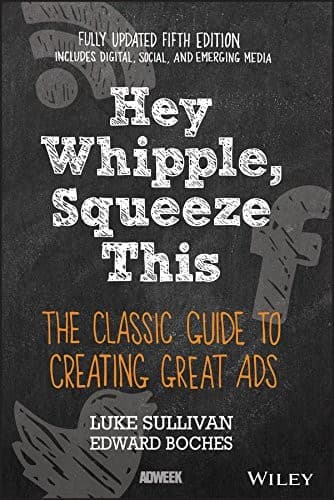
Core Idea
- Difficulty
- Medium
- Read it if
- you're an aspiring or current advertising creative, copywriter, art director, or account manager looking for practical advice and inspiration on how to consistently generate impactful and effective advertising campaigns. It's also great if you appreciate a witty, direct, and often irreverent writing style.
- Skip it if
- you are looking for a purely academic or theoretical treatise on marketing, or if you prefer a more formal and less conversational tone. This book is heavily focused on the creative process within advertising, not broader marketing strategy.
Key Takeaways from Hey Whipple, Squeeze This
The Big Idea Reigns Supreme
Great advertising isn't just clever, it's built on a single, compelling, and unique core concept.
Sullivan emphasizes that effective advertising hinges on a 'Big Idea' – a simple, powerful, and original concept that resonates with the audience and differentiates the product. This isn't just a catchy headline or a clever visual; it's the underlying strategic insight that drives the entire campaign. Without a strong Big Idea, an ad can be aesthetically pleasing but ultimately ineffective in communicating its message and persuading consumers. The Big Idea should be so clear that it can be articulated in a single sentence and understood instantly, making the ad memorable and impactful. It acts as the North Star for all creative execution, ensuring consistency and focus across different mediums and touchpoints.
“A good ad is like a good joke. If you have to explain it, it's not a good ad.”
In the book: Sullivan frequently references classic campaigns like Volkswagen's 'Think Small,' which perfectly encapsulated a unique selling proposition and Big Idea during an era of large American cars.
Try this: Before starting any creative work, define the single, most important message you want to convey. Can you explain your core concept in one clear, concise sentence?
Related ideas: big-idea, unique-selling-proposition, strategic-insight
Embrace the Power of Specificity
Vague claims are forgettable; concrete details make your message real and persuasive.
Sullivan champions the use of specific details and tangible evidence over generic platitudes. Instead of claiming a product is 'better,' illustrate how it's better with concrete examples, features, or benefits. Specificity makes an ad more believable, memorable, and impactful. It allows the audience to visualize and understand the product's value proposition more clearly, moving beyond abstract claims to demonstrable advantages. This approach builds trust and provides the consumer with compelling reasons to choose one product over another, transforming a mere assertion into a persuasive argument rooted in reality. Generic statements, conversely, fade into the background noise, failing to make a lasting impression.
“Facts tell, stories sell. But facts *in* stories sell even better.”
In the book: He cites examples where campaigns used specific product features or user testimonials to demonstrate value, like a car's exact MPG or a detergent's specific stain-fighting ingredients.
Try this: When writing copy, replace adjectives like 'great' or 'innovative' with specific features, benefits, or quantifiable results. Show, don't just tell.
Related ideas: concrete-details, persuasive-copywriting, evidence-based-advertising
The Importance of 'The Why'
Understand the fundamental human need or desire your product fulfills, not just its features.
Sullivan implicitly, and often explicitly, stresses the need to go beyond product features and delve into the deeper 'why' consumers would care. This involves understanding the core human desires, problems, or aspirations that a product addresses. Great advertising taps into these fundamental motivations, connecting the product to a larger emotional or psychological need. For example, a car isn't just transportation; it could be freedom, status, or safety for one's family. By focusing on the 'why,' advertisers can create more resonant and emotionally compelling messages that speak directly to the consumer's heart and mind, fostering a deeper connection than a mere list of specifications ever could.
“People don't buy what you do; they buy why you do it.”
In the book: Sullivan discusses how many successful campaigns don't just sell a product but sell a feeling, an aspiration, or a solution to a common human dilemma.
Try this: For your next campaign, ask yourself: What deep-seated human need or desire does this product truly satisfy? How can I articulate that 'why'?
Related ideas: consumer-psychology, emotional-branding, motivation
Kill Your Darlings
Be ruthless in editing and willing to discard good ideas for truly great ones.
Creativity isn't just about generating ideas; it's also about the discipline of selection and refinement. Sullivan advocates for a brutal editing process, urging creatives to 'kill their darlings' – that is, to be willing to discard even beloved ideas that don't serve the Big Idea or aren't truly exceptional. This requires a certain detachment and objectivity, prioritizing the effectiveness of the final ad over personal attachment to a particular concept. The goal is to distill the message to its purest, most potent form, eliminating anything that clutters, confuses, or dilutes the core message. This rigorous self-critique is essential for elevating good work to truly great work.
“If you want to write, you must be willing to be edited. If you want to be great, you must be willing to kill your darlings.”
In the book: He recounts stories of campaigns where numerous strong concepts were discarded in favor of a single, more powerful one that emerged after relentless iteration.
Try this: After generating multiple ideas, critically evaluate each one against the Big Idea and campaign objectives. Be prepared to let go of concepts that, while good, aren't the absolute best.
Related ideas: creative-editing, iteration, objectivity
The Power of Simplicity and Clarity
Complex ideas confuse; clear, simple messages cut through the noise and are remembered.
Sullivan repeatedly stresses that advertising must be simple and clear to be effective. In a world saturated with information, complex or convoluted messages are easily ignored or misunderstood. The goal is to communicate the Big Idea with maximum impact and minimum effort on the part of the audience. This means stripping away jargon, unnecessary words, and extraneous visuals, leaving only the essential elements that convey the message directly and memorably. Achieving simplicity often requires more effort than complexity, as it demands a deep understanding of the core message and the discipline to refine it until it is perfectly distilled. Simplicity enhances memorability and ensures the message is accessible to a broad audience.
“The greatest ideas are often the simplest. And the simplest ideas are usually the hardest to come up with.”
In the book: He highlights successful ads that use minimal copy and clear visuals to convey powerful messages, such as iconic print ads with just an image and a short headline.
Try this: Review your ad copy and visuals. Can you remove any words, images, or elements without losing the core message? Aim for instant understanding.
Related ideas: clarity-in-advertising, minimalism, cognitive-load
Respect the Consumer's Intelligence
Don't talk down to your audience; engage them with wit, insight, and genuine connection.
Sullivan, echoing Ogilvy, advocates for treating consumers with respect. This means avoiding condescending tones, overly simplistic messages that insult intelligence, or manipulative tactics. Instead, great advertising engages the audience with wit, intelligence, and a genuine understanding of their needs and desires. It assumes the consumer is capable of understanding nuanced messages and appreciates cleverness and authenticity. This approach builds trust and rapport, making the brand more likable and the message more persuasive. When consumers feel respected, they are more likely to pay attention, remember the message, and ultimately choose the product. Disrespectful advertising, conversely, alienates the audience.
“The consumer is not a moron; she is your wife.”
In the book: He contrasts patronizing, feature-heavy ads with campaigns that use humor, empathy, or sophisticated storytelling to connect with consumers.
Try this: Before launching a campaign, ask if the tone and content of your ad would genuinely resonate with someone you respect and admire. Does it feel authentic and intelligent?
Related ideas: consumer-empathy, authentic-marketing, brand-trust
The Power of the Unexpected
Break through the clutter by surprising your audience with fresh perspectives and creative twists.
In a crowded marketplace, predictable advertising is invisible advertising. Sullivan encourages creatives to seek out the unexpected – a fresh angle, a surprising twist, or an unconventional approach that grabs attention and makes the ad memorable. This doesn't mean being weird for weirdness' sake, but rather finding an original way to express the Big Idea that stands out from competitors. The unexpected can come from humor, a visual metaphor, an unusual scenario, or a clever play on words. By disrupting the audience's expectations, an ad can cut through the noise, create intrigue, and embed itself more deeply in the consumer's memory, leading to greater impact and recall.
“Creativity is just connecting things. When you ask creative people how they did something, they feel a little guilty because they didn't really do it, they just saw something. It seemed obvious to them after a while.”
In the book: Sullivan often references campaigns that achieved fame by doing something entirely different from what was expected in their category, like the early Apple campaigns.
Try this: Challenge yourself to find an unconventional way to present your product's benefit. How can you make your ad surprising, delightful, or thought-provoking without sacrificing clarity?
Related ideas: disruptive-advertising, creative-innovation, attention-grabbing
The Importance of Craft
Great ideas need flawless execution; attention to detail elevates good work to iconic status.
Sullivan stresses that even the most brilliant Big Idea can fall flat without meticulous execution. Craft refers to the attention to detail in every aspect of the ad – the copywriting, typography, art direction, photography, and production. Flawless craft enhances credibility, professionalism, and the overall impact of the message. Poorly executed ads, even with a strong concept, can appear cheap, unprofessional, and undermine the brand's perceived value. Investing in high-quality craft ensures that the ad not only communicates its message effectively but also does so in a way that is aesthetically pleasing, memorable, and reflective of the brand's commitment to excellence. It signals respect for both the audience and the product.
“A great idea poorly executed is still a poor idea. A good idea brilliantly executed is a great idea.”
In the book: He showcases examples of campaigns where the visual aesthetic, typography, and writing were all impeccably crafted, reinforcing the Big Idea and making the ad iconic.
Try this: Don't rush the execution phase. Pay close attention to every detail of your copy, visuals, and overall presentation. Seek feedback on the craft as much as the concept.
Related ideas: creative-execution, art-direction, copywriting-excellence
Understand Your Medium
Each advertising channel has unique strengths and weaknesses; tailor your message accordingly.
Sullivan emphasizes that effective advertising isn't a one-size-fits-all endeavor; the message must be tailored to the specific medium through which it's delivered. A compelling print ad won't necessarily translate directly to a successful television commercial, radio spot, or social media campaign. Each medium has its own unique characteristics, limitations, and opportunities. Understanding these nuances – whether it's the visual nature of TV, the auditory focus of radio, the brevity of social media, or the permanence of print – allows creatives to leverage the medium's strengths and adapt the Big Idea accordingly. A well-adapted message feels native to its environment, increasing its effectiveness and resonance with the audience.
“The medium is the message, but only if you know how to talk in its language.”
In the book: He provides examples of how the same core message was successfully adapted for different media, such as a visually driven TV spot having a distinct, yet related, radio counterpart.
Try this: Before developing your creative, deeply consider the chosen medium. How can you best utilize its unique features to communicate your Big Idea effectively?
Related ideas: media-strategy, channel-optimization, integrated-marketing
The Never-Ending Pursuit of Freshness
Great creatives are constantly learning, observing, and seeking new inspiration.
Sullivan asserts that creativity is not a static state but an ongoing process of learning, observation, and adaptation. Truly great creatives are perpetually curious, drawing inspiration from all aspects of life – art, culture, science, human behavior, and even mundane observations. They are voracious consumers of information and experiences, constantly feeding their creative well. This continuous pursuit of freshness ensures that their work remains relevant, innovative, and avoids falling into predictable patterns. It's about staying attuned to the evolving world and understanding how to connect timeless human truths with contemporary contexts, preventing creative stagnation and fostering a dynamic approach to problem-solving.
“The only way to be consistently good is to be consistently curious.”
In the book: He encourages creatives to read widely, travel, engage in diverse hobbies, and pay attention to everyday life as sources of unexpected insights and ideas.
Try this: Dedicate time each week to exploring new interests, reading outside your field, observing people, and consuming diverse media. Actively seek out novel experiences to fuel your creativity.
Related ideas: creative-inspiration, lifelong-learning, curiosity, observational-skills
Hey Whipple, Squeeze This Quotes
“Good advertising is like good sex. You know it when you feel it, and it feels pretty good.”
“The problem with most advertising is that it's trying to sell something. The best advertising isn't trying to sell anything; it's trying to get you to buy something.”
“You can't bore people into buying your product.”
“The greatest enemy of good advertising is the desire to be safe.”
“Don't tell me how good you make cars. Tell me how good I'll be if I drive one.”
“Ideas are cheap. Execution is everything.”
“If it doesn't make a splash, it's a drip.”
“The goal is not to create advertising. The goal is to create conversation.”
“You don't have to be loud to be heard, but you do have to be interesting.”
“The more you try to appeal to everyone, the less you appeal to anyone.”
“Advertising is about finding the tension, the problem, and then resolving it with your product.”
“Great advertising makes you feel something, not just think something.”
“Creativity without strategy is called art. Creativity with strategy is called advertising.”
Quiz
10 questions on the main ideas. Each answer comes with a short explanation.
Question 1
According to 'Hey Whipple, Squeeze This', what is the fundamental problem with most advertising campaigns?
- They don't have enough budget.
- They are boring and don't engage the audience.
- They use too many celebrities.
- They focus too much on product features.
Show answer
B. They are boring and don't engage the audience. Sullivan argues that the biggest sin in advertising is being boring. If an ad doesn't grab attention, it won't be effective.
Question 2
What does Luke Sullivan emphasize as the primary goal of an advertisement?
- To win awards.
- To sell the product.
- To entertain the audience.
- To build brand awareness.
Show answer
B. To sell the product. While entertainment and brand awareness are important, Sullivan consistently brings it back to the ultimate purpose: selling the product.
Question 3
What is the 'creative brief' often referred to as in the book's context?
- The client's wish list.
- The roadmap for the creative team.
- A detailed budget allocation.
- A post-campaign analysis.
Show answer
B. The roadmap for the creative team. The creative brief is presented as the essential document that guides the creative team, outlining the problem, target audience, and key message.
Question 4
Sullivan advises creative teams to focus on finding a single, compelling 'truth' about the product. What does he mean by 'truth'?
- A verifiable scientific fact.
- A unique, often emotional, insight about the product or its consumer.
- The most prominent feature of the product.
- What the client wants to hear.
Show answer
B. A unique, often emotional, insight about the product or its consumer. The 'truth' is about finding a deeper, often emotional or psychological, connection that resonates with the consumer, beyond just features.
Question 5
Which of the following is NOT a common pitfall in advertising, according to Sullivan?
- Being too self-indulgent or 'arty'.
- Over-complicating the message.
- Focusing too much on the target audience's needs.
- Failing to connect with the consumer on an emotional level.
Show answer
C. Focusing too much on the target audience's needs. Focusing on the target audience's needs is crucial for effective advertising; the other options are indeed pitfalls.
Question 6
What does Sullivan mean by 'the voice of the product'?
- The spokesperson chosen for the ad.
- The unique personality and tone conveyed by the advertising.
- The jingle used in the commercial.
- Customer testimonials about the product.
Show answer
B. The unique personality and tone conveyed by the advertising. The 'voice of the product' refers to the consistent and distinctive personality that the advertising creates for the brand.
Question 7
Sullivan often advises creatives to 'kill their darlings.' What does this mean in the context of advertising?
- To eliminate any ideas that are too expensive to produce.
- To be willing to discard beloved but ultimately ineffective ideas for the sake of a better solution.
- To avoid using overly sentimental imagery.
- To remove any controversial elements from the ad.
Show answer
B. To be willing to discard beloved but ultimately ineffective ideas for the sake of a better solution. It's a common creative adage meaning that sometimes you have to let go of an idea you love if it's not serving the overall goal or if a better idea emerges.
Question 8
The book stresses the importance of understanding the 'consumer journey.' What is the primary reason for this understanding?
- To determine the optimal media spend.
- To identify the best touchpoints and messages to influence purchasing decisions.
- To predict future market trends.
- To justify higher creative fees.
Show answer
B. To identify the best touchpoints and messages to influence purchasing decisions. Understanding the consumer journey allows advertisers to strategically place messages and appeals at the most influential moments.
Question 9
What is the main takeaway regarding the relationship between client and agency, according to 'Hey Whipple, Squeeze This'?
- The client always knows best.
- It should be a partnership built on mutual respect and a shared goal of selling the product.
- The agency's role is solely to execute the client's vision.
- Agencies should always prioritize creative freedom over client satisfaction.
Show answer
B. It should be a partnership built on mutual respect and a shared goal of selling the product. Sullivan advocates for a collaborative relationship where both parties are invested in the success of the campaign, working together to create effective advertising.
Question 10
When it comes to presenting creative work, what does Sullivan advise to avoid?
- Presenting multiple strong ideas.
- Over-explaining or defending the work too much.
- Using visual aids.
- Involving the client in the creative process.
Show answer
B. Over-explaining or defending the work too much. He warns against over-explaining, suggesting that if the idea isn't strong enough to speak for itself with a concise explanation, it might not be a good idea.
Hey Whipple, Squeeze This FAQ
What is 'Hey Whipple, Squeeze This' about?
'Hey Whipple, Squeeze This' is a seminal book in advertising that guides aspiring and current creatives through the process of developing effective and compelling advertising campaigns. It covers everything from understanding the client's problem to crafting memorable messages and navigating the industry.
Who is Luke Sullivan and why is he qualified to write this book?
Luke Sullivan is a highly respected figure in the advertising industry, known for his work as a copywriter and creative director at various top agencies. His extensive experience and numerous award-winning campaigns make him a credible authority on the subject of creating great advertising.
Is this book still relevant for today's digital advertising landscape?
Absolutely. While some examples might be older, the core principles of effective communication, understanding human behavior, and creative problem-solving discussed in the book are timeless and directly applicable to digital advertising, social media, and content creation.
What kind of advice does the book offer for aspiring copywriters and art directors?
The book offers practical advice on developing a strong portfolio, understanding strategy, brainstorming ideas, writing compelling headlines, and creating impactful visuals. It emphasizes the importance of originality, simplicity, and connecting with the audience on an emotional level.
Does 'Hey Whipple, Squeeze This' focus more on copywriting or art direction?
While Luke Sullivan is a copywriter, the book provides a balanced perspective, addressing both copywriting and art direction as integral components of successful advertising. It highlights how these two disciplines must collaborate to create a cohesive and powerful message.
How does this book compare to other popular advertising books like 'Ogilvy on Advertising'?
'Hey Whipple' is often seen as a more contemporary and street-smart guide compared to Ogilvy's classic, which focuses more on direct response and agency management. Sullivan's book offers a candid, insider's view of the creative process, often with a humorous and irreverent tone.
What are some key takeaways or recurring themes in the book?
Key themes include the importance of strategy, the power of simplicity, the need for empathy with the audience, and the relentless pursuit of original ideas. It also stresses the value of storytelling and making an emotional connection rather than just listing features.
Is this book suitable for someone completely new to the advertising industry?
Yes, it's highly recommended for newcomers. The book breaks down complex concepts into digestible insights and provides a realistic, no-nonsense introduction to the creative side of advertising, making it an excellent starting point for anyone interested in the field.
Does the book provide exercises or prompts to help develop creative skills?
While it doesn't contain explicit exercises, the book is filled with case studies, examples, and thought-provoking questions that implicitly guide readers to think creatively and apply the concepts. It encourages a mindset of constant observation and idea generation.
Similar books
- Ogilvy on Advertising
David Ogilvy
4.2 (12k) average on GoodreadsMarketingBoth books are foundational texts in advertising, emphasizing the importance of strong ideas, research, and effective communication. Ogilvy provides a broader historical and strategic perspective, while Sullivan offers a more contemporary, hands-on creative guide.
- The Diary of a Young Girl
Anne Frank
4.2 (2.7M) average on GoodreadsBiographyDuring the Nazi occupation, a teenage girl's diary, written from a secret annex, shares observations on humanity, hope, and the wait for freedom.
- Twisted 1. Twisted love
Ana Huang
3.7 (1.7M) average on GoodreadsA quiet billionaire with a difficult past finds his guarded heart opening to the woman he must protect, but their growing passion uncovers dangerous secrets and a shared, traumatic history.
- Eat, Pray, Love
Elizabeth Gilbert
3.6 (1.5M) average on GoodreadsLifestyleA heartbroken writer leaves her conventional life for a year-long global search for pleasure in Italy, spiritual devotion in India, and unexpected love and balance in Bali.
- Night
Elie Wiesel
4.3 (970k) average on GoodreadsBiographyIn the darkness of Auschwitz and Buchenwald, a teenage Elie Wiesel faces the extermination of his family, the loss of his faith, and the lasting scars of humanity's deepest cruelty.
- Steve Jobs
Walter Isaacson
4.1 (957k) average on GoodreadsBusinessSteve Jobs was a visionary who fused creativity and technology to revolutionize six industries and shape our digital world.





Enjoyed the summary?
A summary gives you the shape of the book. The book itself has the detail, the examples and the voice.
Find Hey Whipple, Squeeze This on AmazonAs an Amazon Associate, BookBrief earns from qualifying purchases. How we're funded