
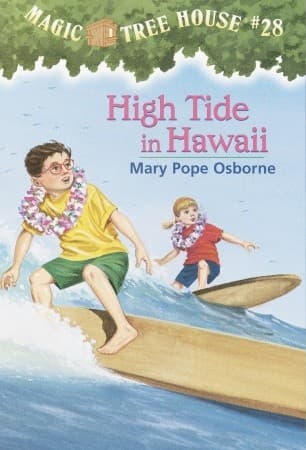
Synopsis
Covers the whole plot, including the ending.
- Difficulty
- Easy
- Pacing
- Fast
- Mood
- Adventurous, Exciting, Educational, Slightly Suspenseful
- Read it if
- You enjoy simple, engaging time-travel adventures with a touch of danger and historical setting, perfect for young readers.
- Skip it if
- You prefer complex plots, deep character development, or high-stakes fantasy for an older audience.
High Tide in Hawaii Plot Summary
Covers the whole plot, including the ending.
A Trip to Hawaii
Jack and Annie are transported by the Magic Tree House to a beautiful beach in ancient Hawaii. Their mission from Merlin is to find a special gift that will help solve a riddle. As they explore the sandy shore, they notice a group of Hawaiian children playing in the waves. They are immediately struck by the warmth and friendliness of the islanders. They meet a young girl named Kama and her older brother, Boka, who are skilled surfers. Jack and Annie are a bit overwhelmed by the new environment but are excited to learn to surf and discover what gift they are meant to find on this tropical island.
Learning to Surf
Kama and Boka, seeing Jack and Annie's curiosity, kindly offer to teach them how to surf. Jack is initially hesitant, worrying about rules and safety, but Annie is eager to try. They watch the Hawaiian children expertly ride the waves on their wooden boards. Kama patiently shows Annie how to position herself on the board and paddle, while Boka guides Jack. Despite some initial tumbles, both Jack and Annie begin to get the hang of it, experiencing the thrill of riding the ocean's power. They quickly bond with Kama and Boka over their shared activity, enjoying the simple pleasure of the beach and the waves.
The Mysterious Tide
While enjoying their surfing lesson, Jack notices several unusual things. The tide seems to be going out much farther than normal, revealing parts of the reef that are usually submerged. He also observes that the birds are flying inland, and the local animals seem agitated. Jack, ever the logical and observant one, consults his research book, which explains that these are often signs of an approaching tsunami. He tries to warn Kama and Boka, but they are initially dismissive, attributing the receding tide to a normal low tide, as they haven't experienced such a large wave before.
A Race Against Time
Jack and Annie, armed with knowledge from Jack's book, become increasingly frantic as the signs of a tsunami become more pronounced. They try to explain the danger to Kama and Boka, describing the immense wave that will soon crash upon the island. Kama and Boka, while kind, are rooted in their traditional understanding of the ocean and have never witnessed such a catastrophic event. Jack points out the truly unusual behavior of the ocean and animals. Eventually, their growing alarm and the undeniable visual evidence of the rapidly receding water convince Kama and Boka that something is truly wrong, and they need to warn their village.
Warning the Village
Realizing the seriousness of the situation, Kama and Boka join Jack and Annie in a desperate race to warn their village. They run through the palm groves, shouting warnings to anyone they encounter. The villagers are initially skeptical, but the children's urgency and the strange behavior of the ocean begin to sway some. Kama and Boka, being respected members of the community, help convince their elders. They explain what Jack and Annie have told them about the receding tide and the signs of a huge wave approaching, urging everyone to seek higher ground immediately.
Seeking Higher Ground
Thanks to the children's warnings, many villagers begin to evacuate, heading towards the higher ground of the nearby mountain. There is a sense of urgency and fear as they leave their homes and belongings behind. Jack and Annie, along with Kama and Boka, help guide the villagers, ensuring that everyone, especially the elderly and young children, are moving quickly and safely. As they ascend the slopes, they can feel the ground tremble and hear a distant, ominous roar from the ocean, confirming Jack's predictions and solidifying the villagers' belief in the impending disaster. The sight of the vast, empty ocean where the waves once crashed is terrifying.
The Wave Hits
From their vantage point high on the mountain, Jack, Annie, Kama, Boka, and the rest of the villagers witness the terrifying sight of the tsunami. A massive wall of water, unlike anything they could have imagined, crashes onto the shore, engulfing the village and the lower parts of the island. The sound is deafening, and the sheer power of the wave is awe-inspiring and destructive. They watch in horror as their homes and the familiar landscape are swallowed by the ocean. Despite the devastation, there is also a sense of relief that they are safe, thanks to the timely warning and their escape to higher ground.
Aftermath and Reflection
After the wave recedes, leaving behind a scene of destruction, the villagers slowly descend the mountain. Their homes are damaged or destroyed, and the landscape is dramatically altered. Despite the immense loss, there is a strong sense of community and gratitude for their lives. Kama and Boka express their deep thanks to Jack and Annie for their knowledge and courage. The experience is a powerful lesson for everyone, highlighting the unpredictable power of nature and the importance of heeding warnings. They begin to assess the damage and plan for rebuilding, united in their resilience and spirit.
The Special Gift
Amidst the aftermath, Jack and Annie realize that the 'special gift' Merlin sent them to find wasn't a tangible object, but rather the gift of knowledge and the ability to help others. Their quick thinking and Jack's reliance on his research book allowed them to save an entire village from a natural disaster. The experience of sharing their knowledge and seeing its life-saving impact is the true treasure. They reflect on how their understanding of the world, combined with the islanders' trust, created a powerful force for good, fulfilling their mission in a way they hadn't initially anticipated.
Farewell to Hawaii
Having completed their mission and knowing the villagers are safe and beginning the process of rebuilding, Jack and Annie prepare to return to the Magic Tree House. They share a heartfelt goodbye with Kama and Boka, who are now not just new friends but also understand the importance of scientific observation. The children exchange promises to remember each other. Jack and Annie step back into the tree house, reflecting on the adventure and the impact they had. With a whisper of 'I wish we could go home,' the tree house spins, whisking them away from ancient Hawaii, leaving behind a community forever grateful for their intervention.
Principal Figures
Jack
Protagonist
The logical, bookish older brother who relies on facts.
Jack is a cautious and intelligent eight-year-old boy who loves to read and research. He carries a backpack filled with books and is always looking up facts to understand the world around him. He is often the more hesitant of the two siblings but possesses a keen sense of observation and a strong desire to follow rules and find logical solutions. His reliance on his research book is crucial to identifying the signs of the tsunami. He cares deeply for Annie and others, driven by a strong sense of responsibility.
Relationships: Annie (Younger sister, companion on adventures, often pushes him out of his comfort zone.); Kama (New friend, Hawaiian girl who teaches him to surf and trusts his warnings.); Boka (New friend, Kama's older brother, initially skeptical but comes to respect Jack's knowledge.)
Annie
Protagonist
The adventurous, empathetic younger sister who embraces new experiences.
Annie is a lively and outgoing seven-year-old girl, Jack's younger sister. She is spontaneous, brave, and possesses a remarkable ability to connect with animals and people. Annie is often the one to push Jack out of his comfort zone, encouraging him to try new things and embrace the adventure. Her empathy and open-mindedness help bridge the cultural gap with the Hawaiian children. She is quick to make friends and trust her instincts, often sensing things before Jack can confirm them with facts.
Relationships: Jack (Older brother, companion on adventures, often grounds her adventurous spirit.); Kama (New friend, Hawaiian girl with whom she quickly bonds and learns to surf.); Boka (New friend, Kama's older brother, whom she helps convince of the danger.)
Kama
Supporting
A friendly Hawaiian girl who teaches Jack and Annie to surf.
Kama is a kind and skilled Hawaiian girl, close in age to Annie. She is an excellent surfer and is patient in teaching Jack and Annie. She embodies the warm hospitality of her culture. Initially, she is skeptical of Jack's warnings about the tsunami, as such an event is beyond her experience. However, she eventually trusts Jack and Annie's urgency and helps to warn her village, demonstrating her own courage and sense of responsibility to her community. She forms a strong bond with Annie.
Relationships: Annie (New friend, surfing companion.); Jack (New friend, the source of the tsunami warning.); Boka (Older brother, with whom she helps warn the village.)
Boka
Supporting
Kama's older brother, a skilled surfer and protector.
Boka is Kama's older brother, a capable and confident young Hawaiian boy. He is an experienced surfer and helps teach Jack and Annie. Like his sister, he is initially dismissive of Jack's warnings, relying on his traditional understanding of the ocean's patterns. However, as the signs become more undeniable, he quickly grasps the severity of the situation and, as an older brother figure, takes on the responsibility of helping to warn his village. He respects Jack's knowledge once the danger becomes clear.
Relationships: Kama (Younger sister, whom he helps protect and warn the village with.); Jack (New friend, whose knowledge he initially doubts but ultimately trusts.); Annie (New friend, whom he helps teach to surf.)
Merlin
Mentioned
The magical enchanter who sends Jack and Annie on their missions.
Merlin is the wise and powerful enchanter who guides Jack and Annie on their magical adventures through the Magic Tree House. Though not physically present in this particular story, his mission to find a 'special gift' serves as the catalyst for their journey to Hawaii. His missions are often designed to teach Jack and Annie valuable lessons beyond simply finding objects, pushing them to grow and understand the world in new ways. His influence is felt through the overarching goal of their quest.
Relationships: Jack (Magical mentor, sets their quests.); Annie (Magical mentor, sets their quests.)
The Hawaiian Villagers
Supporting
The community saved by Jack and Annie's warning.
The villagers are the inhabitants of the ancient Hawaiian settlement on the island. They are depicted as a close-knit community with a deep connection to their land and the ocean, living a traditional life. Initially, they are skeptical of Jack and Annie's warnings about the tsunami, as they have no prior experience with such a devastating event. However, they ultimately trust the children's urgency and their own community leaders (Kama and Boka) and evacuate to higher ground, demonstrating their resilience and collective spirit in the face of disaster.
Relationships: Jack (The source of the life-saving warning.); Annie (A key figure in convincing them of the danger.); Kama (One of their own who helps relay the warning.); Boka (One of their own who helps relay the warning.)
Themes & Insights
The Power of Knowledge and Observation
This theme is central to the story, highlighting how Jack's scientific knowledge and observation skills are crucial for survival. Jack's ability to read and understand the signs of a tsunami (receding tide, agitated animals, birds flying inland) directly leads to saving the Hawaiian village. The narrative shows that knowledge, even from books, can be a powerful tool, especially when combined with careful observation of the natural world. This is clear when Jack uses his research book to identify the danger, which ultimately convinces the skeptical islanders to evacuate.
“Jack checked his book. 'It says here that sometimes, before a tsunami, the ocean pulls way back.'”
Respect for Nature's Power
The story shows the immense and unpredictable power of nature. The tsunami is a stark reminder that humans are at the mercy of natural forces. The Hawaiian villagers, though deeply connected to the ocean, had never witnessed such a catastrophic event, leading to their initial disbelief. Jack and Annie's warnings, born from understanding these forces, ultimately save lives. The theme encourages both awe and caution towards the environment, showing that while nature can be beautiful (like the surfing waves), it can also be devastating.
“Then they saw it. A wall of water, huge and dark, rose from the ocean.”
Intercultural Exchange and Trust
The interaction between Jack and Annie and the Hawaiian children, Kama and Boka, explores the theme of cultural exchange and the development of trust. Despite their different backgrounds and initial skepticism from the islanders, the children form a bond through shared experiences like surfing. More importantly, the Hawaiian children eventually trust Jack and Annie's warnings, even though they come from an unfamiliar perspective and contradict their traditional understanding. This trust, built on shared humanity and the urgency of the situation, is vital for the survival of the village, showing the importance of listening and understanding across cultures.
“We must warn our village!' cried Kama. 'They'll believe us if we tell them!”
Heroism and Responsibility
Jack and Annie are heroes by taking on the responsibility to warn and save the Hawaiian villagers. Despite being children in a foreign land, they act when they realize the danger. Jack's intellectual courage to voice his scientific findings and Annie's empathetic drive to help others lead them to become unlikely heroes. Their actions show that heroism is not just about grand gestures, but about having the courage to speak up, share knowledge, and take responsibility for the well-being of others, even when faced with disbelief.
“We have to tell them, Jack! We have to save them!”
Plot Devices & Literary Techniques
The Magic Tree House
A magical vehicle for time and space travel.
The Magic Tree House is the primary plot device that transports Jack and Annie to different historical periods and geographical locations. It serves as the catalyst for all their adventures, enabling the narrative to explore various settings and challenges. In 'High Tide in Hawaii,' it brings them to ancient Hawaii, setting the stage for their encounter with the tsunami. It also provides a safe return mechanism once their mission is complete, allowing for self-contained adventures in each book.
Jack's Research Book
A source of factual information and a key to solving problems.
Jack's research book is a crucial plot device. It acts as an external source of knowledge and a tool for problem-solving. In this story, the book contains vital information about tsunamis and their warning signs. Without this specific knowledge, Jack would not have been able to identify the impending danger, and the villagers would not have been warned. The book reinforces the theme of the power of knowledge and allows Jack to act as the logical, informed hero.
Omens and Foreshadowing
Subtle hints that build suspense and warn of impending danger.
The story effectively uses omens and foreshadowing to build suspense and signal the approaching tsunami. The unusually receding tide, the agitated animals, and the birds flying inland are all subtle but clear signs of an impending natural disaster. These details are observed by Jack and noted in his research book, creating a growing sense of dread and urgency for the reader. This device allows the plot to slowly reveal the danger before the actual event, making the climax more impactful.
The Quest/Mission
A specific goal given by Merlin that drives the narrative.
Merlin's instruction to find a 'special gift' serves as the initial quest that propels Jack and Annie into their Hawaiian adventure. While they initially search for a tangible object, the 'gift' turns out to be their knowledge and ability to help others. This device provides a clear purpose for their journey, even if the true nature of the quest is revealed to be metaphorical. It gives structure to the narrative and a sense of accomplishment upon its resolution.
High Tide in Hawaii Quotes
“The magic tree house was still there, perched high in the tallest oak.”
“The air was warm and smelled of salt and flowers.”
“A huge wave, like a mountain of water, was coming right at them!”
“They had to find the 'Eye of the Dolphin' before the full moon.”
“The ancient Hawaiians treated the ocean with great respect.”
“If you listen carefully, the ocean will tell you its secrets.”
“He felt a thrill of fear, mixed with a strange excitement.”
“The surfing was like dancing on water.”
“They were learning so much more than just about history.”
“Sometimes the bravest thing you can do is ask for help.”
“The 'Eye of the Dolphin' wasn't a thing you could hold in your hand.”
“It was the feeling of being connected to everything around them.”
“They had brought back more than just a story; they had brought back a feeling.”
“The magic tree house always knew just where they needed to go next.”
Quiz
10 questions on the plot and the characters. Each answer comes with a short explanation.
Question 1
What kind of natural disaster do Jack and Annie discover is headed towards the Hawaiian island?
- A volcanic eruption
- A hurricane
- A tidal wave
- An earthquake
Show answer
C. A tidal wave The book's description explicitly states that Jack and Annie discover 'A tidal wave is headed their way!'
Question 2
What skill do Jack and Annie learn shortly after arriving on the Hawaiian island?
- How to weave leis
- How to surf
- How to play the ukulele
- How to build a canoe
Show answer
B. How to surf The book's summary mentions that 'They learn how to surf and have a great time'.
Question 3
From what magical object are Jack and Annie transported to the Hawaiian island?
- A magic carpet
- A time-traveling car
- The Magic Tree House
- A portal in their backyard
Show answer
C. The Magic Tree House The summary states, 'the Magic Tree House whisks them back to a Hawaiian island of long ago.'
Question 4
What is the primary motivation for Jack and Annie's mission in Hawaii, beyond enjoying their trip?
- To find a hidden treasure on the island.
- To document the local wildlife for a school project.
- To help save their new friends from the impending tidal wave.
- To learn ancient Hawaiian chants and dances.
Show answer
C. To help save their new friends from the impending tidal wave. The summary explicitly asks, 'Can they help save their new friends in time?' in reference to the tidal wave.
Question 5
What genre does 'High Tide in Hawaii' primarily fall under, according to the provided information?
- Mystery and Thriller
- Science Fiction and Dystopian
- Fantasy, Children's, Historical Fiction, Young Adult
- Romance and Contemporary
Show answer
C. Fantasy, Children's, Historical Fiction, Young Adult The provided book information lists 'Fantasy, Children's, Historical Fiction, Young Adult' as its genres.
Question 6
The phrase 'Catch the wave!' at the beginning of the summary is a thematic foreshadowing of what two elements in the story?
- The exciting journey and a musical performance.
- Learning to surf and the arrival of the tidal wave.
- A friendly competition and finding a special artifact.
- Meeting new friends and discovering a hidden cove.
Show answer
B. Learning to surf and the arrival of the tidal wave. The phrase connects to 'They learn how to surf' (catching a wave literally) and the impending 'tidal wave' (a dangerous wave).
Question 7
What indicates that Jack and Annie's visit to Hawaii is not in the present day?
- They use modern technology to communicate with their home.
- The Magic Tree House 'whisks them back to a Hawaiian island of long ago.'
- They encounter dinosaurs on the island.
- The local people are dressed in futuristic clothing.
Show answer
B. The Magic Tree House 'whisks them back to a Hawaiian island of long ago.' The summary explicitly states the Magic Tree House 'whisks them back to a Hawaiian island of long ago,' indicating a past setting.
Question 8
The 'strange things' that start happening before the tidal wave is discovered serve what narrative purpose?
- They are unrelated magical occurrences that add to the fantasy element.
- They are clues or precursors that help Jack and Annie realize a danger is approaching.
- They are pranks played by mischievous island spirits.
- They indicate that Jack and Annie are experiencing culture shock.
Show answer
B. They are clues or precursors that help Jack and Annie realize a danger is approaching. The summary states, 'until strange things start happening. Jack and Annie soon discover the cause: A tidal wave is headed their way!' This implies the strange things are linked to the impending disaster, serving as narrative foreshadowing or early warning signs.
Question 9
What overarching theme is suggested by Jack and Annie's efforts to 'help save their new friends in time' from the tidal wave?
- The importance of historical preservation.
- The inevitability of natural disasters.
- The power of friendship and responsibility to others.
- The thrill of adventure for its own sake.
Show answer
C. The power of friendship and responsibility to others. Their decision to help their 'new friends' in a crisis highlights themes of friendship, empathy, and taking responsibility for the well-being of others.
Question 10
Considering the 'Young Adult' genre classification, what character development might be expected for Jack and Annie through this adventure?
- They will likely experience significant physical growth and aging.
- They will probably gain new magical powers or abilities.
- They will likely learn about courage, problem-solving, and cultural understanding.
- They will discover a hidden family secret from their past.
Show answer
C. They will likely learn about courage, problem-solving, and cultural understanding. For a children's/young adult book, especially one involving danger and cultural exposure, character development often focuses on internal growth like courage, resourcefulness (problem-solving), and appreciating different ways of life (cultural understanding).
High Tide in Hawaii FAQ
What is the primary goal of Jack and Annie's visit to ancient Hawaii in 'High Tide in Hawaii'?
Jack and Annie are sent to ancient Hawaii by Morgan le Fay to find a special gift, one of four gifts they need to gather to help free a trapped magical creature. Their mission is not just for fun, but part of a larger quest to save the creature from a spell.
What significant natural disaster do Jack and Annie face during their adventure?
Jack and Annie discover a tidal wave is rapidly approaching the Hawaiian island where they are. They become aware of the danger through various signs and the warnings of the local people, leading them to race against time to alert and help their new friends.
Who are some of the key Hawaiian characters Jack and Annie interact with?
Jack and Annie befriend a young Hawaiian boy named Kama and his grandfather, who teaches them about surfing and the island's customs. They learn valuable lessons from them about respecting nature and community, which proves crucial later on.
What specific skill do Jack and Annie learn that helps them connect with the Hawaiian culture?
Jack and Annie learn how to surf from Kama's grandfather, embracing the traditional Hawaiian sport. This experience not only provides them with enjoyment but also deepens their understanding of the island's way of life and its close relationship with the ocean.
What is the 'special gift' Jack and Annie are searching for in Hawaii?
The special gift Jack and Annie are looking for is a feather cape, which symbolizes royalty and protection in Hawaiian culture. They must earn or find this item as part of their larger quest to gather four gifts to free a magical creature.
How does the Magic Tree House facilitate their escape or resolution from the tidal wave?
The Magic Tree House allows Jack and Annie to escape the tidal wave by whisking them away just in time, after they have done all they can to warn the villagers. It serves as their reliable portal for safe passage back to their own time and place, completing their mission.
Are there any subtle foreshadowing elements of the tidal wave before it is explicitly mentioned?
Yes, there are subtle signs such as unusual animal behavior, the sea retreating far from the shore, and Kama's grandfather observing the ocean with concern. These details build suspense and hint at the impending danger before the characters fully grasp the situation.
What historical or cultural details about ancient Hawaii are woven into the story?
The story incorporates details like traditional surfing, the importance of feather capes, the concept of kapu (taboos), and the close-knit community life of ancient Hawaiians. These elements provide a glimpse into the rich history and culture of the islands, making the setting vibrant and educational.
How does the story subtly connect to other Magic Tree House adventures or the overarching series plot?
This adventure is part of a larger quest where Jack and Annie must collect four special gifts to save Morgan le Fay from a spell. The feather cape they find in Hawaii is one of these crucial items, linking it directly to the ongoing narrative of the Magic Tree House series.
How do Jack and Annie's individual personalities influence their actions during the crisis?
Jack's cautious and research-oriented nature leads him to consult his book for information about tidal waves, while Annie's brave and impulsive spirit drives her to quickly warn people. Their combined strengths, with Jack's knowledge and Annie's action, are essential in their efforts to help.
What psychological impact does witnessing a natural disaster have on the child protagonists?
Witnessing the impending tidal wave instills a sense of urgency and fear in Jack and Annie, but also a strong desire to help. It forces them to confront their own vulnerability and the power of nature, fostering resilience and a deeper understanding of responsibility.
How does the story explore the theme of trust between strangers from different cultures?
The story highlights how Jack and Annie, as outsiders, gradually earn the trust of Kama and his grandfather through their genuine efforts to learn and help. This trust is crucial when they need to convey the urgent warning about the tidal wave, demonstrating the power of inter-cultural understanding.
What emotions are evoked in the reader through the descriptions of the approaching tidal wave?
The descriptions evoke a strong sense of suspense, fear, and urgency as the tidal wave approaches. Readers feel the characters' anxiety and desperation, creating a thrilling and intense experience, particularly as the children race against time to warn the villagers.
What is the primary moral or lesson taught by 'High Tide in Hawaii'?
The book primarily teaches the importance of quick thinking, courage in the face of danger, and the value of community cooperation, especially during a crisis. It also subtly emphasizes respecting nature and the wisdom of indigenous cultures.
How does the fantasy element of the Magic Tree House enhance the historical fiction aspect?
The Magic Tree House allows Jack and Annie to directly experience historical settings like ancient Hawaii, making the history more engaging and immediate for young readers. It transforms passive learning into an active adventure, bridging fantasy with factual elements.
Is there a deeper meaning to the 'feather cape' as the special gift?
The feather cape, beyond being a quest item, symbolizes protection, leadership, and the sacred connection to the land and ancestors in Hawaiian culture. Its acquisition suggests Jack and Annie are gaining not just an object, but a deeper understanding and respect for these values.
Could the tidal wave be interpreted as a metaphor for larger challenges or changes in life?
Yes, the tidal wave can be seen as a metaphor for unexpected, overwhelming challenges that can suddenly arise in life. It represents the need for preparedness, courage, and community support to navigate and overcome such significant obstacles, much like the characters do.
How does the ending, despite the danger, maintain its child-friendly tone?
The ending maintains a child-friendly tone by ensuring Jack and Annie, and presumably many villagers, are safe due to their warnings and the timely departure via the Magic Tree House. While the threat is serious, the resolution focuses on their success and safety, avoiding overly grim details.
About the author

Mary Pope Osborne is an American author known for her children's fiction, particularly the Magic Tree House series. Her notable works include "The Knight at Dawn," "Dolphins at Daybreak," "Afternoon on the Amazon," "Tonight on the Titanic," "Ghost Town at Sundown," and "Hour of the Olympics," which combine adventure with historical and educational themes.
Similar books
- Harry Potter and the Sorcerer's Stone
J.K. Rowling
4.5 (7M) average on GoodreadsFantasyRescued from a miserable life under the stairs, an orphaned boy discovers he's a wizard destined for a magical school, where he uncovers a dangerous secret tied to the dark wizard who murdered his parents.
- The Hunger Games
Suzanne Collins
4.3 (6.4M) average on GoodreadsFantasyIn a future where children fight to the death on live television, Katniss Everdeen volunteers for the arena, turning a death sentence into a fight for survival and a spark of rebellion.
- 1984
George Orwell
4.2 (3.1M) average on GoodreadsPoliticsIn a future where surveillance and thought control are absolute, a man's search for truth clashes with the Party, showing that hope can be a form of rebellion.
- Divergent
Veronica Roth
4.2 (2.9M) average on GoodreadsFantasyIn a society divided by virtues, a sixteen-year-old's difference from the norm starts a rebellion that threatens her world.
- The Hobbit, or There and Back Again
J.R.R. Tolkien
4.3 (2.9M) average on GoodreadsFantasyA comfort-loving hobbit named Bilbo Baggins is whisked away by a mischievous wizard and a band of dwarves on an unexpected journey to reclaim stolen treasure from a fearsome dragon, discovering courage and a magical ring along the way.
- Animal Farm
George Orwell
4.0 (2.7M) average on GoodreadsPoliticsA farm animals' rebellion against humans turns into a pig-led dictatorship, showing how power corrupts and revolutionary ideals are betrayed.






Enjoyed the summary?
A summary gives you the shape of the book. The book itself has the detail, the examples and the voice.
Find High Tide in Hawaii on AmazonAs an Amazon Associate, BookBrief earns from qualifying purchases. How we're funded