
Synopsis
Covers the whole plot, including the ending.
- Difficulty
- Easy
- Pacing
- Fast
- Mood
- Adventurous, Educational, Whimsical, Fun
- Read it if
- You enjoy light historical fantasy adventures for young readers, especially those with themes of problem-solving and cultural exploration.
- Skip it if
- You are looking for complex plots, deep character development, or high-stakes fantasy.
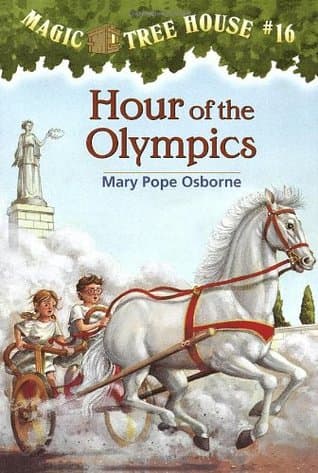
Hour of the Olympics Plot Summary
Covers the whole plot, including the ending.
A Trip to Ancient Greece
Jack and Annie arrive in ancient Greece, transported by the Magic Tree House. They land in an olive grove near Olympia. A note tells them their mission: find the 'fourth special writing' for Morgan le Fay. They quickly learn the Olympic Games are about to start. They meet Aristides, a young boy training for the Games, who explains the rules, including that only men can watch or compete. Annie is immediately upset by this rule.
The Oath and the Rules
Aristides tells them more about the Olympic Games. He explains that all athletes must swear an oath to Zeus that they have trained for ten months and will compete fairly. He also stresses the strict rule against women attending, even as viewers, under penalty of death. Annie, feeling wronged by women's exclusion, wants to see the Games anyway. Jack, always careful, worries about the danger of breaking such a serious law.
Annie's Disguise
Annie decides she will see the Olympic Games. She plans to disguise herself as a boy, finding a tunic and cutting her hair short. She tells Jack to go ahead without her. Jack is very uneasy, knowing the severe consequences if she is caught. He tries to talk her out of it, but Annie's adventurous spirit and sense of unfairness override his worries. She promises to meet him later, leaving Jack to walk to the stadium alone, full of dread.
Jack Enters the Stadium
Jack reaches the Olympic stadium, a large, open-air arena packed with thousands of people. He is amazed by its size and the excitement. He finds a seat and watches the athletes march in, led by heralds. The opening ceremonies are grand, with trumpets playing and a strong sense of tradition. Jack feels both excited and anxious, constantly looking for Annie and worrying about her safety, while also trying to appreciate the event's history.
The First Events
The Olympic Games begin with the footraces. Jack watches closely as athletes compete with speed and strength. He is especially impressed by the runners' focus. The crowd cheers, and Jack feels the energy of the ancient event. Despite the thrill of the races, he keeps thinking about Annie. He scans the crowd, hoping to see her, but also fearing her being found out. His excitement mixes with ongoing worry.
Annie's Discovery and Escape
While Jack watches the races, Annie, disguised as a boy, tries to sneak into the stadium. She gets past some guards but a more watchful official spots her and asks questions. Her disguise is not perfect, and her feminine features are noticed. Realizing she is caught, Annie quickly runs away. She uses her speed to avoid the guards, running through the crowded paths outside the stadium, her heart pounding with fear of being caught and facing punishment for women at the Games.
Reunion and the Olive Branch
After her close call, Annie finds Jack outside the stadium. She is shaken but safe, and Jack is relieved. They agree it is too risky for Annie to try to enter again. Together, they watch the awards ceremony from afar. They see the winners crowned with olive branches, a simple symbol of their achievement. This moment helps them appreciate the Games, even with Annie's earlier exclusion.
The Poet and the Fourth Writing
As they watch the end of the Games, Jack and Annie meet an old, blind poet sitting under an olive tree. The poet recites verses, and Jack realizes this might be their clue. They approach him, and the poet, sensing them, shares his thoughts about the true meaning of the Olympics – not just winning, but striving for excellence and peace. He then reveals that the 'fourth special writing' is a poem, an ode to the Olympic spirit, which he recites. This poetic form of writing surprises Jack, who usually looks for scrolls.
A Message of Peace
The blind poet explains that during the Olympic Games, a sacred truce, called the Ekecheiria, stops all wars across Greece. This allows athletes and spectators to travel safely to and from Olympia. He stresses that the Games are a time of peace and unity, a break from the constant fighting between city-states. This news about the truce deeply affects Jack and Annie, showing a noble purpose behind the contests that goes beyond just competition. The poet's words about peace resonate with the children.
Returning Home
After hearing the poet's 'special writing' – the ode to the Olympics and peace – Jack quickly writes it in his notebook, completing their mission. They thank the poet and hurry back to the Magic Tree House. As they climb inside, Jack and Annie think about their adventure. They discuss the excitement of the Games, the unfairness of the rules for women, and the deep message of peace from the Olympic truce. With the book open to their home, they wish for the tree house to take them back to Frog Creek, Pennsylvania, their task done.
Principal Figures
Jack
Protagonist
The cautious and studious older brother.
Jack is a thoughtful and often anxious eight-year-old boy who loves to read and takes notes in his journal. He is the more cautious of the two siblings, always thinking about rules and consequences. He is fascinated by history and enjoys learning new facts, but his primary concern is often the safety of himself and Annie. He is initially very worried about Annie's plan to sneak into the Games.
Relationships: Annie (Younger sister, often pushes him out of his comfort zone.); Morgan le Fay (Their magical mentor, sends them on missions.)
Annie
Protagonist
The adventurous and empathetic younger sister.
Annie is a fearless, imaginative, and often impulsive seven-year-old girl. She is more adventurous than Jack and frequently leads them into exciting, sometimes risky, situations. She possesses a strong sense of justice and empathy, which is evident in her immediate indignation at the rule excluding women from the Olympic Games. Her determination to experience things firsthand often drives the plot.
Relationships: Jack (Older brother, often tries to keep her out of trouble.); Morgan le Fay (Their magical mentor, sends them on missions.)
Aristides
Supporting
A young Greek athlete training for the Olympics.
Aristides is a young, dedicated Greek boy who is training to compete in the Olympic Games. He is knowledgeable about the traditions, rules, and significance of the Olympics. He is proud of his heritage and the Games, and he patiently explains the customs to Jack and Annie. He represents the youth and the athletic spirit of ancient Greece, providing the children with crucial background information.
Relationships: Jack (Brief acquaintance, provides information about the Games.); Annie (Brief acquaintance, provides information about the Games.)
The Blind Poet
Supporting
An wise old man who reveals the 'fourth special writing'.
The Blind Poet is an elderly, wise man who embodies the philosophical and artistic spirit of ancient Greece. Despite his blindness, he possesses deep insight into the true meaning of the Olympic Games, beyond just the athletic competition. He is calm and serene, and through his words, he conveys the importance of peace, unity, and excellence. He is the one who ultimately provides Jack and Annie with the 'fourth special writing' in the form of an ode.
Relationships: Jack (Provides wisdom and the missing 'writing'.); Annie (Provides wisdom and the missing 'writing'.)
Morgan le Fay
Mentioned
The magical librarian who sends Jack and Annie on quests.
Morgan le Fay is a magical librarian from the time of King Arthur who sends Jack and Annie on various missions through the Magic Tree House. Although she does not appear physically in this book, her presence is felt through the note she leaves for the children, guiding their quest to find the 'fourth special writing.' She is a benevolent figure who trusts Jack and Annie to complete their tasks.
Relationships: Jack (Their magical mentor and employer.); Annie (Their magical mentor and employer.)
Zeus
Mentioned
The king of the gods in Greek mythology.
Zeus is the supreme god in Greek mythology, ruling over Mount Olympus and the sky. In the context of the book, he is mentioned as the deity to whom Olympic athletes swear an oath of fair play. His name is invoked to underscore the sacred and serious nature of the Olympic Games and the traditions surrounding them, highlighting the religious significance of the event in ancient Greece.
Themes & Insights
Gender Inequality and Justice
A main theme is historical gender inequality, especially women's exclusion from the ancient Olympic Games. Annie's strong reaction to the rule – 'No girls allowed!' – highlights the unfairness. Her attempt to disguise herself and sneak in, despite the danger, shows her belief in equal access and her refusal to accept unfair limits. This theme is key to Annie's character and offers a relatable point of frustration for young readers, as when she says, "That's not fair!" after learning the rules.
“No girls allowed!" cried Annie. "That's not fair!”
The Spirit of the Olympics
Beyond just sports, the book looks at the deeper meaning of the ancient Olympic Games. It highlights ideas like striving for excellence, fair play, and, most importantly, peace. The Blind Poet's mention of the 'sacred truce' (Ekecheiria) shows that the Games were a time when all wars stopped, bringing unity among the often-fighting Greek city-states. This theme raises the Olympics from a sports event to a symbol of human hope and harmony, as the poet explains.
“The Games are not just about winning or losing,” said the poet. “They are about striving for excellence and, most of all, for peace.”
Courage and Caution
The contrast between Jack's careful nature and Annie's adventurous spirit drives much of the story. Jack's constant worry about rules and danger differs from Annie's impulsive bravery, especially when she decides to disguise herself to see the Games. This theme explores the balance between taking risks and being responsible. Annie's courage leads to an exciting escape, while Jack's caution keeps them grounded, reminding them of possible problems and ensuring their safety, as seen in his constant concern for Annie.
“Oh, Annie," whispered Jack. "This is really dangerous.”
The Power of Storytelling and Poetry
The 'fourth special writing' turns out to be a poem recited by a blind poet, not a physical scroll. This shows the lasting power of spoken stories, poetry, and tales to preserve history, wisdom, and culture. The poet's ode to the Olympics captures the essence of the Games and finishes Jack and Annie's quest, showing that knowledge and truth can come through art, not just written facts. Jack's initial surprise that the 'writing' is a poem emphasizes this theme.
“The fourth special writing is a poem," said the poet. "It is an ode to the Olympic spirit.”
Plot Devices & Literary Techniques
The Magic Tree House
A magical vehicle for time travel and adventure.
The Magic Tree House is the central plot device that transports Jack and Annie to different historical periods and fantastical realms. It functions as a narrative catalyst, initiating their adventures and providing the means for their return home. Its magical nature allows for immediate immersion into diverse settings without extensive exposition, making it a convenient and exciting way to introduce children to history and various cultures. It typically requires a book and a wish to activate its powers.
The Mission/Quest
A specific task given to the protagonists to drive the plot.
Jack and Annie are consistently given missions by Morgan le Fay, which serve as the primary motivation for their adventures. In 'Hour of the Olympics,' their quest is to find the 'fourth special writing.' This device provides a clear goal, structures the plot, and allows for the introduction of various elements relevant to the historical setting. The ambiguity of what the 'writing' might be adds an element of mystery and discovery to their journey.
Foreshadowing (Annie's Disguise)
Hints or clues about future events or conflicts.
The early mention of the strict rule against women at the Olympic Games, coupled with Annie's immediate indignation ('That's not fair!'), foreshadows her attempt to defy this rule. This device builds anticipation and tension, preparing the reader for Annie's eventual, risky plan to disguise herself and try to enter the stadium. It establishes a clear conflict that will drive a significant portion of the plot, making her actions understandable based on her character.
The Wise Sage (Blind Poet)
A character who provides wisdom, guidance, or crucial information.
The Blind Poet serves as a classic wise sage archetype. He is an elderly, knowledgeable figure who, at a pivotal moment, provides Jack and Annie with the solution to their quest—the 'fourth special writing'—and imparts deeper wisdom about the true meaning of the Olympics and peace. This device allows for the direct delivery of thematic messages and helps the protagonists complete their mission, often appearing when they are at a standstill.
Hour of the Olympics Quotes
“The air was hot and dry. Above them, the sun beat down from a cloudless sky.”
“They were in a small, round building made of stone. A narrow opening let in the light.”
“Annie giggled. 'We're really in ancient Greece!'”
“'We have to find a special story,' said Jack, pulling out the research book.”
“Every four years, men from all over Greece gathered in Olympia to compete in games.”
“The stadium was huge! It was an open field surrounded by grassy hills.”
“Look!' whispered Annie. 'Runners!”
“The sound of trumpets filled the air. A man in a white toga stepped forward.”
“He held up a torch. 'Let the games begin!' he boomed.”
“The runners took off! Dust flew up from their bare feet.”
“'They're running barefoot!' whispered Jack.”
“He felt a rush of excitement. He was watching history!”
“Annie pointed. 'Look! The winner!'”
“A wreath of olive leaves was placed on his head.”
Quiz
10 questions on the plot and the characters. Each answer comes with a short explanation.
Question 1
Which ancient event do Jack and Annie travel back in time to witness?
- The Roman Colosseum games
- The Olympic Games in ancient Greece
- The first World's Fair
- A medieval jousting tournament
Show answer
B. The Olympic Games in ancient Greece Jack and Annie are whisked back to ancient Greece to experience the Olympic Games, as stated in the book's description.
Question 2
What is the primary rule that affects Annie's ability to attend the ancient Olympic Games?
- Only people from the future are allowed.
- No children are allowed to watch.
- Only men are allowed to attend the games.
- Only athletes are permitted entry.
Show answer
C. Only men are allowed to attend the games. The book description explicitly states, 'No girls allowed at the Olympic Games! That's the rule when the Magic Tree House whisks Jack and Annie back to ancient Greece.'
Question 3
When Annie tells Jack to go to the games without her, what does Jack suspect?
- She is tired and wants to rest.
- She is planning to find a way to see the games anyway.
- She wants to explore the ancient city alone.
- She is upset about the rules and doesn't want to go.
Show answer
B. She is planning to find a way to see the games anyway. The synopsis states, 'But when Annie tells Jack to go to the games without her, he knows she's up to something,' implying she has a plan.
Question 4
What is the potential consequence if Annie tries to circumvent the 'no girls allowed' rule at the Olympic Games?
- She might get lost in the crowd.
- She could get herself—and Jack—into 'Olympic-size trouble'.
- She might miss out on seeing the events.
- She would simply be asked to leave.
Show answer
B. She could get herself—and Jack—into 'Olympic-size trouble'. The book's description poses the question: 'Will Annie find a way to see the games? Or will she get herself—and Jack—into Olympic-size trouble?'
Question 5
Which of the following is NOT a type of Magic Tree House book mentioned in the description?
- Merlin Missions
- Adventure Guides
- Fact Trackers
- Super Edition
Show answer
B. Adventure Guides The listed types are 'Magic Tree House: Adventures with Jack and Annie', 'Merlin Missions', 'Super Edition', and 'Fact Trackers'. 'Adventure Guides' is not mentioned.
Question 6
What does the 'Merlin Missions' series offer to readers?
- Simpler adventures for new readers.
- Nonfiction companions to the adventures.
- More challenging adventures for experienced readers.
- Longer and more dangerous adventures.
Show answer
C. More challenging adventures for experienced readers. The description states 'Merlin Missions: More challenging adventures for the experienced reader'.
Question 7
What is the significance of the new numbering system and covers for the Magic Tree House series?
- It indicates a complete reboot of the series storyline.
- It marks the series' 25th anniversary and provides an easier-to-use system.
- It signifies a change in the target age group for the books.
- It means the books are now only available digitally.
Show answer
B. It marks the series' 25th anniversary and provides an easier-to-use system. The description highlights: 'The #1 bestselling chapter book series of all time celebrates 25 years with new covers and a new, easy-to-use numbering system!'
Question 8
Given the historical context of the ancient Olympic Games, what is a likely theme explored in 'Hour of the Olympics' regarding Annie's predicament?
- The importance of following all rules without question.
- The challenge of gender inequality and societal restrictions.
- The superior athletic abilities of men in ancient times.
- The benefits of individual exploration over teamwork.
Show answer
B. The challenge of gender inequality and societal restrictions. The central conflict described is Annie, a girl, being disallowed from the games, which directly points to the theme of gender inequality and societal restrictions of the era.
Question 9
How does the 'Fact Trackers' series relate to the main Magic Tree House adventures?
- They are alternative fantasy stories set in the same universe.
- They provide nonfiction companions to the fictional adventures.
- They feature different characters exploring new time periods.
- They are graphic novel adaptations of the original books.
Show answer
B. They provide nonfiction companions to the fictional adventures. The description specifies: 'Fact Trackers: Nonfiction companions to your favorite Magic Tree House adventures'.
Question 10
Based on the description, what is a key characteristic of the 'Super Edition' books compared to the regular 'Adventures with Jack and Annie'?
- They focus on scientific facts rather than fantasy.
- They are designed for much younger, pre-chapter book readers.
- They are longer and involve more dangerous adventures.
- They feature only one of the two main characters, Jack or Annie.
Show answer
C. They are longer and involve more dangerous adventures. The description states: 'Super Edition: A longer and more dangerous adventure'.
Hour of the Olympics FAQ
What is the primary setting and historical period Jack and Annie visit in 'Hour of the Olympics'?
Jack and Annie are transported by the Magic Tree House to ancient Greece, specifically the city of Olympia, during the time of the ancient Olympic Games. They arrive just as the games are about to begin, immersing them in the historical context of this significant cultural event.
What is the main challenge or rule Jack and Annie face upon arriving in ancient Greece?
The primary challenge is the strict rule that no girls are allowed to attend or even witness the Olympic Games. This creates an immediate problem for Annie, who is determined to see the events despite the prohibition, while Jack tries to adhere to the rules.
What is Jack's initial reaction to Annie's plan to circumvent the 'no girls' rule?
Jack is initially hesitant and worried about Annie's plan. He urges caution and tries to remind her of the potential dangers and consequences of breaking the rules in an unfamiliar historical setting, often expressing his anxiety about getting into trouble.
How does Annie manage to witness some of the Olympic Games despite the restriction?
Annie cleverly disguises herself as a boy to blend in with the spectators and gain access to the Olympic stadium. She ties her hair up and tries to mimic the demeanor of the young boys she observes, allowing her to sneak past the guards.
What specific Olympic events do Jack and Annie witness or learn about?
Jack and Annie witness events such as wrestling and running races. Jack, using his research book, also learns about other events like discus throwing, javelin, and chariot racing, giving readers a glimpse into the ancient athletic competitions.
What object are Jack and Annie searching for in this adventure?
In 'Hour of the Olympics,' Jack and Annie are on a quest to find the second of four special writings needed to help Morgan le Fay. The specific item they are looking for is a laurel wreath, which is a symbol of victory at the Olympic Games.
How does the Magic Tree House's ability to travel through time and space connect to the broader series narrative in this book?
This adventure is part of a larger quest set by Morgan le Fay, where Jack and Annie must collect specific items from different historical periods to break a spell. The laurel wreath they seek is crucial to fulfilling this overarching mission, linking it to previous and future books.
Is there any subtle foreshadowing or hint about future adventures or historical periods?
While not explicit, the continuous search for items for Morgan hints at a variety of diverse historical and geographical settings for future adventures. Each book in the series expands their knowledge and collection, suggesting more complex missions to come.
How does Jack's personality contrast with Annie's in their approach to the Olympic Games and the 'no girls' rule?
Jack is characterized by his caution, adherence to rules, and reliance on facts from his research book. Annie, conversely, is adventurous, impulsive, and willing to bend or break rules to experience things firsthand, showcasing their complementary but often conflicting personalities.
What psychological impact does the strict 'no girls allowed' rule have on Annie?
The rule fuels Annie's determination and sense of injustice, prompting her to actively seek a solution rather than simply accepting the restriction. It highlights her independent spirit and her belief in equality, even in a historical context that doesn't share those values.
How does Jack's anxiety and reliance on his book serve as both a strength and a limitation in this adventure?
Jack's book provides crucial historical information and helps them understand their surroundings, which is a strength. However, his over-reliance on rules and facts sometimes makes him hesitant to act spontaneously, which can be a limitation when faced with unexpected situations or Annie's impulsiveness.
What does Annie's decision to disguise herself reveal about her character and problem-solving approach?
Annie's disguise reveals her resourcefulness, bravery, and independent thinking. She isn't deterred by obstacles and actively seeks creative solutions, demonstrating a 'can-do' attitude that often drives their adventures forward, even if it means taking risks.
What broader message about gender roles and equality can be interpreted from Annie's experience in ancient Greece?
Annie's struggle with the 'no girls allowed' rule highlights historical gender inequality and the arbitrary nature of such restrictions. Her determination to witness the games can be interpreted as a subtle message about challenging unfair rules and advocating for equal access and opportunities, even for young readers.
How does the book balance historical accuracy with the fantastical elements of the Magic Tree House?
The book grounds its fantasy elements (time travel) in historically accurate details about the ancient Olympic Games, Greek culture, and daily life. This blend allows children to learn real history through an engaging, imaginative narrative, making the past accessible and exciting.
Is there a debate to be had about the ethics of Annie's disguise and rule-breaking in a historical context?
One could debate if Annie's actions, while driven by curiosity and a sense of fairness, were appropriate given the historical context and potential consequences. While presented as harmless in the story, it raises questions about respecting historical customs versus challenging perceived injustices.
What is the significance of the laurel wreath as the item they seek in this particular adventure?
The laurel wreath is a powerful symbol of victory and honor in ancient Greece, specifically awarded to Olympic champions. Its significance reinforces the theme of achievement and excellence associated with the games, and its acquisition marks a successful step in Morgan's larger quest.
How does the author use the differing reactions of Jack and Annie to teach readers about historical context versus modern perspectives?
Jack's cautious, rule-abiding nature often reflects a more modern understanding of historical context, while Annie's impulse to challenge rules often reflects a contemporary desire for fairness. This dynamic allows the author to implicitly discuss how historical practices might clash with modern values, prompting young readers to think critically about the past.
About the author

Mary Pope Osborne is an American author known for her children's fiction, particularly the Magic Tree House series. Her notable works include "The Knight at Dawn," "Dolphins at Daybreak," "Afternoon on the Amazon," "Tonight on the Titanic," "Ghost Town at Sundown," and "Hour of the Olympics," which combine adventure with historical and educational themes.
Similar books
- The Eagle of the Ninth
Rosemary Sutcliff
3.9 (9k) average on GoodreadsFantasySutcliff's work, while also historical fiction for a younger audience (though slightly older than Osborne's), offers a much deeper, more nuanced, and meticulously researched portrayal of Roman Britain. It prioritizes historical immersion and character depth over fast-paced adventure, providing a richer, albeit less immediately accessible, historical experience. Osborne's book is more episodic and focuses on a singular event, whereas Sutcliff builds a broader historical world.
- Harry Potter and the Sorcerer's Stone
J.K. Rowling
4.5 (7M) average on GoodreadsFantasyRescued from a miserable life under the stairs, an orphaned boy discovers he's a wizard destined for a magical school, where he uncovers a dangerous secret tied to the dark wizard who murdered his parents.
- The Hunger Games
Suzanne Collins
4.3 (6.4M) average on GoodreadsFantasyIn a future where children fight to the death on live television, Katniss Everdeen volunteers for the arena, turning a death sentence into a fight for survival and a spark of rebellion.
- 1984
George Orwell
4.2 (3.1M) average on GoodreadsPoliticsIn a future where surveillance and thought control are absolute, a man's search for truth clashes with the Party, showing that hope can be a form of rebellion.
- Divergent
Veronica Roth
4.2 (2.9M) average on GoodreadsFantasyIn a society divided by virtues, a sixteen-year-old's difference from the norm starts a rebellion that threatens her world.
- The Hobbit, or There and Back Again
J.R.R. Tolkien
4.3 (2.9M) average on GoodreadsFantasyA comfort-loving hobbit named Bilbo Baggins is whisked away by a mischievous wizard and a band of dwarves on an unexpected journey to reclaim stolen treasure from a fearsome dragon, discovering courage and a magical ring along the way.





Enjoyed the summary?
A summary gives you the shape of the book. The book itself has the detail, the examples and the voice.
Find Hour of the Olympics on AmazonAs an Amazon Associate, BookBrief earns from qualifying purchases. How we're funded