
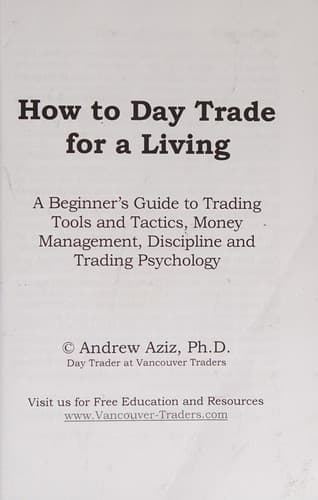
Core Idea
- Difficulty
- Medium
- Read it if
- You are serious about learning the practical aspects of day trading, understanding risk management, and developing a disciplined approach to the market.
- Skip it if
- You are looking for get-rich-quick schemes, guaranteed profits, or a theoretical academic treatise on market mechanics without practical application.
Key Takeaways from How to Day Trade for a Living
Day Trading: A Serious Business, Not a Gamble
Treat day trading with the discipline and preparation of a professional career, not a casual hobby or a lottery ticket.
Aziz states that day trading is a serious profession, needing the same commitment, discipline, and preparation as any high-stakes career. He corrects the idea that it is like gambling or a get-rich-quick scheme. Success here requires careful mental and practical preparation, seeing it as a direct contest against skilled and well-resourced Wall Street professionals. This change in mindset, from casual participant to dedicated professional, is key to navigating markets and making consistent profits.
“Day trading is not gambling. It is not a hobby. You must approach day trading very, very seriously.”
In the book: Aziz contrasts his initial 'pure luck' trade where he made $6,000 but lost it all due to lack of knowledge, with the need for serious preparation. He describes his own morning routine of waking early, exercising, showering, dressing, and eating breakfast before meticulously preparing his trading station and watch list, emphasizing that this routine is crucial for mental readiness.
Try this: Develop and strictly adhere to a consistent pre-market routine that primes you mentally and logistically for trading. This includes physical preparation, reviewing watchlists, and setting a professional tone for your trading environment. Avoid the casual approach of rolling out of bed minutes before the market opens.
Related ideas: trading-discipline, professional-mindset, market-preparation
The Peril of Beginner's Luck
Initial, easy gains often mask a lack of skill, leading to overconfidence and eventual, significant losses.
Aziz warns about 'beginner's luck,' where an easy first profit can create a false sense of skill. This early success, often just chance, can make new traders think they understand the market better than they do. This overconfidence then leads to bigger, riskier trades without proper analysis, eventually causing the loss of both initial gains and capital. It is a common trap that often ends a trading career before it truly begins.
“It was pure luck. I honestly had no idea what I was doing. Within a few weeks I had lost that entire $6,000 by making mistakes in other trades.”
In the book: Aziz recounts his very first trade: buying 1,000 shares of a pharmaceutical company at $4 and selling at over $10, making $6,000 in minutes. He explicitly states, 'It was pure luck. I honestly had no idea what I was doing.' He then admits losing all that money within weeks due to subsequent mistakes.
Try this: If you experience early success, critically evaluate whether it was due to a repeatable strategy or pure chance. Resist the urge to increase your risk exposure dramatically. Instead, use any early gains to invest in further education and refine your trading plan, starting with small, controlled trades.
Related ideas: beginner-psychology, risk-management, overconfidence-bias
Compete with Wall Street, Not Yourself
Recognize that you are up against highly equipped, experienced professionals and must elevate your game accordingly.
The author stresses the need to understand the competitive nature of day trading. New traders are not just competing against market forces, but against highly skilled, well-funded, and experienced professionals. These Wall Street 'sharks' have advanced education, modern tools, and a strong drive for profit. Realizing this should make new traders prepare carefully, learn continuously, and approach the market with respect and strategic planning.
“As a new day trader you should never lose sight of the fact that you are competing with professional traders on Wall Street and other experienced traders around the world who are very serious, highly equipped with advanced education and tools, and most importantly, committed to making money.”
In the book: Aziz directly states that new traders are competing with 'professional traders on Wall Street and other experienced traders around the world who are very serious, highly equipped with advanced education and tools, and most importantly, committed to making money.'
Try this: Invest in your education, acquire appropriate trading tools, and dedicate significant time to market analysis and strategy development. Do not underestimate your competition; approach every trading day as if you are facing the best in the world.
Related ideas: market-competition, professional-trading, edge-development
The Power of a Consistent Morning Routine
A structured start to your day is critical for mental preparedness and optimal decision-making in the market.
Aziz supports a strong morning routine as essential for successful day trading. He argues that the market needs a sharp, alert, and focused mind, which cannot happen with a last-minute rush. A consistent routine, including physical activity, personal care, and pre-market analysis, prepares the trader mentally, improves decision-making, and builds a professional mindset. This disciplined start sets the tone for the trading day, directly affecting performance.
“This morning routine has tremendously helped my mental preparation for coming into the market. Whatever your routine is, starting the morning in a similar fashion will pay invaluable dividends.”
In the book: Aziz details his personal routine: 'I wake up early, go for a run, take a shower, get dressed, eat breakfast, and fire up my trading station before the markets open in New York. I am awake. I am alert. I am motivated when I sit down and start working on the list of stocks I will watch that day.' He explicitly warns against 'rolling out of bed and throwing water on your face 15 minutes before the opening bell' or 'sitting at your computer in your pajamas or underwear.'
Try this: Design and commit to a morning routine that includes physical activity, personal grooming, and dedicated time for market analysis before the opening bell. Treat this routine as sacred, understanding its direct link to your trading success.
Related ideas: trading-routine, mental-preparation, discipline
Clarity Over Complexity
Effective trading education should be concise, practical, and easy to understand, not overly technical.
Aziz says that effective learning in day trading does not need complicated terms or overly complex theories. Instead, he suggests a clear, simple, and practical way to learn. His book aims to simplify complex strategies and ideas, making them easy for anyone to understand, regardless of their financial background. This approach means the core ideas of day trading can be learned and used without getting lost in academic details, helping more people enter the field confidently.
“This book is definitely NOT a difficult, technical, hard to understand, complicated and complex guide to the stock market. It's concise. It's practical. It's written for everyone.”
In the book: Aziz explicitly states his book is 'NOT a difficult, technical, hard to understand, complicated and complex guide' but rather 'concise,' 'practical,' and 'written for everyone,' using 'simple and easy to understand words to explain the strategies and concepts.'
Try this: Seek out educational resources that prioritize clarity and practicality over excessive technicality. Focus on understanding the core concepts and strategies that can be directly applied to live trading, rather than getting lost in theoretical minutiae.
Related ideas: trading-education, simplified-learning, practical-knowledge
Community and Mentorship Accelerate Learning
Engaging with a trading community and observing experienced traders provides invaluable practical insight and support.
The author highlights the great value of a supportive trading community and direct mentorship. Learning from a book is a start, but seeing real-time trading, asking questions, and talking with experienced traders in a shared setting offers practical learning that theory alone cannot provide. This hands-on, interactive learning speeds up skill development, helps clear doubts, and provides emotional support, which is important in the often lonely and tough world of day trading.
“As a purchaser of my book, you will also receive a membership in my community of day traders at www.vancouver-traders.com. You can monitor my screen in real time, watch me trade the strategies explained in his book, and ask questions of me and other traders in our private chat room.”
In the book: Aziz offers readers a membership to his online community, www.vancouver-traders.com, where members can 'monitor my screen in real time, watch me trade the strategies explained in his book, and ask questions of me and other traders in our private chat room.' He also mentions his blog where he shares honest updates, including losses.
Try this: Actively seek out and participate in reputable trading communities. Utilize mentorship opportunities to observe live trading, ask specific questions, and gain insights from experienced traders' decision-making processes.
Related ideas: trading-community, mentorship, experiential-learning
Transparency Builds Trust and Realism
An honest portrayal of trading, including losses, is essential for setting realistic expectations and fostering genuine learning.
Aziz emphasizes transparency from educators in the trading world. He differs from anonymous gurus by openly sharing his own trading experiences, including losses. This honesty is important for setting realistic expectations for aspiring traders, removing the idea of guaranteed profits, and building trust. By seeing that even experienced traders have losses, new traders can better prepare for setbacks and develop the resilience needed for long-term success.
“I'm a real person who you can connect with. I'm not just a photograph here on the Amazon site. I love what I do. You can follow my blog post under Author Updates on my Author page on Amazon. It's honest. You'll see I lose some days.”
In the book: Aziz states, 'I'm a real person who you can connect with.' He invites readers to follow his blog where 'It's honest. You'll see I lose some days.' This direct admission of losses contrasts with typical 'guru' marketing.
Try this: Be wary of trading educators who only showcase wins. Seek out mentors and communities that are transparent about the realities of trading, including the frequency and impact of losses. Embrace the understanding that losses are part of the game and learn from them.
Related ideas: trading-realism, transparency, emotional-resilience
Freedom and Flexibility as the Ultimate Reward
The potential for unparalleled lifestyle freedom is the driving motivation behind mastering day trading.
Aziz presents the unique lifestyle benefits—freedom, flexibility, and unlimited income potential—as the ultimate rewards for going through the tough learning process of day trading. He describes a career that frees individuals from traditional job limits, offering the ability to work from anywhere, set one's own hours, and be accountable only to oneself. This vision is a strong motivator, showing why the intense dedication needed for success is worth it.
“Very few careers can offer you the freedom, flexibility and income that day trading does. As a day trader, you can live and work anywhere in the world. You can decide when to work and when not to work. You only answer to yourself.”
In the book: Aziz opens the book by highlighting the 'freedom, flexibility and income' day trading offers, stating, 'As a day trader, you can live and work anywhere in the world. You can decide when to work and when not to work. You only answer to yourself.'
Try this: Keep the vision of financial independence and lifestyle flexibility as a constant motivator during challenging learning phases. Understand that the hard work invested upfront directly translates into these long-term benefits.
Related ideas: financial-independence, lifestyle-trading, work-life-balance
How to Day Trade for a Living Quotes
“The market is a beast, and you are either its master or its prey.”
“Never risk more than 1% of your capital on any single trade.”
“Patience is not just a virtue in trading; it's a survival skill.”
“Your trading plan is your roadmap; without it, you're lost.”
“Cut your losses quickly, let your winners run.”
“Emotional trading is losing trading.”
“The best traders are also the best record keepers.”
“Focus on process, not just profit.”
“Every trade is a learning opportunity, win or lose.”
“Don't predict, react.”
“The market doesn't care about your opinion, only your capital.”
“Master one setup before trying to master them all.”
“Consistency beats intensity every single time.”
“Your biggest enemy in trading is often yourself.”
Quiz
10 questions on the main ideas. Each answer comes with a short explanation.
Question 1
According to Andrew Aziz, what is a common pitfall for new day traders after a lucky initial success?
- They immediately invest all their profits into long-term stocks.
- They become overconfident and lose all their initial gains, sometimes even their entire account.
- They start teaching others how to trade without sufficient experience.
- They stop trading altogether, believing they've mastered the market.
Show answer
B. They become overconfident and lose all their initial gains, sometimes even their entire account. Aziz recounts his own experience of making $6,000 in a 'pure luck' trade and then losing it all within weeks due to mistakes. He warns that for many, their first mistake after a lucky trade can lead to losing their entire account and quitting day trading.
Question 2
What is the primary characteristic that distinguishes successful day traders from the many who aspire but fail, according to the author?
- Access to exclusive, high-speed trading algorithms.
- The ability to predict market movements with 100% accuracy.
- Having the right tools, motivation, hard work, and perseverance.
- A large initial capital investment.
Show answer
C. Having the right tools, motivation, hard work, and perseverance. The author explicitly states, 'To be successful at day trading you need the right tools and you need to be motivated, to work hard, and to persevere.'
Question 3
What specific routine does Andrew Aziz describe as tremendously helping his mental preparation for the market?
- Reviewing financial news for at least an hour before market open.
- Waking early, running, showering, getting dressed, eating breakfast, and firing up his trading station before markets open.
- Meditating for 30 minutes to clear his mind.
- Practicing simulated trades on a demo account.
Show answer
B. Waking early, running, showering, getting dressed, eating breakfast, and firing up his trading station before markets open. Aziz details his morning routine: 'I wake up early, go for a run, take a shower, get dressed, eat breakfast, and fire up my trading station before the markets open in New York.' He emphasizes this helps his mental preparation.
Question 4
Why does Andrew Aziz stress that day trading is 'not gambling or an online poker game'?
- Because unlike gambling, day trading has no element of risk.
- Because successful day trading requires specific tools, motivation, hard work, and perseverance, implying a serious, skilled approach.
- Because day trading is always profitable, while gambling is not.
- Because day trading is regulated by the SEC, unlike online poker.
Show answer
B. Because successful day trading requires specific tools, motivation, hard work, and perseverance, implying a serious, skilled approach. He explicitly states, 'Day trading is not gambling or an online poker game. To be successful at day trading you need the right tools and you need to be motivated, to work hard, and to persevere.' This contrasts it with activities driven purely by chance.
Question 5
What contrast does Aziz draw between a new day trader and the professionals they compete against?
- New traders have more capital, while professionals rely on speed.
- New traders are often driven by emotion, while professionals are purely logical.
- New traders are often unprepared and lack the advanced education, tools, and commitment of serious, highly equipped professional traders.
- New traders focus on short-term gains, professionals on long-term investments.
Show answer
C. New traders are often unprepared and lack the advanced education, tools, and commitment of serious, highly equipped professional traders. Aziz warns that new traders are 'competing with professional traders on Wall Street and other experienced traders around the world who are very serious, highly equipped with advanced education and tools, and most importantly, committed to making money.'
Question 6
What is one of the key benefits offered to purchasers of 'How to Day Trade for a Living'?
- A personal one-on-one coaching session with Andrew Aziz.
- A free lifetime subscription to a premium stock charting software.
- Membership in his online community of day traders at www.vancouver-traders.com, offering real-time screen monitoring, live trading observation, and Q&A.
- Guaranteed profitable trades for their first month of trading.
Show answer
C. Membership in his online community of day traders at www.vancouver-traders.com, offering real-time screen monitoring, live trading observation, and Q&A. The author states: 'And, as a purchaser of my book, you will also receive a membership in my community of day traders at www.vancouver-traders.com. You can monitor my screen in real time, watch me trade the strategies explained in his book, and ask questions of me and other traders in our private chat room.'
Question 7
What is the author's stated pedagogical approach in 'How to Day Trade for a Living'?
- To provide a highly technical and complex guide for advanced traders.
- To use simple, easy-to-understand words to explain concise, practical strategies and concepts for everyone.
- To focus primarily on theoretical economic models rather than practical application.
- To challenge readers with difficult, abstract concepts to foster critical thinking.
Show answer
B. To use simple, easy-to-understand words to explain concise, practical strategies and concepts for everyone. Aziz explicitly states: 'In this book, I use simple and easy to understand words to explain the strategies and concepts you need to know... This book is definitely NOT a difficult, technical, hard to understand, complicated and complex guide... It's concise. It's practical. It's written for everyone.'
Question 8
The author references an early, 'pure luck' trade where a pharmaceutical stock jumped dramatically. What were the specific details of his profit from this particular trade?
- He bought 1,000 shares at $1 and sold at over $55, making over $54,000.
- He purchased 1,000 shares at $4 and sold them at over $10, making $6,000.
- He bought 100 shares at $4 and sold at over $10, making $600.
- He purchased 500 shares at $1 and sold at $10, making $4,500.
Show answer
B. He purchased 1,000 shares at $4 and sold them at over $10, making $6,000. Aziz states: 'I purchased 1,000 shares at $4 and sold them at over $10. On my very first beginner trade, I made $6,000 in a matter of minutes.'
Question 9
What specific negative impact does Andrew Aziz attribute to starting the trading day unprepared, such as rolling out of bed 15 minutes before the bell or trading in pajamas?
- It leads to technical glitches with trading software.
- It doesn't provide sufficient time for preparation and fails to put one in the right mindset to 'attack the market'.
- It results in immediate account suspension by brokers.
- It attracts negative attention from other traders in online communities.
Show answer
B. It doesn't provide sufficient time for preparation and fails to put one in the right mindset to 'attack the market'. He states: 'Rolling out of bed and throwing water on your face 15 minutes before the opening bell just does not give you sufficient time to be prepared for the market's opening. Sitting at your computer in your pajamas or underwear does not put you in the right mindset to attack the market.'
Question 10
Beyond the book, how does Andrew Aziz demonstrate his commitment to transparency and ongoing support for aspiring traders?
- He offers a money-back guarantee if the reader doesn't become profitable within a month.
- He publicly shares his blog posts under Author Updates on Amazon, acknowledging his losses, and invites interaction in his community.
- He provides a direct phone number for personal trading advice.
- He promises to personally manage the portfolios of his most dedicated readers.
Show answer
B. He publicly shares his blog posts under Author Updates on Amazon, acknowledging his losses, and invites interaction in his community. Aziz says, 'You can follow my blog post under Author Updates on my Author page on Amazon. It's honest. You'll see I lose some days. You can read the reviews of my book. I know you will learn much about day trading and the stock market from studying my book. You can join at no cost and with no obligation my community of day traders at www.vancouver-traders.com. You can ask us questions.'
How to Day Trade for a Living FAQ
What is day trading and how does it differ from traditional investing?
Day trading involves buying and selling financial instruments within the same trading day, aiming to profit from small price fluctuations. Unlike traditional investing, which focuses on long-term growth, day trading is a short-term strategy requiring constant market monitoring and quick decision-making.
Does day trading work for everyone, or do I need specific skills?
While day trading offers freedom and potential income, it's not for everyone. Success requires motivation, hard work, perseverance, and the right tools. It demands a serious approach and mental discipline, rather than treating it like gambling or a hobby.
What is the importance of a morning routine for day traders?
A consistent morning routine is crucial for mental preparation. It helps traders wake up, become alert, and get motivated before the market opens, putting them in the right mindset to analyze stocks and make informed decisions.
How is 'How to Day Trade for a Living' different from other complex trading guides?
This book is designed to be concise, practical, and easy to understand, using simple language to explain strategies and concepts. It avoids difficult, technical jargon often found in other complex guides, making it accessible for everyone interested in day trading.
Can beginners truly beat professional Wall Street traders?
Yes, with the right knowledge and strategies, beginners can learn to compete effectively with professional traders. This book aims to equip new traders with the understanding needed to navigate the market and succeed.
What kind of support is offered to readers of the book?
Purchasers of the book receive a membership to the author's community at www.vancouver-traders.com. This allows them to monitor the author's screen in real-time, watch trading strategies in action, and interact with the author and other traders in a private chat room.
Is day trading considered gambling?
No, day trading is not gambling. It is a serious discipline that requires strategy, analysis, and preparation. Approaching it with a casual mindset, like gambling, often leads to significant losses.
What is the biggest mistake new day traders make?
A common mistake for new day traders is losing their entire capital quickly due to lack of knowledge and making impulsive decisions. Many walk away after one significant loss, highlighting the importance of proper education before trading.
About the author

Andrew Aziz is a successful day trader and author. He is best known for his book "How to Day Trade for a Living," which has become a popular guide for aspiring traders. Aziz shares his practical experience and strategies, making complex trading concepts accessible to a broad audience.
Similar books
- Trading in the Zone
Mark Douglas
4.3 (10k) average on GoodreadsFinanceEmphasizes the psychological discipline crucial for consistent trading success.
- The Diary of a Young Girl
Anne Frank
4.2 (2.7M) average on GoodreadsBiographyDuring the Nazi occupation, a teenage girl's diary, written from a secret annex, shares observations on humanity, hope, and the wait for freedom.
- Twisted 1. Twisted love
Ana Huang
3.7 (1.7M) average on GoodreadsA quiet billionaire with a difficult past finds his guarded heart opening to the woman he must protect, but their growing passion uncovers dangerous secrets and a shared, traumatic history.
- Eat, Pray, Love
Elizabeth Gilbert
3.6 (1.5M) average on GoodreadsLifestyleA heartbroken writer leaves her conventional life for a year-long global search for pleasure in Italy, spiritual devotion in India, and unexpected love and balance in Bali.
- Night
Elie Wiesel
4.3 (970k) average on GoodreadsBiographyIn the darkness of Auschwitz and Buchenwald, a teenage Elie Wiesel faces the extermination of his family, the loss of his faith, and the lasting scars of humanity's deepest cruelty.
- Steve Jobs
Walter Isaacson
4.1 (957k) average on GoodreadsBusinessSteve Jobs was a visionary who fused creativity and technology to revolutionize six industries and shape our digital world.





Enjoyed the summary?
A summary gives you the shape of the book. The book itself has the detail, the examples and the voice.
Find How to Day Trade for a Living on AmazonAs an Amazon Associate, BookBrief earns from qualifying purchases. How we're funded