
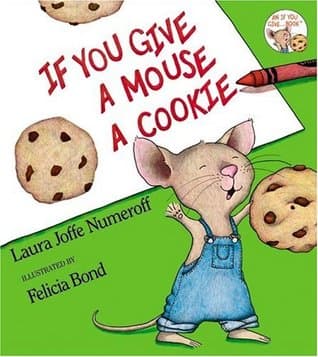
Synopsis
Covers the whole plot, including the ending.
- Difficulty
- Easy
- Pacing
- Fast
- Mood
- Whimsical, Humorous, Energetic, Playful
- Read it if
- You enjoy circular stories, gentle humor, and seeing the unexpected consequences of a simple act of kindness, perfect for young children learning about cause and effect.
- Skip it if
- You prefer complex narratives, character development, or stories with a definitive beginning and end rather than a continuous loop.
If You Give a Mouse a Cookie Plot Summary
Covers the whole plot, including the ending.
A Cookie Request Leads to a Cascade
The story begins with a young boy offering a small, brown mouse a cookie. Immediately, the mouse asks for a glass of milk to go with it. After finishing the milk, he requests a straw. Once he's had his fill, he wants to look in a mirror to check for a milk mustache, prompting him to ask for a pair of nail scissors to trim his hair. This initial series of requests quickly establishes the pattern for the rest of the narrative, where each fulfilled desire leads to a new, related demand from the energetic mouse, keeping the boy involved.
Grooming and Cleaning
After trimming his hair with the boy's scissors, the mouse decides he needs a broom to sweep up the hair trimmings. The boy provides the broom, and the mouse sweeps the entire house. This act of cleaning then makes him feel warm and prompts him to ask for a nap. The boy prepares a cozy bed for the mouse, with a blanket and a pillow. The mouse, however, is not quite ready for sleep.
Naptime and Storytime
The mouse, now in bed, finds it difficult to fall asleep. He requests a story from the boy. The boy reads him a story, and the mouse enjoys it so much that he asks to see the pictures. Looking at the pictures in the book reminds him of his own drawings. This shift from napping to creative expression shows the mouse's unpredictable desires, keeping the boy constantly fulfilling his whims.
Art and Display
Inspired by the book's illustrations, the mouse asks for paper and crayons to draw a picture. He draws a picture, and then, wanting to display his artwork, asks for tape to hang it on the refrigerator. Once his picture is displayed, he stands back to admire it. This moment of artistic satisfaction, however, is short-lived as a new thought immediately sparks in his mind, ready to continue the cycle of requests.
Refrigerator and Refreshments
Standing in front of the refrigerator, admiring his drawing, the mouse suddenly notices the refrigerator door. This visual cue reminds him that he is thirsty again. He then asks for a glass of milk. This request brings the narrative full circle, as the mouse's thirst for milk was the very first demand he made after receiving the initial cookie. The boy, having gone through many tasks, prepares another glass of milk.
The Cycle Continues
As the boy hands the mouse the glass of milk, the mouse, now with his thirst quenched, looks at the boy. The sight of the boy, with the milk, reminds him of the very first thing he was offered. With a contented look, the mouse then asks for a cookie to go with his milk, bringing the story back to its starting point and implying an endless loop of requests for the patient young host.
If You Give a Mouse a Cookie Characters
The Boy
Protagonist
The obliging host who fulfills the mouse's every request.
The boy is the story's young protagonist, characterized by his remarkable patience and willingness to accommodate the mouse's ever-escalating demands. He is the provider of cookies, milk, straws, mirrors, scissors, brooms, beds, books, paper, crayons, and tape. His actions drive the plot as he diligently responds to each new request without complaint. He represents the generous and accommodating nature of a child, caught in a delightful, yet demanding, chain of events initiated by a simple act of kindness.
Relationships: The Mouse (host and guest; provider and demander)
The Mouse
Antagonist/Supporting
The energetic and demanding guest who sets off a chain of events.
The mouse is a small, brown, and highly energetic creature whose initial request for a cookie sets the entire plot in motion. He is characterized by his insatiable curiosity and a seemingly endless stream of interconnected desires. Each fulfilled request immediately sparks a new one, leading him from grooming to cleaning, napping to drawing, and back to thirst. He is the catalyst for the boy's actions, and his whimsical, demanding nature is the central comedic and narrative force of the book.
Relationships: The Boy (guest and host; demander and provider)
If You Give a Mouse a Cookie Themes
The Ripple Effect of Small Actions
This theme is central to the book, showing how a single action—giving a mouse a cookie—can lead to a long, interconnected chain of consequences. Each request from the mouse directly stems from the previous one, showing a cause-and-effect relationship that builds throughout the story. For example, the milk leads to a mirror, the trim leads to a broom, and the drawing leads to the refrigerator, eventually bringing the story full circle. This highlights how one decision can have far-reaching and often unexpected implications.
“If you give a mouse a cookie, he's going to ask for a glass of milk.”
Hospitality and Generosity
The boy's character shows hospitality and generosity. Despite the mouse's many demands, the boy consistently and patiently fulfills each request, from providing food and drink to grooming tools, cleaning supplies, and entertainment. His willingness to go to great lengths for his tiny guest shows a spirit of giving without expectation. This theme emphasizes the kindness and accommodating nature that can be found in simple acts of welcome and care.
“He'll want to look in a mirror to make sure he doesn't have a milk mustache.”
The Nature of Wants and Desires
The story playfully explores the continuous nature of wants and desires. The mouse's every action is driven by a new need or whim that arises directly from the satisfaction of the previous one. This shows how satisfying one desire can immediately trigger another, creating an endless cycle. The mouse's journey from a cookie to milk, a haircut, cleaning, napping, drawing, and back to milk and a cookie, humorously portrays the human (or mouse) tendency for desires to snowball and never be fully satisfied.
“And chances are, if he asks for a glass of milk, he's going to want a cookie to go with it.”
Plot Devices & Literary Techniques
Chain Reaction (Domino Effect)
A series of events where each outcome triggers the next.
The entire narrative structure of 'If You Give a Mouse a Cookie' is built upon a chain reaction. Each action taken by the boy to fulfill a mouse's request immediately leads to the mouse making another, related request. For instance, giving milk leads to a straw, then a mirror, then scissors. This device creates a fast-paced, cumulative plot where the reader anticipates the next logical (or sometimes illogical) step in the sequence, making the story engaging and predictable in its pattern but surprising in its specific demands.
Circular Narrative
The story begins and ends in the same place, creating a loop.
The story employs a circular narrative, starting with the mouse asking for a cookie and concluding with the mouse, after a long sequence of activities, once again asking for a cookie to go with his milk. This device provides a sense of completion while also implying an endless, ongoing cycle. It suggests that the boy's generosity could lead to this entire sequence repeating, reinforcing the idea of continuous wants and the ripple effect of small actions.
Predictable Pattern with Unpredictable Content
A consistent 'if-then' structure with varied outcomes.
The book establishes a clear 'if you give X, then Y will happen' pattern. This predictable structure helps young readers follow the cause-and-effect logic. However, the specific content of the mouse's requests is often unexpected and humorous (e.g., sweeping the whole house after a haircut). This combination of a reliable narrative framework with surprising plot points keeps the story fresh and entertaining, allowing for both anticipation and delight.
If You Give a Mouse a Cookie Quotes
“If you give a mouse a cookie, he's going to ask for a glass of milk.”
“When you give him the milk, he'll probably ask you for a straw.”
“He'll want to look in a mirror to make sure he doesn't have a milk mustache.”
“Then he'll want to trim his hair.”
“When he's finished, he'll want a broom to sweep up.”
“He'll start sweeping. He might get carried away and sweep every room in the house.”
“He might even end up washing the floors.”
“Then he'll probably want to take a nap.”
“You'll have to fix a little box for him with a blanket and a pillow.”
“When he wakes up, he'll want to read a book.”
“He'll ask for paper and crayons to draw a picture.”
“He'll want to hang his drawing on the refrigerator.”
“Looking at the refrigerator will remind him that he's thirsty.”
“So he'll ask for a glass of milk.”
“And chances are if he asks for a glass of milk, he's going to want a cookie to go with it.”
Quiz
10 questions on the plot and the characters. Each answer comes with a short explanation.
Question 1
What is the first thing the mouse asks for after receiving a cookie?
- A glass of milk
- A napkin
- A mirror
- Scissors
Show answer
A. A glass of milk In the book, after receiving a cookie, the mouse immediately asks for a glass of milk to go with it, starting the chain of requests.
Question 2
Why does the mouse want to look in a mirror?
- To check if his fur is tidy
- To make sure he doesn't have a milk mustache
- To see if he looks hungry
- To admire his new haircut
Show answer
B. To make sure he doesn't have a milk mustache After drinking the milk, the mouse wants to look in a mirror specifically to check for a milk mustache, which leads to the next request.
Question 3
What does the mouse do after getting a pair of scissors?
- Cuts the host's hair
- Trims his own fur
- Cuts out paper shapes
- Opens a package
Show answer
B. Trims his own fur The mouse uses the scissors to give himself a trim after seeing himself in the mirror, which creates a mess of hair clippings.
Question 4
What activity does the mouse engage in after sweeping up the hair clippings?
- Taking a nap
- Drawing a picture
- Washing the floors
- Baking more cookies
Show answer
C. Washing the floors After sweeping, the mouse gets carried away and decides to wash the floors, showing how one task leads to another in the story.
Question 5
What does the mouse need after washing the floors?
- A towel to dry off
- A bucket and mop
- A nap
- A snack
Show answer
C. A nap Exhausted from all the cleaning, the mouse asks for a nap, which requires a pillow and blanket, continuing the chain of events.
Question 6
What does the mouse want to do when he wakes up from his nap?
- Eat another cookie
- Read a story
- Play outside
- Clean up again
Show answer
B. Read a story After napping, the mouse feels refreshed and asks to read a story, which leads to drawing a picture of his family.
Question 7
What is a key theme illustrated by the mouse's series of requests?
- The importance of sharing
- The value of hard work
- The chain reaction of cause and effect
- The dangers of being too generous
Show answer
C. The chain reaction of cause and effect The book humorously shows how one small action (giving a cookie) leads to a long, unpredictable chain of events, teaching children about cause and effect.
Question 8
How does the story end?
- The mouse leaves the house
- The host gives the mouse another cookie
- The mouse falls asleep forever
- The host refuses any more requests
Show answer
B. The host gives the mouse another cookie After drawing a picture, the mouse wants to hang it on the refrigerator, which reminds him of cookies, so he asks for another cookie, bringing the story full circle.
Question 9
What does the mouse do with the picture he draws?
- Gives it to the host as a thank-you
- Hangs it on the refrigerator
- Mails it to his family
- Uses it as a placemat
Show answer
B. Hangs it on the refrigerator The mouse draws a picture of his family and then asks for tape to hang it on the refrigerator, which is a key detail leading to the story's cyclical ending.
Question 10
Which of the following best describes the host's role in the story?
- A strict disciplinarian who sets limits
- A passive observer who does nothing
- An exhausted but accommodating helper
- A playful friend who joins in the fun
Show answer
C. An exhausted but accommodating helper The host is constantly running to fulfill the mouse's endless requests, becoming 'ragged' but never refusing, highlighting the humorous burden of hospitality.
If You Give a Mouse a Cookie FAQ
What is 'If You Give a Mouse a Cookie' about?
The book follows a young boy who gives a cookie to a hungry mouse, triggering a chain of escalating requests. The mouse asks for milk, a mirror to check for a milk mustache, scissors for a trim, a broom to clean up, and eventually wants to take a nap, read a story, and draw a picture, ultimately leading back to wanting another cookie.
Why should I read 'If You Give a Mouse a Cookie'?
It's a delightful introduction to cause-and-effect logic for young children, with charming illustrations by Felicia Bond that bring the mouse's energetic antics to life. The circular narrative structure teaches about consequences in a fun, engaging way that resonates with both kids and adults.
What is the background/setting of 'If You Give a Mouse a Cookie'?
The story takes place entirely within a cozy, suburban-style home belonging to a young boy. There's no specific time period indicated, creating a timeless feel that focuses on the domestic interactions between the boy and the mouse in familiar rooms like the kitchen and living room.
What are the most memorable quotes?
The opening line 'If you give a mouse a cookie, he's going to ask for a glass of milk' sets the entire story in motion. The circular ending 'And chances are... he'll want a cookie to go with it' perfectly completes the cycle, while phrases like 'he'll probably ask you for a pair of scissors' capture the mouse's escalating demands.
What writing style does the author use?
Laura Numeroff employs a repetitive, cumulative structure with conditional 'if-then' statements that build logically from one request to the next. The language is simple and rhythmic, perfect for read-aloud sessions, with a circular narrative that returns to the beginning by the end.
What minor details add significant meaning?
The mouse's request for a straw with his milk shows his particular nature, while wanting to check for a milk mustache in a mirror reveals his vanity. The tiny drawings he creates with crayons and tape demonstrate his creativity, and his eventual exhaustion that leads to napping shows he's just an energetic child-like character.
What are some subtle foreshadowing moments?
When the mouse asks for a napkin after drinking milk, it hints at future cleaning requests. His interest in the broom after sweeping up his hair trimmings foreshadows his desire to sweep the entire house. The drawing activity with crayons and tape subtly suggests he'll want to display his artwork.
What unexpected character connections exist?
While only the boy and mouse appear, their relationship evolves from host-guest to something resembling parent-child or older sibling-younger sibling dynamics. The boy's patient responses to increasingly demanding requests create an unspoken bond of caretaking that gives emotional depth to their simple interactions.
What are unspoken character motivations?
The mouse seems driven by both genuine needs (hunger, thirst) and whimsical desires (vanity, creativity), while the boy appears motivated by kindness mixed with a sense of obligation once he starts the chain. Neither character speaks beyond the requests, allowing readers to project their own interpretations onto their silent cooperation.
What psychological complexities do characters exhibit?
The mouse displays ADHD-like traits with rapidly shifting interests, while the boy shows remarkable patience and adaptability. Their dynamic explores how small acts of generosity can create unexpected responsibilities, and how accommodating others' needs can be both exhausting and rewarding.
What are the major emotional turning points?
The transition from practical needs (cookie, milk) to vanity (mirror) marks a shift to more personal requests. When the mouse wants to nap and be read to, it reveals vulnerability. The drawing sequence shows creative fulfillment, while the final return to wanting a cookie creates emotional circularity.
How do relationship dynamics evolve?
Initially transactional (request-fulfillment), the relationship deepens as the boy patiently meets each new need. By the nap and story-reading scenes, it becomes nurturing. The shared activity of drawing creates collaboration, transforming them from strangers to companions engaged in mutual creative expression.
Which parts remain ambiguous or open-ended?
We never learn where the mouse came from or why he chose this particular house. The boy's thoughts and feelings about the escalating demands remain unstated. Most intriguingly, the circular ending leaves open whether this cycle will repeat indefinitely or if patterns might eventually change.
What are controversial scenes or decisions?
Some readers debate whether the boy should have set boundaries instead of accommodating every request. The mouse using scissors without supervision raises safety concerns for some parents. Others question if the story encourages limitless giving or simply illustrates natural consequences of initial actions.
'If You Give a Mouse a Cookie' ending explained: how it ends & what it means
The mouse draws a picture, tapes it to the refrigerator, stands back to admire it, feels thirsty, and asks for a glass of milk - which will likely make him want a cookie to go with it. This completes the circular narrative, suggesting that kindness creates ongoing cycles of interaction and that small actions can have endless consequences.
What deeper themes does the book explore beyond the surface story?
Beyond cause-and-effect, the book explores themes of hospitality, patience, creativity, and the unexpected joys and burdens of caring for others. It subtly comments on how one kind act can lead to a cascade of responsibilities, and how domestic life contains cycles of need, fulfillment, and renewed need.
Similar books
- The Very Hungry Caterpillar
Eric Carle
4.3 (396k) average on GoodreadsChildren'sWhile both use repetition and sequential events, Carle's book centers on a biological transformation and the concept of growth, providing an educational element about nature and counting. Numeroff's work is less about natural science and more about the whimsical, almost absurd, consequences of a simple act of generosity, focusing purely on a cause-and-effect narrative.
- Harry Potter and the Sorcerer's Stone
J.K. Rowling
4.5 (7M) average on GoodreadsFantasyRescued from a miserable life under the stairs, an orphaned boy discovers he's a wizard destined for a magical school, where he uncovers a dangerous secret tied to the dark wizard who murdered his parents.
- The Hunger Games
Suzanne Collins
4.3 (6.4M) average on GoodreadsFantasyIn a future where children fight to the death on live television, Katniss Everdeen volunteers for the arena, turning a death sentence into a fight for survival and a spark of rebellion.
- 1984
George Orwell
4.2 (3.1M) average on GoodreadsPoliticsIn a future where surveillance and thought control are absolute, a man's search for truth clashes with the Party, showing that hope can be a form of rebellion.
- Divergent
Veronica Roth
4.2 (2.9M) average on GoodreadsFantasyIn a society divided by virtues, a sixteen-year-old's difference from the norm starts a rebellion that threatens her world.
- The Hobbit, or There and Back Again
J.R.R. Tolkien
4.3 (2.9M) average on GoodreadsFantasyA comfort-loving hobbit named Bilbo Baggins is whisked away by a mischievous wizard and a band of dwarves on an unexpected journey to reclaim stolen treasure from a fearsome dragon, discovering courage and a magical ring along the way.





Enjoyed the summary?
A summary gives you the shape of the book. The book itself has the detail, the examples and the voice.
Find If You Give a Mouse a Cookie on AmazonAs an Amazon Associate, BookBrief earns from qualifying purchases. How we're funded