
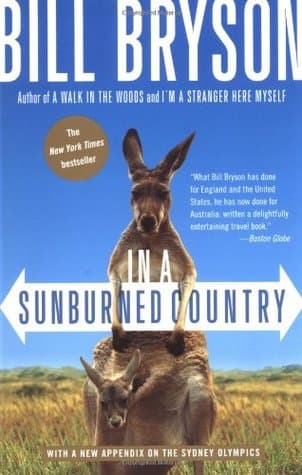
Core Idea
- Difficulty
- Easy
- Read it if
- You enjoy humorous travelogues, want to learn about Australia's history and unique culture through an outsider's perspective, or appreciate witty observations on the absurdities of life and nature.
- Skip it if
- You prefer serious academic histories, are looking for a detailed guide to Australian cities or attractions, or dislike digressions and personal anecdotes in non-fiction.
Key Takeaways from In a Sunburned Country
Australia's Lethal Allure
A continent teeming with unparalleled danger, yet strangely captivating.
Bryson shows the contrast of Australia: a beautiful land with friendly people, but also many deadly creatures and natural hazards. From snakes and spiders to crocodiles, sharks, and the outback, the book describes a country where just living can feel like an extreme sport. This constant danger makes Australia feel like a grand adventure. It is a place where you are always close to a dangerous encounter, yet its charm is clear.
“Australia has more things that can kill you in extremely nasty ways than anywhere else.”
In the book: Bryson recounts numerous close calls and detailed descriptions of various deadly species, from the inland taipan (the world's most venomous snake) to the box jellyfish and saltwater crocodiles. He frequently marvels at the sheer variety and potency of Australia's dangerous fauna.
Try this: When traveling to seemingly 'safe' destinations, research potential local dangers beyond typical crime statistics. Appreciate the unique ecological characteristics of a region, even if they are intimidating. Embrace a sense of adventure, but always with a healthy respect for local hazards.
Related ideas: australian-wildlife, travel-safety, ecological-paradox
The Unflappable Aussie Spirit
Despite constant threats, Australians embody an optimistic, obliging, and resilient character.
One of Bryson's observations is the cheerfulness and resilience of Australians. Despite living in a country that could kill them, and often dealing with extreme weather, Australians are friendly, relaxed, and helpful. This optimism and 'no worries' attitude is a national trait, perhaps shaped by their challenging environment. Bryson often admires their ability to handle life's absurdities and dangers, always with a smile and a cold beer.
“Wherever he goes he finds Australians who are cheerful, extroverted, and unfailingly obliging.”
In the book: Bryson's numerous interactions with locals: the helpful hotel staff, the friendly folks he meets in pubs, the cheerful tour guides, and even the everyday people he encounters who readily offer assistance or strike up conversations. He notes their lack of pretension and genuine hospitality across different regions.
Try this: Cultivate a more resilient and optimistic outlook, even when faced with challenging circumstances. Practice genuine friendliness and helpfulness in daily interactions, mirroring the 'no worries' attitude. Learn to appreciate the simple pleasures and maintain a good sense of humor.
Related ideas: australian-culture, resilience, optimism, no-worries-attitude
The Tyranny of Distance
Australia's immense scale and sparse population create unique challenges and a distinct national identity.
Bryson often points out Australia's huge size. It is a continent so vast that its emptiness defines much of its character. The distances between cities are enormous, and the interior is mostly unpopulated and harsh. This 'tyranny of distance' has shaped everything from roads to the national mood, creating self-reliance and a sense of isolation. It also makes travel within the country a big effort, often requiring long, boring journeys that Bryson describes with humor and frustration.
“Australia is an immense and fortunate land.”
In the book: Bryson's descriptions of endless drives through the outback, the sparse towns he encounters, and statistics about Australia's population density compared to its landmass. He frequently highlights the vast emptiness between pockets of civilization.
Try this: When planning travel, fully grasp the scale of the destination and allocate sufficient time for transit. Appreciate how geography and size can profoundly influence a country's culture and development. Recognize the value of remote and untouched natural spaces.
Related ideas: australian-geography, outback, vastness, isolation
A History of Quirks and Catastrophes
Australia's past is a fascinating blend of penal origins, pioneering spirit, and perplexing decisions.
Bryson explores Australia's short but rich and often strange history, from its start as a penal colony to its struggles with settlement and nation-building. He finds stories of eccentric explorers, failed expeditions, and odd political choices that shaped the modern nation. The story has historical anecdotes that are both funny and touching, showing a country that has defied expectations and made its own path, often against big challenges. Its history shows human cleverness and big environmental challenges.
“Australia is a place that makes you feel small and insignificant, but in a good way.”
In the book: Bryson recounts the story of the First Fleet, the early struggles of colonial governors, the ill-fated expeditions of explorers like Burke and Wills, and the Emu War. He also touches on the treatment of Indigenous Australians and the impact of European settlement.
Try this: Always research the historical context of a place you visit; it enriches the experience. Understand that national identities are often forged through unique and sometimes challenging historical events. Appreciate the human stories behind grand historical narratives.
Related ideas: australian-history, colonialism, exploration, national-identity
The Absurdity of Australian Nomenclature
A place where geographic names are often either mundane or comically literal.
Bryson finds humor in Australia's often uninspired or strange place names. From 'Woolloomooloo' to 'Wagga Wagga,' and many 'Dry Creeks' or 'Mount Disappointments,' the names reflect Indigenous influences, colonial practicality, and a lack of poetic flair. He notes how these names, while sometimes charming, show the vast, untamed nature of the land and the simple approach of its early settlers. This small detail says a lot about the country's character.
“Australia is a land of oddities, and that extends to its place names.”
In the book: Bryson provides a list of numerous real Australian place names, often contrasting their mundane or descriptive nature with the dramatic landscapes they inhabit. He particularly enjoys names that are repetitive or comically literal.
Try this: Pay attention to local place names; they often hold clues to a region's history, geography, or cultural quirks. Find humor in the small, seemingly insignificant details of a new culture. Appreciate the unique linguistic tapestry of different places.
Related ideas: toponymy, australian-culture, linguistic-quirks, travel-humor
Environmental Vulnerability and Resilience
Despite its harshness, Australia's ecosystems are incredibly fragile and require careful stewardship.
Beyond the immediate dangers, Bryson points out the delicate balance of Australia's ecosystems. He mentions the impact of introduced species, the problems of water management in a dry continent, and the threat of bushfires. While admiring the land's rugged beauty, he also shows its vulnerability and the ongoing efforts needed to save its natural wonders. It is a reminder that even the strongest landscapes are affected by human actions and climate change, requiring careful environmental policies.
“Australia is a land of extremes, and its environment often reflects that.”
In the book: Bryson mentions the rabbit plague, the cane toad problem, and the extensive efforts in national parks to preserve native flora and fauna. He also describes the arid conditions of the outback and the importance of water sources.
Try this: Become more aware of the environmental challenges faced by different regions and support sustainable tourism practices. Understand the long-term impact of human intervention on delicate ecosystems. Appreciate the importance of conservation efforts in preserving biodiversity.
Related ideas: environmental-conservation, australian-ecology, introduced-species, climate-impact
The Joy of Unplanned Discovery
Bryson's travel style emphasizes serendipity and embracing the unexpected.
Bryson's trip through Australia is less about a strict plan and more about letting curiosity and chance encounters guide him. He often changes routes, talks to strangers, and explores obscure towns or attractions just because they catch his eye. This way of traveling, marked by a willingness to embrace the unexpected and a joy in discovery, is a main theme. It shows that the best travel experiences often come from letting go of control and being open to good luck, rather than planning every detail.
“The greatest reward and luxury of travel is to be able to experience everyday things as if for the first time.”
In the book: Bryson's numerous detours, spontaneous conversations with locals that lead to new insights, and his willingness to spend time in small, seemingly insignificant towns. His travel narrative often follows a meandering path rather than a direct one.
Try this: Adopt a more flexible and open-minded approach to travel, allowing for spontaneous detours and unplanned experiences. Engage with locals and be open to their recommendations. Practice mindful observation and find wonder in the ordinary details of a new place.
Related ideas: spontaneous-travel, travel-philosophy, discovery, mindful-travel
The Humorous Lens of Observation
Bryson's unique blend of wit and self-deprecation makes even mundane observations entertaining.
A key part of Bryson's writing is his ability to add humor to even the driest facts or hardest situations. His observations, combined with self-deprecating wit and exaggeration, make his Australian adventure a funny read. He finds humor in everything from complicated instructions to the boredom of long journeys, making the reader feel like a friend on his trips. This comedic view entertains and makes the information he presents easier to understand and remember.
“I can't believe I'm doing this, and yet here I am.”
In the book: Bryson's descriptions of trying to understand Australian slang, his exasperation with confusing road signs, his humorous recounting of his own minor mishaps, and his witty asides about historical figures or local customs.
Try this: Cultivate a sense of humor in daily life and travel, finding amusement in challenges and quirks. Practice observational writing or journaling to hone your ability to describe and interpret experiences. Don't take yourself too seriously, especially when encountering new cultures.
Related ideas: travel-writing, humor, observational-skills, self-deprecation
Understated National Pride
Australians possess a deep, quiet affection for their unique, challenging homeland.
While not overly nationalistic, Bryson sees a quiet pride among Australians for their country. This is not boastful patriotism, but an appreciation for their lifestyle, their beautiful yet harsh environment, and their resilient spirit. They seem to understand their unique place in the world – a large, isolated continent with a small population and many natural wonders. Bryson, despite his humorous critiques, comes to share this affection, showing Australia as a special and loved place.
“Australia is immense and fortunate land, and it has found in Bill Bryson its perfect guide.”
In the book: The consistent friendliness and hospitality Bryson encounters, the willingness of locals to share stories and knowledge about their country, and the evident care taken in maintaining national parks and cultural sites. Bryson's own concluding sentiments about his fondness for Australia.
Try this: Seek to understand and appreciate the subtle forms of national identity and pride in cultures you encounter. Look beyond surface-level observations to grasp deeper cultural values. Allow yourself to develop genuine affection for the places you visit.
Related ideas: national-identity, cultural-pride, australian-values, travel-connection
The Enduring Mystery of the Outback
Vast, empty, and strangely compelling, the Australian interior remains an enigma.
Despite traveling widely, Bryson often returns to the Australian outback as a place of lasting mystery and emptiness. It is a landscape that challenges understanding with its size, its harshness, and its ability to absorb human efforts. He finds it both terrifying and captivating, a symbol of Australia's wild heart. The outback represents the ultimate test of survival and a reminder of humanity's smallness against nature, leaving a lasting feeling of awe.
“The outback is not just a place; it's a state of mind.”
In the book: Bryson's detailed descriptions of his long drives through the arid interior, his accounts of the few isolated settlements, and the stories of explorers lost to its vastness. He often reflects on the psychological impact of such an immense, empty space.
Try this: Cultivate an appreciation for wild, untamed natural spaces and their inherent power. Understand the psychological impact of vast landscapes on human perception. Respect the boundaries and dangers of extreme environments when exploring.
Related ideas: australian-outback, wilderness, desolation, natural-wonder
In a Sunburned Country Quotes
“Australia is an, at least outwardly, an uncomplicated place. It is a land of good-natured, unpretentious people who like a beer and a barbecue and who will always give a stranger a fair go.”
“Even the air wants to kill you. The sun is a potent enemy, the humidity often oppressive, and the air itself, at certain times of the year, is filled with pollen and other allergens that can make life miserable.”
“Australia is an enormous country, almost the size of the United States, but with a population of only eighteen million.”
“Australians are not afraid of anything, except perhaps a quiet moment.”
“I had of course been warned about Australia's dangerous creatures, but I hadn't quite grasped the scale of the problem.”
“If you are not careful, you can find yourself in a very deep hole in Australia.”
“The thing about Australia is that it's an old country. Very old. The rocks are old, the land is old, the trees are old, and the people, well, the Aboriginal people have been here for a very long time.”
“It is a country that can kill you in a hundred different ways, but it is also a country that can enthrall you with its beauty and its sheer unlikeliness.”
“Everywhere you go in Australia, you can sense the immensity of the place, the emptiness, the sense of being on the edge of something truly vast and untamed.”
“Australia is an excellent place to go if you want to be reminded that the world is large and full of wonder.”
“I had never imagined that a country could be so utterly, utterly dry and yet so full of life.”
“The history of Australia is largely a history of people trying to get rich quickly and usually failing.”
“It is a country that truly defies expectation.”
“The greatest danger in Australia is not the sharks or the snakes or the spiders, but the sun itself.”
Quiz
10 questions on the main ideas. Each answer comes with a short explanation.
Question 1
Which of the following best describes Bill Bryson's general attitude towards Australia, despite its dangerous wildlife?
- He found it overly hostile and preferred to stay in major cities.
- He adored the place, finding its inhabitants friendly and the country fascinating.
- He was constantly fearful and regretted his decision to visit.
- He was indifferent to the country, focusing solely on its historical aspects.
Show answer
B. He adored the place, finding its inhabitants friendly and the country fascinating. Despite the numerous dangers, the book highlights Bryson's deep affection for Australia, its people, and its unique characteristics. He found the inhabitants cheerful and obliging.
Question 2
What previous book by Bill Bryson is mentioned as a national bestseller, involving a hike?
- Notes from a Small Island
- A Short History of Nearly Everything
- A Walk in the Woods
- Neither Here Nor There
Show answer
C. A Walk in the Woods The description explicitly states that his 'previous excursion along the Appalachian Trail resulted in the sublime national bestseller A Walk in the Woods.'
Question 3
According to the book's description, what unique geographical characteristic does Australia possess?
- It is the only country entirely below sea level.
- It is the largest island in the world.
- It is the only country that doubles as a continent.
- It has no active volcanoes.
Show answer
C. It is the only country that doubles as a continent. The summary states, 'Australia, the country that doubles as a continent,' highlighting its unique geological status.
Question 4
Which of the following is NOT listed as a potential danger in Australia that Bryson encounters or mentions?
- Sharks
- Crocodiles
- Polar bears
- Riptides and deserts
Show answer
C. Polar bears The text mentions sharks, crocodiles, snakes, riptides, and deserts as dangers. Polar bears are not native to Australia and are not mentioned in the context of Australian dangers.
Question 5
How does Bill Bryson typically portray Australians in 'In a Sunburned Country'?
- Reserved and somewhat wary of outsiders.
- Cheerful, extroverted, and unfailingly obliging.
- Primarily focused on their work and less on social interaction.
- Often bewildered by the dangers of their own country.
Show answer
B. Cheerful, extroverted, and unfailingly obliging. The description explicitly states that 'Wherever he goes he finds Australians who are cheerful, extroverted, and unfailingly obliging.'
Question 6
What is a core element of Bryson's writing style highlighted in the description of 'In a Sunburned Country'?
- Strictly academic and objective reporting.
- A blend of humor, wonder, and unflagging curiosity.
- Dark, cynical observations about human nature.
- Focus on fictional narratives rather than factual accounts.
Show answer
B. A blend of humor, wonder, and unflagging curiosity. The text describes the book as 'a deliciously funny, fact-filled, and adventurous performance by a writer who combines humor, wonder, and unflagging curiosity.'
Question 7
The book promises to take readers 'far beyond that beaten tourist path.' What does this imply about Bryson's travel approach in Australia?
- He primarily visited well-known, popular landmarks and resorts.
- He avoided all major cities and only explored remote wilderness.
- He sought out less common destinations and experiences, offering a deeper look at the country.
- He focused exclusively on historical sites, ignoring contemporary Australian life.
Show answer
C. He sought out less common destinations and experiences, offering a deeper look at the country. Going 'far beyond that beaten tourist path' suggests Bryson delves into areas and experiences not typically covered by standard tourism, offering a more unique and comprehensive view of Australia.
Question 8
What specific characteristic is attributed to Australian cities in the book's description?
- They are overcrowded and polluted.
- They are clean and safe.
- They are largely indistinguishable from European cities.
- They are primarily industrial centers with little cultural appeal.
Show answer
B. They are clean and safe. The text mentions 'clean, safe cities' as one of the positive attributes associated with Australia and its inhabitants.
Question 9
The description refers to Australia as 'an immense and fortunate land.' What aspect of this 'fortune' is emphasized in relation to its appeal?
- Its vast mineral wealth and economic power.
- Its rich history of ancient civilizations.
- Its constant sunshine, cold beer, and friendly people.
- Its minimal exposure to global conflicts.
Show answer
C. Its constant sunshine, cold beer, and friendly people. The 'fortune' is linked to the 'beaming products of land with clean, safe cities, cold beer, and constant sunshine' which fill the pages, suggesting these elements contribute to its fortunate nature.
Question 10
How does the book describe the overall experience of reading 'In a Sunburned Country'?
- A somber reflection on environmental challenges.
- A purely academic study of Australian history.
- A rollicking ride that is deliciously funny and fact-filled.
- A tense survival guide for navigating dangerous landscapes.
Show answer
C. A rollicking ride that is deliciously funny and fact-filled. The description calls the result 'a deliciously funny, fact-filled, and adventurous performance' and 'a rollicking ride,' emphasizing the entertaining and informative nature of the book.
In a Sunburned Country FAQ
What is 'In a Sunburned Country' about?
'In a Sunburned Country' is Bill Bryson's humorous and fact-filled account of his travels across Australia. He explores the continent's unique geography, history, peculiar wildlife, and encounters its famously friendly inhabitants, all while sharing his characteristic wit and observations.
Does Bill Bryson enjoy Australia despite its dangers?
Yes, despite detailing the numerous dangerous animals and natural hazards Australia possesses, Bill Bryson expresses a deep affection for the country. He highlights its beauty, the warmth of its people, and its unique charm throughout his journey.
Is 'In a Sunburned Country' a good book for planning a trip to Australia?
While not a traditional travel guide, the book offers vivid descriptions of various regions and insights into Australian culture, history, and wildlife. It can certainly inspire travel and provide a rich background for those planning a visit, though it focuses more on adventure and observation than practical planning.
What kind of humor can I expect in 'In a Sunburned Country'?
Readers can expect Bill Bryson's signature blend of dry wit, self-deprecating humor, and amusing anecdotes derived from his observations and experiences. His humor often comes from unexpected facts, cultural quirks, and his own occasional misadventures.
How does 'In a Sunburned Country' compare to Bryson's 'A Walk in the Woods'?
Both books showcase Bryson's travel writing and humor, but 'In a Sunburned Country' focuses on a continent-wide exploration of Australia, emphasizing its unique dangers and culture. 'A Walk in the Woods' details his specific journey along the Appalachian Trail, with a more singular focus on hiking and American wilderness.
Does the book cover Australian history?
Yes, Bryson weaves a considerable amount of Australian history into his narrative, from its Indigenous origins to its colonial past and modern development. He presents historical facts and figures in an engaging and accessible manner, often connecting them to the places he visits.
What kind of wildlife does Bryson encounter in Australia?
Bryson vividly describes a wide array of Australia's unique and often dangerous wildlife, including various snakes, spiders, crocodiles, sharks, and jellyfish. He also touches upon more iconic creatures like kangaroos and koalas, often highlighting their peculiarities and potential hazards.
Is 'In a Sunburned Country' suitable for all ages?
The book is generally suitable for adult readers and older teenagers due to its detailed descriptions, occasional mature themes (related to history or dangers), and sophisticated humor. Younger readers might find some of the historical and scientific details less engaging.
What are some key themes explored in the book?
Key themes include the immense scale and unique biodiversity of Australia, the resilience and character of its people, the often-overlooked dangers of its natural environment, and the fascinating complexities of its history. Bryson also explores the human desire for exploration and understanding.
About the author

Bill Bryson is an American author known for his engaging non-fiction works that explore various subjects, including travel and science. His notable books include "A Walk in the Woods: Rediscovering America on the Appalachian Trail," which recounts his hiking experience, "A Short History of Nearly Everything," a popular science overview, "In a Sunburned Country," detailing his travels in Australia, and "Made in America," which examines the history of American English.
Similar books
- A Walk in the Woods: Rediscovering America on the Appalachian Trail
Bill Bryson
4.1 (346k) average on GoodreadsLifestyleAnother humorous travelogue by Bryson, focusing on the Appalachian Trail with similar wit and observational style.
- The Hitchhiker's Guide to the Galaxy
Douglas Adams
4.2 (1.4M) average on GoodreadsFantasyShares a similar sense of absurd humor and a knack for making the mundane seem extraordinary, albeit in a sci-fi context.
- Eat, Pray, Love
Elizabeth Gilbert
3.6 (1.5M) average on GoodreadsLifestyleA heartbroken writer leaves her conventional life for a year-long global search for pleasure in Italy, spiritual devotion in India, and unexpected love and balance in Bali.
- Wild: From Lost to Found on the Pacific Crest Trail
Cheryl Strayed
4.0 (615k) average on GoodreadsLifestyleAfter losing her mother and her marriage, a young woman impulsively hikes over a thousand miles of the Pacific Crest Trail alone, finding strength and healing in the unforgiving wilderness.
- Into Thin Air: A Personal Account of the Mount Everest Disaster
Jon Krakauer
4.2 (395k) average on GoodreadsLifestyleOn May 10, 1996, ambition and a sudden, violent storm turned Mount Everest into a deadly trap, leaving Jon Krakauer to tell the harrowing story of a disaster that took lives and shattered climbers' dreams.
- On The Road
Jack Kerouac
3.6 (349k) average on GoodreadsLifestyleDean Moriarty and Sal Paradise go on a wild, cross-country trip with jazz, drugs, and a desperate search for meaning on America's post-war roads.





Enjoyed the summary?
A summary gives you the shape of the book. The book itself has the detail, the examples and the voice.
Find In a Sunburned Country on AmazonAs an Amazon Associate, BookBrief earns from qualifying purchases. How we're funded