
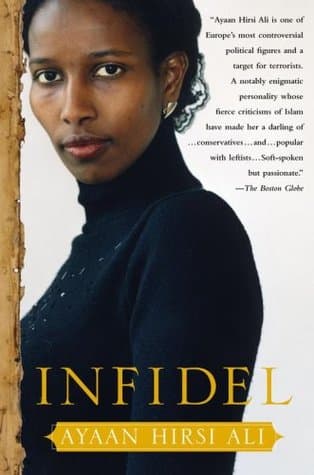
Core Idea
- Difficulty
- Medium
- Read it if
- You are interested in a firsthand account of the challenges faced by women in fundamentalist Islamic societies, the struggle for secularism, or the personal sacrifices involved in rejecting deeply ingrained cultural and religious norms.
- Skip it if
- You are easily offended by strong critiques of religion, prefer a less confrontational narrative, or are looking for a balanced academic analysis rather than a deeply personal and polemical memoir.
Key Takeaways from Infidel
The Tyranny of Tradition
How deeply ingrained cultural and religious norms can stifle individual freedom and critical thought.
Ayaan Hirsi Ali's early life shows how traditional societies, especially those governed by strict religious interpretations, can impose conformity. From birth, her identity was predetermined by her gender and her clan's adherence to a rigid form of Islam. This was not just about personal preference; it was a societal structure that policed thought and behavior, using fear, shame, and violence to enforce its norms. The book highlights how this pressure is not just external but becomes deeply internalized, making it difficult for individuals to even imagine an alternative existence, let alone pursue one. Her journey shows the psychological and social cost of challenging these entrenched systems, even when they are harmful.
“For the first six years of my life I was happy. I was not yet aware of the world, and I was not yet aware that I was a girl and that for a girl life was different.”
In the book: Hirsi Ali recounts her female genital mutilation (FGM) at age five, a common practice justified by tradition and religion, and the constant fear of beatings from her grandmother and father for minor transgressions, such as questioning religious teachings or associating with boys. Her forced marriage to a distant cousin, arranged without her consent, epitomizes the lack of agency afforded to women within this traditional framework.
Try this: Recognize that cultural relativism, while valuable for understanding, can become an excuse for inaction when traditions violate universal human rights. Support organizations and policies that empower individuals to escape oppressive traditions, particularly women and children, by providing education, safe havens, and legal recourse.
Related ideas: cultural-relativism, female-genital-mutilation, honor-culture
The Power of Education (Even Flawed Education)
Formal schooling, despite its ideological biases, can be a crucial catalyst for independent thought.
Even within a religious education system designed to reinforce dogma, Hirsi Ali shows that learning, reading, and engaging with ideas can spark critical thinking. While her early schooling focused on Islamic texts and memorization, it also introduced her to literacy and the structured pursuit of knowledge. This foundation, however narrow, provided a framework upon which she could later build. Exposure to different interpretations, even if presented as heresies to be rejected, planted seeds of doubt and curiosity. The ability to read and analyze, however rudimentary initially, allowed her to question the narratives she had been fed, highlighting how the process of education can be transformative, even when the content is restrictive.
“What I learned at the madrasa was a powerful tool for understanding the world, but it was a tool that also limited my understanding.”
In the book: She describes her schooling in madrasas and later in secular schools in Saudi Arabia and Kenya. While the madrasa instilled deeply conservative Islamic beliefs, it also taught her Arabic and the skill of memorization. Later, exposure to more diverse subjects and even the subtle differences in teaching styles in different countries began to broaden her perspective, despite the ongoing emphasis on religious obedience.
Try this: Advocate for universal access to education, even in contexts where the curriculum might initially seem limited. Focus on fostering critical literacy and the ability to question, rather than just memorize. Support initiatives that introduce diverse perspectives and encourage independent inquiry, even within existing educational structures.
Related ideas: critical-thinking, dogma, literacy
The Betrayal of Ideology
How radical ideologies, initially embraced as solutions, ultimately demand absolute submission and betray individual humanity.
Hirsi Ali's youthful embrace of the Muslim Brotherhood reminds us how appealing radical ideologies can be, especially to those seeking meaning, justice, or belonging in turbulent times. For a period, the Brotherhood offered her a clear framework, a sense of purpose, and a promise of a better, purer world. However, this initial appeal quickly revealed its darker side: an absolute demand for conformity, a suppression of individual thought, and a willingness to justify violence and oppression in the name of a higher cause. Her disillusionment stemmed from realizing that the ideology, rather than liberating, ultimately imprisoned the individual, demanding the sacrifice of personal conscience and critical inquiry for the collective, often violent, agenda. This phase highlights the seductive power of simplistic answers to complex problems and the danger when those answers become dogmatic.
“I was a true believer. I wanted to serve God, and I believed that the Muslim Brotherhood was the best way to do that.”
In the book: She recounts her fervent devotion to the Muslim Brotherhood in her late teens, adopting their strict dress code, participating in their activities, and internalizing their anti-Western rhetoric. Her initial commitment to their cause, driven by a desire for a righteous life, eventually gave way to discomfort and questioning as she witnessed the rigidity and intolerance it fostered.
Try this: Be wary of any ideology that demands absolute loyalty, demonizes dissent, or offers simplistic solutions to complex societal problems. Cultivate an environment that encourages nuanced thinking, critical questioning, and empathy for diverse perspectives, rather than falling prey to the allure of ideological purity.
Related ideas: radicalization, ideological-purity, authoritarianism
The Courage to Escape
Fleeing an arranged marriage becomes a powerful act of self-liberation and a rejection of preordained destiny.
The decision to escape her forced marriage is a turning point in Hirsi Ali's autobiography, an act of self-assertion against overwhelming cultural and familial pressure. This was not merely a personal choice; it was a radical break from centuries of tradition, a rejection of her family's authority, and an embrace of an unknown future. The courage required to make this leap, knowing it would mean ostracization and potential danger, shows the suffocating nature of her previous existence. It demonstrates that true freedom often necessitates a complete severance from past ties and the willingness to face loneliness and uncertainty. Her escape is a symbol of individual agency asserting itself against an entire social system that sought to control her destiny.
“I had to choose between my family and myself. And for the first time in my life, I chose myself.”
In the book: While on a layover in Germany en route to Canada for her arranged marriage, Hirsi Ali makes the spontaneous decision to seek asylum in the Netherlands. She recounts the intense fear and guilt she felt, knowing she was betraying her family, but also the nascent sense of liberation as she took control of her own life for the first time.
Try this: Recognize and support individuals who make courageous choices to escape oppressive situations, understanding the immense personal cost involved. Create safe pathways and resources for those seeking asylum or refuge from forced marriages and other human rights abuses.
Related ideas: self-determination, forced-marriage, asylum
The Culture Shock of Freedom
Arriving in the West reveals that freedom, while liberating, presents its own unique challenges and responsibilities.
Hirsi Ali's arrival in the Netherlands is not a simple ending; it is the beginning of a new, complex struggle. The sudden exposure to Western individualism, secularism, and personal autonomy, while desired, proves disorienting. She highlights the psychological adjustment required to navigate a society where personal choice is paramount and traditional structures of authority are absent. This period exposes the subtle ways in which even 'freedom' can be a burden when one lacks the social conditioning or tools to wield it effectively. It shows that cultural assimilation is rarely a smooth process and that the transition from a collectivist, religiously governed society to a liberal, individualistic one involves relearning fundamental aspects of self and society.
“I was free, but I didn't know what to do with my freedom. It was like being given a vast, empty canvas when all I had ever known was coloring books.”
In the book: She describes her initial confusion and loneliness in the Netherlands, struggling with the language, the lack of community, and the sheer number of choices available to her, from what to eat to how to spend her time. Her experiences working in a factory and later studying at university reveal her gradual adaptation and the stark contrast between her past and present lives.
Try this: Develop more comprehensive integration programs for refugees and immigrants that go beyond basic needs, addressing psychological adjustment, cultural literacy, and civic education. Recognize that the 'freedom' offered by Western societies can be overwhelming without proper support and guidance.
Related ideas: cultural-assimilation, secularism, individualism
The Cost of Speaking Truth to Power
Challenging religious dogma and cultural norms in liberal societies can lead to severe personal consequences.
Once in the Netherlands, Hirsi Ali's journey evolves from personal liberation to public advocacy. Her experiences compelled her to speak out against the abuses she witnessed within some Muslim communities, particularly concerning women's rights and the interpretation of Islam. However, this advocacy came at an extraordinary personal cost. She faced death threats, public condemnation from both religious conservatives and some segments of the political left, and eventually lost her citizenship. This takeaway shows that even in supposedly free societies, challenging deeply held religious or cultural beliefs can be met with extreme hostility, demonstrating that 'free speech' is often a hard-won and fragile right, not a guaranteed comfort. Her story is a reminder of the courage required to be a genuine dissident.
“I was not afraid to speak my mind, but I was not prepared for the storm that would follow.”
In the book: Her work with Theo van Gogh on the film 'Submission,' which criticized the treatment of women in Islam, led directly to van Gogh's murder and a fatwa against her. Her political career in the Dutch Parliament was marked by constant controversy, threats, and ultimately, the revocation of her citizenship over a technicality, forcing her to leave the Netherlands.
Try this: Uphold and protect free speech, especially when it challenges uncomfortable truths or powerful institutions, while also condemning incitement to violence. Support individuals who face threats for exercising their right to criticize religious or cultural practices, and provide them with necessary security and legal protection.
Related ideas: free-speech, blasphemy, fatwa, political-courage
The Limits of Multiculturalism
Uncritical multiculturalism can inadvertently enable harmful practices by prioritizing cultural sensitivity over universal human rights.
Hirsi Ali's critique of Dutch multiculturalism is one of the book's most controversial but vital points. She argues that the well-intentioned desire to respect diverse cultures sometimes led to a reluctance to intervene in practices within immigrant communities that violated fundamental human rights, particularly those of women and children. This 'tolerance of intolerance' created parallel societies where traditional, often oppressive, norms continued unchecked, shielded by the rhetoric of cultural sensitivity. Her experience highlights a tension: how can a liberal democracy uphold universal human rights while respecting cultural diversity, without allowing the latter to undermine the former? She pushes readers to consider whether some cultural practices are simply incompatible with liberal democratic values and should be challenged, not merely accommodated.
“The Dutch were so afraid of being called racist that they often failed to address the real problems within immigrant communities.”
In the book: She details instances where Dutch authorities were hesitant to address issues like forced marriages, honor violence, or FGM within Muslim immigrant communities, fearing accusations of racism or Islamophobia. Her own efforts to bring these issues to light often met with resistance, even from those who ostensibly championed human rights.
Try this: Critically evaluate multicultural policies to ensure they do not inadvertently enable human rights abuses. Prioritize universal human rights, particularly the rights of vulnerable individuals, over cultural or religious sensitivities when conflicts arise. Foster open debate about the challenges of integration and the limits of cultural relativism.
Related ideas: multiculturalism, cultural-relativism, human-rights, islamophobia
The Enduring Scars of Trauma
Even after escaping physical danger, the psychological and emotional wounds of a traumatic past persist.
Despite her triumphs and new life in the West, Hirsi Ali's narrative is infused with the lingering effects of her traumatic past. The physical scars of FGM, the emotional wounds of family abandonment, and the constant threat of violence leave marks. This takeaway emphasizes that escaping oppressive environments does not instantly erase the psychological damage incurred. Her struggles with trust, her guarded nature, and the persistent awareness of danger reveal that trauma creates deep-seated coping mechanisms that are difficult to shed. The book subtly but powerfully conveys that even immense resilience does not equate to an absence of pain, and that the journey of healing is long and complex, often continuing long after the immediate threat has passed.
“You can take the girl out of the desert, but you can't take the desert out of the girl.”
In the book: She describes her sister Haweya's depression and eventual death, attributing it partly to the trauma of their shared past and the inability to adapt to a new life. Hirsi Ali herself carries a constant security detail, lives with the knowledge of a fatwa against her, and recounts the emotional toll of being disowned by her father and clan.
Try this: Provide comprehensive mental health support for refugees and survivors of trauma, acknowledging that adaptation to a new culture is compounded by past suffering. Understand that healing is a non-linear process and that support systems must be long-term and sensitive to individual needs.
Related ideas: trauma-informed-care, post-traumatic-stress, resilience
The Importance of Intellectual Honesty
Genuine progress requires a willingness to critically examine and challenge one's own deeply held beliefs.
Ayaan Hirsi Ali's intellectual journey is marked by an unwavering commitment to honesty, even when that honesty forces her to dismantle her own worldview. From questioning the tenets of Islam to critiquing the failings of Western multiculturalism, she consistently demonstrates a capacity for self-reflection and a refusal to shy away from uncomfortable truths. This is perhaps her greatest strength: the ability to evolve her thinking based on evidence and experience, rather than clinging to dogma or ideological purity. Her narrative argues that true intellectual freedom comes from this relentless self-interrogation, a willingness to admit error, and the courage to follow reason wherever it leads, regardless of personal cost or social pressure. This is a rare and vital quality in a world often dominated by tribal loyalties and confirmation bias.
“I had to be honest with myself, even if it meant abandoning everything I had ever believed.”
In the book: Her evolution from devout Muslim Brotherhood follower to secular atheist and outspoken critic of certain Islamic practices exemplifies her intellectual honesty. She recounts the internal struggle and the extensive reading and research she undertook to come to her conclusions, demonstrating a genuine search for truth rather than adherence to a pre-set agenda.
Try this: Cultivate a personal habit of critical self-reflection and be open to changing your mind based on new information or perspectives. Encourage and reward intellectual honesty in public discourse, even when it challenges popular opinions or comfortable narratives. Prioritize evidence and reason over emotional appeals or ideological conformity.
Related ideas: intellectual-integrity, critical-inquiry, epistemology
The Ongoing Fight for Enlightenment
The values of the Enlightenment – reason, individual liberty, and secularism – are not universally accepted and require continuous defense.
Ultimately, 'Infidel' is an argument for the relevance and fragility of Enlightenment values. Hirsi Ali's journey from a world governed by religious dogma and tribal custom to one that, at its best, champions individual rights, reason, and secular governance, shows the preciousness of these ideals. She argues that these values are not natural or inevitable; they are achievements that must be actively defended against forces that seek to undermine them, whether from religious fundamentalism, cultural relativism, or political apathy. Her life story is a call to action, urging readers not to take for granted the freedoms and intellectual framework that allow for critical inquiry and personal autonomy. It is a reminder that the battle for a more rational, humane world is never truly over.
“The Enlightenment is not a destination, but a journey that must be undertaken anew by each generation.”
In the book: Her entire life trajectory, from escaping a fundamentalist upbringing to becoming a vocal advocate for secularism and free speech in Western parliaments, serves as evidence. Her constant security threats and the political battles she fought highlight that these values are actively contested, even within democratic societies.
Try this: Actively engage in civic discourse to defend and promote Enlightenment values like free speech, secular governance, and individual liberty. Support educational initiatives that teach critical thinking and the history of liberal democracy. Resist pressures to compromise on fundamental human rights in the name of cultural sensitivity or religious appeasement.
Related ideas: enlightenment-values, secularism, human-rights-advocacy
Infidel Quotes
“When I look back, I am horrified. My mind was like a sponge, soaking up the lies, the hatred, the fear that was fed to me daily. I was a child, and I was being taught to hate.”
“The only way to be truly free is to question everything, even the things you hold most sacred.”
“I was a Muslim woman, and I was going to be free. The two things were incompatible.”
“Silence is the language of complicity.”
“It is not enough to be a good person; you must also be a good citizen. You must participate.”
“The greatest weapon against fear is knowledge.”
“I was an infidel, and I was proud of it.”
“To abandon your religion is to abandon your family, your community, your past. It is to become a ghost.”
“The most important thing for me was to be able to think for myself, to make my own choices, to live my own life.”
“Honesty is a luxury that not everyone can afford, especially not women in certain cultures.”
“You can take the girl out of the desert, but you can't take the desert out of the girl.”
“It is not enough to criticize; you must also offer solutions.”
“The only way to truly defeat an ideology is to offer a better one.”
“I was born into a world where women were property, where their bodies were not their own, where their voices were silenced. I refused to accept it.”
Quiz
10 questions on the main ideas. Each answer comes with a short explanation.
Question 1
What significant event in Ayaan Hirsi Ali's early life is explicitly mentioned as a survival experience?
- A severe famine in her village
- A devastating earthquake
- Civil war
- A major flood that destroyed her home
Show answer
C. Civil war The book description states that Hirsi Ali 'survived civil war, female mutilation, brutal beatings...' as part of her early life experiences.
Question 2
Ayaan Hirsi Ali sought asylum in which European country after escaping a forced marriage?
- Germany
- Sweden
- The Netherlands
- United Kingdom
Show answer
C. The Netherlands The text explicitly states she 'sought asylum in the Netherlands, where she earned a college degree in political science.'
Question 3
What was the primary academic field Ayaan Hirsi Ali pursued a college degree in while in the Netherlands?
- Sociology
- Economics
- Political science
- Law
Show answer
C. Political science The summary mentions she 'earned a college degree in political science' after arriving in the Netherlands.
Question 4
How did Ayaan Hirsi Ali initially come to international prominence, as mentioned in the book description?
- Through her groundbreaking academic research
- Following the murder of Theo van Gogh by an Islamist who threatened her next
- By winning a major international human rights award
- As a prominent journalist covering Middle Eastern affairs
Show answer
B. Following the murder of Theo van Gogh by an Islamist who threatened her next The summary states she 'burst into international headlines following the murder of Theo van Gogh by an Islamist who threatened that she would be next.'
Question 5
What specific political role did Ayaan Hirsi Ali hold in the Netherlands, according to the text?
- Ambassador to the United Nations
- Minister of Justice
- Member of Parliament
- Mayor of Amsterdam
Show answer
C. Member of Parliament She 'fought for the rights of Muslim women and the reform of Islam as a member of Parliament.'
Question 6
The book portrays Ayaan Hirsi Ali's adolescence as a devout believer during the rise of which specific Islamic organization?
- Al-Qaeda
- ISIS
- The Muslim Brotherhood
- Hamas
Show answer
C. The Muslim Brotherhood The summary notes her adolescence 'as a devout believer during the rise of the Muslim Brotherhood.'
Question 7
Beyond political threats and disownment by her father, what other significant personal hardship did Ayaan Hirsi Ali face concerning her family, as mentioned in the summary?
- Her parents' divorce due to her beliefs
- Her tragically depressed sister's struggles to adjust to the West
- The imprisonment of her brother for political activism
- Her mother's terminal illness
Show answer
B. Her tragically depressed sister's struggles to adjust to the West The text mentions she 'tried to help her tragically depressed sister adjust to the West,' indicating a significant personal challenge.
Question 8
The book characterizes Hirsi Ali's journey as an evolution from 'dutiful obedience' to what specific role or identity?
- A celebrated academic scholar
- A successful business entrepreneur
- An outspoken, pioneering freedom fighter
- A renowned spiritual leader
Show answer
C. An outspoken, pioneering freedom fighter The final sentence of the summary states her story 'tells how a bright little girl evolves out of dutiful obedience to become an outspoken, pioneering freedom fighter.'
Question 9
In the context of 'Infidel,' what does the phrase 'demonized by reactionary Islamists and politicians' primarily signify about Ayaan Hirsi Ali's experience?
- She was universally praised for her moderate views.
- She faced severe criticism and hostility from both religious hardliners and some political figures for her stances.
- Her political career was boosted by the support of these groups.
- She was misunderstood as a religious figure rather than a political one.
Show answer
B. She faced severe criticism and hostility from both religious hardliners and some political figures for her stances. To be 'demonized' implies being portrayed as evil or harmful, indicating strong opposition and hostility, specifically from 'reactionary Islamists and politicians' due to her work and beliefs.
Question 10
The book is presented as particularly 'timely or significant' because Western governments are currently grappling with what specific challenge?
- Balancing economic growth with environmental protection.
- Balancing democratic ideals with religious pressures.
- Addressing global pandemics and public health crises.
- Managing international trade disputes and tariffs.
Show answer
B. Balancing democratic ideals with religious pressures. The summary concludes by stating, 'As Western governments struggle to balance democratic ideals with religious pressures, no other book could be more timely or more significant.'
Infidel FAQ
What is 'Infidel' by Ayaan Hirsi Ali about?
'Infidel' is the autobiography of Ayaan Hirsi Ali, chronicling her journey from a strict Muslim upbringing in Somalia and other African countries, through her escape from a forced marriage, to becoming a prominent politician in the Netherlands and an outspoken critic of radical Islam.
Does Ayaan Hirsi Ali still advocate for Islamic reform?
While Ayaan Hirsi Ali initially advocated for the reform of Islam, her views have evolved over time. She has become more critical, questioning the possibility of reforming certain aspects of Islam and often highlighting what she perceives as inherent conflicts between Islamic doctrine and liberal democratic values.
What is the significance of the title 'Infidel'?
The title 'Infidel' reflects Ayaan Hirsi Ali's journey away from her Islamic faith and her subsequent ostracization by family and community. It is a term often used pejoratively in Islamic contexts for non-believers, and she reclaims it to describe her intellectual and personal liberation.
How does 'Infidel' differ from other memoirs by ex-Muslims?
'Infidel' stands out due to Ayaan Hirsi Ali's unique trajectory from a survivor of female genital mutilation and forced marriage to a Member of Parliament and a globally recognized activist. Her political engagement and direct confrontation with Islamic fundamentalism provide a distinct perspective compared to many other ex-Muslim narratives.
What challenges did Ayaan Hirsi Ali face after publishing 'Infidel'?
After publishing 'Infidel' and her public criticism of Islam, Ayaan Hirsi Ali faced severe backlash, including death threats from Islamists, most notably after the murder of Theo van Gogh. She was also stripped of her Dutch citizenship and disowned by her family, forcing her to live under constant security protection.
What role did Theo van Gogh play in Ayaan Hirsi Ali's story?
Theo van Gogh was a Dutch filmmaker who collaborated with Ayaan Hirsi Ali on the short film 'Submission,' which criticized the treatment of women in Islam. His subsequent murder by an Islamist, who left a note threatening Hirsi Ali, dramatically escalated the threats against her and brought her story to international attention.
Is 'Infidel' suitable for readers unfamiliar with Islam or Middle Eastern politics?
Yes, 'Infidel' is written in an accessible style and provides sufficient context for readers new to these topics. Ayaan Hirsi Ali's personal narrative serves as an entry point into understanding the complexities of Islamic culture, women's rights, and the challenges of integrating different value systems.
Does 'Infidel' offer solutions to the issues it raises?
While 'Infidel' primarily focuses on Ayaan Hirsi Ali's personal journey and highlights significant problems within certain interpretations of Islam, it implicitly champions free speech, critical thinking, and individual liberty as fundamental solutions. Her subsequent work has further elaborated on policy recommendations and advocacy.
About the author

Ayaan Hirsi Ali is a Somali-American writer and activist known for her critiques of Islam and advocacy for women's rights. Her memoir, 'Infidel,' details her experiences with female genital mutilation and her departure from Islam. Hirsi Ali is a vocal critic of Islamic extremism and an advocate for secularism and women's liberation.
Similar books
- Persepolis: The Story of a Childhood
Marjane Satrapi
4.3 (158k) average on GoodreadsBiographyExplores a young woman's coming-of-age amidst political and religious upheaval in the Middle East.
- Reading Lolita in Tehran: A Memoir in Books
Azar Nafisi
3.6 (118k) average on GoodreadsBiographyDetails intellectual resistance and the search for freedom under an oppressive Islamic regime.
- I Am Malala: The Story of the Girl Who Stood Up for Education and Was Shot by the Taliban
Malala Yousafzai
4.1 (419k) average on GoodreadsPoliticsChronicles a young woman's fight for education and human rights against extremist ideology.
- 1984
George Orwell
4.2 (3.1M) average on GoodreadsPoliticsIn a future where surveillance and thought control are absolute, a man's search for truth clashes with the Party, showing that hope can be a form of rebellion.
- Animal Farm
George Orwell
4.0 (2.7M) average on GoodreadsPoliticsA farm animals' rebellion against humans turns into a pig-led dictatorship, showing how power corrupts and revolutionary ideals are betrayed.
- Freakonomics: A Rogue Economist Explores the Hidden Side of Everything
Steven D. Levitt
4.0 (709k) average on GoodreadsBusinessThis book uses economic principles to reveal the surprising incentives behind everything from drug dealing and real estate to cheating teachers and the decline of crime.




Enjoyed the summary?
A summary gives you the shape of the book. The book itself has the detail, the examples and the voice.
Find Infidel on AmazonAs an Amazon Associate, BookBrief earns from qualifying purchases. How we're funded