
Synopsis
Covers the whole plot, including the ending.
- Difficulty
- Medium
- Pacing
- Moderate
- Mood
- Action-packed, Explorative, Suspenseful, Thought-provoking
- Read it if
- You enjoy military sci-fi, alternate history, or 'isekai' stories with a focus on naval combat and the clash of vastly different technologies and cultures.
- Skip it if
- You dislike detailed descriptions of naval warfare, stories with significant ethical dilemmas, or narratives where humans play a 'god-like' role in a foreign world's conflict.
Into the Storm Plot Summary
Covers the whole plot, including the ending.
The Retreat and the Squall
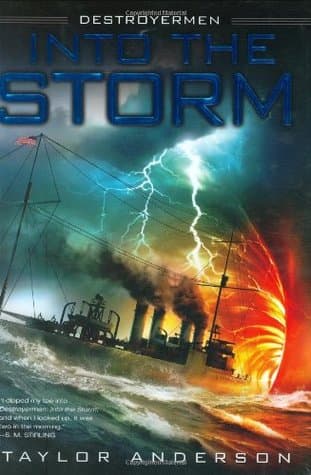
In December 1941, shortly after the attack on Pearl Harbor, the antiquated USS Walker, a four-stacker destroyer commanded by Lieutenant Commander Matthew Reddy, tries to escape a superior Japanese force in the Pacific. Outgunned and outmaneuvered, Reddy makes a desperate decision to steer the Walker directly into a massive, unnatural squall, hoping to use the storm's cover to evade the pursuing Japanese cruisers. The crew endures a harrowing passage through the tempest, with the ship being tossed violently. As they emerge on the other side, the storm dissipates as quickly as it appeared, leaving them in an eerily calm sea under a strangely colored sky, with the familiar landmarks of the Pacific Rim looking subtly, disturbingly different.
A World Transformed
Upon emerging from the squall, the crew of the USS Walker quickly realizes they are no longer in their own world. The familiar islands of Bali and Sumatra are recognizable but look untouched by human civilization. More strikingly, the waters are filled with massive, predatory fish unlike anything known, and observations from the ship reveal dinosaurs grazing on the landmasses. The air is different, the plants are different, and the entire ecosystem points to a world where human evolution never occurred. Lieutenant Commander Reddy and his officers struggle to comprehend their situation, grappling with the impossible reality that they have somehow traveled to an alternate Earth, a primeval world.
First Contact and the Grik
While exploring the new world, the USS Walker encounters its first intelligent species: the Grik. These are bipedal, reptilian creatures, described as vicious and warlike, with a tribal, slave-owning society. The Grik operate primitive sailing vessels and use basic weapons, but their sheer numbers and ferocity make them a formidable threat. Reddy's crew observes their brutal practices, including the enslavement and consumption of other species. The Walker's advanced weaponry, even for a WWI-era ship, proves devastatingly effective against the Grik's crude attacks, establishing the destroyer as a powerful, albeit alien, force in this new world's balance of power.
The Lemurians and the Alliance
Following their encounters with the Grik, the crew of the USS Walker soon makes contact with another intelligent species: the Lemurians. These are primate-like beings, more technologically advanced than the Grik, possessing basic metallurgy and organized societies. The Lemurians are engaged in a centuries-long, existential war with the Grik, who constantly raid their settlements for slaves and resources. Recognizing the Walker's power, the Lemurian leader, Captain-General Ah'hray, seeks an alliance with Lieutenant Commander Reddy. Reddy, seeing the Grik's brutality and the Lemurians' more sympathetic nature, cautiously agrees to provide military assistance, effectively choosing a side in this alien conflict.
The Battle of Baalkpan
The alliance is quickly tested when the USS Walker joins the Lemurians in a critical naval battle against a large Grik fleet near the city of Baalkpan. The Grik, relying on sheer numbers and overwhelming force, attempt to overrun the Lemurian defenses. The Walker, utilizing its steam power, cannon, and machine guns, proves to be a game-changer. Its speed and firepower decimate the Grik's primitive vessels, turning the tide of the battle. Reddy's strategic command and the crew's discipline, combined with the ship's technological superiority, inflict heavy casualties on the Grik, securing a vital victory for the Lemurians and cementing the Walker's role as a powerful ally.
Learning the Language and Culture
Following their initial military successes, Lieutenant Commander Reddy prioritizes intelligence gathering and cultural exchange. Several crew members, particularly Chief Engineer Fitzwilliam and Lieutenant Commander Reddy himself, begin to learn the complex Lemurian language and customs. This effort is crucial for effective communication and understanding the nuances of the ongoing war. Through these interactions, they learn more about Lemurian history, their societal structure, and the deep-seated animosity between them and the Grik. This cultural immersion helps the human crew bridge the gap between their world and this new one, fostering a stronger bond with their Lemurian allies.
Resource Scarcity and Adaption
Despite their technological advantage, the USS Walker faces a critical long-term problem: resource scarcity. Fuel, ammunition, spare parts, and even food are finite. Reddy and his crew must quickly adapt to their new environment. They begin scouting for local resources, including suitable timber for repairs, coal for their boilers, and new food sources. The Lemurians, in turn, offer their knowledge of the local flora and fauna and assist in resource procurement. This forces the crew to become more self-reliant and to integrate their advanced technology with the primitive resources of this alternate Earth, highlighting the ingenuity and adaptability required for survival.
Grik Counter-Offensive
The Grik, despite their losses, are not easily deterred. They demonstrate a surprising capacity for adaptation and organization. After their initial defeats, the Grik chieftain, known as the 'Grand Warlord,' mobilizes an even larger force, learning from their previous encounters with the Walker. They launch a widespread counter-offensive, targeting multiple Lemurian settlements simultaneously. This escalation forces Reddy to make difficult strategic decisions about where to deploy the Walker's limited resources and how to best defend their allies. The Grik's sheer numbers and renewed tactics pose a significant threat, pushing the Walker and the Lemurians to their limits.
The Ethical Dilemma of Intervention
As the war intensifies, Lieutenant Commander Reddy is increasingly confronted with the ethical implications of his intervention. The USS Walker's firepower, while saving the Lemurians, also has the potential to cause unprecedented destruction in this world. He questions whether they are merely prolonging a conflict or genuinely aiding a just cause. The potential for genocide, if they were to fully unleash their capabilities, weighs heavily on him. Reddy understands that their presence has irrevocably altered the course of this world's history, and he must carefully consider the long-term consequences of every decision, striving to balance survival with moral responsibility.
A Decisive Stand
With the Grik pushing relentlessly, the USS Walker and the Lemurians prepare for what appears to be a decisive, climactic battle. The Grik Grand Warlord consolidates his forces for a massive assault on a key Lemurian stronghold. Reddy, understanding the stakes, devises a daring strategy, combining the Walker's naval superiority with Lemurian ground forces. This final confrontation is presented as an all-or-nothing engagement, where the fate of the Lemurian civilization, and possibly the Walker's crew, hangs in the balance. The crew is pushed to their physical and mental limits, knowing that retreat is not an option.
The Aftermath and New Purpose
The climactic battle is a brutal, hard-fought victory for the combined human and Lemurian forces, though not without significant losses. The Grik advance is halted, and their Grand Warlord's forces are severely crippled. In the aftermath, Lieutenant Commander Reddy and his crew fully accept their new reality. They realize that returning to their own world is unlikely, and their purpose has shifted from fighting World War II to defending the Lemurians and helping them rebuild. The USS Walker becomes a symbol of hope and protection, and its crew commits to using their knowledge and technology to secure a future for their new allies in this strange, dangerous world.
Principal Figures
Lieutenant Commander Matthew Patrick Reddy
Protagonist
The pragmatic and honorable captain of the USS Walker.
Reddy is a seasoned naval officer, burdened by the responsibility of his command and crew. He is characterized by his strong moral compass, strategic thinking, and adaptability. Initially focused on survival and returning home, he gradually accepts his role as a protector in this new world. He is a capable leader, earning the respect of both his human crew and his Lemurian allies through his courage and decisive actions. He grapples with the ethical weight of their intervention.
Relationships: Chief Engineer Fitzwilliam (Trusted subordinate and close confidant); Captain-General Ah'hray (Strategic ally and respected leader); Ensign Cletus Miller (Subordinate and interpreter, later friend)
Chief Engineer Fitzwilliam
Supporting
The ingenious and resourceful Chief Engineer of the USS Walker.
Fitzwilliam is a brilliant and practical engineer, essential to the Walker's continued operation in the alternate world. He is constantly tasked with finding solutions to resource scarcity, adapting the ship's systems to local materials, and maintaining its aging machinery. He is loyal to Reddy and often provides a grounded, technical perspective. His ingenuity is critical for the ship's survival and its ability to engage in combat, making him an invaluable member of the crew.
Relationships: Lieutenant Commander Reddy (Superior officer and close working partner)
Captain-General Ah'hray
Supporting
The wise and strategic leader of the Lemurian forces.
Ah'hray is the respected military and political leader of a significant Lemurian faction. She is intelligent, pragmatic, and deeply committed to the survival of her people against the Grik threat. She quickly recognizes the potential power of the USS Walker and forms a strategic alliance with Reddy. Ah'hray is a capable strategist and diplomat, navigating the complex politics of her own species while also fostering trust and cooperation with the alien humans. She represents the hope and resilience of the Lemurian people.
Relationships: Lieutenant Commander Reddy (Strategic ally and mutual respectful leader)
Ensign Cletus Miller
Supporting
A young, observant officer who becomes crucial for communication.
Ensign Miller is a junior officer on the Walker who, due to his keen observational skills and aptitude for languages, becomes one of the primary liaisons between the human crew and the Lemurians. He is often sent on reconnaissance missions and plays a crucial role in understanding Lemurian culture and intentions. Miller is intelligent and earnest, representing the younger generation of the crew who are forced to adapt quickly to their extraordinary circumstances. His linguistic abilities are vital for the alliance's success.
Relationships: Lieutenant Commander Reddy (Superior officer and mentor); Lemurian people (Cultural liaison and student)
The Grik Grand Warlord
Antagonist
The brutal and cunning leader of the Grik Empire.
The Grand Warlord is the overarching antagonist, the supreme leader of the Grik. He is characterized by his ruthlessness, ambition, and strategic cunning. While the Grik are generally portrayed as savage, the Grand Warlord demonstrates an ability to adapt his tactics and mobilize vast forces, making him a formidable opponent. He views other species, especially the Lemurians, as resources to be exploited or enemies to be exterminated. His relentless pursuit of conquest drives much of the conflict in the story.
Relationships: The Grik (Absolute ruler and military commander); Lemurian people (Mortal enemy and target for conquest)
The Grik
Antagonist
A savage, reptilian species at war with the Lemurians.
The Grik are the primary antagonistic species in the alternate world. They are described as bipedal, lizard-like creatures with primitive technology but immense numbers and a brutal, expansionist culture. They engage in slavery, cannibalism, and constant warfare, particularly against the Lemurians. Their ferocity and relentless attacks make them a constant threat, driving the plot's conflicts. Despite their savagery, they show a capacity for organization and adaptation, learning from their encounters with the USS Walker.
Relationships: Lemurian people (Centuries-old mortal enemy); USS Walker crew (New, technologically superior enemy)
The Lemurians
Supporting
A primate-like, technologically advanced species allied with the humans.
The Lemurians are a sentient, primate-like species inhabiting the alternate world. They are more technologically advanced than the Grik, possessing metallurgy, organized cities, and a more complex social structure. They have been engaged in a long and desperate war for survival against the Grik. They are portrayed as intelligent, honorable, and culturally rich, making them sympathetic allies for the humans. Their desperation for survival leads them to form a vital alliance with the USS Walker.
Relationships: USS Walker crew (Strategic allies and cultural exchange partners); The Grik (Mortal enemies)
Themes & Insights
Survival and Adaptation
The core theme is the USS Walker crew's struggle for survival in an alien world. They must adapt not only to the prehistoric environment but also to the realities of dwindling resources and an ongoing war. This shows in Chief Engineer Fitzwilliam's constant efforts to maintain the ship with limited parts, Reddy's strategic decisions to conserve ammunition, and the crew's need to learn new languages and forge alliances with alien species. Their ability to adapt their existing knowledge and technology to new circumstances is paramount.
“We're not in Kansas anymore, fellas. And we're not going home anytime soon. So we adapt, or we die.”
The Burden of Power and Intervention
The USS Walker, despite being a relic in its own world, possesses immense power in the alternate world. This power brings with it a heavy ethical burden. Lieutenant Commander Reddy constantly grapples with the moral implications of intervening in a primitive war, knowing their actions could lead to genocide or irrevocably alter the course of an entire world. The decision to side with the Lemurians is not taken lightly, and Reddy reflects on the responsibility of wielding such destructive force and the long-term consequences of their presence.
“We have the power to destroy them all, but what kind of victory would that be? What kind of men would we become?”
Cultural Clash and Alliance
The story explores the challenges and rewards of interspecies cultural exchange and alliance. The humans, particularly Ensign Miller, must learn the complex languages and customs of the Lemurians, overcoming initial fear and suspicion. This theme is central to the success of the alliance against the Grik. It highlights the importance of empathy, communication, and mutual respect in forging bonds across vastly different civilizations, demonstrating how understanding can lead to powerful cooperation.
“They may not look like us, but their fight is just, and their courage is undeniable. We are allies now.”
The Nature of Warfare and Humanity
The novel contrasts the 'modern' warfare of WWII with the brutal, existential conflict between the Grik and Lemurians. It forces the human crew to confront the raw, primal aspects of war, stripping away some of the technological advancements they are used to. It also questions what it means to be 'human' in a world without humans, as Reddy and his crew find themselves identifying with the more 'civilized' Lemurians against the savage Grik, highlighting inherent values like compassion and justice.
“Back home, we fought for freedom. Here, we fight for survival, and the freedom of those who cannot fight for themselves.”
Plot Devices & Literary Techniques
Isekai/Portal Fantasy
The sudden transportation of characters to an alternate world.
The core plot device is the 'squall' that transports the USS Walker from WWII Earth to an alternate, prehistoric Earth. This serves as the inciting incident, immediately establishing the fish-out-of-water scenario and the crew's struggle to comprehend and survive in a completely alien environment. It isolates the characters from their familiar world and forces them to adapt entirely, creating the central conflict and driving the narrative forward.
Anachronism/Technological Disparity
A WWI-era destroyer's advanced technology in a primitive world.
The USS Walker itself is an anachronism in the alternate world. While considered obsolete in 1941, its steam power, steel hull, and weaponry are vastly superior to anything found in the new world. This technological disparity grants the humans immense power, making them a game-changer in the Grik-Lemurian war, but also creates significant logistical challenges in terms of maintenance and resource acquisition, and poses ethical dilemmas for its use.
Language Barrier
The difficulty of communication between different species.
Initially, the inability of the humans to communicate with either the Grik or Lemurians creates tension, misunderstanding, and danger. This device highlights the alien nature of the new world. As the story progresses, the gradual overcoming of this barrier, particularly by Ensign Miller, becomes crucial for forging alliances, gathering intelligence, and developing trust, demonstrating the importance of communication in bridging cultural divides.
Resource Scarcity
The dwindling of essential supplies for the USS Walker.
The finite nature of fuel, ammunition, spare parts, and even food for the USS Walker creates constant tension and forces ingenuity. This device prevents the Walker from being an invincible force, adding stakes and realism to its operations. It compels the crew to explore, scavenge, and adapt, integrating their advanced technology with the primitive resources of the new world and fostering greater interdependence with their Lemurian allies.
Into the Storm Quotes
“The past is a foreign country; they do things differently there.”
“Survival is not mandatory. It is earned.”
“We are not here to conquer, but to survive. If that means we must fight, then we will fight.”
“Ignorance is not bliss when a dinosaur is about to eat you.”
“Sometimes, the only way to save lives is to take others.”
“Hope is a powerful weapon, but it needs to be wielded with caution.”
“The sea does not care about your plans.”
“We may be from a different time, but we are still human. And humans adapt.”
“Technology can only take you so far. After that, it's courage and ingenuity.”
“Fear is a choice. Survival is a priority.”
“Every day is a battle. Some are fought with guns, others with wits.”
“The greatest danger is not what you can see, but what you can't.”
“We're not just fighting for ourselves. We're fighting for a future that shouldn't exist.”
Quiz
10 questions on the plot and the characters. Each answer comes with a short explanation.
Question 1
What type of ship is the USS Walker, commanded by Lieutenant Commander Matthew Patrick Reddy?
- A modern guided-missile cruiser
- A Great-War vintage 'four-stacker' destroyer
- A World War II aircraft carrier
- A nuclear submarine
Show answer
B. A Great-War vintage 'four-stacker' destroyer The USS Walker is explicitly described as a Great-War vintage 'four-stacker' destroyer, indicating its age and design.
Question 2
From what enemy force is the USS Walker retreating at the beginning of the story?
- German U-boats
- Japanese battleships
- Italian destroyers
- British cruisers
Show answer
B. Japanese battleships The USS Walker is in full retreat from pursuit by Japanese battleships when World War II breaks out in the Pacific.
Question 3
What natural phenomenon does Captain Reddy use to try and escape the pursuing enemy ships, leading to their transport to an alternate world?
- A dense fog bank
- A deep underwater trench
- A squall (violent storm)
- A volcanic eruption's ash cloud
Show answer
C. A squall (violent storm) In desperation, Captain Reddy heads the Walker into a squall, hoping it will give them cover, which is the event that transports them.
Question 4
Upon arriving in the alternate world, what unusual creatures do the crew observe grazing on the plains of Bali?
- Giant sloths
- Mammoths
- Dinosaurs
- Large, flightless birds
Show answer
C. Dinosaurs The text explicitly states that 'there appear to be dinosaurs grazing on the plains of Bali,' indicating a significant difference from their own world.
Question 5
What is a key difference in the evolution of life in the alternate world compared to Earth, as discovered by the Walker's crew?
- Humans evolved into multiple subspecies.
- Humans have not evolved, but two other species have.
- Only aquatic life evolved, no terrestrial species.
- Birds became the dominant intelligent species.
Show answer
B. Humans have not evolved, but two other species have. The crew must accept that 'Humans have not evolved, but two other species have,' which are now at war.
Question 6
What is the primary characteristic of the alternate world's marine life mentioned in the description?
- The water is unusually clear and calm.
- The water teems with monstrous, vicious fish.
- The oceans are devoid of life.
- The marine life is identical to Earth's.
Show answer
B. The water teems with monstrous, vicious fish. One of the first signs of the altered reality is that 'the water teems with monstrous, vicious fish.'
Question 7
What is the crucial decision Captain Reddy and his crew must make regarding the two warring species in the alternate world?
- To remain neutral and avoid all contact.
- To establish a trade agreement with both sides.
- To decide whose side they're on, as their involvement will determine the winner.
- To attempt to negotiate a peace treaty between them.
Show answer
C. To decide whose side they're on, as their involvement will determine the winner. The crew 'must decide whose side they're on. Because whoever they choose to side with is the winner,' highlighting the critical choice they face.
Question 8
How does the USS Walker's technology, specifically its 'steam power and weaponry,' relate to the conflict in the alternate world?
- It is completely useless against the advanced weaponry of the alternate species.
- Its very existence could alter the balance of power in the primitive war.
- It allows them to observe the war from a safe distance without involvement.
- It is quickly reverse-engineered by both species, losing its advantage.
Show answer
B. Its very existence could alter the balance of power in the primitive war. The text states, 'With its steam power and weaponry, the Walker's very existence could alter the balance of power' in the primitive war.
Question 9
What is the potential negative consequence if Matt and his crew misuse their capabilities in the alternate world's conflict?
- They risk depleting their own limited fuel and ammunition.
- They could accidentally create a third, more powerful species.
- They could turn a primitive war into a genocidal Armageddon.
- They might become trapped permanently in the alternate world.
Show answer
C. They could turn a primitive war into a genocidal Armageddon. The crew realizes that they 'have the means to turn a primitive war into a genocidal Armageddon,' highlighting the immense destructive potential of their technology.
Question 10
Who is the captain of the USS Walker?
- Lieutenant Commander Thomas Anderson
- Lieutenant Commander Matthew Patrick Reddy
- Captain John Smith
- Commander William Walker
Show answer
B. Lieutenant Commander Matthew Patrick Reddy The captain is identified as 'Lieutenant Commander Matthew Patrick Reddy' early in the description.
Into the Storm FAQ
What is the core premise of 'Into the Storm'?
The USS Walker, a World War II-era destroyer commanded by Lieutenant Commander Matthew Patrick Reddy, attempts to evade Japanese battleships by entering a squall. Instead of finding cover, they emerge in an alternate world populated by monstrous fish, dinosaurs, and two warring intelligent species that are not human, forcing Reddy and his crew to confront an entirely new reality.
Who is Lieutenant Commander Matthew Patrick Reddy and what is his initial challenge?
Matthew Patrick Reddy is the captain of the USS Walker, a Great War-vintage 'four-stacker' destroyer. His initial challenge is to protect his ship and crew from overwhelming Japanese naval forces in the Pacific theater of World War II, leading him to make the desperate decision to steer into a squall.
What unexpected elements does the crew of the USS Walker encounter in the alternate world?
Upon entering the alternate world, the crew of the USS Walker encounters familiar landmarks alongside bizarre changes, such as waters teeming with monstrous, vicious fish and dinosaurs grazing on the plains of Bali. They also discover two non-human intelligent species locked in a primitive war.
How does the USS Walker's technology impact the alternate world?
The USS Walker, with its steam power and World War II-era weaponry, represents an unprecedented level of technology in the alternate world. Its very existence and capabilities could drastically alter the balance of power between the two warring species, potentially turning a primitive conflict into a genocidal Armageddon.
What is the central moral dilemma faced by Captain Reddy and his crew?
The central moral dilemma for Captain Reddy and his crew is deciding which side to support in the ongoing war between the two intelligent species. They understand that their intervention, due to their superior technology, will guarantee victory for whichever faction they choose, placing immense responsibility on their shoulders.
Are there any subtle clues about the nature of the 'squall' before the Walker enters it?
The book likely hints at the unusual nature of the squall by describing it as particularly fierce or anomalous, perhaps with strange atmospheric phenomena or an unnatural darkness. These subtle environmental cues might foreshadow its role as a portal to an alternate reality rather than just a storm.
How do the crew's reactions to the dinosaurs and monstrous fish differ from their reaction to the intelligent species?
The crew likely reacts to the dinosaurs and monstrous fish with initial shock, fear, and a sense of scientific disbelief, trying to reconcile them with known biology. Their reaction to the intelligent species, however, would involve a deeper existential crisis, realizing they are no longer the dominant sentient species and facing complex ethical decisions.
What specific details about the 'Great War vintage' of the USS Walker are important?
The 'Great War vintage' of the USS Walker, being a 'four-stacker' destroyer, implies it is older and potentially less advanced than contemporary WWII vessels, yet still vastly superior to anything in the alternate world. This detail highlights its anachronistic power in the new setting, making its technology even more impactful.
Are there any implied connections between the alternate world's evolution and Earth's history?
The presence of dinosaurs grazing on Bali suggests a divergence point in the alternate world's evolutionary history where the K-Pg extinction event either didn't occur or had a significantly different outcome. This implies a world where reptilian life continued to dominate large terrestrial niches.
How does Matthew Reddy's leadership style adapt to the unprecedented situation?
Matthew Reddy's leadership style likely evolves from a traditional naval command structure, focused on combat and survival, to one that requires diplomatic skill, anthropological understanding, and profound ethical consideration. He must adapt to leading his crew not just in battle, but in making civilization-altering decisions.
What psychological impact does the loss of their original world have on the crew?
The crew experiences a profound psychological shock, facing the loss of everything familiar – home, family, country, and the very fabric of their reality. This would likely manifest as disorientation, grief, existential dread, and a desperate need to find purpose in their new, alien surroundings.
How do the crew members cope with the sudden shift from fighting a known human enemy to encountering non-human intelligences?
Coping with the shift from human enemies to non-human intelligences would involve a significant psychological adjustment. They would likely struggle with initial xenophobia or fear, followed by attempts to understand and communicate, forcing them to re-evaluate their definitions of 'enemy' and 'ally'.
What internal conflicts might individual crew members face regarding the use of their advanced weaponry?
Individual crew members might grapple with intense internal conflicts about using their weaponry, ranging from the moral burden of causing mass destruction to a primitive society, to the pragmatic desire for survival, or even the thrill of unparalleled power. Some might resist, while others might embrace the role of god-like arbiters.
What is the significance of the book explicitly stating 'Humans have not evolved' in this alternate world?
The statement 'Humans have not evolved' is highly significant because it immediately establishes humanity's unique and alien status in this new world. It removes any possibility of finding familiar societies or even distant human relatives, amplifying the crew's isolation and the moral weight of their decisions.
Does the book suggest the 'squall' was a deliberate or accidental phenomenon?
The narrative likely portrays the squall as an accidental phenomenon from the perspective of the USS Walker, a desperate maneuver for cover. However, the exact nature of the squall—whether it's a natural anomaly, a magical portal, or a scientific phenomenon—is left open for interpretation, potentially becoming a larger mystery.
What philosophical questions does the presence of two warring non-human species raise about conflict?
The presence of two warring non-human species raises profound philosophical questions about the inherent nature of conflict. It suggests that war might be a universal constant, not exclusive to humanity, forcing the crew to reconsider whether their intervention is a rescue or merely an escalation of an inevitable struggle.
How might the concept of 'victory' be re-evaluated by Reddy and his crew in this new context?
The concept of 'victory' is radically re-evaluated. For Reddy and his crew, 'victory' shifts from defeating an enemy in a conventional war to potentially choosing which civilization deserves to survive, or even striving for a peaceful resolution that transcends the local conflict, redefining their mission beyond military objectives.
Is the book suggesting a commentary on the dangers of technological superiority in conflict?
Yes, the book strongly suggests a commentary on the dangers and ethical dilemmas posed by technological superiority. The USS Walker's ability to turn a 'primitive war into a genocidal Armageddon' highlights the immense destructive power of advanced weaponry and the moral responsibility that comes with wielding it.
Could the 'choice of sides' be more complex than simply good vs. evil?
Absolutely. The choice of sides is likely far more complex than a simple good vs. evil dichotomy. The book probably presents both species with their own justifiable reasons for conflict, their own cultures, and their own flaws, forcing Reddy and his crew to make a nuanced decision based on incomplete understanding and potential long-term consequences.
Similar books
- Harry Potter and the Sorcerer's Stone
J.K. Rowling
4.5 (7M) average on GoodreadsFantasyRescued from a miserable life under the stairs, an orphaned boy discovers he's a wizard destined for a magical school, where he uncovers a dangerous secret tied to the dark wizard who murdered his parents.
- The Hunger Games
Suzanne Collins
4.3 (6.4M) average on GoodreadsFantasyIn a future where children fight to the death on live television, Katniss Everdeen volunteers for the arena, turning a death sentence into a fight for survival and a spark of rebellion.
- 1984
George Orwell
4.2 (3.1M) average on GoodreadsPoliticsIn a future where surveillance and thought control are absolute, a man's search for truth clashes with the Party, showing that hope can be a form of rebellion.
- Divergent
Veronica Roth
4.2 (2.9M) average on GoodreadsFantasyIn a society divided by virtues, a sixteen-year-old's difference from the norm starts a rebellion that threatens her world.
- The Hobbit, or There and Back Again
J.R.R. Tolkien
4.3 (2.9M) average on GoodreadsFantasyA comfort-loving hobbit named Bilbo Baggins is whisked away by a mischievous wizard and a band of dwarves on an unexpected journey to reclaim stolen treasure from a fearsome dragon, discovering courage and a magical ring along the way.
- Animal Farm
George Orwell
4.0 (2.7M) average on GoodreadsPoliticsA farm animals' rebellion against humans turns into a pig-led dictatorship, showing how power corrupts and revolutionary ideals are betrayed.






Enjoyed the summary?
A summary gives you the shape of the book. The book itself has the detail, the examples and the voice.
Find Into the Storm on AmazonAs an Amazon Associate, BookBrief earns from qualifying purchases. How we're funded