

Synopsis
Covers the whole plot, including the ending.
- Difficulty
- Hard
- Pacing
- Slow
- Mood
- Philosophical, Reflective, Epic, Profound, Ancient
- Read it if
- You are fascinated by biblical narratives, enjoy deeply philosophical and psychological explorations of character, and appreciate sprawling, meticulously detailed historical fiction that reinterprets ancient myths with modern insight.
- Skip it if
- You prefer fast-paced plots, short books, or straightforward historical accounts without extensive philosophical digressions and literary embellishments.
Joseph and His Brothers Plot Summary
Covers the whole plot, including the ending.
The Descent into Egypt
Jacob, the patriarch, openly favors his youngest son, Joseph, giving him a colorful coat. This, along with Joseph's dreams of his brothers and parents bowing to him, sparks intense jealousy among his ten older brothers. One day, when Jacob sends Joseph to check on his brothers tending flocks near Dothan, they plan to kill him. Reuben, the eldest, suggests throwing him into a dry pit instead, secretly planning to rescue him. While Reuben is away, the other brothers sell Joseph to Midianite merchants for twenty pieces of silver. They then dip Joseph's coat in goat's blood and show it to Jacob, leading him to believe a wild beast devoured Joseph. Jacob falls into deep mourning.
Joseph in Potiphar's House
The Midianite merchants bring Joseph to Egypt and sell him to Potiphar, a high-ranking officer in Pharaoh's court and captain of the guard. Joseph shows diligence and integrity, quickly earning Potiphar's trust. He becomes overseer of Potiphar's entire household. Everything Joseph manages prospers, showing God's favor. However, Potiphar's wife, a beautiful and clever woman, becomes attracted to Joseph and repeatedly tries to seduce him. Joseph remains loyal to Potiphar and his God, rejecting her advances. Enraged by his refusal, she invents a story, claiming Joseph tried to rape her, using his cloak as 'evidence.' Potiphar, despite some doubt, believes his wife and has Joseph thrown into the royal prison.
The Interpretation of Dreams in Prison
Even in prison, Joseph's character stands out. The warden recognizes his integrity and puts him in charge of the other prisoners. Among them are Pharaoh's chief cupbearer and chief baker, both awaiting judgment for offending Pharaoh. One night, both men have disturbing dreams. Joseph, seeing their distress, offers to interpret their dreams, saying his ability comes from God. The cupbearer dreams of a vine with three branches that blossom and produce grapes, which he presses into Pharaoh's cup. Joseph interprets this to mean that in three days, the cupbearer will return to his position. The baker dreams of three baskets of bread on his head, with birds eating from the top basket. Joseph interprets this to mean that in three days, the baker will be hanged, and birds will eat his flesh. Both interpretations come true, as Joseph predicted.
Pharaoh's Dreams and Joseph's Release
Two years after the cupbearer's release, Pharaoh himself has two troubling dreams. In the first, he sees seven fat cows emerge from the Nile, followed by seven thin, sickly cows that devour the fat ones. In the second, he sees seven healthy ears of grain appear, followed by seven thin, scorched ears that swallow the good ones. Pharaoh's wise men and magicians cannot interpret them. The chief cupbearer, remembering Joseph, tells Pharaoh about his dream interpretation ability. Joseph is immediately brought from prison before Pharaoh. Joseph explains that both dreams mean the same thing: seven years of abundant harvest in Egypt, followed by seven years of severe famine. He advises Pharaoh to appoint a wise man to oversee the collection and storage of grain during the years of plenty, to prepare for the coming famine.
Joseph, Governor of Egypt
Impressed by Joseph's wisdom and the clear presence of God's spirit in him, Pharaoh immediately appoints Joseph as his vizier, the second most powerful man in Egypt. Pharaoh gives Joseph a signet ring, fine linen garments, and a gold chain. He also gives him an Egyptian name, Zaphnath-Paaneah, and an Egyptian wife, Asenath, daughter of Potiphera, priest of On. Joseph, now thirty years old, travels throughout Egypt, implementing a plan to store grain during the seven years of abundant harvest. He gathers so much surplus that he stops keeping records, as it becomes immeasurable, ensuring Egypt's survival through the coming scarcity. During this time, Joseph and Asenath have two sons: Manasseh and Ephraim.
The Famine and the First Journey to Egypt
As Joseph predicted, seven years of plenty are followed by seven years of severe famine. This famine affects Egypt and surrounding lands, including Canaan, where Jacob and his family live. When Jacob hears there is grain in Egypt, he sends his ten older sons to buy food, keeping his youngest son, Benjamin (Joseph's full brother), with him out of fear. Upon their arrival in Egypt, the brothers come before Joseph, who, as governor, manages grain distribution. They do not recognize him, but Joseph immediately recognizes them. He remembers his youthful dreams and, hiding his identity, speaks harshly, accusing them of being spies. He demands they bring their youngest brother to prove their honesty, holding Simeon captive until they return.
The Second Journey and Benjamin's Arrival
The brothers return to Canaan, troubled by Joseph's demands and the discovery of their money returned in their sacks. Jacob initially resists sending Benjamin, fearing for his safety, but the severe famine and Judah's plea and guarantee for Benjamin's safety finally persuade him. The brothers, with Benjamin and double the money, return to Egypt. Joseph sees Benjamin and is deeply moved. He orders a feast for them. During the meal, he seats them by age, astonishing them. He also gives Benjamin five times as much food as the others. Joseph, still hiding his identity, arranges another test: he orders his silver cup secretly placed in Benjamin's sack before they leave, planning to accuse him of theft.
The Silver Cup and Judah's Plea
As the brothers leave Egypt, Joseph sends his steward to pursue them and accuse them of stealing his silver cup, which is 'discovered' in Benjamin's sack. The brothers are horrified and offer to become Joseph's slaves if Benjamin is found guilty. Joseph insists that only Benjamin will remain his slave. At this point, Judah steps forward and delivers a powerful, emotional plea. He recounts Jacob's deep love for Benjamin, Jacob's sorrow over Joseph's supposed loss, and offers himself as a slave in Benjamin's place, rather than allowing their father to suffer more grief. This act of self-sacrifice and changed heart deeply moves Joseph. He sees that his brothers are no longer the cruel, jealous men who sold him into slavery years ago.
Joseph Reveals Himself
Overwhelmed by Judah's plea and his brothers' remorse, Joseph can no longer control himself. He sends all his Egyptian servants out of the room and, weeping aloud, reveals his true identity, asking, 'I am Joseph! Is my father still alive?' His brothers are terrified and speechless. Joseph reassures them, telling them not to be distressed or angry with themselves for selling him, for God sent him ahead of them to preserve life. He explains that God arranged these events to save many people from the famine. He then embraces Benjamin, weeping, and embraces all his brothers, after which they are finally able to speak with him. An emotional reconciliation takes place.
Jacob Comes to Egypt
News of Joseph's brothers arriving and his true identity reaches Pharaoh. Pharaoh is pleased and tells Joseph to bring his father and entire family to Egypt, promising them the best of the land. Joseph sends wagons, provisions, and gifts to his family in Canaan, instructing them to make the journey. When the brothers return to Jacob and tell him that Joseph is alive and governor of Egypt, Jacob is initially stunned and disbelieving. But when he sees the wagons and gifts Joseph has sent, his spirit revives, and he declares, 'It is enough! Joseph my son is still alive. I will go and see him before I die.' Jacob and his entire household, seventy people, journey to Egypt, settling in the fertile land of Goshen, where Joseph warmly reunites with his father after decades apart.
Years in Goshen and Jacob's Blessing
Jacob and his family settle in Goshen, a rich pastureland suitable for their flocks, and they prosper under Joseph's protection. Joseph provides for all their needs throughout the remaining years of the famine. Before his death, Jacob, now old and frail, calls Joseph and makes him promise to bury him with his ancestors in Canaan. He then blesses Joseph's two sons, Manasseh and Ephraim, placing his right hand (the greater blessing) on the younger Ephraim, to Joseph's surprise. Jacob explains that Ephraim's descendants will become many nations. Finally, Jacob gathers all his twelve sons and delivers blessings and pronouncements over each, foretelling their future and the destiny of their tribes, emphasizing Judah's central role.
Jacob's Death and Joseph's Forgiveness
After blessing his sons, Jacob dies in Egypt at 147. Joseph mourns his father deeply, and Jacob's body is embalmed according to Egyptian custom. Joseph, with Pharaoh's permission, leads a grand procession, including many Egyptian officials, to Canaan, where Jacob is buried in the cave of Machpelah, alongside Abraham, Isaac, Sarah, Rebekah, and Leah. After their father's burial, Joseph's brothers fear Joseph will now take revenge for their past cruelty. They send a message to Joseph, claiming it was Jacob's dying wish that Joseph forgive them. Joseph weeps upon hearing this and reassures them, stating, 'Do not be afraid, for am I in the place of God? You meant evil against me, but God meant it for good, to bring it about that many people should be kept alive, as they are today.' He comforts them and speaks kindly, solidifying their reconciliation.
Joseph's Death and Prophecy
Joseph lives for many more years, seeing his great-grandchildren, the children of Ephraim and Manasseh. He lives to be 110 years old. Before his death, Joseph gathers his brothers and their descendants. He reaffirms his belief in God's covenant with Abraham, Isaac, and Jacob, and prophesies that God will surely bring them out of Egypt and into the promised land. He makes them swear an oath that when they eventually leave Egypt, they will carry his bones with them to be buried in the Promised Land. Joseph dies, and his body is embalmed and placed in a coffin in Egypt, awaiting the fulfillment of his prophecy and the eventual Exodus of the Israelites from Egypt.
Joseph and His Brothers Characters
Joseph
Protagonist
The favored son, visionary, and eventual savior of his family and Egypt.
Joseph is initially portrayed as a somewhat naive, boastful young man, favored by his father Jacob, which fuels his brothers' jealousy. Throughout his trials – slavery, false accusations, and imprisonment – he develops immense wisdom, patience, and unwavering faith in God's plan. He is characterized by his integrity, his ability to interpret dreams, and his exceptional administrative skills. Despite immense suffering, he never loses his moral compass or his connection to God, ultimately embodying forgiveness and divine purpose.
Relationships: Jacob (Favored son, deeply loved and mourned by his father.); His Brothers (Victim of their jealousy and cruelty, later their benevolent savior and forgiver.); Potiphar (Trusted servant, then falsely accused by his wife.); Pharaoh (Trusted advisor and second-in-command of Egypt.); Asenath (His Egyptian wife.)
Jacob (Israel)
Supporting
The patriarch, deeply devoted to Joseph and later to Benjamin.
Jacob is a complex figure, a patriarch who has known both struggle and divine favor. He is deeply human, demonstrating profound love and favoritism towards Joseph and later Benjamin, which inadvertently causes strife in his family. He is a man of deep faith, wrestling with God and his own sorrows. His life is marked by the consequences of his own past deceptions and the trials of his children. His grief over Joseph's supposed death is immense, and his eventual reunion with Joseph is a testament to enduring love and hope.
Relationships: Joseph (Beloved son, shown extreme favoritism.); Benjamin (Youngest and most cherished son after Joseph's 'death'.); His Ten Older Sons (Often a source of worry and disappointment, yet he provides for them.); God (Has a covenant relationship, often wrestling with God's will.)
Judah
Supporting
One of Joseph's brothers, who evolves from a participant in betrayal to a leader of integrity.
Judah is initially complicit in the plan to sell Joseph into slavery, even suggesting the sale over killing him. However, he undergoes significant moral development. He takes responsibility for his actions, demonstrates leadership among his brothers, and shows profound compassion and self-sacrifice, especially in his willingness to become a slave in Benjamin's place. His transformation is crucial to Joseph's decision to reveal himself, highlighting themes of repentance and redemption. He becomes the progenitor of the royal line from which King David and ultimately the Messiah would descend.
Relationships: Joseph (Initially complicit in his sale, later pleads for his family's safety and Benjamin's freedom.); Jacob (Promises to guarantee Benjamin's safety, earns his father's trust.); His Brothers (Emerges as a leader and spokesman among them.)
Potiphar's Wife
Antagonist
A woman who falsely accuses Joseph out of unrequited desire.
Potiphar's wife is driven by lust and a sense of entitlement. She is beautiful and powerful within her household, accustomed to getting what she wants. When Joseph repeatedly rejects her advances, her desire turns to fury and vengefulness. Her false accusation of sexual assault leads to Joseph's unjust imprisonment, serving as a critical turning point in his journey. She represents temptation and the destructive power of unchecked passion and pride, demonstrating how even a virtuous person can suffer greatly due to the malice of others.
Relationships: Joseph (Her object of unrequited desire and subsequent victim of false accusation.); Potiphar (Her husband, whom she deceives.)
Pharaoh
Supporting
The wise and discerning ruler of Egypt who elevates Joseph.
Pharaoh is portrayed as a powerful yet pragmatic and intelligent ruler. When faced with inexplicable dreams, he seeks wise counsel. He quickly recognizes Joseph's extraordinary abilities, his connection to a divine power, and his practical wisdom. Pharaoh is decisive in his actions, elevating Joseph to the highest position in Egypt based purely on merit and the perceived hand of God. His trust in Joseph is absolute, allowing Joseph to implement the famine relief plan that saves Egypt and the surrounding regions.
Relationships: Joseph (His trusted vizier and second-in-command, whom he holds in high esteem.)
Reuben
Supporting
The eldest brother who attempts to save Joseph.
Reuben is the firstborn son of Jacob and Leah. He often tries to do the right thing, though sometimes with flawed execution. He is the only brother who initially tries to save Joseph from their wrath, suggesting they throw him into a pit rather than kill him, with the intention of rescuing him later. This shows a glimmer of conscience, though he ultimately fails to prevent Joseph's sale. He struggles with his own past moral failings (e.g., sleeping with his father's concubine) and often feels the burden of his birthright.
Relationships: Joseph (Attempts to save him from his brothers' wrath.); Jacob (As the eldest, he carries the burden of leadership and his father's expectations.)
Benjamin
Supporting
Joseph's full brother, cherished by Jacob and central to Joseph's test of his brothers.
Benjamin is the youngest son of Jacob and Rachel, and Joseph's only full brother. After Joseph's supposed death, Benjamin becomes Jacob's sole remaining child from his beloved wife Rachel, making him incredibly precious and protected. His presence in Egypt is crucial for Joseph's plan to test his brothers' changed hearts. He is a relatively passive character, but his safety and well-being become the ultimate measure of his brothers' transformation and loyalty to their father.
Relationships: Joseph (His full brother, deeply cherished by Joseph.); Jacob (His father's most cherished son after Joseph's 'death'.)
The Chief Cupbearer
Supporting
An official in Pharaoh's court, whose dream Joseph interprets.
The Chief Cupbearer serves Pharaoh directly, tasting his wine for poison and generally being in close attendance. He is imprisoned alongside Joseph and the baker. Joseph interprets his dream of a vine producing grapes, predicting his restoration to Pharaoh's service within three days. While initially grateful, he forgets Joseph for two full years after his release, only remembering him when Pharaoh himself is troubled by dreams. He represents human fallibility and the fleeting nature of gratitude, but ultimately plays a vital role in Joseph's elevation.
Relationships: Joseph (He receives a life-saving dream interpretation from Joseph.); Pharaoh (His master, whom he serves directly.)
Joseph and His Brothers Themes
Divine Providence and God's Sovereignty
A central theme is the idea that God arranges events, even difficult ones, for a greater good. Joseph repeatedly says that his suffering and rise to power were part of God's plan to save his family and many others from famine. This is clear when Joseph tells his brothers, 'You meant evil against me, but God meant it for good' (Genesis 50:20). His ability to interpret dreams also shows divine intervention, guiding Pharaoh and securing Joseph's position. The entire narrative, from the colorful coat to the famine, is presented as God's work.
“But as for you, you meant evil against me; but God meant it for good, in order to bring it about as it is this day, to save many people alive.”
Forgiveness and Reconciliation
The story ends with a strong act of forgiveness and reconciliation. Joseph, having suffered greatly from his brothers, chooses not to seek revenge but to offer grace and understanding. His repeated tests of his brothers are not for cruelty but to see their transformation and remorse. Judah's self-sacrificial plea for Benjamin is a key moment that confirms their change of heart, allowing Joseph to reveal himself and offer full forgiveness. This theme highlights forgiveness's power to heal deep family wounds and restore relationships.
“Do not be grieved or angry with yourselves, because you sold me here, for God sent me before you to preserve life.”
Jealousy and Its Destructive Consequences
The story begins with intense jealousy among Joseph's brothers, fueled by Jacob's favoritism and Joseph's prophetic dreams. This jealousy grows into hatred, leading them to conspire against him and sell him into slavery. This betrayal causes decades of separation, grief for Jacob, and suffering for Joseph. The long-term consequences of their jealousy are significant, showing how such negative emotions can tear families apart and lead to morally wrong actions. The brothers' eventual remorse and transformation come directly from facing the consequences of their past envy.
“Now when his brothers saw that their father loved him more than all his brothers, they hated him and could not speak peaceably to him.”
Transformation and Moral Growth
Both Joseph and his brothers change significantly. Joseph matures from a somewhat arrogant youth into a wise, humble, and forgiving leader through his trials. His suffering refines his character and deepens his faith. The brothers, especially Judah, experience deep moral growth. They change from cruel, jealous individuals who would betray their own family to men who show remorse, responsibility, and self-sacrifice for their family. Their willingness to protect Benjamin, even at their own expense, shows their changed hearts and capacity for redemption.
“Please let your servant remain instead of the boy as a slave to my lord, and let the boy go up with his brothers.”
Dreams as Divine Communication
Dreams are a central plot device and theme, acting as a main way for divine communication and prophecy. Joseph's initial dreams foreshadow his future rise and his family bowing to him, which first fuels his brothers' hatred but eventually comes true. Later, his ability to interpret the dreams of the cupbearer, baker, and especially Pharaoh, directly leads to his release from prison and his rise to power. These dreams are not random but specific messages from God, revealing future events and guiding human actions, showing God's active involvement in the world.
“Do not interpretations belong to God? Please tell them to me.”
Plot Devices & Literary Techniques
Prophetic Dreams
Dreams that reveal future events and God's plan.
Prophetic dreams are central to the narrative, driving both conflict and resolution. Joseph's initial dreams of his family bowing to him spark his brothers' jealousy and lead to his sale into slavery. Later, his God-given ability to interpret the dreams of the cupbearer, baker, and Pharaoh himself directly leads to his release from prison and his elevation to governor of Egypt. These dreams not only foreshadow future events but also serve as a constant reminder of divine providence and God's active hand in guiding Joseph's life and the destiny of his family.
Recognition Scene (Anagnorisis)
The moment of discovery when Joseph reveals his identity to his brothers.
The recognition scene is the emotional climax of the story. While Joseph recognizes his brothers immediately upon their arrival in Egypt, he deliberately conceals his identity for an extended period, orchestrating a series of tests. The true 'anagnorisis' occurs when Joseph, overwhelmed by Judah's plea for Benjamin, can no longer hold back and reveals himself. This moment of mutual recognition is profoundly dramatic, shifting the narrative from suspense and testing to forgiveness and reconciliation, allowing for the healing of decades of pain and misunderstanding between Joseph and his brothers.
The Silver Cup Test
Joseph's final test of his brothers' transformed character.
The silver cup test is a crucial plot device designed by Joseph to ascertain if his brothers have truly changed. By secretly placing his personal divining cup in Benjamin's sack and then accusing him of theft, Joseph creates a scenario where Benjamin's life and freedom are at stake. This forces the brothers, particularly Judah, to make a moral choice: abandon Benjamin to slavery or stand by him. Their unified plea and Judah's offer of self-sacrifice demonstrate their profound transformation and loyalty, paving the way for Joseph's revelation and the subsequent reconciliation.
The Coat of Many Colors
A symbol of Jacob's favoritism and the initial catalyst for the brothers' jealousy.
The coat of many colors is more than just a garment; it is a potent symbol of Jacob's blatant favoritism towards Joseph. This gift, intended as a mark of special affection, inadvertently ignites the intense jealousy and hatred of Joseph's older brothers. Its later desecration with goat's blood and presentation to Jacob serves as a cruel deception, convincing Jacob of Joseph's death and plunging him into deep mourning. The coat thus acts as the initial spark for the entire chain of events that leads to Joseph's suffering and eventual elevation.
Joseph and His Brothers Quotes
“Deep is the well of the past. Should one not call it bottomless?”
“For the Lord is a spirit, and where the spirit of the Lord is, there is freedom.”
“Man's life is but a dream, and God's life is but a dream, and the dream of God is man's life.”
“It is not the land that makes the man, but the man that makes the land.”
“The story is always the same, but it is always new.”
“For God is not a God of the dead, but of the living.”
“And the dream is the truth, and the truth is the dream.”
“For what is truth but the knowledge of God, and what is knowledge of God but truth?”
“To be human is to be a story.”
“The greatest freedom is to choose one's own necessity.”
“God is in the details, and the details are God.”
“For love is not a feeling, but a will.”
“The past is not dead, it is not even past.”
“And the Lord loved Joseph, because he was a dreamer and a doer.”
Quiz
10 questions on the plot and the characters. Each answer comes with a short explanation.
Question 1
Which of Joseph's brothers suggests selling him to the Ishmaelites instead of killing him?
- Reuben
- Simeon
- Levi
- Judah
Show answer
A. Reuben Reuben, as the eldest, initially tries to save Joseph by planning to return for him later, but it is Judah who ultimately suggests selling him to the Ishmaelites.
Question 2
What is the name of the master Joseph serves in Egypt before being imprisoned?
- Pharaoh
- Potiphar
- Manasseh
- Asenath
Show answer
B. Potiphar Joseph is sold to Potiphar, an officer of Pharaoh and captain of the guard, where he rises to become the overseer of Potiphar's house.
Question 3
What specific object does Jacob give Joseph that signifies his favoritism?
- A golden staff
- A signet ring
- A coat of many colors
- A flock of sheep
Show answer
C. A coat of many colors Jacob's gift of the 'coat of many colors' (or 'long-sleeved tunic') is a clear symbol of his special affection for Joseph, provoking his brothers' jealousy.
Question 4
What is the primary spiritual theme Mann explores through Joseph's journey from slave to viceroy?
- The triumph of political cunning over divine will.
- The cyclical nature of human suffering and redemption.
- The superiority of Egyptian polytheism over monotheism.
- The inevitable downfall of pride and ambition.
Show answer
B. The cyclical nature of human suffering and redemption. Mann emphasizes the 'repetition' and 'renewal' of mythical patterns in human history, suggesting that Joseph's story is a profound example of suffering leading to redemption and a larger divine plan.
Question 5
How does Mann portray the relationship between Joseph and Pharaoh, particularly regarding the interpretation of dreams?
- Pharaoh is skeptical of Joseph's abilities and only reluctantly accepts his counsel.
- Joseph uses his interpretations to subtly undermine Pharaoh's authority.
- Pharaoh recognizes Joseph's unique connection to the divine, leading to a profound respect and trust.
- Their relationship is purely transactional, based on Joseph's practical skills.
Show answer
C. Pharaoh recognizes Joseph's unique connection to the divine, leading to a profound respect and trust. Pharaoh is deeply impressed by Joseph's ability to interpret his dreams, seeing it as evidence of a divine spirit within him, which leads to Joseph's rapid elevation and Pharaoh's deep trust.
Question 6
What specific detail about Potiphar's wife, Mut-em-enet, does Mann elaborate on to explain her actions towards Joseph?
- Her deep-seated piety and fear of the gods.
- Her unfulfilled desires due to Potiphar's physical condition and her longing for a child.
- Her political ambitions to gain influence through Joseph.
- Her inherent cruelty and malicious nature.
Show answer
B. Her unfulfilled desires due to Potiphar's physical condition and her longing for a child. Mann gives Mut-em-enet a complex psychological portrait, emphasizing her barrenness and Potiphar's impotence as key factors driving her desperate and misguided pursuit of Joseph.
Question 7
How does Mann's narrative style, particularly his use of myth and psychology, deepen the character of Jacob beyond the biblical account?
- By portraying Jacob as a purely pragmatic and ruthless patriarch, devoid of spiritual depth.
- By emphasizing Jacob's internal struggles with his own past, his relationship with God, and his profound grief for Joseph, making him a figure of deeply human suffering and spiritual quest.
- By depicting Jacob primarily as a political leader focused on expanding his family's territory.
- By simplifying Jacob's motivations to mere favoritism and blindness.
Show answer
B. By emphasizing Jacob's internal struggles with his own past, his relationship with God, and his profound grief for Joseph, making him a figure of deeply human suffering and spiritual quest. Mann delves deeply into Jacob's mind, exploring his wrestling with God, his 'dream-seeing' nature, and his profound, almost mythical, experience of grief and longing, transforming him into a complex embodiment of patriarchal spirituality and human struggle.
Question 8
What philosophical concept, central to Mann's work, is vividly illustrated by Joseph's understanding that his seemingly random misfortunes (like being sold into slavery) are part of a larger, divinely ordained 'game' or plan?
- Existential nihilism
- The 'myth as repetition' and the interplay of fate and free will within a divine narrative.
- Radical empiricism
- Social Darwinism
Show answer
B. The 'myth as repetition' and the interplay of fate and free will within a divine narrative. Mann consistently frames Joseph's life as a re-enactment of an ancient pattern, a 'game' played out between God and humanity, where seemingly arbitrary events serve a higher purpose, illustrating his concept of 'myth as repetition'.
Question 9
When Joseph's brothers first come to Egypt seeking grain, how does Joseph test their character and their potential for change, specifically regarding their youngest brother, Benjamin?
- He demands they bring their wives and children to Egypt as hostages.
- He accuses them of being spies, imprisons Simeon, and demands they bring Benjamin to prove their honesty.
- He forces them to compete in a series of physical challenges.
- He asks them to interpret his own dreams to see if they have learned humility.
Show answer
B. He accuses them of being spies, imprisons Simeon, and demands they bring Benjamin to prove their honesty. Joseph accuses his brothers of being spies, keeps Simeon as a hostage, and insists they bring Benjamin to Egypt, later planting his silver cup in Benjamin's sack to test their willingness to sacrifice for their youngest brother.
Question 10
Mann extensively details the cultural and religious differences between Canaanite/Hebrew patriarchal society and ancient Egyptian civilization. What is a key contrast highlighted in the novel regarding their respective views of the divine?
- Egyptian polytheism is presented as entirely materialistic, while Hebrew monotheism is purely abstract.
- The Egyptians worship a vast pantheon of gods with clear, often animalistic forms and functions, deeply integrated into daily life and the state, whereas the Hebrews gradually develop a more abstract, singular, and personal relationship with their God, 'Elohim,' who is often unseen and transcendent.
- Hebrews are depicted as having no religious beliefs, unlike the Egyptians.
- Both cultures share identical religious practices and beliefs.
Show answer
B. The Egyptians worship a vast pantheon of gods with clear, often animalistic forms and functions, deeply integrated into daily life and the state, whereas the Hebrews gradually develop a more abstract, singular, and personal relationship with their God, 'Elohim,' who is often unseen and transcendent. Mann masterfully contrasts the rich, ancient, and often sensual polytheism of Egypt, with its myriad gods and rituals, against the developing monotheism of the Hebrews, emphasizing the uniqueness of their evolving concept of a single, transcendent God.
Joseph and His Brothers FAQ
What is the overarching narrative scope of "Joseph and His Brothers"?
"Joseph and His Brothers" is a monumental retelling of the biblical story of Joseph, expanding it into a four-part novel that delves deep into the patriarchal age. Thomas Mann meticulously reconstructs the cultural and psychological landscape of ancient Mesopotamia, Palestine, and Egypt, exploring the evolution of human consciousness and the interplay between myth and history.
How does Mann portray the character of Joseph, especially in his youth?
Mann portrays young Joseph as exceptionally beautiful, intelligent, and charismatic, but also naive and prone to vanity, which contributes to his brothers' jealousy. He is a dreamer and a 'myth-maker' in his own right, often seeing his life as a re-enactment of earlier mythical patterns, which both blesses and burdens him.
What is the significance of Joseph's dreams in the early parts of the novel?
Joseph's early dreams, where his brothers' sheaves bow to his and the sun, moon, and eleven stars bow to him, are not merely prophetic but also reflect his burgeoning ego and sense of destiny. These dreams, when shared, act as catalysts for his brothers' resentment, setting in motion the events that lead to his sale into slavery.
How does Jacob's favoritism towards Joseph impact the family dynamics?
Jacob's overt favoritism towards Joseph, symbolized by the 'coat of many colors,' creates profound bitterness and envy among his other sons, particularly the elder ones. This favoritism is a central driver of the family's dysfunction and ultimately fuels the brothers' conspiracy against Joseph, leading to his perceived death and their subsequent guilt.
What role does Potiphar's wife, Mut-em-enet, play in Joseph's life in Egypt?
Mut-em-enet, a high-ranking Egyptian noblewoman, develops an obsessive and unrequited love for Joseph. Her persistent attempts to seduce him and his steadfast refusal lead to her false accusations of assault, which result in Joseph's imprisonment. This event, while a setback, ultimately positions him for his rise to power by bringing him into contact with the Pharaoh's chief baker and cupbearer.
How does Mann connect the 'well' where Joseph is thrown to earlier myths or symbols?
Mann frequently uses the 'well' as a symbolic threshold, connecting it to ancient myths of descent into the underworld or the womb of the earth, a place of death and rebirth. For Joseph, it's not just a physical pit but a metaphorical one, representing the beginning of his transformation and his separation from his past self and family.
Are there subtle hints of Abraham or Isaac's stories within Joseph's narrative?
Yes, Mann subtly weaves in echoes and 're-enactments' of ancestral narratives. Joseph often consciously or unconsciously sees himself as playing out roles previously held by Abraham or Isaac, such as the favored son or the one chosen for a great destiny. This concept of inherited mythic patterns is central to Mann's exploration of time and tradition.
What is the significance of Mann's extensive use of leitmotifs throughout the novel?
Mann employs numerous leitmotifs, such as the 'well,' the 'coat,' the 'moon-disk,' and specific phrases, to create a dense web of interconnectedness across the vast narrative. These recurring elements serve to unify the story, highlight recurring thematic ideas, and emphasize the cyclical nature of human experience and myth.
How does Mann portray the concept of 'descent' and 'ascent' in Joseph's journey?
Joseph's life is a constant cycle of descent and ascent. His descent into the well, into slavery, and into prison are all metaphorical deaths, followed by ascents to power in Potiphar's house, then in Pharaoh's court. This pattern reflects not only his external fortune but also his internal spiritual growth and increasing wisdom.
What psychological impact does the betrayal have on Joseph, and how does he process it?
The betrayal by his brothers is a profound trauma for Joseph, leading to a period of deep introspection and maturation. He processes it by gradually understanding the complex motivations behind their actions, moving from youthful self-pity to a more empathetic and forgiving perspective, recognizing his own role in their envy.
How does Mann explore the psychology of the brothers, particularly Reuben and Judah, after selling Joseph?
Mann delves deeply into the brothers' collective guilt and individual struggles following Joseph's disappearance. Reuben, as the eldest, carries immense responsibility, while Judah eventually emerges as a leader, demonstrating a profound moral transformation driven by regret and the need to protect Benjamin, revealing their evolving conscience.
What is the psychological significance of Joseph's 'tests' of his brothers when they come to Egypt?
Joseph's elaborate 'tests' of his brothers – planting the cup, demanding Benjamin – are not simply acts of revenge but psychologically complex maneuvers to gauge their moral development and remorse. He seeks to determine if they have changed, if their loyalty to each other and to Jacob now outweighs their former envy and self-interest.
How does Mann use the concept of 'myth' versus 'history' throughout the novel?
Mann blurs the lines between myth and history, suggesting that ancient stories are not merely fictions but powerful psychological frameworks that shape human experience. He posits that history is a re-enactment of myth, and individuals like Joseph consciously or unconsciously live out archetypal patterns, making their lives both unique and universally resonant.
What is the philosophical implication of Joseph's ultimate forgiveness of his brothers?
Joseph's forgiveness is portrayed not as a simple act of mercy, but as a profound philosophical understanding of destiny, free will, and the interconnectedness of human actions. He comes to see their betrayal as a necessary, if painful, part of a divine plan that led to his own elevation and the salvation of his family, embodying a mature acceptance of fate.
How does the novel explore the theme of identity, particularly Joseph's evolving sense of self?
Joseph's identity is fluid and constantly evolving. He shifts from 'Jacob's darling' to slave, prisoner, and finally, Egyptian vizier, adopting different names and roles. This journey forces him to shed his youthful narcissism and forge a deeper, more integrated self that can reconcile his Hebrew heritage with his Egyptian life, ultimately understanding his universal human role.
What is Mann's stance on the nature of God and spirituality as depicted in the book?
Mann presents a complex and evolving view of God, moving from the tribal, often anthropomorphic deity of the patriarchs to a more abstract, universal 'Lord of the Stars' or 'Spirit.' He suggests that human understanding of the divine deepens and refines over time, with Joseph embodying a more sophisticated, almost humanistic spirituality that emphasizes reason and love.
In what ways does Mann utilize humor and irony in such a serious, sprawling work?
Mann masterfully injects humor and irony through his narrator's voice, often commenting sardonically on human foibles, the predictability of mythic patterns, and the absurdities of life. This intellectual playfulness provides relief from the narrative's density and underscores the human element in even the most sacred stories, making the characters more relatable.
How does the novel address the clash of cultures between the Hebrews and the Egyptians?
The novel vividly contrasts the nomadic, tribal culture of the Hebrews with the sophisticated, ritualized civilization of ancient Egypt. Mann explores the intellectual and spiritual differences, but also highlights surprising commonalities and points of cross-pollination, showing Joseph as a bridge between these worlds, absorbing and synthesizing both.
About the author
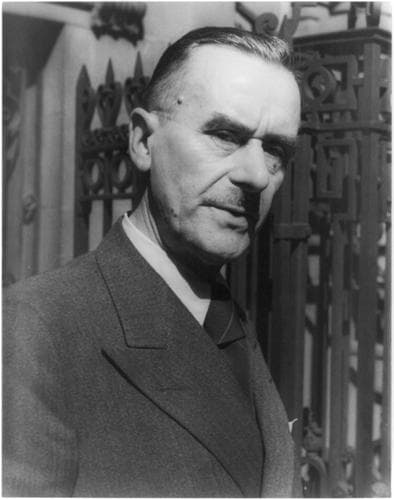
Paul Thomas Mann was a German novelist, short story writer, social critic, philanthropist, essayist, and the 1929 Nobel Prize in Literature laureate. His highly symbolic and ironic epic novels and novellas are noted for their insight into the psychology of the artist and the intellectual. His analysis and critique of the European and German soul used modernized versions of German and Biblical stories, as well as the ideas of Johann Wolfgang von Goethe, Friedrich Nietzsche, and Arthur Schopenhauer.
Similar books
- East of Eden
John Steinbeck
4.4 (429k) average on GoodreadsLiterary FictionExplores themes of sibling rivalry, good vs. evil, and the weight of family legacy across generations, similar to Joseph's family saga.
- War and Peace
Leo Tolstoy
4.1 (265k) average on GoodreadsHistorical FictionA similarly epic, multi-volume work of historical fiction with deep philosophical underpinnings and a vast cast of characters.
- The Red Tent
Anita Diamant
4.2 (520k) average on GoodreadsHistorical FictionDiamant's work retells a biblical story from a feminist perspective, emphasizing domestic life, sensory detail, and the experiences of women. Mann's Joseph operates on a grander, more abstract scale, focusing on metaphysical and psychological dimensions and the universal patterns of human behavior, making it a more intellectual and less sensory-driven experience.
- To Kill a Mockingbird
Harper Lee
4.3 (4.5M) average on GoodreadsHistorical FictionIn the 1930s Jim Crow South, Harper Lee writes about racial injustice, moral growth, and the quiet courage of a lawyer father, Atticus Finch, as seen through his young daughter's eyes.
- The Great Gatsby
F. Scott Fitzgerald
3.9 (3.8M) average on GoodreadsHistorical FictionIn the opulent Roaring Twenties, a mysterious millionaire's lavish parties hide his desperate, tragic pursuit of a lost love, exposing the emptiness within the American Dream.
- Pride and Prejudice
Jane Austen
4.3 (3M) average on GoodreadsHistorical FictionIn a society focused on status and money, Elizabeth Bennet navigates love and pride, challenging Mr. Darcy and social expectations to find true affection.






Enjoyed the summary?
A summary gives you the shape of the book. The book itself has the detail, the examples and the voice.
Find Joseph and His Brothers on AmazonAs an Amazon Associate, BookBrief earns from qualifying purchases. How we're funded