
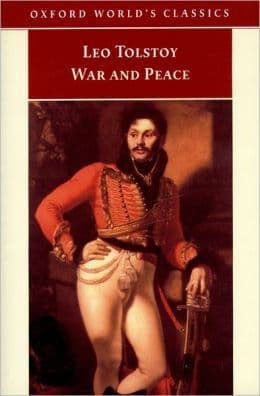
Synopsis
Covers the whole plot, including the ending.
- Difficulty
- Hard
- Pacing
- Variable
- Mood
- Epic, Reflective, Dramatic, Philosophical, Intimate
- Read it if
- You are looking for an epic historical saga that blends deeply personal character development with sweeping historical events and philosophical reflection, and you are prepared for a significant time investment.
- Skip it if
- You prefer fast-paced plots, concise narratives, or stories without extensive philosophical digressions and a large cast of characters.
War and Peace Plot Summary
Covers the whole plot, including the ending.
The Grand Soirée in July 1805
The novel starts in July 1805 at a party given by Anna Pavlovna Scherer in St. Petersburg. Guests include Pierre Bezukhov, the illegitimate son of a rich count; Prince Andrei Bolkonsky, a cynical but ambitious aide to Kutuzov, with his pregnant wife Lise; and the beautiful Hélène Kuragina. They talk about Napoleon's expansion and the coming war. Pierre, awkward but kind, defends Napoleon, which upsets the aristocrats. Prince Andrei wants military glory, seeing home life as a burden. This gathering sets the social and political scene, introducing the main families and their early views on the conflict.
Pierre's Inheritance and Ill-Fated Marriage
After the party, Pierre Bezukhov learns his father, Count Kirill Bezukhov, is dying. Though illegitimate, Pierre is named the Count's sole heir, inheriting great wealth. This suddenly puts the naive Pierre at the center of St. Petersburg society. Prince Vasili Kuragin, wanting to secure his family's future, arranges a marriage between Pierre and his beautiful, manipulative daughter, Hélène Kuragina. Pierre, taken by Hélène's beauty and pressured by society, agrees to the marriage, which soon brings him great unhappiness.
Andrei's Military Ambitions and Austerlitz
Prince Andrei Bolkonsky, unhappy with his home life and wanting glory, leaves his pregnant wife Lise with his strict father, Prince Nikolai Bolkonsky, and pious sister, Princess Marya. He joins the Russian army as an adjutant to General Kutuzov. Andrei fights in the disastrous Battle of Austerlitz (1805), where he is badly wounded trying to rally his troops. Lying on the battlefield, looking at the indifferent sky, he realizes his ambitions for fame were pointless. He is captured by the French but later released, returning home to the sad news of Lise's death during childbirth, leaving him with their infant son, Nikolai.
Natasha Rostova's Debut and Initial Romances
The Rostov family, including the charming Natasha Rostova, the kind Nikolai, and the earnest Petya, are introduced as a lively, loving, but financially struggling Moscow noble family. Natasha, full of life, attends her first grand ball and captivates many. She falls in love with Boris Drubetskoy, a childhood friend, but their romance is complicated by his mother's social ambitions and the Rostovs' money problems. Later, she is drawn to her cousin, Denisov, a hussar officer, who proposes to her, but she refuses due to her age and her parents' disapproval. These early experiences show Natasha's lively nature and her changing understanding of love and society.
Andrei's Reawakening and Love for Natasha
After years of sadness following Austerlitz and Lise's death, Prince Andrei Bolkonsky returns to society. He meets Natasha Rostova at her first grand ball in St. Petersburg. Her lively spirit and joy immediately draw him in, breaking through his cynicism. He falls in love with her, and they become engaged. However, Andrei's strict father, Prince Nikolai, disapproves and requires a one-year waiting period before they can marry. Andrei reluctantly agrees, traveling abroad, leaving Natasha open to other influences and testing their commitment.
Natasha's Folly and Andrei's Heartbreak
While Prince Andrei is away, Natasha Rostova, feeling neglected and lonely, becomes infatuated with Anatole Kuragin, Hélène Bezukhova's brother. Anatole, a known womanizer, manipulates Natasha, convincing her to run away with him even though he knows she is engaged. Their plan is stopped by Sonya Rostova and Pierre Bezukhov, who intervenes, revealing Anatole's deceit and the fact that he is already secretly married. The scandal leaves Natasha devastated. When Prince Andrei returns and learns of Natasha's actions, he is heartbroken and angry, breaking their engagement and returning her letters, causing deep despair for both.
Pierre's Spiritual Crisis and Freemasonry
Pierre Bezukhov, increasingly unhappy in his marriage to Hélène and disillusioned with society, enters a period of spiritual crisis. He tries to change his life, divorcing Hélène, and seeks meaning in different philosophies. He is introduced to Freemasonry, finding a temporary sense of purpose in its ideas of brotherhood and charity. He dedicates himself to charity work, trying to apply Masonic ideals on his estates. However, he eventually becomes disappointed with the hypocrisy within the Masonic lodges, realizing that true change must come from within, not from outside groups.
The Invasion of 1812 and Borodino
In 1812, Napoleon invades Russia, a turning point in the novel. The war unites the Russian people. Prince Andrei Bolkonsky, wanting to forget his personal sorrows, returns to the army and fights well. Nikolai Rostov proves himself a brave cavalry officer. Pierre Bezukhov, wanting to understand the conflict and perhaps assassinate Napoleon, travels to the front lines, seeing the horrors of war. The Battle of Borodino, a brutal engagement, is shown in detail, demonstrating the war's scale and its impact on individuals.
The Burning of Moscow and Pierre's Captivity
After the indecisive Battle of Borodino, the Russian army retreats, and Moscow is evacuated. The city then burns, whether by Russian plan or French accident. Pierre Bezukhov, having stayed in Moscow, tries to assassinate Napoleon, but fails. He is captured by the French, enduring the hardships of a prisoner of war. During his captivity, he meets Platon Karataev, a simple, religious peasant soldier, whose faith, resilience, and practical wisdom deeply influence Pierre, teaching him about the human spirit and life's simple joys, shedding his intellectual pretense.
Andrei's Final Days and Reconciliation with Natasha
Prince Andrei Bolkonsky is mortally wounded during the Battle of Borodino. During the retreat from Moscow, he is evacuated and eventually finds himself in the same convoy as the Rostov family, who are transporting their wounded. Natasha Rostova finds Andrei among the wounded. She nurses him, and they reconcile, forgiving each other for past hurts. Andrei, through his suffering, changes spiritually, finding peace and love in his final moments. He dies in Natasha's arms, leaving her heartbroken but changed by their renewed connection.
The French Retreat and Russian Pursuit
Napoleon's forces, weakened by the Russian winter, lack of supplies, and constant harassment by Russian partisan groups and regular army units, begin their disastrous retreat from Moscow. The novel shows the immense suffering of the French soldiers, many dying from starvation, frostbite, and disease. The Russian army, led by Kutuzov, pursues them, causing heavy casualties. Petya Rostov, Natasha's younger brother, wanting glory, joins a partisan group and is killed in a skirmish during the pursuit, adding grief to the Rostov family but also highlighting the sacrifices for the Russian victory.
Nikolai's Marriage and the Rostov Estate
After the war, the Rostov family faces serious money problems. Nikolai Rostov, burdened by the family's debts, considers marrying a rich heiress for practical reasons. However, he is drawn to the kind, pious, and wealthy Princess Marya Bolkonskaya, Andrei's sister. Despite their initial differences and Marya's shyness, they fall in love and marry. This union brings happiness to Nikolai and secures the Rostov family's financial future, allowing them to rebuild their estate. Their marriage symbolizes the merging of two prominent families and the healing of past wounds.
Pierre and Natasha's Love and Marriage
After his release from French captivity and his experiences, Pierre Bezukhov is a changed man, shedding his earlier naivety and intellectual restlessness. Natasha Rostova, having endured the loss of Andrei and her brother Petya, has matured into a compassionate and resilient woman. Both have been shaped by the war and personal tragedy. They find comfort and understanding in each other. Pierre realizes his deep love for Natasha, and she, in turn, recognizes his goodness and strength. They marry, creating a loving and stable family, representing the novel's affirmation of life, family, and domestic happiness after the war.
The Epilogue: Family Life and Historical Reflection
The epilogue moves several years forward, showing the settled family lives of Pierre and Natasha, and Nikolai and Marya. Pierre and Natasha have children and a happy home life, with Pierre involved in talks about political reform and philosophy. Nikolai manages his estate and family with Marya, finding contentment as a landowner and father. The epilogue also includes a philosophical discussion between Pierre and Nikolai about historical forces and the role of individuals in shaping events. Tolstoy uses this section to further explain his theories of history, emphasizing the collective will and the limits of individual 'great men' in the sweep of time, ending the story with a focus on generational continuity and the human spirit.
Principal Figures
Pierre Bezukhov
Protagonist
The wealthy, illegitimate son who searches for meaning and identity.
Pierre is initially presented as an awkward, naive, and idealistic young man, the illegitimate son of a wealthy count. He inherits a vast fortune, which initially leads him into a disastrous marriage with Hélène Kuragina and a period of social and spiritual confusion. Throughout the novel, Pierre is a seeker, constantly questioning life's purpose, dabbling in philosophy, Freemasonry, and even revolutionary ideas. He is kind-hearted, intelligent, but often impractical and easily swayed. His journey is one of self-discovery, moving from intellectual abstraction to a deeper understanding of life's simple truths.
Relationships: Count Kirill Bezukhov (father, whose death makes Pierre wealthy); Hélène Kuragina (first wife, a manipulative and unfaithful socialite); Natasha Rostova (second wife and true love); Prince Andrei Bolkonsky (closest friend and intellectual confidant); Platon Karataev (fellow prisoner, spiritual mentor)
Prince Andrei Bolkonsky
Protagonist
A brilliant but cynical nobleman seeking glory and eventually spiritual enlightenment.
Prince Andrei is a proud, intelligent, and ambitious aristocrat, initially disillusioned with his domestic life and yearning for military glory. He possesses a sharp intellect and a critical eye, often appearing cynical and aloof. His experiences in war, particularly the Battle of Austerlitz, profoundly shake his worldview, leading to a period of reclusive melancholy. He is driven by a deep desire for meaning and truth, but struggles with pride and a tendency towards intellectual detachment. His journey is marked by intense suffering and a gradual spiritual awakening.
Relationships: Prince Nikolai Bolkonsky (strict, respected father); Princess Marya Bolkonskaya (devout, loving sister); Lise Bolkonskaya (first wife, whom he initially resents); Natasha Rostova (fiancée, who reawakens his capacity for love); Pierre Bezukhov (closest friend and intellectual confidant)
Natasha Rostova
Protagonist
A vibrant, impulsive, and ultimately compassionate young woman.
Natasha is introduced as a spirited, beautiful, and highly emotional young girl, full of life, joy, and an infectious enthusiasm. She is impulsive, sensitive, and deeply empathetic, with a powerful natural intuition. Her early experiences with love and heartbreak (with Boris, Denisov, and Anatole) are central to her character development. She possesses an extraordinary capacity for love and a deep connection to life's simple pleasures, such as dancing and singing. Though she makes mistakes, her fundamental goodness and resilience shine through, making her a symbol of life's enduring power.
Relationships: Count Ilya Rostov (loving, indulgent father); Countess Natalya Rostova (loving, somewhat anxious mother); Nikolai Rostov (beloved brother); Sonya Rostova (cousin and close friend); Prince Andrei Bolkonsky (first great love and fiancé); Pierre Bezukhov (husband and ultimate life partner)
Nikolai Rostov
Supporting
A brave, honorable, but often financially irresponsible cavalry officer.
Nikolai is the eldest Rostov son, a cheerful, straightforward, and honorable young man. He is passionate about military service, initially driven by youthful idealism and a strong sense of duty. He is a brave officer but struggles with gambling debts and the practicalities of managing his family's finances. Nikolai represents the traditional Russian gentry, valuing honor, loyalty, and family. He matures through his experiences in war and his eventual marriage, learning responsibility and finding contentment in a more grounded existence.
Relationships: Natasha Rostova (beloved sister); Sonya Rostova (childhood sweetheart, whom he eventually forsakes); Denisov (commanding officer and friend); Princess Marya Bolkonskaya (wife)
Princess Marya Bolkonskaya
Supporting
The pious, self-sacrificing sister of Prince Andrei, who finds love and strength.
Princess Marya is a devoutly religious, plain-looking, and initially shy woman, devoted to her tyrannical father, Prince Nikolai, and her brother, Andrei. She possesses a deep inner strength, compassion, and spiritual wisdom, often finding solace in her faith. Despite her meek exterior, she is capable of great sacrifice and independent thought. Her journey involves overcoming her father's oppressive influence and her own insecurities to find love and happiness with Nikolai Rostov, embodying the quiet strength of the Russian woman.
Relationships: Prince Nikolai Bolkonsky (tyrannical father); Prince Andrei Bolkonsky (beloved brother); Nikolai Rostov (husband); Mademoiselle Bourienne (companion, whom she often forgives)
Prince Nikolai Bolkonsky
Supporting
Prince Andrei's stern, proud, and intellectually formidable father.
Prince Nikolai Bolkonsky is a formidable figure, a retired general known for his intelligence, sternness, and uncompromising principles. He is deeply proud of his family name and values discipline, reason, and duty above all else. He can be tyrannical and demanding, particularly towards his daughter Marya, but he also possesses a deep, though often unexpressed, love for his children. He represents the old aristocracy, resistant to change and deeply rooted in tradition. His death marks a significant turning point for both Andrei and Marya.
Relationships: Prince Andrei Bolkonsky (respected but often challenged son); Princess Marya Bolkonskaya (dominated but ultimately beloved daughter)
Hélène Kuragina (Bezukhova)
Antagonist/Supporting
A beautiful, manipulative, and promiscuous socialite.
Hélène is stunningly beautiful, graceful, and socially adept, but completely devoid of genuine emotion, morality, or intellect. She uses her beauty and charm to manipulate those around her, especially men. She marries Pierre Bezukhov for his wealth and status, but her infidelity and superficiality make their marriage a torment. She represents the corrupting influence of high society and moral decay, contrasting sharply with the genuine goodness of characters like Natasha and Marya. Her actions directly cause significant suffering for Pierre.
Relationships: Prince Vasili Kuragin (scheming father); Anatole Kuragin (promiscuous brother); Pierre Bezukhov (first husband, whom she torments)
Anatole Kuragin
Supporting
Hélène's equally dissolute and charmingly irresponsible brother.
Anatole is Hélène's brother, a handsome, charming, and utterly irresponsible rake. He lives for pleasure and self-gratification, without any regard for the consequences of his actions or the feelings of others. His attempt to elope with Natasha Rostova, despite being secretly married, causes immense distress and heartbreak. He embodies the superficial and destructive aspects of the aristocratic youth, contrasting with the more earnest pursuits of the protagonists. He is a catalyst for much of Natasha's early suffering.
Relationships: Prince Vasili Kuragin (indulgent father); Hélène Kuragina (sister, with whom he has an incestuous rumor); Natasha Rostova (object of his manipulative seduction)
General Mikhail Kutuzov
Supporting
The sagacious, patient, and ultimately victorious commander of the Russian forces.
Kutuzov is the elderly, one-eyed commander-in-chief of the Russian army. He is portrayed as a wise, patient, and intuitive leader, often appearing sleepy or indifferent, but possessing a deep understanding of the 'spirit' of the army and the nature of warfare. Unlike Napoleon, he does not believe in grand, intellectualized strategies but rather in the power of patience, timing, and allowing events to unfold naturally. He embodies the Russian national character and Tolstoy's philosophy of history, emphasizing the collective will over individual genius.
Relationships: Prince Andrei Bolkonsky (aide-de-camp, whom he respects); Tsar Alexander I (emperor, whose orders he often subtly defies)
Napoleon Bonaparte
Antagonist
The ambitious and charismatic French emperor, a foil to Tolstoy's historical philosophy.
Napoleon is depicted as a brilliant but arrogant and self-aggrandizing military genius. Tolstoy uses Napoleon to challenge the 'Great Man' theory of history, portraying him as a figure who believes he controls events, but is ultimately a pawn of larger historical forces. While his strategic prowess is acknowledged, Tolstoy emphasizes his vanity, coldness, and detachment from the human cost of his ambitions. He serves as the primary external antagonist, representing the forces of conquest and individual will that clash with the Russian spirit and the natural flow of history.
Relationships: Tsar Alexander I (rival emperor); Pierre Bezukhov (object of Pierre's initial admiration, then hatred)
Themes & Insights
The Nature of History and Free Will vs. Determinism
Tolstoy thoroughly explores the forces that drive historical events, questioning the 'Great Man' theory. He argues that history is not shaped by 'heroes' like Napoleon, but by the collective, often unseen, will of the masses and an almost deterministic flow of events. Generals like Kutuzov, who understand and adapt to this flow, are more effective than those who try to force their will. This theme is clear in the detailed battle descriptions, where individual plans often fail, and in Pierre's philosophical discussions, especially in the epilogue, where he grapples with the relationship between necessity and freedom.
“A king is history's slave.”
The Search for Meaning and Spiritual Enlightenment
Many characters, especially Pierre Bezukhov and Prince Andrei Bolkonsky, go on deep spiritual journeys throughout the novel. Pierre seeks meaning in different philosophies, Freemasonry, and ultimately in the simple truths learned from Platon Karataev during his captivity. Andrei, initially driven by ambition, finds spiritual peace and a deeper understanding of life and death after his wounding at Austerlitz and his final reconciliation with Natasha. Their quests highlight the human need for purpose beyond worldly success and societal expectations, often found through suffering and self-reflection.
“We are not masters of our own lives, but are bound by the will of Him who sent us.”
The Contrast Between War and Peace (Public and Private Life)
The novel's title shows this central theme. Tolstoy contrasts the grand, often chaotic, and destructive events of war with the intimate, everyday lives of families and individuals. The public world of battlefields, court intrigues, and political maneuvers is set against the private world of love, family, and personal growth. Characters like Natasha and Nikolai find their true purpose and happiness in the 'peace' of family life after experiencing 'war' firsthand. This contrast shows Tolstoy's belief that true fulfillment is found not in external glory but in internal connection and life's simple rhythms.
“There is no greatness where there is no simplicity, goodness, and truth.”
Love, Family, and Domestic Happiness
Despite the war, the novel ultimately confirms the importance of love, family bonds, and the quiet joys of home life. The Rostovs, with their warmth and strong family ties, represent an ideal family. The journeys of Pierre and Natasha, who both endure great personal suffering, lead to a loving and stable marriage and family, symbolizing the lasting power of human connection. Nikolai and Marya's marriage also signifies the healing and continuity found in domestic happiness. Tolstoy suggests that true happiness and meaning are found in these intimate relationships and the creation of new generations.
“Life is everything. Life is God. Everything changes and moves and that movement is God. And while there is life, there is joy in the consciousness of the divine. To love life is to love God.”
The Authenticity of the 'Natural Man' vs. Societal Artifice
Tolstoy often contrasts characters who are naturally good, simple, and real with those who are artificial, vain, and pretentious. Pierre Bezukhov's initial awkwardness and genuine heart are valued over the polished but empty charm of the Kuragins. Platon Karataev, the simple peasant soldier, with his practical wisdom and faith, deeply influences Pierre, teaching him the value of an uncorrupted spirit. Natasha's natural liveliness and emotional honesty are celebrated, while the calculated social graces of characters like Hélène are shown as hollow. This theme suggests that true virtue comes from a real connection to life and the human spirit, rather than social standing or intellectual sophistication.
“He knew that the whole world was in him and that he was the whole world.”
Plot Devices & Literary Techniques
Omniscient Narrator with Philosophical Interjections
A narrator who provides not only plot details but also extensive historical and philosophical commentary.
Tolstoy employs an omniscient third-person narrator who not only describes the events and inner lives of the characters but also frequently pauses the narrative to interject lengthy essays and philosophical treatises on history, warfare, leadership, and human nature. This device allows Tolstoy to directly present his theories on determinism, the 'Great Man' theory, and the true forces shaping history, often using the characters' experiences as illustrations. It elevates the novel beyond a mere historical chronicle to a profound work of philosophical inquiry, shaping the reader's understanding of the events and their deeper significance.
Contrasting Character Pairs
Using pairs of characters to highlight different philosophies, virtues, or flaws.
Tolstoy frequently uses contrasting character pairs to explore his themes. The most prominent is the friendship between Pierre Bezukhov and Prince Andrei Bolkonsky, whose differing approaches to life, love, and meaning provide a dynamic intellectual and emotional core. Napoleon and Kutuzov serve as foils for Tolstoy's theories on leadership and history. Hélène Kuragina and Natasha Rostova embody contrasting ideals of femininity – one superficial and manipulative, the other authentic and life-affirming. These contrasts allow Tolstoy to present a nuanced exploration of human nature and moral choices, reinforcing his philosophical arguments through character development and interaction.
Symbolic Events and Epiphanies
Key moments where characters experience profound insights or shifts in perspective.
The novel is punctuated by several symbolic events and epiphanies that mark turning points for the characters. Prince Andrei's vision of the 'lofty, eternal sky' at Austerlitz profoundly changes his perspective on glory and ambition. Pierre's encounter with Platon Karataev during his captivity in Moscow teaches him about simplicity, faith, and the true meaning of life. Natasha's singing, dancing, or her desperate plea for forgiveness after her near-elopement are moments of intense emotional and symbolic weight. These moments serve as catalysts for character development, illustrating their spiritual growth and Tolstoy's overarching philosophical messages about life, death, and human connection.
Detailed Historical Research and Blending of Fact and Fiction
Extensive use of historical figures, battles, and societal details to create an authentic backdrop.
Tolstoy meticulously integrates historical facts, figures, and events into his fictional narrative. Real historical personages like Napoleon, Tsar Alexander I, and General Kutuzov interact with the fictional characters, and major battles like Austerlitz and Borodino are described with painstaking detail, often based on extensive research. This device lends immense verisimilitude to the novel, making the historical setting feel alive and authentic. It allows Tolstoy to explore his philosophical theories about history within a credible, grand-scale canvas, blurring the lines between historical chronicle and fictional narrative.
War and Peace Quotes
“All happy families are alike; each unhappy family is unhappy in its own way.”
“We can know only that we know nothing. And that is the highest degree of human wisdom.”
“If everyone fought for their own convictions, there would be no war.”
“The strongest of all warriors are these two — Time and Patience.”
“Pure and complete sorrow is as impossible as pure and complete joy.”
“There is no greatness where there is not simplicity, goodness, and truth.”
“It is not the strength of the army but the strength of the spirit that conquers.”
“He was one of those people who are always convinced that they are telling the truth, and who are therefore the most dangerous.”
“Everything I know, I know because of love.”
“When you love someone, you love the person as they are, and not as you'd like them to be.”
“Man cannot be free while he is afraid.”
“The aim of art is not to solve a problem, but to make us love life in all its countless, inexhaustible manifestations.”
“Life is everything. Life is God. Everything changes and moves and that movement is God. And while there is life, there is joy in the consciousness of the divine. To love life is to love God.”
“A man on a thousand-mile journey must first take a single step.”
“There is no justice in the world, only power.”
Quiz
10 questions on the plot and the characters. Each answer comes with a short explanation.
Question 1
Which of the following characters is NOT one of the primary Rostov children introduced early in the novel?
- Nikolai Rostov
- Natasha Rostova
- Petya Rostov
- Anatole Kuragin
Show answer
D. Anatole Kuragin Anatole Kuragin is a character from a different prominent family, known for his dissolute lifestyle and his pursuit of Natasha. Nikolai, Natasha, and Petya are all children of Count and Countess Rostov.
Question 2
What significant historical battle is Prince Andrei Bolkonsky severely wounded in, leading many to believe he is dead?
- Battle of Borodino
- Battle of Austerlitz
- Battle of Smolensk
- Battle of Schöngraben
Show answer
B. Battle of Austerlitz Prince Andrei is gravely wounded at the Battle of Austerlitz, where he carries the regimental standard and falls, gazing at the 'lofty, infinite sky'. He is later found alive but severely injured.
Question 3
What is Pierre Bezukhov's initial social standing and how does it change dramatically early in the novel?
- He is a poor illegitimate son who inherits a vast fortune.
- He is a wealthy nobleman who loses his fortune through gambling.
- He is a respected army officer who is disgraced and exiled.
- He is a minor bureaucrat who rises through political connections.
Show answer
A. He is a poor illegitimate son who inherits a vast fortune. Pierre begins as an illegitimate son with no clear prospects, but upon the death of his wealthy father, Count Bezukhov, he unexpectedly inherits a vast fortune, making him one of the richest men in Russia.
Question 4
Which character serves as a foil to Prince Andrei's initial disillusionment and later spiritual search, representing a more pragmatic and often cynical view of life?
- Platon Karataev
- Pierre Bezukhov
- Nikolai Rostov
- Denisov
Show answer
B. Pierre Bezukhov Pierre Bezukhov, despite his own spiritual quests, often serves as a contrasting figure to Andrei. While Andrei is intellectual and aristocratic, often seeking glory or absolute truth, Pierre is more intuitive, emotional, and connected to the common man, representing a different path to understanding life.
Question 5
What is the primary reason Natasha Rostova breaks her engagement to Prince Andrei Bolkonsky?
- She falls in love with Denisov.
- She is seduced by and attempts to elope with Anatole Kuragin.
- Prince Andrei's father forbids the marriage.
- She decides to join a convent.
Show answer
B. She is seduced by and attempts to elope with Anatole Kuragin. During Andrei's absence, Natasha is captivated by the charming but unscrupulous Anatole Kuragin and plans to elope with him, leading to the scandalous break of her engagement to Andrei.
Question 6
Tolstoy frequently critiques the 'great man' theory of history. Which general's leadership, often portrayed as ineffective and driven by vanity, serves as a prominent example of this critique?
- General Kutuzov
- Napoleon Bonaparte
- Bagration
- General Mack
Show answer
B. Napoleon Bonaparte Tolstoy consistently undermines the idea of Napoleon as a brilliant, decisive leader, instead portraying him as a man whose actions are often driven by chance and the collective will of the masses, rather than his own genius. Kutuzov, by contrast, is often shown as embodying the more humble, intuitive wisdom of the Russian people.
Question 7
What spiritual organization does Pierre Bezukhov briefly join in his search for meaning, only to become disillusioned?
- The Russian Orthodox Church
- The Jesuits
- The Freemasons
- The Decembrists
Show answer
C. The Freemasons After his early struggles and unhappy marriage, Pierre seeks purpose in the Freemasons, initially finding solace and a sense of brotherhood, but eventually becoming disillusioned with their rituals and perceived hypocrisy.
Question 8
Which character ultimately marries Nikolai Rostov?
- Sonya Rostova
- Princess Marya Bolkonskaya
- Hélène Kuragina
- Natasha Rostova
Show answer
B. Princess Marya Bolkonskaya Nikolai Rostov, after facing financial ruin with his family, eventually marries the wealthy and devout Princess Marya Bolkonskaya, uniting their families and providing financial stability.
Question 9
During the French occupation of Moscow, what happens to Pierre Bezukhov that profoundly changes his perspective on life and humanity?
- He successfully assassinates Napoleon.
- He is captured by the French and experiences peasant life and spiritual simplicity through Platon Karataev.
- He leads a successful guerrilla resistance movement.
- He discovers hidden family treasure and escapes to safety.
Show answer
B. He is captured by the French and experiences peasant life and spiritual simplicity through Platon Karataev. Pierre is captured by the French in Moscow and endures the hardships of a prisoner of war. During this time, his interactions with the peasant Platon Karataev expose him to a profound, simple faith and acceptance of life, which transforms his worldview.
Question 10
Tolstoy's 'War and Peace' explores the tension between free will and determinism. Which of the following best represents his ultimate stance on this philosophical conflict?
- He argues exclusively for the absolute free will of individuals.
- He asserts that all human actions are predetermined by divine intervention.
- He suggests that while individuals perceive free will, their actions are ultimately subject to the vast, impersonal forces of history and the collective will.
- He concludes that only great historical figures possess true free will, while the masses are entirely determined.
Show answer
C. He suggests that while individuals perceive free will, their actions are ultimately subject to the vast, impersonal forces of history and the collective will. Tolstoy extensively discusses the interplay of free will and necessity, ultimately concluding that while individuals feel they act freely, their actions are often components of larger, unfathomable historical processes. He emphasizes the 'swarming life' of humanity over the individual's perceived control, particularly in historical events.
War and Peace FAQ
What is the central historical conflict driving the narrative of 'War and Peace'?
'War and Peace' centers around Russia's resistance to Napoleon's invasion in the early 19th century, specifically covering the period from 1805 to 1812. The narrative vividly portrays the Battle of Austerlitz, the French occupation of Moscow, and the subsequent devastating retreat of Napoleon's army. This historical backdrop intertwines with the personal lives of several aristocratic Russian families.
Who are the three main aristocratic protagonists whose lives intertwine throughout the novel?
The three primary aristocratic protagonists are Pierre Bezukhov, the illegitimate son of a wealthy count, who struggles with existential questions and finding purpose; Prince Andrei Bolkonsky, a cynical but ambitious officer seeking glory and later peace; and Natasha Rostova, a vibrant and impulsive young woman who experiences love, heartbreak, and personal growth. Their individual journeys reflect the broader societal changes and personal transformations brought about by war.
What role does the Battle of Borodino play in the novel's depiction of war?
The Battle of Borodino is a pivotal and extensively detailed event in 'War and Peace', serving as the bloodiest single day of the Napoleonic Wars and a turning point in the invasion. Tolstoy uses it to illustrate the chaos, futility, and human cost of war, often through the eyes of Pierre Bezukhov, who observes it firsthand. It highlights the Russian spirit of resistance and the eventual strategic retreat that leads to Moscow's abandonment.
How does Tolstoy use the burning of Moscow to advance the plot and themes?
The burning of Moscow, after its abandonment by the Russian army, is a catastrophic event that profoundly impacts the characters and the war's trajectory. It signifies the ultimate sacrifice made by the Russians to deny Napoleon a decisive victory and marks the beginning of the French retreat. For characters like Pierre, who witnesses the destruction and chaos, it deepens his understanding of human suffering and the nature of historical forces.
What is the significance of the novel's title, 'War and Peace'?
The title 'War and Peace' encapsulates the novel's dual focus: the grand historical events of war and their devastating impact, contrasted with the intimate, personal struggles for happiness, love, and meaning (peace) in everyday life. Tolstoy explores how these two spheres constantly interact, demonstrating that true peace is not merely the absence of war but an internal state of harmony and understanding, often found amidst or after conflict.
Are there any subtle foreshadowing elements regarding Prince Andrei's ultimate fate?
Yes, Prince Andrei's recurring sense of disillusionment and his fatalistic pronouncements often foreshadow his ultimate demise. His near-death experience at Austerlitz, where he gazes at the 'lofty, eternal sky,' and his later reflections on the meaninglessness of worldly ambition, subtly prepare the reader for his eventual, peaceful death after being wounded at Borodino. His yearning for a simple, true life contrasts with his initial pursuit of glory.
What is the implied fate of Anatole Kuragin after his injury and flight?
After his leg is amputated due to a wound sustained at Borodino, Anatole Kuragin is last seen in a state of suffering and dependence, far from his previous life of carefree debauchery. While his specific long-term fate isn't explicitly detailed, his injury and subsequent emotional breakdown suggest a significant and permanent end to his frivolous lifestyle, implying a life of diminished capacity and regret, a stark contrast to his earlier arrogance.
How does Tolstoy subtly criticize the 'great man' theory of history through Napoleon and Kutuzov?
Tolstoy subtly criticizes the 'great man' theory by portraying Napoleon as a vain, self-important figure whose grand plans are often thwarted by chance and the collective will of the people, rather than his own genius. In contrast, General Kutuzov is depicted as a seemingly passive, aging leader who trusts in the natural flow of events and the spirit of his soldiers, rather than intricate strategies, ultimately achieving victory. This illustrates Tolstoy's belief that history is driven by countless small actions, not individual heroes.
What is the significance of Pierre Bezukhov's Freemasonry experience?
Pierre Bezukhov's involvement with Freemasonry is a significant phase in his quest for meaning and moral guidance. Initially, he finds solace and a sense of purpose in its ideals of brotherhood and self-improvement, attempting to implement reforms on his estates. However, he eventually becomes disillusioned by the order's hypocrisy and ritualism, realizing that true wisdom and goodness must come from within and be expressed in genuine, practical love for humanity, rather than abstract doctrines.
Analyze Natasha Rostova's emotional journey and her moments of impulsiveness.
Natasha Rostova's emotional journey is marked by intense highs and lows, driven by her passionate and impulsive nature. Her youthful exuberance and capacity for love are evident in her early infatuation with Boris and then Andrei. Her impulsive decision to elope with Anatole Kuragin, despite being engaged, showcases her immaturity and vulnerability to fleeting desires. However, her later devotion to the wounded Andrei and her eventual stable marriage to Pierre demonstrate profound growth, transforming her impulsiveness into deep, maternal love and resilience.
How does Prince Andrei's changing perspective on glory and love reflect his psychological development?
Prince Andrei initially pursues military glory, believing it will bring him fulfillment, but he becomes deeply disillusioned after Austerlitz and his wife's death. He then seeks solace in intellectual pursuits and cynical detachment. His reawakening to love through Natasha, and later his profound spiritual transformation on his deathbed, where he embraces universal love and forgiveness, illustrates his psychological journey from ambitious egoism to humble, compassionate acceptance of life's true values. His final moments reveal a peace beyond worldly concerns.
Discuss Pierre Bezukhov's existential crisis and his search for meaning.
Pierre Bezukhov's journey is a continuous existential crisis, marked by his struggles with identity, purpose, and moral conduct. Initially adrift and dissolute, he seeks answers in various philosophies, including Freemasonry, and attempts to apply abstract ideals to his life. His experiences during the war, particularly his capture and interaction with the peasant Platon Karataev, profoundly shift his perspective. He learns to find meaning not in grand theories but in simple human connection, resilience, and an acceptance of life's complexities, leading him to a deeper, more grounded understanding of existence.
What is the psychological impact of war on the individual characters, beyond physical suffering?
Beyond physical suffering, war profoundly impacts the characters' psychology, leading to disillusionment, spiritual awakening, and shifts in personal values. Prince Andrei experiences a profound re-evaluation of life and death, while Pierre's capture forces him to confront his own mortality and find meaning in simplicity. Natasha matures from a frivolous girl into a resilient woman capable of deep empathy and sacrifice. The constant threat and chaos strip away societal pretenses, revealing core human nature and forcing introspection.
How does the novel challenge conventional notions of heroism and leadership?
Tolstoy challenges conventional heroism by portraying 'great' historical figures like Napoleon as flawed and often driven by vanity, while elevating the collective spirit and seemingly ordinary actions of the Russian people and soldiers as the true drivers of history. He also presents General Kutuzov as an unconventional leader who achieves victory through patience and intuition rather than brilliant strategy, suggesting that true leadership lies in understanding and adapting to the flow of events, rather than imposing one's will.
Is 'War and Peace' primarily a historical novel or a philosophical one?
'War and Peace' transcends a simple classification, being both a meticulously researched historical novel and a profound philosophical inquiry. While it vividly chronicles the Napoleonic Wars and Russian society, its deeper purpose lies in exploring Tolstoy's theories of history, free will versus determinism, the nature of love, happiness, and the search for meaning. The historical events serve as a grand canvas upon which these philosophical debates are played out through the lives of its characters, making it a unique blend of both genres.
What is Tolstoy's overarching message about the meaning of life and happiness?
Tolstoy's overarching message about life and happiness is that true fulfillment is not found in ambition, glory, or intellectual pursuits alone, but in simple human connection, love, family, and an acceptance of life's natural flow. Characters like Pierre and Natasha ultimately find happiness in domesticity, compassion, and a humble appreciation for existence, rather than in societal recognition or grand achievements. He emphasizes the importance of living in the present and embracing the ordinary aspects of life.
How does the novel's epic scope contribute to its philosophical arguments?
The novel's epic scope, encompassing vast historical events and numerous characters across many years, is crucial to its philosophical arguments. It allows Tolstoy to demonstrate his theories of history, showing how individual lives are swept up in larger forces, and how the 'great man' theory is flawed. The sheer breadth of experience and perspective allows for a comprehensive exploration of themes like free will, determinism, love, and war, reinforcing the idea that meaning is found in the collective human experience, not just individual actions.
Discuss the role of fate vs. free will as depicted in the novel.
Tolstoy rigorously debates the role of fate versus free will throughout 'War and Peace'. He suggests that while individuals perceive themselves as acting freely, their actions are ultimately determined by countless preceding causes and the larger forces of history. Napoleon's grand plans often fail due to unforeseen circumstances, while Kutuzov's 'inaction' aligns with a natural flow of events. This philosophical stance emphasizes the limited power of individual will against the vast, complex currents of human history and destiny, often leading characters to find peace in accepting their place within this larger scheme.
About the author

Count Lev Nikolayevich Tolstoy, usually referred to in English as Leo Tolstoy, was a Russian writer who is regarded as one of the greatest authors of all time. He received nominations for the Nobel Prize in Literature every year from 1902 to 1906 and for the Nobel Peace Prize in 1901, 1902, and 1909; the fact that he never won is a major controversy.
Similar books
- Les Misérables
Victor Hugo
4.2 (683k) average on GoodreadsHistorical FictionBoth are sprawling 19th-century epics blending personal stories with major historical events and philosophical discussions.
- Anna Karenina
Leo Tolstoy
4.0 (682k) average on GoodreadsHistorical FictionAnother classic by Tolstoy, exploring complex human relationships and societal norms within 19th-century Russia, though more focused on domestic tragedy.
- The Charterhouse of Parma
Stendhal
3.8 (15k) average on GoodreadsHistorical FictionStendhal's "The Charterhouse of Parma" also features a young nobleman, Fabrizio del Dongo, who experiences the Battle of Waterloo, similar to Andrei Bolkonsky's experiences at Austerlitz and Borodino. However, the portrayal of battle and its impact differs significantly. Stendhal famously depicts Fabrizio's experience of Waterloo as confusing and almost anticlimactic, emphasizing the individual's limited perspective amidst chaos. Tolstoy, while acknowledging individual confusion, provides a much more expansive and detailed, almost panoramic, view of battles, often juxtaposing the individual's experience with a broader strategic understanding (or lack thereof). "War and Peace" is far grander in its historical and philosophical ambition, whereas Stendhal's novel is more focused on individual psychology, love, and political intrigue within a smaller, though still significant, historical frame.
- To Kill a Mockingbird
Harper Lee
4.3 (4.5M) average on GoodreadsHistorical FictionIn the 1930s Jim Crow South, Harper Lee writes about racial injustice, moral growth, and the quiet courage of a lawyer father, Atticus Finch, as seen through his young daughter's eyes.
- The Great Gatsby
F. Scott Fitzgerald
3.9 (3.8M) average on GoodreadsHistorical FictionIn the opulent Roaring Twenties, a mysterious millionaire's lavish parties hide his desperate, tragic pursuit of a lost love, exposing the emptiness within the American Dream.
- Pride and Prejudice
Jane Austen
4.3 (3M) average on GoodreadsHistorical FictionIn a society focused on status and money, Elizabeth Bennet navigates love and pride, challenging Mr. Darcy and social expectations to find true affection.





Enjoyed the summary?
A summary gives you the shape of the book. The book itself has the detail, the examples and the voice.
Find War and Peace on AmazonAs an Amazon Associate, BookBrief earns from qualifying purchases. How we're funded