
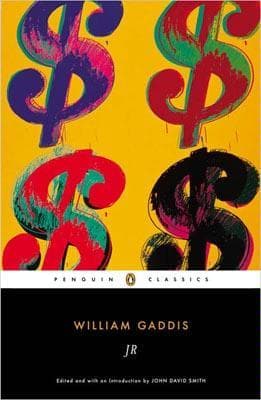
Synopsis
Covers the whole plot, including the ending.
- Difficulty
- Hard
- Pacing
- Variable
- Mood
- Satirical, Chaotic, Absurdist, Cynical, Verbose
- Read it if
- You enjoy experimental literary fiction, dense with dialogue, that satirizes American capitalism and bureaucracy.
- Skip it if
- You prefer traditional narrative structures, clear character arcs, or quiet, introspective prose.
JR Plot Summary
Covers the whole plot, including the ending.
The School Bus and Initial Schemes
The novel opens on a chaotic school bus ride. Sixth-grader J.R. Vansant is already trying to do business, distributing flyers for penny stocks and discussing deals. His teacher, Jack Gibbs, a struggling composer, is overwhelmed by the noise and the students' disinterest in traditional education. J.R.'s entrepreneurial spirit, fueled by mail-order ads and a basic understanding of the stock market, immediately sets the novel's tone for its look at American capitalism. He is trying to sell thousands of surplus Navy picnic forks, a deal he has already started, showing an early grasp of supply and demand, though in an unconventional setting.
The Textile Mill Bankruptcy and Initial Investments
J.R., with the help of some unwitting adults, particularly the bewildered Jack Gibbs, begins to acquire shares in a bankrupt textile mill in upstate New York. He uses proxies and a series of complex, often misunderstood, financial moves to gain control. The adults around him, including lawyers and brokers, are either too distracted, too incompetent, or too eager to make a quick buck to fully grasp the scale of J.R.'s operations. This early expansion sets the stage for the J.R. Corp, showing J.R.'s ability to identify undervalued assets and exploit loopholes, often with a complete disregard for ethics.
The 96th Street Tenement and Corporate HQ
As J.R.'s financial empire grows, he acquires a sprawling, dilapidated tenement on East 96th Street in New York City. This building becomes the headquarters for the J.R. Corp. It is a hub of constant activity and even greater chaos, filled with boxes, legal documents, and a rotating cast of eccentric characters, many of whom are employees or unwilling participants in J.R.'s schemes. The tenement shows the corporation's disorganization and the tangled web of its ventures, from timber to textiles to nursing homes. It is a place where deals are made, broken, and constantly renegotiated amidst ringing phones and shouted instructions.
Gibbs's Entanglement and the Music Project
Jack Gibbs, initially J.R.'s teacher, finds himself pulled into the J.R. Corp's orbit. His attempts to compose music are constantly interrupted and ultimately undermined by his involvement in J.R.'s schemes. J.R., in a misguided attempt to support the arts (and perhaps for tax write-offs), funds a 'frozen music' project, which becomes another chaotic part of the corporation. Gibbs's artistic integrity is challenged as he navigates the bewildering world of finance, legal jargon, and J.R.'s relentless demands, leading to frustration and disillusionment.
The Farber-Schramm Saga
A subplot involves the Farber-Schramm corporation, a complex entity that J.R. tries to acquire or merge with. This involves lawyers, brokers, and various corporate functionaries, all speaking in dense, often nonsensical jargon. The negotiations are full of misunderstandings, double-dealings, and legal quibbles, highlighting the absurdity and opacity of corporate finance. J.R.'s relentless pursuit of this acquisition, often through proxies and phone calls from payphones, further shows his detached yet effective approach to business, where the human element is largely secondary to numbers.
The Nursing Home and Funeral Parlor Venture
One of J.R.'s more questionable ventures involves establishing a chain of nursing homes, which he quickly realizes can be combined with funeral parlors for maximum profit. This scheme shows the novel's critique of unchecked capitalism, where even the most vulnerable people become commodities. The venture is handled with the same detached, profit-first mentality as all of J.R.'s other businesses, highlighting the ethical void at the heart of his empire. The bureaucratic hurdles and the callous discussions about the care of the elderly and the deceased further underscore the satirical edge of the narrative.
The Congressional Hearings and Legal Troubles
As J.R.'s conglomerate grows increasingly complex and sprawling, it eventually draws the attention of regulatory bodies and Congress. Investigations begin into the legality and ethics of the J.R. Corp's various operations, from its obscure financial dealings to its questionable business practices. These hearings and legal battles are portrayed with cynical humor, showing the superficiality and often performative nature of official oversight. J.R., through his proxies and lawyers, navigates these challenges with surprising agility, often by exploiting the very systems designed to regulate him, further demonstrating pervasive corruption and inefficiency.
Anselm's Artistic Struggles and Financial Dependence
Anselm, a talented but struggling painter, finds himself caught in J.R.'s financial web. J.R., in another attempt to manage his corporate image or for tax purposes, invests in Anselm's art. However, this patronage comes with strings attached and is subject to J.R.'s unpredictable whims and the chaotic demands of the corporation. Anselm's artistic integrity and personal life are continually disrupted by his reliance on J.R.'s money, mirroring Gibbs's struggles. His story highlights the corrosive effect of money on creative pursuits and the difficulty of maintaining artistic independence in a world dominated by commercial interests.
The Collapse of the Empire (and Pork Bellies)
The vast, unwieldy, and largely fictitious J.R. Corp begins to unravel. The intricate web of shell corporations, dubious assets, and speculative investments proves unsustainable. A market downturn, particularly a significant drop in pork belly futures – a commodity J.R. has invested heavily in – acts as a catalyst for the empire's collapse. The chaotic final scenes depict a frantic scramble to salvage what little remains, with characters yelling into phones, desperate to understand what went wrong. The collapse is less a dramatic implosion and more a slow, bewildering dissolution, reflecting the ephemeral nature of J.R.'s paper empire.
The Aftermath and Lingering Chaos
After the J.R. Corp's collapse, many characters are left to pick up the pieces of their disrupted lives. Gibbs, deeply disillusioned, tries to return to his music, but the experience has left a lasting mark. Others are financially ruined or simply bewildered by the sudden disappearance of the empire they were a part of. J.R. himself, though his grand scheme has failed, remains largely unfazed, already looking for the next opportunity. The novel ends with a sense of lingering chaos and the suggestion that the cycle of speculative capitalism and human folly will continue, leaving a profound sense of the absurdity of modern life.
Principal Figures
J R Vansant
Protagonist/Antagonist
A precocious sixth-grader who builds a vast, chaotic financial empire.
J R is a ten-year-old boy driven by an insatiable entrepreneurial spirit, fueled by mail-order ads and a rudimentary understanding of finance. He is largely absent from the narrative as a physical presence, operating primarily through phone calls, proxies, and a detached, almost robotic, efficiency. His motivations seem to stem from a pure, amoral desire to make money and control assets, viewing the world as a complex system of transactions to be exploited. He exhibits a profound lack of empathy, seeing people as instruments for his business dealings.
Relationships: Jack Gibbs (Teacher and unwitting proxy/employee); Various Lawyers and Brokers (Unwitting or complicit facilitators of his schemes)
Jack Gibbs
Protagonist/Supporting
A struggling composer and J R's bewildered teacher, drawn into the corporate chaos.
Jack Gibbs is a gifted but perpetually frustrated composer, whose artistic ambitions are constantly thwarted by the demands of his teaching job and, later, his entanglement with J R's business. He is intelligent and sensitive, but easily overwhelmed by the cacophony and complexity of the modern world. Gibbs represents the artistic and intellectual individual struggling to maintain integrity and purpose in a society dominated by commerce and meaningless jargon. He often acts as a moral compass, albeit a frequently ignored one.
Relationships: J R Vansant (Student and later, his accidental business associate); Amy (His lover, often strained by his preoccupation); Edward Bast (Fellow artist and confidant)
Edward Bast
Supporting
A dedicated but struggling composer, often a sounding board for Gibbs.
Edward Bast is another composer, a friend and colleague of Jack Gibbs, who shares similar artistic struggles and frustrations. He is more grounded than Gibbs, often offering a more cynical or pragmatic perspective on their situation. Bast is also drawn into the periphery of J R's world, witnessing the absurdity and corruption firsthand. He represents a different facet of the artist's struggle in a commercial society, often serving as a foil to Gibbs's more existential despair.
Relationships: Jack Gibbs (Close friend and fellow composer)
Amy
Supporting
Jack Gibbs's long-suffering lover, often left to deal with the practicalities of his life.
Amy is Jack Gibbs's lover, a practical and often exasperated woman who tries to bring some order to Gibbs's chaotic life. She is a grounding force, but her patience is frequently tested by Gibbs's artistic preoccupations and his increasing entanglement with J R's business. Amy often acts as a voice of reason, highlighting the absurdity of the situations Gibbs finds himself in. She represents the personal cost of unchecked ambition and the difficulty of maintaining relationships amidst financial and existential chaos.
Relationships: Jack Gibbs (Lover)
Frank Bast
Supporting
Edward Bast's brother, an unscrupulous lawyer involved in J R's schemes.
Frank Bast is Edward's brother, a lawyer who becomes deeply involved in the legal machinations of the J R Corp. He is cynical and opportunistic, representing the legal profession's willingness to bend rules and exploit loopholes for profit. Frank is intelligent and articulate, but his ethics are highly flexible, making him an effective, if morally compromised, facilitator for J R's complex deals. He embodies the legal system's complicity in unchecked capitalism.
Relationships: Edward Bast (Brother); J R Vansant (Legal counsel/facilitator)
Anselm
Supporting
A struggling painter whose art is co-opted by J R's corporate ventures.
Anselm is a painter whose work is purchased by J R, ostensibly for corporate art initiatives or tax write-offs. Like Gibbs, he represents the artist struggling to survive and maintain integrity in a commercialized world. His interactions with the J R Corp highlight the often-absurd ways in which art is commodified and devalued when subjected to corporate logic. He is often bewildered and frustrated by the demands placed upon him by J R's representatives.
Relationships: J R Vansant (Patron (through the corporation))
Coen
Supporting
A corporate functionary, often overwhelmed by the chaos of the J R Corp.
Coen is one of the many bewildered adults who find themselves working for or entangled with the J R Corp. He is often depicted as trying to make sense of the endless paperwork, phone calls, and contradictory instructions emanating from J R. Coen represents the average, well-meaning individual caught in the gears of a vast, incomprehensible corporate machine. His attempts at efficiency and understanding are constantly undermined by the inherent chaos of J R's operations.
Relationships: J R Vansant (Employee/manager); Various corporate staff (Colleague)
Themes & Insights
The Corrupting Nature of Capitalism
The novel is a scathing critique of unchecked capitalism. It portrays it as a system that prioritizes profit above all else, leading to ethical decay, human exploitation, and a devaluation of intrinsic worth. J.R.'s empire, built on speculation, loopholes, and a complete disregard for human well-being (as seen in the nursing home venture), exemplifies this. The constant transactional dialogue, where every person and object has a price, highlights how capitalism can reduce all aspects of life to mere commodities. The chaos and meaninglessness of the corporate jargon further underscore the hollowness at the heart of this system, as seen when Gibbs tries to understand the financial dealings.
“Money, money, money...everything's money. It's like a disease.”
The Erosion of Art and Culture
Gaddis explores how artistic integrity and cultural value are compromised when subjected to commercial demands. Jack Gibbs's struggle to compose amidst the corporate cacophony, and Anselm's experience of having his art commodified by J.R., illustrate this theme. The 'frozen music' project, initiated by J.R. for ostensibly artistic but ultimately financial reasons, becomes a symbol of art distorted and made meaningless by corporate interference. The novel suggests that genuine creativity struggles to survive, let alone flourish, in a world obsessed with profit and efficiency, where art is seen as a tax write-off or a status symbol rather than an end in itself.
“It's all business, isn't it? Even art.”
The Failure of Communication and Meaning
A central theme is the breakdown of meaningful communication, replaced by jargon, clichés, and transactional dialogue. Characters often talk past each other, into phones, or at each other, rarely truly connecting or understanding. The dense, often unintelligible corporate and legal language masks a lack of substance and genuine purpose. This linguistic chaos mirrors the structural chaos of J.R.'s empire and the modern world, where information overload leads to a deficit of understanding. The endless, overlapping conversations contribute to the reader's sense of disorientation, reflecting the characters' own confusion.
“Hello? Hello? Is anyone there?”
The Absurdity of Modern Life and Bureaucracy
The novel portrays modern life, particularly corporate and governmental structures, as absurd and self-perpetuating. The vast, incomprehensible bureaucracy of the J.R. Corp, with its endless paperwork, obscure regulations, and illogical decisions, highlights this. The characters are often caught in Kafkaesque situations, trying to navigate systems that defy logic. The humor in the novel often comes from the sheer ridiculousness of the situations and the characters' reactions to them, emphasizing a world where common sense is rare and the most illogical outcomes are often the most likely.
“It's not what you know, it's who you know. Or what forms you fill out.”
Plot Devices & Literary Techniques
Unattributed Dialogue
Dialogue presented without explicit speaker tags.
Gaddis's most distinctive stylistic choice, unattributed dialogue, forces the reader to infer who is speaking based on context, voice, and subject matter. This device immerses the reader in the chaotic, overlapping conversations, mimicking the experience of being in a crowded room or listening to multiple phone calls simultaneously. It highlights the breakdown of clear communication and the blurring of individual identities within the corporate milieu, making the reader actively participate in deciphering the narrative's meaning.
Polyphony and Cacophony
Multiple voices and conversations occurring simultaneously.
The novel is characterized by a constant stream of overlapping, fragmented conversations, often occurring in different locations (school bus, tenement, phone calls). This polyphonic structure creates a sense of overwhelming noise and information overload, mirroring the chaotic and fragmented nature of the modern world. It emphasizes the difficulty of focused thought or meaningful connection amidst the relentless chatter and transactional exchanges, effectively placing the reader within the disorienting soundscape of J R's world.
The Absent Protagonist
J R Vansant is rarely seen, operating mostly through intermediaries and phone calls.
J R, the central character, is almost entirely an unseen presence, conducting his vast empire from phone booths and through proxies. This absence emphasizes the impersonal, detached nature of modern finance and power. It also allows J R to function as a symbolic figure of unchecked capitalism rather than a fully developed psychological character, highlighting how abstract forces can drive real-world chaos without a visible, accountable agent. His youth further underscores the idea that the system itself is the true antagonist, operating with a childish amorality.
Satire and Irony
Humor used to critique societal norms and institutions.
Gaddis employs sharp satire and pervasive irony to expose the absurdities and hypocrisies of corporate America, the legal system, and even the art world. The humor often arises from the juxtaposition of serious financial dealings with ridiculous details, or from characters' earnest attempts to make sense of an inherently nonsensical situation. This device allows the novel to be both profoundly critical and darkly comedic, inviting the reader to laugh at the very systems that are causing such widespread dysfunction and ethical decay.
JR Quotes
“What, do you mean like a boy, or like a man, a big man, what kind of man?”
“The only thing that really matters is that you're making money.”
“The whole thing is, you see, a question of how you package it.”
“You can't just give people money, you have to give them something to do.”
“It's all in the timing, you see, it's all in the timing.”
“Nobody understands anything, that's the whole point.”
“You just keep buying and selling, that's what it's all about.”
“The only reason you do anything is to make money, right?”
“Art is a commodity, a very valuable commodity.”
“You can't trust anybody in this business, not anybody.”
“What does he want? He wants to be rich, that's what he wants.”
“It's all paper, you see, just paper.”
“The less you know, the better off you are, believe me.”
“You gotta diversify, that's the key, diversify.”
Quiz
10 questions on the plot and the characters. Each answer comes with a short explanation.
Question 1
What is J R's primary business venture that begins his 'family of companies'?
- Selling surplus Navy picnic forks
- Investing in high-tech startups
- Developing a new social media platform
- Brokering real estate deals
Show answer
A. Selling surplus Navy picnic forks J R's empire begins with a seemingly simple deal for thousands of surplus Navy picnic forks, which he parlays into a much larger enterprise.
Question 2
What is J R's grade level when he begins his business dealings?
- Fourth grade
- Sixth grade
- Eighth grade
- High school freshman
Show answer
B. Sixth grade The dustjacket explicitly states that J R is an 'ambitious sixth-grader' when he starts his ventures.
Question 3
Which of the following locations is NOT mentioned as a base of operation for J R?
- Phone booths
- The local post office
- A luxury penthouse apartment
- A tenement on East 96th Street
Show answer
C. A luxury penthouse apartment J R operates from 'remote anonymity of phone booths and the local post office,' and has 'beachheads in a seedy New York cafeteria and a catastrophic, carton-crammed tenement on East 96th Street.' A luxury penthouse is not mentioned.
Question 4
What broad theme does the novel 'J R' primarily explore through its narrative of business and finance?
- The beauty of nature and rural life
- The corrupting influence of money and the absence of genuine human connection
- The importance of traditional family values
- The struggle for artistic purity in a commercial world
Show answer
B. The corrupting influence of money and the absence of genuine human connection The dustjacket describes 'J R' as 'a rushing, raucous look at money and its influence, at love and its absence, at success and its failures,' and a 'frantic, forlorn comedy about who uses -- and misuses -- whom,' clearly pointing to the corrupting nature of finance and lack of genuine connection.
Question 5
What is unique about the narrative style of 'J R' that is 'unprecedented in modern fiction'?
- It features extensive use of magical realism
- It is written entirely in verse
- Its vast mosaic of sound, capturing 'real time' spoken words through cacophony of voices
- It utilizes a non-linear, choose-your-own-adventure structure
Show answer
C. Its vast mosaic of sound, capturing 'real time' spoken words through cacophony of voices The dustjacket highlights the 'cacophony of voices that revolves around this young captive of his own myths -- voices that dominate the book, talking to each other, at each other, into phones, on intercoms, from TV screens and radios -- a vast mosaic of sound that sweeps the reader into the relentless 'real time' of spoken words in a way unprecedented in modern fiction.'
Question 6
The dustjacket mentions a 'fledgling composer' who becomes entangled in J R's business. This character represents the struggle of:
- Political activism against corporate greed
- Artistic integrity in a world dominated by commerce
- Scientific innovation against traditional methods
- Religious faith in a secular society
Show answer
B. Artistic integrity in a world dominated by commerce The dustjacket states J R's empire 'engulfs... a fledgling composer hopelessly entangled in a nightmare marriage of business and the arts,' directly addressing the theme of art's struggle against commercialism.
Question 7
Which of these unlikely products or services is NOT mentioned as part of the J R Corp's diverse portfolio?
- A formula for frozen music
- Cost-plus defense contracts
- Space tourism ventures
- Nursing homes cum funeral parlors
Show answer
C. Space tourism ventures The description lists 'a formula for frozen music,' 'cost-plus defense contracts,' and 'a string of nursing homes cum funeral parlors' among J R's ventures. Space tourism is not mentioned.
Question 8
How does J R's principal relate to the financial world outside the school?
- He is a renowned economist and author.
- He moonlights as a bank president.
- He runs a small, ethical investment firm.
- He is an investigative journalist exposing financial fraud.
Show answer
B. He moonlights as a bank president. The dustjacket notes, 'His teachers would rather be elsewhere, his principal doubles as a bank president,' illustrating the pervasive influence of business.
Question 9
The novel suggests that in the world J R inhabits, 'honesty is no substitute for experience' and 'the letter of the law flouts its spirit at every turn.' What central critique of society do these statements imply?
- A critique of the education system's failure to teach practical skills.
- A critique of the legal system's inefficiency and the prioritization of technicalities over ethical conduct.
- A critique of traditional values being replaced by modern cynicism.
- A critique of the artistic community's detachment from reality.
Show answer
B. A critique of the legal system's inefficiency and the prioritization of technicalities over ethical conduct. The phrases 'honesty is no substitute for experience' and 'the letter of the law flouts its spirit at every turn' directly criticize a system where practical, often amoral, experience trumps honesty, and legal loopholes or technicalities undermine true justice, pointing to a flawed legal and ethical landscape.
Question 10
The description mentions J R's empire is 'on a collision course with the bigger world . . . the pragmatic Real World where the business of America is business, where the stock market exists as a convenience, and the tax laws make some people more equal than others . . . the world that makes the rules because it plays to win, and plays for keeps.' What is the implication of this impending 'collision'?
- J R's moral compass will eventually guide him to reform the system.
- J R's naive, albeit ambitious, ventures will ultimately be absorbed or crushed by the established, ruthless corporate reality.
- J R will expose the hypocrisies of the 'Real World' and revolutionize finance.
- The 'Real World' will learn valuable lessons about innovation from J R.
Show answer
B. J R's naive, albeit ambitious, ventures will ultimately be absorbed or crushed by the established, ruthless corporate reality. The description implies a clash between J R's 'hydra-headed 'family of companies'' and the 'pragmatic Real World' that 'makes the rules because it plays to win, and plays for keeps.' This suggests J R's less sophisticated, though rapidly expanding, empire will likely face an overwhelming challenge from the deeply entrenched and powerful existing financial structures.
JR FAQ
What is the core premise of 'JR'?
'JR' follows J R Vansant, a precocious sixth-grader who, inspired by free enterprise rhetoric, builds a vast, convoluted financial empire from a payphone. His initial venture involves thousands of surplus Navy picnic forks, which he leverages into a complex web of shell corporations and dubious investments, inadvertently entangling numerous adults in his schemes.
Who is Jack Gibbs and what is his role in the novel?
Jack Gibbs is a struggling composer and former teacher who becomes inadvertently embroiled in J R's business dealings. He often serves as a bewildered moral compass and a recipient of J R's relentless phone calls, his artistic aspirations constantly clashing with the chaotic demands of the burgeoning J R Corp.
What is the significance of the East 96th Street tenement?
The tenement on East 96th Street becomes the physical headquarters for the J R Corp, a chaotic, carton-crammed apartment that serves as a nexus for the company's operations. It symbolizes the makeshift, disorganized nature of J R's empire, where business is conducted amidst personal lives and general disarray.
How does the novel portray the American Dream?
'JR' presents a distorted, satirical view of the American Dream, where ambition and 'free enterprise' are divorced from ethics and genuine productivity. J R's success, built on financial manipulation and exploiting loopholes, suggests that the dream has become a cynical pursuit of wealth for its own sake, often at the expense of others.
What is the primary narrative style of 'JR'?
The novel is almost entirely composed of dialogue, presented without quotation marks or clear speaker attribution, creating a cacophonous, stream-of-consciousness effect. This unique style immerses the reader in the chaotic, overlapping conversations and phone calls that drive the plot, mirroring the frenetic pace of modern commerce and communication.
Are there any subtle allusions to 'The Recognitions' within 'JR'?
While not explicitly stated, some readers interpret the pervasive theme of forgery and inauthenticity in 'JR'—financial documents, empty rhetoric—as a thematic echo of the art forgery central to 'The Recognitions.' The recurring motif of individuals struggling to create genuine value in a world obsessed with superficiality connects the two works.
What is the 'formula for frozen music' and its hidden meaning?
The 'formula for frozen music' is a mysterious, ultimately useless patent acquired by the J R Corp. It symbolizes the company's tendency to invest in abstract, non-productive assets, representing the commodification and debasement of art and creativity within a purely capitalist framework. It's a prime example of the empire's absurdity.
How does the novel subtly critique the education system?
The novel critiques the education system by depicting teachers like Gibbs as disaffected and yearning for other careers, and the principal doubling as a bank president. J R's classroom mirrors the corporate world, suggesting that schools are failing to provide genuine education, instead instilling a cynical, profit-driven worldview in students.
What is the significance of the recurring motif of 'pork belly futures'?
The 'pork belly futures' serve as a recurring, almost absurd, financial indicator that J R's empire eventually collides with. Their mundane, tangible nature contrasts sharply with the abstract, paper-based wealth of J R Corp, highlighting the disconnect between real-world commodities and speculative finance, foreshadowing the empire's instability.
How does J R's age contribute to the novel's psychological impact?
J R's young age (sixth-grader) is crucial to the novel's psychological impact, as it highlights the unsettling idea that a child can so effectively manipulate the adult world through sheer financial acumen and lack of ethical constraints. It suggests a societal immaturity where complex systems are easily exploited by a detached, amoral perspective.
Discuss the psychological toll of the J R Corp on its adult participants.
The J R Corp inflicts significant psychological toll on its adult participants, driving many to confusion, frustration, and despair. Characters like Gibbs and Mr. Bast are constantly overwhelmed by the relentless demands, nonsensical transactions, and the blurring lines between their personal lives and the chaotic business, leading to mental and emotional exhaustion.
What psychological defense mechanisms are evident in J R's behavior?
J R exhibits psychological defense mechanisms such as intellectualization, where he focuses on the abstract rules of finance to detach from ethical implications, and a form of grandiosity, believing himself capable of anything. His remote operation from phone booths also suggests a detachment from direct human consequence, fostering a lack of empathy.
How does the novel explore the psychology of greed and ambition?
'JR' delves into the psychology of greed and ambition by showing how these drives, when unchecked by ethics or genuine purpose, create a self-perpetuating cycle of acquisition. Characters are drawn into J R's orbit by the allure of easy money or the fear of being left behind, revealing how ambition can quickly devolve into a destructive force.
Is J R a villain, a prodigy, or a symptom of a larger societal problem?
J R is best interpreted as a symptom of a larger societal problem rather than a simple villain or prodigy. His actions, while ethically questionable, are a direct reflection of a system that rewards financial manipulation and prioritizes profit over all else. He embodies the logical extreme of 'free enterprise' ideology, exposing its inherent flaws.
What is Gaddis's ultimate message about capitalism in 'JR'?
Gaddis's ultimate message about capitalism in 'JR' is a scathing critique: that unchecked, it becomes a chaotic, amoral system detached from genuine human needs or productivity. It fosters an environment where superficial transactions and legal loopholes supersede ethics, ultimately dehumanizing its participants and creating vast, meaningless paper empires.
How does the lack of quotation marks contribute to the novel's themes?
The absence of quotation marks blurs individual voices, creating a sense of collective cacophony and suggesting that in this world, individual expression is subsumed by the overwhelming noise of commerce and communication. It reinforces the theme of identity being lost within the relentless chatter and transactional nature of modern life.
Does the novel offer any hope for genuine artistic or human connection?
The novel offers very little hope for genuine artistic or human connection, as characters like Gibbs struggle immensely to pursue art amidst the financial chaos. Relationships are often transactional or strained, suggesting that the pervasive influence of business makes authentic connection and creative expression incredibly difficult, if not impossible.
How does 'JR' challenge traditional notions of plot and character development?
'JR' challenges traditional notions of plot by creating a sprawling, non-linear narrative driven by overlapping dialogue rather than a conventional arc. Character development is also subverted; instead of evolving, characters often become more entangled and overwhelmed, their personalities defined by their reactions to the relentless, external chaos.
About the author

William Thomas Gaddis, Jr. was an American novelist. The first and longest of his five novels, The Recognitions, was named one of TIME magazine's 100 best novels from 1923 to 2005 and two others, J R and A Frolic of His Own, won the annual U.S. National Book Award for Fiction. A collection of his essays was published posthumously as The Rush for Second Place (2002). The Letters of William Gaddis was published by Dalkey Archive Press in February 2013.
Similar books
- The Recognitions
William Gaddis
4.2 (5k) average on GoodreadsLiterary FictionShares Gaddis's distinctive style, intellectual density, and satirical scope.
- Infinite Jest
David Foster Wallace
4.3 (74k) average on GoodreadsLiterary FictionKnown for its challenging length, dense prose, and satirical examination of American culture.
- Ulysses
James Joyce
3.7 (111k) average on GoodreadsLiterary FictionWhile 'JR' shares 'Ulysses''s experimental spirit and stream-of-consciousness technique, Gaddis takes the concept of unassigned dialogue to an extreme rarely seen. Joyce, even in his most challenging passages, often provides clearer markers for character speech and internal thought. Both novels demand intense reader engagement and feature a day in the life structure (though 'JR' spans more time, its core events are compressed), but Gaddis's focus is squarely on the external cacophony of commerce, whereas Joyce delves deeply into the internal lives of his characters and the mythic underpinnings of everyday life. Gaddis's formal radicalism regarding dialogue is arguably more pronounced than Joyce's.
- The Old Man and the Sea
Ernest Hemingway
3.8 (831k) average on GoodreadsLiterary FictionA Cuban fisherman's long struggle with a giant marlin becomes a story of endurance and dignity, now retold for young adults with illustrations, phonetic guides, and writing prompts in Traditional Chinese.
- One Hundred Years of Solitude
Gabriel García Márquez
4.1 (753k) average on GoodreadsLiterary FictionThrough the multi-generational story of the Buendía family, a mythical town deals with the repeating patterns of time, love, and solitude, as the extraordinary mixes with the ordinary.
- The Goldfinch
Donna Tartt
3.9 (720k) average on GoodreadsLiterary FictionHaunted by a tragic explosion and clutching a stolen Dutch masterpiece, a young orphan navigates the opulent drawing rooms of New York and the gritty underbelly of the art world, desperately seeking connection and redemption amidst a life spiraling into crime and obsession.




Enjoyed the summary?
A summary gives you the shape of the book. The book itself has the detail, the examples and the voice.
Find JR on AmazonAs an Amazon Associate, BookBrief earns from qualifying purchases. How we're funded