
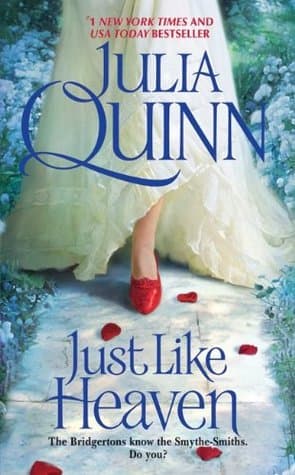
Synopsis
Covers the whole plot, including the ending.
- Difficulty
- Easy
- Pacing
- Moderate
- Mood
- Heartwarming, Witty, Romantic, Charming
- Read it if
- You love witty banter, charming historical settings, and a slow-burn romance between friends-to-lovers.
- Skip it if
- You prefer high-stakes drama and intricate plots over character-driven romance and comedic relief.
Just Like Heaven Plot Summary
Covers the whole plot, including the ending.
The Smythe-Smith Musicale
The novel opens with the annual Smythe-Smith musical soirée, a notoriously dreadful event in London society. Honoria Smythe-Smith, the youngest daughter, is forced to play her violin. Among the polite, yet secretly amused, attendees is Marcus Holroyd, Earl of Chatteris, best friend to Honoria's older brother, Daniel. Marcus has known Honoria since childhood and finds himself observing her with a new interest. During the performance, Honoria feels the familiar humiliation, but also a flicker of rebellion. Marcus, recovering from another sprained ankle, is a reluctant guest, but finds himself drawn to Honoria's spirited, if musically challenged, presence.
A Proposal of Convenience
After the musicale, Honoria's mother, Lady Smythe-Smith, begins to look for a suitable match for her. Lord Robert McGann, a wealthy but boring man, is identified as a potential husband. Honoria is dismayed by his lack of wit and charm. Her family, however, sees his financial stability and respectable standing as ideal. Honoria feels pressured to accept a proposal she dreads, wanting a marriage based on genuine connection rather than societal expectation. Marcus observes these developments with growing unease, feeling protective of Honoria.
Marcus's Recurring Injury
True to his habit, Marcus Holroyd suffers another sprained ankle while out riding. The injury is severe enough to require him to recuperate at Smythe-Smith Lawn, the family's country estate. This unexpected turn of events places Marcus close to Honoria, much to their mutual surprise. While Honoria initially finds his constant presence somewhat annoying, the enforced closeness allows them to interact more casually and deeply than ever before. Marcus uses the time to observe Honoria more closely.
Unexpected Intimacy and Shared Moments
Confined to Smythe-Smith Lawn, Marcus and Honoria spend increasing amounts of time together. They have conversations beyond pleasantries, discussing books, family, and their hopes for the future. Honoria reads to Marcus, helps him with his correspondence, and they share quiet, domestic moments. These interactions show sides of their personalities they had not seen before. Marcus begins to appreciate Honoria's intelligence, humor, and kindness, while Honoria sees beyond Marcus's sometimes gruff exterior to his loyalty and thoughtfulness. A comfortable companionship grows between them.
The Threat of Scarlet Fever
Tragedy strikes Smythe-Smith Lawn when a scarlet fever epidemic breaks out among the servants and then the family. Honoria's younger siblings fall ill, and the estate is in a state of alarm and isolation. Honoria, one of the few adults not yet sick, bravely takes on nursing duties, showing remarkable strength and compassion. Marcus, despite his recovering ankle, also stays at the estate, offering support and assistance. The seriousness of the situation forces them to confront their vulnerability and rely on each other, further strengthening their bond.
Honoria Falls Ill
Despite her diligent efforts, Honoria eventually contracts scarlet fever. Her condition becomes critical, and the family fears for her life. Marcus, who has surprisingly remained healthy, takes on the primary role of nursing Honoria. He stays by her bedside tirelessly, administering medicines, comforting her, and praying for her recovery. During this harrowing period, Marcus realizes the depth of his feelings for Honoria, understanding he cannot imagine a life without her. His devotion is unwavering, and he witnesses her strength and resilience firsthand.
A Confession and a Kiss
As Honoria slowly begins to recover from the fever, still weak but out of immediate danger, Marcus struggles to contain his emotions. Overwhelmed with relief and the realization of his love, he confesses his feelings to her, admitting he has fallen deeply in love during their time together. Honoria, still frail but clear-headed, is surprised but returns his feelings, having developed a deep affection for him herself. This heartfelt confession leads to their first kiss, a tender and significant moment that seals their mutual understanding and growing romance, moving their relationship beyond friendship.
Daniel's Return and Misunderstanding
Honoria's older brother, Daniel Smythe-Smith, returns to Smythe-Smith Lawn after being abroad, unaware of the dramatic events that have happened. He finds Honoria and Marcus in a close, intimate moment, which he misinterprets. Daniel, protective of his sister, assumes Marcus is taking advantage of Honoria's vulnerable state or that Honoria is developing feelings for Marcus that are not returned. This misunderstanding creates tension and conflict, as Daniel confronts Marcus, questioning his intentions and creating an awkward situation for the newly acknowledged couple, who must now navigate family approval.
The Truth Revealed and Approval
Honoria and Marcus quickly clarify the situation for Daniel, explaining their genuine affection and their intention to marry. They recount the events of the fever and how their relationship deepened. Daniel, initially skeptical and protective, sees the sincerity in their eyes and the genuine love they share. He gives his heartfelt blessing to their union, relieved that his sister has found happiness with his best friend. This scene resolves the immediate familial conflict, paving the way for their engagement and future, and solidifying Marcus's place within the Smythe-Smith family.
Lord McGann's Persistence
Despite Honoria's clear disinterest, Lord Robert McGann, encouraged by Honoria's mother before the fever, returns to press his suit. He is oblivious to the changes in Honoria's life and her engagement to Marcus. McGann's persistent, if dull, pursuit creates a final hurdle for Honoria and Marcus. His presence highlights the contrast between a marriage of convenience and one built on genuine love, reinforcing Honoria's conviction that she has made the right choice with Marcus. Marcus, now openly protective, firmly dismisses McGann, asserting his claim to Honoria.
Engagement and Future
With all obstacles overcome, Honoria and Marcus officially announce their engagement to their families and society. The news is met with joy and congratulations. They enjoy their newfound happiness and the prospect of a shared future. The novel concludes with them looking forward to their marriage, confident in their love and the strong foundation they have built through shared adversity and genuine connection. Their journey from childhood acquaintances to deeply committed lovers is complete, promising a future filled with mutual respect, affection, and more chocolate cake.
Just Like Heaven Characters
Honoria Smythe-Smith
Protagonist
The youngest Smythe-Smith daughter, known for her terrible violin playing and spirited nature.
Honoria is a spirited, intelligent, and kind young woman who initially feels somewhat overshadowed by her more accomplished siblings, particularly in musical talent. She possesses a dry wit and a strong sense of duty, but yearns for a marriage based on genuine affection rather than societal expectation. Despite her initial reservations about Marcus, she comes to appreciate his loyalty, humor, and quiet strength. She demonstrates immense courage and compassion during the scarlet fever outbreak, revealing a deeper resilience.
Relationships: Marcus Holroyd (Childhood friend, then love interest and fiancé); Daniel Smythe-Smith (Older brother); Lady Smythe-Smith (Mother); Lord Robert McGann (Unwanted suitor)
Marcus Holroyd, Earl of Chatteris
Protagonist
Daniel Smythe-Smith's best friend, prone to sprained ankles, who unexpectedly falls for Honoria.
Marcus is a seemingly reserved and somewhat accident-prone peer, known for his frequent sprained ankles. He is fiercely loyal to his friends and family, particularly Daniel Smythe-Smith. Initially, he views Honoria as merely his best friend's younger sister, but prolonged exposure and shared hardship reveal her true character to him. He is thoughtful, protective, and possesses a quiet strength. His love for Honoria is profound and unwavering, leading him to overcome his own reticence to declare his feelings.
Relationships: Honoria Smythe-Smith (Childhood friend, then love interest and fiancé); Daniel Smythe-Smith (Best friend)
Daniel Smythe-Smith
Supporting
Honoria's older brother and Marcus's best friend, protective and well-meaning.
Daniel is Honoria's protective older brother and Marcus's closest friend. He is generally good-natured and cares deeply for his family. His initial misunderstanding of Marcus and Honoria's relationship stems from his fierce loyalty and desire to protect his sister. Once he understands the depth of their feelings, he is supportive and gives his blessing, solidifying the bond between the two protagonists and integrating Marcus further into the family.
Relationships: Honoria Smythe-Smith (Sister); Marcus Holroyd (Best friend)
Lady Smythe-Smith
Supporting
Honoria's mother, eager to see her children married well.
Lady Smythe-Smith is a well-meaning but sometimes overly practical mother, focused on securing advantageous marriages for her daughters. She is the orchestrator of the infamous Smythe-Smith musicales and initially pushes Honoria towards Lord McGann due to his wealth and status. While she cares for her children, her priorities are often dictated by societal norms and expectations. She eventually embraces Honoria's choice, prioritizing her daughter's happiness.
Relationships: Honoria Smythe-Smith (Daughter)
Lord Robert McGann
Antagonist
A wealthy but incredibly dull suitor for Honoria.
Lord Robert McGann is a wealthy and respectable peer, but he is utterly devoid of charm, wit, or engaging personality. He represents the kind of marriage Honoria dreads – one based solely on status and convenience. His persistence, despite Honoria's clear lack of interest, serves as a foil to Marcus's genuine affection and highlights the emotional emptiness of a purely pragmatic match. He is a minor antagonist, more of an obstacle than a villain.
Relationships: Honoria Smythe-Smith (Unwanted suitor)
Lady Harriet Smythe-Smith
Supporting
Honoria's younger sister, known for her sharp wit and musical talent.
Harriet is Honoria's younger sister, notable for her intelligence and sometimes biting wit. She is a more talented musician than Honoria, but still part of the family's infamous musicales. She offers occasional humorous commentary and support to Honoria, representing another facet of the eccentric Smythe-Smith family.
Relationships: Honoria Smythe-Smith (Sister)
Francesca Smythe-Smith
Supporting
Honoria's younger sister, known for her quiet nature.
Francesca is Honoria's youngest sister, often depicted as quiet and observant. She is part of the Smythe-Smith family dynamic, though less outwardly vocal than Harriet. Her presence helps to establish the full family context and the shared experience of the musicales and the fever.
Relationships: Honoria Smythe-Smith (Sister)
Lord Winstead
Mentioned
Marcus's father, who also suffered from a peculiar recurring injury.
Lord Winstead is Marcus's deceased father, mentioned primarily to explain Marcus's peculiar propensity for sprained ankles, as it was a family trait. His legacy provides a humorous genetic link and a point of connection for Marcus, showing that his quirks are hereditary.
Relationships: Marcus Holroyd (Father)
Just Like Heaven Themes
Love Beyond Expectation
The novel explores the idea that true love often grows in unexpected places and between unexpected people. Honoria and Marcus, initially seeing each other as just childhood acquaintances, are surprised by the depth of their feelings. Their romance develops not through grand gestures, but through shared vulnerability, quiet companionship, and mutual support during a crisis. This theme challenges societal expectations of arranged marriages, as seen with Lord McGann, and emphasizes genuine connection. The fever acts as a test, forcing them to see beyond superficial roles and into each other's true character.
“He hadn't been looking for love. He hadn't even thought he wanted it. And then Honoria Smythe-Smith had looked at him, truly looked at him, and everything had changed.”
The Power of Vulnerability and Intimacy
The theme of vulnerability is central to Honoria and Marcus's developing relationship. Marcus's recurring sprained ankles force him into physical dependence, while Honoria's illness during the scarlet fever outbreak makes her deeply vulnerable. These periods of weakness, rather than pushing them apart, draw them closer. Nursing each other through illness and injury creates an intense intimacy, breaking down social barriers and allowing them to see each other's true character, compassion, and resilience. This shared experience creates a bond that superficial interactions never could.
“It was during the long, quiet hours of her fever, when he thought she might not live, that he truly understood what she meant to him.”
Family and Belonging
Family plays a significant role, both as a source of comedic eccentricity and as a foundation for support. The Smythe-Smith family, with their infamous musicales, provides a humorous backdrop, but also a loving, if sometimes overwhelming, environment. Marcus, though an outsider, is already deeply connected through his friendship with Daniel. His extended stay and role in nursing Honoria during the fever solidify his place within the family, making him an integral member. The theme explores how love not only unites two individuals but also integrates them into a larger family unit.
“The Smythe-Smiths were a force of nature, and Marcus, whether he liked it or not, was now undeniably a part of their peculiar storm.”
Appearance vs. Reality
This theme appears in several ways. Honoria is publicly known for her terrible violin playing, which often overshadows her intelligence and kindness. Marcus is seen as merely Daniel's friend, prone to accidents, but beneath that is a man of deep loyalty and affection. Lord McGann appears to be an ideal suitor on paper (wealthy, respectable), but in reality, he is dull and uninspiring. The novel consistently reveals the true characters and genuine desires beneath these superficial appearances, emphasizing that true worth and compatibility are found beyond societal facades.
“She played the violin abominably, it was true, but she was also clever and kind and, much to his surprise, utterly captivating.”
Plot Devices & Literary Techniques
The Smythe-Smith Musicale
A recurring, notoriously bad musical performance by the Smythe-Smith family.
The Smythe-Smith Musicale serves as a crucial comedic plot device. It immediately establishes the quirky, endearing nature of Honoria's family and provides a consistent, humorous backdrop against which the more serious romantic developments unfold. It also serves as a point of shared experience and mild mortification for Honoria, and a source of amusement and observation for Marcus, highlighting their individual personalities and subtly bringing them together through shared, albeit uncomfortable, moments. It is a signature element of the Smythe-Smith series.
Marcus's Sprained Ankles
Marcus's recurring injury that repeatedly forces him into a state of immobility.
Marcus's seemingly comical propensity for sprained ankles is a key plot device. It is the catalyst that forces him to stay at Smythe-Smith Lawn for an extended period, creating the necessary proximity and opportunity for him and Honoria to spend significant time together. Without these injuries, their relationship might have remained merely platonic. The recurring nature of the injury also provides lighthearted humor and becomes a character quirk that Honoria comes to accept and even find endearing, symbolizing his vulnerability and her role in caring for him.
The Scarlet Fever Epidemic
A sudden outbreak of scarlet fever that isolates and endangers the Smythe-Smith household.
The scarlet fever epidemic is a significant plot device that dramatically elevates the stakes and accelerates the emotional development of Honoria and Marcus's relationship. It creates a crisis that forces them into a situation of extreme vulnerability, mutual dependence, and selfless care. By stripping away societal formalities and forcing them to confront life and death, the fever acts as a crucible, forging an unbreakable bond between them and compelling Marcus to acknowledge his deep love for Honoria as he nurses her back to health. It is the ultimate test of their burgeoning affection.
The Unwanted Suitor (Lord McGann)
A dull but wealthy suitor pressed upon Honoria by her family.
Lord Robert McGann serves as a foil and an external obstacle in the narrative. His character represents the kind of marriage of convenience that was common in the era, highlighting the societal pressures Honoria faces. His utter lack of charm or connection with Honoria emphasizes the stark contrast with her growing feelings for Marcus. By presenting such an unappealing alternative, McGann's presence reinforces Honoria's desire for true love and makes her eventual choice of Marcus all the more meaningful and satisfying for the reader.
Just Like Heaven Quotes
“Annabel was a woman of science, and while she did not claim to understand the intricacies of love, she knew that it was a force, and like all forces, it could be measured.”
“He didn't want to just like her. He wanted to adore her, to worship her, to be utterly, irrevocably, disastrously in love with her.”
“It was not a question of if she would fall in love with him, but when. And how spectacularly.”
“A gentleman never truly knew a lady until he had seen her in her most natural state: covered in mud, hair askew, and arguing with a pig.”
“She had always thought of love as something that happened to other people, something to be observed and cataloged, never something to be felt so deeply within her own skin.”
“There was a fine line between stubbornness and conviction, and Annabel, bless her scientific heart, often trampled all over it.”
“He wanted to kiss her until the stars fell out of the sky and the moon turned blue, and then he wanted to keep kissing her.”
“The greatest discoveries were often made not by looking for what one expected to find, but by being open to what one did not.”
“Sometimes, the most logical path was not the one that led to the most happiness.”
“He knew, with a certainty that shook him to his very core, that he would never be truly happy without her.”
“She was a whirlwind of intellect and chaos, and he found himself utterly captivated.”
“Love was not a hypothesis to be tested, but a truth to be embraced.”
“He had found his heaven, and it had unruly brown hair and a penchant for arguing.”
Quiz
10 questions on the plot and the characters. Each answer comes with a short explanation.
Question 1
What is the primary reason Honoria Smythe-Smith finds herself in a compromising situation with Marcus Holroyd at the beginning of the novel?
- She was caught eavesdropping on a private conversation between Marcus and her brother.
- She accidentally fell and Marcus caught her, leading to an awkward embrace witnessed by others.
- She was trying to retrieve a dropped item and Marcus was helping her, resulting in them being found in a compromising position.
- They were secretly kissing behind a potted plant.
Show answer
B. She accidentally fell and Marcus caught her, leading to an awkward embrace witnessed by others. The inciting incident involves Honoria tripping and Marcus catching her, leading to them being discovered in a 'compromising' position, which sets the stage for their forced engagement.
Question 2
What is the Smythe-Smith family's infamous annual musical performance known for?
- Its exquisite harmony and professional execution.
- Its charming amateurism and delightful melodies.
- Its consistently terrible quality and ear-splitting discord.
- Its innovative use of unusual instruments.
Show answer
C. Its consistently terrible quality and ear-splitting discord. The Smythe-Smith musical performance is a running gag in the series, universally acknowledged as being spectacularly bad, often described as a 'massacre' of music.
Question 3
Which specific injury does Marcus Holroyd repeatedly suffer from?
- A recurring headache.
- A sprained ankle.
- A dislocated shoulder.
- A persistent cough.
Show answer
B. A sprained ankle. Marcus is comically prone to spraining his ankle, a recurring physical ailment that plays a role in his interactions with Honoria and her family.
Question 4
What is the primary obstacle preventing Marcus and Honoria from immediately acknowledging their feelings for each other?
- A pre-existing engagement for Honoria to another man.
- Marcus's fear of commitment and marriage.
- Their long-standing friendship and Marcus's friendship with Honoria's brother, Daniel.
- A significant age difference between them.
Show answer
C. Their long-standing friendship and Marcus's friendship with Honoria's brother, Daniel. Both Marcus and Honoria initially struggle with their romantic feelings because they are best friends with Daniel, Honoria's brother, and have known each other platonically for years.
Question 5
What significant health crisis does Marcus experience during the course of the novel?
- He contracts a severe case of influenza.
- He falls gravely ill with a fever, possibly scarlet fever.
- He suffers a debilitating injury from a riding accident.
- He experiences a sudden, unexplained collapse.
Show answer
B. He falls gravely ill with a fever, possibly scarlet fever. Marcus falls seriously ill with a fever, which becomes a pivotal plot point where Honoria nurses him back to health, solidifying their bond and revealing deeper feelings.
Question 6
What is the significance of the nickname 'Bug' for Honoria?
- It's a term of endearment given by her parents that she loves.
- It was a childhood nickname given by her brothers and Marcus, which she dislikes but tolerates.
- It refers to her small stature and gentle demeanor.
- It's a secret code name used between her and Marcus.
Show answer
B. It was a childhood nickname given by her brothers and Marcus, which she dislikes but tolerates. Honoria was nicknamed 'Bug' as a child by her brothers and Marcus, a name she finds irritating but which highlights her long-standing, informal relationship with Marcus.
Question 7
Which of the following best describes the central theme explored in 'Just Like Heaven'?
- The challenges of marrying for social status.
- The transition from long-standing friendship to romantic love.
- The importance of family duty over personal desire.
- The pursuit of wealth and power in Regency society.
Show answer
B. The transition from long-standing friendship to romantic love. The core of the novel is Honoria and Marcus's journey from being childhood friends and platonic companions to realizing and embracing their romantic love for each other.
Question 8
How does Marcus's relationship with Honoria's brother, Daniel, complicate his feelings for Honoria?
- Daniel is also in love with Honoria, creating a love triangle.
- Marcus feels a strong loyalty to Daniel and fears betraying their friendship by pursuing his sister.
- Daniel actively discourages Marcus from marrying any of his sisters.
- Daniel wants Marcus to marry a different woman for family alliances.
Show answer
B. Marcus feels a strong loyalty to Daniel and fears betraying their friendship by pursuing his sister. Marcus's deep friendship with Daniel makes him hesitant to acknowledge his feelings for Honoria, as he fears damaging their bond or appearing to take advantage of Daniel's sister.
Question 9
What specific item does Honoria use to 'torture' Marcus during his illness, much to his humorous chagrin?
- Reading aloud from a very dull philosophical text.
- Playing her violin, albeit badly, at his bedside.
- Forcing him to eat bitter medicines he detests.
- Singing off-key lullabies until he falls asleep.
Show answer
B. Playing her violin, albeit badly, at his bedside. During Marcus's illness, Honoria attempts to soothe him by playing her violin, a skill she is notoriously bad at, much to his suffering (and the reader's amusement).
Question 10
How does the 'compromise' at the beginning of the book ultimately serve to advance the plot and the relationship between Honoria and Marcus?
- It forces them to spend time together, leading to a deeper understanding and eventual engagement.
- It causes a scandal that separates them for a significant period.
- It reveals a hidden secret about one of their pasts.
- It leads to a duel between Marcus and another suitor for Honoria's hand.
Show answer
A. It forces them to spend time together, leading to a deeper understanding and eventual engagement. The 'compromise' of being found together creates an expectation of marriage, which forces Marcus and Honoria to confront their feelings and spend concentrated time together, ultimately leading to their genuine courtship and love.
Just Like Heaven FAQ
What is the central premise of 'Just Like Heaven'?
The book centers on Honoria Smythe-Smith, a young woman known for her terrible violin playing, and Marcus Holroyd, her older brother Daniel's best friend and the Earl of Chatteris. When Marcus suffers a severe ankle injury and then contracts a dangerous fever, Honoria finds herself nursing him back to health, leading to unexpected intimacy and a reevaluation of their long-standing relationship.
Who are the main characters and what are their initial perceptions of each other?
The main characters are Honoria Smythe-Smith, who initially views Marcus as an older, somewhat detached family friend, and Marcus Holroyd, who sees Honoria as his best friend's annoying younger sister, often recalling her childhood nickname 'Bug.' Their perceptions begin to shift dramatically as they spend more time together during his convalescence.
What significant event brings Honoria and Marcus closer together?
The most significant event is Marcus's severe ankle injury, followed by a life-threatening fever. Honoria, due to her family's absence and her own compassionate nature, takes on the responsibility of nursing him through his illness, which forces them into close proximity and allows them to see each other in a new, vulnerable light.
How does Honoria's musical talent (or lack thereof) play a role in the story?
Honoria's infamously bad violin playing is a recurring humorous element and a defining characteristic for her and her family. It's often referenced in social gatherings, including the Smythe-Smith musical evenings, and serves as a point of shared amusement and identity for the family, even becoming a quirky comfort for Marcus.
What is the significance of the Smythe-Smith musical evenings in the book?
The Smythe-Smith musical evenings are a beloved, albeit dreadful, tradition in the book, providing comic relief and a unique setting for social interactions. They are a focal point for many characters, including Honoria, and serve as a consistent backdrop that emphasizes the family's eccentric charm and Honoria's distinctive personality.
Are there any subtle foreshadowing elements regarding Marcus's feelings for Honoria?
Yes, there are subtle hints, such as Marcus's heightened awareness of Honoria's presence even before his illness, his discomfort with the idea of her marrying someone else, and his protective instincts towards her. These small observations suggest an underlying affection that he hadn't fully acknowledged, even to himself.
What is the 'hidden' meaning behind Marcus's childhood nickname for Honoria, 'Bug'?
While initially a teasing nickname, 'Bug' subtly reflects Marcus's early perception of Honoria as a persistent, perhaps annoying, but ultimately endearing presence in his life. It also implies a certain familiarity and closeness that predates their romantic development, hinting at their long-standing bond.
Does the book connect to other Julia Quinn series or characters in a subtle way?
Yes, 'Just Like Heaven' is the first book in the Smythe-Smith Quartet, directly introducing Honoria and her family, who are famous for their terrible musical concerts, often mentioned in the Bridgerton series. This book provides their backstory and deepens the world-building for Quinn's interconnected Regency universe.
How does Marcus's illness impact his psychological state and relationship with Honoria?
Marcus's severe illness and vulnerability strip away his usual controlled demeanor, forcing him to rely completely on Honoria. This period of weakness breaks down his emotional barriers, allowing him to experience true intimacy and gratitude, fundamentally altering his perception of Honoria from a childhood friend to a life-saving angel and object of desire.
What psychological journey does Honoria undergo during the course of the novel?
Honoria evolves from a somewhat naive young woman primarily concerned with finding a suitable husband to a compassionate and self-assured individual. Her experience nursing Marcus reveals her strength, resilience, and deep capacity for care, leading her to recognize her own desires and stand up for her feelings.
How do societal expectations of marriage influence Honoria's initial choices and eventual realization?
Initially, Honoria is focused on finding a financially stable and respectable husband, as is expected of women in her era, even considering Lord Robert. However, her deep emotional connection with Marcus challenges these societal norms, making her realize that true love and compatibility are more important than mere social standing or convenience.
Discuss the 'friends-to-lovers' trope in the context of Honoria and Marcus's relationship.
The novel expertly navigates the 'friends-to-lovers' trope by demonstrating how a crisis can reframe a long-standing platonic bond into a passionate romance. The shared history and deep familiarity between Honoria and Marcus provide a strong foundation, making their eventual emotional and physical intimacy feel earned and deeply resonant.
Is Honoria's 'bad' violin playing a weakness or a strength in her character?
Honoria's 'bad' violin playing can be interpreted as both a weakness and a strength. While it's a source of humor and occasionally embarrassment, it also signifies her family's unique charm and her own unpretentious nature. It's a defining quirk that makes her memorable and even endearing to Marcus, proving that perfection isn't necessary for love.
How does the book challenge or reinforce traditional Regency romance conventions?
The book reinforces conventions with its focus on marriage, societal expectations, and a titled hero. However, it challenges them by presenting a heroine who isn't conventionally 'perfect' (with her terrible music) and by building romance from a foundation of long-standing friendship and mutual care during a crisis, rather than instant attraction or scandal.
What role does humor play in 'Just Like Heaven' compared to other romance novels?
Humor is a cornerstone of 'Just Like Heaven,' largely driven by the Smythe-Smith family's musical ineptitude and the witty banter between Honoria and Marcus. This pervasive humor lightens potentially serious plot points, makes the characters more relatable, and is a hallmark of Julia Quinn's writing style, setting it apart from more dramatic historical romances.
What is the significance of the chocolate cake in the story?
The chocolate cake serves as a symbol of comfort, indulgence, and the growing intimacy between Honoria and Marcus. It's a small, shared pleasure during his recovery that highlights Honoria's caring nature and Marcus's appreciation, becoming a recurring motif of their developing connection and domesticity.
How does Marcus's role as an Earl influence his personality and responsibilities?
As the Earl of Chatteris, Marcus carries the weight of his family's legacy and responsibilities, which initially makes him seem more reserved and focused on duty. His title also creates a sense of gravitas and expectation, but his illness and love for Honoria ultimately allow him to prioritize personal happiness over strict aristocratic decorum.
What is the central conflict that Honoria faces regarding her feelings for Marcus?
Honoria's central conflict is reconciling her deep affection and care for Marcus with the societal expectation that she should marry someone else, particularly when Marcus initially seems oblivious to her romantic feelings. She grapples with the fear of unrequited love and the potential loss of their friendship if she were to confess her true emotions.
About the author

Julia Quinn is an American author known for her historical romance novels, particularly set in the Regency era. Her notable works include "The Duke and I," "The Viscount Who Loved Me," "Romancing Mister Bridgerton," "When He Was Wicked," "Just Like Heaven," and "The Secret Diaries of Miss Miranda Cheever." Quinn's writing often features witty dialogue and strong character development, contributing to her popularity in the genre.
Similar books
- The Duke and I
Julia Quinn
4.0 (87k) average on GoodreadsHistorical FictionFeatures the Bridgerton family and similar Regency-era charm with witty dialogue and a fake relationship trope.
- To Kill a Mockingbird
Harper Lee
4.3 (4.5M) average on GoodreadsHistorical FictionIn the 1930s Jim Crow South, Harper Lee writes about racial injustice, moral growth, and the quiet courage of a lawyer father, Atticus Finch, as seen through his young daughter's eyes.
- The Great Gatsby
F. Scott Fitzgerald
3.9 (3.8M) average on GoodreadsHistorical FictionIn the opulent Roaring Twenties, a mysterious millionaire's lavish parties hide his desperate, tragic pursuit of a lost love, exposing the emptiness within the American Dream.
- Pride and Prejudice
Jane Austen
4.3 (3M) average on GoodreadsHistorical FictionIn a society focused on status and money, Elizabeth Bennet navigates love and pride, challenging Mr. Darcy and social expectations to find true affection.
- Angels & Demons
Dan Brown
3.9 (2.7M) average on GoodreadsThrillerA Harvard symbologist races through Rome's ancient sites, deciphering cryptic clues to unmask the Illuminati and stop a vengeful plot to destroy the Vatican with a stolen antimatter weapon.
- The Kite Runner
Khaled Hosseini
4.3 (2.4M) average on GoodreadsHistorical FictionIn pre-Taliban Afghanistan, a wealthy boy's betrayal of his servant's son during a kite-running tournament starts a lifelong journey for amends as his country collapses.





Enjoyed the summary?
A summary gives you the shape of the book. The book itself has the detail, the examples and the voice.
Find Just Like Heaven on AmazonAs an Amazon Associate, BookBrief earns from qualifying purchases. How we're funded