
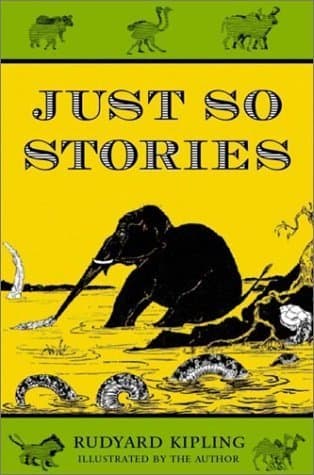
Synopsis
Covers the whole plot, including the ending.
- Difficulty
- Easy
- Pacing
- Moderate
- Mood
- Whimsical, Humorous, Imaginative, Playful
- Read it if
- You enjoy classic children's literature, fables, or origin stories with a unique, whimsical voice.
- Skip it if
- You prefer modern storytelling styles or find older language and colonial-era perspectives off-putting.
Just So Stories Plot Summary
Covers the whole plot, including the ending.
How the Whale Got His Throat
At the beginning, the Whale ate everything in the sea, including all the fish, until only one 'Stute Fish was left. The 'Stute Fish, clever and quick, told the Whale about a 'man' who would be a 'very tasty-bargain.' The Whale, wanting more, asked the 'Stute Fish to lead him to this man. The 'Stute Fish directed him to a raft where a shipwrecked Mariner floated. The Whale, without thinking, opened his huge mouth and swallowed the Mariner, his raft, and his suspenders. Inside, the Mariner was not scared; instead, he made himself comfortable, jumping and dancing, which bothered the Whale.
How the Camel Got His Hump
At the start of the world, when animals began working for humans, a Camel lived in the middle of the Howling Desert. He was very lazy and refused to work, only saying 'Humph!' when spoken to. The Horse, Dog, and Ox each tried to get him to work, asking him to trot, fetch, or plough. Each time, the Camel just said 'Humph!' and did nothing. Frustrated, the three animals complained to the Man, who told them they would have to work extra to cover the Camel's laziness. This unfairness angered the animals, so they complained to the Djinn of All Deserts.
How the Rhinoceros Got His Skin
Long ago, the Rhinoceros had smooth, tight skin that fit him perfectly. He lived on an empty island with a Parsee man who wore a hat 'the colour of the sunrise' and made delicious cakes. One hot day, the Parsee made a special cake with currants and plums and left it on the beach to cool. The Rhinoceros, a 'rude, unmannered beast,' came and ate the whole cake without asking. The Parsee, annoyed by this theft, decided to get revenge. He waited for the Rhinoceros to swim, then filled his smooth skin, which he had taken off, with cake-crumbs, prickles, and bits of dried palm-tree bark.
How the Leopard Got His Spots
In the 'High and Far-Off Times,' the Leopard lived in the High Veldt, which was then yellowish-grey, like his coat. He hunted with the Ethiopian, who was then plain, dusty brown. All animals and hunters were the same color as their surroundings. However, as time passed, the climate changed, and the Veldt became a 'great forest, 'sclusively trees and shadows and patches and stains.' The Giraffe and Zebra, who were also plain, changed their coats to blend in with the new environment. The Leopard and Ethiopian, still plain, found hunting harder. The Ethiopian, seeking a solution, suggested they also change their look to match the new, darker, dappled surroundings.
The Elephant's Child
In ancient times, the Elephant's Child had no trunk; he only had a 'blackish, bulgy nose, no bigger than a boot.' He was very curious and constantly asked questions of his Aunts and Uncles, who often spanked him for it. His biggest question was, 'What does the Crocodile eat for dinner?' No one would tell him, so he set off to the 'great grey-green, greasy Limpopo River' to find out. Along the way, he met a Kolokolo Bird, who warned him of danger. Finally, he met a Bi-Coloured Python-Rock-Snake, who, after several tries, told him to go to the river.
The Sing-Song of Old Man Kangaroo
Long ago, in the 'High and Far-Off Times,' Old Man Kangaroo was a plain creature with short legs, living in the Australian Bush. He was tired of being ordinary and wished to be 'different from all other animals.' He prayed to the 'Big God Nqong' for this. Nqong, hearing his prayer, told him to run, promising that if he ran 'hard and fast' for a thousand years, his wish would be granted. To help him, Nqong enlisted a Dingo, a 'Yellow-Dog Dingo,' who was a tireless hunter. The Dingo's job was to chase Old Man Kangaroo constantly, making him run faster and faster, day after day, across Australia's plains.
The Beginning of the Armadillos
In the 'High and Far-Off Times,' the Jaguar, a 'great, big, 'normous, all-conquering Jaguar,' hunted all other animals. Among his prey were a slow, wise Turtle named Slow-and-Solid and a prickly, shy Hedgehog named Prickly-and-Pearly. The Jaguar loved to eat them, but they were hard to catch – the Turtle could hide in his shell, and the Hedgehog could roll into a ball of spines. One day, the Jaguar decided to learn their tricks. He asked a 'Painted Jaguar' how to catch them. The Painted Jaguar advised him to ask the 'Wily-Old-Malay-Tiger' for advice. Meanwhile, the Turtle and Hedgehog, tired of being hunted, decided to combine their defenses.
How the First Letter Was Made
In the 'High and Far-Off Times,' before writing existed, a little girl named Taffimai Metallumai, or Taffy, lived with her father, Tegumai Bopsulai, a caveman. One day, Tegumai accidentally broke his spear while fishing. He asked Taffy to go to their mother, Teshumai Tewindrow, and ask for a new spear. Taffy, being very literal, wanted to send a 'picture-letter' instead of just telling her mother. Using birch-bark and a shark's tooth, she drew pictures. She drew her father with a broken spear, then herself pointing to the broken spear, and finally a new spear. She then took this 'picture-letter' to a stranger she met.
How the Alphabet Was Made
After Taffy's picture-letter worked in 'How the First Letter Was Made,' Tegumai Bopsulai saw the potential of written communication but also its limits. He and Taffy decided to simplify their picture-writing. Instead of drawing a whole picture for an object, they drew only its most important part. For example, for a 'fish,' they drew the fish's head. Then, they realized the fish's head picture could represent the sound 'F' (for Fish). They continued this for many other objects and sounds, slowly creating a system where each drawing represented a specific sound, not an entire object or idea. This led to the first alphabet, a major invention for their tribe's communication.
The Crab That Played With the Sea
In the 'High and Far-Off Times,' the 'Eldest Magician' created all animals and gave them their roles. Among them was a 'Playful-Paddler-of-the-Shallows' Crab who was lonely and wanted to play with the sea. The Eldest Magician, kindly, gave the Crab control over the tides. The Crab, however, became selfish. Instead of letting the sea flow naturally, he pulled it too far out or pushed it too far in, bothering other animals, especially those who relied on the tides for food and homes. The other animals complained to the Eldest Magician. To fix this, the Magician took away the Crab's full control, but also gave him a new, permanent home.
The Cat That Walked by Himself
In the 'High and Far-Off Times,' when all animals were wild, the Woman, being the 'wisest of all the wise things,' domesticated the Dog, Horse, and Cow. She built a comfortable cave-house and made a fire, attracting these animals with food and shelter, bringing them into human companionship. The Cat, however, stayed independent. He watched from a distance, walking 'by himself' in the 'wet wild woods.' The Woman wanted to domesticate the Cat too, but the Cat was too clever. He made a deal with the Woman: if she could say 'three words' that would make him come into the cave, he would stay. The Woman, thinking she had tricked him, eventually said the right words.
The Butterfly That Stamped
King Solomon, the wisest of all kings, ruled a vast empire, including all animals and Djinns. He had a beautiful and beloved wife, Balkis, the Queen of Sheba. However, Solomon also had a small, insignificant butterfly, a 'Jealous-One,' who was always jealous of Balkis's beauty and influence. One day, the Butterfly, driven by jealousy, decided to cause trouble. He went to King Solomon and whispered a lie, suggesting Balkis was secretly plotting against him. Solomon, usually wise, was briefly swayed by the Butterfly's words. He decided to test Balkis and, in doing so, unknowingly started a series of events involving a powerful Djinn that would lead to unexpected results.
Just So Stories Characters
The Eldest Magician
Supporting
The creator and arbiter of the natural world in several stories.
The Eldest Magician is the ultimate authority figure in several of the 'Just So Stories.' He is responsible for creating animals and giving them their unique characteristics and roles. He is generally benevolent but also firm, correcting imbalances when animals misuse their gifts, as seen with the Crab. He embodies a cosmic order and a sense of justice, ensuring that the world functions as it should, even if it means imposing permanent changes on creatures. His wisdom is absolute, and his decisions are final.
Relationships: The Crab (creator and punisher); All animals (creator and overseer)
The Camel
Protagonist
A lazy animal who earns a hump due to his idleness.
The Camel is introduced as a creature of extreme laziness, living in the desert and refusing to do any work. His only response to requests is 'Humph!' This stubborn idleness frustrates the other working animals (Horse, Dog, Ox) and the Man. His character serves as a cautionary tale against shirking responsibility. He is initially self-centered and oblivious to the impact of his actions on others, but ultimately bears the permanent consequence of his choices.
Relationships: The Djinn of All Deserts (recipient of magical punishment); The Horse, Dog, Ox (fellow animals frustrated by his idleness)
The Elephant's Child
Protagonist
An insatiably curious young elephant who discovers the origin of his trunk.
The Elephant's Child is characterized by his 'insatiable curiosity,' which drives the narrative of his story. He constantly asks questions, much to the annoyance of his family, who frequently spank him. His journey to the Limpopo River to find out what the Crocodile eats for dinner is a quest for knowledge, albeit a dangerous one. He is naive but brave, willing to face the unknown to satisfy his intellectual hunger. His transformation from a short-nosed elephant to one with a long trunk is a direct result of his adventurous spirit.
Relationships: His Aunts and Uncles (family who are annoyed by his questions); The Crocodile (antagonist who gives him his trunk); The Bi-Coloured Python-Rock-Snake (helpful guide)
Taffimai Metallumai (Taffy)
Protagonist
A clever cave-girl who, with her father, invents writing and the alphabet.
Taffy is a sharp, imaginative, and practical little girl living in the 'High and Far-Off Times.' She is the driving force behind the invention of written communication. Her literal interpretation of her father's request to send a message leads to the creation of the first 'picture-letter.' She possesses a keen intellect and a natural understanding of how to simplify complex ideas, making her an ideal partner for her father in the development of the alphabet. She represents ingenuity and the dawn of human innovation.
Relationships: Tegumai Bopsulai (Father) (collaborator in invention); Teshumai Tewindrow (Mother) (recipient of the first letter)
Tegumai Bopsulai
Supporting
Taffy's father, a caveman who helps refine the first letter and alphabet.
Tegumai Bopsulai is Taffy's father, a caveman who, while initially reliant on spoken communication, quickly grasps the potential of his daughter's invention. He is intelligent and open to new ideas, recognizing the limitations of their current communication methods. He collaborates with Taffy to simplify and systematize their picture-writing into a phonetic alphabet. He represents the human capacity for innovation and problem-solving, moving from a primitive existence to a more advanced form of communication.
Relationships: Taffimai Metallumai (Daughter) (collaborator in invention); Teshumai Tewindrow (Wife) (family member)
The Cat
Protagonist
The independent and wild animal who makes a deal to live with humans while retaining his freedom.
The Cat is the epitome of independence and cunning. While other animals (Dog, Horse, Cow) are domesticated by the Woman, the Cat observes from a distance, unwilling to give up his freedom. He is intelligent enough to understand the benefits of the Woman's fire and shelter but too proud and self-sufficient to simply submit. He strikes a clever bargain, ensuring he gets the comforts of home while still being able to 'walk by himself.' He symbolizes untamed nature and the spirit of individual liberty.
Relationships: The Woman (negotiator of his partial domestication); The Dog, Horse, Cow (fellow animals who are fully domesticated)
The Mariner
Protagonist
A clever shipwrecked man who outwits the greedy Whale.
The Mariner is a resourceful and quick-thinking individual, even when faced with being swallowed whole by a Whale. He is not easily intimidated and immediately sets about making the best of his dire situation. His actions inside the Whale's stomach, such as building a raft and dancing, are designed to annoy and inconvenience the Whale. He represents human ingenuity and resilience against overwhelming odds. His ultimate goal is survival and escape, which he achieves through his cleverness.
Relationships: The Whale (antagonist who swallows him); The 'Stute Fish (indirect guide to his predicament)
The Djinn of All Deserts
Supporting
A powerful magical being who punishes the Camel's laziness.
The Djinn of All Deserts is a formidable and wise magical entity responsible for the well-being of the desert and its creatures. He is called upon by the frustrated Horse, Dog, and Ox to address the Camel's chronic idleness. The Djinn embodies cosmic justice and the principle that everyone must contribute to the collective good. He understands the balance of work and rest and is not afraid to impose a permanent, physical consequence (the hump) to correct the Camel's behavior. He is a force of order and consequence.
Relationships: The Camel (punisher); The Horse, Dog, Ox (recipient of their complaints)
The Rhinoceros
Antagonist
A rude, unmannered beast who gets a wrinkled skin as punishment for his gluttony.
The Rhinoceros is depicted as a selfish and ill-mannered creature with a smooth skin. His defining act is his gluttonous theft of the Parsee's delicious cake, without any regard for politeness or ownership. This act of rudeness and lack of consideration for others leads directly to his permanent physical alteration. He embodies the consequences of bad manners and disrespect. His character serves as a simple moral lesson about the repercussions of selfish behavior.
Relationships: The Parsee (victim of his rudeness and orchestrator of his punishment)
The Leopard
Protagonist
A plain-coated hunter who gains spots to blend into the changing jungle.
The Leopard is initially a plain, yellowish-grey creature living on the High Veldt. He is a hunter, but his plain coat makes him increasingly ineffective as the environment changes to a dappled forest. He is pragmatic and adaptive, recognizing the need to change his appearance to survive and continue his hunting lifestyle. His transformation, guided by the Ethiopian, is a story of adaptation to environmental pressures and the evolution of camouflage. He represents the practical aspects of natural selection.
Relationships: The Ethiopian (hunting partner and co-adaptor); The Giraffe and Zebra (fellow animals who also adapted)
Just So Stories Themes
Consequences of Actions
A main theme in many stories is that every action, especially negative ones, has lasting effects. The Camel's laziness gives him a permanent hump. The Rhinoceros's rude eating leads to his wrinkled skin. The Whale's endless eating results in a sieve-like throat. These physical changes are permanent signs of past behavior, showing that choices have irreversible impacts. This theme is clear in 'How the Camel Got His Hump' and 'How the Rhinoceros Got His Skin,' where characters are permanently changed because of their flaws.
“And the Humph that he had got on his back from the Djinn, that was his very own Humph, and not anybody else’s.”
Curiosity and Discovery
The stories explore the power of curiosity, for both good and bad. The Elephant's Child's 'insatiable curiosity' leads him to the dangerous Limpopo River, where he eventually gets his trunk. Taffy's practical curiosity about sending a message leads to the invention of writing. While curiosity can cause danger, as with the Elephant's Child, it is shown as a strong force for learning and innovation, pushing characters to discover new truths or create new things. It highlights the drive for knowledge as a basic part of development.
“He was full of 'satiable curiosity, and that means he asked ever so many questions.”
Adaptation and Evolution
Many stories show how animals adapt to their changing surroundings or to specific challenges. The Leopard and the Ethiopian change their looks to blend into the newly forested Veldt. The Kangaroo's long legs and hopping are an adaptation to escape the Dingo and get his wish to be unique. The Turtle and Hedgehog combine their defenses to form the Armadillo, a new species better suited for survival against the Jaguar. This theme highlights the dynamic nature of the natural world and the need for creatures to change physically or behaviorally to thrive, or simply survive, in new conditions.
“He ran and he ran, and he ran and he ran, till his legs grew long and his back grew strong, and he was the Old Man Kangaroo.”
The Origin of Things
The core idea of the 'Just So Stories' is to give imaginative, often funny, explanations for various natural events and animal traits. The book explains how the whale got its throat, how the camel got its hump, how the alphabet was made, and why the cat walks by himself. These origin stories are not scientific; they are whimsical fables that satisfy a child's natural curiosity about 'how' and 'why' things are the way they are. They create a mythology for the animal kingdom and human inventions, rooting them in specific, often comical, events.
“This is the story of how the Whale got his tiny throat, and why he never eats anything but small 'Stute Fish, and little, tiny, wee-wee shrimpy-shrimp.”
Independence vs. Community
This theme looks at the conflict between an individual's desire for freedom and the benefits or demands of living in a community. The Cat shows ultimate independence, choosing to 'walk by himself' rather than be fully domesticated, yet still enjoying human comforts. The Camel's initial refusal to contribute to the community leads to his isolation and a unique burden. The Crab's selfish manipulation of the tides disrupts the balance for all other creatures. These stories highlight the trade-offs between complete freedom and the responsibilities and advantages of living in a group.
“But the Cat, he walked by himself, and all places were alike to him.”
Plot Devices & Literary Techniques
Anthropomorphism
Giving human characteristics and motivations to animals.
Kipling extensively uses anthropomorphism to make his animal characters relatable and to convey moral lessons. Animals like the Camel, Whale, and Elephant's Child think, speak, and act with human-like emotions, desires, and flaws (laziness, greed, curiosity). This device allows for allegorical storytelling, where animal behaviors reflect human virtues and vices, making the fables accessible and entertaining for a young audience while subtly teaching about consequences and social dynamics.
Cumulative Tale / Repetition
Repeating phrases or actions that build upon each other.
Repetition is a key stylistic element, especially in 'How the Camel Got His Hump' with the repeated 'Humph!' and in 'The Elephant's Child' with the repeated questions and spankings. This cumulative effect not only adds to the rhythmic, sing-song quality of the prose, making it memorable for children, but also emphasizes the persistence of a character's trait or action, building anticipation for the eventual resolution or consequence. It reinforces the idea that repeated behavior leads to an inevitable outcome.
Trickster Figure
A character who uses cunning and deception to achieve their goals.
Characters like the 'Stute Fish in 'How the Whale Got His Throat' and the Mariner himself embody the trickster archetype. The 'Stute Fish cleverly leads the Whale to the Mariner, and the Mariner then outwits the Whale from within its stomach. The Parsee in 'How the Rhinoceros Got His Skin' also acts as a trickster, devising a clever, if slightly cruel, punishment. These figures often use their intellect and resourcefulness to overcome more powerful adversaries, highlighting the power of wit over brute force or size.
Explanatory Fable
A story that explains the origin of a natural phenomenon or characteristic.
This is the overarching device for the entire collection. Each story is a 'just so' explanation for why an animal has a particular feature or why a certain natural event occurs. These fables are not meant to be scientifically accurate but rather imaginative, whimsical, and often humorous narratives that provide a fictional genesis for the world's peculiarities. They satisfy a child's innate desire to understand the 'why' behind things, creating a charming, mythical backstory for reality.
The 'High and Far-Off Times'
A recurring phrase establishing a mythical, primordial setting.
This phrase, or variations of it, consistently sets the stage for many of the stories, immediately transporting the reader to a fantastical, undefined past before the world took its current form. It signals that these are origin stories, detached from historical accuracy, and invites the reader into a realm where magic and transformation are commonplace. This device creates a consistent tone and atmosphere across the collection, reinforcing the idea of a world in its nascent, mutable stages of development.
Just So Stories Quotes
“Best Beloved, in the High and Far-Off Times, O my Best Beloved, there was no such thing as a camel. He was an Idle One, and he lived in the middle of a Howling Desert because he did not want to work.”
“This is the Way of the World. Take the good with the bad, and be very careful not to let the bad get mixed up with the good.”
“He was a small, furry, sleeky, woodsy-nosed, all-together-delicious bear, and his name was the Cat that Walked by Himself.”
“And the Elephant's Child went home across Africa, waving his trunk to and fro and saying to all his dear relations, 'Scratch me that itch!'”
“And from that day to this, O Best Beloved, the Leopard has had spots, and the Ethiopian has been a black man.”
“The great grey-green, greasy Limpopo River, all set about with fever-trees, stood up on its banks and watched him.”
“He took a clean, shiny, smooth piece of bark and he took a clean, sharp, pointed tooth of a shark and he wrote letters.”
“Now, at that time, O Best Beloved, the world was quite new and all in a muddle, and the animals did not know what they ought to do.”
“He was a good, kind, obedient, clever, and useful Dog of the House.”
“And when the Man and the Woman and the Dog and the Horse and the Cow came into the Cave, there was the Cat, walking by himself, exactly as if he had never been there before.”
“And the Whale swallowed the Mariner, and his raft, and his braces, and his jack-knife, and his three-legged stool, and his two-legged table, and his one-legged bed, and the cabin-furniture, and his bath-towel, and his boots, and his button-box, and the everything else.”
“And the Hedgehog knew that the world was round, and so he rolled himself up into a ball and went to sleep.”
“He was the Bushman, and he was the only man in all Africa who knew how to make things.”
“And that is why, O Best Beloved, the Kangaroo has to hop all the time.”
Quiz
10 questions on the plot and the characters. Each answer comes with a short explanation.
Question 1
In 'How the Camel Got His Hump,' what was the Camel's only reply when asked to work?
- Please leave me alone.
- Humph!
- Not today.
- I am busy.
Show answer
B. Humph! The Camel's repeated refusal to work was always 'Humph!', which eventually became his hump.
Question 2
Which character gives the Camel his hump?
- The Horse
- The Dog
- The Djinn of All Deserts
- The Man
Show answer
C. The Djinn of All Deserts The Djinn of All Deserts, a magical being, is the one who gives the lazy Camel his hump as a consequence of his idleness.
Question 3
According to 'How the Whale Got His Throat,' what did the Whale eat that caused his throat to become so narrow?
- A large ship
- A gigantic squid
- The Stute Fish and the Mariner
- A school of sharks
Show answer
C. The Stute Fish and the Mariner The Stute Fish tricked the Mariner into being swallowed by the Whale, and the Mariner then used his raft to wedge in the Whale's throat, making it narrow.
Question 4
In 'How the Leopard Got His Spots,' what did the Leopard and the Ethiopian change to adapt to the High Veldt?
- They grew thicker fur.
- The Leopard got spots and the Ethiopian's skin turned black.
- They learned to climb trees.
- They changed their diet.
Show answer
B. The Leopard got spots and the Ethiopian's skin turned black. To blend in with the new, dappled environment of the High Veldt, the Leopard developed spots and the Ethiopian's skin became black.
Question 5
What animal eventually taught the Elephant's Child 'all the Pushmi-Pullyu secrets'?
- The Hippopotamus
- The Crocodile
- The Giraffe
- The Python
Show answer
B. The Crocodile It was the 'Bi-Coloured-Python-Rock-Snake' who advised the Elephant's Child on how to pull his nose free from the Crocodile's grip, thus stretching it into a trunk.
Question 6
In 'The Sing-Song of Old Man Kangaroo,' what was the Dingo's specific request to the Yellow-Dog Dingo?
- To teach him how to jump.
- To help him find food.
- To hunt the Kangaroo for him.
- To guard his home.
Show answer
C. To hunt the Kangaroo for him. The Old Man Kangaroo, tired of being chased, made a deal with the Yellow-Dog Dingo to hunt the Kangaroo for him, resulting in the Kangaroo learning to hop away.
Question 7
Who is the 'Best Beloved' mentioned throughout the stories?
- Rudyard Kipling's editor
- The reader, often a child
- A character within the stories
- Kipling's wife
Show answer
B. The reader, often a child 'Best Beloved' is the direct address Kipling uses to engage his young audience, creating an intimate storytelling atmosphere.
Question 8
In 'The Butterfly That Stamped,' what was the Butterfly's ultimate goal in making the King and Queen argue?
- To prove his own power.
- To get the Queen to cook for him.
- To ensure the King did not harm his wife, the Butterfly's mate.
- To make the King and Queen leave the palace.
Show answer
C. To ensure the King did not harm his wife, the Butterfly's mate. The Butterfly caused the royal argument to distract the King from his plan to punish his wife, who had previously annoyed the Butterfly's mate.
Question 9
According to 'How the First Letter Was Made,' what did Taffy (Tegumai Bopsulai's daughter) draw on the birch-bark to represent her father's spear?
- A straight line with a triangular tip.
- A wavy line to show its movement.
- A circle, representing its point.
- A complex symbol for hunting.
Show answer
A. A straight line with a triangular tip. Taffy drew a simple straight line with a triangular point at one end to represent her father's spear, which was a crucial part of her pictographic message.
Question 10
In 'The Cat That Walked by Himself,' what was the final agreement between the Woman and the Cat?
- The Cat would work for the Woman in exchange for milk.
- The Cat would always be wild and free, but could enter the cave if he chose.
- The Cat would protect the Woman from other wild animals.
- The Cat would only visit at night.
Show answer
B. The Cat would always be wild and free, but could enter the cave if he chose. The Cat, fiercely independent, made a deal that he would come and go as he pleased, always retaining his wildness, but he could choose to enter the cave for warmth and milk.
Just So Stories FAQ
What is the overarching premise of Rudyard Kipling's 'Just So Stories'?
The 'Just So Stories' offer whimsical, fantastical origin tales for various animal characteristics, natural phenomena, and human inventions. They are framed as explanations given by the 'Eldest Magician' or simply derived from a time 'When the world was so new-and-all.' Each story provides an imaginative, often humorous, 'just so' reason for how things came to be the way they are.
Which story explains the distinctive feature of a camel?
'How the Camel Got His Hump' details how the lazy Camel, living in the Howling Desert, constantly replied 'Humph!' to requests for work from the Horse, Dog, and Ox. Eventually, the Djinn of All Deserts, annoyed by his idleness, magically gave him a hump, which was meant to allow him to work for three days without eating, but also served as a permanent reminder of his earlier 'Humph!'.
What is the premise of 'The Butterfly That Stamped'?
This story explains why the sea is salty and how the Red Sea got its particular color. It revolves around King Solomon and his favorite wife, Balkis, who is outwitted by a mischievous butterfly and his wife, who stamp their feet to cause a great flood, leading to the sea's saltiness and the eventual creation of the Red Sea due to a magical fish.
How does 'How the Alphabet Was Made' describe the invention of writing?
This story features Taffy (Tegumai Bopsulai's daughter) and her father, who, through a series of misunderstandings and creative ingenuity, devise the first pictograms and eventually an alphabet. Taffy's initial 'pictures' for a message, misinterpreted by the stranger, lead to a more systematic way of representing sounds, illustrating the birth of written language.
Which story explains the distinct patterns on a leopard and a zebra?
'How the Leopard Got His Spots' tells how the Leopard, initially plain and sandy-colored, and the Ethiopian, also plain, adapted to the changing landscape from 'Sleek, slick, slimy, and grimy' to 'spickly, speckly, streaky, and patchy.' The Ethiopian used his fingers to put spots on the Leopard, and stripes on the Zebra, to help them camouflage in the new, dappled jungle.
What subtle detail in 'The Elephant's Child' hints at the story's overall theme of curiosity and consequences?
The Elephant's Child, often called the 'Bi-Coloured-Python-Rock-Snake's Best Beloved,' constantly asks 'Satiable Curiosity' questions that annoy his family. His journey to the Limpopo River, despite warnings, directly leads to his nose being stretched into a trunk by the Crocodile, demonstrating that his insatiable curiosity, while painful, ultimately led to a beneficial, defining characteristic.
In 'The Sing-Song of Old Man Kangaroo,' what is the significance of the Dingo's persistent chase?
The Dingo's relentless pursuit, driven by the Eldest Magician's command to 'hunt him till he drops,' is what ultimately causes Old Man Kangaroo to develop his powerful hind legs and tail for hopping. This detail highlights a theme of external pressure and necessity driving evolutionary adaptation, as the Dingo becomes the unwitting catalyst for the Kangaroo's unique locomotion.
What hidden message about the human relationship with nature is present in 'The Cat That Walked by Himself'?
This story subtly explores the domestication of animals while emphasizing the inherent wildness of the Cat, who refuses to be 'tamed' like the Dog, Horse, and Cow. The Woman's cleverness in inviting the Cat into the cave is balanced by the Cat's declaration that he will always be 'the Cat who walks by himself, and all places are alike to him,' signifying a lasting independence despite cohabitation.
How does the character of Taffy in 'How the First Letter Was Made' exemplify childhood ingenuity and the potential for miscommunication?
Taffy's actions demonstrate a child's direct and visual approach to communication, drawing pictures to convey a message. Her lack of a formal system, however, leads to the 'Neolithic Age' stranger completely misunderstanding her drawings, resulting in an attack on her father. This highlights how early attempts at complex communication, though ingenious, are prone to significant misinterpretation.
Analyze the psychological impact of the 'Humph!' on the Camel in 'How the Camel Got His Hump.'
The Camel's repetitive 'Humph!' can be seen as a manifestation of stubbornness, resistance to responsibility, and perhaps even a form of passive aggression. His refusal to engage in productive work stems from a deep-seated idleness. The eventual physical manifestation of the hump serves as a permanent, visible consequence of his psychological state, forcing him to adapt and carry his burden.
What psychological trait is primarily explored through the Elephant's Child in 'The Elephant's Child'?
The Elephant's Child embodies boundless, relentless curiosity, often to his own detriment and the annoyance of others. His 'satiable curiosity' drives him to ask probing questions about everything, culminating in his dangerous journey to the Limpopo River. This trait, while initially causing pain and difficulty, ultimately leads to his unique and useful trunk, suggesting that curiosity, even when inconvenient, can be a powerful driver of development.
How does the relationship between King Solomon and Balkis in 'The Butterfly That Stamped' reflect themes of power dynamics and manipulation?
King Solomon, despite his immense wisdom, is shown to be susceptible to the manipulative whims of his favorite wife, Balkis, and even more so to the cleverness of the Butterfly and his wife. Balkis uses her influence over Solomon to secure gifts, while the Butterflies exploit her vanity and Solomon's power to achieve their own ends. This illustrates how even the most powerful can be swayed by personal relationships and subtle manipulation.
Are the 'Just So Stories' meant to be taken as serious explanations for natural phenomena, or purely as imaginative fables?
The stories are clearly imaginative fables, not scientific explanations. Kipling uses fantastical elements, anthropomorphic animals, and often humorous, almost nonsensical logic (like the Djinn of All Deserts or the Eldest Magician) to create a 'just so' world. Their purpose is to entertain, spark imagination, and perhaps subtly teach about consequences, adaptability, and the origins of things through a whimsical lens, rather than provide factual information.
What is the role of the 'Eldest Magician' in several of the stories, and what does he represent?
The Eldest Magician, appearing in stories like 'The Sing-Song of Old Man Kangaroo' and 'How the First Letter Was Made,' often acts as a prime mover or a force of creation and order in the nascent world. He represents a kind of divine or primordial will that sets things in motion, establishes rules, and sometimes intervenes directly to shape the world and its creatures. He is a figure of ultimate authority and wisdom in Kipling's whimsical cosmology.
How do the stories address the theme of adaptation and change?
Adaptation is a central theme, as most stories explain how animals or phenomena changed from an original state to their current form. For example, the Leopard and Ethiopian change their appearance for camouflage, the Camel develops a hump to work, and the Elephant's Child gains a trunk for reaching food. These changes are often driven by external pressures, necessity, or even punishment, demonstrating that the world and its inhabitants are constantly evolving.
Is there a consistent moral or ethical framework across the 'Just So Stories'?
While not explicitly moralistic in every tale, a consistent theme is that actions have consequences. The Camel's idleness leads to his hump, the Butterfly's vanity causes the sea to be salty, and the Elephant's Child's curiosity, while painful, leads to a useful outcome. The stories often subtly reward industriousness and punishes laziness or excessive pride, though always within a playful, non-preachy narrative.
How does Kipling's use of language contribute to the unique charm and enduring appeal of the stories?
Kipling employs distinctive linguistic features, including repetition ('Pish-tush, my Best Beloved,' 'satiable curiosity,' 'O my Best Beloved'), alliteration, onomatopoeia, and a rhythmic, almost chant-like prose. This rich, evocative language creates a memorable oral quality, making the stories engaging for young readers and contributing significantly to their whimsical, fairytale-like atmosphere and their enduring appeal.
What is the symbolic significance of the Limpopo River in 'The Elephant's Child'?
The Limpopo River, described as 'grey-green, greasy Limpopo River, all set about with fever-trees,' symbolizes a dangerous, unknown frontier. It is the place where the Elephant's Child's curiosity is both fulfilled and punished, leading to his transformation. It represents a threshold between innocence and experience, where venturing into the unknown brings both peril and ultimately, a defining change.
About the author
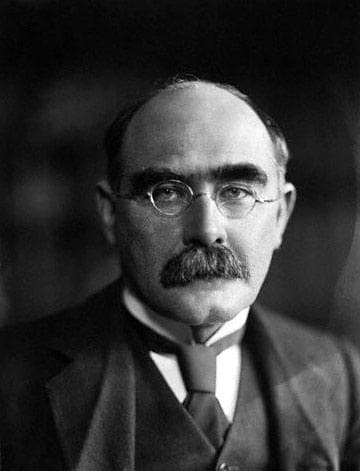
Joseph Rudyard Kipling was an English novelist, short-story writer, poet, and journalist. He was born in British India, which inspired much of his work.
Similar books
- The Jungle Book
Rudyard Kipling
3.9 (104k) average on GoodreadsFantasyAnother classic Kipling collection featuring anthropomorphic animals and moral lessons.
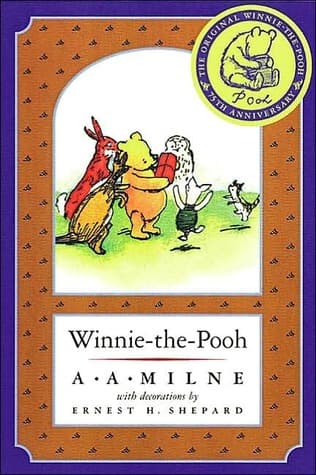
- Winnie-the-Pooh
A.A. Milne
4.3 (270k) average on GoodreadsFantasyMilne's work offers a gentler, more introspective, and universally empathetic fantasy world focused on friendship and simple joys, contrasting with Kipling's more didactic tone and occasional colonial undertones. Milne's characters are less tied to specific cultural or imperial contexts.
- Alice's Adventures in Wonderland
Lewis Carroll
4.0 (245k) average on GoodreadsFantasyCarroll's book, while also imaginative, delves deeper into logic puzzles, wordplay, and a subversive questioning of authority and reality, offering a more complex and less prescriptive form of nonsense. It lacks the 'just so' explanations and didacticism sometimes found in Kipling.
- Harry Potter and the Sorcerer's Stone
J.K. Rowling
4.5 (7M) average on GoodreadsFantasyRescued from a miserable life under the stairs, an orphaned boy discovers he's a wizard destined for a magical school, where he uncovers a dangerous secret tied to the dark wizard who murdered his parents.
- The Hunger Games
Suzanne Collins
4.3 (6.4M) average on GoodreadsFantasyIn a future where children fight to the death on live television, Katniss Everdeen volunteers for the arena, turning a death sentence into a fight for survival and a spark of rebellion.
- 1984
George Orwell
4.2 (3.1M) average on GoodreadsPoliticsIn a future where surveillance and thought control are absolute, a man's search for truth clashes with the Party, showing that hope can be a form of rebellion.



Enjoyed the summary?
A summary gives you the shape of the book. The book itself has the detail, the examples and the voice.
Find Just So Stories on AmazonAs an Amazon Associate, BookBrief earns from qualifying purchases. How we're funded