
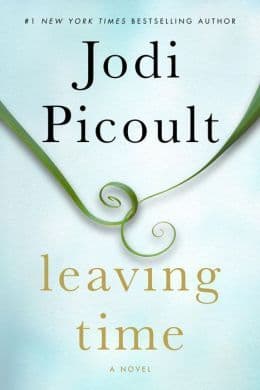
Synopsis
Covers the whole plot, including the ending.
- Difficulty
- Medium
- Pacing
- Moderate
- Mood
- Mysterious, Emotional, Thought-provoking, Hopeful
- Read it if
- You love mysteries with emotional depth, unique settings, and a big, unexpected twist. Perfect for readers fascinated by animal behavior, particularly elephants.
- Skip it if
- You dislike stories with supernatural elements or find the concept of amnesia-induced identity shifts unsatisfying.
Leaving Time Plot Summary
Covers the whole plot, including the ending.
Jenna's Obsession and the Search for Alice
Jenna Metcalf, thirteen, lives with her grandmother, Gigi, in New Hampshire. Ten years ago, her mother, Alice, disappeared after an incident at the elephant sanctuary where she worked, which killed a researcher, Virgil. Jenna has vivid memories of her mother and the sanctuary, especially an elephant's eye. She believes Alice did not abandon her. Jenna spends hours online researching missing people and elephant behavior, wanting to know what happened. She also rereads her mother's journals, hoping to find a clue in Alice's observations about elephant grief and memory.
Enlisting a Skeptical Detective and a Disgraced Psychic
Jenna is frustrated with the lack of progress. She uses saved money to hire Serenity Jones, a psychic whose reputation suffered after a public scandal. Serenity, at first hesitant, agrees to help. Jenna also seeks out Alex Rivera, the detective who investigated Alice's disappearance a decade ago. Alex, now a private investigator, at first dismisses Jenna's theories, thinking Alice just left. But Jenna's strong belief and the details she provides, especially from her mother's journals, interest him, and he agrees to look at the cold case again.
Alice's Journal Entries: Life at the Sanctuary
Alice's journals, placed throughout the story, describe her life before she disappeared. She grew up at the New Hampshire elephant sanctuary, run by her parents. She formed a deep bond with the elephants, especially a matriarch named Maura. Her journals document her research into elephant grief, memory, and social groups. They describe her close relationship with Virgil, a researcher who shared her passion. Alice writes about her struggles with her parents' expectations, her joy in her work, and the emotional lives of the elephants, hinting at future tragic events.
The Developing Investigation: Serenity's Visions and Alex's Logic
As Serenity works with Jenna, she has clearer and more unsettling visions, feeling Alice's presence and reliving parts of her past. These visions often involve elephants, fear, and the smell of blood. Meanwhile, Alex Rivera, guided by Jenna's questions and the journal information, looks deeper into the original police report. He finds inconsistencies and overlooked details, realizing the first investigation was rushed. He re-interviews old witnesses and revisits the sanctuary, finding facts that do not match the official story, especially about Virgil's death.
Alice's Journal: The Accident and Its Aftermath
Alice's journal entries reach the time before Virgil's death. She describes an incident where an elephant named Tariq attacked Virgil during a routine procedure. Virgil died from his injuries. Alice recounts the aftermath: the shock, the police investigation, and the overwhelming grief. She felt guilty, though the incident was called an accident. The sanctuary faced public scrutiny, threatening its existence. Alice's parents were devastated and struggled, adding to Alice's burden as she tried to protect her family and the elephants.
Unraveling the Truth About Virgil's Death
Through Serenity's insights and Alex's detective work, a truth emerges. Serenity's visions become clearer, suggesting foul play, not an accident. Alex, re-examining evidence and witness statements, realizes the official story of Virgil being accidentally killed by Tariq is wrong. He finds differences in the autopsy report and the scene description. It becomes clear Virgil was already dead before the elephant's tusks caused fatal wounds, meaning he was murdered. The police had too quickly accepted the elephant attack as the cause, missing important details.
The Motive and the Killer
The investigation focuses on who wanted Virgil dead. Alex and Serenity discover Virgil had been planning to expose the sanctuary for mistreating elephants and financial problems. This would have ruined Alice's family and closed the sanctuary. Alice's father, Thomas, found out about Virgil's plans. To protect his life's work and his family's reputation, Thomas confronted Virgil. A struggle led to Thomas accidentally killing Virgil. To hide the crime and make it look like an elephant attack, Thomas altered the scene.
Alice's Discovery and Disappearance
Alice, who knew the elephants well, began to understand what happened to Virgil. She realized Tariq's behavior was not consistent with an unprovoked attack and that her father was hiding something. After confronting Thomas, he confessed to accidentally killing Virgil and staging the scene. Devastated and torn between her love for her father and her morals, Alice made a hard choice. Knowing her father's actions would be found out, and fearing for Jenna's future if she stayed, Alice chose to disappear, starting a new life to protect her daughter from the scandal's effects.
The Confrontation and the Revelation
Jenna, Alex, and Serenity confront Thomas Metcalf at the sanctuary. Thomas confesses to Virgil's murder and staging the scene to look like an elephant attack. He explains his reason was to protect his family and the sanctuary. As the truth comes out, Jenna is heartbroken but also feels closure. But there is one last piece. As Thomas is taken away, Serenity has a final, strong vision. She realizes that the 'Alice' she has been communicating with, the 'Alice' who disappeared, is not who Jenna thinks she is.
The Ultimate Twist: Jenna is Alice
In a revelation, the story twists: Jenna Metcalf is not a thirteen-year-old girl looking for her mother. Jenna IS Alice. The entire story has been told by an adult Alice, who has dissociative amnesia. She relives her past trauma as if she were her younger self. Serenity Jones is the adult Alice's younger, psychic self, whose visions are her own repressed memories trying to surface. The 'disappearance' was Alice's psychological break after her father's crime and her actions. She created the persona of 'Jenna' to process her past, and the 'search' was her subconscious attempt to remember and heal.
Leaving Time Characters
Jenna Metcalf
Protagonist
A thirteen-year-old girl obsessed with finding her missing mother, Alice.
Jenna is presented as a determined and intelligent thirteen-year-old living with her grandmother, Gigi. She is deeply affected by her mother's mysterious disappearance ten years prior and refuses to believe Alice abandoned her. Jenna is resourceful, using her savings to hire a psychic and persistently pursuing Alex Rivera. She possesses vivid, fragmented memories of her mother and the elephant sanctuary, which drive her relentless search for the truth. Her journey is one of profound longing and a desperate need for answers, making her resilient despite her young age. Ultimately, Jenna is revealed to be the adult Alice, suffering from psychological trauma.
Relationships: Alice Metcalf (Her missing mother (later revealed to be herself)); Gigi (Her loving grandmother); Serenity Jones (The psychic she hires (later revealed to be her younger self)); Alex Rivera (The detective she enlists)
Alice Metcalf
Central Figure (initially perceived as missing mother)
A scientist who studied elephant grief, whose journals hold clues to her disappearance.
Alice is initially portrayed through her journals and Jenna's memories as a compassionate and brilliant elephant scientist who grew up at the sanctuary. She is deeply connected to the elephants, particularly Maura, and dedicates her life to understanding their complex emotional lives. Her journals reveal her struggles with her parents' expectations, her relationship with Virgil, and her profound grief after his death. She is depicted as highly intuitive and observant. Her disappearance is the central mystery of the book, which is ultimately resolved by the revelation that she is the adult Jenna, having suffered a psychological break.
Relationships: Jenna Metcalf (Her daughter (later revealed to be herself)); Thomas Metcalf (Her father); Gigi (Her mother); Virgil (Fellow researcher and close friend); Maura (An elephant matriarch she studied)
Serenity Jones
Supporting (initially psychic, later revealed as younger Alice)
A disgraced psychic whose visions provide clues to Alice's whereabouts.
Serenity is a once-famous psychic whose career was ruined by a public scandal. She lives a reclusive life, grappling with her past and a loss of faith in her abilities. When Jenna approaches her, Serenity is initially cynical and reluctant, but Jenna's earnestness and the powerful, unsettling visions she begins to experience draw her into the investigation. Her visions are often fragmented and emotionally charged, providing a different lens through which to view the events. Her role is crucial in piecing together the truth, and her identity is later revealed to be the younger, psychic aspect of Alice herself.
Relationships: Jenna Metcalf (Her client (later revealed to be her older self)); Alex Rivera (Her investigative partner)
Alex Rivera
Supporting (detective)
A former detective who reopens Alice's cold case.
Alex Rivera is a pragmatic and logical former police detective who initially handled Alice's disappearance. He is skeptical of psychics and the supernatural, preferring to rely on facts and evidence. Having resigned from the force after the original case went cold, he now works as a private investigator. Jenna's persistence and the inconsistencies he uncovers in the original police report slowly convince him to reinvestigate. He provides a grounded, rational counterpoint to Serenity's psychic insights, meticulously sifting through evidence and interviewing witnesses. His dedication to justice helps unravel the truth behind Virgil's death and Alice's disappearance.
Relationships: Jenna Metcalf (His client); Serenity Jones (His investigative partner)
Gigi (Grace Metcalf)
Supporting
Jenna's loving grandmother and Alice's mother.
Gigi, whose full name is Grace Metcalf, is Alice's mother and Jenna's grandmother. She provides a stable and loving home for Jenna after Alice's disappearance. Gigi is deeply protective of Jenna and carries her own grief and anxieties about Alice's whereabouts. She struggles with the mystery, wanting to believe Alice is alive but also fearing the worst. Her character embodies the quiet strength and enduring love of a grandmother, providing emotional support for Jenna while also grappling with her own unresolved pain and the secrets held within her family.
Relationships: Jenna Metcalf (Her granddaughter); Alice Metcalf (Her daughter); Thomas Metcalf (Her husband)
Thomas Metcalf
Antagonist
Alice's father and the owner of the elephant sanctuary.
Thomas Metcalf is Alice's father and the patriarch of the elephant sanctuary. He is a passionate, albeit sometimes rigid, man dedicated to the welfare of his elephants and the legacy of his family's work. His love for the sanctuary and his family drives him to extreme measures. He is initially presented as grieving the loss of Virgil and Alice, but is later revealed to be Virgil's murderer, having killed him to prevent him from exposing what Thomas perceived as threats to the sanctuary. His character embodies the destructive power of desperation and the lengths one will go to protect what they love.
Relationships: Alice Metcalf (His daughter); Gigi (His wife); Virgil (His employee (whom he murdered))
Virgil
Mentioned (Victim)
A fellow elephant researcher whose death triggers Alice's disappearance.
Virgil is a fellow researcher at the elephant sanctuary and a close friend of Alice. He shared her passion for elephants and collaborated on her research. His death, initially ruled an accident involving an elephant named Tariq, is the catalyst for Alice's disappearance and the central mystery of the book. Through journal entries and flashbacks, he is depicted as a dedicated and kind individual. It is later revealed that he was planning to expose the sanctuary for alleged wrongdoing, which led to his murder by Thomas Metcalf. His death casts a long shadow over the Metcalf family and the sanctuary.
Relationships: Alice Metcalf (Close friend and colleague); Thomas Metcalf (His employer and murderer)
Maura
Supporting (Elephant)
An old elephant matriarch at the sanctuary, deeply connected to Alice.
Maura is one of the oldest and most revered elephants at the Metcalf sanctuary. She is a matriarch, embodying the wisdom, memory, and emotional depth that Alice studies. Alice has a profound, almost telepathic, bond with Maura, often observing her behavior to understand elephant grief and social structures. Maura's presence in Alice's journals and Jenna's memories highlights the central theme of elephant intelligence and emotional lives. Her reactions and behavior after Virgil's death provide subtle clues that challenge the initial narrative of the accident, underscoring the elephants' profound understanding of events.
Relationships: Alice Metcalf (Her primary human caretaker and researcher)
Tariq
Mentioned (Elephant)
The elephant initially blamed for Virgil's death.
Tariq is an elephant at the sanctuary, initially implicated in Virgil's death. He is a bull elephant, and his perceived aggressive behavior is used to explain the 'accident.' However, Alice's deep understanding of Tariq's temperament and elephant behavior, in general, leads her to doubt the official story. Tariq's role is crucial as a red herring and as a symbol of the misunderstanding and misjudgment that human characters project onto the animal world. His 'guilt' serves to mask the true human crime.
Relationships: Virgil (The victim whose death was attributed to him)
Leaving Time Themes
Memory and Trauma
The novel explores memory, especially with trauma. Alice's journals describe elephants' long-term memory, like human struggles with past events. Jenna's fragmented memories and search show repressed trauma. The twist reveals the story is Alice's journey through her own dissociative memory, showing how the mind can separate or change painful experiences. The book suggests healing comes from facing and combining these buried memories.
“Elephants never forget. And neither do we, no matter how hard we try to pretend otherwise.”
Grief and Loss
Grief is a theme, seen in both humans and animals. Alice's work focuses on elephant grief, their mourning, and their deep sadness. This research connects to the human characters' losses: Jenna's grief for her mother, Gigi's quiet sadness, and Alice's own grief for Virgil and her old life. The book suggests grief is a powerful force, and understanding it helps healing and moving forward.
“Grief is a cruel mistress. It takes up residence in your heart and never truly leaves. At best, you learn to live around it.”
Identity and Self-Discovery
Jenna's search for her mother is a search for her own identity. She defines herself by her connection to Alice and the mystery. Alice's past, through her journals, also shows Alice's journey of self-discovery as a scientist and mother. The novel's end, when Jenna realizes she is Alice, redefines the theme. It becomes a story of a person's fragmented self trying to connect and understand its identity after trauma, showing how self can be fluid and broken.
“Perhaps the most difficult thing about life is that there are no do-overs. You can't rewind and correct your mistakes. You can only keep moving forward.”
The Nature of Truth and Perception
The novel challenges the reader's idea of truth. The first 'truth' of Alice's disappearance and Virgil's death is slowly broken down by Alex's logic and Serenity's intuition. The story itself uses unreliable narration, with the final twist changing how past events are understood. It questions what we know about others and ourselves, and how easily 'facts' can be changed. The elephants' silent presence shows that truth can exist beyond human understanding.
“Sometimes the truth is staring you right in the face, and you still can't see it.”
The Human-Animal Bond
The connection between humans and elephants is central. Alice's work is about understanding elephants, their intelligence, and their emotions. The elephants are not just background; they are characters with their own personalities, memories, and roles in the drama. Maura, especially, is a silent witness and a source of comfort for Alice. The bond shows empathy, communication without words, and that animals can offer lessons about life, death, and connection.
“They say elephants never forget. I think it's more than that. I think they remember everything, the way the earth remembers rain.”
Plot Devices & Literary Techniques
Unreliable Narrator
The entire story is filtered through a character whose perception of reality is fractured.
The most significant plot device in 'Leaving Time' is the unreliable narrator. For the majority of the novel, the reader believes Jenna Metcalf is a thirteen-year-old girl searching for her mother. Her memories, observations, and interpretations shape the narrative. The shocking reveal that Jenna *is* Alice, and that the story is a manifestation of Alice's dissociative memory, retroactively makes the entire narrative unreliable. This device creates suspense, forces the reader to re-evaluate every detail, and powerfully conveys the psychological impact of trauma and repression on the protagonist's perception of her own history.
Dual Perspective/Interwoven Narratives
The story alternates between Jenna's present-day search and Alice's past journal entries.
The novel employs a dual narrative structure, alternating chapters between Jenna's present-day investigation and excerpts from Alice's journals. Jenna's chapters provide the forward momentum of the mystery, while Alice's journals offer crucial backstory, character development, and scientific insights into elephant behavior. This interweaving technique slowly builds suspense, reveals clues, and develops both characters simultaneously. The ultimate twist then recontextualizes this structure, revealing that both narratives are, in fact, part of one continuous, fragmented consciousness, with the 'present' being Alice's psychological journey to remember her 'past'.
Psychic Visions
Serenity Jones's psychic abilities provide non-linear, intuitive clues to the mystery.
Serenity Jones's psychic visions serve as a key plot device, offering fragmented, emotional, and often symbolic clues that conventional detective work cannot uncover. Her visions create a sense of unease and mystery, guiding the investigation in directions Alex Rivera's logic might overlook. They represent a different way of 'knowing' or perceiving truth, often tapping into the emotional residue of past events. The device is particularly effective when, at the climax, Serenity's final vision is the catalyst for the ultimate reveal, recontextualizing her 'psychic' abilities as Alice's own repressed memories surfacing.
Elephant Behavior as Metaphor/Clue
The scientific study of elephants parallels and provides clues to the human drama.
Alice's extensive research into elephant grief, memory, and social structures is not merely background; it functions as a profound metaphorical and literal plot device. The elephants' capacity for long-term memory, their mourning rituals, and their sensitivity to emotional cues mirror the human characters' struggles. For example, Maura's behavior after Virgil's death provides subtle clues that contradict the official story. The elephants' 'knowing' serves as a silent commentary on the human events, often foreshadowing truths that humans are reluctant to acknowledge and ultimately helping Alice (and Jenna) to piece together the fragmented reality.
Red Herring (Virgil's Death)
The initial explanation for Virgil's death is intentionally misleading to conceal the true crime.
The initial explanation for Virgil's death—an accidental attack by the elephant Tariq—acts as a significant red herring. This widely accepted 'truth' is what the police initially conclude and what the family publicly maintains. It draws suspicion away from human agency and allows the true crime to remain hidden for a decade. The gradual unraveling of this red herring by Alex and Serenity is central to the mystery's progression, demonstrating how easily a convenient explanation can obscure a more sinister truth, and highlighting the theme of misperception and hidden realities.
Leaving Time Quotes
“There are some things you can't outrun.”
“Maybe the hardest part of losing someone isn't having to say goodbye, but rather having to learn to live without them. To learn to be okay with the absence.”
“Elephants never forget. It's a cliché, but it's also true. They carry their memories, good and bad, for a lifetime.”
“Sometimes the things we think we know best are the things we actually know the least.”
“The past is like a ghost. It haunts you, even if you don't believe in it.”
“There's a difference between seeing and observing.”
“Grief is like a tidal wave. It comes in waves, sometimes small, sometimes crushing. And you never know when it's going to hit.”
“We all have our secrets, even from the people we love the most.”
“An elephant's memory is not just about remembering, but about feeling. They feel the loss, the joy, the fear, just as deeply as we do.”
“Sometimes, the truth isn't what you want it to be. Sometimes, it's far worse.”
“You can't change what happened, but you can change how you remember it.”
“The hardest part of any journey is often the first step, especially when you don't know where you're going.”
“Love isn't always enough to keep people safe. Sometimes, love is the very thing that puts them in danger.”
“There are different kinds of strength. The kind that lifts heavy things, and the kind that holds you together when everything else falls apart.”
Quiz
10 questions on the plot and the characters. Each answer comes with a short explanation.
Question 1
What kind of animal did Alice Metcalf primarily study to understand grief?
- Chimpanzees
- Elephants
- Dolphins
- Wolves
Show answer
B. Elephants Alice Metcalf was a scientist who studied grief among elephants, as detailed in her journals and mentioned early in the book's synopsis.
Question 2
What is the primary motivation for Jenna Metcalf's search for her mother?
- To inherit her mother's fortune
- To prove her mother committed a crime
- She refuses to believe her mother abandoned her and wants to understand what happened.
- Her father asked her to find Alice.
Show answer
C. She refuses to believe her mother abandoned her and wants to understand what happened. Jenna's core motivation is her unwavering belief that her mother did not abandon her and her desire to uncover the truth behind Alice's disappearance.
Question 3
How does Jenna primarily try to find clues about her mother's disappearance?
- By interviewing old colleagues of her mother
- By hiring a private detective immediately
- By searching online and reading her mother's old journals
- By visiting all the places her mother had lived
Show answer
C. By searching online and reading her mother's old journals The synopsis explicitly states that Jenna 'searches for her mother regularly online and pores over the pages of Alice’s old journals' for clues.
Question 4
Who is Virgil Stanhope in relation to Jenna's search?
- Jenna's estranged father
- The police detective who originally investigated Alice's disappearance
- A psychic Jenna consults to help find her mother
- Alice's former research assistant
Show answer
C. A psychic Jenna consults to help find her mother Jenna consults Virgil Stanhope, a psychic who claims to communicate with the dead, hoping he can provide insights into Alice's whereabouts or fate.
Question 5
What role does Serenity Jones play in Jenna's investigation?
- She is Alice's sister, who helps Jenna.
- She is a journalist who wrote about the initial accident.
- She is a disgraced detective, now a private investigator, whom Jenna hires.
- She is the director of the elephant sanctuary where Alice worked.
Show answer
C. She is a disgraced detective, now a private investigator, whom Jenna hires. Serenity Jones is a former detective who was disgraced and now works as a private investigator. Jenna seeks her help to re-examine the cold case of her mother's disappearance.
Question 6
What significant event happened that led to Alice's disappearance?
- Alice had a public argument with a colleague at a conference.
- A tragic accident involving an elephant at the sanctuary.
- Her research funding was suddenly cut off, causing her to flee.
- She was diagnosed with a terminal illness and left to spare her family pain.
Show answer
B. A tragic accident involving an elephant at the sanctuary. The synopsis mentions Alice 'mysteriously disappeared in the wake of a tragic accident,' which in the book is revealed to be an incident at the elephant sanctuary involving an elephant that resulted in a death.
Question 7
What is the primary thematic connection between Alice's elephant research and her own story?
- The economic impact of wildlife conservation on local communities.
- The complex nature of maternal bonds and the profound impact of loss and grief.
- The ethical considerations of animal captivity and research.
- The migratory patterns of large mammals.
Show answer
B. The complex nature of maternal bonds and the profound impact of loss and grief. Alice's research into elephant grief and the strong, lasting bonds within elephant herds directly mirrors the themes of maternal love, loss, and the enduring impact of separation that Jenna experiences.
Question 8
What significant detail is revealed about Jenna's childhood memories that complicates her understanding of the past?
- She realizes her father was abusive to Alice.
- Her memories of the accident and her mother are unreliable and incomplete.
- She discovers her mother had a secret second family.
- She remembers witnessing a murder that the police covered up.
Show answer
B. Her memories of the accident and her mother are unreliable and incomplete. As the story progresses, Jenna's own fragmented and potentially repressed memories of the tragic accident and her mother's disappearance are revealed to be crucial, yet also unreliable, complicating her search for the truth.
Question 9
What is the ultimate twist concerning Alice Metcalf's disappearance?
- Alice faked her death to escape a dangerous cult.
- Alice was actually murdered by a jealous colleague.
- Alice was a ghost all along, and Jenna was imagining her.
- Alice was never a real person; she was a figment of Jenna's imagination, a coping mechanism for Jenna's own death.
Show answer
D. Alice was never a real person; she was a figment of Jenna's imagination, a coping mechanism for Jenna's own death. The book's major twist is that Jenna Metcalf herself died in the tragic accident, and Alice is a manifestation of Jenna's consciousness, living on to process her grief and find peace, effectively 'leaving time.'
Question 10
How does the concept of 'leaving time' relate to the book's ending?
- It refers to Alice's decision to leave her past behind and start a new life.
- It describes the elephants' ability to remember past events over long periods.
- It signifies the moment of death, where one's consciousness lingers before fully departing.
- It's a scientific term for the period before an elephant migrates.
Show answer
C. It signifies the moment of death, where one's consciousness lingers before fully departing. The title 'Leaving Time' refers to the period between life and death, where a consciousness (like Jenna's) might linger to process unresolved issues before fully moving on. This concept is central to the book's twist ending, where Jenna is revealed to be the one who died.
Leaving Time FAQ
What is 'Leaving Time' about?
'Leaving Time' tells the story of Jenna Metcalf, a thirteen-year-old girl who is desperately searching for her mother, Alice, who disappeared after a tragic accident a decade prior. Jenna enlists the help of a cynical detective, Virgil Stanhope, and a discredited psychic, Serenity Jones, to piece together clues from her mother's journals about elephant grief and her past.
Why should I read 'Leaving Time'?
You should read 'Leaving Time' for its unique blend of mystery, family drama, and fascinating insights into elephant behavior and grief. The novel offers a compelling narrative told through multiple perspectives, a deeply emotional core, and a shocking twist that recontextualizes the entire story.
What is the background/setting of 'Leaving Time'?
The story primarily unfolds in the present day as Jenna searches for her mother in the New England area, particularly around the elephant sanctuary where Alice worked. Flashbacks to Alice's past, detailed in her journals, transport readers to various elephant research sites, including the African savanna and the sanctuary, providing a rich backdrop of scientific study and personal struggle.
What are the most memorable quotes?
One memorable quote is Alice's reflection: 'Grief is a house of cards. When one memory crumbles, the whole structure can collapse.' This encapsulates the fragility of memory and the profound impact of loss, central themes of the book. Another is Serenity's line about connections: 'Sometimes the people you think are gone are just waiting for you to find them.'
What writing style does Jodi Picoult use in 'Leaving Time'?
Jodi Picoult employs a multi-perspective narrative, primarily alternating between Jenna's present-day investigation, Alice's journal entries detailing her elephant research, and Serenity Jones's perspective. Her style is characterized by meticulous research, emotional depth, and a compelling, suspenseful pace, often building to a signature plot twist.
What minor details add significant meaning?
The recurring motif of elephants and their complex emotional lives, particularly their grieving rituals, is not just background but a profound mirror to the human experience of loss and memory. Alice's detailed observations of elephant behavior, like their ability to remember grievances and their deep family bonds, subtly foreshadow the human drama and motivations.
What are some subtle foreshadowing moments?
Alice's repeated observations about elephants appearing to 'ghost' or vanish, only to reappear later, subtly foreshadow her own perceived disappearance and eventual revelation. Her journals also contain cryptic references to her own mental state and the challenges of distinguishing reality from hallucination, hinting at the true nature of her situation.
What unexpected character connections exist?
The most unexpected connection is revealed in the novel's climax: Serenity Jones, the psychic Jenna hires, is not merely a consultant but a figure deeply connected to Alice's past. The true nature of Alice's relationship with her husband, Thomas, and the tragic circumstances of her disappearance also reveal surprising connections to other characters.
What are unspoken character motivations?
Alice's unspoken motivation for her intense focus on elephant grief research seems to be a desperate attempt to understand and process her own profound trauma and loss, which are only gradually revealed. Jenna's relentless search for her mother is fueled by a deep-seated fear of abandonment and an unwavering belief in her mother's love, even in the face of contradictory evidence.
What psychological complexities do characters exhibit?
Alice exhibits complex psychological struggles, grappling with trauma, grief, and potentially dissociative states or hallucinations, which blur the lines of her reality. Jenna displays remarkable resilience and determination for her age, but also the vulnerability and magical thinking common in children dealing with profound loss, clinging to the hope of her mother's return.
What are the major emotional turning points?
A major emotional turning point for Jenna is when she begins to truly doubt her mother's existence in the present, forcing her to confront the possibility of permanent loss. For Alice, the accident itself, and the subsequent events leading to her disappearance, represent a catastrophic turning point that reshapes her entire reality and perception.
How do relationship dynamics evolve?
Jenna's relationship with Virgil Stanhope evolves from a reluctant partnership to a deep, trusting bond, as he becomes a surrogate father figure. Her initial skepticism towards Serenity Jones transforms into a profound dependence and understanding. The perceived relationship between Alice and her husband, Thomas, is dramatically recontextualized by the novel's revelations.
Which parts remain ambiguous or open-ended?
While the core mystery is resolved, some readers might ponder the long-term psychological impact on Jenna after the revelations, and how she will process the truth of her mother's 'disappearance.' The exact future for Jenna and Virgil, and the extent of Serenity's continued involvement in Jenna's life, are left somewhat open to interpretation.
What are controversial scenes or decisions?
The most controversial aspect of the book is the major plot twist itself, which some readers find brilliant and others find manipulative or difficult to accept. Alice's decisions and actions leading up to and after the accident, particularly regarding her mental state and the perception of her disappearance, can also be debated.
'Leaving Time' ending explained: how it ends & what it means
The ending reveals that Alice Metcalf has been dead since the accident a decade ago; Jenna has been communicating with her mother's ghost, and Serenity Jones is also a ghost, having died previously. The entire search has been a journey orchestrated by Alice's spirit to help Jenna understand the truth and move on, finally allowing both Alice and Serenity to find peace. It signifies the powerful, enduring bond between mother and daughter that transcends even death.
About the author

Jodi Picoult is an American author known for her thought-provoking fiction that often explores complex moral dilemmas. Her notable works include My Sister's Keeper, Nineteen Minutes, Small Great Things, Plain Truth, Leaving Time, and The Tenth Circle. Picoult's writing frequently delves into themes of family, justice, and the human experience.
Similar books
- The Storyteller
Jodi Picoult
3.7 (4k) average on GoodreadsLiterary FictionExplores complex ethical dilemmas and features a deep, emotional core with a powerful twist.
- Water for Elephants
Sara Gruen
4.1 (1.4M) average on GoodreadsHistorical FictionFeatures a strong connection to elephants and explores themes of love, loss, and resilience in a unique historical setting.
- The Silent Patient
Alex Michaelides
4.1 (507k) average on GoodreadsThrillerKnown for its shocking and well-executed psychological twist at the end.
- The Secret Place
Tana French
3.9 (63k) average on GoodreadsThrillerFrench's novel focuses purely on human psychological drama and interpersonal relationships within a closed setting, whereas Picoult integrates extensive scientific research on animal behavior and ecology to inform her mystery and thematic exploration. Picoult offers a broader, cross-species perspective on memory and grief.
- Sharp Objects
Gillian Flynn
4.0 (678k) average on GoodreadsThrillerFlynn's work delves into a protagonist's traumatic past and dysfunctional family dynamics with a focus on psychological horror and deeply flawed human characters. Picoult, while also exploring trauma, introduces the unique element of animal intelligence and its role in understanding human grief and memory, providing a distinct angle not present in Flynn's anthropocentric narrative.
- Angels & Demons
Dan Brown
3.9 (2.7M) average on GoodreadsThrillerA Harvard symbologist races through Rome's ancient sites, deciphering cryptic clues to unmask the Illuminati and stop a vengeful plot to destroy the Vatican with a stolen antimatter weapon.





Enjoyed the summary?
A summary gives you the shape of the book. The book itself has the detail, the examples and the voice.
Find Leaving Time on AmazonAs an Amazon Associate, BookBrief earns from qualifying purchases. How we're funded