
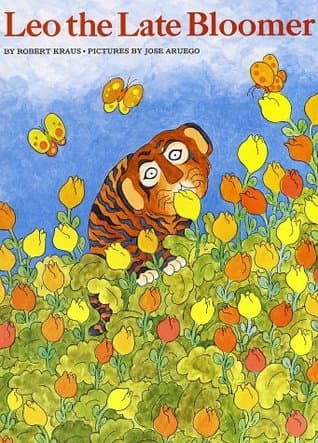
Synopsis
Covers the whole plot, including the ending.
- Difficulty
- Easy
- Pacing
- Slow
- Mood
- Heartwarming, Reassuring, Gentle, Optimistic
- Read it if
- You are a parent looking for a gentle, reassuring story about patience and individual development for young children, or if you want a simple, heartwarming read-aloud.
- Skip it if
- You are looking for a complex plot, deep character development, or a book with a fast-paced, action-oriented narrative.
Leo the Late Bloomer Plot Summary
Covers the whole plot, including the ending.
Leo's Early Struggles
Leo, a young tiger cub, cannot do many things other young animals his age can. He cannot read, write, draw, or even eat neatly. When he tries to eat, food ends up on him, not in his mouth. He also cannot speak, despite his parents' attempts to talk with him. These early scenes show Leo's situation and his lack of progress in several key areas, contrasting him with his peers.
Father's Growing Concern
Leo's father watches his son struggle with growing worry. He sees Leo try various tasks and consistently fail. For instance, he watches Leo try to speak but only make unclear sounds. His father often asks, "What's the matter with Leo?" This question shows his worry and frustration over Leo's slow development, highlighting the pressure he feels for his son to reach certain milestones. He often talks to Leo's mother about his concerns.
Mother's Patience and Reassurance
In contrast to Leo's father, his mother remains patient and understanding. Each time his father worries, asking "What's the matter with Leo?", she calmly responds, "Nothing. Leo is just a late bloomer." She believes Leo will develop at his own pace and that there is no need to rush or worry. Her steady reassurance provides a comforting balance to the father's worry, setting a main theme of the story.
Waiting and Watching
Days turn into weeks, and weeks turn into months, but Leo's behavior stays the same. He still struggles with the same tasks, unable to read, write, draw, or speak. His father continues to watch him, his concern constant, and repeatedly asks his wife if Leo will ever catch up. The mother, however, never changes her belief, always responding with her reassuring phrase, showing the importance of allowing Leo his own time to grow.
The First Sign of Progress: Eating Neatly
One day, without warning or special effort, Leo suddenly eats a meal neatly. Instead of food scattering, he manages to get it all into his mouth. This small but important change is the first sign of progress. It happens quietly, without celebration, surprising his parents and marking the start of his developmental breakthrough. This moment hints that his development is about to begin.
A Cascade of Achievements: Speaking and Reading
After learning to eat neatly, Leo's development speeds up. Soon after, he starts to speak, forming clear words and sentences, to his parents' delight and surprise. This is quickly followed by his ability to read. The story shows him focused on a book, proving he has not only learned to read but also enjoys it. These rapid advancements show a sudden unfolding of skills that were previously hidden, confirming his mother's faith.
Artistic Expression: Drawing and Writing
Leo's progress continues as he also begins to draw and write. He is shown creating pictures and forming letters, tasks that were impossible for him a short while ago. These new skills complete the set of developmental milestones his father had worried about. Leo's new abilities are shown as natural and easy, as if he simply needed the right moment to unlock them, showing his full range of potential.
Leo's Confident Declaration
With all his new skills, Leo confidently approaches his parents. He looks at them with a knowing smile and declares, "I made it!" This simple yet meaningful statement sums up his journey from a struggling cub to a capable one. It shows his self-awareness of his own development and his success over his earlier challenges, confirming his mother's patience and proving that he did indeed develop in his own time. His parents are very proud.
Parents' Joy and Relief
Leo's parents, especially his father, are filled with great joy and relief at their son's sudden and complete development. The father's earlier worries are gone, replaced by pride. The mother's steady faith is proven right. Their happiness shows the emotional journey they experienced with Leo, from worry to deep satisfaction. They celebrate his individual pace of growth.
The Fully Bloomed Leo
By the end of the story, Leo is no longer the struggling cub but a capable and confident young tiger. He can read, write, draw, speak, and eat neatly, doing all the tasks that once seemed impossible for him. His change is complete, showing the main message that everyone develops at their own pace. Leo's journey is a heartwarming example of patience and the natural unfolding of potential.
Leo the Late Bloomer Characters
Leo
Protagonist
A young tiger cub who develops at his own pace.
Leo is a young tiger cub who initially struggles with common developmental milestones such as reading, writing, drawing, speaking, and even eating neatly. He is depicted as being unable to perform these tasks, leading to concern from his father. Despite his initial difficulties, Leo is not shown as distressed, but rather as simply existing in his own state of development. He is the embodiment of the 'late bloomer' concept, eventually blossoming into a capable and confident individual when he is ready.
Relationships: Leo's Father (Son, the subject of his father's worry and eventual pride.); Leo's Mother (Son, the recipient of his mother's unwavering patience and belief.)
Leo's Father
Supporting
A worried parent anxious about his son's slow development.
Leo's father is characterized by his anxiety and concern over Leo's apparent lack of progress. He frequently asks, "What's the matter with Leo?" and worries that his son will never catch up to his peers. He represents the common parental fear of a child falling behind. Despite his worries, he remains loving and attentive, ultimately finding joy and relief when Leo finally 'blooms'. His journey is one from apprehension to proud acceptance.
Relationships: Leo (Father, deeply concerned about his son's developmental delays.); Leo's Mother (Husband, often seeking reassurance from his patient wife.)
Leo's Mother
Supporting
A patient and understanding parent who believes in her son's timing.
Leo's mother is the voice of calm and unwavering reassurance in the story. She consistently responds to her husband's worries with the mantra, "Nothing. Leo is just a late bloomer." She embodies patience, trust, and an understanding of individual developmental timelines. Her steadfast belief in Leo's eventual success provides a comforting presence and a philosophical anchor for the narrative, teaching both her husband and the reader the value of waiting and allowing natural growth.
Relationships: Leo (Mother, holds unwavering faith in her son's ability to develop at his own pace.); Leo's Father (Wife, provides calm reassurance and a steady perspective to her anxious husband.)
Leo the Late Bloomer Themes
Patience and Individual Development
The main theme is the importance of patience and understanding that every individual, especially a child, develops at their own pace. Leo's mother shows this perfectly, always telling her worried husband that 'Leo is just a late bloomer.' The story illustrates that pressuring a child to meet external timelines is less effective than giving them the space and time to develop naturally. Leo's eventual, sudden development in all areas, from eating neatly to reading and speaking, shows that readiness is key, not speed.
“Nothing. Leo is just a late bloomer.”
Parental Worry vs. Trust
This theme explores the contrast between a parent's natural worry about their child's progress and the deep trust in their child's abilities. Leo's father represents the worry, constantly questioning and comparing Leo to others, wanting his son to succeed. In contrast, Leo's mother shows trust, knowing that Leo will develop when he is ready. The story's ending supports the mother's view, suggesting that trust and patience are more helpful than worry in supporting a child's growth.
“What's the matter with Leo?”
The Unfolding of Potential
The story clearly shows that potential exists in everyone, even if it doesn't appear right away. Leo's journey shows that skills and abilities are not always gained slowly but can appear suddenly and completely when the individual is ready. He doesn't just learn one skill; once he starts, all his abilities, from speaking to drawing, emerge quickly. This highlights that development can be a process of internal readiness leading to external actions, rather than a straight line.
“I made it!”
Plot Devices & Literary Techniques
Repetition
The repeated phrase emphasizing parental worry and reassurance.
The consistent repetition of the father's question, "What's the matter with Leo?" and the mother's response, "Nothing. Leo is just a late bloomer," serves as a crucial plot device. This rhythmic repetition not only reinforces the central theme of patience but also highlights the contrasting parental perspectives. It creates a predictable structure that children can easily follow and understand, building anticipation for the moment when Leo finally proves his mother right. It also emphasizes the passage of time without explicitly stating it.
Symbolism of Blooming
Leo's development is metaphorically represented as a flower blooming.
The title itself, "Leo the Late Bloomer," introduces the central metaphor. Leo's gradual and then sudden development is likened to a flower that takes its time to open but eventually reveals its full beauty. This symbolism conveys the natural, unforced nature of growth and development, suggesting that just as a flower cannot be rushed, neither can a child. It frames Leo's initial struggles not as failures, but as part of a natural, albeit slower, preparatory phase before his eventual flourishing.
Contrast
The stark differences between Leo's initial state and his final capabilities.
The story employs strong contrast to highlight Leo's transformation. Initially, Leo is shown unable to do anything: he can't read, write, draw, speak, or eat neatly. This is contrasted sharply with his eventual state, where he confidently performs all these tasks. This dramatic shift underscores the profound nature of his 'blooming' and makes his eventual success more impactful. The contrast also extends to the parents' attitudes, with the father's anxiety contrasting with the mother's patience.
Leo the Late Bloomer Quotes
“Leo couldn't do anything right.”
“He couldn't read.”
“He couldn't write.”
“He couldn't draw.”
“He was a sloppy eater.”
“He made a big mess.”
“And he never said a word.”
“"What's the matter with Leo?" asked Leo's father.”
“Nothing," said Leo's mother. "Leo is just a late bloomer.”
“But Leo's father wasn't so sure.”
“A watched bloomer doesn't bloom.”
“So Leo's father stopped watching.”
“One day, in his own good time, Leo bloomed!”
“He could read! He could write! He could draw!”
“And he ate neatly. He made no mess. And he said... "I made it!"”
Quiz
10 questions on the plot and the characters. Each answer comes with a short explanation.
Question 1
What is Leo, the main character, by species?
- A lion
- A bear
- A tiger
- A monkey
Show answer
C. A tiger The story explicitly states that Leo is a little tiger.
Question 2
Which parent is concerned about Leo's lack of progress at the beginning of the story?
- His mother
- His father
- Both parents
- Neither parent
Show answer
B. His father The book description states, 'Leo isn't reading, or writing, or drawing, or even speaking, and his father is concerned. But Leo's mother isn't.'
Question 3
What is one of the things Leo is NOT doing at the beginning of the story?
- Sleeping
- Eating
- Reading
- Playing
Show answer
C. Reading The story mentions Leo isn't reading, writing, drawing, or speaking.
Question 4
What is the mother's primary attitude towards Leo's delayed development?
- Anxious and worried
- Patient and understanding
- Frustrated and annoyed
- Indifferent and uninvolved
Show answer
B. Patient and understanding Leo's mother 'knows her son will do all those things, and more, when he's ready,' indicating patience.
Question 5
What is the central theme of 'Leo the Late Bloomer'?
- The importance of early education
- The value of competitive learning
- Patience and individual developmental timelines
- The challenges of sibling rivalry
Show answer
C. Patience and individual developmental timelines The story's message is 'patience and humor,' and that Leo will 'do all those things... when he's ready.'
Question 6
Who illustrated 'Leo the Late Bloomer'?
- Robert Kraus
- Jose Aruego
- Maurice Sendak
- Eric Carle
Show answer
B. Jose Aruego The book description credits 'the wonderfully bold illustrations of Jose Aruego.'
Question 7
What does Leo eventually do that signals his 'blooming'?
- He starts flying
- He says 'I made it!'
- He builds a house
- He teaches his parents to read
Show answer
B. He says 'I made it!' The quote from Children's Books and Their Creators mentions 'Leo's reassuring 'I made it!' at the end delights young listeners.'
Question 8
The 'Horn Book' review describes the story as 'Captivating and ______.'
- Quiet
- Rollicking
- Melancholy
- Serious
Show answer
B. Rollicking The provided text includes the quote: '“Captivating and rollicking.” —The Horn Book'.
Question 9
Why is 'Leo the Late Bloomer' considered 'more timely than ever' according to the description?
- Because it promotes academic competition
- Due to its message of patience in a world that often scrutinizes early development
- Because it teaches specific academic skills
- It features popular animal characters
Show answer
B. Due to its message of patience in a world that often scrutinizes early development Children's Books and Their Creators notes it's timely because 'young listeners who may have been scrutinized for early blooming by well-intentioned moms and dads.'
Question 10
What age group is specifically mentioned as an excellent choice for sharing this book?
- Ages 2 to 3
- Ages 4 to 6
- Ages 7 to 9
- Ages 10 to 12
Show answer
B. Ages 4 to 6 The description states it's 'an excellent choice to share during homeschooling, in particular for children ages 4 to 6.'
Leo the Late Bloomer FAQ
What is the central premise of 'Leo the Late Bloomer'?
The story centers on Leo, a young tiger who struggles to develop skills like reading, writing, drawing, and speaking, causing his father significant worry. His mother, however, maintains a calm and patient perspective, believing Leo will blossom in his own time. The narrative follows Leo's journey as he eventually masters these skills when he is ready, validating his mother's faith.
Who are the main characters in the book?
The main characters are Leo, the young tiger cub who is the titular 'late bloomer,' and his parents. Leo's father is characterized by his anxiety and concern over Leo's lack of progress, while Leo's mother embodies patience, wisdom, and unwavering belief in her son's individual timeline.
What skills does Leo struggle with at the beginning of the story?
Initially, Leo struggles with several foundational developmental skills. He cannot read, write, draw, or even speak, which is a source of considerable concern for his father. These challenges highlight the central theme of individual developmental pacing.
How do Leo's parents react differently to his delayed development?
Leo's father reacts with palpable worry and frequently questions Leo's progress, often observing 'Leo isn't blooming.' In contrast, Leo's mother consistently responds with reassurance and patience, stating, 'A late bloomer.' She trusts that Leo will develop when he is ready, offering a calm counterpoint to her husband's anxiety.
What is the ultimate message or resolution of Leo's story?
The story culminates with Leo suddenly and successfully mastering all the skills he previously struggled with, exclaiming, 'I made it!' This resolution reinforces the message that every individual develops at their own pace and that patience and understanding are crucial during the developmental process. It's a celebration of individual timing.
Are there any subtle visual cues from Jose Aruego's illustrations that hint at Leo's eventual blooming?
While the story emphasizes Leo's lack of progress, Aruego's illustrations subtly depict Leo's engagement with the world around him, even if not through conventional means. Perhaps he is observing, listening, or processing internally, suggesting an underlying absorption that will eventually manifest as skills, rather than complete disinterest.
Does the book imply that Leo was actively trying to learn before he 'bloomed' or was it a sudden, natural onset?
The narrative suggests a more sudden, natural onset rather than a result of intense, failed effort. Leo's 'blooming' seems to happen spontaneously when he is ready, without explicit scenes of him struggling to learn prior to his breakthrough. This reinforces the idea of internal readiness over forced instruction.
Is there any significance to Leo being a tiger, or could he have been any animal?
While Leo's species isn't central to the plot, the choice of a tiger, a creature often associated with strength and independence, might subtly underscore the idea that even the most capable individuals have their own unique developmental paths. It adds a touch of charm and relatability for young readers without being overly symbolic.
How does Leo's father's anxiety impact the family dynamic before Leo blooms?
Leo's father's anxiety creates a mild tension within the family, primarily through his repeated questioning and worry. It highlights a common parental struggle of balancing concern with patience, but Leo's mother's calm demeanor largely mitigates any severe negative impact, maintaining a supportive environment.
What psychological effect might Leo's mother's consistent patience have on Leo?
Leo's mother's consistent patience likely provides him with a secure and low-pressure environment, fostering a sense of self-acceptance rather than shame or inadequacy. This emotional safety could be crucial for his eventual development, allowing him to bloom without the added burden of parental disappointment.
How does the story address the potential for comparison among children and its psychological effects?
The story implicitly addresses the pressure of comparison by showing Leo's father's concern, which stems from an expectation of typical development. However, Leo's mother's perspective counters this, suggesting that comparing children to arbitrary timelines can be detrimental and that individual readiness is paramount for healthy development.
What is the psychological significance of Leo's final exclamation, 'I made it!'?
Leo's triumphant exclamation, 'I made it!' signifies not just the acquisition of skills but also a profound moment of self-actualization and confidence. It demonstrates his internal awareness of his own progress and the satisfaction of achieving milestones on his own terms, underscoring the importance of intrinsic motivation and validation.
Could Leo's 'late blooming' be interpreted as a form of neurodivergence, and how does the book's message apply?
While not explicitly stated, Leo's 'late blooming' could be broadly interpreted through a neurodivergent lens, highlighting that different brains develop and function uniquely. The book's message of patience, acceptance, and allowing individuals to develop at their own pace is highly applicable and supportive for understanding diverse developmental trajectories.
Is Leo's story more about intellectual development or emotional readiness?
Leo's story is arguably more about emotional readiness than purely intellectual development. While he acquires intellectual skills, the core message emphasizes the importance of waiting until an individual is internally and emotionally prepared to learn and master new abilities, rather than forcing the process prematurely.
How does 'Leo the Late Bloomer' challenge traditional educational expectations for young children?
'Leo the Late Bloomer' directly challenges the pressure for early academic achievement by advocating for patience and understanding of individual timelines. It suggests that forcing skills before a child is ready can be counterproductive, promoting instead a more child-led, readiness-based approach to learning and development.
What broader societal lessons can be drawn from Leo's parents' contrasting reactions?
The contrasting reactions of Leo's parents offer broader societal lessons about balancing concern with trust. Leo's father represents societal pressures and anxieties about 'keeping up,' while his mother embodies the wisdom of allowing for natural growth and individuality. It encourages a shift towards less comparative and more supportive societal norms.
Could the book be seen as a metaphor for any creative or personal growth process, beyond childhood development?
Absolutely. The story's core message of patience and readiness can be a powerful metaphor for any creative or personal growth process. Whether it's mastering a new skill, pursuing a passion, or even overcoming a personal challenge, the idea that one will 'bloom' when the time is right resonates far beyond childhood development, encouraging perseverance and self-trust.
About the author

Robert Kraus was an American author known for his contributions to children's literature. He is best recognized for his book "Leo the Late Bloomer," which explores themes of growth and self-acceptance. Kraus's works primarily focus on fiction for young readers.
Similar books
- The Little Engine That Could
Watty Piper
4.2 (102k) average on GoodreadsFantasyShares a message of perseverance and eventual success despite initial challenges.
- Harry Potter and the Sorcerer's Stone
J.K. Rowling
4.5 (7M) average on GoodreadsFantasyRescued from a miserable life under the stairs, an orphaned boy discovers he's a wizard destined for a magical school, where he uncovers a dangerous secret tied to the dark wizard who murdered his parents.
- The Hunger Games
Suzanne Collins
4.3 (6.4M) average on GoodreadsFantasyIn a future where children fight to the death on live television, Katniss Everdeen volunteers for the arena, turning a death sentence into a fight for survival and a spark of rebellion.
- 1984
George Orwell
4.2 (3.1M) average on GoodreadsPoliticsIn a future where surveillance and thought control are absolute, a man's search for truth clashes with the Party, showing that hope can be a form of rebellion.
- Divergent
Veronica Roth
4.2 (2.9M) average on GoodreadsFantasyIn a society divided by virtues, a sixteen-year-old's difference from the norm starts a rebellion that threatens her world.
- The Hobbit, or There and Back Again
J.R.R. Tolkien
4.3 (2.9M) average on GoodreadsFantasyA comfort-loving hobbit named Bilbo Baggins is whisked away by a mischievous wizard and a band of dwarves on an unexpected journey to reclaim stolen treasure from a fearsome dragon, discovering courage and a magical ring along the way.





Enjoyed the summary?
A summary gives you the shape of the book. The book itself has the detail, the examples and the voice.
Find Leo the Late Bloomer on AmazonAs an Amazon Associate, BookBrief earns from qualifying purchases. How we're funded