
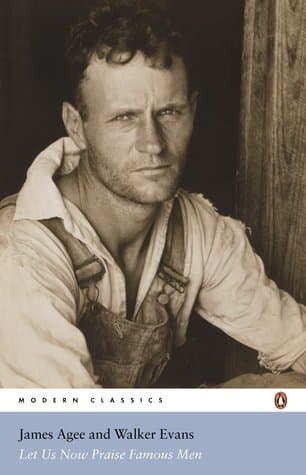
Core Idea
- Difficulty
- Hard
- Read it if
- You are interested in experimental non-fiction, the ethics of observation, the American Great Depression, or a deeply philosophical and poetic exploration of poverty and human dignity.
- Skip it if
- You prefer conventional narrative structures, straightforward historical accounts, or find lengthy, stream-of-consciousness prose challenging to engage with.
Key Takeaways from Let Us Now Praise Famous Men
The Intolerable Burden of Witness
Truth is not objective; it is a profoundly personal and ethically fraught act of engagement.
Agee struggles with the inherent aggression of observation, especially when the observed are vulnerable. His self-questioning throughout the book shows a deep ethical problem: how can one truly show another's suffering without using it, without imposing one's own story, or without reducing their complex humanity to a 'case study'? He knows that seeing, especially for publication, changes the subject and the witness, often uncomfortably. This is not just about journalistic ethics; it is a philosophical look into perception, empathy, and the limits of language in showing lived experience. The book itself shows this struggle, an attempt to break free from standard reporting and embrace a more complete, if difficult, truth.
“For in the immediate world, everything is to be discerned, for the eye of the man who can discern it.”
In the book: Agee's extensive internal monologues and direct addresses to the reader, where he questions his own motives, methods, and the very possibility of accurate representation. His detailed descriptions of the families' homes and possessions often lead to a crisis of conscience about his right to intrude.
Try this: Before attempting to tell someone else's story, particularly those from marginalized communities, engage in rigorous self-reflection about your own position, biases, and the potential impact of your narrative. Prioritize the subject's agency and voice, even if it means challenging conventional storytelling structures.
Related ideas: ethics-of-representation, subjectivity-in-journalism, empathy-and-observation
The Sacred Mundane
Ordinary objects and daily routines hold profound spiritual and human significance.
Agee's detailed descriptions of the sharecroppers' humble possessions—their worn blankets, patched clothing, simple tools, and sparse furniture—make these items more than just useful. He fills them with the weight of human history, labor, and endurance. These are not just things; they are extensions of the lives lived around them, marked by the sweat, tears, and small joys of their owners. This focus on the 'thing-ness' of objects, and the sacredness of everyday acts like eating or sleeping, asks the reader to look beyond surface appearances and see the dignity and beauty in what society often considers unimportant or poor. It is an act of re-sensitization, making us truly 'see' the world around us.
“Every object, every living thing, every happening, is unique and holy.”
In the book: Agee's agonizingly detailed inventory of the Gudger family's house, room by room, item by item, including the exact texture of their bedsheets, the pattern on a teacup, or the worn state of a shovel.
Try this: Practice 'deep looking' at your own environment and the objects within it. Consider the stories and labor embedded in everyday items. This can foster a greater appreciation for the material world and the human effort behind it, moving beyond consumerist detachment.
Related ideas: material-culture, phenomenology, dignity-of-labor
Beyond the 'Problem'
Humanity resists categorization; reducing people to statistics or social problems strips them of their essence.
Agee strongly rejects the social-scientific urge to categorize, analyze, and 'solve' the 'problem' of poverty. He argues that such methods simplify human experience, reducing individuals to data points or types. His goal, instead, is to show the full, unique complexity of the sharecroppers' lives – their inner worlds, their relationships, their moments of joy and sadness, their distinct personalities – in a way that resists easy explanation or generalization. This anti-simplification is a strong criticism of both journalism and sociology of his time. It insists that true understanding requires a radical empathy that recognizes and honors individual differences, even when it resists clear explanation.
“If I could do it, I'd simply set down what is there, and let it speak for itself.”
In the book: Agee's extended meditations on the impossibility of truly knowing another, and his frustration with the limitations of language to convey the 'truth' of the families. He actively pushes back against the 'Fortune' magazine assignment's implicit goal of providing a neat 'report' on poverty.
Try this: When engaging with complex social issues, resist the urge to simplify or categorize individuals. Seek out diverse perspectives and personal narratives that challenge broad generalizations. Prioritize nuance and individual experience over statistical summaries.
Related ideas: anti-reductionism, human-dignity, narrative-ethics
The Power of Unflinching Gaze
True seeing requires an almost unbearable level of sustained, empathetic attention.
Agee's writing uses an extreme level of detail, a constant effort to capture every small part of his subjects' lives, from the texture of their skin to the unspoken dynamics within their families. This is not just description; it is an act of deep, sustained attention that asks the same from the reader. He believes that only through such an unflinching, steady look can one begin to approach the 'truth' of another's existence. This intense observation, matched by Walker Evans's stark and honest photography, creates a sense of closeness that is both moving and, at times, intrusive. It is a call for deeper engagement with the world, moving beyond quick glances.
“It seems to me that the best and most important thing I can do is simply to look at the people, and to look at their lives, and to try to understand what it is that I am seeing.”
In the book: Agee's lengthy, almost stream-of-consciousness descriptions of moments like a family eating dinner, a child sleeping, or a woman washing clothes. These passages often stretch for pages, eschewing conventional narrative structure.
Try this: Practice 'mindful observation' in your daily life. Choose an object, a person, or a scene and dedicate several minutes to simply observing it without judgment or interpretation, noting every detail. This can enhance perception and empathy.
Related ideas: deep-observation, mindfulness, empathetic-seeing
The Limits of Language
Words are inherently insufficient to capture the full truth of human experience.
A main tension in the book is Agee's constant struggle with the limits of language. He often stops his story to regret the inability of words to convey the sensory richness, emotional depth, or existential weight of the sharecroppers' lives. He tries different forms, adding poetry, dramatic scripts, musical notes, and direct addresses, all in an attempt to push against the boundaries of standard prose. This self-awareness about language is not a weakness; it is a deep recognition of what cannot be shown, showing that some truths can only be seen indirectly or through a radical departure from established literary norms. It asks us to question the authority of written accounts.
“Words cannot do it. The job of the artist is to show, not to tell.”
In the book: Agee's explicit statements about his frustration with language, his use of non-traditional literary devices, and his frequent shifts in tone and style, moving from journalistic reportage to poetic reverie to philosophical meditation.
Try this: When communicating complex ideas or emotions, explore non-verbal or multi-modal forms of expression (e.g., visual art, music, movement) in addition to written words. Acknowledge the inherent limitations of language in conveying lived experience.
Related ideas: language-philosophy, literary-experimentation, unrepresentable-truth
The Intertwined Fate of Observer and Observed
The act of documenting inevitably transforms both the subject and the chronicler.
Agee makes it clear that he is not an objective, detached observer. His own worries, class guilt, and moral questions are deeply woven into the story. He acknowledges that his presence, and Evans's camera, changed the lives of the families, however subtly. More deeply, the experience changed him, leaving him with a sense of responsibility and a lasting mark on his mind. This rejection of journalistic 'objectivity' is revolutionary, stating that true engagement requires a mutual transformation. The book becomes as much a self-portrait of Agee's struggle with conscience as it is a depiction of the sharecroppers' lives, highlighting the ethical complexities of any cross-cultural meeting.
“How am I to speak of them at all, except as I am, in my own terms?”
In the book: Agee's detailed accounts of his personal interactions with the families, his internal debates about his privilege, his discomfort, and his admission of how the experience haunted him long after leaving.
Try this: When undertaking any project that involves representing others, especially those in different social or economic positions, explicitly acknowledge your own positionality and biases. Consider how your presence might influence the situation and how the experience is transforming you.
Related ideas: participant-observation, reflexivity-in-research, ethical-interdependence
The Enduring Legacy of Poverty
Poverty is not merely an economic condition but a crushing spiritual and physical burden.
Agee shows the harsh realities of sharecropping poverty: the constant work, the poor food, the lack of medical care, the ongoing threat of eviction. But he does more than list hardships. He explores the psychological and spiritual cost, how poverty shapes identity, relationships, and even the rhythm of life. Yet, he also finds immense strength, dignity, and even a certain 'beauty' in the families' ability to endure, to create meaning and warmth in the face of such hardship. This nuanced portrayal avoids both romanticizing poverty and reducing its victims to mere objects of pity, offering a complex, humanizing view of an often-stigmatized condition.
“Their lives were not merely hard, but in a strange and terrible way, beautiful.”
In the book: Agee's descriptions of the families' physical ailments, their worn bodies, their limited diets, juxtaposed with their deep familial bonds, their simple acts of kindness, and their enduring faith.
Try this: Challenge simplistic narratives about poverty. Seek to understand the multi-faceted impacts (psychological, social, spiritual, economic) and recognize the inherent dignity and resilience of individuals experiencing it, rather than solely focusing on their material lack.
Related ideas: socioeconomic-impact, resilience-in-adversity, dignity-of-the-poor
Art as a Moral Imperative
Authentic artistic creation demands absolute honesty and a willingness to confront discomfort.
Agee's unusual approach to 'Let Us Now Praise Famous Men' is a strong statement about the purpose of art. He rejects the idea that art should be comforting, beautiful, or easy to understand. Instead, he argues for an art that is morally driven, honest, and willing to show the raw, uncomfortable truths of human existence. This commitment to truth, even if it means sacrificing conventional narrative or reader comfort, makes the book a challenging but rewarding experience. It suggests that the artist's main duty is not to entertain, but to bear witness, to make people think, and to stir the conscience, even if that means dealing with the limits of their own medium.
“It is not the business of art to be 'pleasing'. It is the business of art to be true.”
In the book: The book's fragmented structure, its shifts in tone, its inclusion of seemingly extraneous details, and Agee's direct challenges to the reader's expectations and comfort, all serve to disrupt traditional artistic conventions.
Try this: When creating or consuming art, prioritize authenticity and truthfulness over mere aesthetic appeal or entertainment value. Be open to art that challenges your perspectives and provokes discomfort, recognizing its potential for deeper insight.
Related ideas: artistic-integrity, truth-in-art, anti-aesthetic
The Tyranny of Time and Memory
The past is an active, living force that shapes the present and resists easy capture.
Agee is aware of the history that led to the sharecroppers' situation, tracing their past through generations of exploitation and hardship. He also deals with the fleeting nature of the present moment, knowing that his descriptions are just a snapshot in a continuous, unfolding history. His detailed descriptions try to 'freeze' time, to preserve a moment that he knows is constantly disappearing. This struggle with time shows the difficulty of capturing lived experience, emphasizing that any account is always partial, always incomplete, and always subject to the destructive power of time and the subjective distortions of memory. It gives his work a poignant sense of urgency and sadness.
“For the world is not merely that which exists at any given moment, but all that has ever existed, and all that will exist.”
In the book: Agee's frequent reflections on the passage of time, the historical roots of poverty, and his fear that his efforts will ultimately fail to capture the full truth before it is lost to memory.
Try this: When analyzing social issues, always consider their historical roots and how past events continue to shape present realities. Acknowledge the subjective and fluid nature of memory and time in any narrative.
Related ideas: historical-consciousness, ephemerality-of-life, memory-and-narrative
The Unseen Architecture of Life
Beyond visible structures, there exist profound, invisible forces that shape human existence.
Agee's work goes beyond surface observations of poverty to explore the 'unseen architecture' of the sharecroppers' lives – the deep cultural norms, spiritual beliefs, unspoken family dynamics, and the pervasive sense of fatalism or hope that supports their daily existence. He seeks to understand the invisible forces, both internal and external, that control their choices, their sufferings, and their moments of joy. This involves a deep spiritual and psychological inquiry, suggesting that true understanding requires exploring the depths of human experience beyond mere sociological analysis. He implies that much of what makes us human operates in realms beyond easy articulation or empirical measurement, yet it is profoundly real.
“What is important is not what we see, but what is behind what we see.”
In the book: Agee's extensive speculation on the internal lives of the sharecroppers, their dreams, fears, and spiritual conditions, often based on subtle cues and his own empathetic projections, alongside his descriptions of their deep-seated traditions and communal bonds.
Try this: When trying to understand individuals or communities, look beyond their visible behaviors or material conditions. Seek to discern the underlying values, beliefs, motivations, and unarticulated systems that shape their experiences and perspectives.
Related ideas: existentialism, cultural-anthropology, spiritual-dimensions
Let Us Now Praise Famous Men Quotes
“It seems to me that it is the immediately individual, in its full living interrelation of the unique and the general, of the flesh and the spirit, which is the only thing knowable.”
“If I could do it, I'd like to photograph the word 'love'.”
“For in the immediate world, everything is to be discerned, for him who can discern it, and by him who will take the pains.”
“The one thing that is of any importance is the continuance of life.”
“It is a cruel and lovely world, and we are not worthy of it.”
“The camera is a kind of X-ray, it sees not what is there, but what is felt.”
“It is the purpose of this book to tell as nearly as possible the whole truth.”
“All that is left is the record. All that is left is the fact. All that is left is the image.”
“And the people, so far as I could tell, were beautiful.”
“This is a book about the average, the typical, the normal, the poor white farmer of the deep South.”
“The camera is not an instrument of propaganda.”
“And it is a question of a human being's value, which is beyond all measurement.”
“The most important single thing is the voice.”
“And in the whole of it, I could not find a single thing that was not beautiful.”
Quiz
10 questions on the main ideas. Each answer comes with a short explanation.
Question 1
What was the initial magazine assignment that led James Agee and Walker Evans to document sharecropper life in the American South?
- Life Magazine
- Time Magazine
- Fortune Magazine
- The New Yorker
Show answer
C. Fortune Magazine Agee and Evans were originally dispatched by Fortune magazine in the summer of 1936 to report on the lives of sharecroppers.
Question 2
Which of the following best describes Agee's primary goal in writing 'Let Us Now Praise Famous Men'?
- To provide a detached, objective sociological study of poverty.
- To create a 'record' of human lives that resists simplification and fully captures their complexity and dignity.
- To advocate for specific political reforms to alleviate rural poverty.
- To publish a series of photo essays with minimal accompanying text.
Show answer
B. To create a 'record' of human lives that resists simplification and fully captures their complexity and dignity. Agee explicitly states his intention to create an unsparing and deeply personal record, rejecting the conventions of journalism and sociological reports to capture the full truth of the sharecroppers' lives.
Question 3
In what year was 'Let Us Now Praise Famous Men' first published?
- 1936
- 1941
- 1955
- 1960
Show answer
B. 1941 Although the fieldwork took place in 1936, the book 'Let Us Now Praise Famous Men' was first published in 1941.
Question 4
Agee frequently grapples with the ethical dilemma of representation throughout the book. What is a core aspect of this struggle?
- How to make the sharecroppers appear more educated than they were.
- The impossibility of truly capturing another's life without exploiting or distorting it, despite his earnest intentions.
- Whether to use pseudonyms for the families or their real names.
- The challenge of convincing the sharecroppers to pose for Evans's photographs.
Show answer
B. The impossibility of truly capturing another's life without exploiting or distorting it, despite his earnest intentions. Agee's narrative is filled with self-reflexive passages where he questions his own right and ability to portray these lives, fearing he will inevitably diminish or misrepresent them, highlighting the inherent ethical complexities of his project.
Question 5
Walker Evans's photographs in 'Let Us Now Praise Famous Men' are characterized by which photographic style?
- Soft-focus, impressionistic portraits
- Highly staged and dramatic compositions
- Direct, unadorned, and starkly realistic depictions
- Abstract and experimental photography
Show answer
C. Direct, unadorned, and starkly realistic depictions Evans's photographic style is renowned for its straightforward, unromanticized, and documentary approach, capturing subjects and environments with a stark realism that complements Agee's text.
Question 6
Agee dedicates significant portions of the book to minute descriptions of the sharecroppers' material possessions and living spaces. What is the primary purpose of this detailed inventory?
- To demonstrate the sharecroppers' lack of personal taste.
- To highlight the sheer poverty and deprivation they endured.
- To imbue these objects and spaces with the weight of human experience and dignity, making them as significant as the people themselves.
- To provide anthropological data for future studies of rural housing.
Show answer
C. To imbue these objects and spaces with the weight of human experience and dignity, making them as significant as the people themselves. Agee's meticulous descriptions of beds, clothes, and homes are not merely about poverty; they are an attempt to honor the concrete reality of these lives, suggesting that every detail holds meaning and reflects the humanity within.
Question 7
The book's unique structure, including its unconventional organization, poetic prose, and philosophical digressions, can be seen as Agee's attempt to:
- Confuse the reader to prevent easy categorization of the work.
- Replicate the chaotic and disorganized nature of sharecropper life.
- Break from traditional journalistic and literary forms to more accurately convey the complexity and subjective experience of his subject.
Show answer
C. Break from traditional journalistic and literary forms to more accurately convey the complexity and subjective experience of his subject. Agee deliberately shatters conventional narrative structures, using fragmented prose, personal reflections, and detailed inventories to create a form that he felt was more honest and comprehensive in its attempt to capture the 'cruelty, awe, and mystery' of his subjects.
Question 8
Which of the following is NOT one of the sharecropper families prominently featured in the book?
- The Gudgers
- The Ricketts
- The Woods
- The Smiths
Show answer
D. The Smiths Agee primarily focuses on three families, given pseudonyms: the Gudgers, the Ricketts, and the Woods. The Smiths are not one of the central families documented.
Question 9
Agee often expresses a sense of guilt and inadequacy regarding his presence among the sharecroppers. What is a key source of this feeling?
- His inability to provide them with financial assistance.
- His awareness of his own relative privilege and the exploitative nature of observing their suffering for a magazine assignment.
- His fear that his writing would not be critically acclaimed.
- His difficulty in understanding their dialect.
Show answer
B. His awareness of his own relative privilege and the exploitative nature of observing their suffering for a magazine assignment. Agee is acutely aware of the power imbalance and the ethical implications of his role as an observer from a privileged background, constantly questioning whether his project is an act of genuine empathy or a form of intrusion and exploitation.
Question 10
The phrase 'Let Us Now Praise Famous Men' is an ironic inversion of a biblical passage. From which biblical book is the original phrase derived?
- Psalms
- Proverbs
- Ecclesiasticus (Sirach)
- Job
Show answer
C. Ecclesiasticus (Sirach) The title is an ironic twist on a passage from Ecclesiasticus (Sirach) 44:1, which begins, 'Let us now praise famous men, and our fathers that begat us.' Agee applies this to the 'unfamous' sharecroppers.
Let Us Now Praise Famous Men FAQ
What is 'Let Us Now Praise Famous Men' about?
'Let Us Now Praise Famous Men' is a non-fiction book by James Agee, with photographs by Walker Evans, documenting the daily lives of three white sharecropper families in rural Alabama during the Great Depression. Originally an assignment for Fortune magazine, it evolved into a deeply personal and experimental exploration of poverty, human dignity, and the challenges of representation.
When was 'Let Us Now Praise Famous Men' published?
The book was first published in 1941, after several years of struggle to find a publisher willing to take on its unconventional style and length. Despite initial commercial difficulties, it later gained significant critical acclaim and influence.
Does 'Let Us Now Praise Famous Men' include photographs?
Yes, 'Let Us Now Praise Famous Men' is famously accompanied by a series of stark, powerful photographs by Walker Evans, which are integral to the book's narrative and impact. These images capture the lives and environments of the sharecroppers with an unflinching directness.
What is the significance of the title 'Let Us Now Praise Famous Men'?
The title is an ironic reference to a passage from the Apocrypha (Ecclesiasticus 44:1), which speaks of praising the great figures of history. Agee uses it to highlight the contrast between traditional subjects of praise and the 'famous men' he chose to document: the impoverished, uncelebrated sharecroppers, whose lives he believed were equally worthy of profound attention.
How did James Agee and Walker Evans collaborate on this project?
Agee and Evans traveled together to Alabama in the summer of 1936, living alongside and observing the sharecropper families. While Evans focused on capturing images, Agee meticulously recorded observations, thoughts, and interviews, which he later wove into his complex prose. Their distinct but complementary approaches created a unique dual narrative.
How is 'Let Us Now Praise Famous Men' different from typical photojournalism of its time?
Unlike conventional photojournalism that aimed for objective reporting, Agee's text is highly subjective, poetic, and self-reflective, often questioning the ethics of his own documentation. Evans's photographs, while objective in style, also transcended mere reporting to become iconic art. The book challenges traditional notions of objectivity and documentary form.
What impact did 'Let Us Now Praise Famous Men' have on literature and photography?
The book is considered a groundbreaking work that blurred the lines between journalism, literature, and social commentary, influencing generations of writers and photographers. Its experimental structure, intense empathy, and unflinching portrayal of poverty left a lasting mark on documentary art and non-fiction writing.
Is 'Let Us Now Praise Famous Men' considered a challenging read?
Yes, many readers find 'Let Us Now Praise Famous Men' to be a challenging but rewarding read due to Agee's dense, poetic, and often stream-of-consciousness prose. It demands patience and close attention, but its depth of insight and emotional power make it a profound experience for those who engage with it.
About the author

James Rufus Agee was an American novelist, journalist, poet, screenwriter and film critic. In the 1940s, writing for Time Magazine, he was one of the most influential film critics in the United States. His autobiographical novel, A Death in the Family (1957), won the author a posthumous 1958 Pulitzer Prize. Agee is also known as a co-writer of the book Let Us Now Praise Famous Men and as the screenwriter of the film classics The African Queen and The Night of the Hunter.
Similar books
- The Grapes of Wrath
John Steinbeck
4.0 (750k) average on GoodreadsHistorical FictionDepicts the struggles of Depression-era tenant farmers but with a more traditional narrative and broader scope.
- Slouching Towards Bethlehem
Joan Didion
4.2 (37k) average on GoodreadsPoliticsExplores American societal fringes with an intensely personal, critical, and often melancholic observational style.
- In Cold Blood
Truman Capote
4.1 (529k) average on GoodreadsThrillerA pioneering work of literary non-fiction, though more focused on crime and its aftermath, sharing a meticulous attention to detail and a blurring of journalistic and artistic forms.
- The Diary of a Young Girl
Anne Frank
4.2 (2.7M) average on GoodreadsBiographyDuring the Nazi occupation, a teenage girl's diary, written from a secret annex, shares observations on humanity, hope, and the wait for freedom.
- Eat, Pray, Love
Elizabeth Gilbert
3.6 (1.5M) average on GoodreadsLifestyleA heartbroken writer leaves her conventional life for a year-long global search for pleasure in Italy, spiritual devotion in India, and unexpected love and balance in Bali.
- Night
Elie Wiesel
4.3 (970k) average on GoodreadsBiographyIn the darkness of Auschwitz and Buchenwald, a teenage Elie Wiesel faces the extermination of his family, the loss of his faith, and the lasting scars of humanity's deepest cruelty.




Enjoyed the summary?
A summary gives you the shape of the book. The book itself has the detail, the examples and the voice.
Find Let Us Now Praise Famous Men on AmazonAs an Amazon Associate, BookBrief earns from qualifying purchases. How we're funded