
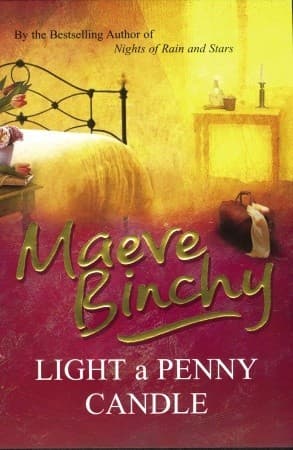
Synopsis
Covers the whole plot, including the ending.
- Difficulty
- Medium
- Pacing
- Moderate
- Mood
- Heartwarming, Melancholy, Nostalgic, Reflective
- Read it if
- You love sprawling sagas about lifelong female friendships, set against a backdrop of historical change, with rich character development and emotional depth.
- Skip it if
- You prefer fast-paced plots, minimalist writing, or stories without significant emotional drama and betrayal.
Light a Penny Candle Plot Summary
Covers the whole plot, including the ending.
Elizabeth's Evacuation to Kilgarret
In 1940, ten-year-old Elizabeth White, a quiet girl from a London family, is evacuated from the Blitz. Her mother arranges for Elizabeth to stay with the O'Connor family in the small Irish town of Kilgarret. The O'Connors, especially the outspoken Aisling, are different from Elizabeth's reserved background. Aisling, the same age as Elizabeth, immediately befriends her. Elizabeth is at first overwhelmed by the O'Connor home's chaos and warmth, but she soon adjusts to her new surroundings and Aisling's friendship.
Adapting to Irish Life and Forming a Deep Bond
Elizabeth slowly gets used to life in Kilgarret. The O'Connor family — Aisling's kind mother, Annie, her father, Frank, and her older brother, Sean — welcome Elizabeth. Elizabeth attends the local school and learns about Irish customs and the differences in their Catholic faith compared to her Anglican background. Aisling guides Elizabeth through these new experiences. Their friendship grows as they share secrets, dreams, and childhood adventures. The war, though distant, affects their lives through news and rationing, but their world is mostly about their growing bond.
Mrs. White's Return and Elizabeth's Conflict
After several years, as the war in Europe ends, Elizabeth's mother arrives in Kilgarret to take Elizabeth back to London. Elizabeth is conflicted; she loves her mother but has come to see the O'Connors as her family and Kilgarret as her home. The difference between her refined but emotionally distant mother and the warm O'Connors is clear. Despite Elizabeth's wish to stay, her mother insists on her return. The goodbye from Aisling and the O'Connors is sad for Elizabeth, marking a move from her Irish childhood back to her more formal life. Aisling and Elizabeth promise to write to each other.
Life in Post-War London
Back in London, Elizabeth finds it hard to fit into her old life. Her mother's strictness and the emotional distance at home make her miss the warmth of Kilgarret. She struggles in school and socially, feeling like an outsider among her English peers. Her only comfort is her letters from Aisling, who updates her on Kilgarret. These letters are a link, keeping their bond alive. Elizabeth often feels alone, dreaming of returning to Ireland and Aisling. She also starts to like her mother's lodger, Simon, a kind man.
Aisling's Teen Years and First Love
Meanwhile, in Kilgarret, Aisling grows into a young woman. She is popular and outgoing, enjoying the town's social life. She falls in love with Sean O'Connor, a local boy with the same last name but no relation. Their relationship is passionate but has the challenges of young love and small-town expectations. Aisling shares her romantic experiences with Elizabeth through letters, making Elizabeth feel involved despite the distance. Aisling's dreams focus on a future with Sean, and she wants to make her own way, often disagreeing with her mother's traditional views.
Elizabeth's Return and New Beginnings
Several years later, Elizabeth, now in her late teens, gets a job in Dublin and plans to visit Kilgarret. The reunion with Aisling is joyful, as if no time has passed. Elizabeth is happy to be back among the O'Connors and familiar places. She quickly re-establishes her place in Aisling's life, sharing in her friend's joys and sorrows. Elizabeth finds a sense of belonging she never had in London. She starts to form her own identity, pursuing a career and enjoying new independence, with Aisling's support.
Love, Marriage, and Growing Apart
Aisling and Sean O'Connor marry, and Aisling soon gets pregnant, becoming a wife and mother. Elizabeth, meanwhile, meets and falls in love with Michael, a charming and ambitious man. Her relationship with Michael is passionate but difficult, marked by his demanding nature and her own insecurities. The friends find their lives diverging, with Aisling settling into family life and Elizabeth navigating a complex relationship. Despite their different paths, they try to stay close, but the demands of their relationships and new responsibilities begin to strain their connection.
Betrayal and its Aftermath
The friendship faces its biggest challenge when Elizabeth discovers Michael has been having an affair with Aisling. This news devastates Elizabeth, destroying her trust in both her best friend and the man she loves. The betrayal feels complete, leaving Elizabeth in despair. Aisling, consumed by guilt, struggles to explain her actions. The bond between the two women seems broken, leaving hurt and resentment. The O'Connor family is also affected by the scandal, which impacts their community.
Separate Lives and Lingering Pain
After the betrayal, Elizabeth cuts ties with Aisling and Michael, trying to rebuild her life alone. She moves away and focuses on her career, but the emotional pain remains. She struggles with trust and loneliness, her spirit dimmed by heartbreak. Aisling also suffers greatly. Her marriage to Sean is difficult, and she lives with the constant burden of guilt and the loss of her friend. Both women live years apart, haunted by their friendship and the events that separated them, wondering if they can heal or reconcile.
A Chance Encounter and the Path to Forgiveness
Years pass, and both Elizabeth and Aisling have matured, carrying their past. A chance meeting brings them together again, making them confront the unresolved pain and anger. The first meeting is tense, but beneath the hurt, a bit of their old bond remains. Through difficult conversations and shared memories of their lives, they slowly start to understand the betrayal's complexities. The path to forgiveness is hard, requiring courage from both women, as they acknowledge their roles and how their friendship shaped their lives.
Reconciliation and Enduring Friendship
Reconciliation happens gradually, with hesitant steps and moments of both pain and understanding. Elizabeth, having found some inner peace, offers a cautious olive branch. Aisling, having lived with years of regret, is relieved and wants to rebuild their connection. They start to understand the circumstances that led to the affair, not as an excuse, but as a way to empathy. While the past cannot be changed, they find a way to move forward, recognizing their bond's irreplaceable value. Their friendship, though changed, proves it can last through even the deepest betrayals, showing its strength.
Light a Penny Candle Characters
Elizabeth White
Protagonist
Shy and reserved English girl, evacuated to Ireland, seeking belonging and identity.
Elizabeth is initially a quiet, somewhat timid girl from a refined but emotionally distant London family. Evacuated to Ireland, she finds warmth and belonging with the O'Connors, especially through her friendship with Aisling. She is intelligent and observant, but prone to insecurity and a desire for acceptance. Her experiences in Ireland shape her profoundly, giving her a sense of family she lacked. Later, she struggles with heartbreak and betrayal but ultimately finds resilience and inner strength, forging her own path in life. She values loyalty and deep connections.
Relationships: Aisling O'Connor (Best friend, surrogate sister); Mrs. White (Strict, emotionally distant mother); Michael (Boyfriend/lover who betrays her); Annie O'Connor (Surrogate mother figure); Frank O'Connor (Surrogate father figure)
Aisling O'Connor
Protagonist
Boisterous, vivacious Irish girl, Elizabeth's best friend and surrogate sister.
Aisling is Elizabeth's spirited and outgoing best friend. Growing up in the heart of the O'Connor family in Kilgarret, she is full of life, confidence, and a strong sense of loyalty. She takes Elizabeth under her wing, becoming her protector and guide. Aisling is passionate and impulsive, often driven by her emotions. She dreams of love and a fulfilling life, sometimes clashing with traditional expectations. Her impulsive nature leads her to make a devastating mistake, causing immense pain to Elizabeth and herself, but she eventually grapples with her guilt and seeks forgiveness.
Relationships: Elizabeth White (Best friend, surrogate sister); Annie O'Connor (Mother); Frank O'Connor (Father); Sean O'Connor (Husband, childhood sweetheart); Michael (Lover, cause of betrayal)
Annie O'Connor
Supporting
Aisling's kind but firm mother, Elizabeth's surrogate mother in Ireland.
Annie is the matriarch of the O'Connor family. She is a strong, practical, and deeply loving woman who takes Elizabeth into her home and heart. She embodies the warmth and generosity of Irish hospitality, providing Elizabeth with the stability and affection she lacked. Annie is a pillar of strength for her family and community, navigating the challenges of raising a family in rural Ireland with common sense and a strong moral compass. She is often the voice of reason and tradition, sometimes clashing with Aisling's more modern aspirations but always acting out of love.
Relationships: Frank O'Connor (Husband); Aisling O'Connor (Daughter); Elizabeth White (Surrogate daughter)
Frank O'Connor
Supporting
Aisling's jovial father, a warm and welcoming figure to Elizabeth.
Frank is Aisling's good-natured and easygoing father. He is a hardworking man who enjoys a pint and a good chat, embodying the friendly and communal spirit of Kilgarret. He is less strict than Annie but equally loving, providing a comforting presence in the O'Connor household. Frank quickly embraces Elizabeth as one of his own, making her feel completely at home. He represents the carefree and warm aspects of Irish life that Elizabeth comes to cherish. His affection and humor help Elizabeth adapt to her new environment.
Relationships: Annie O'Connor (Wife); Aisling O'Connor (Daughter); Elizabeth White (Surrogate daughter)
Mrs. White
Supporting
Elizabeth's refined but emotionally distant mother.
Mrs. White is Elizabeth's biological mother, a woman of traditional English gentility and strictness. She is reserved and struggles to express affection, leading to an emotionally distant relationship with Elizabeth. While she cares for Elizabeth's well-being, her inability to connect on a deeper level leaves Elizabeth feeling unloved and misunderstood. Her decision to send Elizabeth away for safety during the war, and her later insistence on Elizabeth's return, highlights her pragmatic but somewhat cold nature. She represents the structured, less expressive world Elizabeth leaves behind.
Relationships: Elizabeth White (Daughter)
Sean O'Connor
Supporting
Aisling's childhood sweetheart and eventual husband.
Sean O'Connor (no relation to Aisling's family) is Aisling's first love and later her husband. He is a kind, steady, and hardworking young man from Kilgarret. He shares a deep, passionate connection with Aisling, and their relationship forms a central part of Aisling's early adult life. Sean is committed to his family and his life in Ireland. He is deeply hurt by Aisling's betrayal but, true to his character, he tries to navigate the difficult aftermath with a sense of responsibility and loyalty to his family, even when it is painful.
Relationships: Aisling O'Connor (Wife, childhood sweetheart)
Michael
Supporting
Elizabeth's charming but ultimately treacherous boyfriend.
Michael is a charming, ambitious, and superficially attractive man with whom Elizabeth falls deeply in love. He represents a more sophisticated, modern world that appeals to Elizabeth after her sheltered upbringing. However, beneath his charismatic exterior lies a manipulative and selfish streak. His affair with Aisling is the central betrayal of the novel, causing immense pain and fracturing the core friendship. Michael is driven by self-interest and a lack of moral integrity, ultimately exposing his true character through his actions.
Relationships: Elizabeth White (Girlfriend/lover); Aisling O'Connor (Lover (in an affair))
Simon
Mentioned
Lodger in Mrs. White's London home, a kind but fleeting presence for Elizabeth.
Simon is a lodger in Mrs. White's London home during Elizabeth's post-evacuation years. He is a kind and gentle man, offering Elizabeth a rare source of warmth and understanding in her otherwise sterile home environment. Elizabeth develops a childhood crush on him, seeing him as an escape from her mother's strictness. His presence is brief but significant in highlighting Elizabeth's longing for affection and connection outside her immediate family. He subtly represents a fleeting possibility of kindness in her London life.
Relationships: Elizabeth White (Brief, innocent crush/confidant)
Light a Penny Candle Themes
The Enduring Power of Friendship
At its core, the novel explores the bond between Elizabeth and Aisling. Their friendship, formed in childhood, lasts through separation, different lives, and a betrayal. It shows how friendship can bring joy, support, and pain, yet its strength can allow for healing and reconciliation. The story often returns to their connection as the main force in their lives, showing that some bonds, once made, are lasting, even when severely tested.
“What do you mean, is it all right? Of course it is. You and me, Liz, we're like two halves of the same person. Always will be.”
Identity and Belonging
Elizabeth's journey shows her search for identity and belonging. Evacuated from her distant English home to the warm O'Connor family in Ireland, she feels a sense of 'home' and acceptance she never had. Her difficulty adjusting to London after the war shows her feeling like an outsider there, while Kilgarret is her true home. Her eventual independence and ability to forgive relate to her understanding of herself, separate from others' expectations, but always influenced by her Irish roots and her friendship with Aisling.
“She felt as if she had been born again, not just that she had come back to life, but that she had been given a new, better one. This was where she belonged.”
Betrayal and Forgiveness
The novel looks at betrayal and the difficult path to forgiveness. Michael's affair with Aisling breaks Elizabeth's trust and friendship. The story explores the immediate impact of such a betrayal, the years of pain and separation that follow, and the courage needed for both the betrayed and the betrayer to face the past. It suggests that forgiveness is not about forgetting, but about understanding, accepting, and choosing to rebuild, acknowledging the emotional scars while allowing for future connection.
“Forgiveness didn't mean forgetting, Aisling knew. It meant remembering, but without the crippling pain, without the bitterness.”
The Impact of Place and Culture
The difference between wartime London and rural Kilgarret is central to the novel. London is a more formal, reserved, and often lonely place for Elizabeth, while Kilgarret means warmth, community, and open emotion. Irish culture, with its family ties, Catholicism, and community, shapes Elizabeth's views and gives her a sense of identity. The differences in culture and social norms between England and Ireland influence the characters' development, choices, and relationships.
“In London, people kept themselves to themselves. In Kilgarret, everyone knew everyone else's business, and mostly, they cared.”
Love in its Many Forms
The book explores different kinds of love: the unconditional love of family (the O'Connors for Elizabeth), the passionate love between young sweethearts (Aisling and Sean), the deceptive love (Elizabeth and Michael), and, most importantly, the lasting love of a deep friendship. It shows how love can bring joy, but also pain, jealousy, and betrayal. The story suggests that while romantic love can be fleeting, the love in a true friendship, even after being tested, can be the most lasting.
“She had learned that love came in many forms, and not all of them were easy or gentle, but they were all, in their own way, powerful.”
Plot Devices & Literary Techniques
Dual Perspective/Alternating Focus
Narrative shifts focus between Elizabeth and Aisling's lives.
While not strictly dual-narrator, the story frequently shifts its focus between Elizabeth's experiences in London and Aisling's life in Kilgarret. This allows the reader to understand both characters' individual developments and challenges, even when they are separated. It highlights their differing cultural environments and personal growth, making their eventual reunion and the later betrayal more impactful. The alternating focus emphasizes that their lives, though separate, remain deeply interconnected through their friendship and letters.
Letters and Correspondence
Letters serve as a lifeline for Elizabeth and Aisling during their separation.
The exchange of letters between Elizabeth and Aisling is a crucial plot device, especially during their years of separation after Elizabeth returns to London. These letters are not just a means of communication; they are a physical manifestation of their enduring bond, a lifeline that keeps their friendship alive across geographical and cultural divides. They allow the reader to track the parallel developments in each girl's life, build anticipation for their reunions, and later, highlight the painful silence after their betrayal.
Coming-of-Age Narrative
The story follows the protagonists' journey from childhood to adulthood.
The novel is fundamentally a coming-of-age story for both Elizabeth and Aisling, spanning two decades of their lives. It tracks their growth from innocent children to complex adults, detailing their first loves, career choices, marriages, and the profound challenges they face. This device allows Binchy to explore themes of identity, change, and the lasting impact of childhood experiences on adult lives. The long time frame allows for significant character development and the exploration of how relationships evolve and are tested over time.
Wartime Evacuation as Catalyst
The Blitz evacuation initiates the central friendship and plot.
The historical event of the London Blitz and Elizabeth's subsequent evacuation to Ireland serves as the primary catalyst for the entire narrative. Without this event, Elizabeth and Aisling would never have met, and their profound friendship, with all its joys and sorrows, would not have formed. It immediately establishes the theme of displacement and belonging, and sets the stage for the cultural contrasts and personal transformations that define the protagonists' lives. The war provides the initial impetus for their intertwined destinies.
The Small Town Setting (Kilgarret)
Kilgarret acts as a character, shaping the lives and values of its inhabitants.
Kilgarret is more than just a backdrop; it functions almost as a character in itself. Its close-knit community, traditional values, and gossip-driven social structure profoundly influence Aisling's life and Elizabeth's development. The town provides a sense of belonging for Elizabeth and a constant source of both comfort and constraint for Aisling. The impact of the community's judgment and support is a significant factor in the characters' choices and reactions, particularly after the betrayal, highlighting the weight of reputation and interconnectedness in rural Ireland.
Light a Penny Candle Quotes
“It was impossible to stay angry with someone who was genuinely trying to be nice, even if their attempts were clumsy.”
“Life had a way of surprising you, even when you thought you knew exactly how it was going to turn out.”
“There was a certain freedom in knowing you had nothing left to lose.”
“People always wanted to believe the best of themselves, and sometimes, that meant believing the worst of others.”
“You could build a wall around your heart, but eventually, someone would find a way to climb over it.”
“The past was a strange country; they did things differently there.”
“It was a mistake to think that love was always gentle; sometimes it was fierce and demanding.”
“Sometimes the biggest adventures were not in travelling to far-off lands, but in simply surviving your own life.”
“A penny candle could light a very dark room, if you let it.”
“Friendship wasn't about being identical, but about understanding and accepting the differences.”
“The world was full of good intentions, but they often paved the way to disappointment.”
“You never truly knew someone until you saw them at their worst, and then, perhaps, at their very best.”
“Home was not just a place, but a feeling, a memory, a comfort you carried with you.”
“Some secrets were like heavy stones; they weighed you down until you finally let them go.”
Quiz
10 questions on the plot and the characters. Each answer comes with a short explanation.
Question 1
Why is Elizabeth White initially sent to Kilgarret, Ireland?
- To attend a special boarding school.
- To escape the Blitz in London.
- To visit her Irish relatives for the summer.
- Her parents were on an extended work assignment.
Show answer
B. To escape the Blitz in London. Elizabeth is evacuated from Blitz-battered London to the safety of Kilgarret, Ireland, during World War II.
Question 2
What is the primary characteristic that distinguishes Elizabeth White from the O'Connor family when she first arrives?
- Her strong religious beliefs.
- Her boisterous and outgoing personality.
- Her shy and genteel nature.
- Her advanced academic abilities.
Show answer
C. Her shy and genteel nature. The book describes Elizabeth as 'shy and genteel,' a contrast to the 'boisterous O'Connors,' highlighting her initial adjustment to their lively household.
Question 3
Who is Aisling O'Connor in relation to Elizabeth White?
- Her strict teacher at the local school.
- Her best friend and a member of the family she stays with.
- A distant cousin she meets later in life.
- The woman who employs Elizabeth in Kilgarret.
Show answer
B. Her best friend and a member of the family she stays with. Aisling O'Connor is the daughter of the family Elizabeth stays with and becomes her unshakeable best friend.
Question 4
Over what period of time does the friendship between Elizabeth and Aisling primarily unfold in the novel?
- Five years.
- Ten years.
- Twenty years.
- Their entire lives, from childhood to old age.
Show answer
C. Twenty years. The synopsis explicitly states their friendship 'will endure through twenty turbulent years.'
Question 5
What major historical event forms the backdrop for Elizabeth's initial arrival in Ireland?
- The Irish War of Independence.
- World War I.
- The Great Depression.
- World War II (specifically the London Blitz).
Show answer
D. World War II (specifically the London Blitz). Elizabeth is evacuated from 'Blitz-battered London,' which refers to the bombing of London during World War II.
Question 6
What is a central theme explored through the friendship of Elizabeth and Aisling, as suggested by the synopsis?
- The challenges of social mobility in post-war Ireland.
- The enduring power of friendship despite life's challenges and betrayals.
- The conflict between urban and rural lifestyles.
- The pursuit of political freedom in a divided nation.
Show answer
B. The enduring power of friendship despite life's challenges and betrayals. The synopsis emphasizes their 'unshakeable bond' and 'friendship that nothing could tear asunder,' even through 'turbulent years' and 'betrayals.'
Question 7
The synopsis mentions 'the man who threatened to come between them forever.' What does this detail primarily introduce as a potential conflict in the story?
- A political disagreement that divides their loyalties.
- A professional rivalry in their careers.
- A romantic entanglement involving both women.
- A criminal investigation that implicates one of them.
Show answer
C. A romantic entanglement involving both women. In many stories, 'the man who threatened to come between them' in the context of two female friends often implies a romantic rivalry or shared romantic interest, fitting the 'Romance' genre tag.
Question 8
How does Maeve Binchy's writing style contribute to the novel's appeal, according to the description?
- Through sharp, cynical observations and detached narration.
- Through minimalistic prose and ambiguous character motivations.
- Through warmth, wit, and great compassion.
- Through fast-paced action and suspenseful plot twists.
Show answer
C. Through warmth, wit, and great compassion. The description explicitly states Maeve Binchy writes 'with warmth, wit and great compassion,' which defines her characteristic style.
Question 9
What does the phrase 'soaring dreams and searing betrayals' suggest about the nature of the challenges Elizabeth and Aisling face?
- Their lives are exclusively filled with success and happiness.
- They experience both great personal achievements and deep emotional wounds.
- They are constantly involved in espionage and dangerous secrets.
- Their dreams are always realized, and betrayals are easily forgiven.
Show answer
B. They experience both great personal achievements and deep emotional wounds. This phrase indicates a wide spectrum of experiences, from the heights of hope and ambition ('soaring dreams') to the depths of disappointment and emotional pain ('searing betrayals'), making their journey complex and rich.
Question 10
The title 'Light a Penny Candle' is not directly explained in the synopsis, but given the context of a long-lasting friendship through 'joy and sorrow,' what might a 'penny candle' symbolize metaphorically in the story?
- The fleeting nature of happiness and success.
- A small, persistent hope or a quiet act of remembrance and comfort during difficult times.
- The wealth and prosperity achieved by the characters.
- A literal object used in a pivotal plot point involving a church.
Show answer
B. A small, persistent hope or a quiet act of remembrance and comfort during difficult times. A 'penny candle' is a small, inexpensive candle often lit for prayers, remembrance, or to bring a small amount of light into darkness. Given the themes of enduring friendship through 'sorrow' and 'chaos,' it likely symbolizes a modest but persistent source of hope, comfort, or a quiet act of devotion to their bond.
Light a Penny Candle FAQ
What is Light a Penny Candle about?
Light a Penny Candle follows the enduring friendship between Elizabeth White, a shy English girl evacuated to Ireland during WWII, and Aisling O'Connor, a vibrant Irish girl. Their bond forms in childhood and navigates two decades of personal growth, societal changes, family drama, and romantic entanglements, including a shared love interest that tests their loyalty.
Why should I read Light a Penny Candle?
You should read Light a Penny Candle for its rich character development, the deep exploration of female friendship across social divides, and its vivid portrayal of Irish life from the 1940s to the 1960s. Maeve Binchy masterfully combines heartwarming moments with realistic struggles, offering both comfort and compelling drama.
What is the background/setting of Light a Penny Candle?
The story begins in 1940s wartime London, where Elizabeth is evacuated from the Blitz to rural Kilgarret, Ireland. It then spans two decades, moving between Kilgarret and Dublin, depicting post-war Ireland, the burgeoning city life, and the social conservatism of the era, all against the backdrop of the two women's evolving lives.
What are the most memorable quotes?
While Binchy's strength lies more in narrative than standalone quotes, a memorable theme is often encapsulated in phrases about the unbreakable nature of true friendship, like the idea that 'some bonds are forged in fire and last a lifetime,' reflecting Elizabeth and Aisling's journey. Another recurring sentiment is the importance of home and belonging, whether found in family or chosen friendships.
What writing style does the author use?
Maeve Binchy uses a warm, empathetic, and detailed narrative style. Her writing is characterized by rich descriptions of everyday life, natural dialogue, and a keen insight into human nature, often blending humor with poignant observations. She creates a strong sense of place and time, drawing readers deeply into her characters' worlds.
What minor details add significant meaning?
The recurring motif of the 'penny candle' itself, representing hope, remembrance, and a small light in the darkness, subtly reinforces the enduring nature of Elizabeth and Aisling's bond through their darkest times. Also, the small gifts and letters exchanged between them, particularly when they are apart, underscore their constant connection.
What are some subtle foreshadowing moments?
Early on, Aisling's impulsive nature and desire for excitement, contrasted with Elizabeth's cautiousness, subtly foreshadow the differing life paths and choices they will make, particularly regarding their romantic relationships and careers. The initial, almost possessive, nature of their childhood bond also hints at the intense loyalty and potential for jealousy that will later challenge their friendship.
What unexpected character connections exist?
Beyond Elizabeth and Aisling's core bond, the unexpected connection between Elizabeth's sophisticated London relatives and Aisling's simpler Irish family, bridged by Elizabeth's letters and visits, highlights the cultural contrasts and mutual curiosity. Also, the various romantic entanglements that link secondary characters to the main pair often create surprising web of loyalties and betrayals.
What are unspoken character motivations?
Aisling's constant drive for a more exciting life and her tendency to make rash decisions are often fueled by an unspoken desire to escape the perceived limitations of her small-town upbringing and to prove her worth beyond her family's expectations. Elizabeth, on the other hand, silently yearns for a sense of belonging and family, having been displaced and feeling somewhat adrift, which motivates her loyalty and sometimes her passivity.
What psychological complexities do characters exhibit?
Aisling exhibits a complex mix of fierce loyalty and self-centered impulsiveness, often acting on emotion before reason, leading to both great generosity and significant mistakes. Elizabeth struggles with a deep-seated insecurity and a desire to please, which makes her vulnerable but also incredibly resilient. Their dynamic showcases how two very different personalities can form an unbreakable bond while constantly challenging each other's perspectives.
What are the major emotional turning points?
One major turning point is Elizabeth's initial arrival in Kilgarret, which sparks the profound friendship. Another is Aisling's move to Dublin and her pursuit of a more cosmopolitan life, which tests their geographical and emotional closeness. The most significant emotional climax occurs when the same man, Sean, comes between them, forcing both women to confront their deepest feelings of love, betrayal, and the true meaning of their friendship.
How do relationship dynamics evolve?
The relationship between Elizabeth and Aisling evolves from a childhood dependency, where Aisling is the protector and Elizabeth the grateful recipient, to a more adult equilibrium where they support each other through various life crises. It shifts from almost sisterly to a more complex adult friendship, enduring periods of estrangement, jealousy over shared loves, and eventual reconciliation, demonstrating the resilience of their bond.
Which parts remain ambiguous or open-ended?
While the core friendship finds resolution, the long-term romantic future for some characters, particularly after the central conflict involving Sean, is left somewhat open-ended. The full extent of certain characters' happiness or contentment in their final situations is implied rather than explicitly stated, allowing readers to imagine their continuing journeys.
What are controversial scenes or decisions?
A controversial decision is Aisling's choice to pursue Sean, knowing Elizabeth's feelings, which severely tests their friendship and highlights a potential breach of loyalty. Another might be some of the more conservative societal attitudes portrayed, which, while historically accurate, might spark debate among modern readers regarding character choices made under those constraints.
Light a Penny Candle ending explained: how it ends & what it means
The novel concludes with Elizabeth and Aisling having navigated the significant challenges to their friendship, particularly the romantic entanglement with Sean. While their lives have taken different paths and they've both experienced heartbreak and growth, their bond ultimately proves to be unbreakable. The ending signifies that true friendship can endure betrayal, distance, and differing life choices, ultimately finding strength in shared history and unwavering affection, reaffirming the novel's central theme of enduring female companionship.
About the author

Maeve Binchy was an Irish author known for her engaging fiction that often explores themes of friendship and community. Some of her notable works include "Tara Road," "Circle of Friends," "A Week in Winter," "Evening Class," "Nights of Rain and Stars," and "Light a Penny Candle." Her storytelling style has resonated with readers worldwide, making her a significant figure in contemporary literature.
Similar books
- Circle of Friends
Maeve Binchy
4.0 (59k) average on GoodreadsHistorical FictionExplores female friendships and coming-of-age in Ireland with similar warmth and character focus.
- Firefly Lane
Kristin Hannah
4.1 (199k) average on GoodreadsRomanceA decades-spanning story of an intense female friendship, including its challenges and betrayals.
- The Shell Seekers
Rosamunde Pilcher
4.2 (95k) average on GoodreadsHistorical FictionA multi-generational saga with a focus on family, love, and life's journey, offering a similar nostalgic feel.
- A Town Like Alice
Nevil Shute
4.1 (49k) average on GoodreadsHistorical FictionBoth 'Light a Penny Candle' and Nevil Shute's 'A Town Like Alice' (1950) feature a female protagonist enduring the hardships of WWII, but their narrative approaches differ significantly. Shute's novel is more overtly an adventure and survival story, focusing on Jean Paget's harrowing experiences as a prisoner of war in Malaya and her subsequent efforts to build a new life in Australia. Binchy's work, while set during the war, is primarily concerned with the emotional and relational impact of the conflict on domestic life and personal development. 'A Town Like Alice' offers a more direct and often brutal depiction of wartime atrocities, while 'Light a Penny Candle' explores the war's ripple effects through the lens of a close friendship and personal growth.
- To Kill a Mockingbird
Harper Lee
4.3 (4.5M) average on GoodreadsHistorical FictionIn the 1930s Jim Crow South, Harper Lee writes about racial injustice, moral growth, and the quiet courage of a lawyer father, Atticus Finch, as seen through his young daughter's eyes.
- The Great Gatsby
F. Scott Fitzgerald
3.9 (3.8M) average on GoodreadsHistorical FictionIn the opulent Roaring Twenties, a mysterious millionaire's lavish parties hide his desperate, tragic pursuit of a lost love, exposing the emptiness within the American Dream.




Enjoyed the summary?
A summary gives you the shape of the book. The book itself has the detail, the examples and the voice.
Find Light a Penny Candle on AmazonAs an Amazon Associate, BookBrief earns from qualifying purchases. How we're funded