
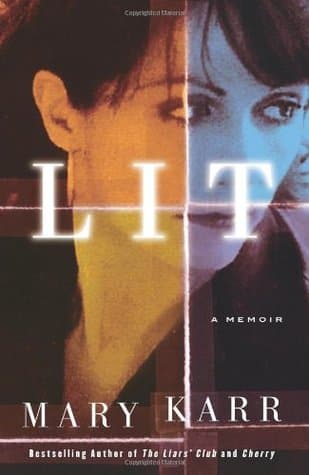
Core Idea
- Difficulty
- Medium
- Read it if
- You appreciate literary memoirs with stark honesty, dark humor, and a deep dive into the psychology of addiction, recovery, and the complexities of family and faith. Ideal for writers, mothers, and anyone grappling with their past or seeking a nuanced portrayal of spiritual awakening.
- Skip it if
- You prefer lighthearted reads, are easily unsettled by graphic descriptions of addiction and mental health struggles, or dislike memoirs that delve deeply into the author's personal spiritual journey.
Key Takeaways from Lit
The Allure and Illusion of Alcohol
Alcohol's initial promise of escape and belonging often leads to deeper isolation and self-destruction.
Karr shows alcohol as a tempting force in her life, offering temporary comfort from deep emotional pain and a chaotic upbringing. It was a false promise of confidence, creativity, and connection, but it led only to more isolation and degradation. The initial feeling of belonging and intellectual stimulation in her literary circles quickly turned into blackouts, career damage, and a slow loss of her identity and relationships. This highlights how addiction deceives, making the very thing sought for comfort the main cause of suffering, creating a cycle of dependency that hides any path to real healing.
“The bottle promised to make me witty and wise, to smooth the rough edges of my fear. It lied.”
In the book: Karr recounts numerous instances of her functional alcoholism, maintaining a teaching career and family life while secretly drinking heavily, often blacking out, and experiencing public humiliations that eventually threatened her marriage and sanity. Her description of the 'glamour' of drinking in literary circles, contrasted with the squalid reality of her hangovers and self-loathing.
Try this: Recognize the subtle ways substances can masquerade as solutions to emotional problems. Instead of reaching for external fixes, cultivate self-awareness to identify underlying pain and seek healthier coping mechanisms or professional support. Challenge the romanticized notions of addiction often perpetuated in culture.
Motherhood as a Catalyst for Reckoning
Becoming a mother forces a confrontation with one's own unresolved trauma and the desire to break generational cycles.
For Karr, her son Dev's birth was not just a happy event but a major personal shift. It broke her ability to keep up her image of control and forced her to face the effects of her own chaotic, alcoholic mother. The strong need to protect her child and create a stable home conflicted directly with her destructive habits, making her alcoholism impossible to continue. This experience became the clear reason for her to get sober, not just for herself, but to stop passing on her trauma to the next generation. Motherhood acted as a mirror, showing the harm she was causing and sparking a strong desire to heal.
“Having a child ripped the lid off my own childhood, forcing me to confront the wreckage I’d been trying to outrun.”
In the book: Her visceral fear of harming Dev, either physically or emotionally, while drunk. The stark contrast between her desire to be a good mother and her inability to stop drinking. The moment she realizes she has to get sober to truly protect her son, leading her to AA.
Try this: For parents, recognize how your own past influences your parenting. Seek support to address unresolved trauma to create a healthier environment for your children. For anyone, consider how significant life changes can serve as powerful motivators for personal growth and breaking negative patterns.
The Unflinching Honesty of Memoir
True memoir requires brutal self-examination, revealing both the ugly and the beautiful truths of one's past.
Karr, a skilled memoirist, shows that the power of memoir comes from its willingness to expose the raw, often unglamorous truth of human experience. She does not hide her failures, her cruel moments, her deep insecurities, or her family's complex problems. This commitment to honesty is what makes her work more than just an autobiography; it turns a personal story into a universal truth. It is a painful process, like digging deep into one's spirit, where self-deception must be removed to reveal the true self. This honest look, even at the most shameful parts of her past, gives her story its strong authenticity and impact.
“The truth is a kind of surgery, and sometimes it cuts deep.”
In the book: Karr's detailed descriptions of her drunken episodes, her harsh judgments of others, her struggles with self-pity, and her initial resistance to admitting the severity of her alcoholism. Her willingness to portray her parents and herself with all their flaws, not just their redeeming qualities.
Try this: Practice radical self-honesty in your own life. Reflect on your past actions and motivations, acknowledging both your strengths and weaknesses without judgment. This self-awareness is crucial for personal growth and fostering genuine connections with others.
Spirituality Beyond Dogma
Finding a 'higher power' can be a pragmatic necessity for recovery, independent of traditional religious beliefs.
Karr, who was an atheist, struggled with the spiritual part of AA. Her journey shows that 'God' or a 'higher power' in recovery does not require following a specific religion. Instead, it means giving in to something greater than oneself—whether it is the shared wisdom of the AA group, the power of connection, or recognizing one's own limits. Her eventual acceptance of a more flexible, personal understanding of spirituality was not an intellectual change but a practical need for survival. It shows that true faith can come from desperation and a willingness to accept help, even when belief seems impossible.
“I didn't believe in God, but I believed in the collective strength of these drunks who had found a way out.”
In the book: Her detailed accounts of resisting the 'God stuff' in AA, her arguments with sponsors, and her eventual, reluctant acceptance of a 'higher power' as simply 'not me.' The stories of how connecting with other alcoholics and following the steps, rather than intellectualizing them, led to her sobriety.
Try this: If struggling with addiction or overwhelming life challenges, be open to unconventional forms of support or spirituality. Focus on the practical benefits of surrendering control and connecting with a supportive community, even if the language or concepts feel unfamiliar.
The Power of Narrative and Witnessing
Sharing one's story and being heard are fundamental to healing and finding community.
A central idea in 'Lit' is the transforming power of telling stories, both in writing her memoirs and in AA. Karr finds deep healing in talking about her experiences, not just to herself, but to a community that understands her pain. In AA meetings, sharing one's 'drunk-a-log' and listening to others' stories creates a strong sense of belonging and reduces the isolating shame of addiction. This mutual sharing breaks down isolation, builds empathy, and shows that personal suffering, when shared, can become a source of collective strength and wisdom. It highlights that people are naturally storytellers and story-sharers.
“In AA, you tell your story and others nod. You're not alone. That's a kind of magic.”
In the book: The vivid descriptions of AA meetings, the structure of sharing, and the sense of camaraderie and understanding she found there. Her own process of writing 'Lit' and previous memoirs as a way to process and make sense of her past.
Try this: Seek out communities where you can share your experiences and feel heard, whether it's a support group, a trusted friend, or a therapeutic setting. Practice active listening when others share their stories, offering empathy and validation rather than judgment or unsolicited advice.
Sobriety as a Continual Act of Will
Recovery is not a destination but a daily, conscious choice requiring vigilance and humility.
Karr's journey emphasizes that getting sober is just the start; staying sober is a lifelong commitment. She dispels the idea that sobriety instantly solves all problems, instead showing it as a foundation on which one must rebuild a life. This requires constant watchfulness, a willingness to reflect on oneself uncomfortably, and a consistent return to AA principles. Her story shows that there are no 'graduates' from recovery; it is a daily negotiation with oneself, a series of choices to pick health over addiction, connection over isolation, and truth over self-deception. It speaks to the lasting human ability to recover.
“Sobriety wasn't a magic cure-all, but it was the ground on which everything else could grow.”
In the book: Her continued attendance at AA meetings even after years of sobriety, her ongoing work with sponsors, and her candid discussions about moments of temptation or emotional struggle where she could have relapsed.
Try this: Understand that significant personal change is a process, not an event. Cultivate daily practices that support your well-being, whether it's mindfulness, exercise, journaling, or connecting with supportive individuals. Be prepared for setbacks and learn to recommit to your goals with humility.
The Literary Life's Double-Edged Sword
The intellectual and creative freedom of the literary world can both inspire and enable destructive behavior.
Karr's experiences in academia and the literary world show a common cultural belief: that artistic talent is linked to self-destruction, especially alcoholism. This romanticized view of the 'tortured artist' gave Karr an easy reason for her drinking, allowing her to see her addiction as normal and even valuable within her professional circles. While these settings offered intellectual stimulation and validation for her writing, they also unintentionally allowed her to fall into severe alcoholism. This point examines how certain cultural environments, despite their creative benefits, can encourage dangerous behaviors by blurring the lines between oddity and illness.
“The poets drank like fish, and it was considered part of the genius. I bought into that lie.”
In the book: Her anecdotes of literary parties and workshops where heavy drinking was not only common but almost expected among writers and poets. The way she and her peers used alcohol to fuel creativity or numb the anxieties of intellectual life.
Try this: Critically examine cultural narratives that romanticize self-destructive behaviors, especially in creative fields. Seek out communities that foster healthy habits and provide genuine support, rather than those that enable or glorify unhealthy coping mechanisms.
Reconciling with the Past, Not Erasing It
Healing involves integrating one's painful history rather than attempting to forget or deny it.
A key insight from Karr's memoir is that true healing is not about escaping or forgetting a difficult past, but about learning to live with it, integrate it, and find meaning within its scars. Her sobriety does not magically erase her childhood wounds or the effects of her alcoholism, but it gives her the tools to process them. This process involves acknowledging the pain, forgiving herself and others (as much as possible), and using her experiences to shape her present and future. It rejects simple ideas of 'moving on' and instead supports a more complex understanding of recovery and growth through acceptance.
“You don't get over a past like mine; you learn to carry it.”
In the book: Karr's continued exploration of her childhood in 'Lit,' building upon her previous memoirs. Her ongoing reflections on her relationships with her parents and her own struggles, showing that these issues are not 'solved' but continually worked through.
Try this: Instead of trying to suppress or ignore painful memories, practice mindfulness and acceptance. Consider how past experiences have shaped you and how you can integrate those lessons into your present identity. Seek therapy or journaling to process trauma in a healthy way.
The Transformative Power of Storytelling
Writing one's own story is a profound act of reclaiming agency and constructing meaning from chaos.
Beyond just recounting events, Karr's act of writing 'Lit' (and her other memoirs) is itself a way to heal. By giving structure to the fragmented, often traumatic memories of her life, she turns raw experience into art and, in doing so, regains control over her past. Storytelling allows her to understand cause and effect, find patterns, and give meaning to her suffering. It speaks to the human need to make sense of existence through narrative, turning personal chaos into a shared, understandable human experience. This act of creation is not just about sharing but about self-discovery and self-authorship.
“To make a story out of my life was to make it mine, to bring order to the chaos.”
In the book: The very existence of 'Lit' as a meticulously crafted memoir, where Karr actively shapes her experiences into a compelling narrative. Her reflections on the process of writing and the insights gained from it.
Try this: Consider journaling or writing your own life story, even if only for yourself. The act of organizing thoughts and memories into a narrative can provide clarity, foster self-understanding, and help process complex emotions.
Lit Quotes
“The past is a country you can't go home to, but you can visit it in your mind.”
“Sobriety is a spiritual path, not a destination.”
“You don't get over it. You just get through it. You don't get by it. You get with it.”
“Writing is a way of wrestling with the angels, of trying to make sense of the senseless.”
“Truth is a funny thing. It can hurt like hell, but it's the only thing that sets you free.”
“Love is not enough, but it's a hell of a start.”
“The hardest part of getting sober was learning to live in my own skin without a chemical buffer.”
“God, as I understand Him, is not a man in the sky, but a force of good that operates in the world.”
“Memoir is not about what happened, but about what it felt like.”
“My mother was a force of nature, beautiful and terrifying.”
“The only way out is through, and the only way through is with help.”
“Humor is a way of surviving, a way of making the unbearable bearable.”
“There's a kind of grace that comes from hitting bottom, a clarity that can only be found in desperation.”
“To tell your story is to own it, and to own it is to begin to heal.”
Quiz
10 questions on the main ideas. Each answer comes with a short explanation.
Question 1
What is the primary addiction Mary Karr struggles with throughout much of 'Lit'?
- Opioid addiction
- Alcoholism
- Gambling addiction
- Food addiction
Show answer
B. Alcoholism 'Lit' extensively details Mary Karr's battle with alcoholism and her journey to sobriety.
Question 2
Which of the following best describes Mary Karr's relationship with her mother in 'Lit'?
- Consistently supportive and stable
- Distant and emotionally detached
- Volatile, complex, and deeply influential
- Primarily absent from her adult life
Show answer
C. Volatile, complex, and deeply influential The memoir explores the tumultuous and often painful relationship Karr had with her mother, which significantly shaped her life and struggles.
Question 3
What religious tradition does Mary Karr eventually embrace as part of her journey to sobriety in 'Lit'?
- Buddhism
- Judaism
- Catholicism
- Protestantism
Show answer
C. Catholicism A significant part of Karr's sobriety and personal growth in 'Lit' involves her conversion to and embrace of Catholicism.
Question 4
What role does writing play in Mary Karr's recovery and self-understanding in 'Lit'?
- It is a distraction that often hinders her progress.
- It serves as a therapeutic tool for processing her past and finding meaning.
- It is primarily a source of financial stress.
- It is unrelated to her personal struggles.
Show answer
B. It serves as a therapeutic tool for processing her past and finding meaning. The book explicitly links Karr's learning to write with her learning to live, highlighting writing as a crucial element in her journey of self-discovery and healing.
Question 5
How does Mary Karr's experience of motherhood intersect with her sobriety journey in 'Lit'?
- Motherhood immediately cured her desire to drink.
- The responsibilities of motherhood added to her drinking problem.
- Becoming a mother provided a powerful impetus for her to get sober and re-evaluate her life.
- Her child's upbringing was largely unaffected by her addiction or recovery.
Show answer
C. Becoming a mother provided a powerful impetus for her to get sober and re-evaluate her life. A central theme of 'Lit' is 'becoming a mother by letting go of a mother,' and Karr often cites her son's well-being as a primary motivator for her sobriety.
Question 6
Which of the following literary devices is most characteristic of Mary Karr's writing style in 'Lit'?
- Highly formal, academic language with minimal personal reflection.
- Sparse, minimalist prose focused solely on external events.
- Vivid, visceral imagery, dark humor, and unflinching honesty.
- Flowery, romantic descriptions and idealized portrayals of characters.
Show answer
C. Vivid, visceral imagery, dark humor, and unflinching honesty. Karr is renowned for her distinctive voice, which employs raw honesty, sharp wit, and striking imagery to convey her experiences.
Question 7
What specific challenge does Mary Karr face regarding her identity as a writer while navigating sobriety and faith?
- Finding new subjects to write about after leaving her old lifestyle.
- Reconciling her artistic persona, which often thrived on chaos, with the stability of recovery and religious belief.
- Overcoming writer's block caused by her new spiritual practices.
- Dealing with criticism from the literary community for her choice of subject matter.
Show answer
B. Reconciling her artistic persona, which often thrived on chaos, with the stability of recovery and religious belief. Karr explores the tension between her identity as an artist, often associated with rebellion and suffering, and the structured, humble path of sobriety and faith, questioning if she can still be a 'good' writer without the 'bad' life.
Question 8
How does 'Lit' challenge common perceptions of addiction and recovery?
- By presenting recovery as a linear, straightforward process devoid of setbacks.
- By emphasizing that addiction is purely a moral failing, not a disease.
- By illustrating the messiness, spiritual dimensions, and ongoing struggle inherent in achieving and maintaining sobriety.
- By suggesting that professional therapy alone is sufficient for recovery without spiritual growth.
Show answer
C. By illustrating the messiness, spiritual dimensions, and ongoing struggle inherent in achieving and maintaining sobriety. Karr's memoir deeply personalizes the recovery process, showing its difficult, often non-linear nature, and the critical role of spiritual and community support, rather than a simplistic view.
Question 9
What specific aspect of the Alcoholics Anonymous program does Karr initially struggle with but eventually embraces?
- The requirement to attend meetings daily.
- The concept of a Higher Power and surrendering control.
- The anonymity principle.
- The practice of sharing personal stories.
Show answer
B. The concept of a Higher Power and surrendering control. A significant internal conflict for Karr, particularly given her intellectual and skeptical nature, is her resistance to and eventual acceptance of the spiritual component of AA, specifically the idea of a Higher Power.
Question 10
In what way does 'Lit' serve as a continuation and evolution of themes from Karr's previous memoirs, 'The Liars' Club' and 'Cherry'?
- It completely abandons the focus on family dynamics.
- It revisits her childhood traumas but offers a path towards healing and breaking cycles, particularly through motherhood and sobriety.
- It focuses exclusively on her professional writing career, separate from personal life.
- It portrays a completely different set of characters and settings.
Show answer
B. It revisits her childhood traumas but offers a path towards healing and breaking cycles, particularly through motherhood and sobriety. 'Lit' builds upon the foundation of her earlier memoirs by exploring how the chaotic upbringing detailed previously led to her adult struggles, and how she ultimately sought to heal those wounds and create a better life for herself and her son, thereby breaking intergenerational cycles.
Lit FAQ
What is 'Lit' by Mary Karr about?
'Lit' is Mary Karr's memoir detailing her journey through alcoholism, her path to sobriety, and the complex process of becoming a mother while simultaneously confronting her own difficult relationship with her mother. It explores themes of addiction, recovery, family dynamics, and the intersection of life and art.
Does 'Lit' delve into the process of creative writing?
Yes, 'Lit' intricately explores how Karr's personal struggles and eventual sobriety profoundly influenced her development as a writer. It examines how learning to live and confront her past became integral to her ability to create compelling literary work, offering insights into the craft of memoir.
What makes 'Lit' different from other addiction memoirs?
'Lit' stands out due to Mary Karr's distinctive literary voice, her raw honesty, and the poetic quality she brings to her painful experiences. Unlike many addiction narratives, it deeply interweaves the personal story of recovery with the artistic process and complex family relationships, elevating it to high art.
Is 'Lit' a standalone book, or part of a series?
'Lit' is the third installment in Mary Karr's acclaimed memoir trilogy, following 'The Liars' Club' and 'Cherry.' While it can be read independently, it offers a deeper understanding of Karr's life and evolution when read in sequence with her previous works.
Does 'Lit' offer insights into overcoming personal trauma?
Absolutely. 'Lit' powerfully illustrates Karr's struggle with and eventual triumph over her personal demons, including alcoholism and the lingering effects of a challenging childhood. Her journey provides a compelling narrative of resilience, self-discovery, and the arduous path to healing.
What is Mary Karr's writing style like in 'Lit'?
Mary Karr's writing in 'Lit' is characterized by its vivid imagery, unflinching honesty, dark humor, and poetic lyricism. She possesses a unique ability to render painful experiences with both brutal candor and profound beauty, making her prose deeply engaging and memorable.
How does 'Lit' explore the theme of motherhood?
'Lit' delves into Karr's complex journey of motherhood, portraying her struggles to be a present and loving parent amidst her addiction and recovery. It explores the challenges of breaking generational cycles and finding her own identity as a mother while grappling with her own mother's influence.
Is 'Lit' suitable for readers interested in psychology or self-help?
While 'Lit' is primarily a memoir, its deep exploration of addiction, recovery, family dynamics, and personal growth offers significant psychological insights. Readers interested in the human psyche, resilience, and the process of healing may find it profoundly resonant and thought-provoking.
About the author

Mary Karr is an American author known for her memoirs and poetry. Her notable work, "Lit," explores her struggles with addiction and the complexities of faith. Karr has received several awards for her writing, including the Pushcart Prize and the Whiting Award.
Similar books
- The Glass Castle
Jeannette Walls
4.3 (903k) average on GoodreadsBiographyExplores a challenging childhood and complex family dynamics with resilience and a distinctive voice.
- Dry
Augusten Burroughs
4.0 (22k) average on GoodreadsScience FictionBurroughs' Dry shares Karr's dark humor and candidness about addiction and early sobriety. However, Burroughs' narrative leans heavily into the absurd and comedic aspects of his experiences, and while deeply personal, it does not delve into the profound spiritual or religious transformation that is central to Karr's journey in Lit.
- The Perks of Being a Wallflower
Stephen Chbosky
4.2 (1.3M) average on GoodreadsPsychologyThrough letters, a shy high school freshman learns to navigate first love, trauma, and self-discovery, stepping off the sidelines and into life.
- Eleanor Oliphant Is Completely Fine
Gail Honeyman
4.3 (708k) average on GoodreadsLiterary FictionA lonely woman's structured life changes when an IT guy and an elderly man help her learn to open her heart.
- One Flew Over the Cuckoo's Nest
Ken Kesey
4.2 (631k) average on GoodreadsPsychologyIn a mind-bending asylum, the boisterous Randle McMurphy wages a defiant war against the tyrannical Nurse Ratched, inspiring his fellow inmates, including the seemingly catatonic Chief Bromden, to reclaim their lost humanity.
- The Bell Jar
Sylvia Plath
4.0 (591k) average on GoodreadsPsychologyIn the suffocating grip of 1950s expectations, a brilliant young woman's descent into mental illness is painted with such vivid, internal clarity that her 'insanity' feels terrifyingly rational and inevitable.





Enjoyed the summary?
A summary gives you the shape of the book. The book itself has the detail, the examples and the voice.
Find Lit on AmazonAs an Amazon Associate, BookBrief earns from qualifying purchases. How we're funded