
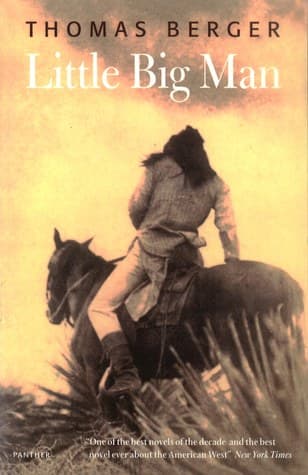
Synopsis
Covers the whole plot, including the ending.
- Difficulty
- Medium
- Pacing
- Moderate
- Mood
- Satirical, Adventurous, Wry, Melancholy
- Read it if
- You enjoy epic historical fiction with a picaresque structure, a cynical and humorous narrator, and a unique perspective on the American Old West, blending fact and fiction.
- Skip it if
- You prefer straightforward historical accounts without a strong satirical tone or a highly unreliable narrator.
Little Big Man Plot Summary
Covers the whole plot, including the ending.
Orphaned and Adopted by the Cheyenne
The narrative begins with Jack Crabb, a 111-year-old man, telling his life story to a historian. Crabb starts by describing how, at age ten, he and his older sister, Caroline, were traveling west with their parents when their wagon train was attacked by Pawnee Indians. Their parents were killed, and the siblings were taken captive. Soon after, a Cheyenne war party attacked the Pawnee camp, rescuing (or re-capturing) Jack and Caroline. While Caroline quickly escapes back to white society, Jack is adopted by the Cheyenne holy man, Old Lodge Skins, who names him 'Little Big Man' due to his small stature but brave demeanor. Jack is raised among the Cheyenne, learning their language, customs, and way of life, becoming one of them.
Life Among the Human Beings
Under Old Lodge Skins' guidance, Jack grows up as a Cheyenne. He learns to hunt, ride, and fight, embracing the tribe's communal lifestyle and spiritual beliefs. He experiences the joys of tribal life, including the hunt and ceremonies, but also sees the harsh realities of inter-tribal warfare and the encroaching presence of white settlers. He develops a deep respect for Old Lodge Skins and the Cheyenne people, considering them his true family. During this period, he marries his first wife, Sunshine, and tries to live a traditional life, often struggling with the cultural differences and his own 'whiteness' that occasionally surfaces, such as his dislike of eating dog meat.
Forced Return to White Society
After several years living as a Cheyenne, Jack's life takes another turn. During a skirmish with white soldiers, he is captured and forcibly returned to white society. This is a traumatic experience for him, as he struggles to re-adapt to the customs, language, and values of the 'white man.' He is placed with various white families, often feeling like a misfit. He meets a series of colorful and often morally ambiguous characters, including a minister and his wife, Mrs. Pendrake, who tries to 'civilize' him and, eventually, seduce him. Jack's experiences in white society are marked by a sense of alienation and a longing for his Cheyenne family.
A String of White Professions
Jack's attempts to integrate into white society lead him through a series of different and often comical professions. He tries being a store clerk, a mule skinner, a gambler, and even a con artist. During these adventures, he meets several figures of the American West. He works for Wild Bill Hickok, seeing his skill and eccentricities, and later meets Wyatt Earp. He observes the lawlessness and opportunism in frontier towns, often finding himself in difficult situations due to his naivety or his attempts to navigate the deceptive nature of white society. Despite his efforts, he never truly feels at home.
Reunion with the Cheyenne and Tragic Loss
Driven by a strong yearning, Jack eventually makes his way back to his adopted Cheyenne family. He is joyfully reunited with Old Lodge Skins and Sunshine. However, their reunion is short-lived and interrupted by the escalating conflict between settlers and Native Americans. Jack is present during the Sand Creek Massacre, where Colonel Chivington's troops brutally attack a peaceful Cheyenne village, killing women, children, and the elderly. Sunshine is among the victims, a loss that deeply traumatizes Jack and strengthens his contempt for the savagery of white expansion.
Seeking Revenge and Becoming a Hermit
Following the Sand Creek Massacre, Jack, consumed by grief and rage, vows to seek revenge against the white soldiers responsible, particularly focusing on General George Armstrong Custer. He tries to assassinate Custer several times, but his efforts are either thwarted by circumstance or his own moral hesitations. His bitterness against white society intensifies. Eventually, disillusioned with both white and Native American ways, and unable to find peace, Jack retreats to live as a hermit, shunning both worlds and living a solitary existence in the wilderness, further showing his 'between worlds' identity.
Rejoining Custer's Command
In a bizarre twist, Jack eventually finds himself serving as a scout for General George Armstrong Custer and the 7th Cavalry. Despite his previous attempts to kill Custer and his deep-seated animosity towards him, Jack's circumstances lead him to this position. He observes Custer's arrogance, vanity, and strategic blunders firsthand, often providing Custer with accurate assessments of the Native American forces that are largely ignored. This period allows Jack to gain an intimate understanding of Custer's character and the military mindset, while also giving him a unique view on the impending clash.
The Battle of Little Bighorn
Jack is present at the Battle of Little Bighorn, often called 'Custer's Last Stand.' He tries to warn Custer of the overwhelming numbers of the combined Lakota and Cheyenne forces, but Custer dismisses his advice. Jack witnesses the battle unfold from multiple perspectives, moving between the white soldiers and his adopted Cheyenne kin. He sees the bravery and desperation on both sides. Ultimately, he witnesses the annihilation of Custer's command, a devastating victory for the Native Americans, but one that he understands will only hasten their ultimate defeat and the end of their way of life. He watches Old Lodge Skins accept his fate and prepare for death.
Old Lodge Skins' Final Journey
After the victory at Little Bighorn, Old Lodge Skins, recognizing the inevitable demise of the Cheyenne way of life, decides it is time to 'go to the other side.' He starts a spiritual journey to die with dignity, and Jack, his adopted son, accompanies him. This journey is a moment of shared understanding and farewell. Old Lodge Skins imparts his final wisdom to Jack, affirming their bond and the cyclical nature of life and death. Jack helps him find a peaceful place to die, and witnesses his adopted father's serene passing, a poignant end to a generation and a way of life.
A Life Lived Between Worlds
In the concluding sections, Jack Crabb thinks about his long and complex life, marked by his unique position straddling two different cultures. He acknowledges the irony of his survival and the fact that he outlived almost everyone he knew. He grapples with the conflicting loyalties and identities he carried throughout his life – a white man raised as a Cheyenne, never fully belonging to either world but shaped by both. His narrative concludes with a sense of resignation, wisdom, and a touch of the same dry humor that characterized his entire story, leaving the historian and the reader to think about the true nature of his experiences and the myth of the American West.
Principal Figures
Jack Crabb
Protagonist
A 111-year-old white man raised by Cheyenne, navigating two conflicting cultures.
Jack Crabb is the central figure and unreliable narrator of the novel, recounting his life story at the age of 111. Orphaned and adopted by the Cheyenne, he lives a life constantly shuttling between white and Native American societies. He is observant, adaptable, and possesses a dry, cynical wit. Despite his frequent misadventures and brushes with famous historical figures, he remains an ordinary man caught in extraordinary circumstances. He develops a deep love and respect for his Cheyenne family, particularly Old Lodge Skins, and carries a profound sense of alienation from both worlds. He struggles with his identity, never fully belonging to either culture.
Relationships: Old Lodge Skins (Adopted son and spiritual protégé); Sunshine (First wife, beloved and tragically lost); General George Armstrong Custer (Enemy, employer, and object of both hatred and fascination); Mrs. Pendrake (Brief guardian and seductress)
Old Lodge Skins
Supporting
Jack's wise, spiritual Cheyenne adoptive grandfather and holy man.
Old Lodge Skins is a Cheyenne holy man and Jack Crabb's adoptive grandfather. He embodies the wisdom, spiritual depth, and traditional values of the Cheyenne people. He is patient, philosophical, and possesses a profound understanding of life, death, and the natural world. He teaches Jack the Cheyenne ways and offers guidance throughout his life, becoming Jack's moral compass. Despite the encroaching white world, he maintains his dignity and traditions, eventually choosing a dignified death when he perceives the end of his people's way of life. He represents the fading era of Native American culture.
Relationships: Jack Crabb (Adoptive grandfather and spiritual mentor)
General George Armstrong Custer
Antagonist/Supporting
The arrogant and self-aggrandizing U.S. Cavalry General.
General George Armstrong Custer is depicted as an arrogant, vain, and often delusional military leader. He is obsessed with glory and fame, frequently ignoring sound advice and underestimating his Native American adversaries. Jack Crabb serves as his scout at one point, providing a unique, critical perspective on Custer's character and leadership. Custer represents the destructive force of American expansionism and the military's often brutal approach to Native American relations. His hubris ultimately leads to his downfall at the Battle of Little Bighorn.
Relationships: Jack Crabb (Commander and scout, object of Jack's hatred and later employment)
Sunshine
Supporting
Jack's first and beloved Cheyenne wife.
Sunshine is Jack Crabb's first wife among the Cheyenne. She is portrayed as a loving, gentle, and traditional Cheyenne woman. She represents the domestic tranquility and personal happiness Jack finds within the Cheyenne tribe. Her relationship with Jack is one of deep affection and understanding, and her presence anchors him in the Cheyenne world. Her tragic death during the Sand Creek Massacre profoundly impacts Jack, intensifying his hatred for the white soldiers and serving as a symbol of the innocent lives lost in the conflict.
Relationships: Jack Crabb (First wife and deeply loved companion)
Wild Bill Hickok
Supporting
A legendary gunslinger and gambler Jack encounters.
Wild Bill Hickok is presented as a complex figure – a skilled gunslinger, gambler, and lawman, but also a showman and a man prone to melancholy. Jack Crabb works for him briefly, witnessing his legendary quick draw and his often-melancholy demeanor. Hickok embodies a certain romanticized, yet ultimately dangerous, aspect of the Wild West. He is a man of codes and contradictions, representing the individualistic and violent nature of frontier life, but also possessing a certain charisma that draws Jack to him.
Relationships: Jack Crabb (Brief employer and acquaintance)
Mrs. Pendrake
Supporting
The lusty, hypocritical minister's wife who attempts to 'civilize' Jack.
Mrs. Pendrake is the wife of a minister who takes Jack in after his return to white society. She is a highly hypocritical character, outwardly pious but secretly lustful and manipulative. She attempts to 'civilize' Jack, teaching him white customs and English, but her true intentions are revealed to be more carnal. She represents the moral hypocrisy and often misguided attempts of white society to impose its values on Native Americans, often under the guise of benevolence. Her character provides moments of dark comedy and highlights the cultural clashes Jack experiences.
Relationships: Jack Crabb (Guardian and seductress)
Caroline Crabb
Supporting
Jack's older sister, who quickly re-assimilates into white society.
Caroline Crabb is Jack's older sister, who is captured alongside him by the Pawnee. Unlike Jack, she quickly escapes her Native American captors and returns to white society, where she later becomes a prostitute. Her rapid and complete re-assimilation contrasts sharply with Jack's prolonged struggle and his deep connection to the Cheyenne. She represents the path Jack could have taken, highlighting his unique journey and the profound impact of his Cheyenne upbringing. Her brief appearances underscore the different ways individuals responded to the frontier's challenges.
Relationships: Jack Crabb (Sister)
The Historian
Mentioned
The unnamed interviewer recording Jack Crabb's story.
The Historian is the unseen and unnamed individual to whom Jack Crabb dictates his life story. He serves as the framing device for the entire novel, prompting Jack's recollections and occasionally interjecting with skeptical or clarifying questions (usually as footnotes). He represents the academic desire to document history, but his limited understanding of Jack's experiences underscores the difficulty of truly capturing the nuances of the past, especially from a perspective outside the mainstream. He is largely a silent presence, allowing Jack's voice to dominate.
Relationships: Jack Crabb (Interviewer and subject)
Themes & Insights
Identity and Belonging
The novel explores Jack Crabb's struggle with identity, as he is a white man raised by Cheyenne. He constantly feels like an outsider in both worlds, never fully belonging to either. This theme is clear in his attempts to adapt to white society after being captured, only to feel alienated, and his occasional 'whiteness' that surfaces even among the Cheyenne. His journey is a lifelong quest to reconcile these two conflicting aspects of himself, culminating in a unique, hybrid identity that allows him to critique both cultures. His name, 'Little Big Man,' itself symbolizes this dual nature.
“I am a white man and never forget it, but I was brought up by the Cheyenne Indians from the age of ten.”
The Myth vs. Reality of the American West
Berger deconstructs the romanticized myths of the American West by presenting a gritty, often unheroic, and morally ambiguous reality. Through Jack Crabb's eyes, figures like Wild Bill Hickok and General Custer are stripped of their heroic facades, revealed as flawed, complex, or even foolish men. The narrative challenges the black-and-white portrayal of 'cowboys and Indians,' showing the brutality and hypocrisy of white expansion, the humanity of Native Americans, and the often mundane or absurd aspects of frontier life. The West is portrayed not as a land of opportunity for all, but a place of violence, displacement, and cultural collision.
“It was just like the white man to make a big thing out of a little thing.”
Cultural Clash and Assimilation
The conflict of the novel is the clash between white American culture and Native American (Cheyenne) culture. Jack Crabb is the ultimate bridge between these two worlds, experiencing firsthand the differences in values, spirituality, social structures, and worldview. The novel shows the destructive impact of white expansion on Native American ways of life, particularly through events like the Sand Creek Massacre. It also examines the difficulties and often futility of forced assimilation, as Jack struggles to adapt to white society while retaining his Cheyenne upbringing, and vice versa. The inability of the two cultures to coexist peacefully is a central tragedy.
“The white man was a strange animal, with a short memory for good things and a long one for bad.”
Survival and Adaptability
Jack Crabb's long life and his ability to survive countless perilous situations show the theme of survival. He adapts to different environments and social structures, from the communal life of the Cheyenne to the cutthroat world of white frontier towns. His survival is less about heroic strength and more about cunning, observation, and a certain resilient quality. He endures massacres, battles, and personal tragedies, always finding a way to persist, even if it means living a life of quiet anonymity. His adaptability is key to his long life, but it also shows his constant displacement.
“I was a survivor, that was my main talent.”
Plot Devices & Literary Techniques
Unreliable Narrator
Jack Crabb's advanced age and selective memory shape the narrative.
Jack Crabb, at 111 years old, is an unreliable narrator. His extreme age, coupled with a tendency towards exaggeration, self-deprecation, and a highly subjective perspective, means that the reader must constantly question the absolute veracity of his tales. This device allows Berger to comment on the nature of history and memory, suggesting that 'truth' is often subjective and shaped by individual experience. It also adds humor and allows for a playful subversion of historical facts and legendary figures, making the reader active in discerning what might be 'true' within the fictional framework.
Picaresque Structure
A series of episodic adventures as Jack wanders through the American West.
The novel employs a picaresque structure, following Jack Crabb, a 'picaro' (rogue/wanderer), through a series of loosely connected adventures. Jack moves from one situation to another, encountering a diverse cast of characters and experiencing various aspects of frontier life without a singular, overarching goal beyond survival. This episodic nature allows Berger to explore different facets of the American West and to introduce a wide array of historical figures and cultural critiques. It also emphasizes Jack's transient nature and his inability to settle permanently in either white or Native American society.
Satire and Irony
Humorous critique of historical figures, societal norms, and cultural assumptions.
Berger heavily uses satire and irony to critique the romanticized notions of the American West, the arrogance of white expansion, and the often absurd behaviors of both cultures. Jack Crabb's dry wit and detached observations highlight the hypocrisy of figures like Mrs. Pendrake and the vanity of Custer. The irony often stems from Jack's unique perspective as an 'insider-outsider,' allowing him to see the follies and contradictions of both white and Native American societies. This device adds a layer of dark humor to the often tragic events of the story, preventing it from becoming overly sentimental.
Framing Device
The historian's interview frames Jack Crabb's dictated memoirs.
The entire narrative is framed as Jack Crabb dictating his memoirs to an unnamed historian. The historian's interjections, often presented as footnotes, serve to ground Jack's fantastical tales in a semblance of historical inquiry, while also highlighting the historian's own limited understanding and occasional skepticism. This device allows for a meta-commentary on the writing of history itself and the challenges of accurately recording subjective experiences. It provides an external, 'objective' counterpoint to Jack's highly personal and often embellished narrative, drawing attention to the tension between lived experience and historical record.
Little Big Man Quotes
“I am a white man and never forget it, but I am also a Cheyenne, and that is something I will never forget either.”
“The only good Indian is a dead Indian.”
“I seen things that would make your hair stand on end, and I done things I ain't particularly proud of.”
“Life is a series of surprises, and would not be worth taking or keeping if it were not.”
“The Cheyenne way is to live with the earth, not against it.”
“I have been called a liar so many times I have come to believe it myself.”
“There is no such thing as a hero; there are only men who do what they must.”
“The white man's god is a god of wrath, but the Cheyenne's gods are in everything around us.”
“I have outlived all my enemies and most of my friends, which is a kind of victory, I suppose.”
“History is written by the winners, but I was there, and I tell you it wasn't like that.”
“A man's life is what he makes of it, and I made mine a damn interesting one.”
“The West wasn't won with guns; it was stolen with paper and promises.”
“I have seen the end of an era, and it wasn't pretty.”
“Sometimes the only way to stay sane is to laugh at the madness.”
Quiz
10 questions on the plot and the characters. Each answer comes with a short explanation.
Question 1
What is the name given to Jack Crabb by the Cheyenne Indians?
- White Buffalo
- Little Big Man
- Running Wolf
- Crazy Horse
Show answer
B. Little Big Man The Cheyenne name Jack Crabb 'Little Big Man' after he proves himself as a 'human being' (their term for their own people), which becomes the title of the book and reflects his dual identity as both white and Cheyenne-raised.
Question 2
At what age does Jack Crabb claim to have been when he began narrating his story?
- 90 years old
- 100 years old
- 111 years old
- 120 years old
Show answer
C. 111 years old The book opens with Jack Crabb stating he is 111 years old, establishing him as an elderly narrator recounting his long and adventurous life in the Wild West.
Question 3
Which historical figure does Jack Crabb swear to kill after seeing his people butchered?
- Wyatt Earp
- Wild Bill Hickok
- General Custer
- Sitting Bull
Show answer
C. General Custer Crabb vows to kill General Custer after witnessing Custer's horse soldiers massacre the Cheyenne, whom he considers his people due to his upbringing. This personal vendetta ties into key historical events like the Battle of Little Bighorn.
Question 4
What term do the Cheyenne use to refer to themselves, as mentioned in the book's description?
- Warriors
- Human beings
- The People
- Braves
Show answer
B. Human beings The Cheyenne call themselves 'human beings,' a term that highlights their cultural perspective and is used to describe Crabb's acceptance into their tribe, emphasizing themes of identity and belonging.
Question 5
Which of these historical events does Jack Crabb claim to have survived?
- The Battle of Gettysburg
- The Battle of Little Bighorn
- The Sand Creek Massacre
- The Wounded Knee Massacre
Show answer
B. The Battle of Little Bighorn Crabb survives the Battle of Little Bighorn, a key historical event where General Custer was defeated. His involvement as a participant and narrator adds a personal, fictionalized layer to this historical moment.
Question 6
What is one of the foods Jack Crabb mentions feasting on as part of Cheyenne culture?
- Buffalo
- Dog
- Corn
- Horse
Show answer
B. Dog Crabb notes that he feasted on dog, a detail that illustrates his immersion in Cheyenne customs and the cultural contrasts he navigates as a white man raised by Native Americans.
Question 7
How does the book's description characterize Jack Crabb's storytelling style?
- As strictly factual and historical
- As a mythomaniac's tale
- As a tragic and somber memoir
- As a scientific account
Show answer
B. As a mythomaniac's tale Crabb is described as a 'mythomaniac,' meaning he compulsively exaggerates or fabricates stories. This unreliable narration adds humor and complexity, blending farce with historical fiction.
Question 8
Which of these famous figures does Jack Crabb NOT interact with, according to the book's description?
- Wyatt Earp
- Wild Bill Hickok
- General Custer
- Jesse James
Show answer
D. Jesse James While Crabb interacts with Wyatt Earp, Wild Bill Hickok, and General Custer, Jesse James is not mentioned in the provided description. This highlights the book's blend of real historical figures with Crabb's fictional adventures.
Question 9
What literary genre best describes 'Little Big Man' based on its picaresque structure and blend of humor and history?
- Tragedy
- Romance
- Picaresque novel
- Gothic fiction
Show answer
C. Picaresque novel 'Little Big Man' is a picaresque novel, featuring a roguish hero (Crabb) who has episodic adventures across a historical landscape. This genre allows for satire, humor, and social commentary on the Wild West.
Question 10
What central theme is highlighted by Jack Crabb's dual identity as both white and Cheyenne-raised?
- The inevitability of progress
- The conflict between civilization and wilderness
- The superiority of European culture
- The importance of wealth accumulation
Show answer
B. The conflict between civilization and wilderness Crabb's life straddles white American and Cheyenne cultures, embodying the theme of civilization versus wilderness. This reflects broader tensions in American history and literature about identity, assimilation, and cultural clash.
Little Big Man FAQ
What is 'Little Big Man' about?
The novel follows the fictional 111-year-old Jack Crabb, who recounts his extraordinary life straddling white and Cheyenne cultures in the 19th-century American West. As a child captured and raised by the Cheyenne, he becomes Little Big Man, living as a 'human being' among them, while later reintegrating into white society where he interacts with historical figures like General Custer, Wyatt Earp, and Wild Bill Hickok. His picaresque adventures span key events like the Battle of Little Bighorn, blending farce and historical drama.
Why should I read 'Little Big Man'?
It offers a unique, satirical perspective on the American West through the eyes of an unreliable narrator who embodies both settler and Native American experiences. Berger's masterful blend of historical fiction, humor, and psychological depth transforms Western myths into serious literature, exploring themes of identity, cultural conflict, and the absurdity of frontier life. The novel's witty prose and complex characterizations make it a compelling read beyond typical Western tropes.
What is the background/setting of 'Little Big Man'?
Set primarily in the American West during the mid-to-late 1800s, the story moves through Cheyenne camps, frontier towns, and historical battlefields like the Little Bighorn. The backdrop includes the expansion of white settlers, conflicts with Native American tribes, and the decline of the buffalo herds, all filtered through Crabb's dual cultural lens. This setting allows Berger to critique Manifest Destiny and romanticized Western narratives.
What are the most memorable quotes?
Key quotes include the opening line: 'I am a white man and never forget it, but I was brought up by the Cheyenne Indians from the age of ten,' which establishes Crabb's divided identity. Another is Crabb's reflection on his Cheyenne name: 'As a human being, as the Cheyenne called their own, he won the name Little Big Man,' highlighting cultural respect. His vow to kill Custer—'the man he had sworn to kill'—underscores the personal stakes in historical conflicts.
What writing style does the author use?
Berger employs a picaresque style, with episodic adventures narrated by Jack Crabb in a conversational, often humorous, and unreliable first-person voice. The prose blends historical detail with farcical elements, using satire to deconstruct Western myths. This approach allows for psychological depth and moral ambiguity, making the Wild West 'the stuff of serious literature' through witty, wily storytelling.
What minor details add significant meaning?
Details like Crabb feasting on dog among the Cheyenne symbolize his cultural assimilation and challenge white sensibilities. His multiple marriages to four Cheyenne wives subtly critique monogamous norms and highlight communal values. The mention of buffalo hunting ties to ecological destruction and the loss of Native American lifeways, adding layers to the historical critique.
What are some subtle foreshadowing moments?
Crabb's early capture by the Cheyenne foreshadows his lifelong identity crisis and dual allegiances. His interactions with General Custer, depicted as arrogant and reckless, hint at the eventual Battle of Little Bighorn and Crabb's personal vendetta. References to declining buffalo herds foreshadow the broader cultural and environmental devastation faced by Native Americans.
What unexpected character connections exist?
Crabb's web of connections links fictional and historical figures in surprising ways: he is both a Cheyenne 'human being' and a white conman who cheats Wild Bill Hickok. His oath to kill Custer places him at the heart of a major historical event, while his tangles with Wyatt Earp blur lines between legend and reality. These ties emphasize the interconnectedness of personal and historical narratives.
What are unspoken character motivations?
Crabb's mythomania and unreliable narration suggest a deep-seated need to reconcile his fractured identity and seek validation in old age. General Custer's portrayal implies motivations driven by ego and ambition, leading to his downfall. The Cheyenne's acceptance of Crabb may stem from a pragmatic adaptation to changing times, rather than mere cultural openness.
What psychological complexities do characters exhibit?
Jack Crabb exhibits complexity as a 'wily mythomaniac' whose stories blend truth and fabrication, reflecting trauma and a search for meaning. His dual identity causes internal conflict, seen in his shifting loyalties. Historical figures like Custer are psychologically layered, with hubris masking vulnerability, while Cheyenne characters display resilience and cultural pride amidst persecution.
What are the major emotional turning points?
Key emotional turns include Crabb's initial capture and assimilation into Cheyenne life, which fosters deep belonging. Witnessing his Cheyenne people 'butchered' by Custer's soldiers ignites lasting rage and a vow of revenge. Surviving the Battle of Little Bighorn brings a mix of triumph and sorrow, as he sees both sides' losses. His final reflections as an old man convey nostalgia and unresolved identity struggles.
How do relationship dynamics evolve?
Crabb's relationships evolve from childhood dependence on the Cheyenne to adult roles as husband and warrior, then to adversarial ties with white figures like Custer. His interactions with historical icons like Wyatt Earp and Wild Bill Hickok shift from camaraderie to conflict, mirroring his unstable identity. Over time, his bond with Cheyenne culture deepens despite physical separation, highlighting enduring emotional connections.
Which parts remain ambiguous or open-ended?
The reliability of Crabb's narration is ambiguous, leaving readers to question how much of his story is truth versus myth-making. The moral implications of his actions—such as cheating Hickok or his vow against Custer—are open to interpretation. The novel's ending doesn't fully resolve Crabb's inner conflict, allowing debate on whether he finds peace or remains trapped between worlds.
What are controversial scenes or decisions?
Controversial elements include Crabb's participation in buffalo hunting, which critiques white exploitation but also implicates him in ecological harm. His deceptive dealings with figures like Wild Bill Hickok challenge heroic Western archetypes. The depiction of Custer's massacre of Cheyenne non-combatants is graphic and politically charged, forcing readers to confront historical atrocities without romanticization.
'Little Big Man' ending explained: how it ends & what it means
The novel ends with Crabb as an old man reflecting on his life, having survived the Battle of Little Bighorn but not achieving clear vengeance on Custer. This conclusion suggests that history is messy and personal resolutions are elusive, emphasizing themes of survival and memory over triumph. It implies that identity is a continuous struggle, with Crabb's stories serving as a legacy that blends fact and fiction to make sense of a chaotic past.
About the author
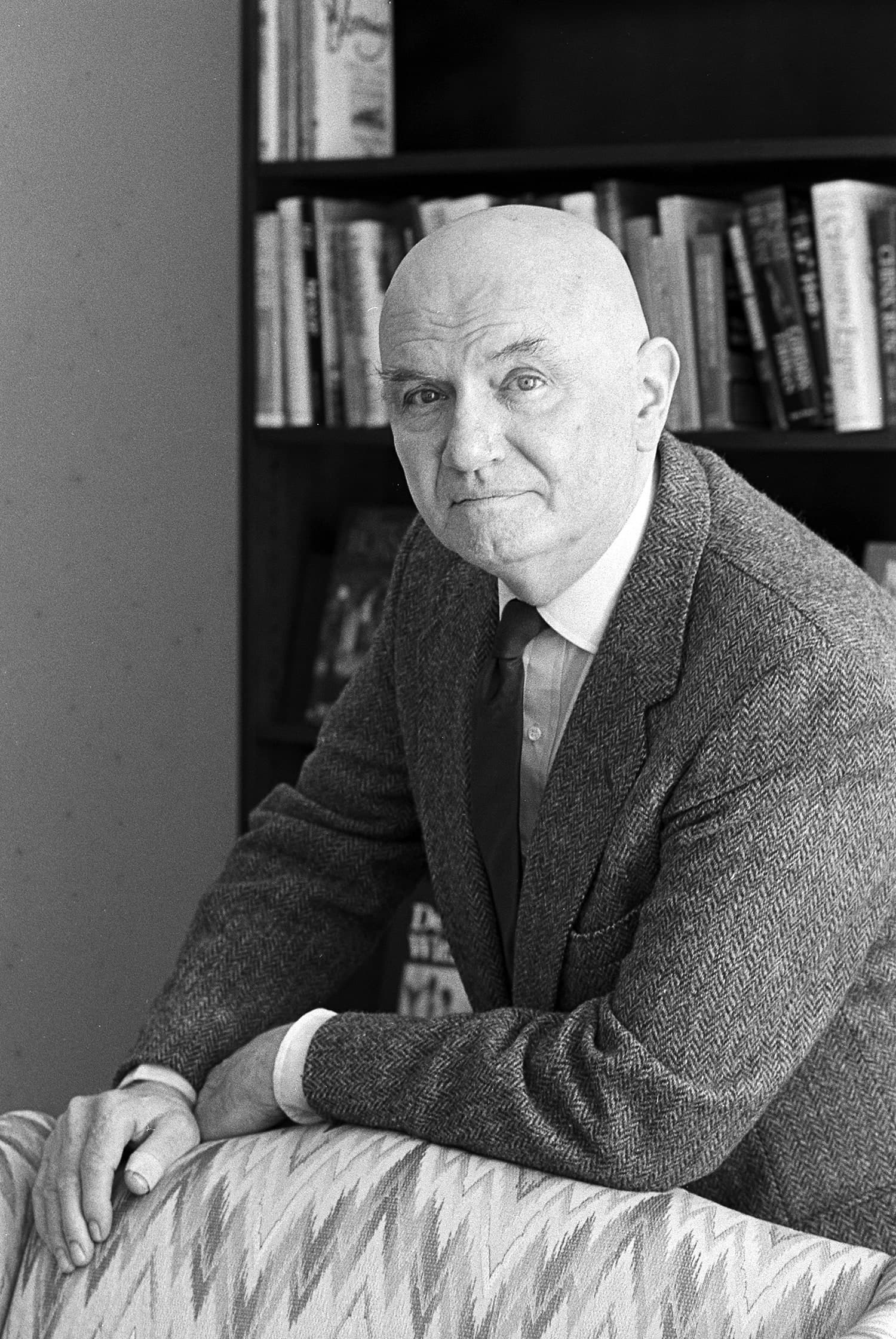
Thomas Berger was an American author known for his contributions to fiction. He is particularly recognized for his novel "Little Big Man," which offers a unique perspective on the American West and Native American culture. Berger's works often explore themes of identity and history.
Similar books
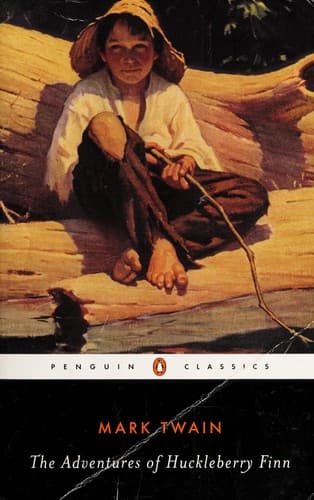
- The Adventures of Huckleberry Finn
Mark Twain
3.8 (1.2M) average on GoodreadsHistorical FictionFeatures a young protagonist on a picaresque journey, observing and commenting on society.
- Lonesome Dove
Larry McMurtry
4.5 (149k) average on GoodreadsHistorical FictionAn expansive and character-driven epic set in the American Old West, with a blend of adventure and realism.
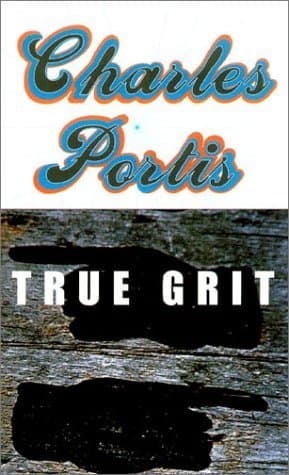
- True Grit
Charles Portis
4.1 (44k) average on GoodreadsHistorical FictionNarrated by a strong, distinctive voice recounting a Western adventure with a mix of humor and hardship.
- To Kill a Mockingbird
Harper Lee
4.3 (4.5M) average on GoodreadsHistorical FictionIn the 1930s Jim Crow South, Harper Lee writes about racial injustice, moral growth, and the quiet courage of a lawyer father, Atticus Finch, as seen through his young daughter's eyes.
- The Great Gatsby
F. Scott Fitzgerald
3.9 (3.8M) average on GoodreadsHistorical FictionIn the opulent Roaring Twenties, a mysterious millionaire's lavish parties hide his desperate, tragic pursuit of a lost love, exposing the emptiness within the American Dream.
- Pride and Prejudice
Jane Austen
4.3 (3M) average on GoodreadsHistorical FictionIn a society focused on status and money, Elizabeth Bennet navigates love and pride, challenging Mr. Darcy and social expectations to find true affection.




Enjoyed the summary?
A summary gives you the shape of the book. The book itself has the detail, the examples and the voice.
Find Little Big Man on AmazonAs an Amazon Associate, BookBrief earns from qualifying purchases. How we're funded