
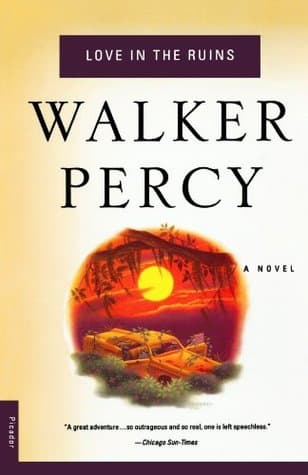
Synopsis
Covers the whole plot, including the ending.
- Difficulty
- Medium
- Pacing
- Moderate
- Mood
- Philosophical, Satirical, Melancholy, Profound, Darkly Humorous
- Read it if
- You enjoy philosophical science fiction that blends satire, spirituality, and a Southern Gothic sensibility, exploring the human condition in times of crisis.
- Skip it if
- You prefer fast-paced action or clear-cut answers to complex moral and existential questions, or are put off by a cynical, sometimes rambling narrator.
Love in the Ruins Plot Summary
Covers the whole plot, including the ending.
The Last Day of the World (and the First of More's New One)
The novel starts on July 4th. Dr. Tom More, a psychiatrist and lapsed Catholic, sits in a water tower in a run-down part of Feliciana Parish, Louisiana. He believes the world is ending, a feeling matched by the decay around him. Tom has invented the 'Ontological Lapsometer,' a device he says can diagnose and cure mankind's spiritual sickness, which he calls 'angelism-bestialism.' He recalls past failures, including a failed attempt to save Lola from suicide and his daughter Samantha's death from a mysterious illness. He plans to use his Lapsometer to save a small community from the coming disaster, which he blames on a societal split between 'angelism' (pure intellect) and 'bestialism' (pure sensuality).
The Paradise Estates Experiment
Tom lives in the remains of Paradise Estates, a former resort now split into a white Protestant section and a black Catholic section. He is in a relationship with three women: his former nurse, Kitty Vaught; a Jewish sculptor, Moira Schaffner; and a young, beautiful former Miss Alabama, Doris. His main patient is Art Immelmann, a former colleague who shows extreme symptoms of angelism-bestialism. Tom's Lapsometer, a helmet-like device with dials, claims to measure the 'ontological lapsus'—the fall from grace—in people. He thinks he can restore balance to the human mind, curing the spiritual illness that caused society's collapse. He tries to use the device on Art, but the results are unclear and frustrating.
Art Immelmann's Influence and the Lapsometer's Flaws
Art Immelmann, a clever and nihilistic character, quickly gains power over Tom and the Lapsometer. He subtly changes Tom's ideas, suggesting the device can be used for control instead of healing. Art's own condition seems to worsen, or he pretends to improve to further his goals. He convinces Tom to use the Lapsometer on other residents, often with disturbing and unpredictable results. The device seems to strengthen existing traits rather than cure them, pushing the 'angelic' further into abstraction and the 'bestial' further into pleasure. Tom begins to suspect that Art is not just a patient but represents the spiritual decay he wants to fight, possibly even an evil agent.
The Racial Divide and the Search for Unity
The racial division in Paradise Estates reflects the larger societal breakdown. The white Protestants, led by Dr. Bob Comeaux, mostly ignore the black Catholics, who struggle with poverty and disease. Tom, though living among the white community, sees the black community's suffering and believes his Lapsometer could bridge the gap, restoring shared humanity. He watches Father Smith, a black Catholic priest, ministering to his flock, and feels a longing for his lost faith. However, his attempts to help are met with suspicion from both sides, showing the deep divisions that even technology cannot easily fix.
The Lapsometer's True Power and Peril
As Tom continues to experiment, he finds that the Lapsometer has an unexpected side effect: it can increase or decrease sexual desire. This discovery makes his ethical problem more complex. Art Immelmann, always manipulative, uses this feature to his advantage with the women, further blurring the lines between healing and control. Tom realizes that his invention, meant for spiritual salvation, could easily become a tool for pleasure or manipulation. This forces him to confront the moral implications of his scientific work and the dangers of trying to engineer human happiness or virtue. He questions if true healing can come from a machine or if it needs something deeper.
The Confrontation with Art and the Lapsometer's Destruction
Tom's suspicions about Art Immelmann lead to a dramatic confrontation. He realizes that Art has been deliberately sabotaging his efforts and using the Lapsometer for selfish reasons, embodying the 'bestialism' Tom tried to cure. In a moment of clarity and desperation, Tom destroys the Lapsometer, seeing its potential for harm and the futility of trying to solve spiritual problems with a purely scientific device. This act shows Tom's rejection of a purely technological solution to human suffering and his acknowledgment of his own scientific pride. Destroying the Lapsometer is a turning point, forcing Tom to find a different path.
A Glimmer of Hope and the Return to Faith
After destroying the Lapsometer, Tom changes deeply. He starts attending mass with the black Catholic community and finds comfort in the Church's rituals and community. He confesses his sins to Father Smith, a key moment in his spiritual journey. He rediscovers his lost Catholic faith, realizing that true healing and meaning are not in scientific invention but in spiritual connection and tradition. This return to faith marks a significant shift from his earlier reliance on technology and intellectual detachment. He begins to see the world not as a problem for science to solve, but as a place where grace and redemption are possible.
The End of the World (as Tom Knew It)
The predicted end of the world on July 4th passes without a dramatic catastrophe. Instead, life continues, though fractured and uncertain. Tom realizes that the apocalypse he expected was more of a spiritual and societal breakdown than a physical one. He accepts that a single invention will not 'cure' the world. He makes peace with his past, including his daughter's death, and starts to rebuild his life and relationships on a more traditional and spiritual basis. The immediate threat of global destruction lessens, replaced by the ongoing challenges of living in a fallen world.
Choosing a Path: Marriage and Medical Practice
Tom chooses to marry Kitty Vaught, his former nurse, recognizing her steady love and practical nature. He abandons his polygamous lifestyle, which he now sees as a sign of his previous spiritual confusion. He re-establishes a humble medical practice in the post-apocalyptic setting, focusing on traditional medicine and compassionate care rather than grand scientific plans. He finds quiet satisfaction in treating physical ailments and serving his community, embracing a more grounded and responsible life. This decision shows his rejection of intellectual abstraction and his commitment to the real parts of human life and relationships.
A New Beginning: Life in the Ruins
The novel ends with Tom living a relatively peaceful and meaningful life with Kitty. They have children, bringing hope and continuity to a broken world. Tom continues his medical practice, offering what help he can. He has found a way to live 'in the ruins'—both society's physical ruins and his own spiritual ruins—with a renewed sense of purpose, based on his Catholic faith and his love for his family. He has learned that true salvation is not in scientific breakthroughs but in faith, love, and the everyday acts of living a good life, even in a world that seems to be falling apart.
Principal Figures
Dr. Tom More
Protagonist
A disillusioned psychiatrist and inventor seeking to cure mankind's spiritual malaise.
Dr. Tom More is a brilliant but troubled psychiatrist, a descendant of Sir Thomas More, and a lapsed Catholic. He is driven by a deep sense of responsibility to humanity, believing he can diagnose and cure the spiritual sickness he sees plaguing society. His intellect often leads him into abstract theories, making him prone to hubris and a detachment from practical realities. He grapples with personal tragedies, including the death of his daughter and a failed marriage, which fuel his quest for meaning. Despite his scientific ambitions, he longs for spiritual grounding and connection.
Relationships: Kitty Vaught (Wife, former nurse, stable and loving partner); Moira Schaffner (Lover, intellectual companion, Jewish sculptor); Doris (Lover, beautiful but shallow former Miss Alabama); Art Immelmann (Former associate, patient, and antagonist; embodies societal decay); Samantha More (Deceased daughter, a source of profound grief and motivation); Father Smith (Spiritual guide, black Catholic priest)
Kitty Vaught
Supporting
Tom's loyal nurse and eventual wife, representing stability and practical love.
Kitty Vaught is Tom's former nurse and one of his lovers, eventually becoming his wife. She is practical, grounded, and possesses an unwavering loyalty and love for Tom. Unlike Moira and Doris, Kitty represents a steady, uncomplicated devotion. She is often overlooked by Tom in his intellectual pursuits but provides a vital anchor to reality. Her common sense and compassion offer a stark contrast to Tom's often-abstract thinking and the chaotic world around them. She embodies the possibility of simple, enduring love and provides a sense of normalcy.
Relationships: Dr. Tom More (Lover, then wife; dedicated and supportive)
Art Immelmann
Antagonist
A manipulative, nihilistic former associate who embodies the spiritual sickness.
Art Immelmann is a former associate of Tom's who becomes his patient and de facto antagonist. He is cunning, nihilistic, and embodies the 'angelism-bestialism' that Tom seeks to cure. Art manipulates Tom and the Lapsometer, twisting its purpose for his own selfish and destructive ends. He is a charming but insidious figure, capable of subtly undermining Tom's work and moral compass. Art represents the seductive power of evil and the intellectual corruption that can lead to spiritual decay. He challenges Tom's beliefs and forces him to confront the dark side of human nature.
Relationships: Dr. Tom More (Former associate, patient, and manipulative antagonist)
Moira Schaffner
Supporting
A Jewish sculptor and intellectual lover, representing intellectual and artistic pursuits.
Moira Schaffner is a Jewish sculptor and one of Tom's lovers. She is intellectual, artistic, and shares Tom's philosophical interests, often engaging in deep discussions with him. Moira represents a different facet of Tom's intellectual and spiritual quest, offering a perspective outside of his Catholic background. Her Jewish heritage and artistic sensibilities add another layer to the novel's exploration of faith and meaning. While she provides intellectual stimulation, she is ultimately part of Tom's fragmented and uncommitted lifestyle before his conversion.
Relationships: Dr. Tom More (Lover, intellectual companion)
Doris
Supporting
A beautiful former Miss Alabama, representing pure sensuality and superficiality.
Doris is a beautiful former Miss Alabama and another of Tom's lovers. She represents the 'bestial' side of the angelism-bestialism dichotomy, embodying pure sensuality and a certain superficiality. She is less intellectual than Moira and Kitty, focused more on immediate pleasures and appearances. Her presence in Tom's life highlights his own indulgence and the fragmented nature of his pre-conversion existence. She serves as a symbol of the societal decay and the pursuit of hedonism that Tom initially believes his Lapsometer can cure.
Relationships: Dr. Tom More (Lover)
Father Smith
Supporting
A black Catholic priest who offers spiritual guidance and a path to redemption.
Father Smith is a black Catholic priest ministering to the black community in the ruins of Paradise Estates. He is a figure of quiet strength, faith, and traditional religious authority. He provides spiritual guidance and a sense of community to his flock, embodying the enduring power of faith amidst societal collapse. Father Smith serves as a crucial spiritual mentor for Tom, guiding him back to his Catholic roots through confession and the sacraments. He represents the authentic, practical application of faith, contrasting with Tom's earlier intellectualized approach.
Relationships: Dr. Tom More (Spiritual guide, confessor)
Dr. Bob Comeaux
Supporting
A pragmatic white Protestant doctor, representing secular authority and societal division.
Dr. Bob Comeaux is a white Protestant doctor who leads the white community in Paradise Estates. He is pragmatic, militaristic, and represents the secular authority and the racial/religious divisions prevalent in the post-apocalyptic world. Comeaux is focused on survival and order, but his approach often lacks compassion and spiritual depth. He embodies the practical, but ultimately limited, solutions offered by a purely secular worldview. His interactions with Tom highlight the tension between scientific ambition, spiritual need, and societal realities.
Relationships: Dr. Tom More (Professional colleague, ideological contrast)
Samantha More
Mentioned
Tom's deceased daughter, whose death is a source of profound grief and motivation.
Samantha More is Tom's deceased daughter, who died from a mysterious illness. Her death is a profound source of grief and guilt for Tom, fueling his quest to understand and cure human suffering. While she never appears in the novel, her memory looms large, representing innocence lost and the personal toll of inexplicable tragedy. Her absence underscores Tom's personal brokenness and his desperate need for meaning and redemption. Her death is a constant reminder of the fragility of life and the limits of medical science.
Relationships: Dr. Tom More (Daughter (deceased), object of profound love and grief)
Themes & Insights
The Search for Meaning in a Post-Apocalyptic World
The novel explores humanity's search for purpose in a decaying society. Dr. Tom More's Lapsometer is his attempt to scientifically fix this meaninglessness. However, he finds that technology is not enough; true meaning comes from faith, love, and traditional human relationships. This is clear when he rejects the Lapsometer and returns to the Catholic Church and marries Kitty, finding peace in a simple, faith-filled life.
“What does a man do when he is told that the best way to save himself and the world is to give up his search for himself and the world?”
The Dangers of Scientific Hubris and Intellectual Abstraction
Percy criticizes the modern reliance on science and intellect to solve deep problems, often ignoring spiritual and emotional truths. Tom More's Lapsometer, though well-intended, symbolizes this pride, trying to reduce complex human spiritual states to data. Art Immelmann's misuse of the device shows the ethical dangers of such an approach. Tom's journey shows that intellectual thinking can lead to detachment and moral confusion, as seen in his early relationships and his inability to connect until he gives up his scientific quest.
“The fact is that if a man is to live, he must be done with all that, all that abstract speculation, all that thinking about himself.”
The Nature of Good and Evil ('Angelism-Bestialism')
A main theme is Percy's idea of 'angelism-bestialism,' a spiritual sickness where humans swing between pure intellect (angelism) and pure sensuality (bestialism), losing their whole humanity. Tom believes this split causes society's decay. Art Immelmann embodies extreme bestialism and nihilism, while Tom struggles with intellectual detachment. The novel suggests that true health means integrating these aspects through faith and love, and that the modern world worsens this split. Societal divisions, like the racial segregation in Paradise Estates, show this deeper spiritual problem.
“The great secret of the coming age is that the world is going to be saved, not by science, but by faith. Which is to say, by a new kind of science.”
Redemption Through Faith and Community
The novel argues for redemption through a return to traditional Catholic faith and genuine human community. Tom's early attempts to 'cure' humanity are scientific and individualistic, but he finds salvation by reconnecting with his lost faith, confessing to Father Smith, and committing to Kitty. This highlights how spiritual tradition, sacraments, and community help counter modern alienation and despair. His final marriage and the birth of his children symbolize a hopeful future built on these foundations.
“One must love God and one's neighbor and not despair. The rest is all vanity.”
Love and Commitment vs. Hedonism and Detachment
The novel contrasts Tom's initial relationships, driven by detachment and a search for fragmented satisfaction, with his commitment to Kitty Vaught. His relationships with Moira (intellectual) and Doris (sensual) represent the 'angelism' and 'bestialism' he struggles with. His choice of Kitty, who embodies stable love and practical care, shows his rejection of pleasure and intellectual detachment for real commitment. This shift emphasizes that true love and commitment are vital for human well-being and spiritual health, providing stability in a chaotic world.
“It is not a question of 'love' in the abstract, but of loving this man or this woman in this place at this time.”
Plot Devices & Literary Techniques
The Ontological Lapsometer
A fictional device that diagnoses and attempts to cure spiritual illness.
The Lapsometer is Dr. Tom More's invention, a helmet-like machine designed to measure and correct the 'ontological lapsus' – the spiritual fall of humanity. It functions as a central plot device, driving Tom's actions and representing his scientific hubris. Initially presented as a potential savior, it quickly becomes a symbol of the limitations and dangers of relying on technology to solve spiritual problems. Its eventual destruction signifies Tom's rejection of a purely scientific worldview and his turn towards faith. It also serves as a vehicle for exploring Percy's 'angelism-bestialism' theory.
The Post-Apocalyptic Setting (Feliciana Parish)
A decaying, racially segregated Louisiana parish symbolizing societal and spiritual collapse.
The setting of Feliciana Parish, Louisiana, in a near-future, post-apocalyptic state, serves as a microcosm of the larger societal and spiritual decay. The physical ruins, racial segregation between white Protestants and black Catholics, and general sense of malaise reflect the internal state of humanity. This setting provides a backdrop against which Tom's personal and spiritual struggles are played out, emphasizing the urgency of his quest for meaning. It highlights the fragility of civilization and the enduring human need for community and faith even in collapse.
First-Person Narrative (Dr. Tom More)
The story is told from Tom More's subjective and often self-deprecating perspective.
The novel is narrated entirely from Dr. Tom More's first-person perspective, offering intimate access to his thoughts, theories, and personal struggles. This allows the reader to experience his intellectual journey, his anxieties about the world's impending doom, and his eventual spiritual awakening. His voice is often ironic, witty, and deeply introspective, providing both humor and profound philosophical insights. The subjectivity of his narration also underscores his initial detachment and the challenge of truly understanding reality when trapped in one's own head.
Symbolism of Names (More, Immelmann)
Character names carry historical and symbolic weight, enriching their roles.
The names of key characters hold symbolic significance. Dr. Tom More is a direct descendant of Sir Thomas More, the Catholic saint executed for refusing to acknowledge Henry VIII's supremacy, linking Tom to a legacy of faith, martyrdom, and resistance to secular power. This lineage foreshadows Tom's eventual return to Catholicism. Art Immelmann's name, while less direct, evokes a sense of artificiality and 'imitation man,' fitting his role as a manipulative and spiritually empty antagonist. This use of names adds depth and intertextual richness to the narrative.
Love in the Ruins Quotes
“The only way to love a woman is to love God first.”
“I am a Catholic, but a bad one. I don't believe in God, but I believe in the Holy Catholic Church. What a fix.”
“Why is it that the only people who know how to live are the ones who are dying?”
“The world is going to hell, and I'm going to cure it.”
“The great thing about the end of the world is that you don't have to worry about anything anymore.”
“The worst thing about the next world is that it will be just like this one, only more so.”
“Man is the only creature who refuses to be what he is.”
“The trouble with people is not that they don't know, but that they know too much.”
“What is life but a series of decisions, each one leading to the next, like dominoes falling?”
“The true catastrophe is not the end of the world, but the end of meaning.”
“It is not enough to be a good man; one must also be a true man.”
“The world is full of signs, but no one knows how to read them.”
“Perhaps the only hope is to start over, to build something new from the ruins.”
“We are all castaways on an island of our own making.”
Quiz
10 questions on the plot and the characters. Each answer comes with a short explanation.
Question 1
What is the primary invention Dr. Tom More has created that allows him to 'cure mankind's spiritual flu'?
- A device that measures brain waves
- A spiritual stethoscope
- A machine that projects future events
- A genetic sequencer for spiritual ailments
Show answer
B. A spiritual stethoscope Dr. Tom More's key invention is a spiritual stethoscope, which he calls the 'More's Qualitative-Quantitative Ontological Lapsometer,' designed to diagnose and potentially cure the spiritual maladies of humanity.
Question 2
What is the general state of American society depicted in 'Love in the Ruins'?
- A utopian society thriving on scientific advancements
- A society on the brink of collapse, divided by ideological and racial strife
- A society that has achieved perfect spiritual harmony
- A world where nature has completely reclaimed urban areas
Show answer
B. A society on the brink of collapse, divided by ideological and racial strife The novel portrays a fragmented and decaying America, experiencing widespread social, political, and spiritual breakdown, often referred to as 'the ruins.'
Question 3
What is Dr. Tom More's profession before he dedicates himself to his spiritual invention?
- Physicist
- Psychiatrist
- Theologian
- Historian
Show answer
B. Psychiatrist Dr. Tom More is a psychiatrist, which gives him a foundation for understanding the human mind and its disorders, though he feels traditional psychiatry is insufficient for the deeper 'spiritual flu' he perceives.
Question 4
Where does Dr. Tom More primarily conduct his experiments and reside for much of the novel?
- A remote island laboratory
- A deserted urban hospital
- A former motel, now called 'Paradise' or 'Knotts Landing'
- A heavily guarded government facility
Show answer
C. A former motel, now called 'Paradise' or 'Knotts Landing' Tom More sets up his 'clinic' and lives in a dilapidated motel, often referred to as 'Paradise' or 'Knotts Landing,' which reflects the ironic state of his surroundings and ambitions.
Question 5
Which of the following best describes the 'spiritual flu' Dr. Tom More aims to cure?
- A literal viral infection affecting the brain
- A pervasive sense of alienation, meaninglessness, and societal dysfunction
- A psychological condition caused by excessive technology use
- A widespread belief in supernatural phenomena
Show answer
B. A pervasive sense of alienation, meaninglessness, and societal dysfunction The 'spiritual flu' is a metaphor for the deep existential malaise, anomie, and loss of meaning that Percy believed plagued modern society, leading to its fragmentation.
Question 6
What is the significance of the Catholic faith in Dr. Tom More's personal life and perspective?
- He is an ardent atheist who rejects all religious dogma.
- He is a lapsed Catholic who struggles with his faith but often returns to its principles.
- He is a fundamentalist who uses his faith to judge others.
- He converts to an Eastern religion during the course of the novel.
Show answer
B. He is a lapsed Catholic who struggles with his faith but often returns to its principles. Tom More is a lapsed Catholic who finds himself continually drawn back to the Church's teachings, despite his scientific pursuits and personal failings. His faith provides a framework for understanding the spiritual crisis he observes.
Question 7
Which of the following themes is most central to 'Love in the Ruins'?
- The triumph of pure scientific rationalism over superstition
- The exploration of existential dread and the search for meaning in a post-apocalyptic world
- A celebration of hedonism and immediate gratification
- The inherent goodness of humanity and its ability to overcome all challenges
Show answer
B. The exploration of existential dread and the search for meaning in a post-apocalyptic world The novel deeply explores themes of existentialism, alienation, and the search for spiritual meaning amidst societal decay and personal crisis, reflecting Percy's philosophical concerns.
Question 8
How does the Lapsometer interact with the political and social divisions in the novel's world?
- It accurately diagnoses physical illnesses that cause political differences.
- It can identify and potentially 'cure' the spiritual imbalances that lead to radical political and racial ideologies, such as 'angelism' and 'bestialism.'
- It is used by the government to enforce conformity and suppress dissent.
- It has no effect on political or social issues, only individual psychological states.
Show answer
B. It can identify and potentially 'cure' the spiritual imbalances that lead to radical political and racial ideologies, such as 'angelism' and 'bestialism.' The Lapsometer is designed to detect and correct imbalances that lead to extreme states like 'angelism' (disembodied intellect) and 'bestialism' (purely carnal existence), which Percy links to the divisive ideologies and behaviors fracturing society.
Question 9
What is the ultimate outcome or 'cure' Tom More achieves with his Lapsometer by the end of the novel?
- He successfully cures all of humanity of the 'spiritual flu,' ushering in a new golden age.
- He realizes the limitations of his scientific approach and finds a measure of personal peace and connection through ordinary life and faith.
- The Lapsometer is stolen and used for nefarious purposes, leading to greater chaos.
- He perfects the machine and becomes a celebrated world leader.
Show answer
B. He realizes the limitations of his scientific approach and finds a measure of personal peace and connection through ordinary life and faith. Despite his grand ambitions, Tom More ultimately finds a form of redemption and meaning not through his scientific invention, but through embracing ordinary life, marriage, and a renewed, albeit imperfect, faith.
Question 10
How does the concept of 'chance and ruin' manifest itself in the lives of the characters and the setting?
- Characters meticulously plan their lives to avoid any risk or failure.
- The physical environment is decaying, and individual lives are often unexpectedly disrupted or destroyed by societal breakdown and personal failings.
- All characters are immune to the effects of chance due to advanced technology.
- The novel suggests that ruin is merely an illusion, and everything is ultimately ordered.
Show answer
B. The physical environment is decaying, and individual lives are often unexpectedly disrupted or destroyed by societal breakdown and personal failings. The novel's title and narrative are permeated by the idea of 'ruin' – both the physical decay of the world and the spiritual and moral decay of its inhabitants. Chance plays a significant role in the unpredictable collapse of society and the personal tragedies experienced by characters, highlighting the fragility of existence.
Love in the Ruins FAQ
What is the core premise of 'Love in the Ruins'?
The novel follows Dr. Tom More, a disgraced psychiatrist in a fractured, post-apocalyptic America, who believes he has invented the 'Ontological Lapsometer.' This device can diagnose and potentially cure the spiritual malaise he calls 'angelism-bestialism,' aiming to restore humanity's connection to God and prevent further societal decay.
Who is Dr. Tom More, and what is his primary motivation?
Dr. Tom More is a lapsed Catholic psychiatrist, descendant of Sir Thomas More, who is haunted by the death of his daughter, Samantha. His primary motivation is to use his Lapsometer to heal humanity's spiritual sickness, which he believes manifests as either an excessive, disembodied intellect (angelism) or base, animalistic desires (bestialism), and in doing so, perhaps redeem himself and prevent a second American Civil War.
What is the 'Ontological Lapsometer' and how does it supposedly work?
The Lapsometer is Tom More's invention, a device that he claims can measure and correct imbalances in the human psyche, specifically the 'lapsus' or fall from grace. It works by detecting 'waves' of spiritual distress and then attempting to re-establish a proper connection between mind, body, and spirit, thus curing the 'angelism-bestialism' that plagues individuals and society.
Describe the setting of the novel. What state is America in?
The novel is set in a near-future, post-apocalyptic America, specifically in the fictional 'Paradise' suburb of Feliciana Parish, Louisiana. The country is deeply fragmented, with a racial civil war brewing, widespread social and moral decay, and a general sense of spiritual and physical ruin, characterized by abandoned highways and a collapsing infrastructure.
Who are the significant women in Tom More's life in the novel?
Tom More is involved with three significant women: Lola, a beautiful but mentally unstable former patient; Kitty Vaught, a wealthy and practical Protestant nurse; and Ellen, a devout Catholic former medical student. Each woman represents a different aspect of his past, present, and potential future, challenging his spiritual and romantic choices.
What is the significance of the motel where Tom More often resides?
The abandoned 'Love in the Ruins' motel serves as Tom More's makeshift laboratory and sanctuary. It symbolizes the decayed state of modern society, a place of former fleeting pleasures now fallen into disuse, yet it also becomes the unlikely site of his scientific and spiritual endeavors, a place where he grapples with the 'ruins' both external and internal.
How does the novel subtly critique both extreme scientific rationalism and unbridled spiritualism?
Percy critiques scientific rationalism through Tom's Lapsometer, which, despite its scientific veneer, is ultimately a spiritual tool addressing a spiritual problem, highlighting science's limitations. He critiques unbridled spiritualism by showing the dangers of disembodied 'angelism,' which leads to mental illness and detachment from reality, advocating for a balance between body and soul.
What is the role of Dr. Max Gottlieb, Tom's former mentor, in the narrative?
Dr. Max Gottlieb is Tom More's Jewish mentor from his medical school days, a brilliant but nihilistic scientist who embodies pure rationalism without spiritual grounding. His presence in Tom's memories and thoughts serves as a foil, representing the scientific worldview that Tom both respects and attempts to transcend with his Lapsometer.
What does the concept of 'angelism-bestialism' truly represent in Percy's philosophy?
'Angelism-bestialism' represents humanity's fundamental alienation from its true nature and from God. 'Angelism' is the attempt to transcend the body through pure intellect, leading to detachment and madness, while 'bestialism' is succumbing entirely to base, animalistic desires, ignoring spiritual and intellectual life. Percy argues for a unified, embodied human existence.
How does Tom More's personal grief over his daughter Samantha influence his scientific pursuits and spiritual journey?
Samantha's death from a brain tumor is the profound trauma that drives Tom's quest. Her suffering, which he felt unable to alleviate with conventional medicine, fuels his desperation to find a cure for human suffering, both physical and spiritual. Her loss pushes him towards a deeper understanding of life's fragility and the need for transcendent meaning.
Discuss the psychological impact of the 'fall' or 'lapsus' on the characters in the novel.
The 'fall' manifests as deep psychological distress, ranging from Lola's catatonia to the general societal malaise of indifference and despair. Characters either become overly intellectual and detached (angelism) or descend into hedonism and violence (bestialism), demonstrating the psychological fragmentation that Percy attributes to humanity's separation from its spiritual core.
How does Tom More's Catholic faith evolve or manifest throughout his chaotic journey?
Tom's Catholic faith is initially lapsed and intellectualized, but his chaotic journey forces him to confront its practical implications. Despite his scientific hubris, he frequently prays and seeks meaning, ultimately returning to a more humble, embodied faith. His scientific quest, ironically, becomes a circuitous route back to spiritual truth and acceptance.
Is the Lapsometer a genuine scientific invention or a metaphor for spiritual seeking?
The Lapsometer functions as both. While described with pseudo-scientific detail, its ultimate purpose is to diagnose and cure spiritual ailments, making it a powerful metaphor for humanity's innate drive to understand and heal its existential condition. It represents Tom's, and perhaps humanity's, flawed but earnest attempt to bridge the gap between science and faith.
What is Percy's broader commentary on the relationship between science, religion, and humanity's future?
Percy suggests that neither pure science nor pure religion alone can fully address the human condition. He critiques science for its inability to provide meaning and religion for its potential to become disembodied. He advocates for an integrated approach where faith informs reason, and science, properly understood, can serve humanity's spiritual well-being, suggesting a future where both must coexist for true healing.
How does the novel's ending, particularly Tom's marriage to Ellen, reflect his journey and the book's themes?
Tom's marriage to Ellen and their simple life, raising children and quietly practicing their faith, signifies his acceptance of a humble, embodied existence. He abandons his grand, world-saving ambitions for personal responsibility and a grounded faith, reflecting Percy's theme that true salvation lies not in utopian schemes but in ordinary, sacramental living and human connection.
Does the novel offer a hopeful or pessimistic vision of humanity's future?
The novel offers a cautiously hopeful vision. While depicting widespread societal collapse and spiritual decay, Tom More's ultimate return to a simple, faithful life with Ellen suggests that individual redemption and the possibility of finding meaning persist even amidst ruin. It's not a grand, utopian hope, but a grounded, personal one, emphasizing resilience.
How does the racial tension and impending civil war contribute to the novel's critique of modern society?
The brewing racial civil war highlights the deep societal divisions and spiritual failures that Percy critiques. It illustrates how the 'angelism-bestialism' manifests on a collective level, leading to conflict, hatred, and an inability to coexist. This societal breakdown serves as a dramatic backdrop to Tom's personal quest for healing and understanding.
What is the significance of the novel being set on the Fourth of July weekend?
Setting the novel on the Fourth of July weekend is highly ironic. It juxtaposes the traditional celebration of American independence and ideals with the nation's profound state of spiritual and societal ruin. This timing underscores the themes of a fallen nation and the failure to live up to its founding principles, highlighting the deep irony of its 'love in the ruins'.
About the author

Walker Percy, OblSB was an American writer whose interests included philosophy and semiotics. Percy is noted for his philosophical novels set in and around New Orleans; his first, The Moviegoer, won the National Book Award for Fiction.
Similar books
- A Canticle for Leibowitz
Walter M. Miller Jr.
4.0 (93k) average on GoodreadsFantasyExplores the aftermath of societal collapse, the role of faith, and the cyclical nature of human progress and destruction.
- The Road
Cormac McCarthy
4.0 (716k) average on GoodreadsScience FictionDepicts a bleak, post-apocalyptic landscape and the struggle for survival, though 'Love in the Ruins' is more overtly philosophical and satirical.
- The Moviegoer
Walker Percy
3.7 (25k) average on GoodreadsLiterary FictionShares Percy's distinctive prose, existential themes, and a protagonist grappling with anomie and the search for meaning in modern society.
- Brave New World
Aldous Huxley
4.0 (1.4M) average on GoodreadsFantasyWhile both critique scientific overreach and explore dystopian futures, Huxley focuses on a society engineered for pleasure and conformity through genetic engineering and conditioning. Percy, conversely, delves into the individual's spiritual crisis and the search for meaning in a world suffering from 'angelism-bestialism,' with a distinct Catholic existentialist lens. Percy's dystopia is more a consequence of societal decay and spiritual emptiness rather than overt state control.
- Nineteen Eighty-Four
George Orwell
4.2 (5.5M) average on GoodreadsFictionOrwell's novel depicts an oppressive totalitarian state with constant surveillance and thought control, where political power is the ultimate goal. Percy's Love in the Ruins presents a dystopia driven more by internal societal disintegration, spiritual malaise, and the misapplication of technology to solve existential problems. While both feature protagonists struggling against their worlds, More's battle is primarily internal and spiritual, rather than against an external, omnipotent political entity.
- Eat, Pray, Love
Elizabeth Gilbert
3.6 (1.5M) average on GoodreadsLifestyleA heartbroken writer leaves her conventional life for a year-long global search for pleasure in Italy, spiritual devotion in India, and unexpected love and balance in Bali.





Enjoyed the summary?
A summary gives you the shape of the book. The book itself has the detail, the examples and the voice.
Find Love in the Ruins on AmazonAs an Amazon Associate, BookBrief earns from qualifying purchases. How we're funded