
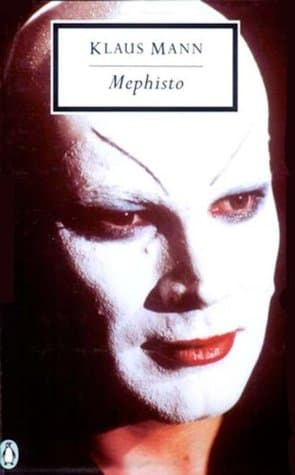
Synopsis
Covers the whole plot, including the ending.
- Difficulty
- Medium
- Pacing
- Moderate
- Mood
- Dark, Satirical, Decadent, Reflective
- Read it if
- You're interested in the moral compromises made by artists under totalitarian regimes, or enjoy a satirical look at ambition and the seduction of power in a historical setting.
- Skip it if
- You prefer straightforward plots without allegorical or satirical elements, or find stories about morally ambiguous protagonists unappealing.
Mephisto Plot Summary
Covers the whole plot, including the ending.
The Provincial Actor and His Ambitions
Hendrik Höfgen, an ambitious actor, works at the Hamburg Playhouse. He feels limited by provincial theater and dreams of Berlin's stages. He sees himself as a revolutionary artist, supporting leftist ideas and openly criticizing the rising Nazi Party. He has a complicated relationship with Dora Martin, an older actress who sees his talent and his narcissism. He also has a secret affair with Juliette Martens, a Black dancer, which he hides to protect his career. His marriage to Barbara Bruckner, a professor's daughter, is mainly a strategic move for social standing.
The Lure of Berlin and Political Compromise
Hendrik moves to Berlin and gets a job at a major theater. The political situation in Germany worsens as the Nazi Party gains power. Hendrik at first tries to appear politically neutral, or even subtly against the Nazis, but his ambition increasingly overpowers his beliefs. He sees his former leftist friends and colleagues, like Hans Miklas, arrested or disappear, and he focuses on self-preservation. While he privately dislikes the Nazis, he publicly avoids anything that might harm his growing career. His relationship with Barbara becomes tense as she, unlike him, holds firm in her moral opposition to the regime.
The Breakthrough Role: Mephisto
Hendrik Höfgen's career changes when he plays Mephisto in Goethe's 'Faust'. His performance is powerful, capturing the evil and seductive nature of the character. This role becomes his most famous, bringing him praise and public recognition. More importantly, his performance gets the attention of the 'Prime Minister', a high-ranking Nazi official (a character based on Hermann Göring). The Prime Minister, impressed by Hendrik's talent, starts to take a personal interest in him, seeing him as a cultural asset for the Third Reich. This attention puts Hendrik in a difficult spot, forcing him to choose between his artistic honesty and the tempting promise of power and security.
The Embrace of the Regime
After his success as Mephisto, Hendrik begins to build his relationship with the Prime Minister. He accepts invitations to parties hosted by Nazi leaders, where he sees the regime's lavish and often brutal reality. He starts to make careful compromises, avoiding political statements and even joining in propaganda efforts, subtly at first. His former friends and colleagues, now exiled or imprisoned, are disgusted by his change. Barbara, upset by his choices, confronts him, but Hendrik ignores her, saying his actions are necessary for his art and survival. He increasingly avoids anyone considered an enemy of the state.
Head of the State Theater
The Prime Minister, now his patron, appoints Hendrik Höfgen as director of the State Theater. This is the peak of Hendrik's career, giving him great power over German culture. He enjoys his new status, the perks, and the respect shown to him. However, his new job comes with moral compromises. He must fire Jewish actors and employees, follow Nazi cultural rules, and take part in propaganda. He tries to justify these actions by claiming he is protecting German art, but the internal conflict affects him. His public image as the famous 'Mephisto' increasingly blends with his private reality as a compliant servant of the regime.
The Peril of Juliette
Hendrik's secret affair with Juliette Martens, his 'Black Venus', becomes a risk as the Nazi regime increases its racial purges. The Prime Minister, aware of Hendrik's past, subtly warns him about such a relationship. Hendrik, afraid of being exposed and ruining his career, tries to distance himself from Juliette. He gives her money and arranges for her to leave the country, hoping to erase all signs of their relationship. This shows his cowardice and self-interest, as he prioritizes his safety and career over any real affection or loyalty to Juliette, who is now in great danger due to the regime's racial policies.
The Mask Becomes the Face
As Hendrik Höfgen gains power as director, the line between his stage roles and his real self blurs. He fully embodies Mephisto's manipulative, charming, and ultimately soulless traits, both on and off stage. He becomes skilled at navigating the dangerous political world, flattering his superiors and ruthlessly getting rid of those in his way. The moral compromises he makes build up, leaving him empty. He sometimes feels doubt or self-loathing, especially when he remembers his past ideals or the fate of his exiled friends, but he quickly pushes these feelings away with his need for power and approval from the regime.
Barbara's Departure
Barbara Bruckner, Hendrik's wife, reaches her limit. She has watched in horror as Hendrik changed from an ambitious artist into a willing tool of the Nazi regime. Her moral compass is completely opposite to his practical compromises. After a particularly bad act of complicity or a chilling display of his new self, Barbara decides she cannot stay married to him. She leaves him, choosing exile and poverty over the luxury and moral corruption Hendrik now lives in. Her departure means Hendrik is completely cut off from his past and any remaining connection to his former ideals, leaving him alone in his golden cage.
The Empty Triumph
Hendrik Höfgen achieves all his professional goals: he is the celebrated director of the State Theater, favored by the regime, and a national cultural icon. Yet, he is deeply unhappy. The constant need to please his Nazi masters, the fear of losing favor, and the nagging awareness of his moral compromises weigh heavily on him. He is haunted by his past — his leftist friends, his exiled wife, and Juliette. The applause and praise now feel hollow, and the power he holds offers no real satisfaction. He realizes that in gaining everything he wanted, he has lost himself.
The Prime Minister's Grip
Despite his high position, Hendrik knows he is completely dependent on the Prime Minister. He is a puppet, though a rich one, and his life and career depend entirely on the Nazi leader's continued approval. He tries to appeal to the Prime Minister's humanity or artistic side, but finds only cold calculation. The Prime Minister reminds him that he owes his existence to the regime and that any deviation will lead to his downfall. Hendrik is left in despair, realizing he is trapped in a system he helped create, unable to escape the golden cage he so desperately sought. His final moments are filled with a chilling awareness of his own doom.
Principal Figures
Hendrik Höfgen
Protagonist
A highly ambitious and narcissistic actor who compromises his morals to achieve fame and power under the Nazi regime.
Hendrik Höfgen is a talented but deeply vain and self-absorbed actor. Driven by an insatiable hunger for fame and recognition, he is willing to discard his political ideals, personal relationships, and even his own sense of self to climb the social and professional ladder. He initially presents as a revolutionary artist with leftist sympathies, but this facade quickly crumbles under the allure of power offered by the Nazi regime. His defining characteristic is his ability to chameleon-like adapt to his surroundings, making him a master of performance both on and off stage. He is a tragic figure, ultimately achieving his dreams only to find them hollow and himself morally bankrupt.
Relationships: Dora Martin (mentor/lover, recognizes his talent and flaws); Juliette Martens (secret lover, a Black dancer, a dangerous liability for him); Barbara Bruckner (wife, represents his fading conscience and moral opposition); The Prime Minister (patron and ultimate controller, a Faustian bargain)
The Prime Minister
Antagonist
A powerful and calculating Nazi leader who becomes Hendrik's patron and ultimate manipulator.
The Prime Minister, a thinly veiled representation of Hermann Göring, is the embodiment of the seductive and brutal power of the Nazi regime. He is a figure of immense political and cultural authority, with a discerning eye for talent and a ruthless approach to control. He sees Hendrik not as an artist, but as a valuable propaganda tool and a symbol of the regime's cultural dominance. His interactions with Hendrik are always calculated, offering lavish rewards while subtly asserting his absolute power and demanding unwavering loyalty. He represents the ultimate temptation and the inescapable trap for Hendrik, offering everything in exchange for the actor's soul.
Relationships: Hendrik Höfgen (patron and manipulator, offering power in exchange for loyalty); The Nazi Regime (a key architect and enforcer of its ideology)
Juliette Martens
Supporting
Hendrik's secret Black lover, a dancer, who becomes a dangerous liability in Nazi Germany.
Juliette Martens, referred to as Hendrik's 'Black Venus', is a talented dancer and Hendrik's passionate, secret lover. She represents a genuine, albeit complicated, emotional connection for Hendrik, but also embodies everything the Nazi regime despises. Her existence highlights Hendrik's hypocrisy and cowardice, as he keeps their relationship hidden and eventually abandons her to protect his career. She is a victim of the regime's racial ideology and Hendrik's self-preservation. Her character serves as a stark reminder of the human cost of the regime's policies and Hendrik's moral compromises.
Relationships: Hendrik Höfgen (secret lover, then abandoned by him)
Barbara Bruckner
Supporting
Hendrik's wife, a principled woman who represents his fading conscience and moral opposition to the Nazis.
Barbara Bruckner is the daughter of an eminent professor and Hendrik's wife. Unlike Hendrik, she possesses a strong moral compass and unwavering anti-Nazi convictions. She initially marries Hendrik partly for his artistic promise, but grows increasingly disillusioned and horrified by his compromises and descent into complicity with the regime. She serves as a moral counterpoint to Hendrik, constantly challenging his actions and reminding him of his former ideals. Her eventual departure from Hendrik symbolizes his complete abandonment of his conscience and his past, leaving him isolated in his morally compromised world.
Relationships: Hendrik Höfgen (wife, then estranged due to his moral compromises); Professor Bruckner (father, a figure of academic integrity)
Dora Martin
Supporting
An older, established actress who mentors Hendrik and recognizes his talent and profound narcissism.
Dora Martin is an experienced and celebrated actress who has a long-standing, complex relationship with Hendrik. She is both a mentor and a lover figure to him, recognizing his immense talent but also his deep-seated vanity and ambition. She represents an earlier generation of theater, one that valued artistic integrity more than political expediency. While she navigates the changing political landscape with caution, she never fully compromises her artistic or personal dignity. She sees Hendrik's transformation with a mix of sadness and understanding, recognizing the dangerous path he is on.
Relationships: Hendrik Höfgen (mentor and former lover, a confidante); The Theater World (an established figure within it)
Hans Miklas
Supporting
A former leftist friend and colleague of Hendrik, who becomes a victim of Nazi persecution.
Hans Miklas is one of Hendrik's former leftist friends and colleagues from his early Hamburg days. He is a fervent Communist and anti-Nazi activist, representing the political ideals Hendrik once claimed to hold. His steadfast opposition to the regime leads to his inevitable arrest and persecution. Miklas serves as a stark reminder of the dangers faced by those who resisted the Nazis and highlights Hendrik's cowardice and self-preservation. His fate underscores the moral choices Hendrik avoids, and his memory occasionally haunts Hendrik, serving as a faint echo of his abandoned conscience.
Relationships: Hendrik Höfgen (former friend and political associate); The Communist Party (an active member)
Professor Bruckner
Supporting
Barbara's father, an eminent and respected academic figure who represents intellectual integrity.
Professor Bruckner is Barbara's father and a highly respected academic. He embodies intellectual integrity and a commitment to truth and scholarship, standing in stark contrast to the intellectual suppression and propaganda of the Nazi regime. While not a direct political activist, his very existence as a man of reason and culture poses a silent challenge to the regime. His disapproval of Hendrik's choices, though often unspoken, carries significant moral weight for Barbara and symbolizes the values Hendrik has abandoned. He represents the old, cultured Germany that the Nazis sought to dismantle.
Relationships: Barbara Bruckner (father); Hendrik Höfgen (father-in-law, disapproves of his actions)
Nicoletta von Niebuhr
Supporting
A socialite and former acquaintance who observes Hendrik's rise and moral decay.
Nicoletta von Niebuhr is a socialite and a peripheral figure in Hendrik's life, initially an acquaintance from his early career. She moves within the same circles as Hendrik and other artists, and as the political climate shifts, she too adapts to the new realities. She represents the opportunistic elements of society who, while perhaps not ardent Nazis, are willing to align themselves with the regime for personal gain or to maintain their social standing. She offers a detached, observational perspective on Hendrik's transformation, noting his moral compromises without necessarily condemning them, highlighting the widespread moral erosion.
Relationships: Hendrik Höfgen (social acquaintance, observer of his career)
Themes & Insights
The Corrupting Power of Ambition
The novel shows how unchecked ambition can lead to moral decay. Hendrik Höfgen's desire for fame and power makes him abandon his political ideals, betray his friends, and sacrifice his personal honesty. His rise to director of the State Theater, achieved by working with the Nazi regime, leaves him empty. This theme appears in Hendrik's pursuit of the Mephisto role, a metaphor for his Faustian bargain, and his reasons for firing Jewish actors and supporting Nazi propaganda.
“He knew that he was a genius, and that the world would one day recognize it, no matter what sacrifices he had to make.”
The Artist's Responsibility in a Totalitarian State
Mann examines the artist's role under a totalitarian government. Hendrik Höfgen, a talented actor, chooses to serve the Nazi state, believing he can preserve 'art' by cooperating, or that his art is above politics. However, his actions show that artistic neutrality is impossible when art is used for propaganda. His Mephisto portrayal, at first a rebellious act, becomes a tool for the regime, and he becomes a puppet. The novel argues that artists have a moral duty to resist oppression, and that complicity, even to protect art, ultimately harms both the artist and the art.
“To serve art, one had to serve the state. And the state was the Führer. This was the new, terrible truth.”
Identity and Performance
The novel looks at how identity and performance blend in Hendrik Höfgen's life. His greatest role, Mephisto, becomes part of his public and private self. He is always 'acting,' on stage and with Nazi leaders, changing his personality to gain favor and power. This theme highlights the dangers of losing one's true self to a created image, especially when that image is controlled by a harmful force. Hendrik's inability to tell the difference between the mask and his true face leads to his spiritual emptiness, as he becomes the evil he plays.
“He was Mephisto, and Mephisto was he. The mask had eaten into his face.”
Moral Compromise and Betrayal
A main theme is the slow loss of moral principles and the betrayal of oneself and others. Hendrik repeatedly compromises his values, from abandoning his leftist friends like Hans Miklas to discarding his lover Juliette Martens, and finally alienating his principled wife, Barbara. Each compromise, small at first, leads to bigger betrayals, ending in his full support of the Nazi regime. The novel shows how moral compromise, even when justified as a means to an end, leads to deep guilt, isolation, and self-hatred, trapping the individual in their own choices.
“Every step he took away from his past was a step closer to a future he would despise.”
The Nature of Evil
Mann explores the evil nature of the Nazi regime. The novel shows how evil is not always obvious brutality but can appear as a slow loss of values, a tempting promise of power, and a demand for complicity. The Prime Minister, representing this evil, is charming and frightening, offering Hendrik everything he wants while subtly tightening his control. Hendrik's change into a servant of this evil shows how individuals, even those with talent and good intentions, can be drawn into and corrupted by a totalitarian system, becoming involved in its atrocities.
“The devil was no longer a grotesque figure in red tights; he was a charming host, a powerful patron, a man who offered everything.”
Plot Devices & Literary Techniques
Faustian Bargain
Hendrik's career ascent mirrors the legend of Faust, trading his soul for fame and power.
The entire narrative of 'Mephisto' is structured around the classic Faustian bargain. Hendrik Höfgen, much like Goethe's Faust, trades his moral integrity and soul for worldly success, fame, and power. His signature role as Mephisto in 'Faust' is not merely a coincidence but a direct, symbolic representation of his life's trajectory. The Prime Minister acts as the contemporary Mephistopheles, offering Hendrik the directorship of the State Theater and immense influence, but at the cost of his conscience and ultimately, his freedom. This device highlights the theme of corrupting ambition and the tragic consequences of such a deal, where the triumph is ultimately empty.
Thinly Veiled Caricature
Characters, especially the Prime Minister, are thinly disguised representations of real historical figures.
Klaus Mann employs the device of thinly veiled caricature, particularly with the character of the Prime Minister, who is clearly modeled on Hermann Göring, and Hendrik Höfgen himself, who is based on Mann's brother-in-law, Gustaf Gründgens. This device allows Mann to critique real historical figures and the moral climate of Nazi Germany without explicitly naming them, providing a layer of fictionalization while maintaining a sharp, critical edge. It adds a layer of biting satire and historical relevance to the narrative, making the critique of complicity and totalitarianism deeply personal and resonant for contemporary readers.
Dramatic Irony
The reader is aware of Hendrik's moral decline and the true nature of his 'success' long before he fully comprehends it.
Dramatic irony is prevalent throughout the novel. The reader is often privy to Hendrik's internal justifications and his growing compromises, understanding the tragic implications of his choices, even as Hendrik himself remains oblivious or in denial. For instance, the reader knows that Hendrik's 'success' under the Nazi regime is a gilded cage, a form of enslavement, long before Hendrik fully realizes his entrapment. This creates a sense of foreboding and emphasizes the tragic inevitability of Hendrik's downfall, as his ambition blinds him to the true cost of his actions, while the reader can see the path he is on.
Symbolism of the Mephisto Role
Hendrik's signature role as Mephisto mirrors his own transformation into a servant of evil.
The role of Mephisto in Goethe's 'Faust' serves as a profound symbol throughout the novel. Initially, Hendrik's brilliant portrayal of Mephisto brings him fame and the attention of the Prime Minister. However, the character of Mephisto, the embodiment of seductive evil and manipulative power, gradually consumes Hendrik. The line between the actor and the role blurs, symbolizing Hendrik's own transformation into a complicit servant of the Nazi regime. He doesn't just play Mephisto; he becomes a Mephisto figure in real life, making deals with the devil (the Prime Minister) and leading others to their damnation or abandoning them for his own gain.
Mephisto Quotes
“He was an actor, and his life was a stage.”
“The greatest art is to give the illusion of life.”
“He loved the theater more than anything, more than people, more than himself.”
“One could not escape the times, no matter how high one built one's ivory tower.”
“Conscience was a luxury he could no longer afford.”
“The devil pays well, but he demands his due.”
“He played the role of the great artist, the genius, but he was only a puppet.”
“The applause was intoxicating, a drug that dulled all questions of right and wrong.”
“To be a great actor, one must be a great liar.”
“He had sold his soul for a leading role.”
“The mirror showed him a stranger, a caricature of his former self.”
“Art should be a weapon, not a decoration.”
“He was not a monster; he was simply weak.”
“The stage was his only reality, the world outside a mere backdrop.”
Quiz
10 questions on the plot and the characters. Each answer comes with a short explanation.
Question 1
Which historical figure is Hendrik Hofgen's character widely considered to be a thinly veiled caricature of?
- Klaus Mann's father, Thomas Mann
- Klaus Mann's brother-in-law
- The Führer himself
- A prominent German actor of the 1920s
Show answer
B. Klaus Mann's brother-in-law The provided text explicitly states that Hendrik Hofgen is 'a thinly veiled caricature of his own brother-in-law.'
Question 2
What is the name of the play in which Hendrik Hofgen's brilliant success as Mephisto brings him the support of the Führer’s prime minister?
- Anja and Esther
- The Pious Dance
- Faust
- Mephisto's Dream
Show answer
C. Faust The text states, 'His brilliant success as Mephisto in FAUST brings him the support of the Führer’s prime minister.'
Question 3
What is Hendrik Hofgen's primary motivation for his actions and pursuit of success?
- To genuinely support the revolutionary ideals he publicly espouses
- An obsessive need for power and fame
- To expose the corruption within the Third Reich
- To secure financial stability for his family
Show answer
B. An obsessive need for power and fame The description of Hofgen states, 'publicly a revolutionary, but secretly he is a man driven by an obsessive need for power and fame.'
Question 4
What position is Hendrik Hofgen appointed to after his success as Mephisto?
- Head of the State Opera
- Cultural Minister of the Third Reich
- Head of the State Theater
- Personal advisor to the Führer’s prime minister
Show answer
C. Head of the State Theater The text explicitly states that the Führer’s prime minister 'appoints him head of the State Theater.'
Question 5
How does Klaus Mann's personal experience relate to the setting and themes of 'Mephisto'?
- He remained in Germany throughout WWII, observing events firsthand.
- He wrote the novel while living in exile from Nazi Germany.
- He was a high-ranking official within the Nazi regime, providing an insider's view.
- He based the story on his experiences as a soldier in WWII.
Show answer
B. He wrote the novel while living in exile from Nazi Germany. The introductory paragraph states, 'Klaus Mann wrote MEPHISTO while living in exile from the Germany of World War II.'
Question 6
What is the ultimate emotional state Hendrik Hofgen confronts at the end of the story, despite achieving his dreams?
- Triumphant satisfaction
- Profound despair
- Contentment and peace
- Renewed revolutionary zeal
Show answer
B. Profound despair The text concludes, 'His dreams are finally realized, but the story ends on a note of despair as Hofgen is forced to confront the emptiness of his life.'
Question 7
What specific act endangers Hendrik Hofgen's rise in Nazi society?
- His public revolutionary statements
- His marriage to the daughter of an eminent politician
- His compulsive involvement with ‘a black Venus’
- His refusal to play Mephisto in Faust
Show answer
C. His compulsive involvement with ‘a black Venus’ The text states, 'he endangers his rise in Nazi society by his compulsive involvement with ‘a black Venus.’'
Question 8
The novel 'Mephisto' is described as capturing the 'Isherwood-like atmosphere' of Nazi Germany. What does this comparison imply about the novel's depiction of that era?
- It focuses primarily on military strategies and battles.
- It presents a detached, journalistic account of political events.
- It emphasizes the decadent, morally ambiguous, and culturally rich pre-Nazi and early Nazi society, often through a foreign observer's lens.
- It is a straightforward, patriotic narrative celebrating German culture.
Show answer
C. It emphasizes the decadent, morally ambiguous, and culturally rich pre-Nazi and early Nazi society, often through a foreign observer's lens. Christopher Isherwood's Berlin novels (e.g., 'Goodbye to Berlin') are known for their portrayals of the bohemian, morally complex, and often decadent cultural scene of Weimar Germany and the rise of Nazism, often seen through the eyes of an outsider. The comparison suggests 'Mephisto' shares this kind of atmospheric depiction.
Question 9
Considering the themes of decadence, evil, and the rise to power in Nazi Germany, what larger societal critique does 'Mephisto' implicitly offer through Hendrik Hofgen's story?
- A celebration of artistic freedom under totalitarian regimes.
- An examination of how individuals compromise their integrity and values for personal gain within oppressive systems.
- A purely historical account of the German theatrical scene during WWII.
- The inherent goodness of people, even in difficult times.
Show answer
B. An examination of how individuals compromise their integrity and values for personal gain within oppressive systems. Hofgen, 'publicly a revolutionary, but secretly he is a man driven by an obsessive need for power and fame,' rises within the Nazi elite, benefiting from the system he once opposed. This trajectory strongly critiques the moral compromises and corruption of individuals within a decadent and evil regime.
Question 10
Klaus Mann's life experiences, such as being deprived of German citizenship and becoming a U.S. citizen, contribute to which aspect of 'Mephisto'?
- His ability to write a purely objective, unbiased account of the era.
- A deep understanding of the internal mechanisms of the Nazi party from an insider's perspective.
- The critical and exiled perspective from which he satirizes and condemns the regime and those who collaborated with it.
- His focus on American characters and their involvement in European politics.
Show answer
C. The critical and exiled perspective from which he satirizes and condemns the regime and those who collaborated with it. Mann wrote 'Mephisto' while in exile after being deprived of his German citizenship by the Nazis. This personal experience of rejection and opposition to the regime informs his satirical and critical stance towards characters like Hofgen who collaborate and thrive within the Third Reich.
Mephisto FAQ
What is the central premise of 'Mephisto' by Klaus Mann?
'Mephisto' satirizes the rise of Hendrik Hofgen, a character actor in Nazi Germany, who achieves immense power and fame within the Third Reich. Despite his public revolutionary persona, Hofgen is driven by a deep-seated ambition that leads him to compromise his morals and align himself with the regime he once opposed, ultimately confronting the hollowness of his success.
Who is Hendrik Hofgen based on, and what is the significance of this connection?
Hendrik Hofgen is a thinly veiled caricature of Klaus Mann's brother-in-law, Gustaf Gründgens, a prominent actor and director who collaborated with the Nazi regime. This personal connection adds a layer of bitter satire and intimate critique to the novel, as Mann, writing in exile, uses fiction to condemn those who profited from or legitimized the Nazi state.
How does Hofgen's marriage contribute to his social and political ascent?
Hofgen's marriage to the daughter of an eminent politician provides him with crucial social standing and connections within the elite circles of the Third Reich. This strategic alliance lends him an air of respectability and access, which he leverages to further his career and gain favor with influential figures, despite his often controversial personal life.
What role does Hofgen's portrayal of Mephisto play in his career?
Hofgen's brilliant performance as Mephisto in Goethe's 'Faust' is a pivotal moment, capturing the attention and support of the Führer's prime minister. This role, ironically mirroring his own Faustian bargain with the Nazi regime, propels him to the pinnacle of the German theater world, leading to his appointment as head of the State Theater.
What is the 'black Venus' and how does her relationship with Hofgen endanger him?
The 'black Venus' refers to Juliette Martens, a Black dancer with whom Hendrik Hofgen has a passionate and compulsive affair. Their relationship is considered highly dangerous and taboo in Nazi society due to the regime's racist ideologies, risking Hofgen's position and reputation within the race-obsessed Third Reich.
How does the novel reflect Klaus Mann's experience as an exile from Nazi Germany?
Writing 'Mephisto' while in exile, Klaus Mann channels his firsthand experience of observing the rise of Nazism and the moral compromises made by many. The novel serves as a powerful critique of artistic collaboration with totalitarian regimes and a lament for the cultural and moral decay of his homeland, offering a unique perspective from outside the regime's control.
Are there other historical figures besides Gründgens subtly referenced in the novel?
While Gustaf Gründgens is the most prominent inspiration for Hofgen, the 'Führer's prime minister' is clearly a stand-in for Hermann Göring, who held significant power and influence over the arts in Nazi Germany. Other characters likely draw inspiration from various artists and politicians of the era, reflecting the complex web of collaboration and resistance.
What is the significance of the novel's setting in 1930s Germany?
The novel's setting in 1930s Germany is crucial, capturing the specific sociopolitical atmosphere of the Weimar Republic's decline and the Nazi Party's consolidation of power. Mann meticulously recreates the 'Isherwood-like atmosphere' of cultural vibrancy intertwined with growing political menace, highlighting the insidious way totalitarianism infiltrated society and the arts.
How does Hendrik Hofgen's public persona as a 'revolutionary' conflict with his private ambitions?
Hofgen cultivates a public image as a progressive or even revolutionary artist, embodying an intellectual and artistic freedom that stands in stark contrast to his private, obsessive need for power and fame. This duality reveals his profound hypocrisy, as he readily abandons his supposed ideals to align with the very regime he once seemed to oppose, prioritizing personal gain above all else.
What psychological factors drive Hofgen's relentless pursuit of fame and power?
Hofgen's relentless pursuit of fame and power stems from a deep-seated insecurity and a profound narcissism. He yearns for external validation and recognition, believing that status and influence will fill an inner void. This psychological drive leads him to make increasingly morally compromising choices, sacrificing personal integrity for professional advancement.
How does Hofgen rationalize his collaboration with the Nazi regime?
Hofgen rationalizes his collaboration by convincing himself that his artistic talent transcends politics, or that he can somehow 'civilize' the regime from within. He believes his work as an actor and director is essential and that his position allows him to preserve culture, even as he becomes a tool for Nazi propaganda and legitimization.
Describe the 'emptiness' Hofgen confronts at the end of the story.
At the end, Hofgen confronts the profound emptiness of his life, realizing that his achieved fame and power have come at the cost of his soul and genuine human connection. Despite his material success and high office, he is isolated, morally bankrupt, and devoid of true purpose, left with only the bitter taste of his compromises and betrayals.
Is 'Mephisto' primarily a political allegory or a character study?
'Mephisto' functions powerfully as both a political allegory for the moral decay under Nazism and a penetrating character study of Hendrik Hofgen. While the political backdrop is crucial, the novel delves deeply into Hofgen's psychological motivations, showing how personal ambition can intersect with and be exploited by totalitarian systems, making it hard to disentangle the two.
How does the title 'Mephisto' relate to Hofgen's character arc?
The title 'Mephisto' directly links Hofgen to the demonic figure from Faust, symbolizing his own Faustian bargain. Hofgen, like Faust, trades his soul for worldly success, fame, and power, aligning himself with a destructive force (the Nazi regime). His ultimate despair reflects the tragic consequences of such a pact, mirroring Mephisto's role in corrupting a soul.
What message about art and morality does Klaus Mann convey through 'Mephisto'?
Klaus Mann conveys a stark message that art is not morally neutral and that artists have a responsibility to resist tyranny. Through Hofgen's tragic trajectory, Mann argues that collaborating with an evil regime corrupts art itself, turning it into a tool for propaganda and ultimately rendering the artist morally bankrupt, underscoring the vital link between artistic integrity and moral courage.
How does the novel critique the intellectual and artistic elite of Nazi Germany?
The novel critiques the intellectual and artistic elite by exposing their complicity and opportunism under the Nazi regime. Through characters like Hofgen, Mann demonstrates how many prominent figures, rather than resisting, either actively embraced or passively accommodated the regime, using their talents and influence to legitimize it in exchange for personal gain, thereby betraying their cultural and moral duties.
What is the lasting legacy or relevance of 'Mephisto' today?
'Mephisto' remains relevant today as a timeless exploration of ambition, moral compromise, and the seductive power of totalitarianism. It serves as a cautionary tale about the dangers of unchecked narcissism and the responsibility of artists and intellectuals in the face of political oppression, resonating in any context where power seeks to corrupt culture.
About the author

Klaus Mann was a German writer known for his contributions to fiction in the early to mid-20th century. His notable work, "Mephisto," explores themes of identity and morality against the backdrop of Nazi Germany. Mann's writing often reflects his experiences and critiques of totalitarianism.
Similar books
- The Master And Margarita
Mikhail Bulgakov
4.3 (243k) average on GoodreadsFantasyExplores art, power, and the devil in a satirical, totalitarian setting.
- Goodbye to Berlin
Christopher Isherwood
4.0 (10k) average on GoodreadsHistorical FictionCaptures the atmosphere of pre-war Berlin and the rise of Nazism, with a focus on character studies.
- Doctor Faustus
Thomas Mann
4.1 (10k) average on GoodreadsLiterary FictionExplores the Faustian bargain, artistic genius, and moral decay in the context of German history.
- Darkness at Noon
Arthur Koestler
4.0 (26k) average on GoodreadsPoliticsKoestler's novel focuses on ideological purges and the psychological torment of a communist party member facing execution, exploring the logic of self-incrimination. Mephisto, however, scrutinizes artistic and cultural capitulation to a totalitarian regime, highlighting the seduction of power and status for an artist rather than political ideology.
- The Old Man and the Sea
Ernest Hemingway
3.8 (831k) average on GoodreadsLiterary FictionA Cuban fisherman's long struggle with a giant marlin becomes a story of endurance and dignity, now retold for young adults with illustrations, phonetic guides, and writing prompts in Traditional Chinese.
- One Hundred Years of Solitude
Gabriel García Márquez
4.1 (753k) average on GoodreadsLiterary FictionThrough the multi-generational story of the Buendía family, a mythical town deals with the repeating patterns of time, love, and solitude, as the extraordinary mixes with the ordinary.



Enjoyed the summary?
A summary gives you the shape of the book. The book itself has the detail, the examples and the voice.
Find Mephisto on AmazonAs an Amazon Associate, BookBrief earns from qualifying purchases. How we're funded