
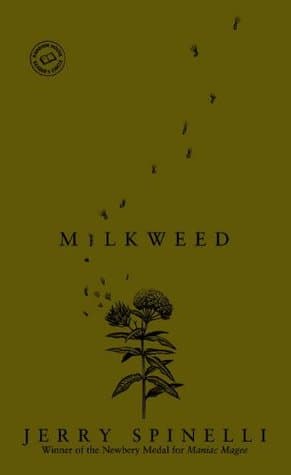
Synopsis
Covers the whole plot, including the ending.
- Difficulty
- Medium
- Pacing
- Moderate
- Mood
- Heartbreaking, Hopeful, Thought-provoking, Dark, Resilient
- Read it if
- You want a poignant, accessible, and powerful introduction to the Holocaust from a child's unique perspective.
- Skip it if
- You prefer a less ambiguous protagonist or are looking for a strictly factual historical account without allegorical elements.
Milkweed Plot Summary
Covers the whole plot, including the ending.
A Boy Called Stopthief
The story begins with an unnamed, unkempt orphan boy surviving on the streets of Warsaw. He doesn't know his name, age, or origin, calling himself 'Stopthief' because that's what people yell at him. He lives by stealing food, often from people's pockets or market stalls, and shares his spoils with other younger orphans hidden in a stable. He is fascinated by the Nazi soldiers, especially their shiny boots and uniforms, and dreams of becoming one. He often meets a kind, older girl named Janina, who at first seems to dislike him but later becomes important in his life, and a gruff but caring man named Uri, who offers him guidance and protection, warning him about the dangers of being a Jew.
Finding a Family with the Milgroms
After Janina's father, Mr. Milgrom, finds the boy in the streets, he mistakenly believes the boy is Janina's friend and takes him in. The boy, who has been calling himself 'Jew' because Uri told him he was one, is given the name 'Misha Pilsudski' by Mr. Milgrom, who invents a backstory for him. Misha is overjoyed to have a family, a bed, and regular food, even if it is little. He quickly bonds with Janina, seeing her as a sister, and cherishes the love and stability offered by Mr. and Mrs. Milgrom and their older son, Enos. This time is Misha's first experience of belonging and family affection, a clear contrast to his previous solitary life.
Life in the Warsaw Ghetto
The Milgrom family, along with Misha, is forced to move into the Warsaw Ghetto. Misha, used to stealing, continues to sneak out of the ghetto through small holes in the wall, often with Janina following him, to find food for his family. He brings back potatoes, bread, and other scraps, which are necessary for their survival. The conditions in the ghetto are terrible: overcrowding, starvation, disease, and constant fear of the German soldiers, or 'Jackboots.' Misha, with his street smarts and small size, becomes an essential provider, risking his life daily while Janina, though younger, insists on going with him, curious about the world outside the ghetto walls.
Loss and Hardship
Life in the ghetto quickly worsens. Mrs. Milgrom dies from illness and starvation, leaving the family heartbroken. Soon after, Enos, Mr. Milgrom's older son, is taken away by the Jackboots during a 'resettlement' action, never to be seen again. Misha struggles to understand these losses, his innocent view clashing with the brutal reality. He continues his dangerous trips outside the ghetto walls, driven now by a desperate need to keep Mr. Milgrom and Janina alive. The constant presence of death and suffering becomes a grim background to his daily life, yet his child-like hope and endurance remain.
Janina's Defiance and Mr. Milgrom's Resilience
As the ghetto's situation becomes more desperate, Janina grows more defiant and reckless, often copying Misha's daring escapes and even stealing on her own. Mr. Milgrom, despite his deep sadness and the crushing circumstances, tries to keep some sense of normal life and hope for Misha and Janina. He continues to believe in God and the eventual end of their suffering, often sharing stories and comforting words. Misha, though he doesn't fully grasp how bad their situation is, is deeply affected by Mr. Milgrom's lasting spirit, even as he continues to see the increasing horrors, including public hangings and the constant threat of deportation.
The Deportations Begin
The 'resettlement' actions increase, ending with the arrival of trains meant to deport the ghetto's inhabitants. Panic grips the ghetto as people are rounded up and forced onto the trains. Misha, Janina, and Mr. Milgrom try to hide, but the searches are thorough and brutal. During one such roundup, Misha is separated from Janina and Mr. Milgrom. He sees countless people being herded onto the trains, including his family. He desperately tries to find them amidst the chaos, his small body weaving through the desperate crowds, but he cannot stop their fate, a moment of deep helplessness for the boy.
Escape from the Ghetto
Misha, trying to follow Janina, manages to slip onto a train but is thrown off by a Jackboot. He escapes the ghetto, finding himself alone in the war-torn countryside. He wanders for days, months, and eventually years, surviving by scavenging, stealing, and sometimes receiving help from kind strangers. He sees the devastation of war firsthand, encountering burning villages, fleeing refugees, and the constant threat of violence. His journey shows his incredible endurance, but also the deep loneliness and loss he experiences, always searching for Janina and his family, holding onto fragmented memories.
Post-War Wanderings
After the war ends, Misha continues to wander across Europe, a displaced person with no home or family. He lives as a beggar, a farmhand, and a general laborer, always moving. He eventually makes his way to America, believing it to be a land of angels and safety. He struggles to adapt to this new world, his past experiences making it hard to connect with others. He carries the trauma of the Holocaust, often speaking of the Jackboots and the ghetto, but people are either dismissive or unable to understand his stories, further isolating him in his new life.
Finding a New Life and Family
Years pass, and Misha, now an old man, still haunted by his past, finds work as a street vendor. He meets a kind woman named Vivian, who listens to his stories and offers him compassion. He eventually marries Vivian and has a daughter, whom he names Janina, in honor of his lost sister. He finally finds the family and love he wanted, a sense of belonging that had been denied to him for so long. Through his daughter, he begins to heal and share his story, making sure that the memory of those he lost is not forgotten, and that his experiences were not in vain.
Legacy and Hope
Misha's daughter, Janina, grows up and has a daughter of her own, whom she names Wendy. Misha, now a grandfather, finally receives a proper name: "Poppynoodle," from his granddaughter. He is able to share his full story with his family, who accept him and his past. This act of sharing and acceptance brings him a deep sense of peace and identity, something he had lacked his entire life. The novel ends with Misha, no longer just a 'stopthief' or 'nobody,' but a man with a name, a family, and a powerful story to tell, finally finding his place in the world.
Milkweed Characters
Misha Pilsudski (Stopthief)
Protagonist
An orphaned boy surviving the Holocaust, searching for identity and family.
Misha begins as an unnamed, naive orphan, living on the streets of Warsaw, stealing to survive. He is small, quick, and remarkably resilient, possessing a child-like innocence that often shields him from the full horror of his surroundings. He has a vivid imagination, blurring the lines between reality and fantasy, and a deep longing for family and belonging. His initial fascination with the Jackboots stems from a desire for power and identity. Despite immense suffering and loss, he retains a core of kindness and an enduring hope, constantly seeking connection and love.
Relationships: Uri (Protector and initial guide, teaches Misha about being a Jew and survival.); Janina Milgrom (Adopted sister, Misha's closest companion and emotional anchor in the ghetto.); Mr. Milgrom (Adopted father, provides Misha with a name, family, and a sense of belonging.); Mrs. Milgrom (Adopted mother, offers Misha initial maternal comfort.); Vivian (Wife, provides love, understanding, and a new family.); Janina (daughter) (Daughter, represents new hope and the continuation of his family line.); Wendy (Granddaughter, gives Misha the name 'Poppynoodle' and helps him find peace.)
Janina Milgrom
Supporting
Misha's adopted sister, a spirited and increasingly defiant girl in the ghetto.
Janina is initially a spoiled, stubborn little girl, but the harsh realities of the ghetto quickly harden her. She is fiercely independent and often follows Misha on his dangerous escapades, developing her own street smarts. She is a source of both frustration and profound connection for Misha, representing his closest familial bond. Her defiance and eventual despair reflect the tragic impact of the Holocaust on children. She is a symbol of lost innocence and the devastating toll of the war.
Relationships: Misha Pilsudski (Adopted brother and closest companion.); Mr. Milgrom (Father, her primary caregiver and source of comfort.); Mrs. Milgrom (Mother, her early maternal figure.)
Uri
Supporting
A mysterious older boy who guides Misha in the early days of the war.
Uri is a street-smart, cynical, and protective older boy who first teaches Misha about survival and the dangers of the world. He is a shadowy figure, often appearing and disappearing, and seems to have a deeper understanding of the political situation and the true nature of the Jackboots. He warns Misha about being a Jew and is instrumental in Misha's early survival. His ultimate fate is ambiguous, but he represents a crucial mentor figure for Misha, embodying both harsh reality and a form of tough love.
Relationships: Misha Pilsudski (Mentor and protector, teaches Misha about survival and identity.)
Mr. Milgrom
Supporting
Misha's adopted father, a kind and resilient Jewish man in the ghetto.
Mr. Milgrom is a gentle, compassionate, and deeply religious man who takes Misha in and provides him with a name and a family. Despite the unimaginable hardships and losses in the ghetto, he tries to maintain hope, dignity, and a sense of normalcy for his children. He represents the enduring human spirit and faith in the face of atrocity. He is a source of love, stability, and moral guidance for Misha, showing him what it means to be part of a family, even in the most brutal circumstances.
Relationships: Misha Pilsudski (Adopted father, provides Misha with a family and identity.); Janina Milgrom (Biological father, his primary concern and source of love.); Mrs. Milgrom (Wife, deeply loved and mourned.)
Mrs. Milgrom
Supporting
Misha's adopted mother, who succumbs to the ghetto's conditions.
Mrs. Milgrom is a kind and loving woman who, despite the meager resources, offers Misha a sense of maternal care and warmth when he first joins the family. She quickly succumbs to the harsh conditions of the ghetto, symbolizing the devastating impact of starvation and disease on its inhabitants. Her death is one of Misha's first major losses, highlighting the fragility of life and the brutal reality of the Holocaust.
Relationships: Misha Pilsudski (Adopted mother, offers initial maternal comfort.); Mr. Milgrom (Husband, her devoted partner.); Janina Milgrom (Biological mother.)
Vivian
Supporting
Misha's eventual wife, who provides him with love and a new family in America.
Vivian is a kind and compassionate woman whom Misha meets later in his life in America. She is the first person who truly listens to his fragmented stories and offers him unconditional love and acceptance. She helps Misha build a new life, gives him a daughter, and provides the familial stability he has longed for since the war. Vivian represents healing, new beginnings, and the power of human connection to overcome past trauma.
Relationships: Misha Pilsudski (Wife, offers love and a new family.); Janina (daughter) (Mother.)
Janina (Misha's daughter)
Supporting
Misha's daughter, named after his lost sister, who helps him share his story.
Misha names his daughter after his lost sister, a poignant tribute to his past. She represents the continuation of his family line and the hope for the future. As she grows up, she becomes a crucial listener to Misha's stories, helping him process his trauma and connect with his past in a meaningful way. Her existence signifies Misha's ability to create a new, loving family despite his horrific past.
Relationships: Misha Pilsudski (Father, deeply loved.); Vivian (Mother.); Wendy (Daughter.)
Wendy
Supporting
Misha's granddaughter, who gives him the name 'Poppynoodle'.
Wendy is Misha's granddaughter, a symbol of innocence and unconditional love. She is the one who affectionately names him 'Poppynoodle,' giving him a unique and cherished identity in his old age. Her presence brings Misha immense joy and a sense of belonging, completing his journey for identity and family. She represents the ultimate triumph of love and connection over the trauma of the past.
Relationships: Misha Pilsudski (Grandfather, deeply loved.); Janina (daughter) (Mother.)
Milkweed Themes
The Search for Identity and Belonging
Misha's entire journey is a constant search for identity and a place to belong. As an unnamed orphan, he first tries on identities ('Jew,' 'Stopthief,' 'Misha Pilsudski') and wants a family. His adoption by the Milgroms gives him his first taste of belonging, which the Holocaust then cruelly takes away. His post-war wanderings show his displacement and lack of a true home or name. Only by forming his own family in America and having his granddaughter, Wendy, give him the name 'Poppynoodle' does he finally find a complete sense of self and belonging, allowing him to connect his past to his present.
“I was a Gypsy. I was a Jew. I was a stopthief. I was a run. I was a happy. I was a filthy son of Abraham. I was all of these. I was none of these. I was a boy, and I had no name.”
Loss of Innocence and the Brutality of War
The novel clearly shows the terrible impact of war, especially the Holocaust, on children and their innocence. Misha's initial naivety, where he sees the Jackboots as powerful figures to copy and views the ghetto as a strange new home, slowly disappears as he sees starvation, disease, murder, and forced deportations. Janina's change from a spoiled child to a defiant, despairing girl further shows this. The constant presence of death and suffering forces Misha to face unimaginable brutality, taking away his childhood and leaving him with deep, lasting trauma, even as he struggles to understand it.
“I was a small, quick, dark-haired Jew, and I was running. I was running from the Jackboots. I was running from the ghetto. I was running from the trains. I was running from everything.”
Resilience and the Human Spirit
Despite enduring terrible horrors—starvation, loss of family, constant fear, and displacement—Misha's resilience is a main theme. His ability to survive on the streets, adapt to the ghetto, escape the trains, and wander across Europe and America shows a strong will to live. Even when facing despair, he continues to look for food, connection, and hope. Mr. Milgrom's steady faith and kindness in the ghetto also highlight this theme, showing that even in the most dehumanizing situations, the human spirit can keep its compassion and belief in a better future, ultimately leading Misha to find peace and love.
“I was alive. I was a survivor. I was a miracle.”
The Power of Storytelling and Memory
Misha's journey ends with him sharing his story, which is important for his healing and for keeping the memory of the Holocaust alive. For years, his fragmented memories and experiences isolate him. However, when he finally finds a family who listens to and accepts his past, his story becomes a way to connect and find identity. Naming his daughter Janina and having his granddaughter, Wendy, listen to his tales ensures that the lives lost are remembered and that the lessons of the past are passed on. Storytelling becomes an act of remembrance, a sign of survival, and a way to find meaning in his suffering.
“I told them everything. I told them about Uri. I told them about Janina. I told them about the ghetto. I told them about the trains. I told them about the Jackboots. I told them everything.”
Plot Devices & Literary Techniques
First-Person Naive Narrator
The story is told from the perspective of an innocent, uncomprehending child.
The novel employs a first-person naive narrator through Misha's eyes. This device allows the reader to experience the horrors of the Holocaust through a filter of innocence and misunderstanding. Misha's lack of full comprehension of the political and historical context makes the atrocities he witnesses even more chilling and impactful. His child-like observations and misinterpretations (e.g., seeing the Jackboots as powerful, almost angelic figures, or not fully grasping the permanence of death) highlight the profound tragedy of children caught in war, while also allowing moments of unexpected hope and beauty to shine through his perspective.
Symbolism of Milkweed
The plant represents resilience, hope, and the continuation of life.
Milkweed serves as a subtle but powerful symbol throughout the novel. Misha initially finds comfort in the fluff of milkweed pods, seeing them as representations of angels or even lost family. The plant itself is known for its resilience, growing in harsh conditions, mirroring Misha's own ability to survive and persist despite the brutal environment of the ghetto and his subsequent wanderings. It represents the enduring spirit of life, hope, and the possibility of beauty even amidst destruction, and a connection to something pure and natural in a world consumed by unnatural violence and hatred.
The Jackboots/Flames
Symbols of Nazi oppression, fear, and dehumanization.
The Jackboots, referring to the Nazi soldiers, symbolize the oppressive, brutal, and dehumanizing force of the regime. Misha's initial awe of their shiny boots quickly transforms into fear as he experiences their cruelty. The 'Flames,' a term Misha uses for the crematoria, represent the ultimate horror of the Holocaust, the systematic extermination and the unspeakable loss of life. These symbols are stripped of complex political context through Misha's eyes, making them pure embodiments of evil and terror, highlighting the raw, visceral impact of the Nazi regime on its victims.
The Wall of the Ghetto
A physical and metaphorical barrier representing imprisonment and separation.
The wall of the Warsaw Ghetto functions as a central plot device, both physically and metaphorically. Physically, it traps the Jewish population, creating a sealed-off world of starvation and despair. Misha's repeated attempts to sneak through holes in the wall symbolize his innate drive for freedom and survival, and his refusal to be contained. Metaphorically, the wall represents the segregation, dehumanization, and ultimate separation of the Jews from the rest of the world, leading to their eventual extermination. It is a constant reminder of their imprisonment and the arbitrary lines drawn by hatred.
Milkweed Quotes
“I was a Gypsy, a Jew, a beggar, a thief, a Gypsy, a Jew, a beggar, a thief.”
“And the angels, they were there too. They were the ones who took the dead to heaven.”
“I was nobody. I was everybody.”
“The wall was a living thing. It breathed. It stretched. It grew.”
“Food was God. Money was God. Warmth was God. A roof was God.”
“Sometimes I saw a flicker of something in his eyes. Something like sadness. Or maybe it was just hunger.”
“I knew what a Jew was. A Jew was someone who stole bread.”
“And the boots. Oh, the boots. They were everywhere.”
“I wanted to be a hero. I wanted to be like Uri.”
“I was a smuggler. I was a hero. I was a Jew. I was a nobody.”
“Milkweed. It was the only thing that grew in the cracks of the ghetto.”
“I was a legend. I was a ghost. I was a rumor.”
“He saved me. He saved me from the dead. He saved me from the living.”
“And I knew, in that moment, that I would never forget. I would never forget the boys. I would never forget the ghetto. I would never forget the war.”
Quiz
10 questions on the plot and the characters. Each answer comes with a short explanation.
Question 1
What is the primary name the protagonist adopts and uses for most of the story, given to him by Uri?
- Gypsy
- Misha
- Stopthief
- Runt
Show answer
B. Misha Uri gives the protagonist the name 'Misha' and tells him he is a Gypsy, which Misha believes for a long time.
Question 2
What does Misha initially believe about the 'Jackboots' (Nazis) before he fully understands their role?
- They are angels sent to protect the city.
- They are like big, important brothers to him.
- He wants to be one of them someday, with shiny boots and a hat.
- They are simply part of the everyday street life, like beggars.
Show answer
C. He wants to be one of them someday, with shiny boots and a hat. Misha, in his naivete, initially admires the Jackboots' appearance and power, even fantasizing about becoming one.
Question 3
What is the main reason Misha frequently sneaks outside the ghetto walls?
- To find his birth family.
- To play with non-Jewish children.
- To steal food to bring back to Janina and the Milgroms.
- To observe the Nazi parades and celebrations.
Show answer
C. To steal food to bring back to Janina and the Milgroms. Misha is a 'smuggler,' risking his life to bring food back into the ghetto for Janina and the Milgrom family.
Question 4
What object does Janina cling to and refuse to let go of, even when it puts her at risk?
- A small wooden doll.
- A white stone.
- Her yellow star.
- Her small, black, dusty shoe.
Show answer
D. Her small, black, dusty shoe. Janina is deeply attached to her small, black, dusty shoe, which Misha often has to retrieve for her after she throws it.
Question 5
How does Misha end up living with the Milgrom family?
- He is adopted by Mr. Milgrom after his parents die.
- He is found by Mr. Milgrom and Janina and invited to stay.
- Uri arranges for him to live there for safety.
- He sneaks in to steal food and is caught, then allowed to stay.
Show answer
B. He is found by Mr. Milgrom and Janina and invited to stay. Misha is found by Mr. Milgrom and Janina one cold night, and Mr. Milgrom, seeing his need, takes him in.
Question 6
What happens to Janina when she follows the trains at the end of the ghetto's existence?
- She successfully escapes with Misha to the countryside.
- She is shot by a Jackboot while Misha watches, horrified.
- She gets on a train, and Misha never sees her again.
- She is separated from Misha in the chaos but later reunites with him.
Show answer
B. She is shot by a Jackboot while Misha watches, horrified. In a heartbreaking moment, Janina, following Misha, is shot and killed by a Jackboot near the train tracks.
Question 7
What does Misha eventually learn about Uri's true identity and role during the war?
- Uri was a leader in the Jewish resistance movement.
- Uri was forced to work for the Jackboots as a ghetto enforcer.
- Uri escaped to America early in the war.
- Uri was a double agent, secretly helping the Jews escape.
Show answer
B. Uri was forced to work for the Jackboots as a ghetto enforcer. Misha later sees Uri as a ghetto enforcer, wearing a uniform and carrying a whip, suggesting he was forced to collaborate with the Nazis to survive.
Question 8
The novel explores the theme of identity through Misha's journey. Which of the following best describes his ultimate understanding of his identity by the end of the book?
- He fully embraces his Gypsy heritage as his true identity.
- He realizes that in the face of such atrocities, it's safest and most resilient to be 'nobody' or to create his own identity.
- He discovers his real family name and reclaims his birth identity.
- He identifies solely as an American immigrant, leaving his past behind.
Show answer
B. He realizes that in the face of such atrocities, it's safest and most resilient to be 'nobody' or to create his own identity. Misha's journey is one of shedding imposed identities ('Jew', 'Gypsy') and realizing that in a world that seeks to define and destroy, being 'nobody' or creating his own identity offers a form of survival and peace.
Question 9
After the war, Misha eventually finds a new life and family. What name does his granddaughter give him?
- Grandpa Milgrom
- Poppynoodle
- Mr. Stopthief
- Uncle Misha
Show answer
B. Poppynoodle In his later life in America, Misha's granddaughter, Wendy, affectionately calls him 'Poppynoodle,' giving him a new, loving identity.
Question 10
What is the significance of the 'milkweed' in the title and throughout the story?
- It represents the common food source Misha and the orphans find.
- It symbolizes resilience, survival, and the persistent presence of life even in harsh conditions.
- It is a specific type of flower that Janina loved to collect.
- It's a metaphor for the 'white plants' or weeds that Misha initially believes are bread.
Show answer
B. It symbolizes resilience, survival, and the persistent presence of life even in harsh conditions. Milkweed, with its ability to grow anywhere and its resilient seeds that float on the wind, symbolizes life, hope, and survival amidst the devastation, much like Misha's own journey.
Milkweed FAQ
What is the protagonist's original name and how does he acquire the name 'Misha'?
The protagonist doesn't remember his original name, only that he was called 'Jew' and 'Gypsy' by others. Uri gives him the name 'Misha' after he describes himself as a gypsy, and Uri tells him he needs a proper name, suggesting 'Misha Pilsudski' as a Polish-sounding name, though Misha later shortens it.
Who is Uri and what role does he play in Misha's early survival?
Uri is a red-haired boy, slightly older than Misha, who leads a group of orphans in the streets of Warsaw. He teaches Misha how to survive by stealing food, warning him about dangers, and providing a sense of belonging and protection, acting as a reluctant mentor and big brother figure.
How does Misha perceive the Jackboots (Nazis) initially, and what changes his perspective?
Initially, Misha is fascinated by the Jackboots, seeing them as powerful figures with shiny boots and hats, even expressing a desire to become one. His perspective shifts dramatically as he witnesses their brutality, the establishment of the ghetto, and their increasing violence towards the Jewish people, culminating in the deportations.
Describe Misha's relationship with Janina Milgrom.
Misha forms a deep bond with Janina Milgrom after he starts sneaking into her family's apartment to steal food. He sees her as a younger sister, protecting her, sharing food, and eventually following her into the ghetto. His devotion to her becomes a central driving force for his actions.
What is the significance of the 'milkweed' Misha carries?
Misha carries a piece of milkweed fluff, believing it to be an angel's feather, a symbol of hope and innocence. He often attributes miraculous events or good fortune to its presence, and it represents his enduring childlike wonder and belief in goodness amidst the horrors he experiences.
What becomes of Uri after Misha is shot trying to escape the ghetto?
Uri, who has joined the Jackboots as a cook to survive, finds Misha after he is shot trying to escape the ghetto. Instead of helping him, Uri shoots Misha in the ear, effectively 'killing' his old identity to save him from being recognized as a Jew, an act of brutal mercy and survival.
What is the 'Pickle Park' and why is it important to Misha?
Pickle Park is the name Misha gives to a deserted area outside the ghetto walls where he and Janina would sometimes play. It represents a fleeting escape from the grim reality of the ghetto and a place where they could briefly reclaim some semblance of childhood and freedom, even if imagined.
How does the author use food as a recurring motif throughout the novel?
Food is a constant, desperate pursuit for Misha and the orphans, symbolizing survival, scarcity, and the brutal reality of the ghetto. The sharing of food, like the single potato, often signifies acts of kindness and community, while its absence underscores the pervasive starvation and dehumanization.
What is the significance of Misha's repeated attempts to 'fly' or 'float' over the ghetto wall?
Misha's attempts to 'fly' or 'float' over the ghetto wall represent his childlike innocence and his desperate desire to escape the confines and horrors of his reality. It shows his belief in a magical solution, a fundamental misunderstanding of the physical and political barriers he faces.
How does Misha's fragmented memory and tendency to exaggerate or invent stories impact his understanding of the world?
Misha's fragmented memory and storytelling, like claiming to be a gypsy or remembering fantastical elements, are coping mechanisms. They allow him to create a narrative for himself in a world where he has no identity or history, helping him to process overwhelming trauma and maintain a sense of self.
Discuss the psychological impact of repeated loss and abandonment on Misha.
Misha experiences profound and repeated loss, first of his original family, then of Uri, Janina, and the Milgroms. This leads to a deep-seated fear of abandonment and a desperate need for connection, driving his loyalty to Janina and his later search for a family, profoundly shaping his adult identity.
How does Misha's simple, almost naive perspective serve to highlight the atrocities of the Holocaust?
Misha's innocent, literal interpretation of events, such as believing the trains are going to a 'happy place' or seeing the Jackboots as just 'big men,' creates a stark contrast with the horrific reality. This naive perspective makes the atrocities even more chilling, as the reader understands the true implications that Misha cannot grasp.
The ending reveals Misha's adult life and new family. How does this provide a sense of closure or hope after the trauma?
The ending shows Misha (now 'Jack') finding a family, a daughter he names Janina, and a grandson he calls Poppynoodle, reminiscent of his past. This provides a powerful sense of hope and continuity, demonstrating that even after immense trauma, new life and love can flourish, and the past can be honored and integrated.
Is Uri's act of shooting Misha an act of betrayal or salvation?
Uri's act is a complex blend of both. While it is a violent betrayal of their friendship, it is also an act of desperate salvation, effectively 'killing' Misha's Jewish identity to save his life from the Nazis. It highlights the impossible moral choices forced upon individuals in extreme circumstances.
What is the thematic significance of Misha's ultimate name, 'Jack,' and his daughter's name, 'Janina'?
Misha's final name, 'Jack,' signifies his integration into a new life and identity, moving beyond the wartime names. Naming his daughter 'Janina' is a profound act of remembrance and honoring the memory of the sister figure he lost, ensuring her spirit lives on and bringing a cyclical sense of healing to his life.
How does the book portray the resilience of the human spirit in the face of unimaginable suffering?
The book portrays resilience through Misha's continuous drive to survive, his ability to find moments of joy and connection even in the ghetto, and his enduring hope, symbolized by the milkweed. Despite profound loss and trauma, he ultimately finds a way to build a new life and family, demonstrating the capacity for recovery.
What is the symbolic meaning of the 'yellow star' in the context of the novel?
The yellow star symbolizes the dehumanization and forced identification of Jewish people. For Misha, who initially doesn't understand its meaning, it's just another strange detail, but as the story progresses, it becomes a stark marker of segregation, persecution, and ultimately, death. It's a physical manifestation of the growing divide and hatred.
How does the author use the character of Doctor Korczak to represent hope and dignity within the ghetto?
Doctor Korczak, based on a real historical figure, represents an unwavering commitment to the children and their welfare, even in the direst circumstances. His decision to stay with his orphans until the very end, walking with them to the trains, embodies dignity, self-sacrifice, and a profound refusal to abandon humanity, offering a beacon of moral integrity.
About the author

Jerry Spinelli is an American author known for his contributions to children's and young adult literature. His notable works include "Stargirl," "Maniac Magee," "Milkweed," "Loser," "Smiles to Go," and "The Library Card," which often explore themes of individuality and resilience. Spinelli's writing has earned him various awards, including the Newbery Medal for "Maniac Magee."
Similar books
- The Boy in the Striped Pajamas
John Boyne
4.2 (518k) average on GoodreadsChildren'sExplores the Holocaust through the innocent eyes of a child, focusing on themes of friendship and loss amidst tragedy.
- Number the Stars
Lois Lowry
4.2 (448k) average on GoodreadsChildren'sChildren's historical fiction set during WWII, depicting courage and the impact of war on families.
- Harry Potter and the Sorcerer's Stone
J.K. Rowling
4.5 (7M) average on GoodreadsFantasyRescued from a miserable life under the stairs, an orphaned boy discovers he's a wizard destined for a magical school, where he uncovers a dangerous secret tied to the dark wizard who murdered his parents.
- The Hobbit, or There and Back Again
J.R.R. Tolkien
4.3 (2.9M) average on GoodreadsFantasyA comfort-loving hobbit named Bilbo Baggins is whisked away by a mischievous wizard and a band of dwarves on an unexpected journey to reclaim stolen treasure from a fearsome dragon, discovering courage and a magical ring along the way.
- Harry Potter and the Goblet of Fire
J.K. Rowling
4.6 (2.6M) average on GoodreadsFantasyA bewildered Harry Potter, underage and thrust into a deadly Triwizard Tournament, must brave dragons, mermaids, and a resurgent dark magic to survive a year that will forever alter the wizarding world.
- Harry Potter and the Order of the Phoenix
J.K. Rowling
4.5 (2.5M) average on GoodreadsFantasyIn a year of oppressive secrets and the threat of Voldemort, Harry Potter and Dumbledore's Army secretly train for war, shown through Jim Kay and Neil Packer's dark illustrations.





Enjoyed the summary?
A summary gives you the shape of the book. The book itself has the detail, the examples and the voice.
Find Milkweed on AmazonAs an Amazon Associate, BookBrief earns from qualifying purchases. How we're funded