
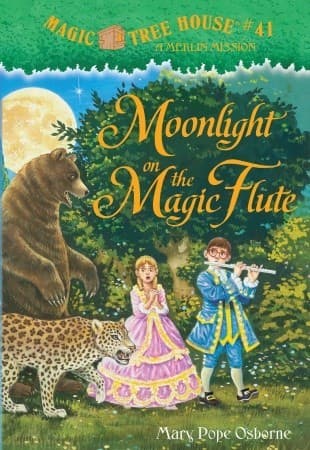
Synopsis
Covers the whole plot, including the ending.
- Difficulty
- Easy
- Pacing
- Fast
- Mood
- Whimsical, Educational, Adventurous, Lighthearted
- Read it if
- You enjoy lighthearted historical adventures with a touch of magic and famous historical figures.
- Skip it if
- You prefer complex plots, mature themes, or realistic historical fiction without fantasy elements.
Moonlight on the Magic Flute Plot Summary
Covers the whole plot, including the ending.
A Mysterious Mission to Vienna
Jack and Annie, siblings from Frog Creek, Pennsylvania, are called by Merlin for a new mission. They arrive in the Magic Tree House, which has landed in a grand 18th-century garden. Their task is to find and help a musician named Mozart. Merlin's instructions are vague, only saying that Mozart needs inspiration to create music that will bring joy to the world. They are given period clothing: Jack receives a powdered wig and breeches, while Annie is excited about a wide hoop skirt and a fancy dress. This sets a lighthearted tone as they struggle with their elaborate costumes before starting their search for the famous composer.
Exploring Schönbrunn Palace
Dressed in their 18th-century clothes, Jack and Annie leave the Magic Tree House and step into the grounds of what they soon realize is Schönbrunn Palace in Vienna. They are amazed by the palace and its gardens. As they look for Mozart, they quickly meet a mischievous young boy, about five or six years old, who appears from nowhere. Dressed in fine clothes, this boy is very curious and follows them everywhere, despite their attempts to gently get rid of him. His constant presence and playful actions distract them, but also add charm to their quest, making it hard for them to focus on finding Mozart.
The Search Continues Indoors
Jack and Annie, with the persistent little boy following them, decide to look for Mozart inside the palace, thinking he might be practicing or performing there. They walk through grand rooms filled with historical items, paintings, and decorations, impressed by the size of the royal residence. The boy, however, continues to cause playful trouble, touching things he shouldn't and giggling as he avoids their attempts to keep him out of mischief. His antics constantly interrupt their search for clues about Mozart, making their mission more challenging and funny. They begin to wonder if the boy is more than just a random child.
A Visit to the Palace Zoo
The persistent young boy, who still hasn't said his name, eventually leads Jack and Annie to the palace's private zoo, the Tiergarten Schönbrunn, one of the oldest zoos in the world. He seems especially interested in the animals. Jack and Annie are first excited to see the exotic creatures, but their attention quickly returns to the boy, who, in a playful moment, manages to unlatch several cages. This act of mischief causes chaos as various animals, including a monkey and a peacock, escape their enclosures and roam freely within the palace grounds, alarming the staff. Jack and Annie know they must act fast to control the situation.
The Flute's Magic
As the escaped animals cause a commotion, Jack remembers the magic flute Merlin gave them, a small, beautiful instrument with calming power. He takes it out and, despite his nervousness, begins to play a simple tune. To his surprise, the music immediately calms the animals, drawing them back to their enclosures. The mischievous boy, who had been laughing at the chaos, is suddenly captivated by the music. As the last animal returns to its cage, the boy reveals his name: Wolfgang Amadeus Mozart. Jack and Annie are shocked, realizing their constant companion was the musician they were sent to help. Young Mozart expresses his delight and wonder at Jack's music.
Mozart's Inspiration
With the animals safely returned and the mischievous boy identified as young Wolfgang Amadeus Mozart, Jack and Annie understand their mission. Merlin had not sent them to find an adult composer, but to inspire the child who would become one. Young Mozart is enchanted by Jack's flute playing, his eyes wide with wonder and a new spark of creativity. He expresses a wish to learn an instrument and create music himself. Jack and Annie realize that their simple act of playing the flute, combined with their adventurous spirit, has given Mozart the inspiration he needed to begin his journey as a musical prodigy, ensuring he would bring joy to the world through his compositions.
A Royal Encounter
After calming the animals and inspiring young Mozart, Jack and Annie are brought before Empress Maria Theresa, the ruler of Schönbrunn Palace and Mozart's patron. Despite the earlier chaos, the Empress is kind and curious about the children and their magical flute. She praises their quick thinking and the soothing power of Jack's music. Recognizing their kindness and impact on her young protégé, she gives them each a small, beautiful music box. This gift is a reminder of their successful mission and the connection they made with young Mozart in 18th-century Vienna.
Farewell to Vienna
As the day ends, Jack and Annie prepare to leave Schönbrunn Palace and return to the Magic Tree House. They share a final moment with young Wolfgang Amadeus Mozart, who is now full of ideas for new melodies and eager to begin his musical studies. He thanks them for their adventure and the wonderful music. Jack and Annie feel a sense of accomplishment, knowing they played a role in shaping the future of one of history's greatest composers. They climb back into the Magic Tree House, ready for their next adventure, carrying memories of their time in Vienna and the unique magic of the flute.
Back to Frog Creek
With a whispered wish for 'home,' the Magic Tree House whirls through time and space, taking Jack and Annie back to the familiar woods of Frog Creek, Pennsylvania. They are still wearing their 18th-century clothes, which now seem out of place, but they carry their new music boxes as souvenirs. As they change back into their modern clothes, they think about their incredible journey. They are amazed to have met young Mozart and how they unexpectedly fulfilled Merlin's mission. The adventure strengthens their understanding of history and how small actions can have an impact, leaving them eager for their next magical journey.
Moonlight on the Magic Flute Characters
Jack
Protagonist
The cautious and intelligent older brother.
Jack is a thoughtful and often cautious eight-year-old boy. He loves to read and learn, always carrying a backpack filled with notebooks and pencils to record observations. He is the more analytical of the two siblings, often looking up facts in books to understand their surroundings. Despite his initial hesitation, he is always brave when it counts, especially when protecting Annie or solving a problem. His intelligence and resourcefulness are key to navigating their magical adventures.
Relationships: Annie (Younger sister, companion on adventures); Merlin (Magical mentor, assigns missions); Wolfgang Amadeus Mozart (Inspires him with music)
Annie
Protagonist
The adventurous and empathetic younger sister.
Annie is Jack's spirited and outgoing seven-year-old sister. She is fearless, impulsive, and has a natural knack for connecting with people and animals. Annie often acts first and thinks later, which can get them into trouble but also leads to exciting discoveries. Her empathy and kindness are evident in her interactions, and she often sees the good in everyone, including the mischievous young Mozart. Her enthusiasm is infectious and drives many of their adventures forward.
Relationships: Jack (Older brother, companion on adventures); Merlin (Magical mentor, assigns missions); Wolfgang Amadeus Mozart (Befriends him and recognizes his potential)
Wolfgang Amadeus Mozart (Young)
Supporting
A mischievous and curious young boy who is a future musical genius.
In this story, Wolfgang Amadeus Mozart appears as a five or six-year-old boy. He is incredibly mischievous, playful, and full of boundless energy, constantly getting into trouble and testing boundaries. He is also highly curious and observant, drawn to anything new or exciting. His playful nature initially makes him seem like a nuisance to Jack and Annie, but his intense fascination with Jack's flute playing reveals his deep, innate connection to music. He is the target of Merlin's mission, needing inspiration to unlock his future as a world-renowned composer.
Relationships: Jack (Source of musical inspiration); Annie (Playful companion); Empress Maria Theresa (Royal patron)
Merlin
Mentioned
The legendary sorcerer who sends Jack and Annie on their missions.
Merlin is the powerful and wise sorcerer from Camelot who guides Jack and Annie on their magical adventures. Although he does not appear physically in this book, his presence is felt through the mission he assigns them and the magical items he provides, such as the magic flute. He trusts the children to fulfill important historical tasks, often with a subtle hint or a mysterious instruction. His purpose is to ensure that historical figures receive the inspiration or help they need to fulfill their destinies, thus shaping the course of history for the better.
Empress Maria Theresa
Supporting
The powerful and gracious ruler of Austria.
Empress Maria Theresa is the real-life ruler of Austria during the 18th century, and the mother of Emperor Joseph II. She is depicted as a regal, intelligent, and ultimately benevolent figure. She resides in Schönbrunn Palace and is a patron of the arts, including young Mozart. Despite the chaos caused by the escaped animals, she shows grace and understanding towards Jack and Annie, recognizing their positive influence on Mozart. Her interaction with the children highlights the historical context and the importance of the palace setting.
Relationships: Wolfgang Amadeus Mozart (Patron and benefactor); Jack (Gracious host); Annie (Gracious host)
Moonlight on the Magic Flute Themes
The Power of Inspiration
The main theme is how inspiration, often from unexpected places, can spark genius. Merlin sends Jack and Annie to inspire Mozart, and Jack's simple playing of the magic flute truly ignites young Wolfgang's imagination. This is clear when Mozart, initially a mischievous child, becomes captivated by the music, leading him to want to create his own. The story suggests that even small acts of kindness or creativity can have big, lasting effects on individuals and, in turn, on history.
“You opened his eyes to the magic of music,” said Annie. “You helped him find his dream.”
The Importance of Creativity and Art
The book highlights the value of music and artistic expression. Mozart's future is important because his music will bring joy to the world. Jack's initial hesitation to play the flute changes to a realization of its power to soothe and inspire. The entire mission focuses on ensuring a great artist fulfills his potential, showing how art enriches humanity. The grand setting of Schönbrunn Palace, a cultural center, further emphasizes art's importance in society.
“Music,” said Jack. “It’s like a secret language that everyone can understand.”
Childhood Mischief and Discovery
The depiction of young Wolfgang Amadeus Mozart as a mischievous, curious child shows the universal nature of childhood. His playful actions, like letting animals out of their cages, are not mean but come from boundless energy and a desire to explore. This mischief ultimately leads him and the siblings to his musical awakening. The theme suggests that children's natural curiosity, even when it causes trouble, can lead to discovery and personal growth, especially with positive influences.
“He’s a little wild,” whispered Annie, “but I think he’s really nice.”
The Interconnectedness of History
The Magic Tree House series often explores how small actions in the past can significantly affect the future. In this book, Jack and Annie's mission to inspire young Mozart shows that personal encounters, even with children, can change history. Their presence in 18th-century Vienna, and Jack's act of playing the flute, directly influences the development of one of the world's greatest composers. This reinforces the idea that all moments in time are connected and that every action, no matter how minor, can contribute to a larger historical story.
“We changed history,” whispered Annie, eyes wide. “We helped Mozart become Mozart.”
Plot Devices & Literary Techniques
The Magic Tree House
A magical vehicle for time and space travel.
The Magic Tree House serves as the primary plot device, transporting Jack and Annie to different historical periods and locations. It acts as their portal, initiating each adventure and providing a safe base. In 'Moonlight on the Magic Flute,' it lands them in 18th-century Vienna, setting the stage for their encounter with Mozart. Its magical ability to travel through time and space is the catalyst for all their missions, allowing them to interact with historical figures and events.
The Magic Flute
A magical instrument that soothes animals and inspires creativity.
The magic flute is a crucial plot device given to Jack by Merlin. Its power to calm animals and, more importantly, to deeply affect human listeners, becomes central to the resolution of the plot. Jack's playing of the flute not only resolves the immediate crisis of the escaped zoo animals but also directly provides the inspiration young Mozart needs. It symbolizes the power of music and serves as the physical manifestation of Merlin's mission to inspire the future composer.
Historical Setting (Schönbrunn Palace)
A real-world historical location that provides rich context and challenges.
Schönbrunn Palace in 18th-century Vienna is a significant plot device, providing an authentic and immersive backdrop for the adventure. Its grandeur, the costumes, the presence of a royal zoo, and the character of Empress Maria Theresa ground the fantasy elements in historical reality. The palace's vastness and intricate layout create obstacles for Jack and Annie's search, while its opulence highlights the world young Mozart grew up in, enriching the narrative and adding educational value.
The Mysterious Mission
A vague task from Merlin that requires problem-solving and discovery.
Merlin's missions are often intentionally vague, requiring Jack and Annie to use their intelligence and intuition to figure out the true objective. In this book, they are told to 'help Mozart' without specifying his age or how. This ambiguity serves as a plot device to create suspense and allow for the surprise revelation that their mischievous companion is the young Mozart. It encourages the children, and the reader, to engage in active problem-solving and critical thinking throughout the adventure.
Moonlight on the Magic Flute Quotes
“The Magic Tree House was still there, perched high in the tallest oak tree.”
“A scroll was tied with a red ribbon to the top of the ladder. Jack carefully untied it. 'Save the music, and the world will be free,' he read aloud.”
“The world outside the window seemed to blur. The wind began to blow. The tree house started to spin. Faster and faster it spun!”
“He wore a fancy white wig and a long coat. He had a serious expression on his face. 'Mozart,' Annie whispered.”
“Suddenly, a small black dog ran out from behind the carriage. It barked at Jack and Annie.”
“The Queen of the Night is very angry,' Mozart said. 'She has locked up the princess.”
“Jack pulled out his book on Vienna. He found a picture of the opera house. It was huge and grand.”
“Annie looked at the dog. 'Are you going to help us?' she whispered. The dog wagged its tail.”
“The music began. It was beautiful and strange. Jack felt a shiver run down his spine.”
“He pulled the flute out of his bag. He blew into it. A soft, clear note filled the air.”
“You saved the music!' cried Mozart. 'You brought it to the world!”
“The scroll glowed. The red ribbon shimmered. 'The world is free,' Jack read aloud.”
“They had helped Mozart. They had saved the music. They had made the world a better place.”
“The Magic Tree House spun again, carrying them home through the starry night.”
Quiz
10 questions on the plot and the characters. Each answer comes with a short explanation.
Question 1
What century do Jack and Annie travel to in 'Moonlight on the Magic Flute'?
- 17th-century
- 18th-century
- 19th-century
- 20th-century
Show answer
B. 18th-century The book description clearly states Jack and Annie head to 18th-century Austria.
Question 2
Which specific country do Jack and Annie visit in this adventure?
- Germany
- France
- Austria
- Italy
Show answer
C. Austria The summary mentions they travel to '18th-century Austria' to find Mozart.
Question 3
What unique costume item does Jack wear in 18th-century Austria?
- A feathered hat
- A wig
- A monocle
- A cape
Show answer
B. A wig The description specifies 'a wig for Jack' as part of their crazy outfits.
Question 4
What is the name of the musician Jack and Annie are tasked with helping?
- Beethoven
- Bach
- Mozart
- Haydn
Show answer
C. Mozart The book's premise is that they must 'find and help a musician by the name of Mozart'.
Question 5
What specific item of clothing does Annie wear that is described as 'giant'?
- A giant hat
- A giant cloak
- A giant hoopskirt
- Giant boots
Show answer
C. A giant hoopskirt The summary states their outfits include 'a giant hoopskirt for Annie!'.
Question 6
Who hampers Jack and Annie's hunt for Mozart?
- A palace guard
- A mischievous little boy
- A palace maid
- A rival musician
Show answer
B. A mischievous little boy Their hunt is 'further hampered by the appearance of a mischievous little boy who is determined to follow them everywhere'.
Question 7
Where do Jack and Annie primarily search for Mozart within Austria?
- A concert hall
- A small village
- An entire palace
- A bustling market
Show answer
C. An entire palace The summary indicates they 'search an entire palace to no avail'.
Question 8
What specific problem does the mischievous little boy cause that requires Jack and Annie's magic?
- He steals their belongings.
- He gets them lost in the palace.
- He lets the animals out of the palace zoo.
- He breaks a valuable instrument.
Show answer
C. He lets the animals out of the palace zoo. The climax mentioned is 'when the boy lets the animals out of the palace zoo, Jack and Annie have to use the only magic at their disposal'.
Question 9
What is the primary genre classification for 'Moonlight on the Magic Flute' according to the provided text?
- Science Fiction
- Mystery
- Fantasy, Children's, Historical Fiction
- Adventure, Romance
Show answer
C. Fantasy, Children's, Historical Fiction The provided information explicitly lists the genres as 'Fantasy, Children's, Historical Fiction'.
Question 10
What is the 'only magic at their disposal' that Jack and Annie use to save themselves and the mischievous boy?
- A special musical note from Mozart
- The magic of the Magic Tree House itself
- A magical object they found in the palace
- A spell learned from a book
Show answer
B. The magic of the Magic Tree House itself The Magic Tree House series implies that the 'magic' refers to the tree house's ability to transport them and often resolve situations, even if not explicitly detailed in the summary, it's the core magical element of the series.
Moonlight on the Magic Flute FAQ
What is the primary mission Jack and Annie undertake in 'Moonlight on the Magic Flute'?
Jack and Annie's main objective is to travel to 18th-century Austria and locate a musician named Mozart. They are tasked with helping him, although the specific nature of this assistance isn't immediately clear, leading them on a search through a grand palace.
What historical period and location do Jack and Annie visit in this adventure?
The siblings are transported to 18th-century Austria, specifically a grand palace that suggests a royal or aristocratic setting. This historical backdrop is crucial to their encounter with Mozart and the overall atmosphere of their mission.
Describe the unusual costumes Jack and Annie wear during their trip to Austria.
Jack is outfitted with a wig, a common fashion accessory for men in 18th-century European aristocracy, while Annie wears a giant hoopskirt, characteristic of women's formal attire from the same era. These elaborate costumes make them stand out and add to the historical immersion.
Who is the 'mischievous little boy' who keeps following Jack and Annie?
The mischievous little boy who persistently follows Jack and Annie is Wolfgang Amadeus Mozart himself, though they don't realize his identity initially. His playful and sometimes disruptive behavior is a key plot point, complicating their search for the famous composer.
What significant event does the mischievous boy cause that forces Jack and Annie to act?
The mischievous boy, Mozart, lets the animals out of the palace zoo, creating chaos and a dangerous situation. This act of mischief directly precipitates the climax where Jack and Annie must use their unique 'magic' to resolve the crisis.
How do Jack and Annie eventually help Mozart, despite their initial struggles to find him?
Jack and Annie help Mozart by using the 'magic' of his own music, specifically a piece he is composing. They encourage him and provide the inspiration needed for him to finish his work, ultimately fulfilling their mission to assist him.
What is the 'only magic at their disposal' that Jack and Annie use to save themselves and the boy?
The 'only magic at their disposal' refers to the power of music, specifically Mozart's composition. They learn that his music can calm the animals, demonstrating the profound influence and magical quality of artistic expression.
What specific piece of music is implied to be central to the story's resolution?
While not explicitly named, the story strongly implies that the central piece of music is an early form or inspiration for 'The Magic Flute,' given the book's title and the context of helping Mozart. This connection highlights the origin of a famous opera.
How does Jack's initial discomfort with his wig reflect a broader theme of adapting to new environments?
Jack's initial discomfort with his wig, finding it itchy and strange, symbolizes his initial resistance to fully immersing himself in the foreign historical setting. His eventual acceptance or forgetting of it represents his growing adaptability and focus on the mission, a common theme in their adventures.
Analyze Annie's approach to the mischievous boy compared to Jack's.
Annie is typically more open, trusting, and empathetic towards others, including the mischievous boy, often seeing the good in him despite his antics. Jack, on the other hand, is usually more cautious, analytical, and initially frustrated by the boy's disruptive behavior, reflecting their distinct personality traits.
How does the book portray the creative process through Mozart's character?
The book subtly portrays the creative process by showing Mozart as a child who is both playful and deeply absorbed in music. His 'mischief' can be interpreted as a manifestation of his boundless energy and imaginative mind, which are crucial components of his genius and the spontaneous nature of artistic creation.
What psychological impact might the elaborate costumes have on Jack and Annie?
The elaborate costumes likely create a sense of both wonder and awkwardness for Jack and Annie. While they help them blend in historically, the physical constraints (like Annie's hoopskirt) and the unfamiliarity of the attire might initially make them feel self-conscious or out of place, challenging their comfort zones.
Is the 'magic' of the Magic Tree House supernatural, or does this book suggest another interpretation of 'magic'?
While the Magic Tree House's travel ability is supernatural, this book suggests a broader interpretation of 'magic' as the profound and transformative power of art, specifically music. It implies that true 'magic' can also reside in human creativity and its ability to influence emotions and even nature.
How does the book's title, 'Moonlight on the Magic Flute,' connect to the historical figure and his work?
The title directly references Mozart's famous opera, 'The Magic Flute,' hinting that the story explores the origins or inspiration behind this masterpiece. 'Moonlight' adds a mystical, atmospheric touch, suggesting the magical and dreamlike quality of their adventure and Mozart's musical genius.
What message does the story convey about the importance of childhood and playfulness, even for a genius like Mozart?
The story emphasizes that even a genius like Mozart experienced a playful, mischievous childhood. It suggests that this seemingly 'naughty' behavior is not a distraction but an integral part of his creative spirit and boundless energy, highlighting the importance of imagination and freedom in formative years.
Could the 'mischievous little boy' be interpreted as a symbol of untamed genius rather than just a child?
Yes, the mischievous little boy could certainly be interpreted as a symbol of untamed genius. His boundless energy, curiosity, and tendency to create chaos, only to be soothed by music, reflect the often unconventional and powerful nature of creative brilliance before it is fully harnessed or understood.
How does the book balance historical accuracy with its fantasy elements for young readers?
The book balances historical accuracy by placing Jack and Annie in a period-appropriate setting with authentic costumes and a real historical figure (Mozart), while integrating fantasy through the Magic Tree House's travel and the 'magical' effect of music. This blend makes history accessible and engaging for young readers.
What lesson do Jack and Annie learn about judging others from their interaction with the mischievous boy?
Jack and Annie learn a valuable lesson about not judging others based on initial impressions or behavior. They initially find the boy annoying, but come to understand that his 'mischief' stems from a unique personality and, ultimately, that he is the very person they were meant to help, teaching them empathy and open-mindedness.
About the author

Mary Pope Osborne is an American author known for her children's fiction, particularly the Magic Tree House series. Her notable works include "The Knight at Dawn," "Dolphins at Daybreak," "Afternoon on the Amazon," "Tonight on the Titanic," "Ghost Town at Sundown," and "Hour of the Olympics," which combine adventure with historical and educational themes.
Similar books
- Harry Potter and the Sorcerer's Stone
J.K. Rowling
4.5 (7M) average on GoodreadsFantasyRescued from a miserable life under the stairs, an orphaned boy discovers he's a wizard destined for a magical school, where he uncovers a dangerous secret tied to the dark wizard who murdered his parents.
- The Hunger Games
Suzanne Collins
4.3 (6.4M) average on GoodreadsFantasyIn a future where children fight to the death on live television, Katniss Everdeen volunteers for the arena, turning a death sentence into a fight for survival and a spark of rebellion.
- 1984
George Orwell
4.2 (3.1M) average on GoodreadsPoliticsIn a future where surveillance and thought control are absolute, a man's search for truth clashes with the Party, showing that hope can be a form of rebellion.
- Divergent
Veronica Roth
4.2 (2.9M) average on GoodreadsFantasyIn a society divided by virtues, a sixteen-year-old's difference from the norm starts a rebellion that threatens her world.
- The Hobbit, or There and Back Again
J.R.R. Tolkien
4.3 (2.9M) average on GoodreadsFantasyA comfort-loving hobbit named Bilbo Baggins is whisked away by a mischievous wizard and a band of dwarves on an unexpected journey to reclaim stolen treasure from a fearsome dragon, discovering courage and a magical ring along the way.
- Animal Farm
George Orwell
4.0 (2.7M) average on GoodreadsPoliticsA farm animals' rebellion against humans turns into a pig-led dictatorship, showing how power corrupts and revolutionary ideals are betrayed.






Enjoyed the summary?
A summary gives you the shape of the book. The book itself has the detail, the examples and the voice.
Find Moonlight on the Magic Flute on AmazonAs an Amazon Associate, BookBrief earns from qualifying purchases. How we're funded