
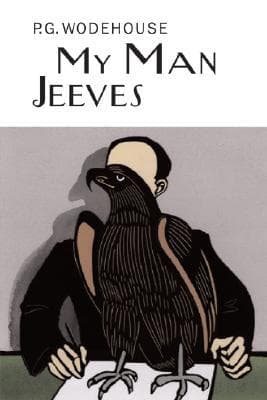
Synopsis
Covers the whole plot, including the ending.
- Difficulty
- Easy
- Pacing
- Moderate
- Mood
- Humorous, Witty, Lighthearted, Charming
- Read it if
- You enjoy classic British humor, witty dialogue, and lighthearted tales of aristocratic folly with clever resolutions.
- Skip it if
- You prefer serious, plot-driven narratives or dislike episodic short story collections.
My Man Jeeves Plot Summary
Covers the whole plot, including the ending.
Leave It to Jeeves
Bertie Wooster is engaged to Florence Craye. Her father, Lord Worplesdon, demands Bertie stop his Uncle George, the Earl of Rowcester, from marrying an American chorus girl, Lillian Gish. Florence also wants Bertie to steal Uncle George's scandalous memoirs, which would embarrass her. Bertie tries to get the memoirs from a safe at Worplesdon's estate, but Jeeves subtly stops him. Jeeves then arranges for Florence's father to find the memoirs. This leads to an argument that ends with Florence breaking off the engagement with Bertie, to his secret relief. Jeeves's actions ensure Bertie avoids a marriage he does not want and also protects the family's name in a complicated way.
Jeeves and the Unbidden Guest
Bertie Wooster's Aunt Agatha visits and insists he host and reform a shy, artistic poet named Wilmot 'Motty' Pershore, her friend's son. Motty is an anarchist and vegetarian who quickly causes problems in Bertie's flat. He refuses to pay for anything and criticizes Bertie's life. Bertie tries to make Motty tougher by taking him to boxing matches and giving him hearty meals, but it fails. Motty, however, becomes interested in a maid named Agnes. Jeeves, seeing this, subtly encourages the infatuation. This leads to Motty eloping with Agnes. This unexpected event not only removes Motty from Bertie's care but also satisfies Aunt Agatha's wish for Motty to 'settle down,' though not as she imagined.
Jeeves and the Hard-boiled Egg
Bertie Wooster's friend, Bingo Little, loves a waitress named Mabel and wants to marry her. But Bingo's uncle, Lord Bittlesham, who controls his money, strongly opposes such a match, preferring Bingo to marry someone of his own social class. Bingo asks Bertie to help him get his uncle's approval. Bertie, in his usual clumsy way, tries to make Bingo's case, but only irritates Lord Bittlesham. Jeeves steps in, suggesting Lord Bittlesham meet Mabel in a different setting, highlighting her efficient nature. This plan, along with a misunderstanding about a stolen necklace and Mabel's quick thinking, impresses Lord Bittlesham. He reluctantly agrees to the marriage, making Bingo happy.
Absent Treatment
Freddie Bullivant, a friend of Bertie Wooster, loves Elizabeth Vickers, a rich American heiress. Elizabeth dislikes Freddie, finding him dull. Bertie, trying to help, suggests Freddie make her jealous by pretending to love another woman. Freddie chooses a chorus girl named Dora. But the plan fails when Elizabeth becomes even more annoyed, and Dora, thinking Freddie is serious, starts making demands. Jeeves, seeing the chaos, plans a more subtle approach. He arranges for Elizabeth to see Freddie perform an act of surprising kindness and bravery, though Jeeves completely fakes it. This staged heroism, with Jeeves's timely help, softens Elizabeth's heart, making her reconsider Freddie.
Helping Freddie
This story continues Freddie Bullivant and Elizabeth Vickers's saga. After the events of 'Absent Treatment,' Freddie still struggles to win Elizabeth's heart. Bertie Wooster, again trying to play matchmaker, suggests Freddie write poetry to express his feelings, believing Elizabeth, who loves literature, will be moved. Freddie, having no poetic talent, asks Bertie for help, who in turn relies heavily on Jeeves for ideas and actual verses. The poems, however, are too complex for Freddie's usual manner, and Elizabeth immediately suspects he is not the true author. Jeeves then plans a staged 'rescue' of Elizabeth from a potentially embarrassing situation. This makes Freddie appear heroic and clever, finally leading Elizabeth to accept Freddie's proposal.
Rallying Round Old George
Bertie Wooster's Uncle George, Lord Rowcester, the same one from 'Leave It to Jeeves,' has fallen in love with Maudie Sprott, a barmaid. The family, especially Aunt Agatha, strongly opposes the match, fearing a scandal. Bertie is sent to try and talk Uncle George out of it, but his efforts are clumsy and useless. Uncle George is firm in his love for Maudie. Jeeves, seeing that direct action is pointless, plans to show Maudie the realities of aristocratic life and, conversely, show Uncle George the less glamorous parts of Maudie's world. Through a series of carefully arranged events, Maudie realizes Uncle George's lifestyle is not for her. She breaks off the engagement, to the relief of the Wooster family and Uncle George himself, who finds himself quite relieved once his initial infatuation fades.
Doing Clarence a Bit of Good
Bertie Wooster's Aunt Agatha tasks him with looking after her shy, artistic nephew, Clarence 'Chuffy' Chuffnell. Clarence loves a lively American actress named Cora but lacks the confidence to tell her. Aunt Agatha believes Clarence needs to be tougher and more assertive. Bertie tries to help Clarence by encouraging him to stand up for himself, but Clarence's attempts are comically bad. Jeeves, seeing the situation, subtly manipulates events. He arranges for Clarence to be in a situation where he must act decisively to protect Cora, though Jeeves himself created the situation. This staged heroism, combined with Cora's existing affection for Clarence, allows Clarence to finally express his love, and Cora accepts, to Aunt Agatha's surprised satisfaction.
The Aunt and the Sluggard
Bertie Wooster's Aunt Agatha, always worried about his idleness, decides he needs a 'purpose' in life. She arranges for him to work as a secretary to a politician, Mr. Cuthbert Gudgeon. Bertie, of course, dreads the idea of actual work and its responsibilities. His attempts to avoid his duties are met with Aunt Agatha's disapproval. Jeeves, however, notices Bertie's discomfort and Aunt Agatha's constant pressure. He subtly sabotages Bertie's secretarial efforts, making Bertie seem completely incompetent and unfit for the job. Through a series of planned mishaps and misunderstandings, Jeeves ensures Bertie is quickly fired, to Bertie's great relief and Aunt Agatha's frustration, confirming Bertie's return to his preferred state of leisurely unemployment.
My Man Jeeves Characters
Bertie Wooster
Protagonist
A well-meaning but dim-witted young gentleman of leisure.
Bertie is the quintessential idle rich Englishman, prone to getting entangled in romantic and social predicaments, often involving his formidable aunts or well-meaning but misguided friends. He possesses a charming naivete and a distinct lack of common sense, which frequently leads him into embarrassing situations. Despite his foibles, he is fundamentally good-hearted and loyal to his friends and family, even when their demands are unreasonable. His primary concern is usually avoiding marriage or any form of gainful employment.
Relationships: Jeeves (Master and valet, with Jeeves acting as the primary problem-solver and Bertie as the often clueless recipient of his aid.); Aunt Agatha (Feared and respected aunt who frequently imposes tasks and expectations on Bertie.); Florence Craye (One of Bertie's many fiancées, whom he secretly tries to escape.); Bingo Little (Close friend who often seeks Bertie's help in romantic endeavors.)
Jeeves
Supporting
Bertie Wooster's highly intelligent and resourceful gentleman's personal gentleman.
Jeeves is the true mastermind behind the solutions to Bertie's many predicaments. He is exceptionally intelligent, cultured, and possesses an encyclopedic knowledge of literature, philosophy, and human nature. His methods are always subtle, often involving intricate psychological manipulation and carefully orchestrated events, which Bertie himself rarely fully comprehends. Jeeves maintains an air of dignified professionalism and rarely expresses strong emotions, though his quiet disapproval or approval can be keenly felt by Bertie. He is fiercely loyal to Bertie, albeit with a paternalistic oversight.
Relationships: Bertie Wooster (Valet and de facto guardian, constantly bailing Bertie out of trouble.); Aunt Agatha (Respects her formidable nature but often outmaneuvers her plans for Bertie.)
Aunt Agatha
Supporting
Bertie's formidable and imposing aunt, a constant source of trouble and 'good advice'.
Aunt Agatha is a dominant and terrifying figure in Bertie's life. She is a woman of strong will and even stronger opinions, particularly concerning Bertie's perceived idleness and lack of ambition. She frequently attempts to steer Bertie towards a 'respectable' marriage or a proper career, often setting him up in situations he desperately tries to escape. Her presence instills fear in Bertie, and her directives are usually met with immediate, albeit reluctant, compliance. She represents the societal expectations and pressures that Bertie constantly tries to avoid.
Relationships: Bertie Wooster (Dominant aunt who tries to control Bertie's life for his 'own good'.); Clarence 'Chuffy' Chuffnell (Nephew whom she tries to 'toughen up'.); Wilmot 'Motty' Pershore (Friend's son whom she tasks Bertie with reforming.)
Florence Craye
Supporting
Bertie's intellectual and demanding fiancée, whom he secretly wishes to escape.
Florence Craye is one of Bertie's recurring fiancées, characterized by her intelligence, strong will, and a desire to 'improve' Bertie. She is highly cultured and expects Bertie to match her intellectual pursuits, often assigning him books and expecting him to engage in serious discussions. Bertie finds her intellectually intimidating and her attempts to reform him stifling, secretly wishing to break off their engagement. Her primary role is to provide a romantic entanglement from which Jeeves must extricate Bertie.
Relationships: Bertie Wooster (Fiancée, with Bertie secretly trying to escape the engagement.); Lord Worplesdon (Her father, who initially approves of Bertie but is easily swayed.)
Bingo Little
Supporting
Bertie's perpetually lovestruck friend, often in need of financial and romantic assistance.
Bingo Little is a good-natured but somewhat feckless friend of Bertie's, known for falling head-over-heels in love with a different woman in almost every story. His romantic entanglements often involve women unsuitable for his social standing, leading to financial difficulties and the disapproval of his wealthy uncle, Lord Bittlesham. Bingo is consistently optimistic but lacks the cunning or resources to navigate his own romantic predicaments, making him a frequent client for Jeeves's problem-solving skills, usually through Bertie.
Relationships: Bertie Wooster (Close friend, often seeks Bertie's aid and advice.); Lord Bittlesham (Wealthy uncle who controls Bingo's finances and disapproves of his romantic choices.); Mabel (Waitress he falls in love with and eventually marries.)
Lord Worplesdon
Supporting
Florence Craye's father, a formidable and easily irked aristocrat.
Lord Worplesdon is Florence Craye's father and a powerful, somewhat volatile peer. He is concerned with family reputation and social standing, making him a formidable obstacle to Bertie's less-than-stellar character. He is easily angered and often manipulated by Jeeves's schemes, though he remains unaware of the manipulation. His primary role is to exert pressure on Bertie and to be a target for Jeeves's elaborate plans, often to Bertie's ultimate benefit.
Relationships: Florence Craye (His daughter, whose romantic prospects he carefully oversees.); Bertie Wooster (Initially approves of Bertie as a suitor, but his opinion can quickly change.)
Lord Rowcester (Uncle George)
Supporting
Bertie's eccentric uncle, prone to scandalous romantic entanglements.
Lord Rowcester, Bertie's Uncle George, is an older aristocrat with a penchant for falling in love with women from lower social strata, much to the dismay of his family, particularly Aunt Agatha. He is somewhat naive and easily swayed by his affections, often leading to potential scandals. His memoirs, detailing past indiscretions, become a central plot point in 'Leave It to Jeeves.' He represents the older generation's capacity for folly, which Bertie himself often mirrors.
Relationships: Bertie Wooster (Nephew whom he relies on for various tasks.); Aunt Agatha (Sister-in-law who strongly disapproves of his romantic choices.); Lillian Gish (American chorus girl he almost marries in 'Leave It to Jeeves'.); Maudie Sprott (Barmaid he falls in love with in 'Rallying Round Old George'.)
Freddie Bullivant
Supporting
Bertie's friend, a persistent but inept suitor of Elizabeth Vickers.
Freddie Bullivant is another of Bertie's friends who frequently finds himself in romantic predicaments. He is deeply in love with Elizabeth Vickers, but his attempts to woo her are consistently clumsy and ill-conadvised, often making him appear foolish or insincere. Freddie is well-meaning but lacks sophistication and wit, making him an ideal candidate for Jeeves's intricate plans to make him appear more appealing to Elizabeth. He is a recurring example of the kind of friend Bertie tries to help, only to make things worse.
Relationships: Bertie Wooster (Friend who tries to help Freddie with his romantic troubles.); Elizabeth Vickers (His love interest, whom he eventually marries.)
My Man Jeeves Themes
The Superiority of Intellect Over Social Standing
This theme is central to Bertie Wooster and Jeeves's relationship. Despite Bertie's rich background and Jeeves's role as a servant, Jeeves's intelligence, wit, and deep understanding of people always solve the problems. Bertie, representing the upper class, is charming but clumsy, while Jeeves, from a lower social class, is the real power behind the scenes. This overturns traditional class structures, showing that true ability comes from mental sharpness, not inherited status. For example, in 'Leave It to Jeeves,' Bertie's attempts to steal the memoirs are clumsy, while Jeeves arranges a subtle plan that achieves the goal without Bertie's direct involvement.
“One of the most remarkable things about Jeeves is his power of silent sympathy. It is a curiously soothing experience to explain to him a predicament, and to know that he is taking it all in and will shortly produce the perfect solution.”
The Absurdity of Aristocratic Life
Wodehouse often makes fun of the lives of the idle rich, showing them as self-absorbed, naive, and concerned with trivial things. Bertie Wooster and his friends—Bingo Little, Freddie Bullivant—are often driven by fleeting crushes, fear of strong aunts, or attempts to avoid responsibility. Their problems, though seemingly serious to them, are often minor and easily solved by a clear-thinking person like Jeeves. The constant change of fiancées, the fear of working, and the elaborate plans to avoid small social embarrassments highlight how superficial and detached their lives are. The whole idea of Bertie needing constant rescue from his own poor judgment shows this theme.
“I say, Jeeves, what about a spot of the old brain-food? Something to buck a fella up.”
The Nature of Help and Intervention
The stories repeatedly explore different ways of helping. Bertie's attempts to 'help' his friends or uncle always lead to more complications, showing his well-meaning but harmful actions. In contrast, Jeeves's 'help' is always effective, though often manipulative and unseen. He never directly confronts problems but rather arranges events and influences people, leading them to solutions they think they found themselves. This shows that true help requires intelligence, foresight, and a deep understanding of human psychology, rather than brute force or simple good intentions. His actions are always for the greater good, even if they sometimes cause Bertie temporary discomfort, like ending an unwanted engagement.
“If I may say so, sir, a certain delicacy is essential when dealing with affairs of the heart.”
Escapism and the Avoidance of Responsibility
Bertie Wooster's main goal throughout the stories is to avoid responsibility, whether it's marriage, a career, or uncomfortable social duties. He actively tries to escape any situation that requires serious effort or commitment. This theme is clear in his constant attempts to break off engagements, his dread of Aunt Agatha's demands, and his relief when Jeeves arranges his dismissal from a secretarial job. The stories often revolve around Bertie's efforts to keep his comfortable, responsibility-free life, with Jeeves ultimately helping him achieve this, even if it means orchestrating complex deceptions. This theme fits the comedic element of a main character who prefers leisure over any productive activity.
“As a rule, I am not a man who enjoys responsibility. I am a man who enjoys peace and quiet and the occasional gin-and-tonic.”
Plot Devices & Literary Techniques
The Deus ex Machina (Jeeves as the solution)
Jeeves consistently provides an improbable and unexpected solution to Bertie's problems.
Jeeves functions as a perpetual deus ex machina. Whenever Bertie and his friends are embroiled in seemingly insurmountable difficulties, Jeeves, with his vast intellect and subtle machinations, always produces an ingenious, often unexpected, solution. This device drives the plot by creating a sense of inevitability that problems will be resolved, while simultaneously providing the comedic tension of how Jeeves will achieve this. His solutions often involve manipulating others into desired actions without their full awareness, such as orchestrating the 'theft' of Uncle George's memoirs or arranging for Freddie Bullivant to appear heroic. This device ensures a comedic resolution to every predicament.
Mistaken Identity/Misunderstanding
Characters frequently misinterpret situations or are mistaken for others, leading to comedic chaos.
Mistaken identity and misunderstandings are frequent comedic engines in the stories. Characters often jump to incorrect conclusions based on partial information, leading to humorous complications. For instance, in 'Jeeves and the Hard-boiled Egg,' a misunderstanding about a stolen necklace contributes to the resolution. These misunderstandings are often exploited by Jeeves to his advantage, allowing him to subtly guide events without direct intervention. The humor arises from the characters' inability to grasp the full picture and their often-exaggerated reactions to these misinterpretations.
The Meddling Aunt
A formidable female relative who imposes her will and creates problems for the protagonist.
Aunt Agatha serves as a recurring 'meddling aunt' figure. This device introduces conflict and sets the plot in motion by imposing unwanted tasks, romantic prospects, or career paths upon Bertie. Her formidable personality and Bertie's inherent fear of her drive many of the initial problems in the stories. While she intends to 'improve' Bertie, her interventions almost invariably lead to a series of escalating complications that only Jeeves can resolve. This character type provides a consistent source of external pressure and an antagonist to Bertie's desired life of leisure.
The Love Triangle/Quadrilateral
Complex romantic entanglements where characters vie for affection, often ineptly.
Many of the stories revolve around intricate romantic entanglements, often involving multiple characters vying for the affection of one person, or a character like Bertie trying to escape an unwanted engagement. For example, Bingo Little's constant infatuations and Freddie Bullivant's pursuit of Elizabeth Vickers create a web of romantic complications. These 'love triangles' (or quadrilaterals) provide the primary motivation for many of the characters' actions and the predicaments Bertie finds himself in, needing Jeeves to untangle the emotional knots.
My Man Jeeves Quotes
“I was not a little startled by this, as my experience of country-house hostesses has been that they are generally as keen on the chase as a cat on a mouse.”
“It is a curious thing, but I have never known a man with a really strong, masterful personality who was not at the same time a bit of a bounder.”
“Jeeves, you are a marvel! You are a wizard! You are a genius! You are a — you are a good egg!”
“I remember once being told by an eminent psychologist that the human brain is like a highly sensitive photographic plate, on which every impression is permanently registered.”
“The Right Hon. was one of those large, red-faced, important-looking johnnies, with a booming voice and an air of knowing all about everything.”
“There are moments, Jeeves, when one asks oneself, 'Do trousers matter?'”
“Jeeves is not a man to be trifled with. He has a mind like a steel trap, and a memory like an elephant.”
“The sun was shining, the birds were singing, and everything pointed to a day of peace and quiet, with no dashed unpleasantness of any kind.”
“It is a great thing to be able to look a man in the eye and tell him to go to the deuce.”
“I have always held that the only way to get through life with any degree of comfort is to avoid responsibilities.”
“One of the most beastly things about being in love is that it makes you so dashed unselfish.”
“The great thing about Jeeves is that he can always be relied upon to produce the goods.”
“I may not be a man of genius, but I am at least a man of common sense.”
“There are moments when one feels that the world is too much with us, and that a quiet evening with a good book is the only thing.”
“As far as I'm concerned, the only good thing about a country house is that it's generally miles from anywhere.”
Quiz
10 questions on the plot and the characters. Each answer comes with a short explanation.
Question 1
In 'Leave It to Jeeves,' why does Bertie Wooster initially go to New York?
- To escape a forceful aunt who wants him to marry.
- To pursue a business venture with a friend.
- To help his friend Lord Pershore, alias 'Motty,' who is in trouble.
- To attend a high-society event.
Show answer
C. To help his friend Lord Pershore, alias 'Motty,' who is in trouble. Bertie travels to New York in 'Leave It to Jeeves' to assist his friend Lord Pershore, who has gotten himself into a rather sticky situation.
Question 2
What is the primary concern of Bertie Wooster in 'Jeeves and the Hard-boiled Egg' regarding his friend Bingo Little?
- Bingo's gambling debts.
- Bingo's infatuation with a waitress, which Bertie's uncle disapproves of.
- Bingo's poor fashion choices.
- Bingo's inability to hold a steady job.
Show answer
B. Bingo's infatuation with a waitress, which Bertie's uncle disapproves of. In 'Jeeves and the Hard-boiled Egg,' Bertie is trying to navigate Bingo Little's romantic entanglements, specifically his love for a waitress, which puts him at odds with his formidable Uncle George.
Question 3
What is Jeeves's typical method for resolving Bertie's predicaments?
- Direct confrontation with the antagonist.
- Physical intervention and brute force.
- Subtle manipulation, clever schemes, and insightful psychological understanding.
- Relying on luck and chance.
Show answer
C. Subtle manipulation, clever schemes, and insightful psychological understanding. Jeeves invariably solves Bertie's problems through his unparalleled intellect, employing subtle and elaborate plans that often involve manipulating situations and people without them realizing it.
Question 4
In 'Jeeves and the Unbidden Guest,' what is the 'unbidden guest' that Bertie is tasked with entertaining?
- An eccentric artist friend of his aunt.
- A poet named Rupert Worple, who is staying with Bertie.
- A distant cousin who has fallen on hard times.
- A stray dog that Bertie takes in.
Show answer
B. A poet named Rupert Worple, who is staying with Bertie. The 'unbidden guest' in the story is Rupert Worple, a poet whom Bertie's Aunt Agatha sends to stay with him, much to Bertie's chagrin.
Question 5
What is the underlying theme often explored through Bertie Wooster's mishaps?
- The importance of hard work and self-reliance.
- The pitfalls of impulsive decisions and the need for a capable assistant.
- The triumph of good over evil.
- The inevitable decline of the aristocracy.
Show answer
B. The pitfalls of impulsive decisions and the need for a capable assistant. Bertie's constant predicaments highlight how his lack of foresight and impulsive actions often lead to trouble, emphasizing the invaluable role Jeeves plays in extricating him.
Question 6
In 'Absent Treatment,' what is the primary source of conflict for Bertie regarding Lady Malvern and her son Wilmot?
- Lady Malvern's attempts to arrange a marriage for Bertie.
- Wilmot's constant practical jokes.
- Lady Malvern's desire for Bertie to publish Wilmot's terrible poetry.
- Lady Malvern's disapproval of Bertie's lifestyle.
Show answer
C. Lady Malvern's desire for Bertie to publish Wilmot's terrible poetry. The central issue in 'Absent Treatment' is Lady Malvern's insistence that Bertie assist in getting her son Wilmot's dreadful poetry published, putting Bertie in an awkward position.
Question 7
What distinguishes Jeeves's intelligence from Bertie's?
- Jeeves has a formal education, while Bertie does not.
- Jeeves possesses practical wisdom, foresight, and a vast knowledge of human nature, contrasting with Bertie's superficial understanding.
- Jeeves is more physically capable than Bertie.
- Bertie is more artistic, and Jeeves is more scientific.
Show answer
B. Jeeves possesses practical wisdom, foresight, and a vast knowledge of human nature, contrasting with Bertie's superficial understanding. Jeeves's intelligence is characterized by his deep understanding of human psychology, his foresight, and his ability to construct elaborate, often subtle, plans, which is a stark contrast to Bertie's more superficial and often naive worldview.
Question 8
In 'Helping Freddie,' what is Freddie's main dilemma that Bertie and Jeeves must resolve?
- Freddie has lost a large sum of money gambling.
- Freddie is trying to win the hand of a woman whose uncle disapproves of him.
- Freddie is attempting to start a new business venture that is failing.
- Freddie has inadvertently insulted a powerful socialite.
Show answer
B. Freddie is trying to win the hand of a woman whose uncle disapproves of him. Freddie's predicament in 'Helping Freddie' revolves around his desire to marry a girl whose uncle, Mr. Bream, does not approve of him, requiring Jeeves's ingenious intervention.
Question 9
Which of the following best describes the typical setting for the stories in 'My Man Jeeves'?
- Rural farms and villages.
- Working-class neighborhoods in London.
- The residences and social circles of the English upper class, often in London or country estates.
- Academic institutions and libraries.
Show answer
C. The residences and social circles of the English upper class, often in London or country estates. The stories are consistently set within the world of the English upper classes, featuring their apartments, clubs, and country houses, highlighting their particular social customs and dilemmas.
Question 10
In 'The Aunt and the Sluggard,' what is the 'sluggard' that Bertie's Aunt Agatha is so concerned about?
- Bertie himself, for his indolent lifestyle.
- His cousin Claude, whom she wants to reform through a job.
- A lazy gardener on her estate.
- A perpetually sleeping dog.
Show answer
B. His cousin Claude, whom she wants to reform through a job. Aunt Agatha's concern in 'The Aunt and the Sluggard' is her nephew Claude, whom she considers a 'sluggard' and attempts to force into a job, leading to predictable Woosterian chaos.
My Man Jeeves FAQ
What is the overarching premise of 'Leave It to Jeeves' and how does Jeeves resolve the central conflict?
'Leave It to Jeeves' introduces Bertie Wooster's engagement to Florence Craye, which is contingent on his cousin George's reformation. Bertie struggles to keep George from marrying a barmaid, leading Jeeves to orchestrate a scheme where George is tricked into believing the barmaid is a thief, thereby breaking off the engagement and satisfying Florence.
In 'Jeeves and the Unbidden Guest,' what predicament does Bertie find himself in regarding Wilmot 'Motty' Pershore?
Bertie is tasked with looking after Motty, his aunt Agatha's troublesome son, who insists on pursuing a career on the stage despite his mother's disapproval. Motty's antics, including getting arrested for swimming in a fountain, repeatedly embarrass Bertie and threaten to incur Aunt Agatha's wrath.
How does Jeeves resolve the issue of Bertie's friend Bingo Little's infatuation with the waitress in 'Jeeves and the Hard-boiled Egg'?
Bingo Little falls for a waitress and needs financial assistance to marry her, but his uncle disapproves. Jeeves cleverly arranges for the uncle to witness a staged argument between Bingo and the waitress, making the uncle believe Bingo has come to his senses and thus securing financial support for Bingo, albeit for a different purpose.
What is the main plot of 'Absent Treatment' and how does Bertie inadvertently complicate matters?
'Absent Treatment' involves Bertie trying to help his friend Freddie Widgeon, who is secretly in love with a girl whose father, a stern colonel, disapproves of Freddie. Bertie's attempts to deliver a letter and act as a go-between only lead to misunderstandings and nearly expose Freddie's secret.
In 'Helping Freddie,' what is Freddie's central romantic problem and how does Jeeves step in?
Freddie Widgeon is in love with a girl whose father, Colonel H.B. Bream, forbids their union. Jeeves arranges for Freddie to 'save' the Colonel's dog from a supposed dognapper (actually Jeeves himself), making Freddie appear heroic and winning the Colonel's approval for the marriage.
What recurring theme of aristocratic idleness is subtly highlighted through Bertie Wooster's character across the stories?
Bertie Wooster consistently demonstrates a complete lack of practical skills or responsibility, relying entirely on Jeeves for all problem-solving. This subtly satirizes the leisure class, showing how their wealth allows them to remain charmingly incompetent, utterly dependent on the competence of their staff.
How does Jeeves often exploit the social conventions and expectations of the upper class to achieve his desired outcomes?
Jeeves frequently manipulates the rigid social codes and expectations of Bertie's circle, such as the importance of appearances, the fear of scandal, or the desire for respectability. He knows how to push the right buttons, often creating elaborate deceptions that play on these very conventions to achieve a favorable resolution.
In 'The Aunt and the Sluggard,' what subtle commentary on the value of hard work vs. inherited wealth can be inferred?
The story contrasts Bertie's carefree, inherited wealth with the 'sluggard' who seemingly avoids work. Jeeves's solution often involves Bertie's friends trying to avoid genuine labor, suggesting a critique of a society where financial security doesn't necessarily correlate with personal effort or contribution.
What is the psychological dynamic between Bertie Wooster and Jeeves, particularly regarding Bertie's self-perception?
Bertie views Jeeves as an indispensable, almost magical, problem-solver, but rarely questions his own agency or intellectual capabilities. This dynamic fosters a comfortable dependency, where Bertie is content to remain a charming dilettante, his self-perception as a 'good chap' untroubled by his reliance on Jeeves's superior intellect.
How does Bertie's anxiety about Aunt Agatha manifest throughout the collection, and what does it reveal about his character?
Bertie's fear of Aunt Agatha is a constant motivator for his actions, revealing his deep-seated desire for approval and his underlying insecurity. He dreads her disapproval and sharp tongue, often leading him into worse predicaments as he tries to avoid her wrath, showcasing a childlike need for familial acceptance.
What psychological need does Jeeves fulfill for Bertie and his circle of friends?
Jeeves fulfills a crucial need for order and control in the chaotic lives of Bertie and his friends. He provides a stable, intelligent force that navigates their romantic entanglements, financial predicaments, and social gaffes, allowing them to continue their carefree existence without facing serious consequences.
Discuss the 'hard-boiled egg' metaphor in 'Jeeves and the Hard-boiled Egg' beyond its literal meaning.
The 'hard-boiled egg' can be seen as a metaphor for the stubborn, unyielding nature of certain characters or situations Bertie encounters, particularly the uncle's intransigence regarding Bingo's marriage. It represents a problem that is difficult to crack or resolve through conventional means, requiring Jeeves's unconventional approach.
Is Jeeves's manipulation of events and people morally justifiable, given that his intentions are usually benign?
This is debatable. While Jeeves's interventions generally lead to positive outcomes for Bertie and his friends, they often involve significant deception and manipulation of others' emotions and beliefs. One could argue the ends justify the means, or conversely, that his methods undermine genuine relationships and personal growth.
How does the repeated motif of Bertie's unwanted engagements contribute to the comedic tone and thematic exploration of freedom?
Bertie's recurring unwanted engagements, like with Florence Craye, serve as a running gag that highlights his desire for personal freedom and avoidance of commitment. These entanglements provide ample comedic opportunities for Jeeves to 'rescue' Bertie, reinforcing the theme of escaping responsibility and maintaining a bachelor's carefree life.
To what extent is Jeeves a character with his own desires and motivations, or merely a plot device for Wodehouse?
While Jeeves's primary function is to resolve plots, his subtle expressions of disapproval, his enjoyment of orchestrating complex schemes, and his occasional pursuit of personal comfort (like certain ties) suggest a degree of independent character. He is more than a mere plot device, possessing a distinct personality and a subtle, dry wit that hints at his own internal world.
In 'Rallying Round Old George,' how does the story explore the theme of reputation and social standing among the aristocracy?
The story revolves around Bertie's efforts to prevent his cousin George from marrying a common barmaid, which would damage the family's social standing. This highlights the immense importance placed on reputation, class distinctions, and maintaining appearances within the aristocratic milieu, even at the cost of genuine happiness.
What is the role of Bertie's fashion choices in establishing his character and providing comedic relief?
Bertie's flamboyant and often questionable fashion choices, such as his bright ties or loud suits, instantly establish him as a dandy and a man of leisure. These sartorial preferences often clash with Jeeves's more refined taste, creating humorous friction and underscoring Bertie's slightly oblivious yet charming persona.
How does 'Doing Clarence a Bit of Good' exemplify the recurring Wodehousean trope of misguided attempts at self-improvement?
This story, like many others, features a character (Clarence) attempting to improve himself or his situation through ill-conceived schemes, which invariably backfire. It highlights the comedic futility of amateurish self-help efforts when contrasted with Jeeves's professional, calculated brilliance, often reinforcing the idea that some problems are beyond simple good intentions.
About the author

Sir Pelham Grenville Wodehouse, was an English writer and one of the most widely read humorists of the 20th century. His creations include the feather-brained Bertie Wooster and his sagacious valet, Jeeves; the immaculate and loquacious Psmith; Lord Emsworth and the Blandings Castle set; the Oldest Member, with stories about golf; and Mr Mulliner, with tall tales on subjects ranging from bibulous bishops to megalomaniac movie moguls.
Similar books
- Three Men in a Boat
Jerome K. Jerome
3.9 (56k) average on GoodreadsLifestyleOffers similar gentle, observational British humor and episodic adventures.
- To Kill a Mockingbird
Harper Lee
4.3 (4.5M) average on GoodreadsHistorical FictionIn the 1930s Jim Crow South, Harper Lee writes about racial injustice, moral growth, and the quiet courage of a lawyer father, Atticus Finch, as seen through his young daughter's eyes.
- The Great Gatsby
F. Scott Fitzgerald
3.9 (3.8M) average on GoodreadsHistorical FictionIn the opulent Roaring Twenties, a mysterious millionaire's lavish parties hide his desperate, tragic pursuit of a lost love, exposing the emptiness within the American Dream.
- Pride and Prejudice
Jane Austen
4.3 (3M) average on GoodreadsHistorical FictionIn a society focused on status and money, Elizabeth Bennet navigates love and pride, challenging Mr. Darcy and social expectations to find true affection.
- Angels & Demons
Dan Brown
3.9 (2.7M) average on GoodreadsThrillerA Harvard symbologist races through Rome's ancient sites, deciphering cryptic clues to unmask the Illuminati and stop a vengeful plot to destroy the Vatican with a stolen antimatter weapon.
- The Kite Runner
Khaled Hosseini
4.3 (2.4M) average on GoodreadsHistorical FictionIn pre-Taliban Afghanistan, a wealthy boy's betrayal of his servant's son during a kite-running tournament starts a lifelong journey for amends as his country collapses.





Enjoyed the summary?
A summary gives you the shape of the book. The book itself has the detail, the examples and the voice.
Find My Man Jeeves on AmazonAs an Amazon Associate, BookBrief earns from qualifying purchases. How we're funded