
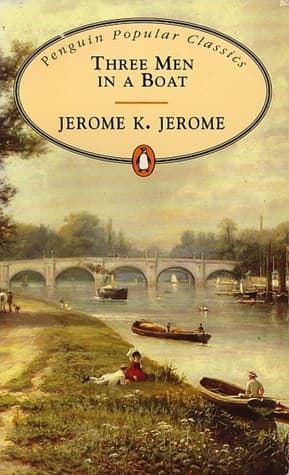
Synopsis
Covers the whole plot, including the ending.
- Difficulty
- Easy
- Pacing
- Slow
- Mood
- Humorous, Whimsical, Reflective, Nostalgic
- Read it if
- You enjoy classic British humor, travelogues, and a lighthearted, episodic narrative with charming digressions.
- Skip it if
- You prefer fast-paced plots, deep character development, or modern, action-driven narratives.
Three Men in a Boat Plot Summary
Covers the whole plot, including the ending.
The Genesis of a River Trip
The narrator, J., starts the story by describing a meeting with his friends, George and Harris, and his dog, Montmorency, in his room. All three men are sure they have various serious illnesses, which they diagnose themselves using medical books. J. thinks he has every known disease except housemaid's knee. George is sure he has worked too much, and Harris feels generally 'unwell.' After much talk about their terrible health, J. suggests that their real problem is 'overwork' and that a relaxing trip up the Thames is the only good cure. They reject a sea trip because of possible seasickness and the perceived boredom of land travel, eagerly choosing the river journey.
Planning and Packing Perils
The men begin the difficult task of packing for their trip. J. remembers a bad past experience trying to pack a bag for a journey, where he carefully packed and repacked, only to find important items missing or misplaced. This time, the packing is just as messy. They argue about what to bring, often choosing unnecessary items and forgetting important ones. Harris takes charge of packing the food basket, which results in a funny jumble. Montmorency, J.'s fox-terrier, adds to the confusion by getting in the way, pretending to be packed, and generally causing trouble, much to the men's frustration. The process is full of disorganization, lost items, and general inefficiency, setting the tone for their journey.
The Journey Begins: Kingston to Hampton Court
The three friends, with Montmorency, finally leave Kingston. George will join them later because of work. J. and Harris, left alone, immediately face small problems. J. struggles with the tow-rope, getting tangled and causing some initial embarrassment. As they move along the river, J. mixes in historical stories and comments about the places they pass, often going into funny side stories about historical figures and events connected to the Thames. They pass Hampton Court, which makes J. recall its rich history, especially the story of Cardinal Wolsey and the various kings and queens who lived there, creating a clear picture of the past as their present journey continues.
The Art of Handling a Boat
As they go on, J. and Harris show a clear lack of skill in handling a boat. J. tells about his own earlier tries at learning to row, which always ended badly, often with him falling into the water or hitting other boats. Harris, though perhaps a bit more able, also makes mistakes. They struggle with simply mooring the boat, often floating past their planned spots. J. also thinks about river manners and the different kinds of people one meets, often with a funny, critical eye. Their combined inexperience leads to several close calls and small embarrassments, showing their amateur status on the water and giving J. plenty of material for his observant humor.
Camping and Culinary Catastrophes
The first night of camping is hard. The men struggle to put up the tent, resulting in a funny mess of poles and canvas. Their attempts at cooking are even worse. They decide to make Irish stew, but their idea of 'stew' is very broad, including almost every leftover item they have, even a half-eaten plum pudding. The resulting mix is, to say the least, unappetizing. Later, they try to boil water for tea, but the kettle stubbornly refuses to boil, leading to much frustration and a funny discussion about kettles and the rules of heat. These household difficulties highlight their general clumsiness outside their city comfort zones.
George Joins and the Pineapple Incident
George finally joins J. and Harris, bringing his banjo and a sense of calm, though he is not immune to the group's general clumsiness. Soon after he arrives, the men decide to open a tin of pineapple chunks. What should be a simple task turns into a long, funny fight. They try various tools – a penknife, scissors, a hammer, even their teeth – but the tin cannot be opened. Their frustration grows with each failed try, leading to tiredness and a feeling of defeat. Eventually, they smash it open with a large stone, only to find the pineapple inside is bruised and unappetizing. The event shows their wider struggles with simple tasks.
The Lock-Keeper and the Tow-Rope
As they continue their journey, the men meet various people and problems common to river travel. They have a memorable interaction with a very slow and uncaring lock-keeper, whose relaxed pace tests their patience. The tow-rope often causes them trouble. They struggle with getting the rope tangled, finding good paths for towing, and dealing with its general inconvenience. J. often uses these moments to go into funny side stories about the perceived laziness or inefficiency of certain people they meet, or the natural difficulties of moving along the river with such a clumsy way of moving. These encounters show the charming, if sometimes annoying, realities of their adventure.
The Maze and Its Misinterpretations
One of their planned stops is the Hampton Court Maze. J. tells a funny story about a man who confidently offered to guide a group through the maze, only to get completely lost himself, much to the amusement of those watching. The three friends decide to try it themselves, sure they can succeed where others failed. As expected, they too get lost almost immediately, wandering aimlessly through its twisting paths. Their initial confidence quickly disappears, replaced by frustration and a feeling of confused helplessness. The experience is another example of their overconfidence and later failure when faced with practical challenges, supporting the funny tone of their journey.
Weather Woes and the Whisky Episode
The nice weather they first had turns bad, bringing rain and discomfort. This change makes the men look for shelter and warmth. J. tells a funny story about a bottle of whisky. They think they have lost or run out of their whisky, leading to a frantic search. The search becomes increasingly desperate and over-the-top, with each man sure the other is to blame for its disappearance. The solution is anticlimactic and funny, showing the bottle was simply overlooked in a clear spot. This event, like many others, shows their collective forgetfulness and their habit of making minor problems seem like big dramas.
The Return Journey and Reflections
After several days on the river, marked by minor accidents, bad cooking, and general discomfort, the men decide they have had enough. The constant rain and the growing frustrations of river life weigh heavily on them. They conclude that the 'rest' they wanted has become harder than their 'overwork.' They choose to leave their boat and go home by train, a decision they make with relief and resignation. J. thinks about the trip, acknowledging its problems but also the friendship and funny memories made. Despite the mishaps, the experience has been memorable, if not entirely restful, and they return with a new appreciation for their comfortable city lives.
Three Men in a Boat Characters
J. (the Narrator)
Protagonist
A hypochondriac, prone to philosophical digressions and witty observations.
J. is the central narrator and observer of the group. He is a self-proclaimed hypochondriac, convinced he suffers from nearly every known illness, a trait that kickstarts the entire river trip idea. He is highly introspective, often delving into lengthy historical anecdotes, philosophical musings, or humorous personal reminiscences that are only tangentially related to the main plot. He is generally well-meaning but somewhat impractical, often contributing to the group's blunders through his absent-mindedness or lack of foresight. His wit and dry humor are the driving forces of the book's comedic style.
Relationships: George (Close friend and travel companion); Harris (Close friend and travel companion); Montmorency (Beloved, though mischievous, pet dog)
George
Supporting
The most responsible of the trio, working at a bank, and often the voice of reason.
George is introduced as the most sensible and 'normal' of the three friends, at least initially. He works at a bank and is often portrayed as slightly more grounded than J. or Harris, though he still succumbs to their shared hypochondria and impracticality. He is initially delayed in joining the trip due to work, which makes his eventual arrival a point of anticipation. George is known for his ability to sleep soundly, even in uncomfortable conditions, and his occasional attempts to bring order to the chaos, often through music (his banjo) or practical suggestions, though these are frequently overruled or ignored.
Relationships: J. (Close friend and travel companion); Harris (Close friend and travel companion)
Harris
Supporting
Blustery and opinionated, often contributing to the group's mishaps with his overconfidence.
Harris is portrayed as a boisterous and somewhat overconfident character. He fancies himself an expert in various practical matters, particularly packing and navigation, but his attempts often lead to greater disarray. He is prone to making grand statements and offering unsolicited advice, which frequently backfires. Harris is less introspective than J. but more physically active, though his actions often result in comical failures. He is responsible for some of the most memorable blunders, such as his disastrous attempt to pack the food hamper or his confident but misguided navigation of the river. He provides much of the physical comedy and direct conflict within the group.
Relationships: J. (Close friend and travel companion); George (Close friend and travel companion)
Montmorency
Supporting
J.'s mischievous fox-terrier, whose antics add to the group's chaotic journey.
Montmorency is J.'s fox-terrier, a small but highly energetic and mischievous dog. He is not a speaking character but plays a significant role in the comedic relief. Montmorency is described as having a strong desire to 'get into trouble' and is often found getting in the way during packing, chasing swans, or generally adding to the chaotic atmosphere. He embodies the spirit of playful disruption and provides a non-human perspective on the men's struggles, often acting as a catalyst for their frustrations or simply observing their follies with canine indifference. His presence underscores the lighthearted and often absurd nature of the journey.
Relationships: J. (Owner); George (Travel companion); Harris (Travel companion)
The Lock-Keepers
Mentioned
Various river officials encountered by the men, often depicted as slow or eccentric.
The lock-keepers are a recurring, albeit minor, presence in the narrative. They represent the bureaucratic, often slow-moving, aspect of river travel. J. describes them with a mixture of exasperation and amusement, often highlighting their perceived laziness, indifference, or eccentric habits. They are not individual characters with developed personalities but rather a collective representation of the minor obstacles and quaint peculiarities of navigating the Thames. Their interactions with the main characters often lead to humorous digressions or moments of impatience for the impatient travelers.
Other Boaters
Mentioned
Various other individuals encountered on the Thames, often caricatured by J.
Throughout their journey, J. and his friends encounter a variety of other individuals on the river – from experienced sailors to amateur holidaymakers. These 'other boaters' are often caricatured by J. in his digressions, serving as examples of different types of people one might meet on the Thames. They range from the overly serious and rule-abiding to the clumsy and inexperienced. They provide J. with opportunities for social commentary and humorous observation, often highlighting the contrast between the ideal of river life and its messy reality, or the general peculiarities of human behavior when confronted with nature and leisure.
Three Men in a Boat Themes
The Absurdity of Human Endeavor
The whole idea of the trip, coming from imagined illnesses and a wish to escape 'overwork' that doesn't really exist, sets a silly tone. The men constantly make simple tasks too complicated, from packing a bag to opening a tin of pineapple, turning everyday activities into huge struggles. Their tries at camping, cooking, and navigating are full of funny failures, showing the common human tendency to mess up even the simplest plans. This theme is everywhere, appearing in almost every mishap and mistake, such as Harris's terrible packing or the kettle's refusal to boil, highlighting the funny uselessness of much human effort.
“It is a most extraordinary thing, but I never read a patent medicine advertisement without being impelled to the conclusion that I am suffering from the particular disease therein dealt with in its most virulent form.”
The Charm and Challenges of Nature
The Thames River itself is almost a character, shown with both respect for its beauty and a real look at its problems. J. often speaks highly of the beautiful scenery and historical importance of the riverbanks, enjoying the calm and natural beauty. However, this perfect vision is always set against the practical problems of river travel: unpredictable weather, difficult locks, the hard work of towing, and the general discomfort of camping. The river offers both escape and annoyance, reminding the reader that nature, though beautiful, is not always easy or helpful to human wishes, as seen when their clear skies turn to constant rain.
“How calm, how peaceful, how far removed from the toil and turmoil of the struggling world, seem the sleepy waters of the Thames!”
Friendship and Camaraderie
Despite their frequent arguments, mistakes, and frustrations with each other, the friendship between J., George, and Harris is central to the story. Their shared experiences, good and bad, make their connection stronger. They tease, argue, and sometimes blame each other, but they ultimately rely on one another. The humor often comes from their interactions and how they all react to problems. The journey, while physically challenging, ultimately strengthens their friendship, proving that shared difficulty, when seen with humor, can create lasting memories and stronger bonds. Their ability to laugh at themselves and each other is key to their lasting friendship.
“We are very good friends, we three. We are all of us, always, very pleased to see each other.”
The Irony of Leisure and Escape
The men start the trip looking for rest and an escape from 'overwork,' but the journey itself becomes a source of much hard work and stress. What begins as an ideal search for relaxation quickly turns into a series of physical and mental challenges, from the hard task of pitching a tent to the struggle with a stubborn kettle. The irony is that their pursuit of leisure leads to more work and discomfort than their supposed city problems. This theme shows the human tendency to romanticize escape, only to find that reality often interferes, making even 'rest' an effort. Their decision to return by train instead of continuing by boat shows this ironic truth.
“We had started that trip for rest and a change, and we had got them. And we had come to the conclusion that, so far as rest was concerned, there was a good deal to be said for the comforts of home.”
Plot Devices & Literary Techniques
Digressions and Anecdotes
The narrator frequently deviates from the main plot to share humorous stories or historical facts.
J.'s narrative style is characterized by frequent digressions and anecdotes. These are often triggered by a current event or observation during the trip but quickly spiral into unrelated personal reminiscences, historical facts about the Thames, or humorous philosophical musings. For example, passing Hampton Court leads to a detailed account of Cardinal Wolsey. This device serves multiple purposes: it provides a break from the main plot's continuous action, allows J. to showcase his wit and erudition (or perceived erudition), and adds layers of humor and social commentary, often contrasting the past with the present or highlighting the absurdities of human nature.
Hyperbole and Exaggeration
The use of extreme overstatement for comedic effect.
Jerome K. Jerome frequently employs hyperbole to enhance the comedic effect of the men's predicaments. Their perceived illnesses are exaggerated to an absurd degree, as are the difficulties they face with simple tasks like packing or opening a tin of pineapple. The 'struggles' become epic battles, and minor inconveniences are blown out of proportion. This exaggeration highlights the men's impracticality and their dramatic reactions to the challenges of their journey, making their experiences far more humorous than they would be if described realistically. It transforms everyday blunders into memorable comedic set pieces.
Situational Irony
A discrepancy between expectation and reality, often for humorous effect.
Situational irony is a core comedic device throughout the book. The men embark on a trip for 'rest' and 'cure,' only to find it more arduous and stress-inducing than their daily lives. They expect an idyllic river journey but encounter constant mishaps, bad weather, and their own incompetence. For instance, their confident attempts at simple tasks, like navigating a maze or cooking, invariably lead to failure. This contrast between their high expectations and the often-humbling reality of their experiences drives much of the humor, underscoring the theme of the absurdity of human endeavor and the unpredictable nature of life.
Anthropomorphism
Attributing human characteristics or behavior to animals or inanimate objects.
While Montmorency is a dog, his actions are often described with human-like mischievous intent and understanding, contributing to the humor. More subtly, J. sometimes anthropomorphizes inanimate objects or abstract concepts, such as the 'obstinate' kettle that refuses to boil or the 'lazy' river. This device injects personality into the non-human elements of the story, making them active participants in the comedic chaos rather than passive backdrops. It allows J. to further exaggerate the men's struggles by portraying objects as actively working against them, adding to the whimsical tone.
Three Men in a Boat Quotes
“I like work: it fascinates me. I can sit and look at it for hours.”
“How many people, for instance, are aware that if you sit on a pin, you will get a pain in your back?”
“I have come to the conclusion that one of the most exasperating things in life is to be compelled to listen to a story which you know by heart, and which the narrator insists on telling you as if it were a new invention.”
“It is a most extraordinary thing, but I never read a patent medicine advertisement without being impelled to the conclusion that I am suffering from the particular malady therein dealt with in its most virulent form.”
“Let your boat of life be light, packed with only what you need - a homely home and simple pleasures, one or two friends, worth the name, someone to love and someone to love you, a cat, a dog, and a pipe or two, enough to eat and enough to wear, and a little more than enough to drink; for thirst is a dangerous thing.”
“We are a nation of grumblers. We grumble at our food, we grumble at our climate, we grumble at our government, we grumble at ourselves.”
“There were, of course, no children in our party. We were all bachelors, and therefore, of course, all exceedingly wise.”
“It is impossible to get a boat's crew to pull together unless they are all of one mind, and that mind usually belongs to the cox.”
“The greatest charm of the river is that it is always there, and always the same, and always different.”
“I can resist everything except temptation.”
“It is a thing that always strikes me that the best type of man is he who can make a joke out of his own troubles.”
“It is very easy to say that all you need is a good heart and a clear conscience; but if you go for a walk on a wet day, you will find that you need waterproof boots as well.”
“One day, when the world is wide awake, and there is no more room for doubt, then men will understand that the only true wisdom is kindness.”
“I wonder what we should do without the river. It is the only friend we have in this part of the world.”
Quiz
10 questions on the plot and the characters. Each answer comes with a short explanation.
Question 1
What is the primary mode of transportation chosen by J. and his friends for their holiday?
- A train journey across England
- A boat trip up the River Thames
- A bicycling tour through the countryside
- A walking expedition through the Lake District
Show answer
B. A boat trip up the River Thames The synopsis explicitly states that J. and his friends decide 'a jaunt up the Thames would suit them to a 'T'', indicating a boat trip.
Question 2
Which of the following is NOT one of the three men in the boat?
- J. (Jerome)
- George
- Harris
- Montmorency
Show answer
D. Montmorency Montmorency is J.'s small fox-terrier, not one of the three human companions.
Question 3
What common ailment do J. and his friends suffer from, leading them to seek a change of scenery?
- Severe seasickness
- Chronic insomnia
- Hypochondria and general seediness
- Extreme claustrophobia
Show answer
C. Hypochondria and general seediness The description states they are 'Martyrs to hypochondria and general seediness', which prompts their decision for the trip.
Question 4
What specific type of canned food is mentioned as causing trouble during the trip?
- Tins of sardines
- Tins of corned beef
- Tins of pineapple chunks
- Tins of baked beans
Show answer
C. Tins of pineapple chunks The synopsis specifically lists 'tins of pineapple chunks' as one of the troubles ahead for the travelers.
Question 5
Which of the following is NOT listed as a potential trouble or challenge faced by the men on their journey?
- Tow-ropes
- Unreliable weather forecasts
- Lost luggage
- Montmorency's devastation
Show answer
C. Lost luggage The text mentions 'tow-ropes, unreliable weather forecasts and tins of pineapple chunks - not to mention the devastation left in the wake of J.'s small fox-terrier Montmorency.' Lost luggage is not mentioned.
Question 6
The novel 'Three Men in a Boat' is described as hilariously capturing the spirit of its age. Which social class is specifically mentioned in relation to this capture?
- The industrial working class
- The aristocratic gentry
- The late-Victorian 'clerking classes'
- The burgeoning merchant class
Show answer
C. The late-Victorian 'clerking classes' The description states the book 'wonderfully evocation of the late-Victorian 'clerking classes', it hilariously captured the spirit of its age.'
Question 7
In what year was 'Three Men in a Boat' first published, and how is its publication status described since then?
- 1905, intermittently in print
- 1889, never been out of print
- 1899, recently re-released
- 1875, a limited edition run
Show answer
B. 1889, never been out of print The text states it 'was first published in 1889' and 'has never been out of print since it was first published in 1889'.
Question 8
Jeremy Lewis's introduction examines Jerome K. Jerome's life and times, and the changing world of Victorian England. Which of the following is NOT mentioned as a craze or cultural shift depicted by Jerome?
- The rise of a new mass-culture of tabloids
- Crazes for daytripping
- The popularity of hot air ballooning
- Crazes for bicycling
Show answer
C. The popularity of hot air ballooning The introduction mentions 'the rise of a new mass-culture of tabloids and bestselling novels to crazes for daytripping and bicycling.' Hot air ballooning is not listed.
Question 9
The book is described as a 'comic masterpiece' with 'benign escapism' and 'authorial discursions'. What does 'authorial discursions' most accurately refer to in the context of the novel?
- Detailed maps and travel guides provided by the author
- The author's tendency to stray from the main plot with humorous anecdotes or reflections
- Critical essays and analyses embedded within the narrative
- Sudden changes in the narrative perspective without warning
Show answer
B. The author's tendency to stray from the main plot with humorous anecdotes or reflections Authorial discursions refer to the author's digressions or tangents from the main story, often for humorous or reflective purposes, which is a hallmark of Jerome K. Jerome's style.
Question 10
The phrase 'Martyrs to hypochondria and general seediness' sets a specific tone for the characters' initial motivation. What does 'seediness' imply about their condition or lifestyle before the trip?
- They were actively engaged in illicit activities.
- They were experiencing a lack of vitality, feeling unwell, or generally run-down.
- They were living in extreme poverty and squalor.
- They had recently suffered a significant financial loss.
Show answer
B. They were experiencing a lack of vitality, feeling unwell, or generally run-down. In this context, 'seediness' refers to a state of feeling unwell, unkempt, or generally run-down, aligning with their hypochondria and desire for a restorative trip.
Three Men in a Boat FAQ
What is the basic premise of 'Three Men in a Boat'?
The book follows J. (the narrator), George, and Harris, three friends suffering from hypochondria and general malaise, who decide to embark on a two-week boating holiday up the River Thames. They are accompanied by J.'s fox-terrier, Montmorency, and their journey is filled with humorous mishaps, digressions, and observations about life and history along the river.
Who are the main characters in the story?
The main characters are J. (Jerome, the narrator), George, and Harris. J. is reflective and prone to philosophical musings, George is often pragmatic but also falls prey to silliness, and Harris is boisterous and prone to making bad decisions, particularly regarding food and navigation. Montmorency, J.'s fox-terrier, is also a prominent 'character' known for causing mischief.
What kind of troubles do the men encounter during their journey up the Thames?
Their troubles range from difficulties with tow-ropes and unreliable weather forecasts to struggles with opening tins of pineapple chunks and finding suitable accommodation. Montmorency frequently exacerbates situations by getting into fights or causing general chaos, adding to the men's humorous predicaments.
How does the book blend travelogue with comic narrative?
The narrative seamlessly weaves descriptions of the Thames and its historical landmarks with the men's humorous adventures. Jerome frequently interrupts the plot with digressions on various topics, such as the art of packing, the benefits of exercise, or historical anecdotes about places like Magna Carta Island, creating a unique blend of travel writing and comedic storytelling.
What role does Montmorency, J.'s fox-terrier, play in the narrative?
Montmorency serves as a constant source of comic relief and disruption. His mischievous nature, particularly his propensity for fighting other dogs and causing general havoc, often escalates the men's minor inconveniences into major comedic events, highlighting the unpredictable element of their trip.
Are there any deeper, unstated reasons for the men's trip besides their stated hypochondria?
While hypochondria is the stated reason, the 'general seediness' and the narrator's descriptions of their sedentary lives suggest a deeper yearning for escape from the monotonous routines of their Victorian 'clerking classes'. The river trip serves as an attempt to reconnect with nature and vitality, even if their execution is often clumsy.
What subtle social commentary does Jerome make about Victorian life?
Jerome subtly critiques the burgeoning mass-culture and the often-stifling conventions of Victorian society through his characters' attempts at leisure and their observations. He pokes fun at the 'clerking classes' and their sometimes-awkward attempts to engage with nature and adventure, highlighting the shift towards day-tripping and new forms of recreation.
How do the historical anecdotes woven into the narrative contribute to the book's overall theme?
The historical anecdotes about places like Magna Carta Island or the fate of various monarchs serve to ground the seemingly trivial boating trip in a broader historical context. They offer a contrast between the grand past and the men's more mundane, yet equally human, struggles, emphasizing the enduring nature of human folly and the timelessness of the Thames.
What is the significance of the initial scene where the men diagnose their various ailments from a medical dictionary?
This scene establishes the central comedic premise of their hypochondria and sets the tone for their journey, illustrating their exaggerated self-concern and their tendency to overthink simple matters. It also highlights the absurdity of their perceived illnesses, which are quickly forgotten once the actual physical demands of the trip begin.
How do the characters' individual personalities contribute to the group dynamic and the humor?
J.'s contemplative nature, George's occasional practicality mixed with his own eccentricities (like his bugle), and Harris's boisterous, often ill-conceived plans (like the labyrinth at Hampton Court) create a rich dynamic. Their differing reactions to challenges and their shared capacity for silliness bounce off each other, generating much of the book's humor.
Does the book suggest a psychological benefit to their 'benign escapism' despite the mishaps?
Yes, despite the continuous stream of minor disasters and frustrations, the men consistently return to a state of good humor and enjoy the simple pleasures of the river. This suggests that the act of escapism itself, even when imperfect, provides a significant psychological respite from their ordinary lives, promoting a sense of well-being and camaraderie.
How does Jerome use the technique of digression to explore human nature and societal norms?
Jerome frequently diverts from the main narrative to offer his opinions, anecdotes, or philosophical reflections on topics like packing, fishing, or the weather. These digressions allow him to indirectly comment on human foibles, the absurdities of social conventions, and the universal experiences of frustration and joy, enriching the comedic and observational depth of the book.
Is 'Three Men in a Boat' primarily a critique of Victorian leisure, or an embrace of it?
It is more of an affectionate embrace with a gentle, humorous critique. While Jerome pokes fun at the awkwardness and sometimes misplaced priorities of the 'clerking classes' attempting leisure, he ultimately celebrates the spirit of adventure, camaraderie, and the simple joys of nature that the Thames offers, making it a benign and relatable escapist fantasy.
What is the significance of the changing world of Victorian England depicted in the book, such as the rise of mass-culture?
The book captures a moment of transition where new forms of leisure like day-tripping and bicycling were becoming popular, reflecting a shift towards a more accessible mass-culture. Jerome subtly highlights the humor and sometimes the awkwardness of these new social phenomena, contrasting them with older traditions and making the book a historical snapshot of its age.
How does the book's enduring popularity reflect its themes?
Its enduring popularity stems from its timeless themes of friendship, the pursuit of simple pleasures, and the universal human experience of encountering humorous setbacks. The benign escapism and relatable characters resonate with readers across generations, offering a lighthearted perspective on life's minor frustrations and the joy of shared adventure.
What does the frequent mention of food and drink, particularly the tin of pineapple, symbolize?
The constant focus on food and drink, from the potted meat to the infamous pineapple tin, symbolizes the men's attempts to create comfort and pleasure amidst their journey. The struggles with opening the pineapple tin in particular represent the small, frustrating obstacles that can derail even the simplest plans, adding to the comedic realism of their adventure.
How does the narrator's self-deprecating humor contribute to the book's charm?
J.'s tendency to mock his own foibles and those of his friends creates an approachable and relatable narrative voice. His self-deprecating humor allows the reader to laugh with, rather than at, the characters, fostering a sense of shared humanity and making their mishaps all the more endearing.
What message does the book convey about the importance of friendship?
Despite their occasional squabbles and the frustrations caused by each other's quirks, the unbreakable bond between J., George, and Harris is central to the book. Their shared experiences and mutual support, even in comedic adversity, highlight the profound importance of camaraderie and enduring friendship in making life's journey enjoyable.
About the author
Jerome K. Jerome was an English writer best known for his humorous works in the late 19th century. His notable books include "Three Men in a Boat," which chronicles a comedic boating trip, "Three Men on the Bummel," a sequel that follows the characters on a cycling tour, and "Idle Thoughts of an Idle Fellow," a collection of essays reflecting on leisure and life.
Similar books
- The Hitchhiker's Guide to the Galaxy
Douglas Adams
4.2 (1.4M) average on GoodreadsFantasyShares a similar dry, observational humor and episodic structure with philosophical digressions.
- A Walk in the Woods: Rediscovering America on the Appalachian Trail
Bill Bryson
4.1 (346k) average on GoodreadsLifestyleA humorous travelogue about two friends encountering absurd situations and reflecting on history and nature.
- Eat, Pray, Love
Elizabeth Gilbert
3.6 (1.5M) average on GoodreadsLifestyleA heartbroken writer leaves her conventional life for a year-long global search for pleasure in Italy, spiritual devotion in India, and unexpected love and balance in Bali.
- Wild: From Lost to Found on the Pacific Crest Trail
Cheryl Strayed
4.0 (615k) average on GoodreadsLifestyleAfter losing her mother and her marriage, a young woman impulsively hikes over a thousand miles of the Pacific Crest Trail alone, finding strength and healing in the unforgiving wilderness.
- Into Thin Air: A Personal Account of the Mount Everest Disaster
Jon Krakauer
4.2 (395k) average on GoodreadsLifestyleOn May 10, 1996, ambition and a sudden, violent storm turned Mount Everest into a deadly trap, leaving Jon Krakauer to tell the harrowing story of a disaster that took lives and shattered climbers' dreams.
- On The Road
Jack Kerouac
3.6 (349k) average on GoodreadsLifestyleDean Moriarty and Sal Paradise go on a wild, cross-country trip with jazz, drugs, and a desperate search for meaning on America's post-war roads.






Enjoyed the summary?
A summary gives you the shape of the book. The book itself has the detail, the examples and the voice.
Find Three Men in a Boat on AmazonAs an Amazon Associate, BookBrief earns from qualifying purchases. How we're funded