
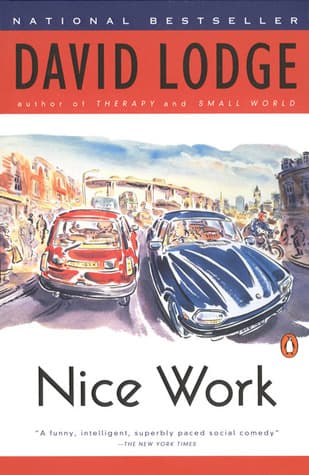
Synopsis
Covers the whole plot, including the ending.
- Difficulty
- Medium
- Pacing
- Moderate
- Mood
- Witty, Intellectual, Satirical, Reflective
- Read it if
- You enjoy witty academic satire, explorations of class and gender, and intellectual sparring that evolves into unexpected human connection.
- Skip it if
- You dislike lengthy intellectual discussions, or prefer fast-paced plot-driven narratives over character and idea exploration.
Nice Work Plot Summary
Covers the whole plot, including the ending.
The Industry Year Scheme and Initial Collision
Dr. Robyn Penrose, a temporary lecturer in English Literature at the University of Rummidge, struggles with her postmodern feminist theories and a lack of practical experience. Her department head, Professor Philip Swallow, informs her that she has been selected for the 'Industry Year' scheme. This requires her to shadow a local industrial manager for a term. Reluctantly, Robyn agrees. She is paired with Vic Wilcox, the Managing Director of Pringle's, a struggling engineering firm in the industrial Black Country. Their first meeting is tense; Robyn, with her academic jargon and casual dress, immediately clashes with Vic's pragmatic, no-nonsense approach and traditional masculine demeanor. Vic views the scheme as a waste of his time, while Robyn sees it as an anthropological study of an alien culture.
Factory Floor and Theoretical Discomfort
Robyn begins her weekly visits to Pringle's. She observes the factory floor, the production processes, and the office dynamics, taking notes. She attempts to apply her semiotic and deconstructionist theories to the factory environment, viewing machines as 'texts' and the workers' interactions as 'discourses.' However, she finds it difficult to reconcile her abstract academic framework with the realities of manufacturing, industrial relations, and the constant pressure of profit margins. Vic, initially dismissive, finds Robyn's presence mildly irritating but also occasionally thought-provoking, as she asks questions he has never considered about his own world. Their conversations are often arguments, showing their different perspectives on language, work, and value.
The Business Trip and Shared Vulnerabilities
Vic's company faces a critical period. He must secure a contract for new machinery from a German firm, Rheinhardt & Sohn. He decides to take Robyn with him on the business trip to Düsseldorf, partly to show her the 'real' world of international business and partly out of a sense of responsibility for the scheme. During the trip, away from their usual environments, their guards drop. Robyn sees the intense pressure Vic is under. Vic, in turn, gets a glimpse into Robyn's intellectual world as she discusses art and culture. A shared meal and drinks lead to a more relaxed, almost intimate conversation, revealing their personal lives and vulnerabilities. This subtly shifts their dynamic from antagonism to something more complex.
Marital Troubles and Academic Pressures
Back in Rummidge, Robyn's relationship with her live-in boyfriend, Neil, a sociologist, becomes strained. Neil is frustrated by Robyn's focus on Vic and the Industry Year project, and her academic work on the 'text' of the factory. Meanwhile, Vic's marriage to Marjorie is also under stress. Marjorie feels neglected and unappreciated. She suspects Vic's growing interest in Robyn. The contrasting demands of Vic's business (securing the Rheinhardt & Sohn contract) and Robyn's academic career (writing her paper on the factory) create parallel pressures. Their weekly meetings become a shared escape or confessional for their anxieties.
The Sexual Encounter and Its Aftermath
After a stressful week for both of them, and following a celebratory drink after Vic successfully secures the Rheinhardt & Sohn contract, Robyn and Vic find themselves in a moment of unexpected intimacy. Fueled by alcohol and a strange sense of camaraderie from their shared experiences, they end up in bed together. The encounter is not passionate or romantic, but a clumsy, almost inevitable physical manifestation of their intense, complex relationship. The morning after, both are awkward and uncertain how to proceed. Robyn, despite her feminist theories, is disoriented by the experience. Vic, though initially pleased, quickly becomes concerned about the implications for his marriage and career.
Repercussions and Confessions
The sexual encounter casts a shadow over their subsequent meetings. Robyn tries to intellectualize it, while Vic tries to ignore it. Vic's wife, Marjorie, grows suspicious and eventually confronts him. Vic confesses to the affair, leading to a major marital crisis. Robyn feels a strange mix of guilt and intellectual curiosity about the experience. Her relationship with Neil further deteriorates as he senses her emotional distance and preoccupation. The 'Industry Year' scheme, initially a professional obligation, has now deeply entangled their personal lives. This forces both to confront uncomfortable truths about their desires, values, and identities.
The Strike and Economic Realities
Pringle's faces a crisis when a strike erupts over proposed redundancies and new working practices mandated by the Rheinhardt & Sohn contract. Vic is consumed by the industrial dispute, experiencing immense pressure to save his company and the jobs of his workers. Robyn observes the strike from a new perspective. Her academic theories about power and class confront the human cost of economic struggle. Vic's stress levels are immense, and the affair with Robyn now feels like an added burden. The strike shows the chasm between Robyn's theoretical understanding of capitalism and Vic's lived experience of its realities. This further complicates their already strained relationship.
Vic's Promotion and Robyn's Paper
Despite the strike and ongoing economic challenges, Vic's handling of the Rheinhardt & Sohn deal and his overall performance are recognized by his superiors. He is offered a promotion to a more senior position within the company's parent group, which would mean relocating away from Rummidge. This career advancement offers a potential escape from the marital and emotional turmoil. Simultaneously, Robyn is nearing the deadline for her Industry Year paper. She struggles to synthesize her observations of Pringle's with her postmodern theories. She finds the lived experience too complex and messy to fit neatly into her academic framework. The gap between theory and practice is a central theme of her intellectual struggle.
The Conference and Public Display
Robyn presents her paper, 'The Semiotics of the Factory,' at an academic conference. Vic, surprisingly, attends the presentation, sitting anonymously at the back. Robyn's paper is an intellectualized, deconstructionist analysis of Pringle's, interpreting the factory as a 'text.' Her presentation, while academically rigorous, feels detached from the human reality of the factory and Vic's struggles. Vic listens, both intrigued and bewildered, recognizing aspects of his world but filtered through a language he barely understands. This public display of their intertwined worlds, from different perspectives, marks a culmination of their 'Industry Year' journey. It highlights the unbridgeable gap between their professional spheres, even as their personal lives had briefly intersected.
Resolutions and Departures
Vic accepts the promotion, which means moving away from Rummidge and Pringle's. He and Marjorie begin the difficult process of mending their marriage, acknowledging the challenges and seeking a fresh start. Robyn, having completed her Industry Year obligations, decides not to pursue a permanent academic position. She realizes that her theoretical approach might be too detached from real-world applicability. She accepts a job in publishing, a field where her analytical skills can be applied in a more tangible way. Their paths diverge. Each has been changed by their forced interaction. They exchange a final, somewhat melancholic goodbye, recognizing the unique, transformative impact they've had on each other's lives, even as they move on to separate futures.
Nice Work Characters
Robyn Penrose
Protagonist
Postmodern feminist academic whose theories clash with industrial reality.
Dr. Robyn Penrose is a temporary lecturer in English Literature at the University of Rummidge, specializing in postmodernism, feminism, and semiotics. She is highly intelligent, articulate, and committed to her academic theories, often viewing the world through a lens of 'texts' and 'discourses.' Initially, she is somewhat naive about the practicalities of the industrial world, which she approaches as an anthropological study. Her interactions with Vic Wilcox challenge her intellectual frameworks and force her to confront the limitations of pure theory when faced with lived experience. She is driven by a desire for intellectual understanding and self-improvement, but also harbors a hidden vulnerability and a longing for connection that her academic life doesn't fully satisfy.
Relationships: Vic Wilcox (Antagonistic professional pairing, evolving into a complex personal relationship and brief affair.); Neil (Live-in boyfriend; their relationship deteriorates due to Robyn's preoccupation and the affair.); Philip Swallow (Head of her department, her academic mentor and boss.)
Vic Wilcox
Protagonist
Pragmatic, working-class managing director of an engineering firm.
Vic Wilcox is the Managing Director of Pringle's, an engineering company in the Black Country. He is a self-made man, having risen through the ranks from the factory floor. He is pragmatic, results-oriented, and deeply committed to his work and his employees. He initially views Robyn and her academic world with suspicion and disdain, seeing her as an impractical intellectual. However, through their interactions, he begins to question his own assumptions about work, language, and value. He is a traditional masculine figure, struggling with the pressures of his job and the complexities of his marriage, and is ultimately humanized by his unexpected connection with Robyn.
Relationships: Robyn Penrose (Antagonistic professional pairing, evolving into a complex personal relationship and brief affair.); Marjorie Wilcox (His wife; their marriage is strained by his work and the affair.); Dave (His foreman and long-time colleague.)
Marjorie Wilcox
Supporting
Vic's wife, a traditional homemaker struggling with her husband's dedication to work.
Marjorie is Vic Wilcox's wife, a conventional woman who maintains their home and provides emotional support, albeit often unacknowledged. She feels increasingly neglected by Vic's relentless focus on his work and his subsequent preoccupation with Robyn. She represents a traditional working-class wife's perspective, valuing stability, family, and home life. Her growing suspicion and eventual confrontation of Vic highlight the domestic costs of his professional ambition and the disruption caused by Robyn's entry into their lives. She is ultimately resilient, willing to work on her marriage despite the betrayal.
Relationships: Vic Wilcox (Wife; their marriage is strained but ultimately endures.)
Neil
Supporting
Robyn's live-in boyfriend, a sociologist.
Neil is Robyn Penrose's live-in boyfriend, a sociologist who is also engaged in academic work. He shares Robyn's intellectual world but is more grounded and less theoretical than she is. He becomes increasingly frustrated and alienated by Robyn's intense focus on the Industry Year project and her growing emotional distance, particularly after her affair with Vic. His character serves to highlight the differences in Robyn's intellectual and emotional priorities, and the strain that her unique professional experience places on their relationship.
Relationships: Robyn Penrose (Boyfriend; their relationship ends due to her affair and changing priorities.)
Professor Philip Swallow
Supporting
Head of the English department at Rummidge University.
Professor Philip Swallow is the pragmatic and somewhat world-weary head of the English department at the University of Rummidge. He is responsible for assigning Robyn to the Industry Year scheme and acts as a bridge between the academic and administrative worlds. He is a generally well-meaning but ultimately detached figure, representing the institutional side of academia. He offers Robyn advice and support, but his primary concern is the smooth running of his department and maintaining good relations with the university administration. He is a recurring character in Lodge's 'Rummidge' novels.
Relationships: Robyn Penrose (Her academic superior and mentor.)
Dave
Supporting
Vic's foreman and loyal colleague at Pringle's.
Dave is Vic Wilcox's foreman at Pringle's, a long-serving employee who has worked his way up. He is a practical, salt-of-the-earth character who embodies the working-class ethos of the factory. He is loyal to Vic and a steady presence on the factory floor, often providing Vic with ground-level information and support during times of crisis, such as the strike. He initially views Robyn with amusement and skepticism, representing the workforce's perspective on the academic intruder. His character provides a contrast to Vic's management role, showing another facet of industrial life.
Relationships: Vic Wilcox (Foreman and trusted colleague.)
Fiona
Mentioned
Vic and Marjorie's daughter.
Fiona is Vic and Marjorie Wilcox's daughter. She is mentioned periodically throughout the novel, often in the context of family life and the impact of Vic's work and personal stresses on his home. While not a central character, her presence underscores the domestic responsibilities and personal stakes for Vic, especially when his marriage is under threat. Her future and well-being are part of Marjorie's concerns during the marital crisis.
Relationships: Vic Wilcox (Daughter.); Marjorie Wilcox (Daughter.)
Mrs. Hudson
Mentioned
Vic Wilcox's secretary at Pringle's.
Mrs. Hudson is Vic Wilcox's efficient and observant secretary at Pringle's. She is a minor character but provides a glimpse into the day-to-day operations of the factory office. She witnesses Robyn's visits and the evolving dynamic between Robyn and Vic, often with a knowing glance or comment. Her presence highlights the bureaucratic and social aspects of the workplace, and she serves as a practical, behind-the-scenes support for Vic.
Relationships: Vic Wilcox (Secretary.)
Nice Work Themes
The Clash of Cultures: Academia vs. Industry
The central theme explores the cultural differences and misunderstandings between the academic world of literary theory and the practical world of industrial manufacturing. Robyn's abstract, language-focused perspective clashes with Vic's concrete, profit-driven reality. The novel shows how each side views the other with suspicion and condescension. However, their forced interaction leads to respect and a broadening of horizons for both. It questions the 'value' of different kinds of knowledge and work, showing how both are essential but often fail to communicate effectively.
“What had they in common, these two? Nothing, except that they inhabited the same country, the same century, and were both, in their different ways, intelligent, articulate, and curious.”
Identity and Self-Discovery
Both Robyn and Vic undergo self-discovery because of their interaction. Robyn, initially secure in her academic identity, finds her theories challenged and her understanding of 'reality' expanded, leading her to question her career path. Vic, a man defined by his work and traditional masculinity, re-evaluates his values, his marriage, and his perception of intellectual life. The novel suggests that true self-understanding often comes from encountering and grappling with perspectives different from one's own, leading to personal growth and a redefinition of identity.
“He knew her, and she knew him, in a way that no one else did, or ever would. They had seen each other naked, not just physically, but morally, intellectually.”
Language, Meaning, and Communication
David Lodge, a literary critic himself, explores the theme of language and its limitations. Robyn's postmodern theories emphasize language as a construct, while Vic uses language for direct, pragmatic communication. Their initial inability to understand each other's 'discourse' shows how language can be a barrier as much as a bridge. The novel satirizes academic jargon and industrial slang. It also shows how, through sustained effort, they begin to decode each other's linguistic worlds, leading to deeper understanding and even intimacy, despite their different uses of words.
“She was talking about texts, and he was talking about things. She was talking about meaning, and he was talking about money.”
The Relationship Between Theory and Practice
A core theme is the tension between abstract theory and lived practice. Robyn applies her literary theories to the realities of a factory floor, often finding them inadequate or simplistic. Vic, on the other hand, operates purely on practical experience, initially dismissing theory as useless. The novel demonstrates that while theory can offer frameworks for understanding, it often falls short in explaining the complexities of human behavior and economic pressures. Conversely, pure practice without reflection can lead to stagnation. The book suggests a need for synthesis or at least a respectful dialogue between the two.
“She had theories, but he had facts. She could deconstruct a text, but he could build a machine.”
Gender Roles and Expectations
The novel examines traditional gender roles and expectations through the characters of Robyn, Vic, and Marjorie. Robyn challenges traditional female academic roles and confronts Vic's masculine assumptions about women and work. Vic embodies a working-class male identity, struggling with the emotional demands of his wife and the intellectual challenge of Robyn. Marjorie represents the traditional wife whose identity is tied to her husband's career and family. The affair itself, and its aftermath, forces all three characters to confront societal and personal expectations about gender, fidelity, and power dynamics in relationships.
“He was a man who made things, she was a woman who thought about things. The division seemed absolute.”
Plot Devices & Literary Techniques
Binary Opposition
Structuring the narrative around contrasting pairs of characters, ideas, and settings.
Lodge uses binary opposition as a fundamental structural device, most prominently in the pairing of Robyn Penrose (academia, theory, female, intellectual, deconstructionist) and Vic Wilcox (industry, practice, male, pragmatic, capitalist). This device highlights the cultural chasm between their worlds, fueling their initial antagonism and subsequent mutual education. Other oppositions include Rummidge University vs. Pringle's factory, abstract language vs. concrete action, and intellectual value vs. monetary value, all of which drive the plot and thematic exploration. The device allows for a clear comparison and contrast, emphasizing the novel's central conflict.
Free Indirect Discourse
Alternating between the perspectives of Robyn and Vic, blending their thoughts with the narrator's voice.
The narrative frequently shifts between Robyn's and Vic's internal monologues and observations, often blending their specific vocabularies and thought patterns with the narrator's voice. This allows the reader deep access into both characters' minds, fostering empathy and understanding for their vastly different viewpoints. For example, when Vic observes Robyn's academic discussions, the narrative might briefly adopt his pragmatic, slightly bewildered tone, even while remaining in the third person. This technique effectively immerses the reader in the 'clash of cultures' by presenting both sides from an intimate, internal perspective.
Satire and Irony
Using humor and exaggeration to critique academic jargon and industrial pragmatism.
Lodge employs satire and irony to critique the excesses and limitations of both academic discourse and industrial culture. Robyn's attempts to apply complex postmodern theories (e.g., 'the factory as text') to mundane realities are often presented humorously, highlighting the disconnect between theory and practice. Similarly, Vic's initial dismissiveness of anything non-commercial is gently satirized. The irony often arises from the characters' unwitting adoption of aspects of the other's world, or the unexpected outcomes of their interactions. This device makes the novel entertaining while subtly conveying its serious thematic concerns about communication and understanding.
The 'Industry Year' Scheme
A real-world government initiative serving as the central plot catalyst.
The 'Industry Year' scheme is a specific, real-world government initiative from the 1980s that provides the central premise for the novel. It acts as a clever plot device to force the two protagonists, Robyn and Vic, together despite their vastly different backgrounds and inclinations. Without this external mandate, their paths would never have crossed. The scheme is not just a backdrop but an active catalyst, creating the initial conflict, providing the structure for their weekly meetings, and justifying their continued interaction, ultimately leading to their personal and professional transformations. Its 'artificiality' highlights the natural human tendency to remain in one's own cultural silo.
Epistolary Elements (Robyn's Notes/Paper)
Incorporating excerpts from Robyn's academic notes and final paper.
Lodge occasionally includes direct excerpts from Robyn's detailed notes and her eventual academic paper, 'The Semiotics of the Factory.' These sections serve as a meta-commentary on the narrative itself, showing Robyn's intellectual process and her attempt to 'make sense' of Vic's world through her theoretical lens. This device not only provides insight into Robyn's character and her academic struggles but also allows Lodge to playfully critique and illustrate the very academic theories he is exploring within the novel, further emphasizing the theme of language and interpretation. It provides an 'inside look' at the academic's perspective.
Nice Work Quotes
“The university is a factory for the production of knowledge, and like any factory it has its assembly lines, its quality control, its management structure, and its industrial disputes.”
“Literature is not a mirror held up to reality but a hammer with which to shape it.”
“The trouble with you academics is that you think you're above the grubby business of making money.”
“I'm a post-structuralist. I don't believe in the author, only in the text.”
“You can't run a factory on theory. You need practical men who know how to make things work.”
“The world is a text, and we are all engaged in reading it, but we can never agree on what it means.”
“If you want to understand how the world works, study economics, not literature.”
“There is no such thing as a self-made man. We are all products of our circumstances.”
“A factory is a community, not just a machine for making profits.”
“Language is not a transparent medium for conveying truth; it shapes and distorts what we perceive.”
“You have to adapt or die. That's the law of the market.”
“The personal is political, and the political is personal.”
“We're all selling something, whether it's ideas or products.”
“There is no fixed meaning in a text; it changes with every reader.”
“Sometimes you have to get your hands dirty to get things done.”
Quiz
10 questions on the plot and the characters. Each answer comes with a short explanation.
Question 1
What is Vic Wilcox's profession at the beginning of 'Nice Work'?
- University lecturer
- Managing Director of an engineering works
- Journalist
- Factory worker
Show answer
B. Managing Director of an engineering works Vic Wilcox is the Managing Director (MD) of Pringle's engineering works, a Midlands manufacturing company, which sets up his practical, business-oriented worldview that contrasts with Robyn's academic perspective.
Question 2
What is the name of the 'Shadow Scheme' that brings Vic and Robyn together in the novel?
- Industry-Academia Partnership
- The Shadowing Program
- The Industry Year Shadow Scheme
- The University-Industry Exchange
Show answer
C. The Industry Year Shadow Scheme The 'Industry Year Shadow Scheme' is a government initiative in the book that pairs academics with industrial managers, leading Robyn Penrose to shadow Vic Wilcox at his factory, sparking their initial conflict and eventual mutual understanding.
Question 3
What literary theory does Robyn Penrose specialize in as an English lecturer?
- Romanticism
- Post-structuralism and feminism
- Marxist criticism
- New Criticism
Show answer
B. Post-structuralism and feminism Robyn Penrose is a lecturer specializing in post-structuralism and feminist theory, which influences her critical, deconstructive approach to literature and society, contrasting sharply with Vic's pragmatic industrial mindset.
Question 4
Why does Vic initially resent having Robyn shadow him at the factory?
- He thinks she is spying for competitors
- He views academics as impractical and out of touch with real-world business
- He dislikes her personal appearance
- He is jealous of her university position
Show answer
B. He views academics as impractical and out of touch with real-world business Vic resents Robyn's presence because he sees academics like her as theoretical and detached from the practical challenges of running a factory, reflecting the book's theme of the clash between industry and academia.
Question 5
What critical incident at the factory helps bridge the gap between Vic and Robyn?
- A successful product launch
- A strike by the workers
- A machinery breakdown that Robyn helps solve
- A visit from government inspectors
Show answer
C. A machinery breakdown that Robyn helps solve When a machine breaks down at the factory, Robyn uses her analytical skills to suggest a solution, demonstrating practical usefulness and earning Vic's respect, marking a turning point in their relationship.
Question 6
Which of the following is a major theme explored in 'Nice Work'?
- The supernatural and Gothic elements
- The conflict and eventual synthesis between industry and academia
- Time travel and historical fiction
- Exploration of outer space
Show answer
B. The conflict and eventual synthesis between industry and academia The novel centers on the clash and eventual mutual influence between Vic's industrial world and Robyn's academic world, highlighting themes of cultural divide, personal growth, and the value of different perspectives.
Question 7
How does Robyn's view of Vic change over the course of the novel?
- She comes to see him as a stereotypical capitalist villain
- She realizes he is a complex individual with integrity and skill in his field
- She decides he is intellectually inferior and not worth engaging with
- She falls in love with him immediately
Show answer
B. She realizes he is a complex individual with integrity and skill in his field Initially critical of Vic as a symbol of oppressive industry, Robyn gradually appreciates his competence, ethical struggles, and humanity, leading to a more nuanced understanding that challenges her theoretical assumptions.
Question 8
What personal crisis does Vic face that influences his interactions with Robyn?
- A midlife crisis and marital problems
- A serious illness diagnosis
- Bankruptcy of his company
- Exile from his community
Show answer
A. A midlife crisis and marital problems Vic is experiencing a midlife crisis and strains in his marriage, which makes him more receptive to Robyn's different perspective and contributes to his personal development throughout the story.
Question 9
In what way does the novel parody the Victorian industrial novel, such as those by Elizabeth Gaskell?
- By including supernatural elements
- By setting the story in a futuristic dystopia
- By updating the 'two cultures' clash to 1980s Britain with humor and irony
- By focusing exclusively on romantic relationships
Show answer
C. By updating the 'two cultures' clash to 1980s Britain with humor and irony 'Nice Work' is a campus novel that humorously reworks the Victorian industrial novel tradition, applying its themes of social and cultural divide to the late 20th-century context of academia and industry in Britain.
Question 10
What is the outcome of the Shadow Scheme for both Vic and Robyn by the end of the book?
- They both switch careers permanently
- They gain a deeper mutual respect and understanding, though they return to their own worlds
- They get married and start a business together
- They become bitter enemies due to ideological differences
Show answer
B. They gain a deeper mutual respect and understanding, though they return to their own worlds While Vic and Robyn do not abandon their respective fields, the Shadow Scheme leads them to appreciate each other's worlds and undergo personal growth, ending with a sense of mutual respect and changed perspectives.
Nice Work FAQ
What is 'Nice Work' about?
The novel follows Vic Wilcox, the managing director of Pringle's engineering works in the fictional industrial city of Rummidge, and Dr. Robyn Penrose, a temporary lecturer in English literature at the University of Rummidge. Through an 'Industry Year' shadowing scheme, Robyn is assigned to observe Vic's factory, leading to intense clashes between her post-structuralist academic worldview and his pragmatic industrial management, but ultimately forcing both to reconsider their assumptions.
Why should I read 'Nice Work'?
It's a witty, insightful campus novel and industrial satire that explores 1980s Britain's cultural divide between academia and industry. Lodge masterfully blends intellectual debate with human drama, using the unlikely relationship between Vic and Robyn to critique Thatcher-era economics, gender roles, and class structures while remaining entertaining and character-driven.
What is the background/setting of 'Nice Work'?
Set in the mid-1980s in the fictional industrial Midlands city of Rummidge (based on Birmingham), during Margaret Thatcher's conservative government. The backdrop includes factory closures, university funding cuts, and the widening gap between the 'two cultures' of humanities and industry, reflecting Britain's deindustrialization and the rise of neoliberal policies.
What are the most memorable quotes?
Key quotes include Robyn's academic mantra: 'There is no such thing as the self, only a subject position in discourse,' contrasted with Vic's practical retort: 'You can't eat discourse.' Another is Vic's reflection on industry: 'Making things is what keeps the world going,' highlighting the novel's central tension between theory and practice.
What writing style does the author use?
David Lodge employs a satirical, third-person omniscient narrative with free indirect discourse, shifting between Vic and Robyn's perspectives. The style is accessible yet intellectually dense, blending academic references (e.g., to Roland Barthes) with industrial jargon, and includes self-aware, metafictional elements, such as references to the Victorian industrial novel tradition.
What minor details add significant meaning?
Vic's meticulously maintained company car, a Rover, symbolizes his pride in traditional British industry and his precarious social mobility. Robyn's feminist T-shirts and academic books scattered in her messy car reflect her chaotic but principled intellectual life. The factory's 'Juggernaut' machine, which nearly kills a worker, becomes a metaphor for impersonal industrial forces.
What are some subtle foreshadowing moments?
Early scenes where Vic dismisses Robyn's theories as 'airy-fairy' foreshadow his later adoption of her analytical skills to save his factory. Robyn's initial disgust at the factory's grime hints at her eventual appreciation for its tangible reality. The novel's opening reference to 'shadowing' prefigures how both characters metaphorically shadow each other's lives.
What unexpected character connections exist?
Robyn's boyfriend, Charles, an academic writing a book on the Victorian industrial novel, ironically parallels Vic's real-world industrial struggles. Shirley, Vic's secretary, secretly admires Robyn's feminism, bridging the factory and university worlds. Vic's estranged wife, Marjorie, and Robyn's brother, who works in finance, represent the peripheral social pressures influencing the main characters.
What are unspoken character motivations?
Vic is driven by a deep-seated fear of failure and irrelevance in a declining industry, masked by his blustery confidence. Robyn, despite her anti-capitalist rhetoric, secretly craves stability and recognition in academia, which her temporary lectureship denies her. Both use their ideological clashes as a defense against personal vulnerability.
What psychological complexities do characters exhibit?
Vic exhibits cognitive dissonance, clinging to traditional masculinity while feeling emotionally stunted in his marriage. Robyn struggles with hypocrisy, applying post-structuralist critique to everything except her own privileged position. Their interactions reveal how identity is performative—Vic plays the 'practical man,' Robyn the 'radical intellectual'—yet both are more flexible than they admit.
What are the major emotional turning points?
The turning points include Vic's factory crisis, where Robyn helps him devise a PR strategy, softening their antagonism; their intimate conversation after a dinner party, where they acknowledge mutual respect; and the climax where Vic risks his job to expose corporate corruption, inspired by Robyn's ethical stance, leading to a bittersweet parting.
How do relationship dynamics evolve?
Vic and Robyn's relationship evolves from hostile skepticism to grudging admiration, then to a platonic but deeply affectionate bond. They influence each other profoundly: Vic becomes more reflective and ethically aware, while Robyn gains practical insight and questions her academic detachment. Their final scene, sharing a kiss without romantic commitment, symbolizes a synthesis of their worlds.
Which parts remain ambiguous or open-ended?
The novel's ending is ambiguous: Vic leaves for a new job in Germany, and Robyn returns to academia, but their future relationship is unresolved. It's unclear if their personal growth will last or if they'll revert to old habits. The satire on academia and industry leaves open whether synthesis is possible or if the 'two cultures' divide is irreconcilable.
What are controversial scenes or decisions?
Robyn's decision to sleep with her married colleague, Philip Swallow, is controversial, highlighting her moral contradictions. Vic's choice to secretly record a corrupt business deal, risking legal and professional fallout, sparks debate on ethical versus practical action. The novel's portrayal of academia as self-indulgent and industry as soulless has drawn criticism from both sectors.
'Nice Work' ending explained: how it ends & what it means
The ending sees Vic accepting a job in Germany after exposing corruption at Pringle's, while Robyn secures a permanent lectureship but feels unfulfilled. Their farewell kiss suggests a meaningful connection that transcends their ideological clash, implying that personal change is possible through engagement with 'the other.' The open-ended conclusion critiques 1980s Britain's fragmentation while hinting at hope through human empathy.
About the author
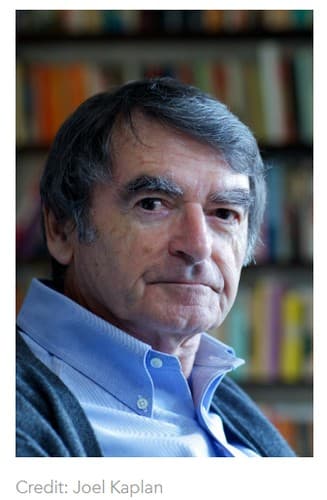
David Lodge is a celebrated British novelist and critic known for his satirical explorations of academic life. His acclaimed works, including "Small World," "Nice Work," and "Changing Places," humorously dissect the absurdities of university culture and the literary world. Lodge's sharp wit and intellectual depth have earned him a significant place in contemporary British fiction.
Similar books
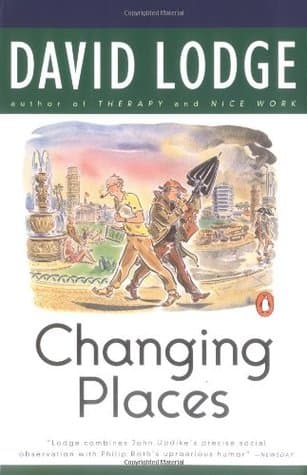
- Changing Places
David Lodge
3.9 (7k) average on GoodreadsLiterary FictionShares Lodge's signature academic satire and transatlantic cultural clashes.
- The War of the Worlds
H.G. Wells
3.8 (245k) average on GoodreadsFantasyA classic science fiction novel exploring societal reactions to an alien invasion, similar to how 'Nice Work' explores the clash of two seemingly alien cultures.
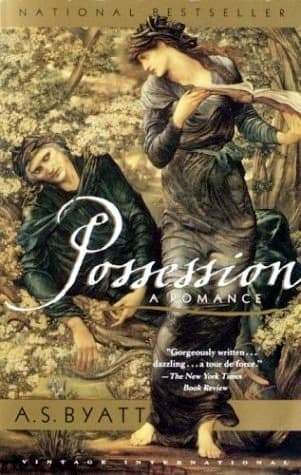
- Possession
A.S. Byatt
4.3 (13k) average on GoodreadsRomanceWhile both novels feature academics and literary theory, Byatt's 'Possession' engages with the methodology of literary research and historical scholarship with profound intellectual depth and seriousness, exploring the impact of theory on interpretation. Lodge's 'Nice Work,' in contrast, uses academic theory more as a backdrop for social comedy and satire, prioritizing accessibility and humor over intense intellectual engagement with the theoretical frameworks themselves.
- The Old Man and the Sea
Ernest Hemingway
3.8 (831k) average on GoodreadsLiterary FictionA Cuban fisherman's long struggle with a giant marlin becomes a story of endurance and dignity, now retold for young adults with illustrations, phonetic guides, and writing prompts in Traditional Chinese.
- One Hundred Years of Solitude
Gabriel García Márquez
4.1 (753k) average on GoodreadsLiterary FictionThrough the multi-generational story of the Buendía family, a mythical town deals with the repeating patterns of time, love, and solitude, as the extraordinary mixes with the ordinary.
- The Goldfinch
Donna Tartt
3.9 (720k) average on GoodreadsLiterary FictionHaunted by a tragic explosion and clutching a stolen Dutch masterpiece, a young orphan navigates the opulent drawing rooms of New York and the gritty underbelly of the art world, desperately seeking connection and redemption amidst a life spiraling into crime and obsession.




Enjoyed the summary?
A summary gives you the shape of the book. The book itself has the detail, the examples and the voice.
Find Nice Work on AmazonAs an Amazon Associate, BookBrief earns from qualifying purchases. How we're funded